
Quick Answer
Choose the best peo services by running a document-first comparison, not a popularity scan. Start with providers like Justworks, Insperity, ADP TotalSource, TriNet, Paychex, and Deel, then require written confirmation of service scope, onboarding ownership, support escalation, and co-employer responsibility lines. A practical decision usually comes down to scenario fit: lean teams often favor simplicity, higher-risk teams prioritize compliance depth, and boundary cases should resolve PEO vs EOR before ranking vendors.
Why the best PEO for your business is a fit question, not a rankings question#
Many best peo services pages are just comparison lists. They help you spot names, but they usually do not answer which provider fits your hiring model, your risk tolerance, or how much HR admin your team can realistically absorb.
That gap matters because there is no universal winner here. Ranked comparisons are common, but the more useful question is not "Who is number one?" It is "Which option matches how this business actually operates in 2026?" A ranking can help with a first scan. It is not a signing decision by itself.
This guide uses three rules:
- Fit beats brand recognition
A Professional Employer Organization, or PEO, is an HR outsourcing model built around co-employment. In plain English, the provider shares certain employer responsibilities while you keep control of daily operations. The right choice depends less on market visibility and more on whether you want help with administrative load, compliance structure, and ongoing support without giving up operational control.
- Your operating reality determines what "best" means
Two companies can look at the same shortlist and make different smart choices. Your decision should match your business objectives and growth plans. If your team is lean and you need cleaner U.S. payroll and admin support, your priority may be simplicity and responsiveness. If your risk exposure is higher, you should care more about how clearly the provider handles co-employment responsibilities and whether those responsibilities are spelled out in writing, not just pitched in a sales demo.
- The goal is a faster shortlist and a cleaner go or no-go call
This guide is built to help you narrow options quickly, verify claims more carefully, and avoid ending up with a service model that is a bad fit. A practical checkpoint: if a provider cannot explain the co-employment boundary in plain language, or answers it differently across sales and implementation conversations, that is a stop-and-revalidate signal.
The scope here is U.S.-oriented PEO selection. If your main need is domestic HR optimization through a co-employer model, you are in the right place. If your main need is international expansion, start with EOR instead. Employer of Record and PEO services are different legal structures with different use cases. If you are on that boundary, read EOR vs. PEO: What's the Difference? first, then come back with a clearer shortlist.
The rest of this guide is built around one promise: less brand-list noise, better verification, and a decision you can defend before you sign. Need the full breakdown? Read The Best Payroll Services for Small Agencies with US Contractors.
Who This List Is For and How to Judge a PEO#
This list fits small businesses that want a co-employment model and need payroll, benefits, and compliance work handled with less internal HR overhead. If your main need is employer coverage across borders, compare EOR options first, then return to PEOs. Some comparison lists mix domestic co-employer services with global-employment offerings, which can distort your shortlist from day one.
A PEO is a full-service HR partner that shares certain employer responsibilities through co-employment, while you still run day-to-day operations and manage your people. That is why fit matters more than brand visibility.
Use these 5 criteria on every provider#
- Compliance depth
Ask for a clear, written explanation of the co-employment boundary and responsibility lines.
- Service responsiveness
Confirm who supports you, how escalation works, and what changes after implementation.
- Implementation friction
Request a written onboarding plan with milestones, required documents, and owners.
- Reporting clarity
Review sample outputs early so your finance lead or accountant can verify them without extra translation.
- Contract flexibility
Check scope, termination terms, and accountability language before you are deep in procurement.
Weight the score to match your risk#
Do not weight all five criteria evenly by default. If your independent-contractor misclassification risk is high, weight compliance depth and workers' compensation handling ahead of feature breadth or app polish. If you are on the PEO vs. EOR boundary, read EOR vs. PEO: What's the Difference? first.
What a PEO Actually Takes Off Your Plate#
A PEO mainly reduces admin load; it is not a handoff of company control. In a co-employment setup, the provider takes on HR and tax-related administration, while you keep control of day-to-day work and business decisions.
| Area | What the PEO usually handles | What stays with you |
|---|---|---|
| Payroll and tax administration | Payroll processing, tax-related admin, and related reporting workflows | Operational decisions and internal accountability when exceptions impact your team |
| Benefits and workers' compensation support | Benefits administration, workers' compensation support, and recurring enrollment/change workflows | Final business decisions on plan fit, budget, and people strategy |
| Ongoing HR/compliance support | Routine HR outsourcing support, documentation help, risk-management support, and in some setups time-and-attendance admin | Managing people, priorities, and day-to-day operations |
The tradeoff is clear: you gain structure and reduce repetitive admin, but you accept a tighter operating boundary. If contract terms are vague or support quality is weak, your team can still end up chasing exceptions manually, just with less flexibility than before. Related: What to Do If You've Been Misclassified as an Independent Contractor.
How We Compared the Providers#
We compared ADP TotalSource, Paychex, Justworks, TriNet, Deel, and Insperity using a transparent rubric tied to core PEO work, not brand familiarity or list position. The baseline came from Gartner's category definition: benefits, payroll administration, workers' compensation, and employment taxes. We then checked whether each provider's public material made support ownership and implementation tradeoffs clear enough for a small business operator to audit.
Our rubric had two layers: fit for a co-employment model, where the provider handles HR tasks while you keep day-to-day control, and evidence quality, meaning whether each pro or con mapped to a real operating concern after signing.
Rubric and evidence rules#
- Core coverage and compliance
We counted claims only when they mapped to payroll processing, benefits administration, risk management, employee support, or compliance expertise.
- Support and ownership clarity
We looked for named support structures and clear ownership of onboarding, escalations, and exception handling.
- Implementation fit
We screened for onboarding friction, reporting clarity, and model-fit boundaries. For Deel, we added a boundary check: one comparison source notes that PEO-style arrangements require a local entity in each region where employees are based. If that is your use case, compare models first in EOR vs. PEO: What's the Difference?.
Editorial lists were treated as leads, not proof. Forbes states, "We independently select all products and services," and marks its page "Audited & Verified: Aug 26, 2025, 8:17am," which helps with recency checks. Gartner showing "Products 1 - 20 of 24" is also a useful completeness reminder when you review shortlist visibility.
| Provider | Best-for lens we tested | Key pros we would count | Key cons we would count | Support model checkpoint | Implementation consideration | Verification checkpoint |
|---|---|---|---|---|---|---|
| ADP TotalSource | Full-scope admin offload | Core PEO functions tied to payroll, benefits, workers' comp, taxes | Gaps in ownership or contract clarity | Named onboarding and escalation path | Transition ownership and corrections handling | Editorial review pages + Gartner category context |
| Paychex | Small-business HR outsourcing fit | Compliance, payroll, benefits, employee support | Vague service boundaries | Specific service ownership | Setup friction and reporting clarity | Editorial review pages + Gartner category context |
| Justworks | Co-employment model fit | Clear core-service descriptions | Missing depth on exceptions or limits | Human support model made explicit | Rollout ease versus reduced flexibility | Editorial review pages + Gartner category context |
| TriNet | Compliance and risk-management fit | Evidence on compliance and risk management | Unclear limits on day-to-day support | Escalation path visibility | Onboarding and account handoff | Editorial review pages + Gartner category context |
| Deel | PEO-versus-EOR boundary fit | U.S. PEO-relevant claims only | Category blur or entity mismatch | Support ownership for selected model | Local-entity requirement check | Editorial review pages + local-entity source |
| Insperity | Service-ownership clarity | Core admin plus employee support | Ambiguity around responsibilities | Named support structure | Transition detail and exception handling | Editorial review pages + Gartner category context |
This section does not rely on SHRM Vendor Directory or Reddit r/humanresources.
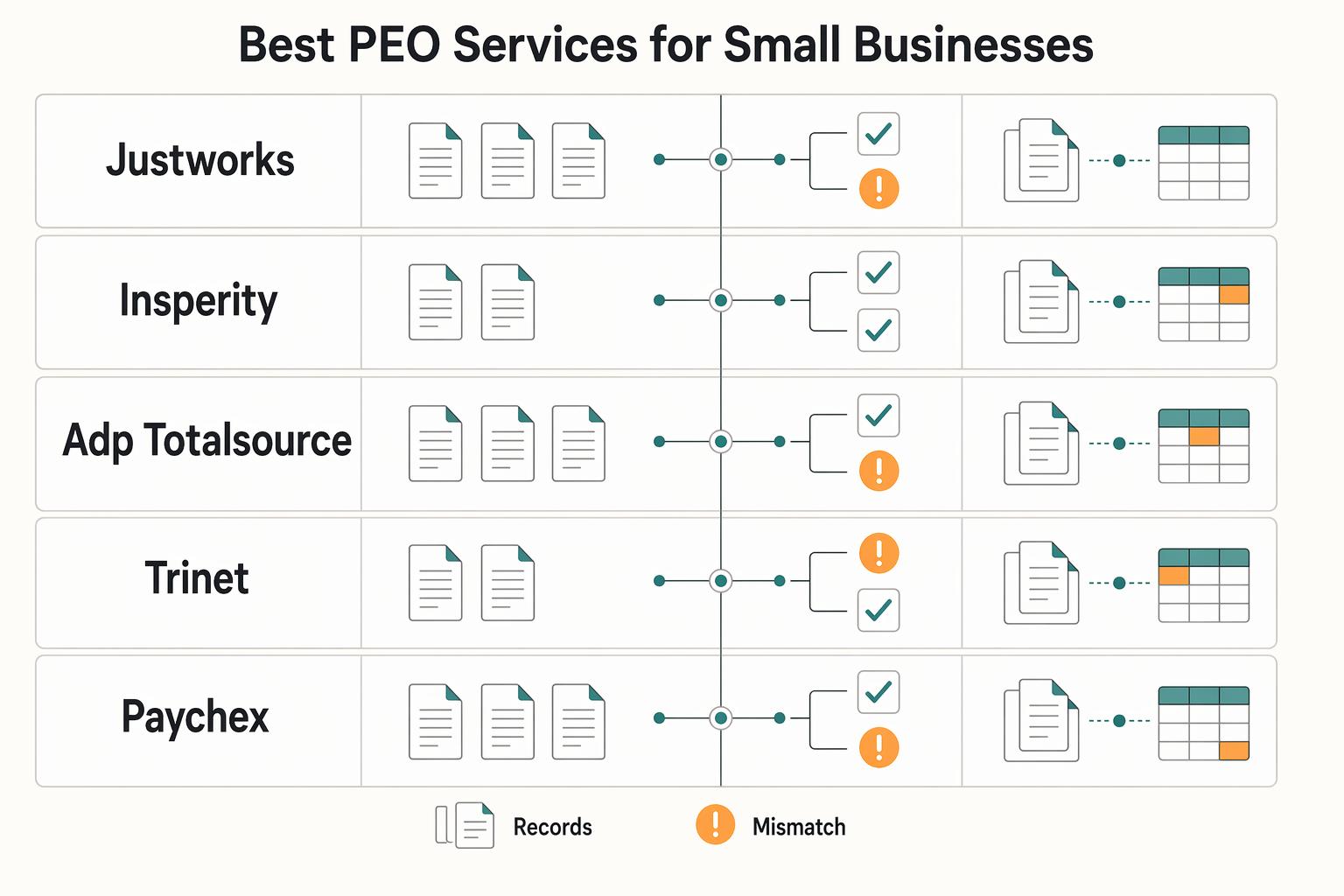
Best PEO Services for Small Businesses#
Treat this ranking as a diligence order, not a definitive market truth. Public scopes differ: Deel frames an "8 Best PEOs for Small Businesses in 2026" list (updated March 16, 2026), while Forbes publishes "10 Best PEO Services" and marks it "Audited & Verified: Aug 26, 2025, 8:17am." The practical move is to verify fit, ownership, and scope before you commit.
| Provider | Best for | Limitation | Use case |
|---|---|---|---|
| Justworks | straightforward PEO evaluation with less category confusion | thinner public detail on edge cases, exceptions, and flexibility limits | a small team that wants payroll, benefits, and employment-tax administration handled under a co-employment model |
| Insperity | buyers who prioritize ownership clarity after signing | clear support structure does not automatically prove escalation speed or accountability | a growing company with limited ops bandwidth that needs named points of responsibility |
| ADP TotalSource | teams seeking broad administrative offload | transition handoffs can stay unclear unless responsibilities are documented early | an employer that wants to reduce recurring HR-admin burden through one provider relationship |
| TriNet | compliance-first screening | public comparison detail is thinner on day-to-day support limits; treat that as an unknown | a company expanding operations and trying to reduce payroll or employment-practice risk |
| Paychex | small businesses that want broad HR outsourcing coverage | service boundaries can remain vague without written scope detail | an owner-led business aiming to consolidate payroll, benefits, and support conversations |
| Deel | boundary cases where you may need PEO vs. EOR clarification first | category confusion risk if international hiring needs are mixed into a PEO search | a company evaluating domestic operations now while considering cross-border hiring |
| Rippling | buyers willing to run deeper diligence where public comparison detail is limited | unknowns remain on support ownership, implementation friction, and correction workflows | shortlist only if your internal requirements strongly match what you see in discovery |
| G&A Partners | teams keeping a secondary option active while validating fit | support model, escalation ownership, and transition detail are not clear enough here | keep in reserve when top options miss your contract or service-style requirements |
- Justworks
Best for: straightforward PEO evaluation with less category confusion. Strongest advantage: the easiest starting point in this screen if you want core PEO scope communicated clearly. Biggest limitation: thinner public detail on edge cases, exceptions, and flexibility limits. Use-case: a small team that wants payroll, benefits, and employment-tax administration handled under a co-employment model. If X, do Y: if simplicity matters most, start here and confirm payroll-correction ownership in writing.
- Insperity
Best for: buyers who prioritize ownership clarity after signing. Strongest advantage: clearer expectations around who supports onboarding and ongoing admin. Biggest limitation: clear support structure does not automatically prove escalation speed or accountability. Use-case: a growing company with limited ops bandwidth that needs named points of responsibility. If X, do Y: if your team is stretched, prioritize the provider that documents ownership for onboarding, escalations, and tax notices.
- ADP TotalSource
Best for: teams seeking broad administrative offload. Strongest advantage: aligns with full-scope PEO needs across payroll, benefits, workers' comp, and employment taxes. Biggest limitation: transition handoffs can stay unclear unless responsibilities are documented early. Use-case: an employer that wants to reduce recurring HR-admin burden through one provider relationship. If X, do Y: if compliance pressure is rising, favor operational depth and verify post-launch correction handling before selection.
- TriNet
Best for: compliance-first screening. Strongest advantage: relevant when risk-management depth is the main buying filter. Biggest limitation: public comparison detail is thinner on day-to-day support limits; treat that as an unknown. Use-case: a company expanding operations and trying to reduce payroll or employment-practice risk. If X, do Y: if compliance complexity is high, move TriNet up and require a clear escalation path.
- Paychex
Best for: small businesses that want broad HR outsourcing coverage. Strongest advantage: practical one-vendor appeal across common PEO admin needs. Biggest limitation: service boundaries can remain vague without written scope detail. Use-case: an owner-led business aiming to consolidate payroll, benefits, and support conversations. If X, do Y: if scope language is broad, request a written included-vs-add-on breakdown.
- Deel
Best for: boundary cases where you may need PEO vs. EOR clarification first. Strongest advantage: useful when the first decision is model fit, not just vendor preference. Biggest limitation: category confusion risk if international hiring needs are mixed into a PEO search. Use-case: a company evaluating domestic operations now while considering cross-border hiring. If X, do Y: if international hiring is central, read EOR vs. PEO: What's the Difference? before treating this as a standard PEO comparison.
- Rippling
Best for: buyers willing to run deeper diligence where public comparison detail is limited. Strongest advantage: not established in available public detail. Biggest limitation: unknowns remain on support ownership, implementation friction, and correction workflows. Use-case: shortlist only if your internal requirements strongly match what you see in discovery. If X, do Y: if evidence stays thin, require a written implementation and ownership plan before ranking it above better-documented options.
- G&A Partners
Best for: teams keeping a secondary option active while validating fit. Strongest advantage: unknown from the public comparison detail used for this section. Biggest limitation: support model, escalation ownership, and transition detail are not clear enough here. Use-case: keep in reserve when top options miss your contract or service-style requirements. If X, do Y: if you keep it in process, request the same written evidence pack as your top three and score it consistently.
On the watchlist: AlphaStaff, Engage PEO, Amplify PEO, BBSI, Infiniti HR, and Remote People are worth investigating only when you have a specific trigger, such as a referral signal, local-market need, or a scope gap your primary shortlist cannot cover. Public detail is thin, so treat missing data as unknown, not as strength. Minimum checkpoint for any watchlist candidate: written scope, onboarding ownership, tax-notice ownership, and payroll-correction process after launch.
Which Provider Fits Your Operating Scenario#
Choose by operating scenario, not demo polish. In this shortlist, Justworks is usually the cleaner first pass for lean admin needs, TriNet is the pressure-test option when compliance load is higher, and Insperity is the check when support ownership clarity matters most after signing.
| Scenario | Path | Verify |
|---|---|---|
| Lean team with minimal HR admin | Start with Justworks | Confirm in writing who owns payroll corrections and post-launch fixes |
| Benefits-sensitive hiring | Run a Justworks vs. Insperity decision check | Ask both providers for a written scope that separates included services from add-ons and names escalation ownership |
| Multi-state complexity | Move TriNet up, then validate support limits against Insperity | Prioritize compliance handling, pricing transparency, and service model; verify day-to-day escalation paths |
| Remote-first growth | Separate U.S. PEO needs from cross-border hiring needs | Read EOR vs. PEO before treating Deel as a standard domestic PEO comparison |
- Lean team with minimal HR admin: start with Justworks
If you look more like a 15-person startup profile, favor a simpler service model over feature volume. Use Justworks as an initial screen, then confirm in writing who owns payroll corrections and post-launch fixes so you are not relying on sales-call assumptions.
- Benefits-sensitive hiring: run a Justworks vs. Insperity decision check
If your team cannot sustain a dedicated people-ops function, compare service ownership detail, not broad "small business" positioning. Ask both providers for a written scope that separates included services from add-ons and names escalation ownership.
- Multi-state complexity: move TriNet up, then validate support limits against Insperity
For multi-state hiring, prioritize compliance handling, pricing transparency, and service model over the longest feature list. That matters because 30 states plus DC sit above the federal $7.25 wage floor, and states differ on unemployment insurance, workers' compensation, and wage-hour rules. If your profile is closer to a 200-employee operation, pressure-test TriNet for compliance fit, then verify day-to-day escalation paths before ranking it above Insperity.
- Remote-first growth: separate U.S. PEO needs from cross-border hiring needs
A PEO is a co-employment model, so U.S.-based remote growth still belongs in a standard PEO evaluation lane. If upcoming hiring may fall outside your current U.S. entity footprint, pause and read EOR vs. PEO: What's the Difference? before treating Deel as a standard domestic PEO comparison.
Final tie-breaker: choose the provider whose compliance and support model matches your real operating cadence. If your month-to-month operations are steady, simpler service can be enough; if you expect expansions, notices, or frequent exceptions, require named ownership for onboarding, corrections, and compliance questions in writing.
Red Flags That Should Remove a PEO From Your Shortlist#
Remove a PEO from your shortlist when ownership, compliance responsibility, and pricing are not clear in writing before you sign. If answers change across sales, legal, and implementation, pause the process and re-validate.
- Vague service commitments and unclear support ownership
A polished sales call is not enough if scope documents stay fuzzy. You should get written detail on what is included for payroll, benefits administration, tax administration, and workers' compensation support, plus whether support is dedicated or queue-based. If they cannot name the post-sale owner, escalation path, and transition lead in writing, treat that as a disqualifier.
- Inconsistent co-employer responsibility (hard stop)
If teams give different answers on payroll tax deposits, tax notices, workers' compensation issues, or corrections, stop and re-check before signing. That inconsistency is not minor: if payroll tax deposits or workers' compensation premiums are mishandled, you may still be on the hook with the IRS and state agencies. A credible provider should explain the same co-employer boundary in the demo, contract, and kickoff.
- Smooth sales process, weak onboarding accountability
A common failure mode is clean sales, then messy onboarding and recurring exceptions your team has to manually fix. Watch for missing implementation milestones, no named owner for data migration, and vague language on payroll corrections after go-live. Ask for the implementation plan before signature, not after.
- Reluctance to share documents, opaque pricing, or financial warning signs
If a provider resists diligence, take that seriously. Ask for audited financial statements from the past two years, proof of fiduciary liability insurance, and a clear explanation of workers' compensation carrier changes. Reluctance to provide documentation, declining revenue, high client turnover, frequent carrier changes, opaque fees, and confusing contracts are all reasons to remove a vendor; and if pricing models are not normalized on an effective-rate basis, you could overpay by 20-30%.
No written ownership, no shortlist. The right provider can handle due diligence with clear documents and consistent answers that still hold after the sales call.
Pre-Signing Checklist and Evidence Pack#
When you are down to two finalists, make it document-first: define needs, score both providers the same way, run references, review contract language, then approve only if the written evidence is consistent.
| Checkpoint | Written confirmation |
|---|---|
| Service scope | Included services are clear for payroll, benefits administration, tax administration, workers' compensation, and retirement processing |
| Implementation | Setup ownership and early milestones are documented |
| Support model | You know whether support is named-contact or queue-based, plus escalation path |
| Compliance responsibilities | Co-employer responsibilities and your retained responsibilities are written |
| Payroll corrections | Ownership, submission path, and communication flow are confirmed in writing |
| Tax administration issues | Notice handling and exception follow-up are confirmed in writing |
| Retirement transition | Transition changes, timing, and employee communication approach are confirmed in writing |
| Financial stability and pricing | Certification status where applicable and pricing transparency are sufficient for side-by-side comparison |
1. Define needs first List the work you want to hand off: payroll, benefits administration, tax administration, workers' compensation support, retirement processing, and day-to-day compliance help. Also document what stays with your team under a co-employer model, since daily responsibilities remain with you. If risk reduction is the goal, prioritize written responsibility clarity over demo polish.
2. Score finalists on one fixed scorecard Use the same criteria for each provider: service scope, pricing transparency, onboarding fit, support model, and compliance coverage. Keep this comparison question-driven across services, pricing, features, and onboarding. Score only what is written or clearly shown.
3. Run reference checks before legal review Speak with recently onboarded clients, not only long-term accounts. Ask how support works in practice and whether issues are handled through personalized support or a shared queue. A high-value question is: what changed after signing, and how was it resolved?
4. Collect the same evidence pack from each provider Use one packet format so comparison stays clean:
- service scope summary
- implementation plan
- support model description
- written compliance-responsibility statement
- pricing summary with included and excluded services
- financial-stability proof, including whether certifications such as CPEO and ESAC apply
If a finalist will not provide core documents before signature, treat that as a decision signal. Due diligence is non-negotiable.
5. Review contract language last, then decide The contract should confirm the operating model, not change it. Review it next to the scope summary and implementation plan for consistency on support access, pricing triggers, termination terms, and compliance responsibilities. If ownership language differs across documents, pause until the provider reconciles it in writing.
Use this go/no-go checklist in one decision meeting:
- Service scope is complete and written. Included services are clear for payroll, benefits administration, tax administration, workers' compensation, and retirement processing.
- Implementation has named ownership. Setup ownership and early milestones are documented.
- Support model is clear. You know whether support is named-contact or queue-based, plus escalation path.
- Compliance responsibilities are mapped. Co-employer responsibilities and your retained responsibilities are written.
- Payroll corrections are clarified before signature. Ownership, submission path, and communication flow are confirmed in writing.
- Tax administration issues are clarified before signature. Notice handling and exception follow-up are confirmed in writing.
- Retirement transition handling is clarified before signature. Transition changes, timing, and employee communication approach are confirmed in writing.
- Financial stability and pricing checks are complete. Certification status (where applicable) and pricing transparency are sufficient for side-by-side comparison.
If any item still depends on a verbal promise, do not approve yet. The right choice should survive document review as well as it survives a demo.
Conclusion#
The right PEO is the one that fits your operating reality, not the one that shows up most often in a loud top 10 list. If you remember one thing, make it this: a strong choice is proved by written scope, clear ownership, and support you can actually use when payroll, benefits administration, or compliance gets messy.
- Fit to your actual employer model
A PEO works as a co-employer, which means you keep control of day-to-day work, hiring, firing, and performance management while shifting part of the HR and payroll burden. That is useful when your real problem is admin load, benefits administration, and compliance support. The key question is boundary clarity. If the co-employer model does not match your legal and operational needs across locations, pause and reassess before choosing a provider.
- Trust documents over demos
Use the scoring rubric, red-flag screen, and pre-signing checklist before you commit, even if one provider felt smoother in the sales process. Your evidence pack should include the written service scope, implementation plan, support model, and compliance responsibility map, plus specific answers on who owns payroll corrections, compliance notices, and benefits changes during transition. If a provider cannot put those answers in writing, or if contract language softens what sales promised, that is a real removal signal.
- Make a defensible two-vendor decision
Do not keep a bloated shortlist alive. Pick two finalists, score them against the same criteria, complete the evidence pack for both, and hold one go or no-go decision meeting with your actual risks on the table. The deciding factor is operational resilience, not branding. PEO support can offload HR and payroll tasks and may help companies stay steadier as complexity grows, but that only matters if the support model matches how your team operates when something breaks.
This is where teams can slip: expectations set in sales may not match onboarding realities, especially around exception handling and ownership. If you see inconsistent answers on co-employer responsibilities, unclear escalation paths, or hand-waving around implementation, pause the deal.
So the practical next step is simple: shortlist two providers, complete the evidence pack, and make the call from documented facts. That is how you choose among the best peo services without guessing, overtrusting rankings, or signing up for surprises you could have screened out.
Frequently Asked Questions
What is a Professional Employer Organization and who should use one?
A Professional Employer Organization helps small and midsized businesses simplify HR, access employee benefits, and stay compliant. It is usually a fit for teams that want support with people-operations administration and plan to compare service quality closely, since support levels are not uniform across providers.
What is the difference between a PEO and an Employer of Record?
The exact difference depends on your hiring footprint, legal setup, and who needs to hold formal employer responsibilities, so confirm role ownership in writing before you decide. If that is your real use case, start with EOR vs. PEO: What's the Difference? before you compare provider options.
How do I choose the best PEO service for a small business without relying on brand rankings?
Use one scorecard and require every finalist to answer the same written questions on scope, pricing, implementation, support access, and compliance ownership. A concrete checkpoint is support availability: ask for published hours, after-hours handling, and whether you get a dedicated point of contact instead of a shared queue. That will get you closer to a sound decision than any generic top 10 list, because providers often look similar on paper until something urgent breaks.
Which PEO providers are most commonly shortlisted for small businesses?
There is no universal shortlist that fits every small business. Start with providers that match your operating scenario, then narrow the list using written answers on support hours, after-hours handling, and support continuity. Keep the focus on fit and service quality, especially for urgent-issue scenarios where differences become clear.
What are the biggest tradeoffs of using HR outsourcing through a co-employer model?
The upside is less admin burden and more structure around HR, benefits administration, and compliance support. The tradeoff is operational friction if support quality is weak, escalation paths are vague, or responsibility lines are unclear. The wrong fit can cost time, money, and control, especially when urgent issues expose gaps.
What should I verify before signing a PEO contract?
Verify the written service scope, implementation plan, support model, compliance responsibility map, pricing triggers, and escalation ownership. One concrete test is customer support hours and availability: if a provider shows a window like Monday through Friday from 8:00 AM to 7:00 PM ET, ask what happens outside that window and get the answer in writing. If the contract introduces new limits or a different ownership split than the sales materials, pause the deal.
How should I use sources like Forbes Advisor, SHRM Vendor Directory, and Reddit r/humanresources without overtrusting them?
Use them to gather names and build better due-diligence questions, not as proof that one vendor is objectively the winner. Treat rankings, directories, and forum threads as starting points, then verify meaningful claims against provider documents, support details, and direct checks before signing.
Try a related tool
Researched and edited by the Gruv editorial team. Gruv builds cross-border billing, payouts, and finance-operations software for global businesses.
Sources
Includes 3 external sources outside the trusted-domain allowlist.
- congress.gov/119/crec/2025/12/10/171/208/CREC-2025-12-10.pdftrusted
- ecfr.gov/current/title-13/chapter-I/part-121trusted
- ideas.wharton.upenn.edu/wp-content/uploads/2018/07/Leading-Diversity...trusted
- library.samhsa.gov/sites/default/files/sma14-4435.pdftrusted
- oecd.org/content/dam/oecd/en/publications/reports/202...trusted
- adtools.org/buyers-guide/goco-vs-zoho-people-vs-paycom-v...external
- atlashxm.com/resources/eor-vs-peo-vs-staffing-agency-unde...external
- begroup.online/blog/best-peo-companies-for-small-businessexternal
Educational content only. Not legal, tax, or financial advice.
Related Posts
Value-Based Pricing for Freelancers Under Real Payment Risk
Value-based pricing works when you and the client can name the business result before kickoff and agree on how progress will be judged. If that link is weak, use a tighter model first. This is not about defending one pricing philosophy over another. It is about avoiding surprises by keeping pricing, scope, delivery, and payment aligned from day one.

What to Do If You've Been Misclassified as an Independent Contractor
Treat this as a protection problem first, not a label debate. If your work was treated as an independent contractor arrangement even though the relationship functioned differently, your first goal is to protect pay, rights, and records while you choose the least risky escalation path. You can do that without making accusations on day one, which often keeps communication open while you document what happened.
EOR vs. PEO: What's the Difference?
For a global independent professional, structure is a strategic choice, not just back-office admin. The question is not which HR label sounds better. It is which model protects your autonomy, allocates risk clearly, and lets you work across borders without unnecessary complexity.