
Quick Answer
Start with one conversion path, then launch only after your KDP setup and follow-up flow are operational. For launch strategies for self-published book goals tied to client work, align your blurb, keywords, categories, and audience to one buyer promise, choose a channel model you can sustain, and map one live event to one paid next step. If you use KDP Select, account for the 90-day ebook exclusivity period before committing to wide distribution.
For consultants and global professionals, writing a book is usually a business decision, not a bid for literary fame. The frustration starts when people follow the standard author path: write, publish, hope for traction, then wonder why a burst of Amazon sales does not turn into serious client work.
The issue is not the book itself. It is treating the book as the finished product. For your purposes, the book is not the product. It is an asset designed to generate leads, strengthen authority, and move the right readers toward premium work.
That requires a different approach. Ignore vanity metrics and bestseller talk. Focus on the number that matters: return on investment in new business. This guide walks through a three-phase framework for turning your book into a durable, scalable growth engine for your practice.
Phase 1: Engineer the Foundational Asset#
If the book is an asset, this is where you make it usable. Before you think about launch tactics, make sure one reader can move from the book to a clear business next step without hitting mixed messages, dead links, or a vague offer.
Asset readiness before launch#
Build one conversion path, and make every step point to the same promise. A conversion path is how an unknown reader becomes a known lead. A practical version is still the most useful: book CTA, landing page, form, thank-you page, then one follow-up action.
| Asset | What to confirm | Note |
|---|---|---|
| In-book CTA | Names one offer and one next step | Keep the path single-threaded |
| Landing page | Headline closely matches the CTA wording | Repeat the same promise |
| Form | Only asks for information you will actually use | Avoid extra fields |
| Thank-you page | Delivers the resource and points to one consultation action | Do not stack several next steps |
| Links | Every link has been tested on desktop and mobile | Click each one yourself |
A simple example looks like this. The book invites the reader to get a short resource tied to the book's core problem. The landing page repeats that same promise in nearly identical language. The form captures contact details, and the thank-you page offers one next step, such as requesting a consultation. Keep it single-threaded. If your CTA asks readers to download a guide, join a newsletter, follow you on LinkedIn, and book a call, it can create hesitation instead of momentum.
Use this as a quick readiness check:
- Your in-book CTA names one offer and one next step.
- The landing page headline closely matches the CTA wording.
- The form only asks for information you will actually use.
- The thank-you page delivers the resource and points to one consultation action, not several.
- You have clicked every link yourself on desktop and mobile.
One practical warning: some CTA tools enforce a single action object. For example, a single CTA cannot contain both a form and a meeting module. That constraint is useful. Pick the primary action first, then design the rest around it.
Pick a lead magnet that qualifies, not just attracts#
Do not default to a free chapter. Choose the offer that helps readers self-select before they ask for your time.
| Lead magnet | Best use case | Qualification strength | Delivery effort | Ideal follow-up action |
|---|---|---|---|---|
| Checklist | Reader needs a quick win or implementation aid | Low to medium | Low | Invite them to a short consult request or reply with their main gap |
| Diagnostic | Reader needs to assess fit, readiness, or pain level | High | Medium | Route qualified respondents to a consultation request |
| Mini-training | You need to teach method and show how you think | Medium to high | High | Offer a strategy call tied to the training topic |
Treat this as a planning heuristic, then validate with your own testing.
Verify proof and finish QA#
Social proof needs a verification pass, not just collection. Check four things for every endorsement: Is the endorser relevant to the audience you want? Is the endorsement honest, specific, and not misleading? Is any material connection disclosed clearly and conspicuously if it could affect credibility? Since October 21, 2024, the FTC's consumer reviews rule has also prohibited buying or selling fake testimonials. That makes sloppy proof a compliance risk, not just a brand problem.
Then do a final KDP quality pass. Confirm the title field matches the title on the cover. Keep title plus subtitle under 200 characters. Review your up to seven keywords and 3 categories. Run KDP Print Previewer before publishing because it checks errors that must be fixed. Last, test every CTA link in the manuscript and on the landing page. If a reader cannot tell what to do next in five seconds, the asset is not ready.
If you want a deeper dive, read A Freelancer's Guide to LinkedIn Marketing.
Phase 2: Execute a Strategic Go-to-Market#
Do not push visibility until your positioning, channel choice, and follow-up path are operationally ready. Most launch friction starts when those decisions happen after outreach.
Audit the launch path before traffic#
Run this check before interviews, partner outreach, or paid promotion. On KDP, your book details are metadata, and many fields are hard to change after publishing.
| Input | What to check | Limit / note |
|---|---|---|
| Description (blurb) | Often the reader's first experience on the Amazon detail page | 4,000-character limit |
| Keywords | Validate the terms before launch traffic | Use up to seven |
| Categories | Choose options that fit how readers will find the book | Choose 3 |
| Comparable titles | Confirm how similar books are categorized and how their promises are framed | Use for positioning checks |
| Audience definition | Keep one clear buyer profile | Avoid a broad mix |
Validate those five inputs together before you send launch traffic. If they feel guessed, pause promotion. Strong outreach cannot fix weak message-market fit on the detail page.
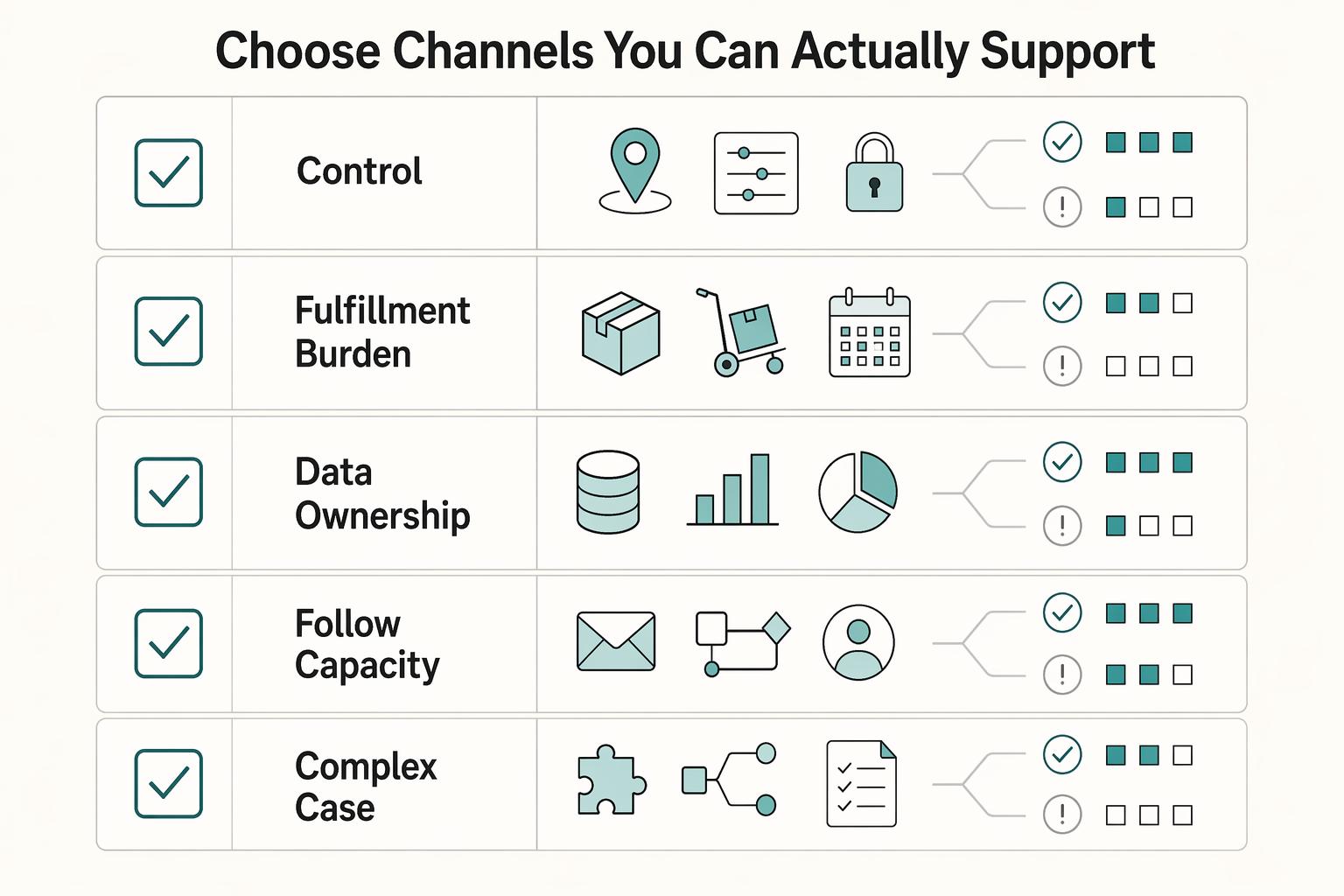
Choose channels you can actually support#
Distribution is an operating decision, not just a reach decision. Pick the path you can execute consistently.
| Decision factor | Amazon-centric | Wide plus direct |
|---|---|---|
| Channel control | Lower control over store environment and buyer relationship | More control if you sell on your own site and add storefronts |
| Fulfillment burden | Lighter for print because KDP prints on demand and ships | Higher for direct sales unless fulfillment is outsourced |
| Data ownership | Limited direct buyer data in marketplace flow | Stronger access to order data from your store, including exports |
| Follow-up capacity | Better for straightforward retailer conversion | Better for segmentation and post-purchase follow-up |
| Execution complexity | Fewer moving parts in one primary channel | More coordination across storefronts, links, fulfillment, and support |
| Key constraint | KDP Select requires ebook digital exclusivity during the 90-day enrollment period | Wide setups require consistent links/offers; aggregators can route per storefront, and IngramSpark cites access to over 45,000 outlets |
If you want simpler operations, an Amazon-centric path is usually easier to run. If you already have partner or owned traffic and a real follow-up system, wide plus direct can be the better fit.
Map one live event to one paid next step#
Use one educational event and one commercial action. Keep the CTA explicit, and mirror that same CTA on the destination page.
- Strategy offer: send people to a strategy-session application or booking page.
- Training or implementation offer: send people to a request page for that engagement.
Do not stack asks in the same event flow.
Score partners before launch on audience fit, trust, format fit, promotion reliability, and compliance readiness. Endorsements must be honest and not misleading, material connections must be disclosed clearly and conspicuously, and Amazon prohibits false, misleading, or inauthentic review activity.
After launch starts, run a short review loop:
- Add UTM parameters to partner and ad links to track campaign traffic.
- If traffic goes to Amazon, use Amazon Attribution to measure non-Amazon channel impact.
- Review placement quality, response signals (registrations, attendance, replies, feedback), and CTA-page performance.
- Wait for retail processing lag before judging outcomes (up to 24 hours for ebooks, up to a few days for print).
Before launch traffic begins, confirm this go/no-go checklist:
- Blurb, keywords, categories, comparable titles, and audience definition align to one buyer promise.
- Channel choice matches your real capacity for exclusivity, fulfillment, support, and follow-up.
- Live event CTA maps to one paid next step, and destination-page copy matches that CTA.
- Each partner has a confirmed format, date, link, disclosure plan, and tracking tag.
For a step-by-step walkthrough, see How to claim 'copyright' for your self-published book.
Phase 3: Systematize Growth and Compliance#
After launch, this phase is your system: protect lead quality, conversion quality, and compliance hygiene every month. If you do not instrument it, a strong launch quickly turns into guesswork, noisy inquiries, and avoidable admin risk.
Run a monthly scorecard that tells you what to change#
Use visibility metrics for context and decision metrics for action. KDP data is useful, but it has reporting lag: Dashboard refreshes every 15 minutes, eBook orders can take up to 24 hours, print orders can appear within 24 hours after shipment, and KENP can lag 24-48 hours with monthly totals still changing until near the 15th of the following month.
| Metric class | KPI | Where to check | If performance slips |
|---|---|---|---|
| Visibility metric | KDP orders, estimated royalties, KENP reads | KDP Dashboard | Do not change offers on a short dip. Wait for lag, then compare with inquiry volume and qualified calls. |
| Visibility metric | Traffic by source, medium, campaign | GA4 Traffic acquisition report | If traffic is high but actions are low, audit the destination page, CTA wording, and audience fit before buying more reach. |
| Decision metric | Book CTA to form completion rate | GA4 key events plus form records | If clicks happen but forms do not complete, shorten the form, tighten the promise, or fix page-message mismatch. |
| Decision metric | Reader to application or booking rate | CRM by lead source | If this drops, your promise and next step are misaligned. Rework the offer path before adding channels. |
| Decision metric | Qualified call rate | CRM notes against ideal client criteria | If call quality is low, add stronger qualification questions and stop routing low-intent traffic straight to calls. |
| Decision metric | Revenue mix by offer type | Invoicing and revenue records | If revenue stays mostly custom one-off work, pilot a narrower repeatable offer before scaling outreach. |
End each monthly review with one change decision, not a dashboard recap. The common miss is celebrating visibility while ignoring unqualified conversations.
Make every inquiry traceable and every asset qualify intent#
Make attribution mandatory and testable. Add UTM parameters to every partner link, QR code, webinar link, chapter CTA, appendix URL, and email CTA, then keep campaign naming consistent across links, forms, and CRM.
| Path | Asset | Qualification approach |
|---|---|---|
| Chapter CTA | Checklist, template, or diagnostic | Ask one or two qualifier questions tied to need and timeline |
| Appendix offer page | One clear service path | Use BANT-style prompts: budget, authority, need, timeline |
| Resource hub | Grouped assets plus email capture | Route calls only after stronger intent is shown through the offer-specific path |
Capture UTM values into hidden form fields and prospect records, then run a monthly test: click a tagged link, submit a form, and confirm source, medium, campaign, and asset name appear correctly in CRM. If they do not, too much traffic will collapse into direct or unknown, and you will not know which book asset created the inquiry.
Set each path to qualify intent before it creates calendar load:
- Chapter CTA: one checklist, template, or diagnostic with one or two qualifier questions tied to need and timeline.
- Appendix offer page: one clear service path with BANT-style prompts (budget, authority, need, timeline).
- Resource hub: grouped assets plus email capture, with call routing only after stronger intent is shown through the offer-specific path.
Do not send every reader to a generic contact page. That usually raises inquiry volume while lowering fit.
Evolve the offer carefully and verify responsibilities before scale#
Shift from custom delivery to repeatable offers only when the pattern is real. Pilot a narrower offer when qualified inquiries request the same outcome, scope is predictable, and delivery steps repeat. Standardize messaging when your calls, proposal language, and delivery promise stop changing week to week. Hold if prospects still require heavy customization or your qualification flow is not filtering well.
Keep your sales/compliance model explicit:
| Responsibility area | Platform / managed merchant-of-record path | Direct-sales path |
|---|---|---|
| Transaction and tax operations | Provider may handle transaction responsibilities and some tax operations; verify exact scope in your setup. | You own setup and ongoing execution; verify the exact setup threshold from current platform terms and official guidance before use. |
| Payouts, refunds, invoicing, records | You still verify payouts, refunds, invoicing visibility, customer-data access, and record retention. | You run payment, invoice, refund, reconciliation, and record workflows directly. |
| Customer-data and request handling | Confirm what customer data you receive and what request handling remains yours. | Build request-handling process from day one and verify applicability rules (for example, CCPA) against current official guidance before use. |
| Filing and trigger checks | Do not assume platform coverage removes your filing duties; verify the exact filing trigger from platform terms, official guidance, adviser records, or publisher/source records before use. | Review filing obligations as revenue grows; verify the exact filing trigger from official guidance, adviser records, or publisher/source records before use. |
Non-negotiables to keep in place:
- If you use KDP, provide valid taxpayer identification for U.S. tax reporting compliance.
- If you run email follow-up, CAN-SPAM responsibility cannot be outsourced; FTC guidance notes penalties can be up to $53,088 per violating email.
- If partners have a material connection when endorsing your book or services, disclose that connection clearly and conspicuously.
- If you collect reader data directly, verify whether laws such as CCPA apply and confirm current applicability thresholds before relying on them.
- Review filing obligations as revenue grows and verify the trigger that applies to you; for example, IRS guidance states an income tax return is required if net self-employment earnings are $400 or more.
The red flag is assuming platform sales handle everything, or that direct sales are only a marketing task. As volume grows, both become operations work.
You might also find this useful: How to Get an ISBN for Your Self-Published Book.
Conclusion: Your Book Is the Engine, Not the Destination#
After launch, judge the book by one standard: does it move the right reader toward a real conversion, or does it mainly create noise? Sales rank, reach, and social activity can give you context, but the stronger operating signal is whether readers take the next meaningful action.
Use that evidence to refine the asset itself. Check where readers stall in your path, not just where they click. In GA4, a conversion is built from an Analytics event, and funnel exploration or custom funnel reports can show where people drop off. If readers reach a page but do not continue, simplify the weak step before you spend more on promotion. Tighten the wording, reduce the number of choices, and make the next action easier to understand. When the same point keeps failing, that is often a clarity problem, not only a traffic problem.
Keep your go-to-market tightly matched to one audience problem. Your title promise, positioning, KDP categories, keywords, launch messaging, and CTA should all describe the same reader need. On KDP, you get 3 categories and up to seven keywords, so broad or vague choices dilute fit. Categories should accurately describe the book, and the title in your metadata should match the title on the cover. If your landing page or ad copy promises one action, the destination page should mirror that same action.
Before the next launch cycle, run this short reset:
- Review conversion events and funnel drop-off, not just top-line traffic.
- Validate every conversion link and tracked URL. Check UTMs, confirm the final URL and landing page share the same domain, and catch failures such as a 404.
- Adjust clarity where readers hesitate most, then relaunch the cleaner version.
Related: How to Write a Book to Establish Your Freelance Expertise.
Frequently Asked Questions
How should you calculate the real ROI of your book?
Define success goals before launch, then review post-launch outcomes you can actually observe. Track which readers respond, what they gravitate toward, and whether those signals align with your goals. Use those signals to adjust decisions instead of relying on assumptions.
What funnel should you use to turn readers into clients?
Keep the reader path simple, then refine it based on your core audiences. After release, review which readers respond and what they engage with, and prioritize the paths that match those signals. Avoid locking your plan to assumptions made before the book is on sale.
How much launch effort should you budget?
Plan by scenario, not by a fixed timeline. If you take the DIY route and hire your own cover designer, copy editor, and interior formatter, expect a heavier coordination load because you are managing the moving pieces yourself. If your channel mix and production setup are narrower, the planning load is lighter. Set your goals first so you can choose the right services and avoid unnecessary spend, then give yourself a planning window that matches your setup.
What signals professionalism before launch?
Run a short QA check before publication: editing, illustration, layout, and printing complete. Do not cut corners on production just to save money. A structured launch plan helps your book present professionally and improves discoverability in a crowded market.
Do you need to register your business in every country where someone buys your ebook?
Requirements can differ by where and how you sell, so treat this as a legal and accounting question and confirm current obligations with qualified local advice.
Try a related tool
Researched and edited by the Gruv editorial team. Gruv builds cross-border billing, payouts, and finance-operations software for global businesses.
Sources
- copyright.gov/engage/docs/registration.pdftrusted
- ecfr.gov/current/title-16/chapter-I/subchapter-B/part...trusted
- ecfr.gov/current/title-16/chapter-I/subchapter-D/part...trusted
- federalregister.gov/documents/2024/08/22/2024-18519/trade-regula...trusted
- ftc.gov/business-guidance/resources/can-spam-act-com...trusted
- ftc.gov/business-guidance/resources/ftcs-endorsement...trusted
- irs.gov/businesses/small-businesses-self-employed/se...trusted
- law.cornell.edu/cfr/text/16/255.5trusted
Educational content only. Not legal, tax, or financial advice.
Related Posts

LinkedIn for Freelancers Who Want a Predictable Client Pipeline
Treat LinkedIn as two jobs you run at the same time: a credibility check and a conversation engine. If you only chase attention, you can get noise. If you only send messages, prospects may click through to a thin profile and hesitate.

How to Write a Book as a Freelancer Without Scope Drift
The book needs a defined job and a defined boundary before you draft. In this cycle, give it one job: either support your client book services, or strengthen your own authority book so your niche, offer, and sales conversations become clearer.

The Freelance Payment Penalty: A Modeled Audit of Platform Fees, FX Spreads, and Payout Delays
The money rarely disappears through a single, easy-to-spot fee. The real loss is stacked. A marketplace takes its commission, a processor adds a charge for international cards, a bank or payment company converts the currency at a spread, a platform holds the funds before release, and a wire sheds a little to intermediaries on the way in. Each layer looks defensible on its own, but the worker feels the combined result as a smaller deposit and a later payday.