
Quick Answer
SEO freelancers should choose a keyword research tool by business goal: use a lighter stack for market validation, Ahrefs for competitor research and deeper SEO analysis, and Semrush for a broader acquisition and tracking workflow. The right tool is the one that improves decision quality, saves time, and supports the work you actually need to ship.
Introduction: Stop Shopping for a Tool. Start Investing in an Asset.#
Do not buy a keyword tool because it looks complete. Buy one because it helps you make a better business decision faster.
| Phase | Primary goal | Tool fit |
|---|---|---|
| Phase 1 | Test service viability | Use a lighter stack for market validation |
| Phase 2 | Build authority with intent, not noise | Use Ahrefs when competitor research and deeper SEO analysis will shape your authority work |
| Phase 3 | Support client acquisition | Use Semrush when you need a broader all-in-one marketing workflow |
Short answer: choose the tool by the job you need done right now. Use a lighter stack for market validation, Ahrefs when competitor research and deeper SEO analysis will shape your authority work, and Semrush when you need a broader all-in-one marketing workflow.
That is the point of this guide. It is here to help you choose the right keyword research tool for your current objective, not the one with the longest feature list.
Start with the job you need done, then judge each platform by whether it improves decision quality and saves time in the work you actually do. Good keyword research is grounded in data, not intuition. Before you commit to a topic, check both search difficulty and search volume. Looking at one without the other leads to bad calls.
- Phase 1: Test service viability
Use keyword data to check whether a service idea has real demand before you spend weeks packaging it. The goal is a cleaner go or no-go decision, backed by demand signals and a quick screen for difficulty and volume.
- Phase 2: Build authority with intent, not noise
Once the offer looks viable, the next job is choosing topics that match searcher intent and expose gaps in competitor coverage. That matters even more as search behavior keeps shifting. One March 2026 industry guide pointed to AI tools reaching 800M+ weekly users, which is a useful reminder that raw traffic alone is a weak planning signal.
- Phase 3: Support client acquisition
Here, you need a tool that helps you find opportunities, assess competition, and prioritize work you can actually ship. The Ahrefs versus Semrush question belongs here, but only as one decision. Semrush is broadly positioned as an all-in-one marketing suite, while Ahrefs is often framed as deeper on SEO analysis. Their origins in 2008 and 2010 matter less than your project needs.
Use this guide in a simple order. First, identify your primary goal. Then use the later sections to compare Ahrefs, Semrush, Keyword Planner, and other options against that goal. If you skip that step, the failure mode is predictable. You work inefficiently, miss key signals, and pay for a tool that does not fit the way you actually work.
For a step-by-step walkthrough, see The best tools for 'YouTube Keyword Research'.
Phase 1: Is Your Service Viable? Using Keyword Tools for Market Intelligence#
Use this phase to decide whether to build, refine, or pause a service idea before you spend time packaging it. You are validating demand, intent, and SERP fit, not trying to publish content yet.
Run a four-step viability workflow#
| Step | Focus | Key check |
|---|---|---|
| Define a testable service hypothesis | Start with one offer, one buyer, and one core problem | Keep it specific enough that the keyword signals mean something you can act on |
| Pull intent patterns before you judge demand | Classify terms by intent, then review volume, competition, and trend signals | Use ranges directionally; precision can be lower for non-advertisers |
| Check SERP fit at the page level | Inspect what currently ranks | Focus on page type and offer framing |
| Make the decision from combined signals | Choose build, refine, or pause | Save a short evidence pack before deciding |
- Define a testable service hypothesis
Start with one offer, one buyer, and one core problem. Keep it specific enough that the keyword signals mean something you can act on.
- Pull intent patterns before you judge demand
Classify terms by intent (informational, commercial, transactional), then review volume, competition, and trend signals. If budget is tight, Google Keyword Planner is a practical starting point: it provides keyword suggestions, broad monthly volume ranges, competition levels, and CPC estimates. Use those ranges directionally, because precision can be lower for non-advertisers.
- Check SERP fit at the page level
Enter a keyword or URL to generate related terms and performance insights, then inspect what currently ranks. Focus on page type and offer framing: are results mostly service pages, educational posts, comparisons, or directories? This tells you whether your offer matches what searchers and search engines currently reward.
- Make the decision from combined signals
Choose build when intent, demand, and SERP format align with a service like yours. Choose refine when demand exists but the niche, promise, or deliverable needs to narrow. Choose pause when intent is mostly educational or SERP patterns do not support a realistic service entry.
Before deciding, save a short evidence pack: keyword export, SERP screenshots, three competing URLs, and notes on offer framing and CTA style. That keeps your decision grounded in what you observed, not what you remember.
Match query type to the right asset#
Do not send every promising keyword to a sales page. Match the asset to intent so your funnel is usable from first visit to inquiry.
| Query type | Recommended asset type | Primary CTA | Expected business outcome for a solo freelancer |
|---|---|---|---|
| Informational | Pillar guide or diagnostic article | Download checklist or book a discovery call | Build early trust and qualify future leads |
| Commercial | Comparison page, service explainer, or case-led article | Request proposal or view service details | Attract better-fit prospects evaluating options |
| Transactional | Conversion-focused service page | Book consult or start project inquiry | Generate direct inquiries from ready-to-hire searches |
Use competitor analysis as context, not proof. Traffic alone does not validate a profitable service. What matters more is service-page intent, promise clarity, niche focus, and gaps you can credibly win.
Then cluster findings into a service-line architecture: one pillar topic for the core problem, supporting topics for adjacent questions, and one conversion page tied to the same intent pattern. That gives you a clean handoff to authority-building and client-acquisition phases.
If you want the broader process, A Freelancer's Guide to Keyword Research is a useful next read.
Phase 2: How Do You Build Gravity? Selecting a Platform for Authority#
Build authority by choosing one commercial problem and staying with it. Most authority programs fail from topic drift, not from publishing too slowly.
Once Phase 1 confirms viability, set one focal area tied to business intent and keep both your content and off-site work aligned to that same buyer problem.
- Pick a center of gravity
Authority usually comes from depth on one problem, not from chasing every keyword with volume. A keyword-driven strategy still works, but only when the keyword matches business intent. If you sell technical SEO for SaaS, a tighter center like "measurement and growth constraints for SaaS SEO teams" is more useful than a broad bucket like "content marketing."
Keep a simple topic sheet for each candidate area: - buyer type - service tie-in - core claim you can support from firsthand work
- Prioritize topics like an operator, not a volume chaser
Use tools as inputs, not verdicts. Score each expert-level topic on intent, business relevance, SERP format, and your ability to add firsthand expertise. "Decent demand + manageable competition" is useful; "strong fit + weak incumbent coverage" is often better.
| Tool | Best use in authority work | Practical limit |
|---|---|---|
Keyword Planner | Validate demand signals early | Not a full competitive content review tool |
Semrush | Competitor benchmarking and incumbent content review | Best value comes with a more advanced workflow |
Ahrefs | Page-level competitor and backlink inspection (Site Explorer, Backlink Checker) | Still needs your judgment on topic fit and message |
If budget is tight, treat older roundup prices as rough context only. Verify the exact tool cost against current vendor pricing or source records before purchase.
Treat KD as one line item, not the decision. A harder term can still be worth it when the SERP format fits your asset, incumbent coverage is weak, and you can add firsthand insight. Also, not every tool fully supports semantic mapping or entity coverage, so manual subtopic mapping still matters.
- Build off-site proof through relevant relationships
Backlinks support authority, but relevance and relationship quality matter more than list size. Review backlink patterns from competing pages and peer experts, then prioritize opportunities your buyers actually trust.
| Action | Verify before you pitch | What to send |
|---|---|---|
| Guest post | The publication already covers your niche problem and publishes practitioner content | Two specific topic angles plus one firsthand example |
| Podcast appearance | The host interviews operators your buyers trust | A short bio, one clear thesis, and three talking points |
| Reference or inclusion request | The page already links to similar resources | Exact URL, why your asset is more relevant, and the section it improves |
Track progress with a practical checkpoint: whether your authority cluster moves five or six target keywords into top-ten positions over time, not whether every post wins quickly. Save a small outreach evidence pack (target URL, contact, fit reason, asset pitched) to keep outreach specific and avoid generic asks.
We covered this in detail in The Best Tools for Competitive Intelligence for Agencies.
Phase 3: What's Your System for Client Acquisition? Targeting High-Intent Leads#
At this stage, your goal is not more visibility. Your goal is more qualified sales conversations. Use keyword tools to qualify buying intent, not to collect high-volume terms that will not move revenue.
- Use a qualification sheet for bottom-of-funnel terms
Start with role-fit modifiers and qualify each term on four checks: modifier, live SERP type, likely buyer stage, and fit with a real page or offer. If you use Semrush's Keyword Magic Tool, intent classification helps you sort terms by likely intent alongside volume and difficulty, instead of letting volume drive the decision.
For freelancers, a tight pattern set is usually enough.
| Pattern | Likely buyer stage | Target now when | Park for later when |
|---|---|---|---|
[service] consultant, [service] freelancer, [service] specialist | Selecting a provider | Public search results show service-led results and you have a matching service page | SERP is mostly job posts, glossary pages, or broad explainers |
[service] pricing, [service] cost, [service] packages | Comparing options | You can explain scope and engagement model clearly | You do not have a credible offer page behind the term |
[competitor] alternative, [in-house option] vs consultant | Shortlisting | You can provide a credible, experience-based comparison | The comparison would be generic or speculative |
hire [service] for [buyer type] | Confirming fit | You serve that buyer type and can show relevant proof | The buyer type is outside your current offer |
Use one rule: target now when the query signals action and the SERP supports service pages; park when the searcher is still learning or your destination page is weak.
- Track enquiry pages, not every ranking URL
Keep your watchlist focused on pages that can create enquiries: core service pages, buyer-fit landing pages, pricing/packages pages (if you publish them), local pages, and comparison pages for evaluation-stage searches.
Review those pages when performance shifts in the wrong direction or when SERP features change, because click behavior can change even without a ranking collapse. Test in order: title/H1 match, proof elements (case studies/testimonials), CTA clarity, then offer structure.
- Turn content gaps into proposal-ready opportunities
Content gap work should feed proposals, not just reports. Compare a prospect site with relevant competitors, pull missing terms competitors already rank for, and check whether those terms map to pages buyers use when choosing a provider.
Keep a lean evidence pack: keyword, intent label, SERP notes, competitor ranking URLs, recommended page type, and offer angle. That lets you make a concrete recommendation instead of a generic "publish more content" suggestion.
- Use CPC as a supporting signal, then execute follow-up
Treat CPC as supporting evidence, not a standalone decision metric. Combine it with intent, SERP type, and offer fit before you prioritize a term.
Revenue outcomes also depend on qualification and follow-up quality, not tooling alone. Tag enquiries to the page that generated them, respond quickly, and use those conversations to improve both the page and the proposal.
If you want a deeper dive, read Value-Based Pricing: A Freelancer's Guide.
How to Decide Which Tool to Buy, and When to Wait#
For a solo operator, the right tool is the one that serves one clear objective and removes meaningful manual work. If you cannot name the exact job it will handle this month, wait before you buy.
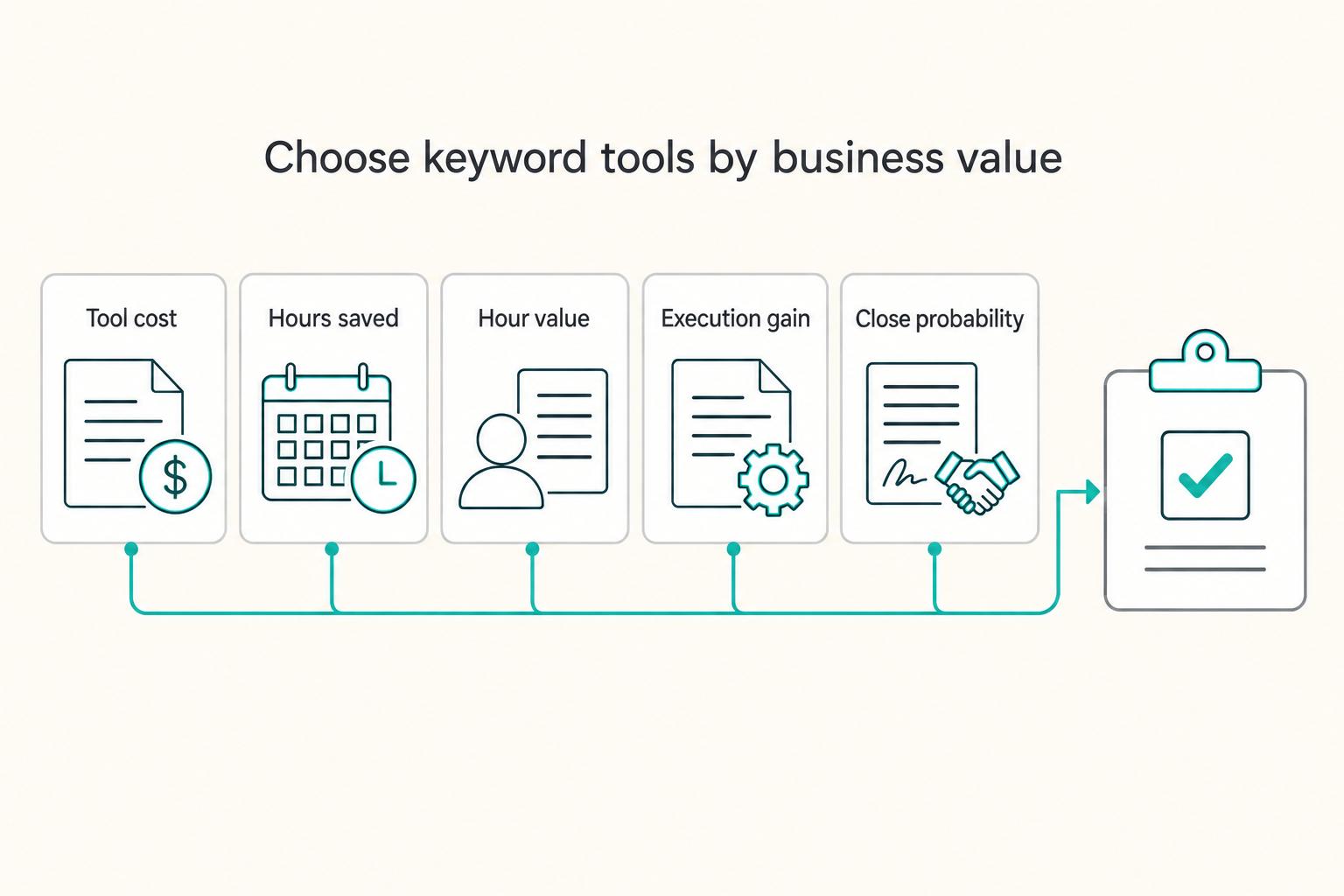
1. Build your investment case with your own numbers#
Use a short worksheet instead of someone else's ROI story.
| Input | What to capture | Verify against |
|---|---|---|
| Tool cost | Monthly or annual price for the option you are considering | Current vendor pricing or source records |
| Hours saved | Time currently spent on manual research, spreadsheet cleanup, rank checks, and competitor review | A 2-week work sample |
| Hour value | Your billable rate or internal hourly target | Finance records or current operating targets |
| Execution gain | Pages, proposals, or audits you could actually ship with the time saved | Current operating targets |
| Close probability | Your recent rate for turning qualified opportunities into paid work | Qualified-opportunity records from the last 6 to 12 months |
- Tool cost: monthly or annual price for the option you are considering. Verify the exact cost against current vendor pricing or source records before using it.
- Hours saved: time currently spent on manual research, spreadsheet cleanup, rank checks, and competitor review. Measure this from a 2-week work sample before using it.
- Hour value: your billable rate or internal hourly target. Verify the hour value against finance records or current operating targets before using it.
- Execution gain: pages, proposals, or audits you could actually ship with the time saved. Verify the execution-gain benchmark against current operating targets before using it.
- Close probability: your recent rate for turning qualified opportunities into paid work. Verify it against qualified-opportunity records from the last 6 to 12 months before using it.
Then run a quick opportunity-cost check each week:
- Billable work: protect this time first.
- Strategic work: keep room for planning and improvement.
- Low-value manual tasks: reduce these with tooling where possible.
If a paid tool mostly replaces low-value manual work and protects billable and strategic time, it is worth a serious look. If it mostly adds another dashboard, treat that as a warning sign. Instinct-only decisions tend to waste effort, and juggling separate tools across each step can become time-consuming.
After 30 days, use one checkpoint: are you monitoring rankings over time and making better page decisions (update, keep, or retire)? If not, the tool is likely not earning its place.
2. Match the platform to your primary job#
Many options overlap, so pick based on the work you need most often.
| Platform or stack | Best-fit use case | Main limitation | Effort to use well | Upgrade when |
|---|---|---|---|---|
| Semrush | Acquisition and measurable performance, especially when rank tracking drives page updates | Can be more platform than you need for narrow research-only workflows | Can require more experience to use deeply | You already have pages live and need tracking/reporting to guide what to improve |
| Ahrefs | Competitor research and authority-focused planning | Harder to justify if competitor analysis is not central to your plan | Can require more experience to use deeply | Your publish and outreach priorities depend on competitor intelligence |
| Keyword Planner + free Google tools or a lighter stack | Early market validation and basic research before committing to a paid platform | Gaps can appear in deeper research, tracking, and optimization; multi-tool workflows add overhead | Often simpler to start, but more manual | You can point to a specific gap in tracking, competitor research, or page-level decisions |
3. Commit to one objective first#
Choose one objective before comparing feature lists. This keeps execution clear.
- Market validation: start lighter, then upgrade when free tools no longer answer your core decisions.
- Authority: choose Ahrefs when competitor research directly shapes what you publish and pitch.
- Acquisition: choose Semrush when rank tracking and page performance must become measurable inputs to action.
Related: The Best SEO Tools for Freelancers.
Your Next Move: From Tool Selection to Strategic Execution#
Pick your tool by business goal, then run it as an operating habit. Start with one clear job: validate demand, build authority, or improve client acquisition.
Set a flexible execution window around that single use case instead of trying to use every feature at once. For validation, focus on search volume and SERP intent checks. For authority and acquisition work, prioritize terms and pages you can act on in client-facing content and proposals. This is how you avoid the common failure modes: guessing what people search for or stacking multiple subscriptions without a clear workflow.
| Cadence | Activity | Output | Business use |
|---|---|---|---|
| Setup | Choose one goal and one tool | Short list of target terms, pages, and intent notes | Keeps decisions tied to a real business need |
| 1-2 times per week | Qualify opportunities using search volume, keyword difficulty, and live SERP fit | 3-5 priority terms with a page action | Decides what to publish, update, or pitch next |
| Before client-facing work | Review relevant ranking pages and capture gaps you can address | Proposal notes or content recommendations | Improves proposal quality and sales conversations |
| Monthly | Review SERP performance alongside business outcomes | Keep, revise, or drop decisions | Connects research to qualified leads, conversion, and project value |
Use rankings as a checkpoint, not the score. Judge success by qualified leads, proposal quality, conversion, and average project value.
Choose the platform, run one plan consistently, and review results against revenue-linked outcomes. This pairs well with The Best Social Media Scheduling Tools for Freelancers.
Frequently Asked Questions
Which option should you choose first?
Choose the option that fits the job you need done this month, not the biggest feature set. Use a free or lighter stack for early demand validation, move to Semrush when you need broader research and ongoing optimization, or take a hybrid approach when free tools still cover validation but workflow friction is growing. If you are comparing paid options, pick the one that best fits how you research, prioritize, and report.
When should you pay for one of the best keyword research tools?
Pay for a tool when manual research starts stealing time from billable or strategic work. If you are copying ideas between tabs, cleaning spreadsheets, checking results page by page, or struggling to justify page priorities, paid access can be worth it. If it only adds another dashboard, wait.
Can you still do useful research for free?
Yes. Google Keyword Planner and Ahrefs Webmaster Tools are a legitimate starting point for early-stage validation and basic intent checks. Free tools can answer a lot before you buy, but they have limits in depth, tracking, and some filtering.
How should you research high-intent service keywords?
Start with long-tail queries in the 3 to 5 word range and build terms around service plus outcome plus modifier. Then check the live search results to confirm intent before creating a page. If the ranking pages do not match your planned asset type, you have an intent mismatch, and that usually leads to weak conversions.
How do these tools fit into your weekly operating cadence?
Use the tools to research topics, prioritize pages, execute updates or drafts, and explain your decisions clearly. A short list of target terms and page actions is more useful than a giant export. If the tool consistently helps you turn keywords into the next page to publish, update, or pitch, it is doing its job.
Try a related tool
Researched and edited by the Gruv editorial team. Gruv builds cross-border billing, payouts, and finance-operations software for global businesses.
Sources
Includes 7 external sources outside the trusted-domain allowlist.
- pmc.ncbi.nlm.nih.gov/articles/PMC11157186trusted
- almcorp.com/blog/best-lead-generation-toolsexternal
- clickrank.ai/best-keyword-research-toolsexternal
- clicksgeek.com/keyword-research-toolsexternal
- competitiveintelligencealliance.io/top-5-keyword-research-toolsexternal
- dezigndigital.com.au/best-keyword-research-toolsexternal
- elementor.com/blog/best-seo-toolsexternal
- esignwebservices.com/blog/15-best-free-paid-seo-tools-for-small-b...external
Educational content only. Not legal, tax, or financial advice.
Related Posts
Value-Based Pricing for Freelancers Under Real Payment Risk
Value-based pricing works when you and the client can name the business result before kickoff and agree on how progress will be judged. If that link is weak, use a tighter model first. This is not about defending one pricing philosophy over another. It is about avoiding surprises by keeping pricing, scope, delivery, and payment aligned from day one.

The Best SEO Tools for Freelancers
Before you buy anything, decide how you will defend it to yourself and to a client. For a solo operator, tool selection is not a taste question. It is an operations decision about whether you can produce the same monthly report on time, explain the numbers, and keep working if a tool changes or disappears.

A Freelancer's Guide to Keyword Research
**You can't run keyword research like a professional service if your "process" changes every time you open a new tool.** If you're running a business of one, your job is to operate with a system you can repeat, quality-control, and defend. Stop shopping for features. Build a repeatable standard you can explain to a client without hand-waving.