
Quick Answer
Choose the jurisdiction your team can run cleanly, not the one with the loudest reputation. For defense-heavy planning, Cook Islands and Nevis are usually the first comparison; for company-share continuity or broader governance design, Cayman Islands and BVI may fit better. Before moving assets, require signed trustee engagement, deed terms that define protector powers, and a written U.S. reporting workflow covering Form 3520, Form 3520-A, FBAR, and Form 8938.
Phase 1: The Strategic Self-Assessment#
Before you compare offshore trust jurisdictions, decide whether you should be shopping for one at all. A foreign trust can be a sensible asset-protection tool, but only if your risk profile, asset mix, and compliance tolerance justify the cost and upkeep.
| Factor | Key question | Grounded note |
|---|---|---|
| Litigation exposure | Whether your work regularly creates creditor or lawsuit risk, and whether planning is early | 11 U.S.C. 548 includes a 2-year lookback window. |
| Asset profile | Whether the legal, trustee, banking, and tax-reporting burden is proportionate to what you are protecting | Liquid investment assets can be easier to place than operating businesses, hard-to-value private interests, or assets with lender restrictions. |
| Cross-border complexity | Whether you are willing to operate transparently across countries | For U.S. persons, worldwide income reporting remains the baseline; FBAR may apply once aggregate value exceeds $10,000. |
| Ongoing compliance tolerance | Who will handle trust accounting, beneficiary statements if needed, Forms 3520 and 3520-A, and any FBAR support | If no one owns that answer in writing, pause. |
| Compliance-first intent | Whether the goal is lawful planning, transparent reporting, and asset separation before problems arise | DOJ offshore enforcement remains active, and concealment is prosecuted criminally. |
- Litigation exposure
Start with the real threat, not the brochure. If your work regularly creates creditor or lawsuit risk, this gets more relevant. Think less about dramatic one-off scenarios and more about whether you operate in a field where a bad contract dispute, professional claim, or personal guarantee could spill into your personal balance sheet. Timing is the key differentiator. Lawful planning is early. If a claim is already forming, or you are moving assets after a demand letter, you are in dangerous territory. In U.S. bankruptcy law, transfers can be challenged if made with actual intent to hinder, delay, or defraud creditors, and 11 U.S.C. 548 includes a 2-year lookback window.
- Asset profile
An offshore trust usually makes more sense when you have enough exposed value, enough concentration, or enough future earning power to protect. The question is not "Do I meet a magic minimum?" It is "Would the legal, trustee, banking, and tax-reporting burden be proportionate to what I am protecting?" Transferability matters most here. Liquid investment assets can be easier to place than operating businesses, hard-to-value private interests, or assets with lender restrictions. If most of your wealth is tied up in an active company, get clear advice on what can actually be transferred without breaking other documents.
- Cross-border complexity
If your life or business already spans countries, a structure built for cross-border ownership may help. But more countries usually means more reporting, more account-opening friction, and more advisor coordination. The real question is whether you are willing to operate transparently. For U.S. persons, worldwide income reporting remains the baseline. Foreign-trust reporting can require Form 3520, and a foreign trust with at least one U.S. owner files Form 3520-A annually. Foreign financial accounts may also trigger FBAR filing once aggregate value exceeds $10,000 at any point in the year. FATCA and CRS also mean offshore does not mean invisible.
- Ongoing compliance tolerance
This is where many otherwise good candidates pause, often for the right reasons. An offshore trust is not a set-and-forget arrangement. You need clean records, annual follow-through, and advisors who know who prepares what. Operator discipline is the deciding factor. Before setup, ask who will handle trust accounting, beneficiary statements if needed, Form 3520, Form 3520-A, and any FBAR support. Also ask what evidence pack you will receive each year. If no one owns that answer in writing, pause.
Cost reality#
Get quotes, not generic online ranges. Published pricing conflicts across providers, so treat the cost column below as a request-for-quote tracker until you have written proposals.
| Cost area | What moves it up or down |
|---|---|
| Setup | Jurisdiction, deed complexity, whether an LLC or company sits under the trust, asset type |
| Annual administration | Trustee scope, number of accounts/entities, transaction volume, reporting support |
| Legal and tax advisory | Cross-border residence issues, business interests, restructuring work, document review |
| Filing support | Whether 3520/3520-A prep is included, FBAR coordination, valuation and bookkeeping needs |
A common planning risk is buying on setup price alone, then discovering annual administration, tax prep, and banking support were treated as extras.
- Compliance-first intent
Your intent matters. If your goal is lawful planning, transparent reporting, and asset separation before problems arise, keep going. If your real goal is hiding money, reducing U.S. tax by secrecy, or keeping accounts off the radar, stop here. DOJ offshore enforcement remains active, and concealment is prosecuted criminally. Advisor-led execution is the practical dividing line. A legitimate trust plan should come with legal drafting, tax reporting guidance, and a paper trail that shows you are structuring, not concealing.
- If this is you: you face credible future liability, hold transferable assets worth protecting, can fund ongoing administration, and are prepared to report everything properly. Move on to the jurisdiction matrix.
- If this is not you: your risk is low, assets are modest or hard to transfer, or you already dislike annual filings and advisor coordination. Pause and consider simpler domestic options first, or review A Guide to Setting Up a Trust for Asset Protection.
Phase 2: The Jurisdiction Decision Matrix#
Choose jurisdiction by operational fit, not brand name. Your best option is the one your trustee, legal team, tax advisors, and banks can run cleanly for your specific facts.
Before comparing jurisdictions, document the settlor's and beneficiaries' citizenship, tax residency, and domicile. That baseline helps determine where a trust should be settled and how distributions or accumulations may be treated for reporting. Jurisdictions can look similar in theory and still perform very differently in practice.
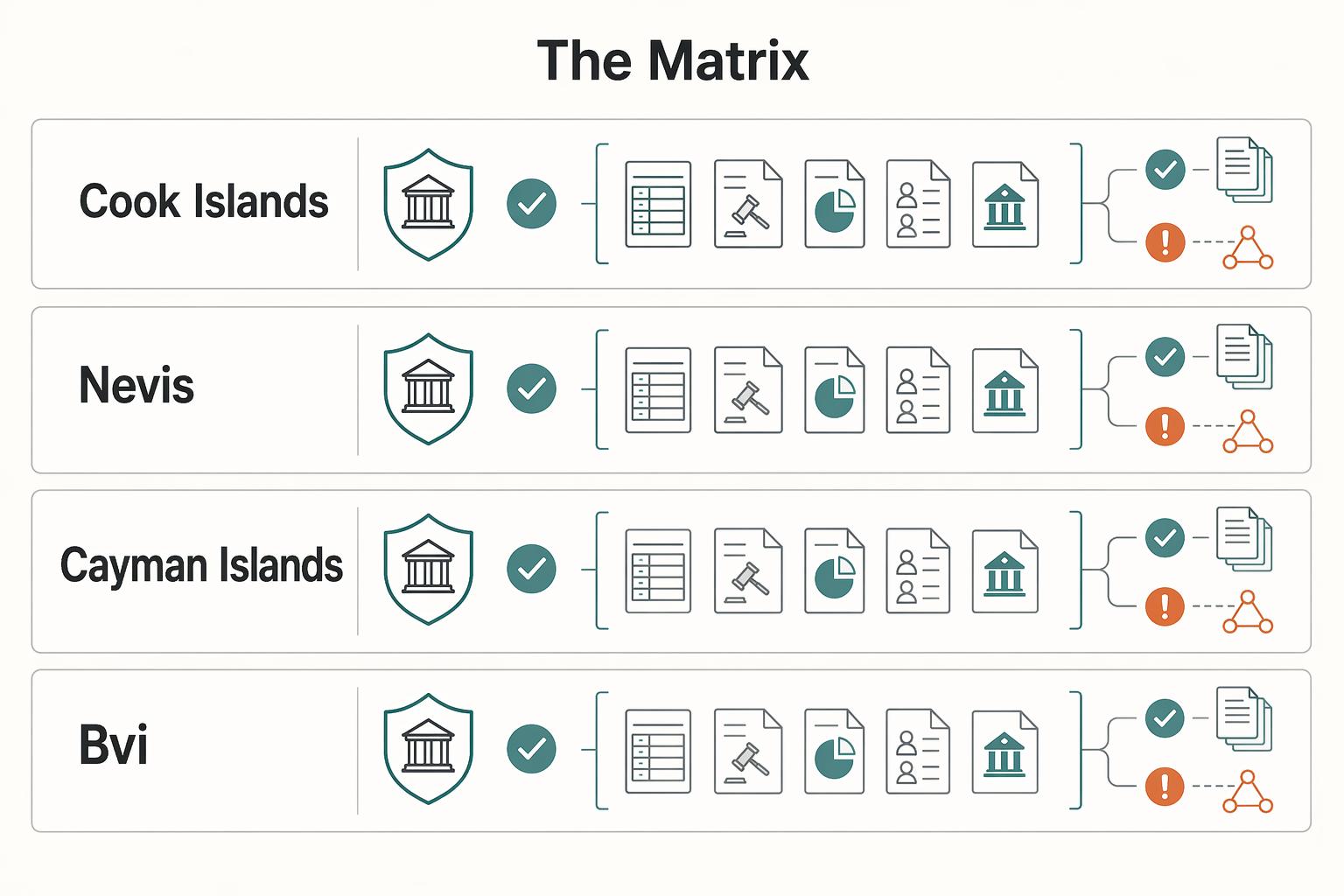
The matrix#
| Jurisdiction | Best-fit use case | Key legal angle to confirm before drafting | Operational tradeoff | Admin burden | Who should avoid it |
|---|---|---|---|---|---|
| Cook Islands | You are prioritizing defense-oriented planning and can support specialist counsel/trustee workflows. | Confirm current law on foreign judgment treatment, creditor burden, transfer-challenge windows, court-access barriers, and permitted settlor reserved powers. | Some institutions may ask more onboarding questions if they are less familiar with local courts, jurisprudence, or trustee practice. | High | Avoid if your priority is the simplest mainstream onboarding path or basic succession planning without heavier defense features. |
| Nevis | You want a defense-oriented option and your advisors already have a proven trustee/banking path there. | Confirm the same core items: foreign judgment treatment, creditor burden, challenge periods, filing barriers, and trustee regulation. | Bank and brokerage acceptance can vary; unfamiliar institutions may move slowly on compliance review. | Medium to high | Avoid if you need broad institutional familiarity from day one or do not have advisors with current jurisdiction experience. |
| Cayman Islands | You need a major financial-center environment for complex governance, investment holding, or succession design. | Verify current trust-law features relevant to your draft, including reserved-powers provisions and the exact scope of STAR structures. Confirm current statutory details before drafting. | More stakeholders and formality usually mean more coordination and diligence requests. | High | Avoid if your only objective is narrow lawsuit-defense positioning and you do not need broader structuring flexibility. |
| BVI | You want trust planning closely tied to company ownership and continuity. | Verify the current scope of VISTA-style planning and any trustee non-interference rules for company shares. Confirm current statutory details before drafting. | Company-plus-trust structures often draw deeper UBO/source-of-funds review; overly layered structures can trigger enhanced due diligence. | Medium to high | Avoid if your assets are mostly liquid portfolios and you do not need company-holding mechanics. |
Two checks matter in every option. First, decide whether you want a regulated trustee environment and get that position in writing. Second, require an annual evidence pack that clearly shows trust accounts, trustee decisions, asset statements, distribution records, and responsibility for reporting support and bank certifications.
The common failure mode is operational friction, not headline legal theory. A bank, broker, or counterparty may be unfamiliar with a jurisdiction's court system, jurisprudence, or trustee network and slow or block onboarding. In current compliance environments, institutions may also stress-test UBO data against thresholds often used in practice, such as 25% and, in higher-risk contexts, 10%.
Choose by objective#
Use this quick path once your shortlist is set:
| Objective | Start with | Key note |
|---|---|---|
| Maximum lawsuit defense | Validate Cook Islands and Nevis against your facts | Choose based on which team can show stronger current drafting, court, and banking execution. |
| Business succession flexibility | Shortlist Cayman for broader purpose-driven planning, and BVI when the trust is mainly supporting company-share continuity | Confirm STAR/VISTA statutory details before drafting. |
| Operating simplicity | Favor the jurisdiction where your trustee, bank, and tax advisors already work together smoothly | Choose by operational fit, not brand name. |
| Cost sensitivity | Use written proposals, not assumptions | Compare full-year trustee, entity, reporting, and banking-support costs before deciding. |
You might also find this useful: Anguilla vs Seychelles Offshore for Independent Professionals.
Phase 3: The Implementation Roadmap#
Treat implementation as a controlled launch: do not fund the trust until your advisor team, deed terms, compliance calendar, and account-opening path are all confirmed in writing.
| Filing | Timing | Trigger or note |
|---|---|---|
| Form 3520 | 15th day of the 4th month after your tax year-end | Map reporting before funding. |
| Form 3520-A | 15th day of the 3rd month after the foreign trust's tax year-end | As a U.S. owner, you are responsible for making sure it is filed. |
| FBAR (FinCEN Form 114) | April 15 with automatic extension to October 15 | Required if aggregate foreign accounts exceed $10,000 at any time during the calendar year. |
| Form 8938 | Filed with the annual return | Baseline trigger is $50,000 for some filers, with higher thresholds in other filing/residency cases. |
- Engage licensed advisors and pre-screen the trustee before mandate.
You should appoint legal counsel, tax counsel, and a trustee/TCSP that can support both setup and annual administration. In the Cook Islands, verify the trustee company is licensed before engagement. In Nevis, confirm the provider's licence class under the Nevis Trust and Corporate Service Providers Ordinance, 2021.
Use this trustee vetting screen by risk domain:
- Licensing and regulation: Can they prove current licensing status and supervising authority?
- Financial and operational resilience: Who actually performs administration, and what is their continuity plan?
- Reporting discipline: Can they show sample trust accounts, resolutions, and distribution records?
- Dispute handling: What is the escalation path for trustee-protector or trustee-beneficiary disputes?
- KYC/AML posture: How do they verify beneficial ownership and run ongoing customer due diligence?
Red flags before engagement:
- They cannot clearly evidence licensing.
- They are vague about who prepares annual records.
- They treat KYC/AML as optional friction.
- They cannot explain dispute escalation mechanics.
- Finalize the trust deed before any transfer planning.
Your deed should define how governance works in practice, not just in theory. Lock down reserved powers, distribution standards, successor roles, and document flow before assets move. For Cook Islands structures, confirm registration and annual certification mechanics before funding, including whether an annual certificate of registration concept applies to your structure.
- Use the protector as a control layer with written limits.
A protector works when powers are explicit in the governing instrument and role boundaries are clear. State decision rights directly in the deed, including whether the protector may direct trustee actions, approve amendments, appoint/remove trustees, and set succession.
Keep control safeguards explicit:
- The protector does not run day-to-day administration.
- No exercise of powers for personal benefit.
- Notice/consent rules are defined.
- Replacement authority is reciprocal, including who can remove the protector.
- Deadlock handling is documented.
Who does what#
| Role | Setup responsibility | Annual responsibility | Accountability checkpoint |
|---|---|---|---|
| Settlor | Provide facts, asset schedule, source-of-funds documents, and intent | Review trustee reporting and tax packets | No funding until deed + banking path are finalized |
| Trustee | Accept appointment, administer trust, open accounts, maintain records | Prepare trust accounts, resolutions, distribution records, and compliance support | Licensing verified and reporting standards accepted |
| Protector | Accept only deed-defined powers and succession terms | Exercise approval/veto/replacement rights only when triggered | Conflict safeguards and replacement mechanics documented |
| Tax counsel | Map U.S. reporting obligations and ownership consequences | Prepare/supervise filings and year-end review | Filing calendar approved before funding |
- Build your U.S. compliance checklist before launch.
If you are a U.S. person, map reporting before funding:
- Form 3520: due by the 15th day of the 4th month after your tax year-end.
- Form 3520-A: due by the 15th day of the 3rd month after the foreign trust's tax year-end; as a U.S. owner, you are responsible for making sure it is filed.
- FBAR (FinCEN Form 114): required if aggregate foreign accounts exceed $10,000 at any time during the calendar year; due April 15 with automatic extension to October 15.
- Form 8938: filed with the annual return; baseline trigger is $50,000 for some filers, with higher thresholds in other filing/residency cases.
- Use a funding readiness gate, then schedule year-one governance.
Fund only when all of the following are complete:
- Signed trustee engagement.
- Final deed with accepted protector powers and succession terms.
- Confirmed account-opening path.
- Written tax memo covering Form 3520, 3520-A, FBAR, and Form 8938 review points.
- Beneficial-ownership data package ready for institution onboarding, with any institution-specific threshold notes marked.
Immediately schedule your first annual governance review after funding: trust accounts, resolutions, distribution records, asset statements, and tax handoff. If you cannot produce that evidence pack cleanly at year-end, the structure was funded too early.
Your Next Strategic Move#
Proceed only when three things are true: your Phase 1 fit check is complete, your Phase 2 shortlist is down to one or two realistic jurisdictions, and your Phase 3 implementation/reporting burden is clear. If any of those is still unclear, pause now.
- Confirm your advisor team
Lock in who will cover trust law, U.S. tax reporting, and trustee coordination before drafting. Your team should map Form 3520, Form 3520-A, and possible FBAR obligations from day one: Form 3520 is due by the 15th day of the 4th month after your tax year-end, and Form 3520-A is due by the 15th day of the 3rd month after the foreign trust year-end.
- Validate jurisdiction assumptions against current law status
Do not rely on older summaries. For Nevis, the revised ordinance is shown as law as at 31 December 2017, including section 30, "Foreign judgments not enforceable," and section 31, "Exclusion of foreign laws." For the Cook Islands, the legal portal shows consolidation as at 1 December 2025 and points to newer laws-as-made after that date.
- Finalize governance terms before funding
Complete the trust deed, trustee acceptance, and protector terms before transferring assets. If you want oversight, define the trust protector role explicitly in the deed.
- Complete compliance prep
Build your file now: deed, onboarding records, transfer documents, reporting calendar, and account list. If aggregate foreign financial accounts will exceed $10,000 at any point in the year, plan FBAR early because FinCEN Report 114 is filed electronically.
- Fund only after documentation is complete
Do not fund while filing obligations, control rights, or local-law assumptions are unresolved. Penalties under 26 U.S.C. 6677 can begin at the greater of $10,000 or 35 percent of the gross reportable amount.
Readiness screen (pause if any answer is "no"):
- Do you have written confirmation of who handles Form 3520, Form 3520-A, and FBAR workflow?
- Have you re-checked your jurisdiction legal assumptions against current primary-law status?
- Are trust protector powers and governance terms clearly written in the deed?
- Is your compliance file complete before any transfer?
Read A Guide to Setting Up a Trust for Asset Protection next if you want the document-by-document setup path. Read What is FinCEN? A Guide for Freelancers and FinTech Users next if your open questions are FBAR filing, BSA E-Filing, or account-reporting scope.
Frequently Asked Questions
What is the minimum asset level for an offshore trust?
This guide does not establish a universal minimum asset level for offshore trusts. For U.S. reporting, thresholds are filer-specific, so verify the Form 8938 rules that apply to your filing status rather than relying on a single number.
Is setting up an offshore trust legal for a U.S. citizen?
This guide does not support a general legal/illegal conclusion. If you are evaluating one, have counsel confirm your filing obligations, including Forms 3520/3520-A where relevant, and test separately for Form 8938 and FinCEN Form 114. Form 8938 attaches to your annual return and is due with that return (including extensions), and filing Form 8938 does not replace possible FBAR obligations.
What is the single strongest jurisdiction for asset protection?
There is no supported basis in this guide to name a single “best” jurisdiction. Use jurisdiction-specific legal and tax advice before making that choice.
How do I maintain control over an offshore trust?
This guide does not provide support for specific control mechanics (including trust-protector powers, appointment rules, or removal rights). Confirm any control terms directly in the governing documents with qualified counsel.
Can an offshore trust help with estate planning?
This guide does not establish estate-planning benefits for offshore trusts. Review fit with your broader plan and reporting obligations with legal and tax advisors before funding.
Are the assets in an offshore trust completely confidential?
Do not assume complete confidentiality. FATCA context applies, Form 8938 may apply if you are a specified person with specified foreign financial assets above the applicable threshold, and filing Form 8938 does not replace potential FBAR filing obligations. Also verify exclusions so you do not over-report or miss a required filing. If you are moving forward, use the implementation checklist in the next section to turn the choice into a fundable, reportable structure.
Try a related tool
Researched and edited by the Gruv editorial team. Gruv builds cross-border billing, payouts, and finance-operations software for global businesses.
Sources
- bsaefiling.fincen.gov/resources/FinCENFBARHelp.pdftrusted
- coast.noaa.gov/data/digitalcoast/pdf/marine-managed-areas.pdftrusted
- ecfr.gov/current/title-31/subtitle-B/chapter-X/part-1...trusted
- irs.gov/businesses/small-businesses-self-employed/re...trusted
- irs.gov/businesses/corporations/do-i-need-to-file-fo...trusted
- justice.gov/opa/pr/credit-suisse-services-ag-admits-cons...trusted
- oecd.org/en/publications/consolidated-text-of-the-com...trusted
- uknowledge.uky.edu/cgi/viewcontent.cgitrusted
Educational content only. Not legal, tax, or financial advice.
Related Posts

Sole Proprietorship vs LLC for Global Freelancers in 2026
For most freelancers in 2026, the practical default is still simple: use the simplest structure you can run cleanly, then formalize when risk actually rises. If your work is still in validation mode and the downside is contained, a sole proprietorship is often the practical starting point. When contract exposure, delivery stakes, or dispute risk starts climbing, forming an LLC deserves earlier attention.
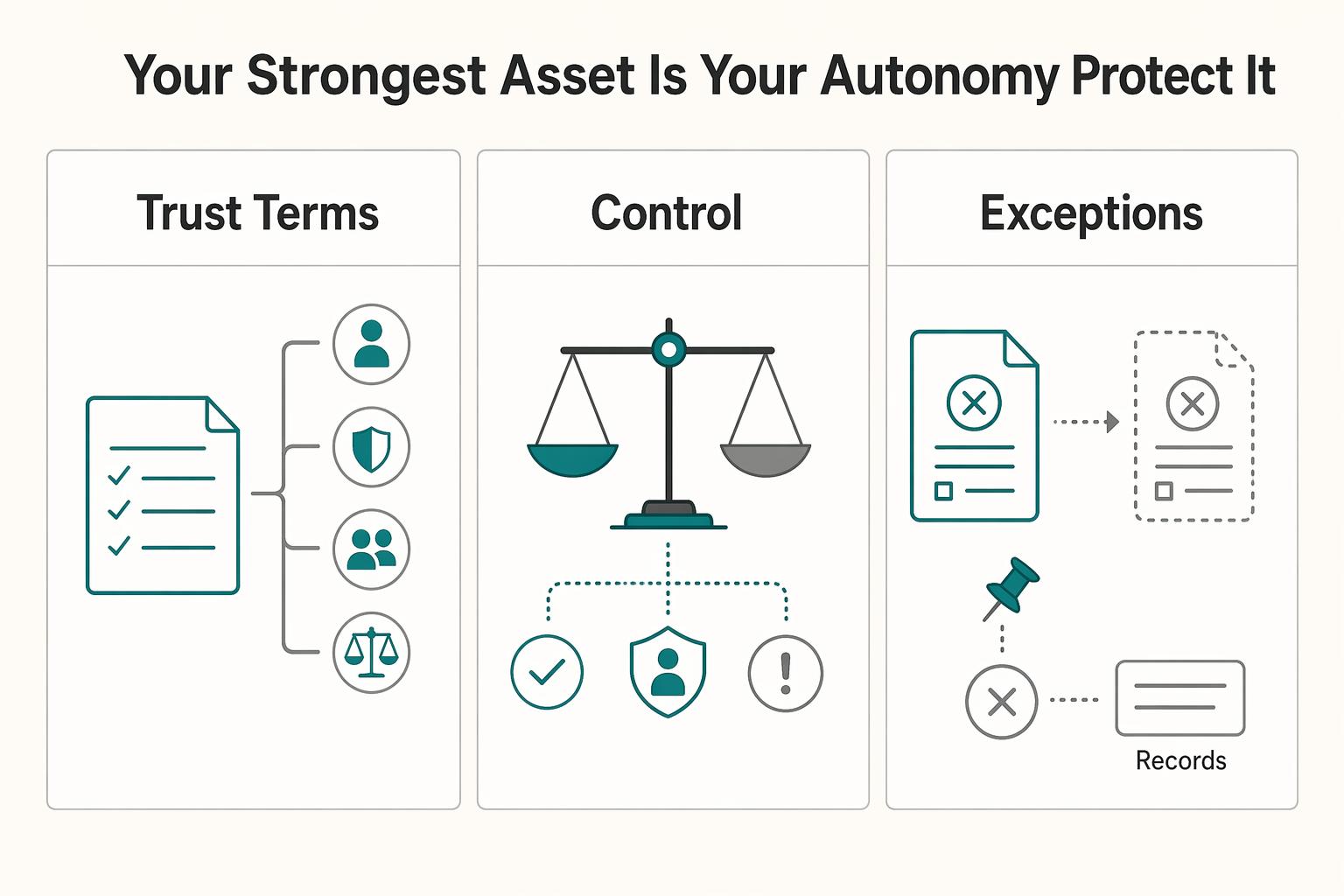
When a Trust for Asset Protection Makes Sense for Your Business
Use a trust only after your core liability setup is solid. A trust for asset protection is an escalation layer, not a substitute for entity separation, insurance, or clean operations.

What Is FinCEN for Freelancers and FinTech Users
If you are asking **what is fincen**, focus first on the decision in front of you. FinCEN, the Financial Crimes Enforcement Network, is tied to FBAR filing through FinCEN Form 114 when foreign financial accounts create reporting duties. By the end, you should know whether to act now, gather records, or escalate.