
Quick Answer
Start by using saas sales interview questions as a qualification tool, not a performance script. Use early calls to confirm company context, then present evidence-based examples tied to business outcomes, and finish by auditing written offer terms before deciding. The strongest process checks role scope, quota logic, and variable-pay mechanics across stages so you can accept, negotiate, or walk with clear reasons.
Phase 1: Discovery & Qualification - Is This the Right Client for "Me, Inc."?#
Start by qualifying the company like a prospect. Do not spend real interview energy until you know the company is worth it. In this phase, you gather evidence, separate signal from noise, and walk early if the operating reality looks weak.
| Source | Look for | Warning sign |
|---|---|---|
| G2 and TrustRadius | Repeated complaints about onboarding or lack of strategic guidance from account managers | Recurring issues you likely cannot influence from the role |
| Hiring manager, recent sales hires, and visible exits on the team or in leadership | Short tenures across multiple reps or recent executive changes | |
| Funding news | Growth trajectory and pressure to perform | Long gap between rounds may indicate struggles without proving failure |
| Recruiter screen | Why the role is open now, success in the role, average quota attainment, and CAC | Answers stay abstract, avoid quota attainment or CAC, or shift topics |
| Later interviews | How the team interprets repeated customer complaints, what changed after leadership transitions, and how current growth expectations connect to funding context | Patterns are dismissed without detail or conflict with what you already found in reviews, funding signals, and team-change mapping |
- Sort diligence by source quality. Start outside the interview process, then use interviews to confirm or disprove what you found. On G2 and TrustRadius, skip the star rating at first and read for repeated complaints about onboarding or lack of strategic guidance from account managers. If those pains match problems you know how to solve, the role may be a fit. If they point to recurring issues you likely cannot influence from the role, treat that as caution.
LinkedIn gives you a different signal. Map the hiring manager, recent sales hires, and visible exits on the team or in leadership. One departure is not the story, but short tenures across multiple reps or recent executive changes should affect your go/no-go call, especially when they line up with weak customer feedback. Funding news matters too. Announcements often signal growth trajectory and pressure to perform, while a long gap between rounds may indicate struggles without proving failure.
- Use the recruiter screen to get operating facts, not just logistics. This call should be an intelligence-gathering step, not just a fit check. Ask sharper questions than "What are you looking for?" Try: "Why is this role open now?", "How do you define success in the role?", "What can you share about average quota attainment?", and "How do you think about customer acquisition cost right now?" You are testing whether the company can talk clearly and consistently about business health.
Strong answers are specific, internally consistent, and easy to explain. Weak answers stay abstract, avoid business-health metrics like quota attainment or CAC, or shift topics when you ask direct follow-ups.
- Use later interviews to confirm or disprove your external signals. This is where you test whether the narrative holds up under detail. Bring your diligence into the conversation: ask how the team interprets repeated customer complaints, what changed after leadership transitions, and how current growth expectations connect to funding context.
Strong answers acknowledge specifics and explain what is changing. Weak answers dismiss patterns without detail or conflict with what you already found in reviews, funding signals, and team-change mapping.
- Keep a scorecard and insist on evidence. If you cannot verify a claim, do not score it green.
| Criterion | Evidence to request | Acceptable range | Walk-away trigger |
|---|---|---|---|
| Customer feedback signal | Repeated themes from G2/TrustRadius plus interview response | Team can explain the pattern and what is improving | Patterns are dismissed or ignored |
| Funding trajectory context | Public funding timeline plus interview explanation | Coherent story on growth pressure and priorities | Long gap questions get evasive answers |
| Team stability signal | LinkedIn map of hires/exits and leadership changes | Changes are explainable and role impact is clear | High turnover or exits with no clear explanation |
| Business-health transparency | Direct discussion of quota attainment and CAC | Clear, consistent answers to both | Avoidance or contradictions on both metrics |
| Cross-source consistency | Compare outside research with interview claims | Signals generally align | External and interview narratives repeatedly conflict |
Move to Phase 2 only when the outside signals and interview answers tell the same story. If one core area is still unclear, pause and ask for clarification. If risks stack up - weak customer feedback patterns, turnover red flags, and evasive answers on quota attainment or CAC - exit before you invest more.
You might also find this useful: The Best CRMs for a B2B SaaS Sales Team.
Phase 2: The Value Demonstration - Building Your Business Case#
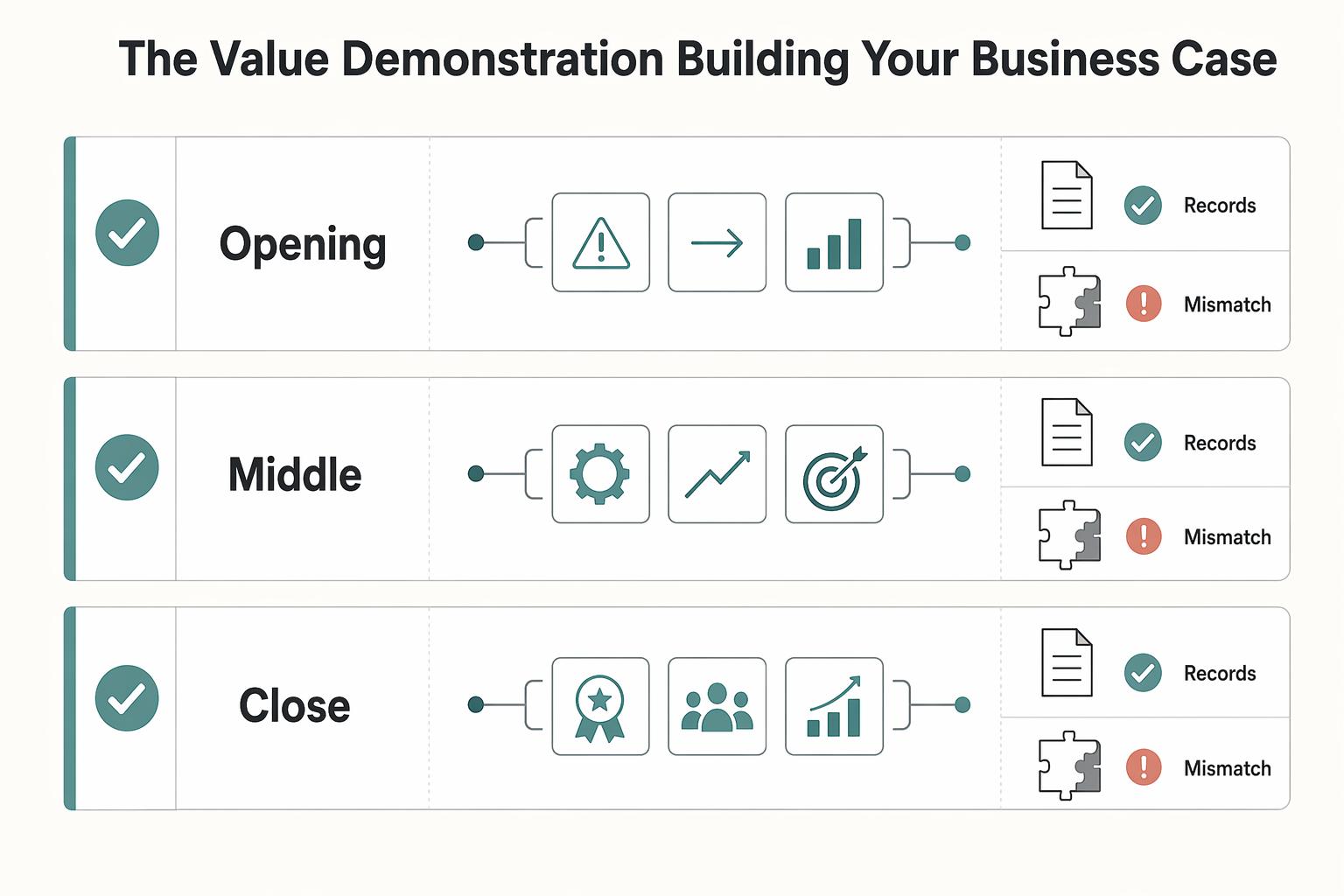
In this phase, your goal is to reduce hiring risk by giving clear proof of how you think, act, and deliver results. Most prompts are really asking for the same core story: Problem -> Action -> ROI.
- Use a repeatable answer template for behavioral questions.
Keep your setup brief, then spend most of your time on what you did and what changed.
Template you can reuse
- Problem: What business issue was in the way, and why it mattered.
- Action: The 2-3 decisions or moves you personally made.
- ROI: The measurable outcome and timeframe.
If a story has no defensible result, it is not ready yet. A practical check is whether you can support at least one concrete performance point, such as quota performance YTD and previous year, or another verified outcome.
| Answer part | Weak answer | Strong answer |
|---|---|---|
| Opening | Resume recap and broad background | Clear problem with business stakes |
| Middle | "We did..." with unclear ownership | Your specific actions and decisions |
| Close | Vague positive ending | Measurable result with timeframe |
- Handle situational questions like live objection handling.
Do not jump to tactics before you diagnose the obstacle. Use this sequence:
- Diagnose cause: What is actually blocking progress?
- Choose play: What is your response and why this move?
- Define success signal: What evidence shows the plan is working?
Prompt stems you can adapt in real time
- "Before choosing an approach, I'd confirm whether the issue is budget, perceived value, or timing."
- "If it's a value gap, I'd re-anchor on use case, buying criteria, and expected outcomes."
- "I'd track progress by whether we regain clarity on scope, timeline, and next-step ownership."
- Use SaaS metrics to show judgment, not jargon.
You do not need to recite acronyms. You need to show you can connect numbers to decisions. Organize examples into four buckets:
- Pipeline quality
- Conversion efficiency
- Retention quality
- Unit economics
When benchmarks are not verified, flag them in prep notes as pending source-record verification, then confirm them before interviews.
- Run a quick role-alignment check before each interview.
Match your proof points to the actual role:
- Sales motion: inbound, outbound, expansion, enterprise, or mixed
- Segment: who you sold to and deal profile
- Buying committee complexity: who influenced and approved the deal
- Evidence fit: which of your stories best matches that reality
Next, make sure the offer terms are as solid as your interview case. For a deeper breakdown of structured responses, see A Guide to Behavioral Interview Questions.
Phase 3: Closing the Deal - Navigating Final Rounds and Securing Your Terms#
Final rounds are an offer audit, not a victory lap. Your decision should come from the written terms that control earnings, ownership, and restrictions, not the headline OTE. Also close the process directly: in sales hiring, not closing is often read as weak selling, and one recruiter-led sample reported nearly three-quarters of candidates did not close interviews.
A minimum close line you can always use: "When should I expect to hear whether or not I've secured the role?"
Run the offer audit line by line#
Read the offer like a customer contract: line by line, document by document.
| Offer item | Confirm | Details |
|---|---|---|
| Compensation design | What is base and what is variable | Which written document governs each |
| Quota realism | How the target was set | How ramp assumptions connect to the role criteria |
| Territory/account ownership | Named-account, routing, and ownership rules | Get them in writing before you sign |
| Payout mechanics | What event creates credit and where it is recorded | Which policy controls disputes or exceptions |
| Restrictive clauses | Non-compete, non-solicit, confidentiality, IP assignment, and post-employment terms | Review before acceptance |
Use that checklist line by line before you sign.
| Offer element | Healthier structure | Riskier structure |
|---|---|---|
| Compensation design | Base and variable structure documented before signature, with market-range alignment confirmed against source records | OTE shared verbally; variable details deferred |
| Quota + ownership | Quota logic, ramp assumptions, and territory/account rules documented | Quota fixed but ownership "to be finalized" |
| Variable pay terms | Variable-pay plan attached and referenced clearly in offer docs | "Subject to plan" language without attached plan |
| Restrictions + acknowledgments | Clauses and required policy acknowledgments provided for review before signature | Broad clauses, multiple acknowledgments, limited review time |
Negotiate from impact, scope, and support#
Anchor negotiation to expected business impact, role scope, and support model, not salary history. Use language like: "Based on the impact expected in this role, the scope across the verified segment or territory, and the support model from SDR, marketing, and solutions, I'm looking for terms that match that level of ownership."
If scope expands, ask to update terms. If support is lighter than presented, push for clearer variable-pay language and stronger base stability.
Ask final-round questions you can score#
| Question | Why it matters | Red-flag signal |
|---|---|---|
| How were the success criteria for this role defined? | Confirms the role is being evaluated against clear criteria, not ad hoc impressions | Vague or shifting criteria |
| What has team quota attainment looked like recently? | Tests whether targets appear grounded in operating reality | Evasive response or anecdotes only |
| What is the current territory/account structure for this seat? | Clarifies what you actually own on day one | "We'll sort that out later" |
| What document governs variable pay, exceptions, and disputes? | Confirms payout rules are reviewable before you commit | No document shared before signature |
| What is the biggest constraint on this team right now? | Surfaces execution risk you will inherit | Blame-only answers with no process ownership |
If your process stretches across multiple rounds, for example, 3 to 4 in some companies, by the final conversation you should already have clear role criteria, ownership boundaries, and governing variable-pay documents.
Before signing, run compliance checks: confirm your employment classification matches the actual working model, review every policy acknowledgment, and treat any threshold-based item as pending HR or policy verification until you have the written policy text. If the paperwork labels you as a contractor but the role is structured like a managed employee seat, pause and compare with What to Do If You've Been Misclassified as an Independent Contractor.
- Accept: economics, ownership, and governing documents align in writing.
- Negotiate: core role is strong, but scope/support/variable terms are still loose.
- Walk: they will not share governing documents, cannot explain target logic, or pressure you to sign before review.
Related: How to Create a Sales Playbook for Your SaaS Team.
Beyond the Quota: Projecting Executive Presence#
Executive presence is a trainable interview skill, not a personality trait. You show it through observable behaviors: disciplined listening, structured answers, explicit tradeoffs, and clear awareness of how decisions affect customers, teammates, and business outcomes.
1. Start with diagnosis before recommendations#
Your first signal is whether you inspect before you prescribe. When a question is broad, begin with what you would diagnose, then explain your action.
In one turnaround example, a leader inherited a team of 10 enterprise account executives running at 65% of quota for two consecutive quarters. The first move was 1-on-1 listening sessions, then actions tied to what surfaced: product-knowledge gaps, lead-quality issues, and coordination gaps with marketing.
Use that same pattern in your answers: what you checked, what you found, and why that changed your next step.
2. Use a response loop to stay concise and credible#
For complex questions, use this loop:
| Step | Prompt or action |
|---|---|
| Clarify intent | "Do you want pipeline-generation detail or late-stage recovery?" |
| Answer with relevance | Pick one example that directly fits |
| Summarize alignment | State the core issue in one line |
| Transition to business impact | Tie the action to revenue quality, decision speed, or stakeholder confidence |
This structure keeps you from rambling and invites dialogue instead of a monologue.
3. Frame examples as decisions, not just activity#
Interviewers are testing decision quality and stakeholder judgment, not effort alone.
| Common statement | Executive-level framing |
|---|---|
| "I pushed for more outreach." | "I ran 1-on-1 diagnostics first, identified multiple failure drivers, then matched actions to each driver." |
| "Marketing sent weak leads." | "I set weekly syncs with marketing to refine ICP and improve targeting quality." |
| "I trained the team." | "We used a focused two-day workshop on strategic selling and negotiation to close a defined capability gap." |
| "I fight for the customer." | "I make tradeoffs explicit, such as balancing technical integrity with commercial urgency in active deals." |
4. Use curiosity to surface constraints and tradeoffs#
Curiosity reads as executive when your questions expose root causes and decision boundaries. Practical prompts:
- "Where does this motion usually stall: qualification, proof, procurement, or expansion?"
- "How do you separate a technical decision-maker from an economic buyer in this process?"
- "If a POC had to land within a two-week timeline, what would you protect and what would you cut?"
These questions show stakeholder mapping, not performative curiosity.
Quick self-audit before interviews#
- Did I clarify intent before at least one complex answer?
- Did I show one cross-functional action, not just solo effort?
- Did I name at least one real tradeoff?
- Did I summarize business impact in one concise sentence?
- Did I stay precise without overstating my role?
We covered related patterns in detail in A Guide to Channel Sales for SaaS Businesses.
Your Career Is a Business, Not a Job Application#
Treat this interview process as mutual qualification, not approval seeking. Your goal is to decide whether the role fits your stage, strengths, and risk tolerance before you commit.
Use three moves. Qualify early, especially in the recruiter phone screen. Bring evidence, not generic talking points. Then set a decision checkpoint after every round so momentum does not replace judgment.
| Stage | Passive habit | Professional alternative | What to say | What signal to look for |
|---|---|---|---|---|
| Recruiter phone screen | Wait for a role pitch | Qualify company context and stage fit | "Can you share current ARR, growth, team size, and sales motion so I can answer concretely?" | They can explain the business context, not just read a job description |
| Hiring manager interview | Give polished but generic answers | Tie your proof to their operating reality | "My most recent quota is verified from source records, and here is how I am tracking against it YTD." | They evaluate judgment and fit, not only rehearsed answers |
| Final round | Assume scope is already clear | Confirm whether you are scaling or building from scratch | "Am I scaling an existing motion, or being asked to figure it out from scratch?" | Clear role design; vague "build everything" language is a stage-fit warning |
| Offer stage | Optimize for headline pay only | Request written role and pay mechanics before deciding | "Can you send a written summary of quota, variable pay mechanics, and core expectations?" | Terms get clearer in writing, not looser |
Before you sign, run a quick risk screen:
- Role design clarity: confirm ownership and success criteria from source records.
- Manager quality: confirm coaching, inspection rhythm, and hiring approach from source records.
- Quota realism: confirm attainment measurement and communication from source records.
- Enablement maturity: confirm onboarding, tooling, and handoff expectations from source records.
- Compensation mechanics: confirm definitions, timing, and triggers from the written compensation plan.
If tools and process sound dated or pre-AI, treat that as a risk signal and slow down.
Use this process every time:
- Discovery and qualification: collect context and decide whether to continue.
- Interview rounds: answer with evidence, including quota history and business judgment.
- Final round and offer: confirm scope, document expectations, and pause if key items cannot be verified.
If you want a deeper dive, read How to Hire Your First Salesperson.
Frequently Asked Questions
How should you answer “Walk me through your sales process”?
Describe a repeatable revenue method, not just energy and activity. Move in sequence from prospecting to discovery, demo, objection handling, close, and handoff, and name one checkpoint you verify at each stage, such as ICP fit, stakeholder access, or next-step commitment. The common mistake is giving a generic “I build relationships” answer with no stages, no buyer logic, and no handoff to customer success or implementation.
How do you handle a “sell me this pen” prompt or an objection-handling question?
Start with discovery before you pitch. Ask a few clarifying questions, identify the use case, restate the objection, then respond with value tied to that need and confirm the next step. The common mistake is jumping straight to features, debating the objection, or treating resistance as something to overpower instead of diagnose.
What is the best way to talk about missing quota or a failed quarter?
Show ownership, coachability, and diagnosis. Use a tight sequence: what happened, what you found, what you changed, and what followed. Be ready to say what you inspected, such as pipeline coverage, stage conversion, deal slippage, lead quality, or access to the economic buyer, instead of blaming pricing, marketing, territory, or leadership first.
What should you ask the interviewer?
Qualify the role like an operator, not with generic curiosity. Ask for the company context you need to give good answers, especially ARR, growth, team size, and sales motion, then use that context to ask sharper follow-ups. The mistake is asking broad culture questions first and leaving role scope, business context, and success criteria vague. | Strong diligence question | Weak generic question | Decision signal it reveals | | --- | --- | --- | | “Can you share the current context for ARR, growth, team size, and sales motion so I can answer concretely?” | “Can you tell me more about the company?” | Whether the interviewer can give enough operating detail for a meaningful fit assessment | | “For this role, are you expected to scale an existing motion or build one from scratch?” | “What would success look like here?” | Whether the scope matches the mandate you are being hired for | | “After the recruiter screen, what common scenarios should I expect to be tested on?” | “How many rounds are there?” | Whether the process is structured around actual role requirements, not just admin steps |
What SaaS metrics should you know?
Know the business story behind the core metrics this team uses, not just acronyms. Explain key metrics in plain English, then connect each one to decisions about acquisition quality, expansion potential, or revenue durability. If you keep prep notes, verify each benchmark from source records before using it in an interview.
What should you verify before the final round or offer stage?
Confirm the role scope in writing if possible. That includes whether you are scaling an existing motion, inheriting one, or being asked to build from scratch, plus the current context on ARR, growth, team size, and motion. The mistake is accepting a role with executive expectations but startup ambiguity, especially when success measures are verbal only.
Should you ask about compensation-plan clarity or role documentation?
You can ask whether a written summary of quota, variable pay mechanics, and core expectations is available before you sign. Treat this as a diligence check, not a legal rule, unless you verify requirements from sources that cover compensation documentation directly.
Try a related tool
Researched and edited by the Gruv editorial team. Gruv builds cross-border billing, payouts, and finance-operations software for global businesses.
Sources
Includes 7 external sources outside the trusted-domain allowlist.
- das.nebraska.gov/materiel/purchasing/5948/5948%20Z1%20Acro%20...trusted
- aaronwallis.co.uk/candidates/advice/sales-interview-advice/wow...external
- bluebirdrecruitment.com/top-saas-sales-interview-questionsexternal
- digitaldefynd.com/IQ/b2b-sales-interview-questions-answersexternal
- gruv.ai/blog/the-best-interview-questions-to-ask-a-s...external
- hyperbound.ai/blog/sales-interview-star-methodexternal
- indeed.com/career-advice/interviewing/saas-interview-qu...external
- indexventures.com/scaling-through-chaos/adjust-your-hiring-mixexternal
Educational content only. Not legal, tax, or financial advice.
Related Posts

What to Do If You've Been Misclassified as an Independent Contractor
Treat this as a protection problem first, not a label debate. If your work was treated as an independent contractor arrangement even though the relationship functioned differently, your first goal is to protect pay, rights, and records while you choose the least risky escalation path. You can do that without making accusations on day one, which often keeps communication open while you document what happened.
How to Hire Your First Salesperson
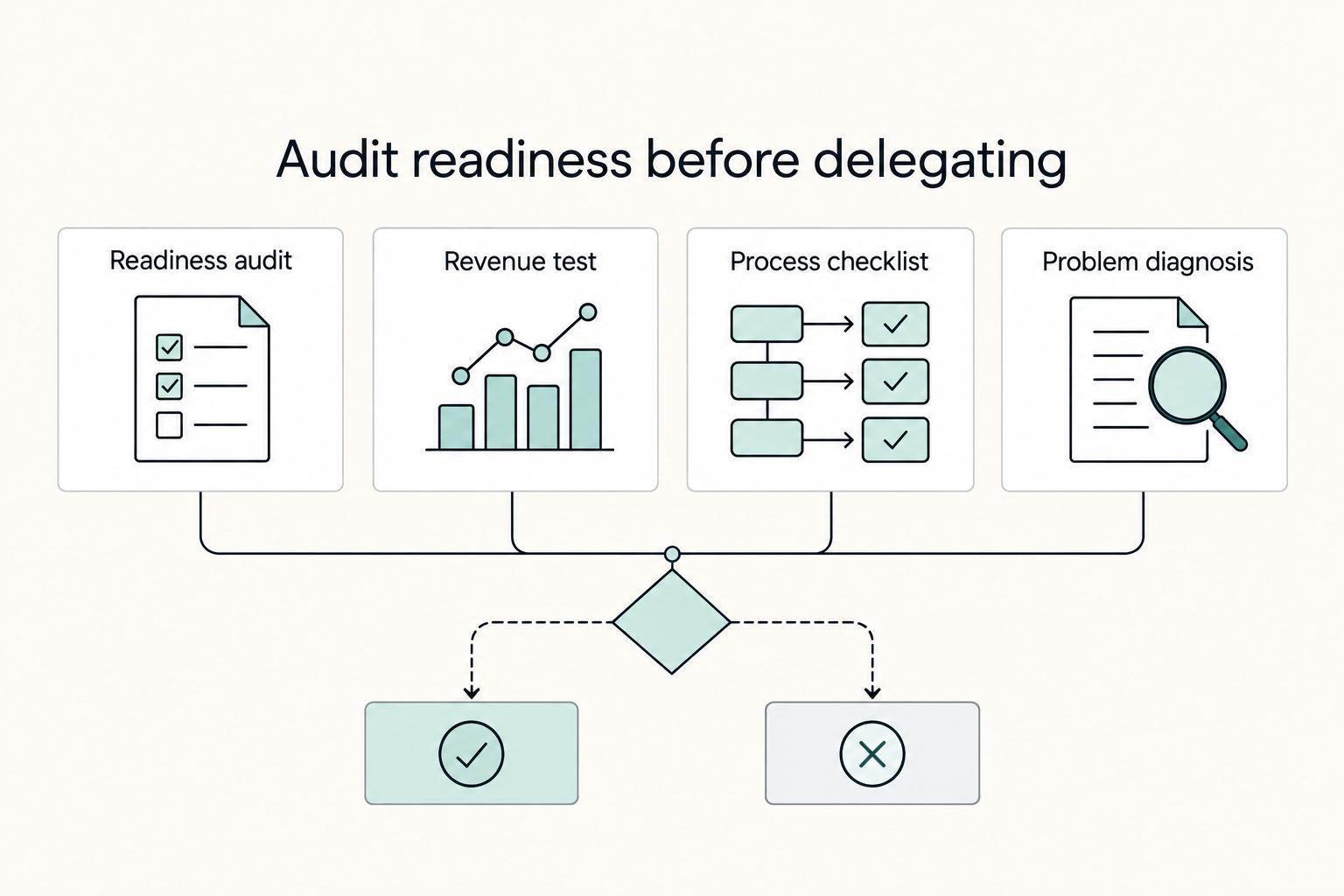
The decision to bring on your first salesperson begins not with a job description, but with a hard look in the mirror. This hire is an investment that goes far beyond salary; it's a strategic commitment of cash, time, and trust. Get this wrong, and you risk not only a significant financial loss but also damage to your brand and morale. Get it right, and you build the foundation for scalable growth.
How to Create a Sales Playbook for Your SaaS Team
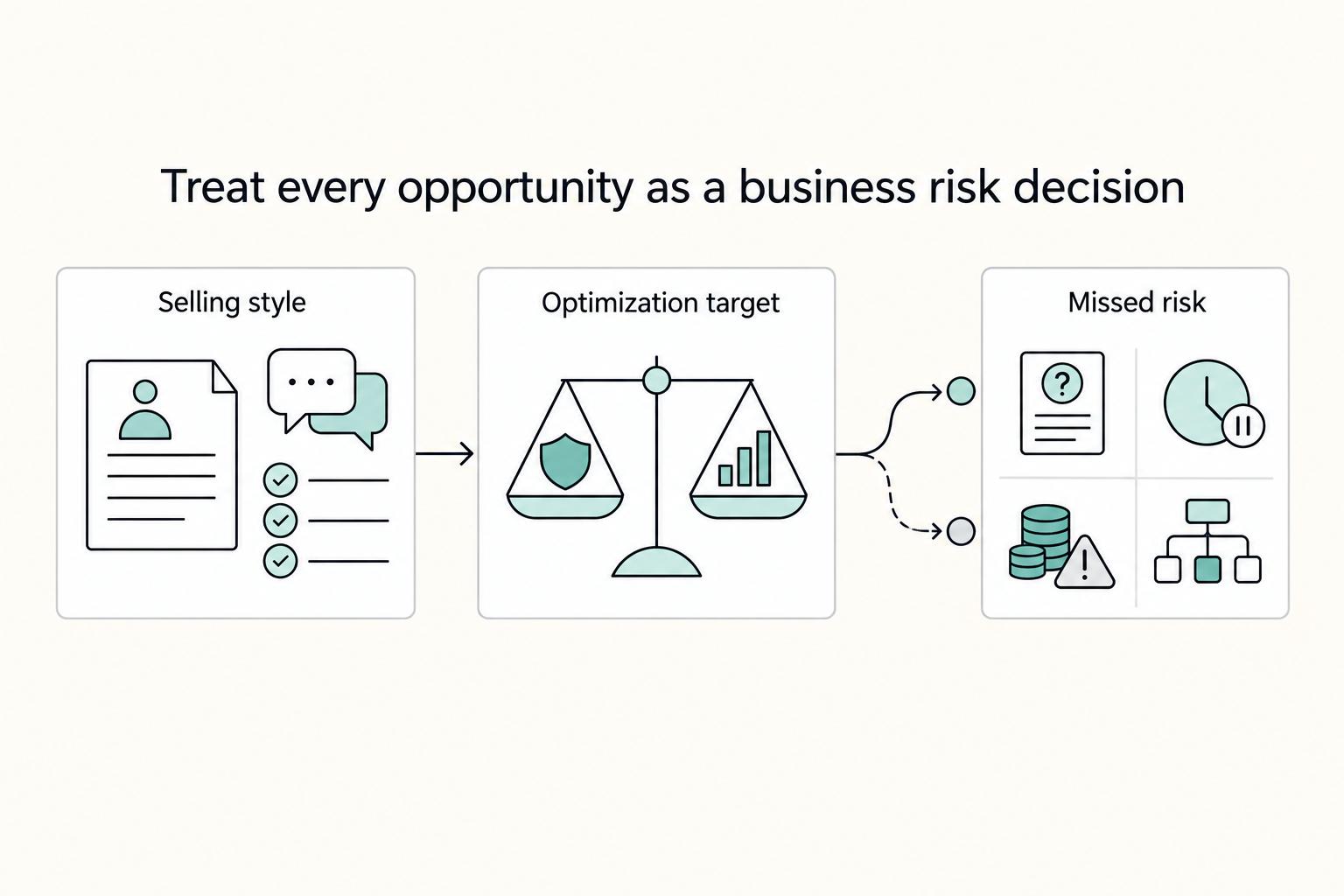
A sales playbook can help you avoid the wrong deal, not just win the right one. Treat each opportunity as a business risk decision first and a sales opportunity second. If you take on a prospect who is wrong for your offer, the impact often shows up later: unclear expectations, slower payment, rushed delivery, and product decisions shaped by the wrong customer.