
Quick Answer
Start with the first decision your client workshop must make, then pick an opener that supports that task by minute 10. Use one primary room condition from the four-bucket lens, run a short prompt tied to the agenda, and capture answers where everyone can see them. For time-tight groups, a low-disclosure alignment question is usually safer than a playful exercise that does not feed the next block.
Why Your Goal Isn't to 'Break Ice' - It's to Engineer a Specific Outcome#
The most useful icebreaker activities for workshop settings are not always the funniest. They are the ones that make the first real task easier. If you cannot explain, in one sentence, how the opening helps minute 10, cut it.
That is the useful reframing. Yes, openers can help people relax, participate early, and settle into the room. They can also backfire. SessionLab notes that when icebreakers are run poorly, they can frustrate participants and start the session on the wrong foot. So do not ask, "What will wake people up?" Ask, "What does this group need to be ready to do in minute 10?"
Use this decision flow before you pick anything#
Start with the work, not the activity. Choose the opener in this order so the first five minutes support the rest of the agenda:
| Step | Focus | Key cue |
|---|---|---|
| Name the business objective | Write the workshop goal as a concrete task | Keep it to one sentence, one decision, one output |
| Choose the room state you need first | Pick one primary state: psychological safety, strategic alignment, creative thinking, or energy and focus | Do not try to solve all four in the first five minutes |
| Select an opener type from a category, not from memory | Use labels such as "5-minute icebreakers" or "NO PROPS NEEDED" to rule activities out quickly | Useful when time, materials, or setup are limited |
| Link the opener directly to the first agenda task | Choose an opener that produces language, signals, or participation you can use right away | The handoff should feel obvious, not forced |
- Name the business objective
Write the workshop goal as a concrete task, not a mood. "Align on Q3 priorities" is usable. "Have a good session" is not. Keep it to one sentence, one decision, one output.
- Choose the room state you need first
As a working facilitation lens (not a validated model), use four buckets: psychological safety, strategic alignment, creative thinking, or energy and focus. Pick one primary state, not all four. If you try to solve everything in the first five minutes, you usually get a muddled opening.
- Select an opener type from a category, not from memory
This is a simple quality check. SessionLab groups 67 engaging icebreakers by category, including a "5-minute icebreakers" section, and Cornell's team-building library, updated April 2024, includes a "NO PROPS NEEDED" category. Those labels help you rule activities out quickly when time, materials, or setup are limited.
- Link the opener directly to the first agenda task
The opener should produce language, signals, or participation you can use right away. If your first task is risk mapping, an opening that surfaces concerns is a better fit than personal trivia. The handoff into the first work block should feel obvious, not forced.
Match the opener to the room you actually have#
Use these four buckets as a facilitator's lens, not a formal model. They help reduce mismatch between the opener and the work ahead.
| Desired outcome | Signals in the room | Best-fit opener style | Likely failure mode if misaligned |
|---|---|---|---|
| Psychological safety | People are quiet, new to each other, or the topic requires candor | Low-risk check-in tied to the work | Asking for personal disclosure too early can make people retreat |
| Strategic alignment | You hear different assumptions about goals, scope, or success | Short round on priorities, success criteria, or risks | A fun but unrelated opener creates energy without shared direction |
| Creative thinking | Answers are narrow, literal, or stuck in status reporting | Prompt that reframes, compares, or invites divergent ideas | An opener that feels evaluative can keep people in analysis mode |
| Energy and focus | Post-lunch slump, visible multitasking, low participation | Brief, fast participation round or light movement | High-energy activity before a serious discussion can feel tone-deaf |
Treat the table as a planning heuristic, not a guaranteed formula. Use facilitator judgment for your context, participants, and first task.
Frame the why before you start#
Buy-in comes from relevance, not charm. Give a short business reason, a time box, and a bridge to the next task.
| Element | What it covers | Example from the script |
|---|---|---|
| Why this | Business reason for the opener | The point is to surface the assumptions already in the room so we are not solving different problems |
| Why now | Why it comes before the next agenda task | Before we jump into prioritizing options |
| How long | Time box for the opening | a quick 5-minute round |
| What happens next | Immediate handoff after the opener | Once we hear those, we'll move straight into the decision criteria |
A simple structure is: why this, why now, how long, what happens next. For example: "Before we jump into prioritizing options, I want to do a quick 5-minute round. The point is to surface the assumptions already in the room so we are not solving different problems. Once we hear those, we'll move straight into the decision criteria."
That script does two jobs. It respects participants' time, and it makes clear that the opener is part of the work, not a detour.
De-Risk Your Opening by Profiling Your Audience#
Profile the room before you pick the opener: check familiarity, shared context, and participation constraints so your first activity supports the real work instead of competing with it.
| Factor | What to check | Adjustment |
|---|---|---|
| Seniority and formality | Who sponsored the session, how tight the agenda is, and whether the first work block is a decision, review, or exploration | If the room feels formal or time-pressed, keep the opener short and directly tied to the next task |
| Cultural context | Whether you can explain the task with one example and fit instructions on one slide | Use plain language, clear instructions, and prompts tied to shared professional ground |
| Participation style and setup | Audience size, desired interactivity, and available technology | Structure contributions in stages: silent reflection, then pairs or breakout groups, then short report-back |
Seniority and formality#
Use observable signals, not assumptions. Check who sponsored the session, how tight the agenda is, and what the first work block requires (decision, review, or exploration).
If the room feels formal or time-pressed, keep the opener short and directly tied to the next task. Some busy teams will see icebreakers as wasted time, so choose a prompt that immediately surfaces priorities, risks, or assumptions you will use in minute 10.
Cultural context#
In mixed-context groups, reduce interpretation risk. Use plain language, clear instructions, and prompts tied to shared professional ground (goals, constraints, current challenges).
A simple test: can you explain the task with one example and fit instructions on one slide? If an opener depends on inside jokes, subtle humor, or heavy context, it is more likely to distract from your message than support it.
Participation style and setup#
Plan participation from the setup you actually have. Confirm audience size, desired interactivity, and available technology before choosing format.
If you expect uneven speaking, structure contributions in stages: silent reflection, then pairs or breakout groups, then short report-back. This supports active participation and reduces the risk of passive listening or a few dominant voices.
Operationally, pre-check tools before the session (video conferencing with screen sharing plus a digital collaboration tool if remote). A practical benchmark from common playbooks is 15m prep for a 30m icebreaker run, with formats that can scale from 3 to 100 participants.
| Audience profile pattern | Recommended opener type | Risk level | Likely failure mode if misapplied |
|---|---|---|---|
| Formal, time-tight, decision-oriented room | One brief, work-linked question round | Low | Gets treated as wasted time if it feels unrelated |
| New group with low familiarity | Simple question opener tied to agenda | Medium | Personal/playful prompts create hesitation |
| Mixed-context group (different jargon or norms) | Plain-language prompt on shared goals/challenges | Medium | Instructions take over and distract from the objective |
| Large, remote, or uneven-participation group | Silent input -> pairs/breakouts -> plenary report-back | Low to medium | Open-floor format turns into passive listening |
Before you start, run this fit check:
- Who already knows each other, and who is new?
- What is the first real task after the opener?
- What interactivity level do you want, and can your setup support it?
- If using breakout groups, are they configured in advance?
- Can you explain purpose, instructions, and handoff in under one minute?
Related: The Best Digital Nomad Cities for Remote Teams and Meetups.
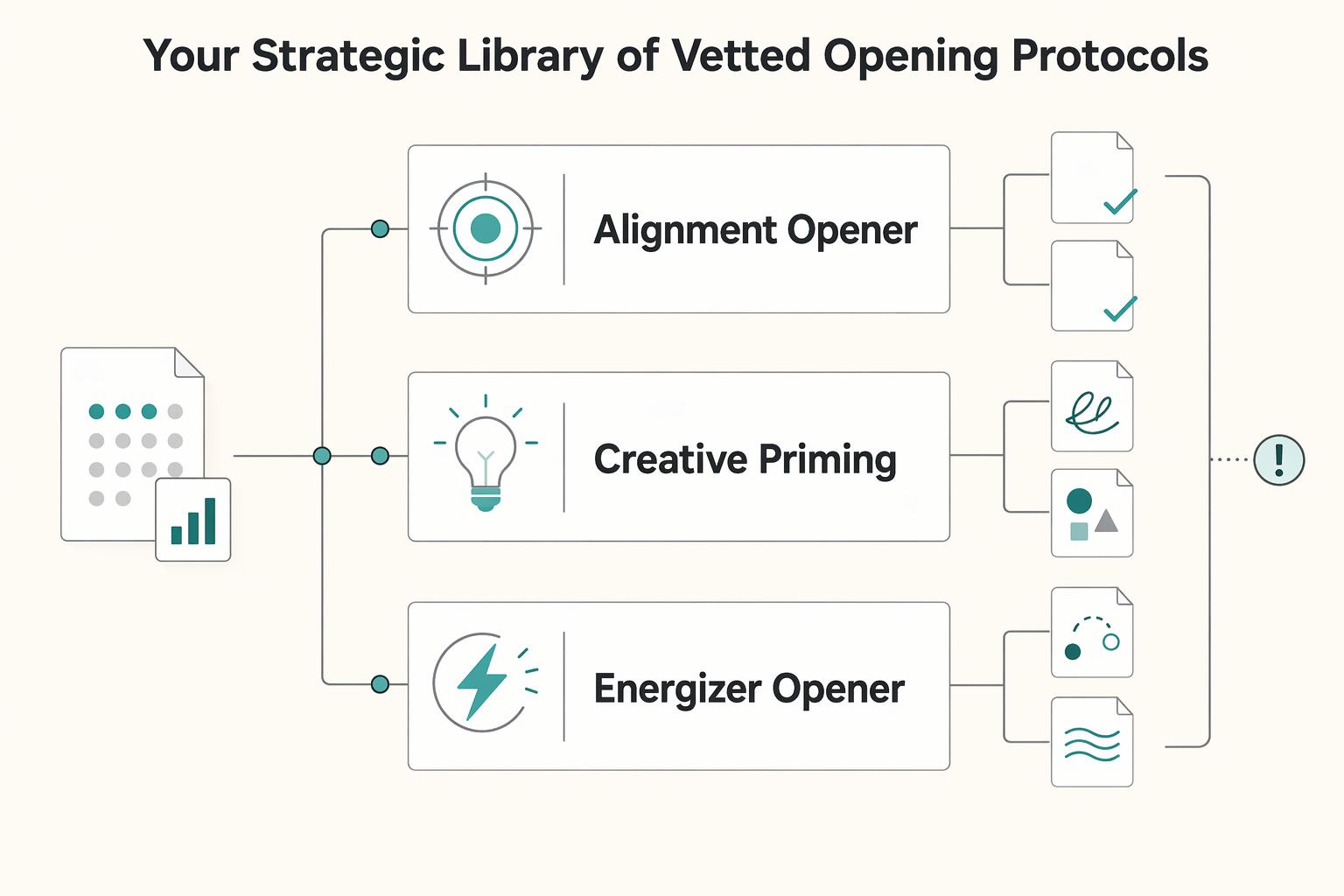
Your Strategic Library of Vetted Opening Protocols#
Use a small library, not a long menu: one alignment opener, one creative-priming opener, and one energizer. Choose by the room's immediate need, not by novelty. A public list of 38 ideas can inspire options, but it is not your decision rule.
| Protocol type | Best objective | Risk profile | Best group type | Remote / in-person fit | Effort level |
|---|---|---|---|---|---|
| Alignment opener | Clarify goals, expectations, and responsibilities before core work starts | Low | New client groups, mixed-context teams, decision-focused sessions | Works in in-person, virtual, and hybrid formats | Low |
| Creative priming opener | Move the room from analysis to exploration on the workshop topic | Medium | Teams with enough shared context to explore one problem | Works in person and virtual; hybrid needs clear shared capture | Medium |
| Energizer opener | Reset attention when formality, distraction, or low energy is blocking participation | Low to medium | Tired or passive groups | Works across formats if instructions are simple | Low |
Alignment#
When to use: Use this first when the room needs shared direction before discussion or decisions.
How to run: Ask one short, work-linked prompt about goals, expectations, or responsibilities. Capture responses where everyone can see them, and reference that input in the next agenda block.
What outcome to expect: You reduce early barriers and get people talking about the work. You also make expectations clearer, which helps prevent misunderstandings later.
What can go wrong: Vague prompts produce generic answers. If responses are not captured visibly, the opener feels disconnected from the workshop.
Adaptation note: For senior stakeholders, keep one business-focused question and a tight handoff. For introvert-heavy or virtual rooms, start with written input, then invite a few spoken responses.
Creative priming#
When to use: Use this when ideation follows immediately and participants share enough context to work on the same challenge.
How to run: Give one problem-focused prompt that invites reframing or new options. Collect responses on a shared board or document, and keep instructions short and plain.
What outcome to expect: You create early participation that feeds the next exercise. The output can become input for risks, opportunities, or selection criteria.
What can go wrong: If the prompt feels abstract or unrelated to the brief, participation drops. In hybrid settings, weak shared capture can fragment the group.
Adaptation note: For cross-cultural groups, use plain language and avoid idioms. For virtual delivery, confirm board access and instructions before the session starts.
Energizers#
When to use: Use this when attention is the blocker and the room arrives distracted or overly formal.
How to run: Switch participation mode quickly with a simple, work-safe activity (for example: short pair exchange or fast chat round). Then connect the output directly to the next task.
What outcome to expect: You lower friction and restart conversation so collaboration is easier in the work block that follows.
What can go wrong: If it feels performative or disconnected from purpose, resistance increases instead of engagement.
Adaptation note: With senior stakeholders, keep participation optional and purpose explicit. In virtual rooms, avoid activities that depend on perfect breakout timing or extra setup.
Build your library as a short run-of-show reference: purpose, prompt, capture method, handoff line, plus one fallback per category (resource pages are not always usable when you need them).
- Keep 3 defaults: one alignment opener, one creative-priming opener, one energizer.
- Note a virtual version, in-person version, and no-tech fallback for each.
- Reject any opener you cannot explain clearly in under one minute.
- Reject any opener whose output does not feed the next work block.
- Selection rule: choose alignment for clarity, creative priming for exploration, energizer for attention reset. If needs compete, start with alignment.
You might also find this useful: How to facilitate a 'Brainstorming Session' with a client.
Conclusion: From Facilitator to Strategic Leader#
The shift is simpler than it sounds. Stop treating the opening as filler and use it to create the room state the work actually needs: present, participatory, and pointed at the session goal.
- Diagnose the room state
Start by naming what the group needs most in the first few minutes: connection, ease, or active participation. That matters more than searching for the right activity in the abstract. You are choosing for intent, not novelty.
- Profile the participants
Read the room before you run it. Consider who is in it, how much trust already exists, and whether the format is in-person, remote, or hybrid. If a prompt feels awkward or forced, it is more likely to drain momentum than build it.
- Choose protocol fit
Pick an opener by filtering for tone, format, and time, then ask one practical question: will this move the group from passive to participatory? Your checkpoint is visible participation. If responses are relevant and easy to capture, you are on track. If participation drops or the prompt creates confusion, switch to something simpler.
- Frame the purpose before launch
Tell people why this opening is here and how it connects to the next discussion. That is the difference between running an activity and leading the room with intent. Clients usually feel it in three ways: clearer tone, stronger connection, and stronger participation.
Next workshop checklist
- Name the room state you need.
- Note the audience and format risks.
- Select one opener that fits the context.
- Prepare the exact framing sentence.
- Decide how you will capture responses.
- Identify your switch signal if the opener stalls.
To apply the same thinking to a full client session, read A guide to running a 'Brand Workshop' with a client.
Frequently Asked Questions
How do you choose an opening for senior executives?
There is no single opener proven best for senior executives. A low-risk starting point is a low-disclosure alignment question tied to the decision in front of them. For example, ask about the outcome they need or the risk they want surfaced. Then capture responses where everyone can see them. If you cannot use those answers in the next discussion, the opener was too vague.
What is a quick opener for a professional meeting?
Use a prompt people can answer in a few words or one word. That keeps pressure low and gets active participation early, which is one of the clearest signs the opening is working. If speaking order feels slow, have people respond in writing first, then read out a few answers yourself.
How do you run an opening for a culturally diverse group?
Choose a question that is easy, connective, and non-threatening, then keep it inside shared professional context. Ask about goals, concerns, or what would make the session useful, and keep disclosure low. Your checkpoint is simple: are people contributing without needing extra explanation?
What is the main goal of a workshop opening?
You are not filling time or trying to manufacture chemistry. You are creating the right atmosphere for the rest of the session by helping people become present and ready to collaborate. There is older evidence, including a 1997 study cited by Atlassian. It suggests structured self-sharing can feel more connective than meaningless small talk. That is not a reason to force disclosure in a client workshop.
What makes a good virtual opener?
A good remote opener gives everyone an easy way to respond. Use one short prompt in writing or verbally, and make sure the answer fits in a few words. If the setup starts slowing the room down, switch to a simple verbal round and capture responses yourself rather than troubleshooting live.
When should you switch protocols?
If participation drops, resistance shows up, or alignment is still unclear after the first responses, switch down to a lower-risk alignment question. Poorly run icebreakers can frustrate people and put the session on the wrong foot, so do not double down on a format that is not landing. If energy is the only issue, change participation mode quickly, then reconnect the room to the next work block.
Try a related tool
Researched and edited by the Gruv editorial team. Gruv builds cross-border billing, payouts, and finance-operations software for global businesses.
Sources
Includes 4 external sources outside the trusted-domain allowlist.
- home.snu.edu/~jsmith/library/body/v18.pdftrusted
- scl.cornell.edu/sites/scl/files/downloads/basic_page/Group%2...trusted
- asana.com/resources/icebreaker-questions-team-buildingexternal
- atlassian.com/team-playbook/plays/icebreaker-activitiesexternal
- gruv.ai/blog/the-best-icebreaker-activities-for-a-cl...external
- sessionlab.com/blog/icebreaker-gamesexternal
Educational content only. Not legal, tax, or financial advice.
Related Posts

Thailand's Long-Term Resident (LTR) Visa for Professionals
For a long stay in Thailand, the biggest avoidable risk is doing the right steps in the wrong order. Pick the LTR track first, build the evidence pack that matches it second, and verify live official checkpoints right before every submission or payment. That extra day of discipline usually saves far more time than it costs.
Run a Brand Workshop With a Client That Clarifies Scope Early
If you want to [run a brand workshop](https://trekk.com/insights/how-to-run-a-brand-workshop) well, treat brand as a decision model, not a debate about fonts. The real job is to help a client define how they explain value, where they draw boundaries, and how work gets approved before visuals lock anything in.

The Freelance Payment Penalty: A Modeled Audit of Platform Fees, FX Spreads, and Payout Delays
The money rarely disappears through a single, easy-to-spot fee. The real loss is stacked. A marketplace takes its commission, a processor adds a charge for international cards, a bank or payment company converts the currency at a spread, a platform holds the funds before release, and a wire sheds a little to intermediaries on the way in. Each layer looks defensible on its own, but the worker feels the combined result as a smaller deposit and a later payday.