
Quick Answer
Choose based on your primary workflow constraint, not headline price: reliability if interruptions hurt deadlines, precision if cup control matters most, or efficiency if you need speed with fewer decisions. For best coffee makers for home office use, the article’s framework compares these lanes with representative options like Technivorm Moccamaster, Breville Barista models, and Nespresso VertuoPlus, then validates the pick with a one-week friction audit and a five-year ownership view.
Your Coffee Maker Isn't an Expense, It's a Capital Expenditure#
You should evaluate your coffee setup like an operating asset, not a cheap kitchen add-on. Whatever its accounting treatment in your jurisdiction, the buying decision should still focus on operations. Choose for dependable output, ease of use, maintenance load, and fit with your actual workday.
| Cost bucket | What to include |
|---|---|
| Purchase price | Upfront machine cost |
| Ongoing inputs and upkeep | Pods or beans, filters, descaler, and water filters |
| Maintenance time | Cleaning, refilling, and descaling time |
| Reliability risk | Missed brews, warning lights, and downtime |
| Your own time cost | Minutes lost to brewing, cleanup, and workarounds |
Total cost of ownership only becomes useful when you break it into buckets you can actually audit. Start with purchase price, then add ongoing inputs and upkeep, for example pods or beans, filters, descaler, and water filters. Add maintenance time, reliability risk, and your own time cost. That last line item is easy to ignore, even though your setup is a small system, not a single box on the counter.
Two ways to look at the same machine#
- Consumer-price view
You compare shelf price, reviews, and maybe design. A machine in the $180 to $230 range like the Ninja DualBrew Pro will look cheaper upfront than something in the $1000 to $1300 range like the Philips 5500 LatteGo. It is fast to judge, but often blind to cleanup burden, consumables, and downtime.
- Owner-operator TCO view
You compare purchase price, consumables, maintenance load, reliability, and the minutes your routine loses or saves each day. It takes more work upfront, but it is much closer to how a coffee maker affects your home office in practice.
Run a one-week admin tax check#
Track what actually happens for five workdays instead of relying on assumptions:
- brew start to first sip
- cleanup minutes and refill frequency
- any missed brews, warning lights, or maintenance tasks you delayed
- whether the machine was easy to use when you were rushed
A good red flag is friction you keep working around. A common failure mode is the temperamental pod machine that seems to break right when you need a fast cup before a call. If you are comparing machines for a home office, do not rank them yet. First classify your workflow priority, then evaluate each option against that priority and its total operating cost.
Why Your Current Coffee Maker is Quietly Costing You Billable Hours#
Your coffee setup can quietly reduce output when it adds repeatable delays, avoidable interruptions, and extra decisions before real work starts. Instead of guessing, run a one-week workflow friction audit and map what you find to your own revenue model.
| Friction area | What to log | Article signal |
|---|---|---|
| Brew latency | Time from brew start to first sip for five workdays | Losing around seven minutes to a slow, sputtering cycle |
| Cleanup drag | Hands-on steps after brewing: empty, rinse, wipe, refill, reset | Cleanup regularly takes ten minutes |
| Reliability interruptions | Failed starts, warning lights, empty-reservoir surprises, and second attempts | One machine issue can derail the start of your day |
| Call interference | When you mute, repeat yourself, delay brewing, or shift timing because the machine is running | The machine disrupts client-facing work |
| Mental overhead | Dose guesswork, grind tweaks, taste inconsistency, descaling uncertainty, and re-brew decisions | Inconsistent output drains attention before your first high-value task |
- Brew latency
Track time from brew start to first sip for five workdays. If you keep losing around seven minutes to a slow, sputtering cycle, treat that as a recurring workflow delay, not a minor inconvenience.
- Cleanup drag
Count the hands-on steps after brewing: empty, rinse, wipe, refill, reset. If cleanup regularly takes ten minutes, that is admin tax you are paying instead of using that time for client prep.
- Reliability interruptions
Log failed starts, warning lights, empty-reservoir surprises, and second attempts. You do not need a failure-rate model; you need to see whether one machine issue can derail the start of your day.
- Call interference
For one week, note when you mute, repeat yourself, delay brewing, or shift timing because the machine is running. The issue is not abstract noise; it is whether the machine disrupts client-facing work.
- Mental overhead
Track recurring choices your setup should remove: dose guesswork, grind tweaks, taste inconsistency, descaling uncertainty, and re-brew decisions. Inconsistent output drains attention before your first high-value task.
Convert that friction into business impact with verified inputs, not false precision. Confirm your billable-rate formula from your own business records. Downtime cost should be added only after the downtime assumption is verified from your own work records.
If interruptions keep showing up, treat coffee as continuity planning: identify the single point of failure, keep a backup brew option, and follow manufacturer cleaning and descaling guidance so outages are less likely to surprise you.
After the audit, pick by workflow priority: reliability if failures dominate, control if inconsistency and choice overload dominate, or speed if waiting and cleanup dominate. If you want a deeper pricing lens, read Value-Based Pricing: A Freelancer's Guide.
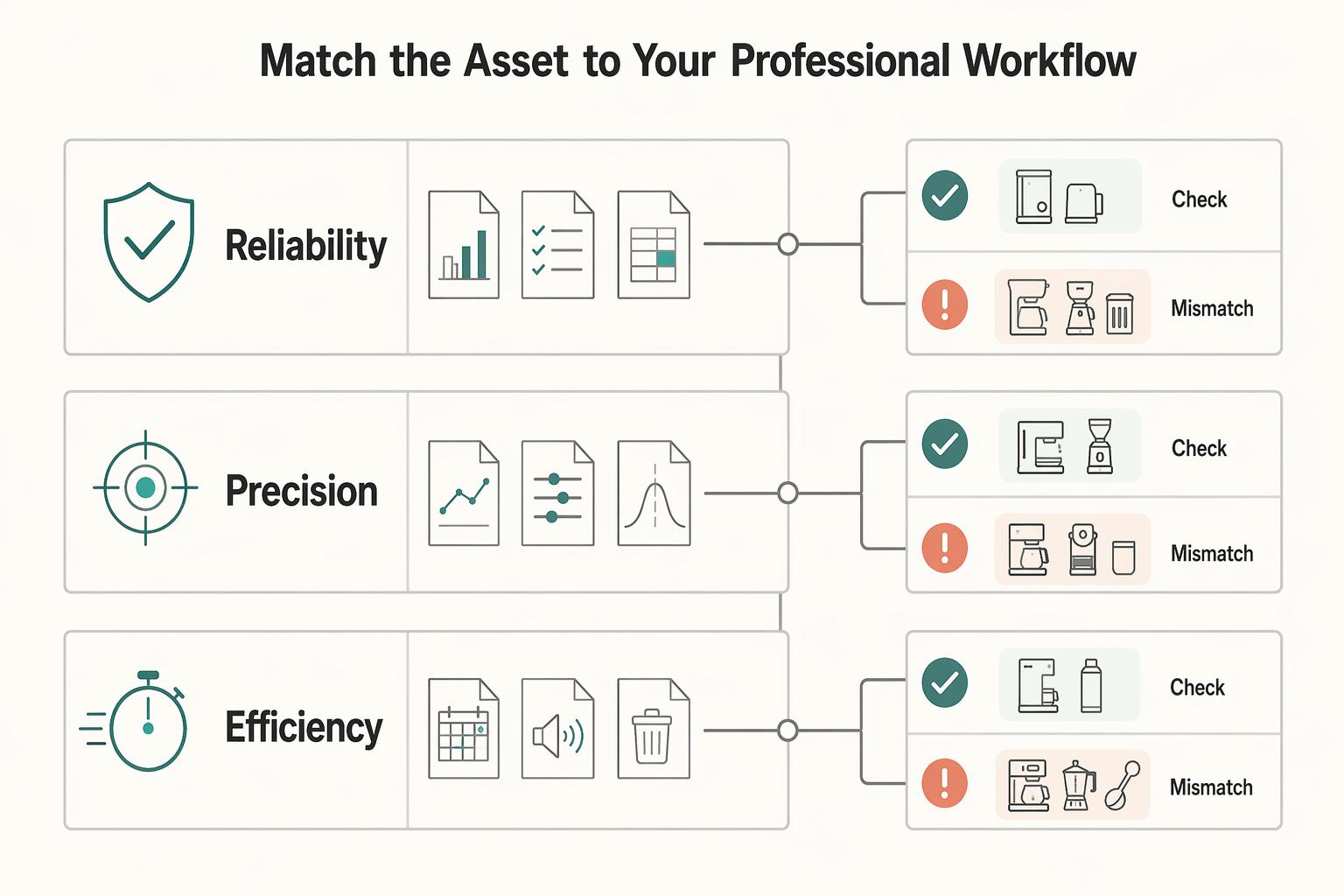
The Strategic Framework: Match the Asset to Your Professional Workflow#
Start with your main operating constraint, then choose an asset type to match it. Do not shop for a universal "best" machine. Pick the setup that reduces the problem your audit exposed most often: reliability gaps, too many variables, or too much daily friction.
Use your busiest hour as the stress test, not just your daily total. That checkpoint comes from commercial planning, so treat it as a decision aid for home offices, not a strict rule. A setup can feel fine across a full day and still become a bottleneck during the one hour when you need coffee quickly, quietly enough for calls, and without cleanup surprises.
| Asset type | Best for | Main tradeoffs | Daily effort | Risk profile |
|---|---|---|---|---|
| Reliability | Consistent output without adding operator workload | Less room to experiment; verify call-time noise and maintenance prompts before buying | Low to medium, based on fill and cleaning steps | Lower process risk, but still check single-point failures, for example grinder dependence or proprietary parts |
| Precision | Hands-on control and repeatable tuning | More skill required; more variables on rushed mornings | Medium to high, especially with grinding, dialing in, and milk steps | Higher consistency risk when you are tired, rushed, or sharing the machine |
| Efficiency | Speed, variety, and low maintenance | Less craft control; may lock you into specific consumables or formats | Low, but verify refill, disposal, and descaling routine | Lower time risk, with medium supply risk if one pod or cartridge format becomes your dependency |
Reliability asset#
Choose this if interruptions are your core problem. The standard is simple: consistent quality without creating more work for you.
Check whether the machine can produce the same drink during your busiest hour with minimal intervention. In a home office, that usually means a straightforward brew path, fewer moving parts, and cleanup that does not spill into your first call block. For noise, verify real-world behavior such as startup, grinder, and steam or purge through demos or trusted video walk-throughs.
Technivorm Moccamaster is a representative option in this lane. Also consider manual brewers like AeroPress or Chemex if simpler equipment fits your routine and the hands-on steps do not add morning friction.
Choose this if: dependable output and low mental overhead matter more than maximum flexibility.
Precision asset#
Choose this when control is the priority. Manual setups can fit experienced operators who want to tune the cup, but more control also means more ways to lose consistency when your day gets compressed.
Focus on controls you will actually use. If you make milk drinks often, workflow fit matters more than feature count: sustained steam performance becomes practical, not optional. In this tier, the failure mode is usually workflow drag before meetings, not just an imperfect cup.
Breville Barista models are representative options here. Also consider a V60 if you want intentional, hands-on brewing without espresso-machine maintenance overhead.
Choose this if: you value control enough to accept higher daily effort.
Efficiency asset#
Choose this when protecting work time is the main goal. Keep the criteria narrow: speed, drink variety, and low maintenance.
Test the full cycle, not brew time alone: fill, brew, cleanup, reset. Then run that cycle during your busiest hour. Many solo operators get the biggest gain from fewer repeatable steps and fewer decisions, not deeper brewing control.
Nespresso VertuoPlus is a representative example in this tier. If you want less appliance upkeep and can accept a manual step, AeroPress can also fit an efficiency-first workflow.
Choose this if: you want the fastest repeatable routine with the least daily friction, and you are comfortable giving up some control.
For a step-by-step walkthrough, see The Best Air Purifiers for a Home Office.
Want a quick next step? Try the home office deduction calculator.
The 5-Year ROI: A Data-Driven Breakdown of Your Investment#
Treat this as an operating decision: compare your current coffee-shop habit to a realistic five-year ownership model, then test whether it still holds under tougher assumptions.
| Metric | Formula |
|---|---|
| 5-year coffee shop cost | Average drink cost × workday purchase frequency × 5 years |
| 5-year home cost | hardware + variable drink cost + upkeep + replacement reserve |
| Payback period | hardware price ÷ daily savings versus coffee shop |
| Reclaimed time value | minutes avoided ÷ 60 × value assigned to protected work time |
- Build one comparison sheet first
Use one table for every option so you can compare like for like. Keep at least these fields: price, dimensions, capacity, consumables, upkeep, replacement reserve, and five-year total. Before you decide, refresh prices and specs from current listings and recent review updates.
| Option | Hardware price | Dimensions | Capacity | Variable cost per drink | Upkeep and parts | Replacement reserve | 5-year total |
|---|---|---|---|---|---|---|---|
| Coffee shop baseline | $0 upfront | n/a | n/a | Local drink price pending local market verification | n/a | n/a | Five-year total pending verified inputs |
| Home scenario A (drip/reliability) | Confirm current price from current listings | Confirm dimensions from the product listing | Confirm water or cup capacity from the product listing | Bean, filter, and water cost pending local market verification | Confirm descaling, filter, and cleaning supply costs from current listings | Confirm your replacement or repair reserve from your own business records | Five-year total pending verified inputs |
| Home scenario B (single-serve/efficiency) | Confirm current price from current listings | Confirm dimensions from the product listing | Confirm pod bin or tank capacity from the product listing | Pod or capsule cost pending local market verification | Confirm descaling and disposal costs from current listings | Confirm your replacement or repair reserve from your own business records | Five-year total pending verified inputs |
| Home scenario C (dual or higher-capacity setup) | Confirm current price from current listings | Confirm dimensions from the product listing | Confirm brew capacity from the product listing | Consumables pending local market verification | Confirm maintenance supply costs from current listings | Confirm your replacement or repair reserve from your own business records | Five-year total pending verified inputs |
- Run payback math with your own inputs
Do not use generic averages. Use your real pattern with these formulas: 5-year coffee shop cost = average drink cost × workday purchase frequency × 5 years 5-year home cost = hardware + variable drink cost + upkeep + replacement reserve payback period = hardware price ÷ daily savings versus coffee shop Keep at least a lower-cost and higher-cost home scenario so you can see how sensitive your result is to machine tier.
- Pressure-test weak assumptions before you choose
Run a base case, best case, and stress case by changing usage frequency, bean or pod pricing, maintenance events, and replacement timing. Savings can disappear if your home setup is not satisfying enough and you drift back to coffee-shop buying.
- Model the Productivity Dividend separately
Money savings and focus continuity are different outcomes, so calculate them separately. For two workweeks, log minutes spent on coffee trips, waiting, cleanup, and restart time after interruptions, then estimate: reclaimed time value = minutes avoided ÷ 60 × value assigned to protected work time Keep this as a range, not a guaranteed return. Related: How to Stay Productive While Working from a Cafe.
Choose the Path That Removes the Most Friction from Your Workweek#
Choose the path that removes the most friction from your actual workweek. Keep the reliability, precision, and efficiency lens, and decide from your main constraint, not feature envy.
Start by naming the one job coffee needs to do in your routine. Pick a machine category first: drip, espresso, single-serve pod, manual, or hybrid. If control is your priority, manual brewers are the clearest fit because they offer the highest control over taste. If speed and fewer decisions matter most, check pod systems first. If your preferences vary, hybrid models can be a practical middle ground.
| Path | Best for | Tradeoff | Daily effort | Failure mode | Who should avoid it |
|---|---|---|---|---|---|
| Reliability | You want a repeatable routine with minimal variation, often through drip or hybrid setups | Less cup-by-cup control | Low to medium | Coffee held on a warming plate can turn bland or burnt | You want to tune every variable |
| Precision | You want to dial in flavor, often with manual brewing methods | Slower learning curve and more hands-on steps | Medium to high | You skip brewing when rushed because the process feels too involved | You have packed mornings or low cleanup tolerance |
| Efficiency | You want fast, consistent output, often from single-serve pod systems | Recurring supply dependence and ongoing pod or maintenance burden | Low | Pods run out, or recurring supplies become a frustration | You dislike locked-in consumables |
Before you buy, run a short pre-buy check: time one normal morning, confirm your cleanup tolerance, and define your fallback if your primary method fails. Pick one primary mode, keep a simple backup, and move forward only if the machine makes your weekly routine easier.
You might also find this useful: The Best Tea Kettles for a Home Office.
Frequently Asked Questions
Is an expensive coffee maker worth it for a home office?
Maybe, but only if your 5-year sheet still works after you lower usage and add a maintenance reserve. The real test is whether the machine keeps you out of the coffee line and fits your morning without adding friction. Reviewers do not agree on one universal winner, so treat any pick as a scenario fit, not a final truth. If downtime risk and repeatability matter more than the lowest upfront price, pay for reliability only after you verify payback against current market prices and your own usage assumptions.
What is the best low-maintenance coffee maker for busy professionals?
The best low-maintenance option is the one you will actually clean and restock without resentment. Define maintenance as everything you touch in a normal week: brewing, cleanup, refills, descaling, and waste. A common failure mode is buying for taste first, then reverting to cafe runs because cleanup or refill friction shows up every morning. If you want coffee with the fewest decisions, choose the format that stays easy to live with after the first week.
What is the quietest coffee maker for a home office?
Do not assume there is a verified decibel ranking; do not trust vague words like "quiet" on a product page. Your best checkpoint is a live desk test: brew one full cycle where you actually work, with your call microphone on, and note what gets picked up before meetings or during recordings. In practice, noise issues often depend on when and how you brew, not only the machine choice. If client calls start early, pick a setup you can brew before the first meeting or one that keeps noisy prep away from your mic.
Breville Barista Express vs. Nespresso, which is better for a home office?
This is control versus speed, so decide based on your mornings, not brand prestige. A manual espresso path can give you more influence over grind, dose, and taste, but it also asks more from you when you are rushed. A capsule path can cut decisions and get you to the first sip faster. If you enjoy dialing in coffee, choose control. If you need consistent output under deadline, choose speed.
How much should I spend on a coffee maker for my business?
Start with your outside coffee spend, then convert that into a replacement budget instead of shopping by consumer price tags alone. Use a current cost range from verified retailer or vendor listings for the machine tier you are considering, then compare it with a payback assumption based on your own usage. Prices and availability can change quickly, so pair a current listing with a recent editorial update date. If the machine fits your workflow and the numbers still hold after a stress case, spend to the point where reliability improves, then stop.
How do rituals, like making coffee, actually improve productivity?
Rituals may help when they reduce startup friction and give you a clear "work begins now" cue. For some people, a short, repeatable sequence makes the first focused block easier to enter, especially if it removes small decisions. That benefit can disappear if the ritual turns into fiddling, cleanup, or a detour out of the house, so keep it simple and consistent. If you want to build that habit more deliberately, see A Digital Detox Routine for Freelancers.
Try a related tool
Researched and edited by the Gruv editorial team. Gruv builds cross-border billing, payouts, and finance-operations software for global businesses.
Sources
Includes 4 external sources outside the trusted-domain allowlist.
- 4h.uada.edu/youth/opportunities/Consumer%20Decision%20Ma...trusted
- dot.nd.gov/sites/www/files/documents/Drivers%20-%20docu...trusted
- ftc.gov/news-events/events/2000/12/mobile-wireless-w...trusted
- lib.guides.umd.edu/az.phptrusted
- bomakitchen.com/best-home-coffee-machine-2026external
- brandmag.net/best-coffee-makers-for-your-home-office-setupexternal
- cnn.com/cnn-underscored/reviews/best-drip-coffee-makersexternal
- coffeebrewshub.com/blog/best-office-coffee-machinesexternal
Educational content only. Not legal, tax, or financial advice.
Related Posts
Value-Based Pricing for Freelancers Under Real Payment Risk
Value-based pricing works when you and the client can name the business result before kickoff and agree on how progress will be judged. If that link is weak, use a tighter model first. This is not about defending one pricing philosophy over another. It is about avoiding surprises by keeping pricing, scope, delivery, and payment aligned from day one.

A Digital Detox Routine for Freelancers Who Need to Stay Reachable
Use your devices as operating tools, not open doors to constant interruption. The goal is not to quit screens. It is to control when they get to interrupt your work.

How to Stay Productive While Working from a Cafe
Treat a café session like a shipment, not a mood. Before you order, write down one deliverable and one proof-of-completion artifact. If you cannot name both, you are setting up a busy session, not a useful one.