
Quick Answer
Shortlist three operators and decide with a P3 scorecard, not a tour impression. Compare WeWork Bangalore, BHIVE, Awfis, and 91springboard on contract terms, real monthly spend, and workday reliability, then drop any option that cannot show clear notice clauses, deposit return rules, sample invoices, and credible answers on internet failover and meeting-room readiness.
For a Business-of-One in Bangalore, the right coworking space has to do three jobs at once. It is your office, your client venue, and part of your operating backbone.
That makes the decision more consequential than most brochures make it sound. Unreliable internet is not a minor hassle if it drops a client call. A rigid 12-month contract is not just a commitment if your work is project-based or your plans are still changing. Hidden fees, poor access, and constant noise do not just irritate you. They chip away at margin, credibility, and focus.
This guide is built for that reality. It does not sort spaces by hype or surface-level amenities. Instead, it looks at leading options, from global operators like WeWork to local names like BHIVE, through the things that matter when you are doing serious client work.
We will use the P3 Framework: Protection, Professionalism, and Productivity.
- Protection: How do the contract terms, billing practices, and security controls protect your cash flow, flexibility, and sensitive work?
- Professionalism: How does the space shape client perception and support strong in-person interactions?
- Productivity: Does the environment, from acoustics to internet reliability, help you do focused work consistently?
Use that lens and the decision gets simpler. You are not choosing a trendy desk. You are choosing a working headquarters that should reduce risk, support delivery, and make your business easier to run.
Protection: Deconstructing Contracts, Costs, and Compliance#
If you want Protection to mean anything, treat every coworking offer like a vendor contract, not a lifestyle purchase. Before you sign, keep cash flow predictable, avoid lock-ins you do not need, and make sure billing or connectivity issues do not turn into client problems.
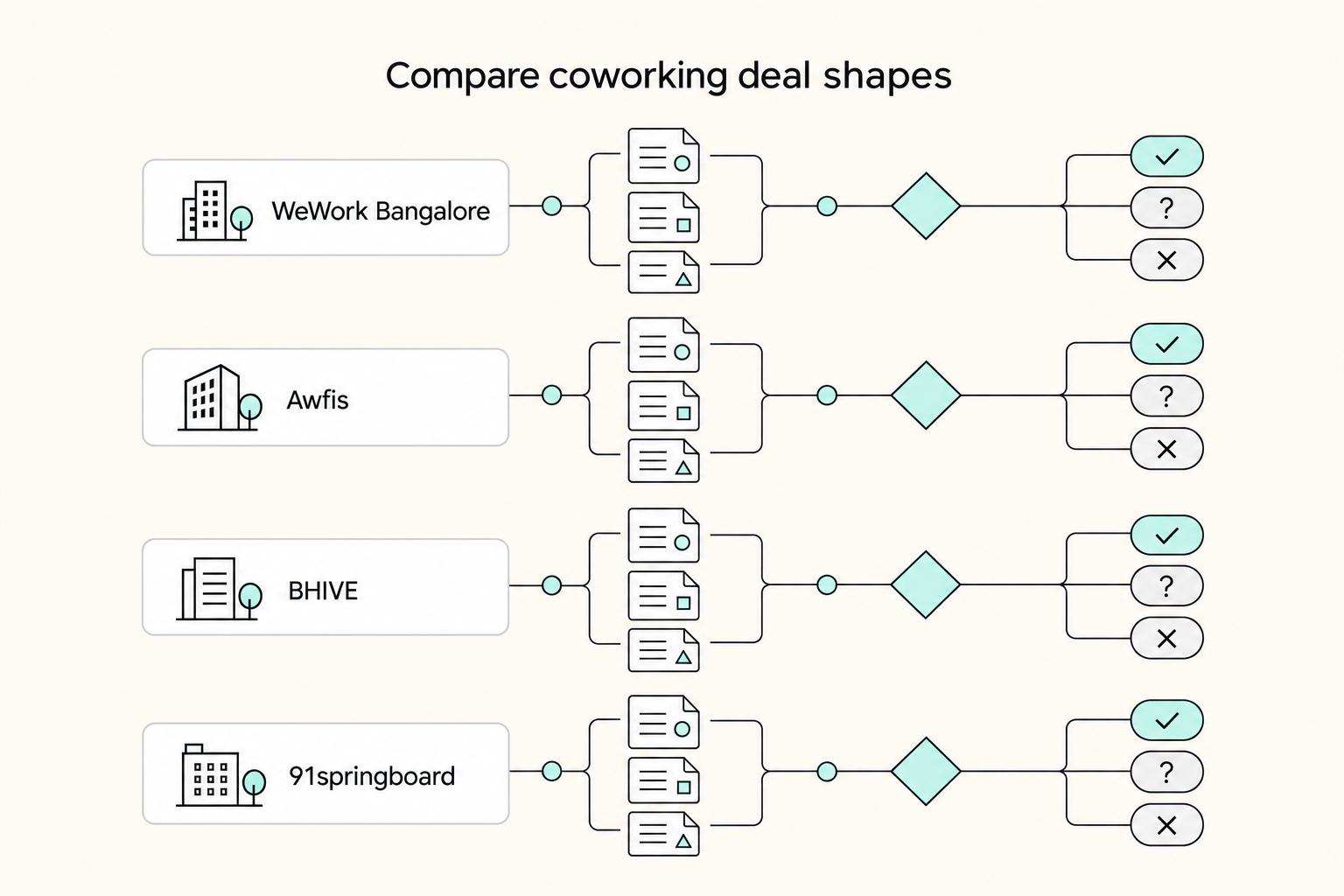
1. Compare the deal shape before you compare the space#
Start with the agreement, not the tour. For your Bangalore shortlist, ask each operator for the actual membership contract, not a sales deck or verbal summary.
The core decision rule is simple. If your work is project-based or you are still testing Bangalore, prioritize true month-to-month terms. If the only attractive price comes with a long lock-in, assume you are trading flexibility for that discount.
| Provider | Lock-in style to verify | Exit terms to verify | Deposit treatment to verify | Billing transparency to verify |
|---|---|---|---|---|
| WeWork Bangalore | Month-to-month or fixed term? | Notice period, early-exit charge, downgrade rules. | Amount, refund trigger, deduction basis, refund timeline. | Sample invoice, portal access, credit-note process. |
| Awfis | Flex pass, monthly seat, or longer commitment? | Notice window and cancellation conditions. | Deposit amount and refund mechanics. | Billing cadence and support route for corrections. |
| BHIVE | Short-term option or fixed lock-in? | Exit notice, transfer rules, location-switch rules. | Deposit holdback terms and refund timing. | Whether charges are itemized cleanly each month. |
| 91springboard | Monthly membership or longer term by product type? | Cancellation policy and seat reduction terms. | Deposit applicability and documentation required for refund. | Access to invoices, statements, and historical billing. |
One red flag outweighs polished language. If the salesperson cannot show you the exact clause for notice, deposit return, and overage billing, stop there.
Ask for the latest agreement PDF, the current rate card, and a written summary of any exceptions they are offering you.
2. Audit the invoice and the real monthly spend#
This is where many buyers get surprised by the final number. In this framework, Total Cost of Ownership can run 15 to 25% above the advertised price once GST and hidden fees show up. Do not approve anything off the headline desk rate.
| Check | What to verify |
|---|---|
| Invoice detail | Legal entity details, service period, taxable value, tax breakup, and enough line-item detail for reconciliation |
| Portal access | Whether you can download invoices, receipts, and credit notes yourself or whether every request goes through support |
| Correction workflow | Who fixes invoice errors, which email or portal route you must use, and the expected turnaround |
| Refund timeline | The written timeline for deposit refunds, billing reversals, and credit-note settlement |
| Common cost buckets | For mandatory fees, meeting-room overages, printing, parking, taxes, and one-time charges, get what is included, what triggers extra billing, and the current charge |
Ask for a sample invoice, one real monthly statement, and the current add-on sheet before you commit. Then force one pricing check across the common cost buckets in the table: mandatory fees, meeting-room overages, printing, parking, taxes, and one-time charges. For each, get three things in writing: what is included, what triggers extra billing, and what the current charge is.
If a provider cannot put that on one clear sheet, expect future reconciliation to be messy.
3. Verify the network and privacy basics like an operator#
Protection is not just about contracts and invoices. Unreliable internet can become a direct business risk. At minimum, the site should be able to explain redundant internet providers and network segmentation.
Do not accept "enterprise-grade Wi-Fi" as a real answer. Ask whether member traffic is isolated and how guest Wi-Fi is separated. Ask what happens during an outage, how access cards and visitor entry are logged, and how incidents are reported to members.
If the team cannot explain guest Wi-Fi policy, access control, or privacy handling in plain language, treat that as a risk signal and verify further before signing.
For privacy handling, stay practical. Ask how visitor IDs, member records, CCTV footage, and network logs are stored, who can access them, how long they are retained, and how deletion or correction requests are handled.
That evidence pack, alongside the contract and billing documents, tells you far more than a tour does.
Related: How to Price Webflow Development Services.
Professionalism: Projecting an Image That Elevates Your Brand#
Once you clear contract risk, run a simple professionalism check: will this space help a first-time visitor trust your business quickly? If clients, partners, or candidates may meet you there, treat the workspace as part of your client-readiness system.
1. Match workspace style to the client conversation#
Do not pick a space by "premium" feel alone. Pick the setup that fits the meeting type you run most often.
| Client profile | Suitable workspace style | Likely operators to check | Best use case | Watch-out |
|---|---|---|---|---|
| Process-heavy enterprise or procurement conversations | Formal business-centre environment with clear check-in and structured meeting flow | Regus, Awfis | Vendor onboarding, formal reviews, compliance-heavy discussions | Confirm guest handling and booking mechanics in advance. Awfis states meeting rooms are prepaid, so confirm payment before meeting day. |
| Product, startup, or execution-focused teams | Flexible coworking environment with practical breakout options | WeWork Bangalore, BHIVE | Working sessions, product demos, hiring loops | Verify room acoustics and reliability in the exact room you would book, not just tour areas. |
| Founder, freelancer, or operator-led relationship building | Community-led coworking with visible member activity | 91springboard, BHIVE | Introductions, partnership conversations, collaboration days | Check whether community activity is business-relevant, not only social. |
| Mixed client base where brand control matters | Managed office solution inside a flexible building | Regus, WeWork Bangalore, BHIVE | Repeat client meetings with a steadier branded setup | Confirm what can be customized vs what remains shared building experience. |
If your work depends on trust, choose the most consistently reliable client experience you can verify in person.
2. Choose area with a simple decision framework#
Pick location using three tests: client access, commute predictability, and brand fit.
Use Koramangala, HSR Layout, and Indiranagar as direct comparison points, not assumptions. Visit one centre in each area in the same weekday time window, then compare entry friction, pickup/drop convenience, and how easy the address is for a first-time visitor to handle.
If meetings are occasional, test before committing. A day pass is a practical trial format, and BHIVE positions day passes for freelancers, remote workers, and travelers.
3. Run an in-person client-readiness tour checklist#
Do one trial workday plus one meeting-room test before signing. Judge normal operations, not tour performance.
| Check | How to test | Detail in article |
|---|---|---|
| Reception handling | Time how long guest acknowledgment takes | See whether front desk can explain waiting flow and host notification clearly |
| Visitor flow | Walk the exact path from entry to room | Watch for avoidable bottlenecks at security or lifts |
| Meeting-room reliability | Validate the room type you will actually book and test your own deck, adapter, and call setup | Awfis states Wi-Fi, display/sound setup, one complimentary tea/coffee round, HDMI support in 6-seater and larger rooms, and internet up to 30 MBPS for meeting-room use |
| Arrival friction | Verify parking expectations if guests may drive | Awfis states parking is subject to availability on arrival |
| Experience consistency | Re-check later in the day | Look for cleanliness, noise spill, and room readiness, not only during peak tour hours |
| Community relevance | Observe member mix and ask about recent events during a trial day | Confirm collaboration opportunities align with your actual work |
Even if the listed meeting-room specs look fine, still test your own deck, adapter, and call setup in the room you would actually book.
If a space markets itself as client-ready but cannot deliver smooth handoff, dependable room setup, and relevant community signals on a normal day, keep looking.
You might also find this useful: The Best Co-Working Spaces in Mumbai for Creative Professionals.
Productivity: The Deep Work Audit of Your Operational Core#
A space is productive only if you can get through a full paid workday without friction. After it passes the client-facing test, run one trial work block and one peak-hour check before you sign.
A dropped client call or a noisy cabin is not a minor annoyance. It can damage both revenue and credibility.
1. Verify the network before you trust the brochure#
For this part of the P3 framework, treat redundant internet providers and network segmentation as non-negotiable controls. Ask the site team to confirm, in writing, how failover works, how member and guest traffic are separated, and who handles incidents during a live call.
Current live specs for individual Bangalore sites are not confirmed. Have the centre manager complete this for the exact location you are evaluating, then keep it with your contract notes.
| Operator | Redundancy setup | Network separation | Backup workflow | Support responsiveness |
|---|---|---|---|---|
| WeWork Bangalore | Confirm with the operator for this site | Confirm with the operator for this site | Confirm with the operator for this site | Confirm with the operator for this site |
| Awfis | Confirm with the operator for this site | Confirm with the operator for this site | Confirm with the operator for this site | Confirm with the operator for this site |
| BHIVE | Confirm with the operator for this site | Confirm with the operator for this site | Confirm with the operator for this site | Confirm with the operator for this site |
| 91springboard | Confirm with the operator for this site | Confirm with the operator for this site | Confirm with the operator for this site | Confirm with the operator for this site |
If the team cannot clearly explain failover and separation, assume the sales narrative is stronger than the operating setup.
2. Measure acoustic privacy under real conditions#
Acoustic performance decides whether deep work is realistic. Test privacy when the building is busy, not during a quiet walkthrough.
| Test | What to check |
|---|---|
| Call-test conditions | Take a 10-15 minute video call in the actual cabin or room you would use and confirm whether the other person hears hallway, pantry, or echo noise |
| Focus-room availability | Verify how many quiet rooms exist and whether they are available when you typically need heads-down time |
| Cabin spillover | Stand outside a private cabin while someone speaks at normal volume inside; if you can follow the conversation, privacy is weak |
| Peak-hour noise behavior | Stay through the busiest hour and observe door noise, chair movement, reception traffic, and event spill into work zones |
3. Treat access and ergonomics as operating continuity#
"24/7 access" only helps if the site still works after hours. Confirm the exact site-level setup before you commit.
| Operations check | What to confirm for this site |
|---|---|
| After-hours staffing | Who is physically present late and what they can resolve on-site |
| Climate control | Whether HVAC continues during extended hours and in private work areas |
| Power continuity | What happens during a power interruption and what backup path exists |
| Incident escalation | Who is contacted first, expected response flow, and after-hours escalation path |
Then run a trial-day ergonomics pass/fail:
- Pass: Chair has real height and back adjustment.
- Pass: Desk fits laptop plus external monitor without crowding.
- Pass: Lighting remains consistent enough to avoid glare by mid-afternoon.
- Fail: You leave with neck strain, cannot place a second screen, or keep relocating to escape noise or bad light.
For a step-by-step walkthrough, see The Best Coworking Retreats for Digital Nomads.
The P3 Verdict: Your Strategic Shortlist for Bangalore#
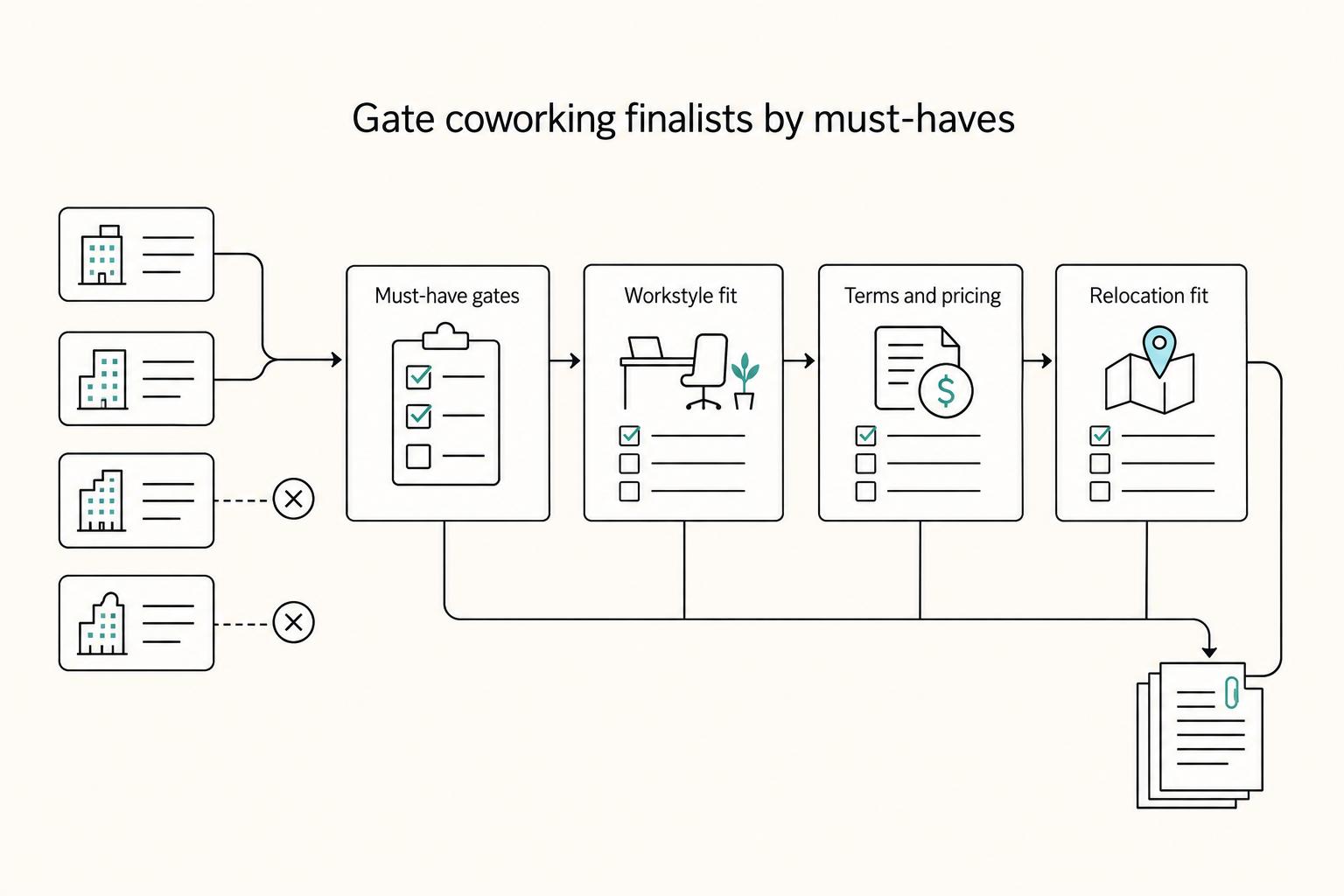
Make the final decision by choosing the space that protects the part of your business that fails most expensively. If your shortlist still feels crowded, pick one dominant P first, then keep only operators that match it.
| Profile | Primary P3 priority | Suitable operator types and examples | Key trade-off to accept |
|---|---|---|---|
| Client-facing consultant | Professionalism | Premium global or corporate-style operators such as WeWork Bangalore, Regus. | You may accept higher total spend once you add a 15-25% TCO buffer for GST and hidden fees, but do not excuse weak contract terms for a polished lobby. |
| Deep-focus builder | Productivity | Operators worth testing for quieter, functional setups such as Awfis, IndiQube, 91springboard. | You may give up some brand polish or social energy, but do not compromise on redundant internet providers, network segmentation, and real acoustic privacy. |
| Cost-sensitive solo freelancer | Protection | Flexible-feeling operators and local-market options such as BHIVE, Awfis, 91springboard. | You may accept a less polished client experience, but avoid a rigid 12-month commitment unless the terms clearly justify reduced agility. |
| Mixed-mode operator | Balanced across all three | A mixed shortlist across WeWork Bangalore, BHIVE, Awfis, IndiQube, Regus. | No single space will win every category, so eliminate hard failures first, then choose the least damaging compromise. |
Operator names are only a starting point. You are choosing contract risk, client-facing fit, and whether the environment supports consistent focused work.
Choose in one pass#
- Name your dominant P. If client perception is your biggest risk, start with Professionalism. If financial flexibility is the risk, start with Protection. If uninterrupted output drives revenue, start with Productivity.
- Build a minimum viable shortlist of three. Keep one global-style option, one local-style option, and one middle-ground option. For each, request the exact contract term, written fee sheet, and confirmation of redundant internet providers plus network segmentation.
- Eliminate on non-negotiables, not vibes. Cut any site with unclear total cost after the 15-25% TCO buffer, a rigid 12-month contract you do not want, weak client-facing fit, or vague answers on connectivity reliability.
Use this matrix during tours or trial days, and keep every choice conditional until the site confirms current offering, location status, contract terms, and deep-work essentials in writing.
If you want a deeper dive, read The Best Co-Working Spaces for Digital Nomads.
Conclusion: Your Workspace is a Strategic Advantage#
There is no universal winner here. The right Bangalore workspace is the one that matches how you work, how clients experience you, and how much operational and contract risk you can realistically carry.
- Protection
Start with the written terms, not the lounge. If a space cannot provide clear commercial terms and transparent governance details, such as SLAs, audit expectations, and performance visibility, treat that as a warning sign. This matters because coworking and managed offices are often chosen for lower-risk, OPEX-style flexibility compared with traditional leased offices.
- Professionalism
Choose the site your clients will read correctly within 30 seconds of arrival. Verify reception handling, guest check-in, meeting setup, transport access, and the surrounding business context before you assume a premium-looking website equals a credible in-person experience. In Bangalore, neighborhood context can be part of that signal.
- Productivity
Do not accept vague answers about internet reliability or after-hours usability. Test the connection where you would actually sit, ask what support exists when you work late, and check whether the space still feels workable when calls, foot traffic, and common-area noise pick up. Speed-to-operationalization only helps if you can do focused work from day one.
- Final selection workflow
Put your shortlisted spaces side by side and score them against your actual work style, client mix, and risk tolerance. If you host clients weekly, let Professionalism break ties. If you work in long heads-down blocks, let Productivity decide. If cash flow and contract clarity matter most, choose on Protection. Schedule final tours, close every open legal, compliance, and operations question in writing, and sign only after unresolved risks are verified.
For related finance-ops guidance, see The Best Invoicing Software for Indian Freelancers with GST Compliance.
Frequently Asked Questions
Which Bangalore coworking space is strongest for client meetings?
There is no single strongest option for every team. Choose for Professionalism, not aesthetics alone, and shortlist operators based on client expectations plus commute practicality. Before signing, verify reception handling, guest check-in flow, and the surrounding businesses and transport access.
How should you plan the real monthly cost?
Assume the advertised desk or cabin price is only the starting point. Ask for the full monthly sheet with the current cost range, plus every included and extra item, because monthly-rent inclusions and hidden costs are known pre-signing checks. Before signing, verify the written fee sheet, any deposit terms, and the minimum lock-in period.
Do coworking spaces in Bangalore usually work for invoicing and compliance?
Treat this as a Protection question, not an assumption. Ask for the current tax and compliance detail and a sample invoice before you commit. Before signing, verify the invoice format, billing cycle, legal entity name on the invoice, and whether invoices are available through a portal or only on request.
Is after-hours access actually usable for late calls or global clients?
Sometimes, but only if Productivity still holds after normal hours. “Access” may only cover entry, so confirm what remains operational when support is limited. Before signing, verify your exact access window, security presence, internet support escalation, and which key services remain available when you work late.
How do you compare WeWork Bangalore, Awfis, BHIVE, and 91springboard after shortlisting?
Match each operator to your dominant P first, then compare only contract terms, client-facing fit, and deep-work basics. Use operator-specific comparisons for WeWork, AWFIS, and 91Springboard, and include BHIVE only after you confirm current terms and site details directly. Before signing, verify a tour, quote inputs, the lock-in clause, and the workspace type offered for your plan.
Researched and edited by the Gruv editorial team. Gruv builds cross-border billing, payouts, and finance-operations software for global businesses.
Sources
Includes 7 external sources outside the trusted-domain allowlist.
- sec.gov/Archives/edgar/data/1898416/0001628280250150...trusted
- 315workavenue.com/5-questions-to-ask-while-choosing-a-coworkin...external
- assets.executivecentre.com/titan-doc/CBRE%20-%20Industry%20Report%20on%...external
- awfis.com/meeting-rooms/bengaluruexternal
- bhiveworkspace.com/best-coworking-spaces-in-bangalore-guideexternal
- bhiveworkspace.com/from-interviews-to-meetings-boost-your-profe...external
- clayworks.space/faqexternal
- entrepreneur3776.rssing.com/chan-68088969/all_p3.htmlexternal
Educational content only. Not legal, tax, or financial advice.
Related Posts
Best Coworking Spaces for Nomads Who Need Reliable Workdays
Start with infrastructure, not aesthetics. If a space cannot support your real work window, client calls, and first week in town, it is not a real option.

How to Price Webflow Development Services
If you want to price Webflow development without leaking margin, treat pricing as an operating model, not a number you pull from memory. Separate platform costs from service work so the client can see what they are buying.

The Freelance Payment Penalty: A Modeled Audit of Platform Fees, FX Spreads, and Payout Delays
The money rarely disappears through a single, easy-to-spot fee. The real loss is stacked. A marketplace takes its commission, a processor adds a charge for international cards, a bank or payment company converts the currency at a spread, a platform holds the funds before release, and a wire sheds a little to intermediaries on the way in. Each layer looks defensible on its own, but the worker feels the combined result as a smaller deposit and a later payday.