

Quick Answer
Compare Jira, Linear, Asana and GitHub Issues using one bug, one scope change and one approval-needed item. Jira native approvals require Premium and a company-managed workflow with admin setup. Asana approval tasks require Advanced, Enterprise or Enterprise+ and appropriate completion permissions. Linear or GitHub Issues can support a documented manual approval process. Test actual client visibility, history and code links in the plan you would buy before choosing.
Why Your Bug Tracker is Secretly Your Most Important Business Tool#
Your tracker is not just where bugs go. It is the record of what the client asked for, how important it was, who accepted it, who owns it now, and what "done" actually meant. If a request lives only in email or chat, you are setting yourself up for fuzzy scope, missed handoffs, and awkward invoice conversations later.
| Decision point | Task list behavior | Business-control behavior |
|---|---|---|
| Intake | "I'll remember that from Slack." | Every request gets its own work item or task. |
| Priority | Priority stays implied or verbal. | Priority is recorded and visible in the tracker. |
| Ownership | "We're working on it." | One owner is assigned. |
| Approval | A comment thread hints at consent. | Approval is captured as a defined step or field. |
| Completion | Done means "I shipped something." | Done includes acceptance notes and final status. |
A solid record carries the same core artifacts every time. You need the request, so the original ask is preserved. You need priority, so tradeoffs are explicit, and an owner, so one person is accountable. You also need status, so progress is visible, approval, so starts and changes are not assumed, and acceptance notes, so completion is testable.
In Jira, those details fit naturally on a work item through fields like assignee, priority, due date, status, and resolution. In Linear, triage gives you a dedicated intake inbox, and each issue has a single owner with ordered states such as Backlog, Todo, In Progress, Done, and Canceled. In Asana, custom fields can hold stage, priority, or cost, and approval tasks on Advanced, Enterprise and Enterprise+ give explicit approve, reject or request-changes outcomes. If only the assigned reviewer should approve, configure comment-only project access as described in the approval guidance.
Say a client asks for "CSV export for invoices." Create one item, attach the request, set priority to high, assign it to yourself, and add acceptance notes like "includes date, amount, and status columns." After approval, move it forward, complete the work, and close it with final notes. That gives you a clearer record for invoicing and much less reconstruction work later.
Use this checkpoint before you start. Confirm the item has an owner, a priority, and an explicit approval signal. One easy red flag is Linear history. Changes made in the first 3 minutes are treated as part of creation, so do not assume every early edit will appear as a distinct history event.
This pairs well with our guide on The Best Customer Support Software for SaaS Businesses.
Layer 1: How to Use Your Tracker to Build Unbreakable Client Trust#
If you want client trust to feel steady, make your process predictable before it gets sophisticated. You need one intake path, one visible status surface, and one decision record the client can follow without chasing you.
| Tool | Client visibility | Structured intake | Communication trail | Shareable status view |
|---|---|---|---|---|
| Jira Service Management | Strong external option with a customer-facing portal where customers can send and track requests. | Request forms support conditional sections, rich formatting, and custom layouts. | Request participants can view, comment on, and receive notifications. | Yes, through help centers and portals. |
| ClickUp | Good when you want client-facing visibility by link, not a dedicated support portal. | Forms can be shared externally, and each submission creates a task in the selected location. Form limits and settings depend on the plan and role. | Every task includes a running log of updates and comments. | Public links are available on all ClickUp plans for supported items and views. |
| Linear | Strong for controlled intake, but not a dedicated client portal. | Linear Asks on Business and Enterprise turns Slack or email requests into issues; test requester access in your actual channel. Enterprise web forms require identity-provider sign-in. | People with issue access can comment and use threaded replies. | Project updates can be viewed in Linear and sent to Slack channels. |
| Asana | Practical for external intake and stakeholder visibility. | Forms can be shared with anyone, including people without an Asana account. | Keep decisions in the task thread when the client has access. | Read-only links auto-refresh with project updates, and status reports support repeatable stakeholder updates. |
| GitHub Issues | Works when your client already collaborates in GitHub. | Issue forms convert responses into issue content, and the feature is in public preview. | Anyone with repository read access can view comment edit history. | Public GitHub Projects can be visible on the internet. |
Use this operating cadence at kickoff so expectations stay clear:
- What clients see: a shared portal, project view, or status link where progress is visible.
- What clients submit: one form or intake path for every new request.
- Where approvals happen: on the item itself, in comments or approval fields.
- Where updates live: in the same tracker view each week, not scattered across chat.
Then set one clarity rule: if it is not in the tracker, it does not exist yet. If a decision happens in Slack or email, copy the final decision into the item before work starts. This keeps handoffs cleaner and avoids avoidable "I thought we agreed" moments.
A simple kickoff script you can reuse: "New requests go through this form. Status lives here. Approvals happen on the item. Weekly updates are in this shared view. If something is only in chat, I'll copy it into the tracker before acting on it."
You might also find this useful: How to Use Linear for Agile Project Management as a Freelance Developer.
Layer 2: The Ironclad Framework for Mitigating Risk and Preventing Scope Creep#
To reduce scope creep and invoice friction, treat every issue as a controlled business record, not a loose task. Before you mark work done, the item should clearly show scope, approval state, owner, delivery evidence, and acceptance.
| Change case | Record | Next step |
|---|---|---|
| Same scope clarification | Record it | Continue |
| New scope or expanded acceptance criteria | Mark approval pending | Pause that work |
| Approved change | Update scope, owner, and due expectation | Continue |
Risk control fit by tool#
| Tool | Workflow guardrails | Permission controls | History visibility | Approval traceability |
|---|---|---|---|---|
| Jira | Defined transitions and configured workflow rules can control stage changes; test the rule in your chosen space type and plan. | Permission customization is limited on Free; verify the actual actors who can transition work. | Comments, history, and work logs can be viewed together on the issue. | Native approval steps require Jira Premium, a company-managed workflow and admin setup; code links are separate delivery evidence. |
| Asana | Good for disciplined flow through rules, sections, and custom-field triggers. | Project roles include admin, editor, commenter, and viewer. | Keep decisions on the task so the task remains the record of what changed. | Approval tasks on Advanced, Enterprise and Enterprise+ record Approved, Changes requested or Rejected. Use comment-only project permissions if approval must be restricted to the assignee. |
| Linear | Good for clear ownership and team-specific workflow design. | Workspace role types control access and permissions. | Issue description history can show and restore earlier versions; preserve explicit approval decisions separately. | No equivalent native approval states; use a manual approval field/comment rule. |
| GitHub Issues | Strong when code and issue tracking already live together; lighter for approval-heavy client flows. | Roles are sets of permissions; each issue/PR can have up to 10 assignees. | Timeline events show issue and pull request activity. | Link PRs or branches for delivery evidence. Closing keywords apply only when the PR targets the default branch; they do not represent client signoff. |
Strong trust helps, but this layer is about dispute readiness.
- Create a complete issue record every time. Each item should answer six questions: request source, scope decision, approval state, owner, delivery evidence, and acceptance note. Jira gives you Reporter and Assignee directly on the item; Asana form submissions become assignable tasks; Linear enforces a single owner.
- Use one scope-change workflow on every request. When a new ask appears, classify it, set approval status, pause execution while approval is pending, and resume only after confirmation is documented on the item.
- Same scope clarification: record it and continue.
- New scope or expanded acceptance criteria: mark approval pending and pause that work.
- Approved change: update scope, owner and due expectation, then continue.
- Link code to the approved item. Treat this as traceability hygiene and invoice support. Use a pattern like
fix(module): short description for ISSUE-KEYso the request, code, and billable work stay connected. - Close only dispute-ready items. Before moving to Done, confirm the issue reads like a complete file someone can review later without extra context.
- Request source captured
- Final scope and acceptance criteria stated plainly
- Approval state visible
- One owner named
- Delivery evidence linked: commit, branch, PR, screenshot or deploy note
- Acceptance comment, approval result or equivalent signoff
If even one of these is missing, the item is still in progress.
Related: The Best Project Management Tools for Freelance Developers.
Layer 3: One daily view, a few automations, one hub#
For a solo operator, CEO-level control comes from three things: one clear daily view, a few reliable automations, and one place where decisions live.
Build a daily operating view#
Your dashboard should answer these five questions in under a minute:
- What is waiting on you?
- What is waiting on the client?
- What is due soon?
- What is ready for review?
- What is finished but still needs a client-facing update?
Run a quick morning check on every open item: one owner, one current state, one next action. If updates are split across multiple places, handoffs get missed and work can drift into the same silo pattern that causes backlog growth and deadline misses.
Choose the lightest tool that stays clean#
Pick the lightest system you will maintain consistently. Power only helps if your workflow stays clear week after week.
| Tool | Setup burden (your 30-minute trial) | Automation depth (your 3-rule trial) | Cross-client visibility (your daily view test) |
|---|---|---|---|
| Jira | Low / Medium / High | Low / Medium / High | Low / Medium / High |
| Linear | Low / Medium / High | Low / Medium / High | Low / Medium / High |
| Asana | Low / Medium / High | Low / Medium / High | Low / Medium / High |
| GitHub Issues | Low / Medium / High | Low / Medium / High | Low / Medium / High |
Automate only three moves first:
- Assign new items to an owner.
- Move status when a real handoff happens.
- Send a client-facing update when status changes matter externally.
Test these rules in a non-client project first. The common failure is noisy automation: duplicate triggers, early status moves, and alerts people stop trusting.
Keep one hub and link everything else to it#
Use your tracker as the hub, then link out to the tools that hold execution context:
| System | What lives there |
|---|---|
| Tracker | Decision record, status, owner, next action |
| Code host | Branches, commits, pull requests |
| Communication tool | Alerts and quick clarifications |
| Design/docs tool | Source material and specs |
Keep approvals and final decisions on the issue, even if discussion happened elsewhere. For bugs that are hard to describe, add a screen recording with the written report so reproduction is faster and clarification loops are shorter.
Roll this out incrementally so you do not overbuild:
- Create one dashboard with the five daily views.
- Add only the three core automations.
- Connect tracker to code host, then communication, then design/docs.
- Require clear reproduction steps and add a screen recording when useful.
- Review after two weeks and remove anything you are not using.
We covered this in detail in Choosing Time Tracking Software for Billable Hours in 2026.
Compare the top trackers on visibility, scope control, and history#
For a solo business, choose the tracker that gives you clear client visibility, explicit scope control, and a defensible history, with only as much process as you will actually maintain.
Use this comparison to answer four practical questions: Can you show what was requested and approved? Can you trace changes over time? Can you connect work to code? Can clients see the right things without seeing everything?
| Tool | Client-facing visibility | Approval and scope control | Audit and history quality | Automation and integrations | Setup overhead | Best fit, main limitation, avoid when |
|---|---|---|---|---|---|---|
| Jira | Usable, but usually needs deliberate workflow/view setup | Native approval steps require Jira Premium, a company-managed workflow and admin setup; other transition restrictions depend on configuration. | Strong when configured; can show linked branches, commits, PRs, builds, deployments, and feature flags. Jira app audit logs are not available if all Jira Cloud apps are on Free | Deep trigger/condition/action automation | Measure setup effort in your trial | Best for high-change client work that needs explicit approval gates. Main limitation: admin/setup burden. Avoid when you will not maintain the process. |
| Linear | Guests on Business or Enterprise are billed as regular members and limited to invited teams; test integrations and shared-project visibility. | Use an explicit approval record and pause rule; test whether your configured process meets the required control. | Per-issue activity feed tracks assignment/delegation history; recently deleted issues are archived for 30 days before permanent removal | Strong dev flow; GitHub/GitLab integrations can move issues to In Progress from Git activity | Measure setup effort in your trial | Consider for code-first delivery with clear ownership. Test the recorded approval and client-access workflow rather than assuming every scope change needs a different tool. |
| Asana | Strong when clients need visibility across code and non-code work | Approval tasks require Advanced, Enterprise or Enterprise+; restrict completion permissions when only a designated approver may sign off. | Audit Log API events are retained 90 days; access uses a service account on Enterprise+, legacy Enterprise or Enterprise with the Compliance Management Add-on. Task history is separate. | Rules-based automation, API integrations, and app integrations; custom-field limits: 150/project, 60/task, 500 dropdown options | Measure setup effort in your trial | Best for mixed delivery (bugs, reviews, content, approvals). Main limitation: work-management-first orientation. Avoid when repo-native traceability is your primary system. |
| GitHub Issues | Limited for non-technical client collaboration (repo access is required) | Minimal native approval/scope controls | Strong code traceability when issues link to PRs/branches; timeline events available via API | GitHub Actions can automate issue communication (for example, comments on label events) | Measure setup effort in your trial | Best when work already lives in the repo and clients do not need to operate in the tracker. Main limitation: weak client-facing structure. Avoid for approval-heavy, non-technical stakeholder workflows. |
| ClickUp | Guest permissions help shape external access | Custom statuses can support control, but validate against your approval requirements | Validate history depth before relying on it as dispute evidence | Flexible for mixed work and handoff reminders | Measure setup effort in your trial | Best when you want one workspace for client-facing and internal tasks. Main limitation: audit expectations must be tested early. Avoid for compliance-sensitive workflows until evidence needs are proven. |
Before committing, run a three-item trial in each finalist tool: one bug, one change request, and one approval-needed item. Keep the tool only if it clearly shows status-change history, next action, code linkage where relevant, and correct client visibility boundaries.
How to choose#
| Situation | Tool | Note |
|---|---|---|
| Scope disputes are likely | Jira | Native approvals require Premium and a company-managed workflow with admin setup. Free allows up to 10 users and 2 GB storage, but has permission limits and no Jira audit logs when all Jira apps are Free. |
| You want the lightest code-first flow | Linear or GitHub Issues | Pick Linear when you need more structured collaboration than GitHub Issues alone. |
| Delivery includes reviews and non-code work | Asana first; test ClickUp | Test ClickUp when guest-access flexibility is a higher priority, and validate history quality before relying on it in disputes. |
If two tools survive this filter, pick the one you are most likely to keep current every day.
If you want a deeper dive, read Value-Based Pricing: A Freelancer's Guide.
Conclusion: One tracker, one approval step, linked code#
The final choice is not really about features first. It is about how much control your client work needs, and whether your tracker can support that control every day without becoming another inbox.
- Trust comes from one record
Keep a single source of truth for requests, status, and decisions. GitHub's own guidance is blunt here: maintain one place so information does not get out of sync. The checkpoint is simple. If a client reports something in chat or email, does it end up in the tracker before you act on it? If not, you can end up with duplicate requests, missed updates, and avoidable "I thought this was included" moments.
- Risk control comes from approval before movement
Add an approval step for changes to scope, budget or timing. Jira native approval steps require Premium, a company-managed workflow and admin setup. Ordinary transition restrictions are separate controls. Test that an unauthorized user cannot advance the change and that the designated signoff remains visible; if a manual approval record meets your process, document who checks it before work resumes.
- Personal control comes from delivery evidence
Link code changes to the tracked issue. Jira development links use issue keys with a connected code host. GitHub can link a PR manually or through closing keywords; keywords work only when the PR targets the default branch, and automatic closure follows the merge there. Treat that as code-delivery evidence, then record client acceptance separately.
If your client work has multiple approvers, heavier governance tools can make sense. If you mostly need fast execution, a lighter option like Linear or GitHub Issues can be enough. Linear's default path is just Backlog > Todo > In Progress > Done > Canceled, which is often all a solo operator needs.
This week, choose one tracker, move every open request into it, add one approval checkpoint before work starts, require commit or PR to issue linking, and test the full path with one bug and one change request.
For a step-by-step walkthrough, see The Best Tools for Managing a Remote Development Team's Workflow.
Frequently Asked Questions
Do you really need an issue tracker if you work alone?
Yes, if requests can be missed, delayed, or disputed. Issue tracking software is meant to document, prioritize, assign, and monitor issues from initial report to resolution, and that matters just as much when the team is one person. If work is arriving through email, chat, and call notes, you are relying on memory where a record should exist.
How do you use Jira without turning it into admin overhead?
If you are considering Jira, use the same core check you would use for any tracker: can you monitor status, prioritize work, assign responsibility, and still close issues on time without side channels becoming the real system? If not, overhead is already taking over.
Is GitHub Issues enough for professional client work?
It can be, in the right setup. The practical test is whether your process in that tool still keeps status, priority, ownership, and resolution clear from report to close. If those basics are unclear, the risk of overlooked and unresolved issues goes up.
Can Asana work for bug tracking?
It can, if your workflow still treats bug handling as a tracked process rather than ad hoc messages. Before you commit, run one issue from report to resolution and confirm you can clearly track status, priority, owner, and completion.
What should you use when clients want a portal?
For client request intake, consider a customer portal such as Jira Service Management and test who can submit, comment and see status. Linear Asks supports Slack and email intake on Business and Enterprise; its Enterprise web forms require identity-provider sign-in and are designed for internal requests. Keep accepted reports in the same tracker and verify requester visibility using a client test account.
What is the best bug tracking software for preventing scope creep?
There is no universal winner. The safer choice is the tool and process that force a scope decision before work starts and keep requests visible as tracked items, not side conversations.
How should you test a tool before you switch?
Create three sample items: a bug, a change request, and an approval-needed item. Then verify four things: you can monitor status, set priority, assign responsibility, and reach timely resolution without side conversations becoming the real record. Before you commit, choose one workflow rule and one tool constraint. For example: "No work starts without tracked approval" and "Clients must be able to see status without asking me in chat."
Try a related tool
Researched and edited by the Gruv editorial team. Gruv builds cross-border billing, payouts, and finance-operations software for global businesses.
Sources
Includes 8 external sources outside the trusted-domain allowlist.
- atlassian.com/software/jira/features/bug-trackingexternal
- atlassian.com/software/jira/guides/issues/overviewexternal
- developers.asana.com/docs/audit-log-eventsexternal
- docs.github.com/en/issues/tracking-your-work-with-issues/usi...external
- docs.github.com/en/communities/using-templates-to-encourage-...external
- help.asana.com/s/article/custom-fieldsexternal
- help.asana.com/s/article/how-to-use-approvalsexternal
- help.clickup.com/hc/en-us/articles/6309298874775-Share-locati...external
Educational content only. Not legal, tax, or financial advice.
Related Posts
Value-Based Pricing for Freelancers Under Real Payment Risk
Value-based pricing starts with the client’s expected benefit and willingness to pay. It still needs a deliverable, scope and payment agreement you can perform. Use a discovery phase when the benefit or effort is too uncertain to support a defensible quote.
The Best Project Management Tools for Freelance Developers
Freelance delivery gets more predictable when planning and client updates follow one clear setup instead of improvised tickets and scattered chat threads. In practice, project management for developers means planning, scheduling, and organizing software work so scope, time, quality, and stakeholder expectations stay aligned.
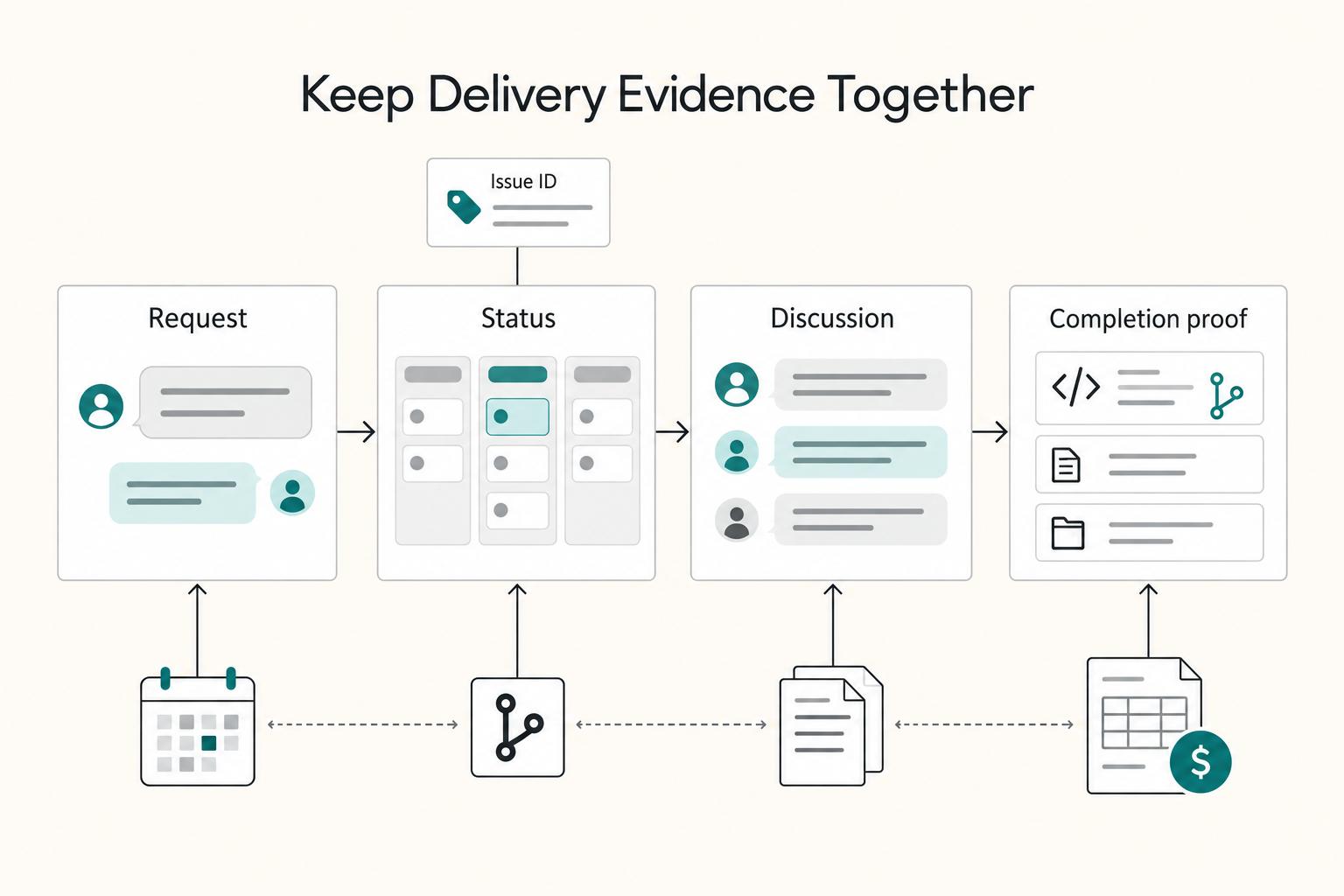
How Freelance Developers Use Linear to Control Scope and Billing
If your delivery record is split across email, chat, docs, and a separate tracker, you are likely giving up margin in ways you can verify this week. The loss usually shows up in three places on a normal project: admin overhead, rework from misalignment, and scope ambiguity.