
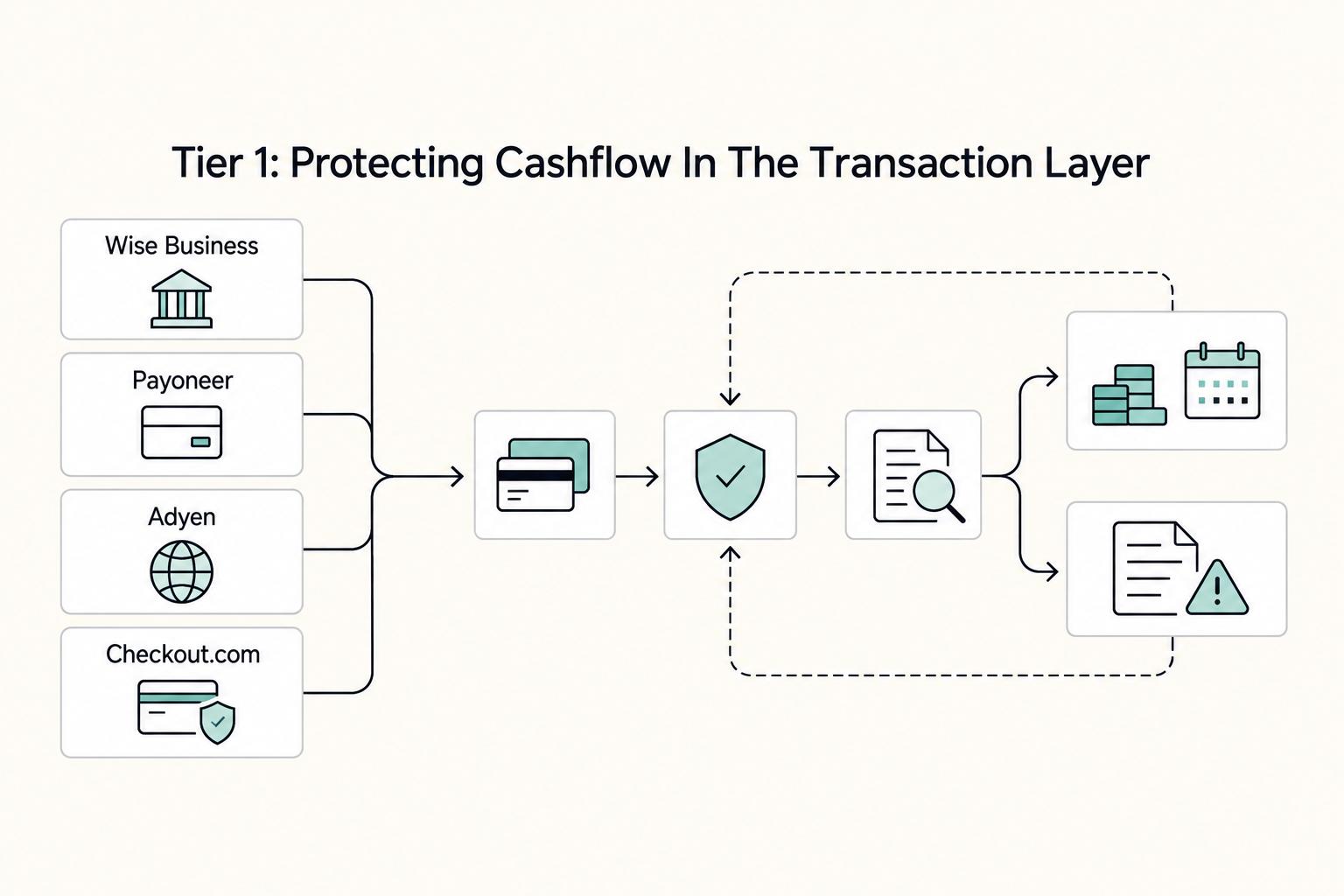
Quick Answer
For checkout processing, investigate Adyen, Checkout.com or the appropriate PayPal Checkout product. For eligible software sales through a merchant of record, compare Paddle and FastSpring. For invoice bank-transfer receipts, qualify a business receiving account separately.
An international business may need a second checkout provider, a different tax and seller model, or a way to collect invoices by bank transfer. Those are distinct buying decisions. Define the missing capability before comparing company names.
Identify the Stripe product you would replace#
Ordinary Stripe Payments helps your business accept payments; your business remains merchant of record. Stripe now also documents Managed Payments, a merchant-of-record solution for eligible digital products. Its integration and eligibility limits differ, including lack of Connect support. A comparison that labels every Stripe product a processor can send you toward the wrong replacement.
Write down the actual product, contracting entity, checkout integration, recurring billing and platform features in use. If you need to collect for independent sellers, assess a platform product explicitly rather than assuming a software MoR can serve that marketplace.
Checkout-processing alternatives#
The following product distinctions reflect official material checked on October 3, 2026. They are a shortlist by function, not tested rankings or a promise of acceptance in every merchant country.
| Product | Documented role or capability | Useful selection question |
|---|---|---|
| Adyen online payments | Payment methods and recurring tokenization for subscription or unscheduled card-on-file payments. | Does your entity qualify, and can its methods, acquiring setup and integration meet your markets? |
| Checkout.com payment services | An end-to-end PSP with online integration options, payment methods and payment-management tools. | Can it onboard your entity and quote the needed acquiring, risk and settlement configuration? |
| PayPal Checkout / Expanded Checkout | Hosted or more custom embedded checkout options; methods and presentation differ by product. | Do customers need PayPal, and which local product supports your card and wallet requirements? |
Adyen’s method directory and recurring documentation help qualify a specific payment method rather than assuming every local method can renew a subscription. Its pricing includes method-dependent costs and variable interchange arrangements. Ask for the cost of your card mix and contracted setup, not an unsupported revenue cutoff.
Checkout.com describes modular payment services and tailored pricing. Obtain a quote tied to your legal entities and processing needs. Product pages can establish the service category, but they do not establish your settlement timetable, reserve or dispute charges.
The cited PayPal comparison is the US product page. It distinguishes hosted Checkout from Expanded Checkout, including customisation and card-statement presentation. Verify the corresponding product in your merchant country; a worldwide buyer reach figure is not merchant-account eligibility.
Merchant-of-record alternatives for software#
| Product | Documented model | Boundary to qualify |
|---|---|---|
| Paddle | Resells supported products as merchant of record, with SaaS billing and transaction sales-tax responsibilities. | Check accepted software/activity, supplier country, checkout and contract terms. |
| FastSpring | Acts as merchant of record for supported digital goods, with checkout, subscription and tax services. | Check your actual product approval, subscription behaviour, buyer support and settlement contract. |
Paddle’s current acceptable-use guidance is built around software businesses; a primary offering of human services or physical goods is not a general fit. Its reseller agreement assigns transaction sales-tax responsibilities while retaining obligations for the supplier. Product operation, corporate income tax and your own legal duties still require ownership.
FastSpring describes a resale model in which the buyer purchases from FastSpring at checkout. That is a different relationship from paying your company through a processor. Confirm receipt presentation, refunds, disputes, settlement deductions and customer communication before changing the seller model.
Bank-transfer receiving is another category#
Wise Business can give eligible businesses receiving details for supported currencies and payment types. Its business eligibility depends on jurisdiction and activity. Those details can help collect an invoice or receive a processor settlement, but they do not by themselves supply card checkout, recurring billing or merchant-of-record responsibility.
If your problem is an overseas client paying a EUR invoice, compare receiving routes. If your problem is card renewal failure, compare checkout and billing. Moving money to a new account does not resolve the second problem.
Qualify international eligibility in the right order#
- Merchant: registered entity, actual operating location, ownership and activity.
- Product: approved category and the specific feature you intend to use.
- Buyer: permitted customer markets and methods for those transactions.
- Money: presentment currencies, settlement currencies and eligible destination accounts.
- Contract: reserves, refunds, disputes, support and exit conditions.
Stripe’s own global-availability page distinguishes merchant countries and preview or extended-network entries. Use the same discipline for alternatives. Do not change residence or substitute an address to make an application appear eligible. Obtain a product-specific answer for a restricted or uncertain profile.
Compare full costs on one example#
Illustration only: 100 transactions of USD 100 produce USD 10,000, with no tax, conversion, refunds or disputes. Suppose a processor quote is 3% plus USD 0.30 per transaction. Processing is USD 300 + USD 30 = USD 330. Add hypothetical USD 100 billing/tax tooling and USD 250 operating work, giving USD 680 for the defined scope.
Paddle’s public checkout price checked on the same date is 5% plus USD 0.50 per transaction. On those simplified inputs, that is USD 500 + USD 50 = USD 550 before other applicable terms. This does not prove Paddle is cheaper for your business: the assumed processor rate and operating costs are not quotes, and the provider responsibilities differ.
For a real comparison, establish whether percentage fees apply to tax-inclusive amounts, how refunds affect retained fees, and whether cross-border, FX, payout, dispute or add-on charges apply. Use signed terms and actual statements. Avoid comparing a US domestic-card headline with an international software MoR bundle.
Prove the replacement with a small pilot#
- Confirm live onboarding eligibility and written commercial terms.
- Demonstrate a first payment, customer authentication, refund and failed payment.
- For subscriptions, demonstrate renewal, card update, cancellation and pricing changes.
- Reconcile the sale, fee, tax, reserve and settlement to the provider statement.
- Confirm exports and the supported payment-credential migration process.
Do not treat two processor accounts as safe automatic fallback. After a timeout, resolve whether the first charge can still complete before starting another. An idempotency key is scoped to its provider and operation; it does not prevent a second charge at a different provider.
Move customers without duplicate collections#
Assign each subscription’s next charge to one system. Record the last successful invoice, renewal date, migrated state and any action the customer must take. Payment tokens and mandates are not necessarily portable; obtain the approved migration process and consent requirements.
Leave old refunds, disputes and receivables with an accountable owner after cutover. A new checkout can work while old financial obligations remain. Choose the alternative that closes your identified capability gap and passes the pilot with your own transaction mix.
Frequently Asked Questions
Is Wise a like-for-like replacement for card checkout?
A business receiving account can collect supported bank transfers or receive settlements. That does not by itself replace card checkout, billing or merchant-of-record services. Compare the function you actually need.
Are all Stripe products processor services?
No. Ordinary Payments keeps your business as merchant of record, while Managed Payments is a separate MoR solution for eligible digital products with different integration limits. Scope the comparison to the product in use.
Which providers should a software company compare for MoR?
Paddle and FastSpring document merchant-of-record models for supported software or digital products. Confirm your eligibility, buyer experience and contractual scope before selecting either.
Can I retry a timed-out charge at the new provider?
Resolve the original charge first. A second provider does not share the first provider’s idempotency protection, so an unresolved original can cause duplicate collection.
Try a related tool
Researched and edited by the Gruv editorial team. Gruv builds cross-border billing, payouts, and finance-operations software for global businesses.
Sources
Includes 2 external sources outside the trusted-domain allowlist.
- docs.stripe.com/paymentstrusted
- docs.stripe.com/payments/managed-paymentstrusted
- paypal.com/us/business/accept-payments/checkouttrusted
- stripe.com/globaltrusted
- wise.com/help/articles/2977974/can-my-business-use-wisetrusted
- wise.com/help/articles/2898124/how-do-i-receive-money...trusted
- adyen.com/payment-methodsexternal
- adyen.com/pricingexternal
Educational content only. Not legal, tax, or financial advice.
Related Posts

The Freelance Payment Penalty: A Modeled Audit of Platform Fees, FX Spreads, and Payout Delays
The money rarely disappears through a single, easy-to-spot fee. The real loss is stacked. A marketplace takes its commission, a processor adds a charge for international cards, a bank or payment company converts the currency at a spread, a platform holds the funds before release, and a wire sheds a little to intermediaries on the way in. Each layer looks defensible on its own, but the worker feels the combined result as a smaller deposit and a later payday.

How to Respond to a Subpoena for Business Records
Move fast, but do not produce records on instinct. If you need to **respond to a subpoena for business records**, your immediate job is to control deadlines, preserve records, and make any later production defensible.

A US Expat's Guide to Investing in UCITS ETFs to Avoid PFIC Issues
The real problem is a two-system conflict. U.S. tax treatment can punish the wrong fund choice, while local product-access constraints can block the funds you want to buy in the first place. For **us expat ucits etfs**, the practical question is not "Which product is best?" It is "What can I access, report, and keep doing every year without guessing?" Use this four-part filter before any trade: