
Quick Answer
Choose accounting support by the work you need now: cleanup and reconciliations, tax filing and advice, or wider finance planning. Ask each firm to specify deliverables, tool access, country expertise and separate cleanup costs. Keep ownership of records and payment approvals clear. Request specialist help early for deadlines, uncertain residency or cross-border reporting; clean books improve the handoff but are not a prerequisite for asking for help.
Stop Asking "Which Accounting Firm?" Start Asking "What's My Stack?"#
If you searched for the best accounting firms for startups, the goal makes sense: you want clean books, timely filings, and fewer surprises. The catch is the assumption that one firm should own the whole job. For a solo operator, creator, or small global team, the better move is to build a risk-first financial operations stack around how money actually moves through your business.
| Risk bucket | What to track | Key evidence/action |
|---|---|---|
| Foreign account reporting | Applicable jurisdiction, account authority and balances | For U.S. persons, review FBAR when aggregate foreign accounts exceed USD 10,000 at any time in the calendar year; assess other reporting separately |
| Residency tracking | Travel days against the current rule | Travel records and dates |
| Cross-border invoicing controls | Entity details and required payment documents | For U.S. tax documentation: W-9 for U.S. persons; appropriate W-8 for foreign payees, generally W-8BEN for individuals or W-8BEN-E for entities |
Most firm roundups are built around a venture-backed profile. Your exposure is usually more practical: cash flow interruptions, missing payment documents, and compliance tasks that sit outside generic startup accounting. A stack keeps ownership with you and outsources only the parts that truly need specialist help.
| Decision lens | Single-firm model | Stack model |
|---|---|---|
| Ownership | One provider holds most context | You keep the records, tools, and handoff points |
| Issue resolution | Depends on firm scope and process | You route each issue to the right tool or specialist |
| Cost control | Simpler billing, but scope can be broad | More moving parts, with spend tied to the tools and support you choose |
In practice, three risk buckets usually drive the choice:
- Foreign account reporting: First identify the jurisdictions that apply. A U.S. person with financial interest in or signature authority over foreign financial accounts generally must file FBAR if their aggregate value exceeds USD 10,000 at any time in the calendar year. FATCA/Form 8938 is a separate test. Keep account and balance records throughout the year.
- Residency tracking: If tax treatment depends on physical presence, count travel days against the current rule. Your evidence pack matters here, including travel records and dates, not just what you remember later. Day counts are evidence, not a complete residency determination; treaties and other local tests may also matter.
- Cross-border invoicing controls: Verify entity details and payment documents upfront. Where U.S. tax documentation applies, request W-9 from U.S. persons and the appropriate W-8 from foreign payees, generally W-8BEN for individuals or W-8BEN-E for entities. Other forms can apply depending on income and status. Service income generally follows where the work is performed; a form alone does not settle withholding or worker classification.
A good stack is simple: one core recordkeeping layer, plus specialist support where the risk is real. The next section turns that into a staged model so you can build only what your business needs now. If you want a step-by-step walkthrough, see Best Accounting Software for Small Agencies That Protects Cashflow. For a practical next step, try the free invoice generator.
How Client-Funded Startups Differ from Venture-Backed Teams#
If you invoice clients and fund growth from cash flow, you are operating a different model than a venture-backed startup. That is why many startup accounting-firm lists can feel misaligned, even when the firms are credible.
The gap is operational. Venture-oriented guidance is built for investor readiness: clean books, familiar software, and financials that stand up during diligence. Your baseline is usually different: payments arriving on time, monthly reconciliations, a consistent month-end close, and clear ownership of compliance tasks.
| Decision dimension | Venture-backed company | Cashflow-funded solo founder or small remote team |
|---|---|---|
| Payment reliability | Important, but funding can buffer short gaps | Core constraint because client payments fund operations |
| Compliance ownership | Split across finance staff and advisors | Usually sits with you unless explicitly assigned |
| Reporting needs | Investor-facing reporting and diligence readiness | Internal cash visibility, tax prep support, and clean monthly records |
| Advisor fit | Startup specialists, controller support, fractional CFO discussions | Lean bookkeeping plus targeted specialist help when specific risk appears |
Kruze Consulting specializes in VC-funded startups. Pilot also describes bookkeeping and cleanup work for operating businesses. Treat them as candidates to assess by scope, rather than assuming both require venture funding or that either is the best fit. Ask each about your entity, country, transaction volume and immediate reporting needs.
Use this self-check: if no one is asking for investor-ready reporting, do not buy an investor-ready finance function by default. Keep the core controls first: reconcile accounts monthly and close the books consistently.
Three signs you are in a different category#
- Cashflow-first business
If delayed invoices or held payments affect your month, prioritize collections, reconciliations, and margin visibility.
- Founder-owned compliance
If you do not have an in-house finance team, unassigned tasks become your responsibility, and scope gaps can create blind spots.
- Selective senior finance needs
Bring in controller, CPA, or fractional CFO support for specific decisions. Revenue-based trigger points appear in some commentary, but they are not universal rules.
The practical consequence is straightforward: the wrong label leads to unnecessary spend and missed operational risks. Your advantage is control. You can choose systems and specialists by risk profile, margin protection, and cash flow stability. That is why the next section shifts from firm-first thinking to a staged stack. Related: The Best Accounting and Tax Advisors for US Expats.
Stage 1: The Foundation - Build a Simple Risk-Control Stack#
At Stage 1, your goal is a simple risk-control stack: you run daily bookkeeping controls, and a specialist handles periodic tax and threshold-sensitive review. That gives you cleaner invoicing, fewer avoidable payment disputes, and less compliance stress when deadlines arrive.
Keep the boundary clear. You own the repeatable transaction work: invoices, payment matching, expense logging, monthly reconciliations, and document storage. Your specialist owns periodic filing positions, jurisdiction-specific interpretation, and any rule tied to a legal trigger or verified threshold. When these roles blur, cleanup work usually replaces strategy work. You can delegate bookkeeping or cleanup too; confirm who performs each task and who reviews it instead of assuming the founder must do it all.
| Stage 1 risk | Control in your stack | Protection outcome |
|---|---|---|
| Client challenges an invoice as incomplete or incorrect | Standard invoice packet: signed scope, approved changes, invoice, and proof of delivery stored together | Faster dispute handling and fewer avoidable payment delays |
| Cash appears healthy but records are inaccurate | Reconcile every bank, card, and payment account monthly, then run a simple month-end close | Cleaner books and earlier detection of missing income, duplicate expenses, or unreconciled transfers |
| A filing/reporting trigger is missed | Maintain a running tracker for travel days, account activity, and cross-border exposure; review against the verified threshold or rule before filing decisions | Lower risk of discovering filing issues at year-end |
| Tax prep stalls because records are incomplete | Keep a monthly evidence pack: invoices, receipts, statements, contracts, and owner draws/distributions log | Faster tax prep with less deadline back-and-forth |
Use this checklist to implement Stage 1 without overbuying services:
- Name your top three failure scenarios.
Focus on the operational risks you actually face, such as unpaid invoices, unreconciled accounts, or uncertainty around a filing trigger.
- Map each risk to one control.
Define one owner and one document trail per risk so the control is testable, not aspirational.
- Assign owners now.
You own weekly controls; your specialist owns periodic review and threshold-sensitive interpretation.
- Set the review cadence.
Close monthly, and run specialist review at least annually, then tighten cadence when complexity changes (new country, new accounts, or approaching a verified filing trigger or legal threshold).
Once this foundation is steady, Stage 2 adds people, payroll, and contractor controls on top of it. For a deeper operating playbook, see How to Manage Bookkeeping for Your Freelance Business.
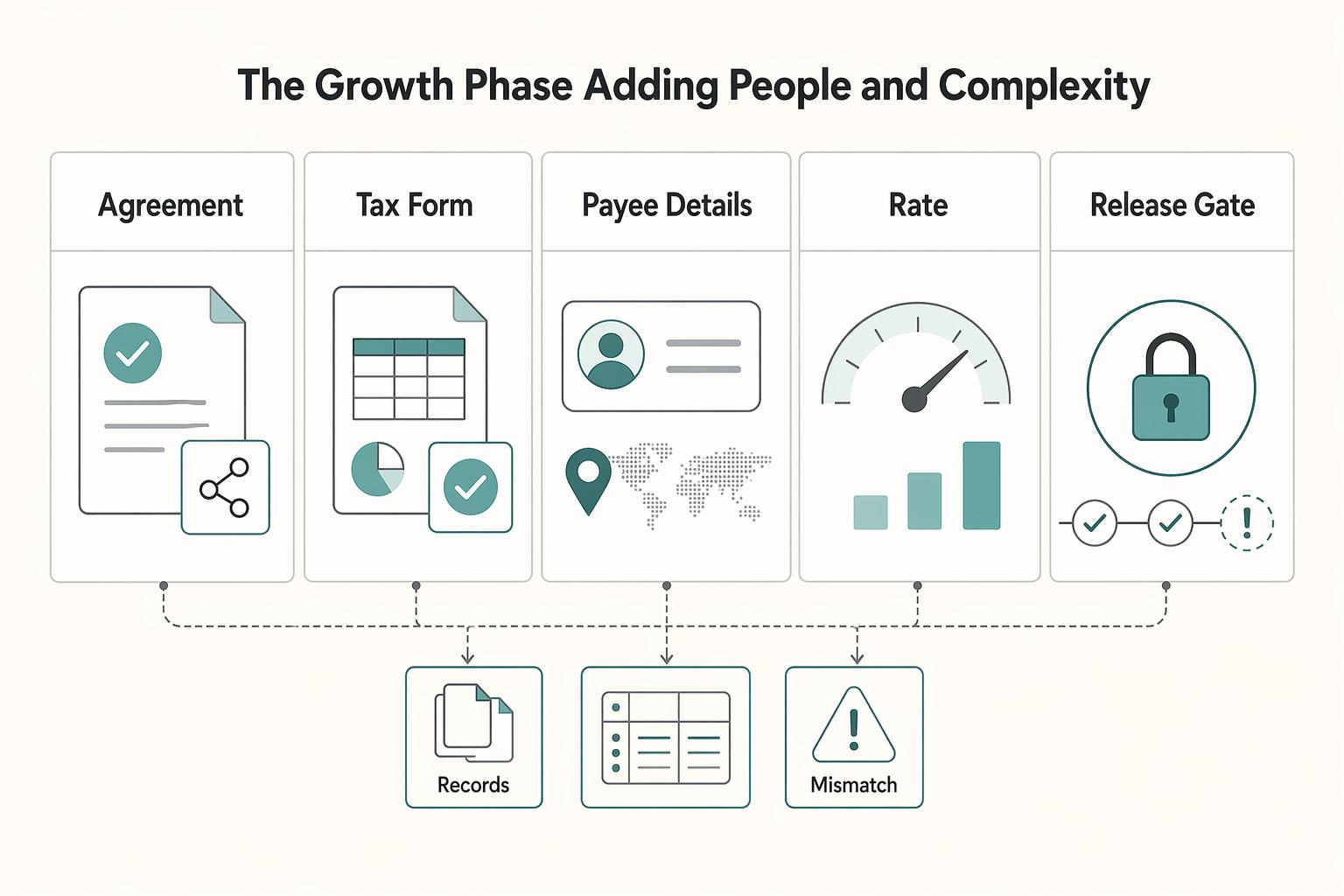
Stage 2: The Growth Phase - Adding People and Complexity#
Once your month-end close is stable, the main risk shifts to team operations: payment errors, onboarding gaps, and margin drift. Use a three-part stack to keep cashflow reliable: your Core OS as source of truth, the right payment platform for your team geography, and advisor time focused on planning instead of cleanup.
| Checklist item | Requirement | Timing |
|---|---|---|
| Agreement | Signed agreement | Before first payment |
| Tax form | Applicable jurisdictional tax documentation; for U.S. purposes W-9 or appropriate W-8 based on status and income (see scope above) | Before first payment |
| Payee details | Verified payee details | Before first payment |
| Rate | Agreed rate | Before first payment |
| Approval | Approval record | Before first payment |
| Area | Manual ops | Systemized ops |
|---|---|---|
| Payment errors | Ad hoc transfers, late exception discovery, inconsistent records | Separate payout flow, platform records, and routine reconciliation to catch exceptions early |
| Contractor onboarding quality | Agreements or tax forms collected after work starts or after first payment | Standard onboarding checklist completed before first payment, with documents stored together |
| Reporting clarity | Revenue, cards, payouts, and spreadsheets do not align | Accounts synced in one workflow, including payroll and spending cards, with recurring monthly statements |
| Profitability forecast | Cash-balance guesswork | Repeatable project-margin review and cleaner inputs for budgets and forecasts |
Keep your Core OS (Gruv or your equivalent) as the source of truth for invoices, incoming funds, project costs, and reconciled payouts. Then run this sequence each cycle:
- Separate operating cash from payout cash.
- Review project margin on a fixed cadence (revenue minus contractor cost and direct delivery expense).
- Enforce a contractor onboarding checklist before first payment: signed agreement, applicable tax documentation, verified payee details, agreed rate, and approval record. Use the jurisdiction and payee-status distinctions above.
Choose payment tooling by payer location, worker country and worker type. Gusto supports U.S. payroll and international contractor payments; those are different services. Deel offers global payroll, employer-of-record and contractor products with different country coverage. Confirm the exact product supports your worker, country, currency and payout method before choosing it.
Bring statements, a list of unreconciled items and your margin review so an advisor can separate cleanup from budgets, forecasts and tax planning. For an eligible U.S. entity, an S-corporation election may be a planning question; it is not a global business option, and nonresident alien shareholders are ineligible. Get specialist advice before any election or filing deadline.
If this system is running but you still need dedicated ownership of reporting quality and forward planning, that is your signal you are nearing Stage 3.
Stage 3: The Agency - When a Full-Service Firm Makes Sense#
Move to a full-service firm when decisions are moving faster than your visibility and controls, not as a status upgrade. If pricing, hiring, or service changes are happening without reliable cash, margin, and close data, this is usually the point where outside support helps.
Your Stage 2 stack stays in place. Your core platform remains the operating data source, and the firm takes on formal accounting execution and strategic finance support on top of that.
Readiness is about complexity, not status#
The trigger is rising complexity: more transaction volume, more exceptions, and heavier reporting/compliance work. Do not force this on a fixed timeline. Use readiness criteria instead:
| Readiness criterion | What should be true |
|---|---|
| Clean data handoff | You can provide source records and identify gaps; agree a cleanup scope if the data is not yet reconciled |
| Records current | Bank, card, payroll, and payout records are organized and current |
| Support traceable | Payment approvals and contractor-cost support are traceable |
| Exceptions limited | Open exceptions are limited and clearly documented |
If records are unstable, price cleanup and catch-up work explicitly before ongoing strategic support. A firm can help establish the controls; missing records are a scoping issue rather than a reason to delay urgent tax advice.
Keep ownership explicit to prevent scope creep#
Define ownership before kickoff so work is not duplicated.
| Workstream | Primary owner | Handoff inputs | Expected outputs |
|---|---|---|---|
| Operating data capture | You (core platform) | Invoices, revenue detail, project costs, payout activity | Current source data and usable cash/margin visibility |
| Formal bookkeeping and close | Firm | Synced financial activity, statements, chart of accounts, prior reports | Reconciliations, closed books, reporting package |
| Payment operations execution | You (payment tools) | Approved rates, signed onboarding docs, verified payee details, approval records | Completed payments and exception logs |
| Planning and finance review | Firm (with your input) | Clean books plus pricing/hiring assumptions | Forecasts, budgets, and decision support |
If both sides are categorizing transactions or both assume the other owns cross-border workflow checks, costs rise and answers arrive late.
Select and onboard in a narrow sequence#
- Define required services
Decide whether you need outsourced bookkeeping, broader finance/accounting outsourcing, or recurring fractional CFO support.
- Gather source records and known gaps
Gather statements, prior reports, core ledgers and approval records, and list missing documents or unreconciled items for initial onboarding. Provide reconciled records when available; otherwise agree the cleanup scope with the firm.
- Confirm tool and workflow fit
Validate support for your payment stack, cross-border workflows, and reconciliation cadence (weekly vs monthly) before signing.
- Set diligence, pricing, and review cadence
Use directories to filter by budget, services, industry, and location; verify credibility checks and reviews; then lock reporting dates and strategic review cadence in writing. Treat example price points as examples only, and plan for scope-based cost expansion.
Proceed with ongoing finance support if you need it and can supply the agreed records. If reconciliations are late or documents are inconsistent, request a cleanup proposal with milestones, cost and ownership first. Bring deadlines and uncertain filing positions to a specialist promptly.
Your First Step: Define the Work and Assign Owners#
Start by listing record gaps, upcoming deadlines and decisions that need specialist judgment. Build reliable daily controls with a bookkeeper or firm if needed, and contact a CPA promptly when tax or reporting questions arise.
| Choice | Control | Risk visibility | Response speed | Cost predictability |
|---|---|---|---|---|
| Foundation stack now | Higher, because you own the records and checks | Better day-to-day visibility when tracking is consistent | Faster, because you can resolve issues in the same cycle | Usually clearer, because routine work and advisory work stay separated |
| Hire firm now | Keep access to source records and approve the scope | Ask the firm to identify gaps and reporting risks | Agree cleanup milestones and urgent filing priorities | Price cleanup, recurring work and advice separately |
Use this model: technology for daily execution, expert support for strategy and filing.
- Own daily recordkeeping first
Start with dependable bookkeeping and an accounting method appropriate to your entity and reporting duties. Under the cash method, income is generally recorded when actually or constructively received and expenses when paid, subject to exceptions. Ask an advisor whether cash or accrual accounting is permitted and useful for your business.
- Track risk signals continuously
Keep your own logs for residency days, foreign accounts, and invoice compliance checks. When a legal limit applies, record the verified threshold beside the relevant log before relying on it.
- Keep documents audit-ready
Maintain one evidence pack with statements, invoices, receipts, approved payments and applicable tax forms. For U.S. documentation, use W-9 or the appropriate W-8 according to payee status and income; foreign entities generally use W-8BEN-E rather than W-8BEN. Store forms securely and have unusual cases reviewed before payment.
- Add a specialized CPA at a complexity trigger
Bring in specialized support when you move into multi-country operations, contractor expansion, or recurring compliance exceptions. Evaluate firms on industry expertise, technology integration, communication style, and pricing structure, not price alone.
This week, gather statements and invoices, list unreconciled items, record upcoming deadlines and set up a shared evidence folder. Start travel and foreign-account logs where relevant. Ask firms to quote cleanup and recurring support separately, and contact a specialist now for any time-sensitive filing or uncertain tax position.
We covered this in detail in Best Banking for US Startups Without Payroll Surprises.
Frequently Asked Questions
Do you need a platform, a CPA, or both?
Many teams need both over time, just not at the same time or in the same scope. A platform handles ongoing record capture and visibility, while a CPA handles filing, interpretation, and advice. If you have more complex operations, keep the platform as your source of truth and bring the CPA clean exports, statements, and account records.
What does bookkeeping handle, and when is that enough?
Bookkeeping records what happened: bank activity, card charges, payroll entries, contractor payments, and reconciliations. It is enough when your main problem is late books or an unclear cash position, not tax strategy or forecasting. Your input is the raw evidence pack, including statements, invoices, receipts, approved payments, and required tax documents.
What does accounting or a CPA handle that a bookkeeper does not?
Accounting turns records into financial statements, tax-ready reports, and compliance decisions. You need this when you are filing returns, dealing with entity questions, or preparing for more formal diligence. If you plan to raise Series A or B, GAAP compliance becomes a real checkpoint, not a nice extra. Bring source records and notes on gaps, unusual items and owner-level transactions. Closed books are preferred when available; incomplete books can be the starting point for a scoped cleanup engagement.
When do you actually need a fractional CFO?
You need one when historical reports stop being enough and you need forward-looking decisions, such as burn rate and runway, hiring timing, pricing changes, or expansion planning. That shift can happen faster than you expect, sometimes within months. Your input is not just clean books, but current assumptions about revenue, staffing, margins, and cash commitments.
Should you limit your search to a local CPA?
You can consider remote firms, but verify the individual and firm authorization required in your jurisdiction, especially for audit or other attest work. Country expertise, permitted service scope and secure document handling matter more than proximity alone. Ask how any required onsite procedures would be handled.
How much should you expect to pay?
Do not anchor on old list prices or roundup articles. Ask for current pricing on bookkeeping, annual tax work, cleanup, and advisory hours, and get any upcharges spelled out in writing before you sign. A practical red flag is hidden fees outside advertised monthly pricing, so ask what is included, what triggers extra billing, and who approves it.
How do you check whether an advisor can handle a remote or cross-border business?
Run three checks before hiring: confirm which services they can deliver remotely, verify they have experience with your specific needs, and ask how data will move from your core systems each month. During onboarding, verify whether they can connect to your payroll, expense, and cap table tools. Examples include Gusto or Rippling for payroll, Ramp or Brex for expenses, and Carta for cap table data. If the answer is manual, ask what the monthly evidence pack must include so nothing slips.
What is the biggest onboarding failure mode?
Role confusion. Finance titles are often used interchangeably, so write down who owns transaction coding, month-end close, tax filing, and planning before kickoff. If you and the advisor both think the other side is checking a key compliance task, you have a real risk, not just an admin issue.
Try a related tool
Researched and edited by the Gruv editorial team. Gruv builds cross-border billing, payouts, and finance-operations software for global businesses.
Sources
Includes 5 external sources outside the trusted-domain allowlist.
- irs.gov/individuals/international-taxpayers/forms-fo...trusted
- irs.gov/individuals/international-taxpayers/source-o...trusted
- deel.com/hiringexternal
- kruzeconsulting.comexternal
- nasba.org/blog/2025/03/04/what-is-cpaverify-2external
- pilot.com/customers/customer-story-swarmexternal
- support.gusto.com/article/106622337100000/add-and-pay-non-us-i...external
Educational content only. Not legal, tax, or financial advice.
Related Posts

Hiring a Subcontractor for the First Time Without Costly Surprises
Hiring your first subcontractor works best when you can describe the job, review the result and afford the coordination time. Agree on scope, authority and payment terms before handing over client work, then pay according to those terms.

Freelance Bookkeeping: Invoices, Receipts, and Month-End Close
Freelance bookkeeping connects what you earned, what a client owes, what a provider received, and what reached your bank. It also records expenses and the evidence behind them. Clear records help you identify missing payments and resolve mismatches; they cannot guarantee faster payment or prevent every dispute.

Best Accounting and Tax Advisors for U.S. Expats: Pick the Right Support Level
**Pick the support level that matches your compliance surface area, then evaluate providers on written scope and form coverage.** The common failure mode for most U.S. expats is not "forgetting to file." It is hiring the wrong help model, under-scoping what you actually need, and finding the gap when IRS filings and related reporting obligations hit the critical path. You run a business-of-one, and your tax workflow is part of the system.