
Quick Answer
A freelance barbell strategy protects the work and cash needed to meet existing commitments, then uses a smaller, separately capped cash and time budget to test uncertain opportunities. Choose the allocation from cleared discretionary cash after obligations and buffers. The approach can support learning and growth, but it cannot eliminate risk or guarantee gains from disruption.
What a Barbell Strategy Means for a Freelance Career#
The barbell strategy, associated with Nassim Nicholas Taleb, combines a conservative core with a smaller exposure to uncertain opportunities. Taleb's co-authored research on barbell portfolios describes the separation of these risk profiles; it does not establish a universal career allocation. For a freelancer, the useful adaptation is to protect essential cash flow and delivery capacity, then test projects whose failure you can absorb. A 90/10 split can illustrate a time budget, but it is not an investment prescription or a guarantee that the core is safe.
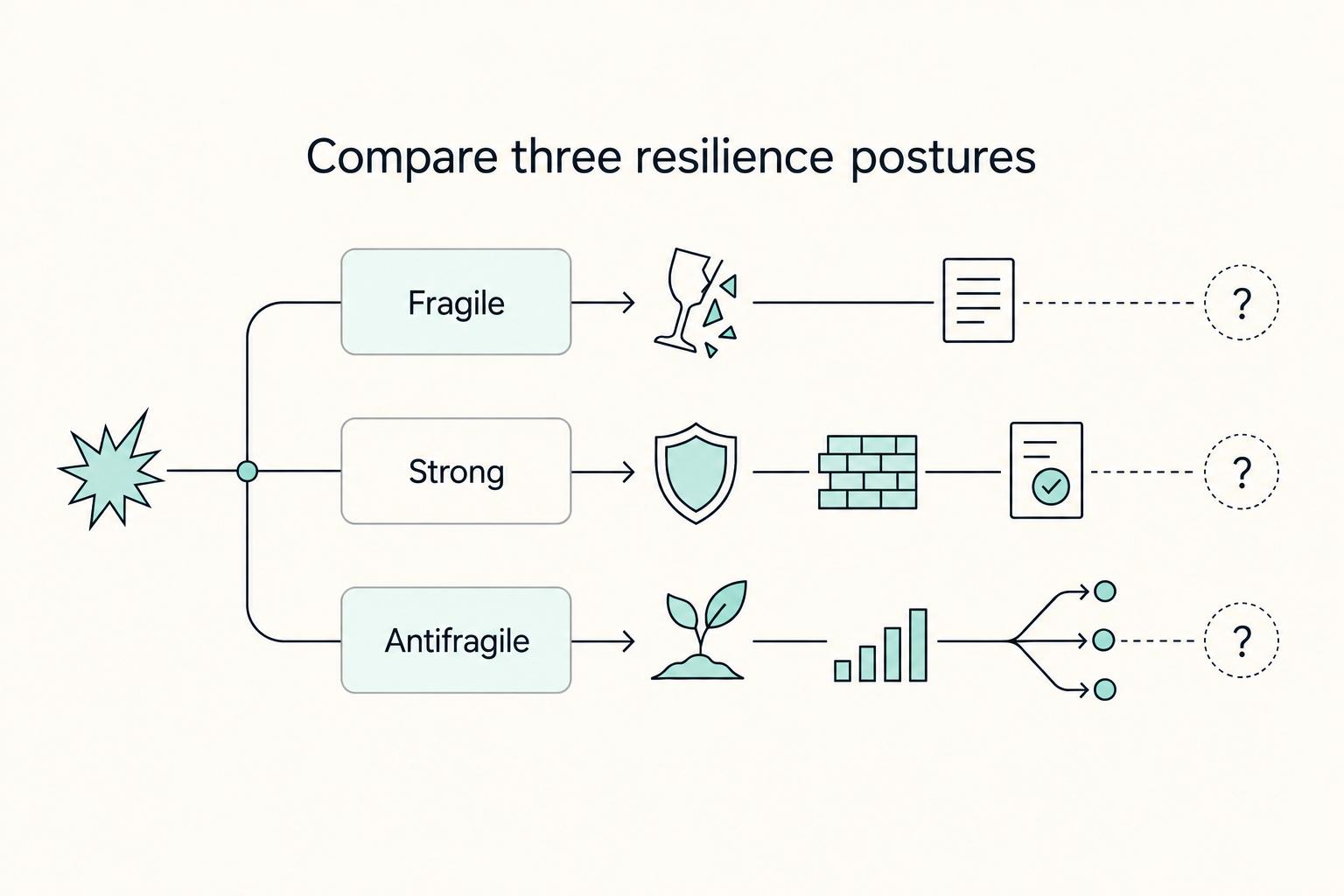
The aspiration is antifragility: finding opportunities to improve through disruption, rather than only restoring the previous position. A new technology might reduce demand for one service while creating demand for a tool you can build. A funded core gives you room to investigate that opportunity. Neither a retainer nor a speculative project guarantees that a recession will benefit you. For related planning, review this guide to antifragile thinking.
These pairings show how the career analogy can work. The distinction depends on the actual contract, demand and downside, rather than the label attached to the work:
| Core work to protect | Small experiment to test |
|---|---|
| Retainer work with documented scope and payment terms; still exposed to cancellation and client concentration | A separately budgeted product prototype or negotiated startup equity |
| Maintaining a skill with demonstrated client demand | Testing an emerging technology against a specific customer problem |
| Projects with manageable delivery costs and payment schedules | A limited performance-based engagement whose measurement and maximum loss are agreed |
Steady revenue is only one part of the core. Late payment, losing a major client, illness, tax errors and insecure customer data can all threaten it. Their importance depends on your circumstances; compliance failures are not universally more damaging than lost income. Build a risk register that names the exposure, owner, next action and cash consequence. Tax and reporting checks reduce avoidable errors, but no invoice process or calendar makes a freelance business legally invulnerable.
Layer 1: Protect Income, Obligations and Delivery#
Start with the downside you cannot afford. Review client concentration, cancellation notice, receivables, essential costs, appropriate insurance and the permissions needed to work where you live. Reserve time for renewal conversations and a replacement-client pipeline. Keep compliance alongside these commercial risks. A speculative budget should remain small enough that losing it would not prevent payment of existing obligations; separate accounts alone do not limit legal liability.
For cross-border work, maintain separate location tests. The Schengen short-stay calculator helps track an applicable 90-days-in-180 allowance; it does not establish a right to work or tax residence. The U.S. Foreign Earned Income Exclusion has a foreign-tax-home requirement and qualifying residence or physical-presence tests; the latter generally requires 330 full days in one or more foreign countries in a consecutive 12-month period. It is not a universal residence rule. The UK's Statutory Residence Test considers its own day, work and connection tests. Keep travel records, then obtain country-specific advice before a change of location affects work permission, filing or client obligations. U.S. citizens and resident aliens may still have U.S. filing duties while abroad; an exclusion is not automatic. For EU-client personal data, add a practical GDPR checklist.
Next, document the correct invoicing treatment. Customer location alone does not determine VAT. Supplier location, customer business status, the type of supply and applicable exceptions matter. For many cross-border B2B services within the EU, the customer accounts for VAT under reverse charge, but the EU guidance identifies exceptions. Build these checks into invoicing:
- Validate relevant VAT details. Use VIES where appropriate and save the result with the invoice evidence. An invalid VIES response can mean a number is absent, not activated for intra-EU transactions or not yet finalized. Confirm with the customer and relevant national authority when needed. It does not automatically freeze a payment or settle the correct tax treatment.
- Apply reverse charge only when it applies. Include the required wording when the customer is liable for the VAT; putting those words on an invoice does not itself transfer liability. Confirm the other invoice particulars and local requirements against EU invoicing guidance. Resolve a tax-detail problem through the agreed invoice correction and payment process rather than assuming every EU business invoice follows the same rule.
Use cash reserves based on a forecast, with bank rules as an aid to carrying out the plan. Separate taxes collected for remittance, expected income and self-employment taxes, operating commitments and a buffer before funding experiments. A reserve transfer is not a tax payment: schedule the actual estimated-tax obligations and review estimates as earnings change. Nor is a retirement reserve automatically a contribution. For a U.S. self-employed owner, the SEP contribution calculation uses special adjusted net-earnings rules and plan limits, not a blanket percentage of every receipt. Choose amounts for your circumstances instead of treating 25–35% tax, 10–15% retirement and 5–10% savings as universal safe ratios.
Layer 2: Choose a Small Experiment With Defined Downside#
Choose an opportunity connected to a problem you understand and can test cheaply. A book or podcast may be useful if it serves a specific audience; software is not inherently the better bet. For each project, write the customer hypothesis, cash and time limits, evidence needed to continue, review date and commitments that survive closure. Protect client confidentiality and check ownership and licensing before reusing work. Count support, refunds, security and contractual exposure as well as development time.
Three possible models have different demands. Compare them before assigning a budget:
- Productize a core service. Package a repeatable component into a fixed-scope, fixed-price deliverable, such as a content strategy blueprint. Define inputs, revisions, acceptance and exclusions. Standardization can reduce delivery effort, but a service still requires labor and may lose money if the scope exceeds the price. Selling a reusable template is a different offer; it needs its own rights, support and suitability checks.
- Build a niche micro-SaaS or paid API. Test one customer problem before committing to a broad product. One hundred customers paying $50 a month would produce $5,000 in monthly subscription revenue before fees, refunds, hosting, support, development and taxes; it does not establish high margins. Cap prototype spending and time, test willingness to pay and define a continuation threshold. Customer contracts, data protection and ongoing support can create obligations beyond that budget. Avoid personal guarantees or other open-ended commitments you cannot absorb.
- Consider a small investment in a tool supplier. Knowing a product as a customer can inform questions, but it is not financial diligence or a right to invest. Check eligibility, the offering terms, dilution, rights and your ability to lose the entire investment. SEC investor guidance on private placements highlights illiquidity and limited disclosure. A supplier failure could impair both the investment and your core workflow, making this a correlated exposure. Ownership does not promise influence, better service or a strategic relationship. You can choose to make no private investment.
| Custom consulting | Productized service |
|---|---|
| Offering: work tailored to each client's requirements. | Offering: a defined content strategy blueprint with explicit inputs and revisions. |
| Pricing: hourly or project pricing based on expected scope and costs. | Pricing: a flat fee whose delivery costs and scope still need to support a margin. |
| Capacity: each engagement consumes delivery time. | Capacity: reusable methods may reduce effort; individualized delivery remains work. A separately licensed template may scale differently. |
Layer 3: The Allocation Dashboard That Funds and Tracks Your Bets#
An allocation dashboard connects these choices to available resources. Track cash and hours separately: 10% of free cash is not the same as 10% of total revenue, and 10% of a working week is not 10% of non-billable time. Pick explicit denominators and maximum amounts before the experiment starts.
Here is the four-step process to build your allocation dashboard:
A short monthly review can check essential coverage, upcoming compliance deadlines, receivables and remaining experiment budgets. Urgent notices and filing deadlines need their own reminders; a monthly dashboard is not a substitute for acting when they arise.
- Step 1: Calculate essential coverage. List required business costs, personal living needs, insurance, minimum debt payments and upcoming annual bills. Keep business expenses distinct from personal drawings and debt principal for accounting. Update variable and one-off amounts rather than treating the estimate as permanently exact.
- Step 2: Check cleared cash and obligations. Compare expected receipts and payment dates with the coverage requirement. Do not count an unpaid invoice as bank cash. Protect tax remittances, existing commitments and a chosen buffer before considering experiments. Cash left after personal needs is an allocation measure, not accounting profit; a retainer can still terminate or pay late.
- Step 3: Set cash and time limits. Choose a small share of cash genuinely available after those protections, plus an absolute cash cap and a separate hours cap. For illustration, 10% of $1,500 available cash is $150, while four hours out of a 40-hour working week is a 10% time allocation. These are choices for the example, not prescribed ratios. Include foreseeable ongoing costs and leave core delivery capacity intact.
- Step 4: Review evidence and rebalance. Record actual spending, hours, customer feedback and commitments still owed. Compare results with a predefined continue, change or stop threshold. If core coverage weakens, reduce or suspend new bets. Closing a test includes fulfilling, transferring or resolving its existing customer and legal obligations; it does not erase them.
Worked cash example: Assume $8,000 of cleared receipts are available this month, with no opening unrestricted cash. Of that, $500 is VAT collected for remittance, $1,000 is committed business spending, $1,500 is the forecast reserve for income and self-employment taxes, $3,000 covers personal essentials and $500 replenishes the chosen buffer. That leaves $1,500 for discretionary allocation: $8,000 − $500 − $1,000 − $1,500 − $3,000 − $500. A chosen 10% experiment allocation is $150, leaving $1,350 unallocated. This is a simplified cash plan, not a profit calculation or a validated tax estimate. If an additional $900 committed bill is due, available cash falls to $600 and the same choice yields $60. An unpaid $2,000 invoice does not increase today's spendable cash.
Keep the Core Funded While You Test#
The practical value of the freelance barbell is a clear boundary between resources needed to meet commitments and resources you can afford to experiment with. Stable income matters, and so do receivables, client concentration, appropriate compliance and enough capacity to deliver. Protecting these foundations makes a test affordable; it does not make the business invulnerable.
Use repeatable checks to reduce avoidable mistakes: a travel and filing calendar, an invoice checklist, forecast-based reserves and a register of contract commitments. Give each recurring check an owner and deadline. When a material legal or tax question remains unresolved, budget for qualified advice before acting. This system should make the next decision clearer, not encourage a larger bet because a checklist is complete.
The dashboard can turn broad intentions into decisions you can review:
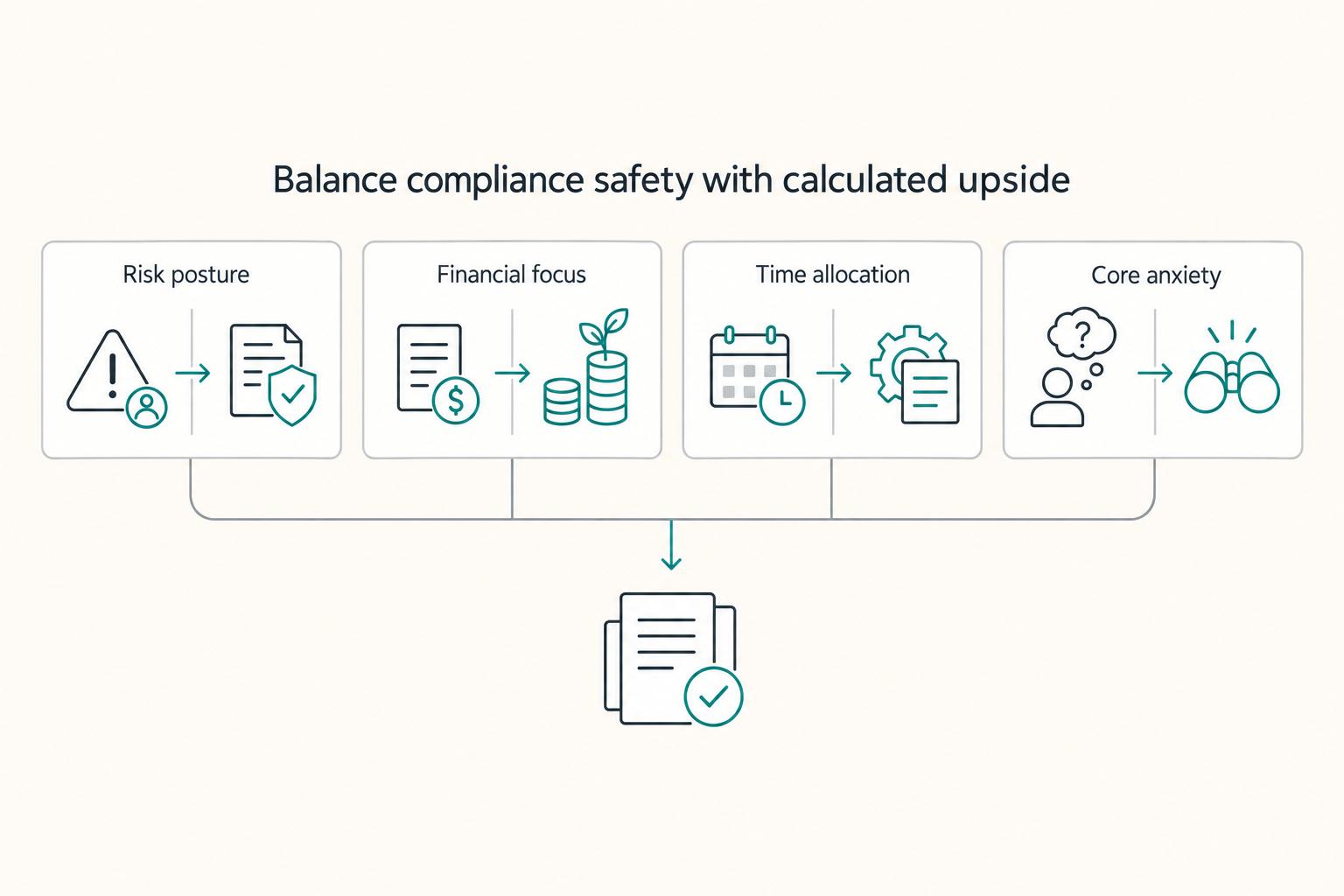
| Planning area | Reactive pattern | Deliberate control |
|---|---|---|
| Risk posture | Focuses on today's client request while other exposures remain unexamined. | Reviews income, legal and operational exposures; budgets tests without promising zero risk. |
| Financial focus | Treats invoiced revenue or cash above living costs as profit available to spend. | Separates cleared receipts, accounting profit, protected obligations and discretionary cash. |
| Time allocation | Experiments consume unplanned evenings or displace paid delivery. | Caps test hours, protects delivery and schedules a review of customer evidence. |
| Core anxiety | Has no response planned for client loss or a failed experiment. | Maintains a replacement-client plan and a stop condition, alongside a search for opportunities. |
Start with one small test, a realistic cash forecast and a review date. If the experiment fails, preserve what you learned and meet the obligations it created before trying another. If the core weakens, pause new spending and restore coverage. A career allocation earns its usefulness through these decisions, not through a permanent 90/10 label.
Frequently Asked Questions
What's a real-world example of a barbell strategy for a freelance developer?
A developer might reserve 36 of a 40-hour week for existing delivery, administration and pipeline work, with four hours for a paid-API prototype. Reliable retainers help cover essentials, but one enterprise client still creates concentration risk. The developer checks payment terms, tax obligations and the cash buffer, then funds the test within a separate affordable cash cap. Before using a problem discovered in client work, they verify confidentiality, IP ownership and permission to reuse any materials. Open-source contributions do not automatically earn equity; any equity arrangement needs explicit terms. A useful test might be three prospective customers trying a demo by a review date, rather than an assumption of exponential returns.
How do you implement a barbell strategy for your freelance finances?
Calculate essential coverage, then assess cleared cash after remittances, committed spending, forecast taxes and the buffer. Choose an affordable experiment amount from the remainder, with an absolute cap. Automate transfers only if the rule respects those obligations and updates when receipts or costs change. Maintain payment reminders separately: a tax reserve has not paid the tax, and a retirement reserve has not funded a plan. Keep cash allocation distinct from accounting profit.
What is the biggest risk for a global freelancer?
There is no single biggest risk for every global freelancer. Map client concentration, liquidity, work permission, tax residence, reporting, data and contractual exposure to your own situation. For example, FBAR reporting generally concerns U.S. persons with a financial interest in or signature authority over foreign financial accounts whose aggregate value exceeds $10,000 at any time during the calendar year, subject to exceptions. Form 8938 has separate thresholds and requirements. In Bittner v. United States, the Supreme Court held that non-willful FBAR penalties operate per report, rather than per account. Willful failures follow different rules; penalty amounts and application require current, fact-specific assessment. Location may also affect a client's taxable presence, but it is not automatically a permanent establishment or the end of the relationship. Resolve material cross-border questions before relocation or contract changes.
How does the barbell strategy make a career 'antifragile'?
It aims to leave room for learning and opportunity during disruption. A cash buffer and protected delivery capacity help you avoid funding experiments from money already owed. Small tests can reveal a useful skill or product when demand changes, but shocks can still hurt both sides and experiments can fail. The test is whether an affordable loss produces useful evidence without undermining the core, rather than whether every shock generates profit.
Is this different from just diversifying my income?
Diversification spreads exposure across sources whose risks may differ; it need not mean accepting the same risk repeatedly. A career barbell emphasizes a protected operating core and a small, explicitly speculative allocation. They can work together: several clients may reduce concentration in the core while a separate prototype tests a new revenue source. Neither approach eliminates all risk or guarantees uncapped upside. Check whether the client work and experiment depend on the same industry, supplier or technology before calling them independent.
Researched and edited by the Gruv editorial team. Gruv builds cross-border billing, payouts, and finance-operations software for global businesses.
Sources
- europa.eu/youreurope/business/finance-and-tax/vat/cros...trusted
- europa.eu/youreurope/business/finance-and-tax/vat/chec...trusted
- fincen.gov/report-foreign-bank-and-financial-accountstrusted
- home-affairs.ec.europa.eu/policies/schengen/border-crossing/short-stay...trusted
- investor.gov/introduction-investing/general-resources/new...trusted
- irs.gov/individuals/international-taxpayers/foreign-...trusted
- irs.gov/businesses/small-businesses-self-employed/es...trusted
- supremecourt.gov/opinions/22pdf/21-1195_h3ci.pdftrusted
Educational content only. Not legal, tax, or financial advice.
Related Posts

GDPR Compliance Checklist for Freelancers Working With EU Clients
Start by separating the decisions you are actually making. For a workable **GDPR setup**, run three distinct tracks and record each one in writing before the first invoice goes out: VAT treatment, GDPR scope and role, and daily privacy operations.
How to Build an Antifragile Freelance Business: Financial Core, Compliance Firewall, and Shock Absorbers
If you want an antifragile freelance business, design your operations to benefit from disruption, not just survive it. Resilience means you absorb a shock and recover. Antifragility, in Taleb's framing, means you improve because of volatility rather than merely endure it.

The Freelance Payment Penalty: A Modeled Audit of Platform Fees, FX Spreads, and Payout Delays
The money rarely disappears through a single, easy-to-spot fee. The real loss is stacked. A marketplace takes its commission, a processor adds a charge for international cards, a bank or payment company converts the currency at a spread, a platform holds the funds before release, and a wire sheds a little to intermediaries on the way in. Each layer looks defensible on its own, but the worker feels the combined result as a smaller deposit and a later payday.