
Quick Answer
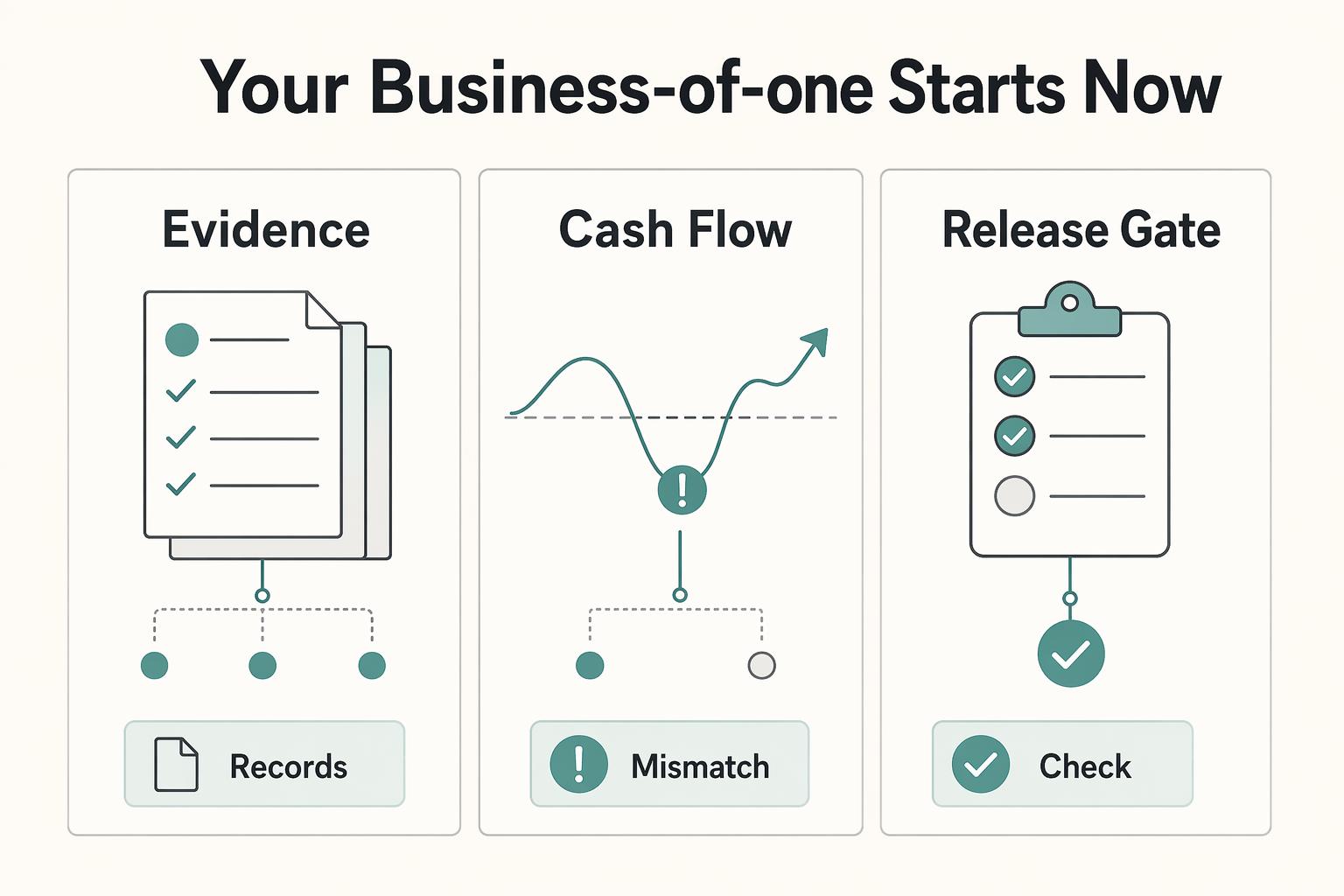
Start with the most urgent exposure: unpaid delivered work, a coming cash gap, or a jurisdiction obligation with a deadline. Confirm client and supplier entities, agreed scope, invoice requirements, and the payment path. Use the engagement’s deposit and milestone policy, verify receipts, approve extra work before delivery, and reconcile fees, withdrawals, and bank outcomes. Review unresolved items weekly with a named owner and next action.
You've seen the endless lists of familiar freelancer pain points: late payments, scope creep, inconsistent income, and the feast-or-famine cycle.
Cross-border solo work adds payment and compliance questions to ordinary delivery risk. A late invoice, unclear scope, or wrong billing entity can delay collection; an unverified tax or registration obligation can create a separate exposure. Prioritize the issue that can cause the largest loss in your own business rather than assuming every freelancer faces the same main threat.
Uncertainty is easier to manage when each open question has a record, an owner, and a review date. Separate a missing client approval from an unknown payment outcome or a jurisdiction rule that still needs checking; each needs a different next action.
Assess exposure by likely impact and deadline: unpaid work already delivered, cash you need before the next expense, and legal or tax obligations that apply to your facts. A country checklist helps with the third category, but it cannot replace collection controls or guarantee compliance.
Use three operating areas: jurisdiction records, client payment terms, and internal execution. The tables below turn each into evidence, a next action, and a review cadence. Keep the controls small enough to use before the next invoice or project starts.
Pillar 1: Make jurisdiction obligations visible#
For jurisdiction risks, start by identifying which obligations apply to your facts and review them on a schedule. Compliance mistakes can create financial exposure, payment or account friction, and time-consuming remediation afterward.
The easiest way to handle this is with a risk snapshot, not a giant global checklist. Cross-border work creates exposure from several directions at once, and the same label can mean different things in different places. Do not trust one template to cover every country. Keep a short, per-jurisdiction snapshot for each country where you spend time, invoice clients, hold accounts, or buy coverage, and rank the top five risks you need to watch in each one.
Build your compliance dashboard#
A useful dashboard should answer four questions at a glance: where you are creating exposure, what evidence you have, when the next review happens, and what should trigger expert help. The minimum fields are practical: country, exposure type, current status, threshold or rule, evidence on file, next review date, and owner or adviser.
| Risk area | What to monitor | Why it matters | Action cadence |
|---|---|---|---|
| Residency tracking | Travel dates, residence and work facts, local registration, and the applicable tax-residency tests | Days can be one factor; residence, status, exceptions, or treaty rules may also matter | Update after every trip; review weekly |
| Account reporting | Which banks, payment platforms, and wallets you use; highest balances; current reporting trigger to confirm from the official source | Financial account obligations can be jurisdiction-specific and easy to miss when you use multiple providers | Reconcile monthly; review quarterly |
| Invoice compliance | Client legal entity, tax status, invoice field requirements, and current retention requirement to confirm with counsel | Invoice and record rules can vary by jurisdiction and setup | Check before every invoice; review templates quarterly |
Escalate the affected decision when you approach a relevant threshold, enter a new country, change accounts or billing entity, or find a contract-to-invoice mismatch. Assign the specific question to an adviser and track its deadline. Avoid freezing unrelated work automatically; identify which invoice, registration, filing, or payment action actually depends on the missing fact.
Start with the adviser closest to the issue. Use a local tax adviser for residency or indirect tax questions, a cross-border accountant for filings and recordkeeping, a lawyer for establishment or contract mismatch issues, and your broker or insurer if an incident could become a claim.
Keep dated travel confirmations, calendar records, account statements, client onboarding records, and registrations. Day counts alone do not determine every country’s tax residence. For example, US federal tax residence for non-citizens can depend on a green-card or substantial-presence test, with exceptions and treaty considerations. Check the actual rules for each relevant jurisdiction.
Check each invoice against the client, contract, and evidence file#
Invoices are not just billing documents. In cross-border work, they are control points. Before you send one, run a short check that matches the invoice to the client, the contract, and the evidence file.
| Step | Focus | Detail |
|---|---|---|
| Validate client facts | Client identity | Confirm the legal name, registered address, contracting entity, and tax status; if an official registry exists, check it and save a dated screenshot or PDF. |
| Match invoice template to the jurisdiction | Jurisdiction-specific fields | Use the invoicing rules that apply to your supplier entity and transaction, considering client status and place of supply. Verify required tax fields and wording before issue; keep unresolved adviser questions out of the invoice itself. |
| Check contract consistency | Alignment with the signed agreement | Match entity name, service description, currency, and payment terms; if one affiliate signed but another entity asks to be invoiced, treat it as a review trigger. |
| Store the evidence pack before sending | Supporting file | Save the contract or statement of work, client status check, final invoice PDF, and any email confirming billing details or place-of-supply assumptions. |
Do not skip the evidence pack. If a client rejects the invoice, a processor asks questions, or a local adviser needs to reconstruct the facts, you want the file ready.
This week#
- Create one dashboard tab per country you touch and list the top five risks for each.
- Mark every unverified threshold or rule as pending adviser verification, then assign an adviser or official source for each one.
- Audit your next three invoices against the four-step control flow and build the evidence pack before you send them.
If you want a deeper dive, read GDPR for Freelancers: A Step-by-Step Compliance Checklist for EU Clients.
Pillar 2: Set client scope and collection controls#
Clear scope and payment terms can reduce avoidable disputes and delays, although they cannot prevent a client’s insolvency or every missed payment. Tighten intake, invoicing, and change approvals so you can identify an issue early and limit further unpaid work.
A client payment protocol#
Agree terms, payment stages, approval ownership, and the remedy for late payment before kickoff. Make any deposit a documented policy for that engagement, and verify its receipt through the provider or bank rather than a client screenshot. Available funds can still be subject to refunds, disputes, or other reversals; confirmation is a start gate, not a guarantee.
Use this pre-engagement sequence every time:
- Set the engagement’s deposit policy. Define the amount, due date, refund or cancellation treatment, and when work starts. Confirm signed terms, any required purchase order, and receipt of the required deposit through your bank or provider. Keep the invoice, confirmation, and agreement together.
- Bill by agreed milestones or service periods. Name the deliverable, approver, review deadline, invoice date, and payment due date. Define how delayed feedback affects the schedule.
- Enforce verified late terms. Confirm any fee or pause-work clause is lawful and agreed before using it. Schedule reminders and an owner review at the trigger; check disputes, notice requirements, and actual payment status before pausing work or adding charges.
For an illustrative $3,000 project, agree a $900 deposit, a $1,200 invoice at draft acceptance, and a $900 final milestone. A requested $300 extra deliverable needs written scope, fee, and timeline approval before work begins. This schedule manages exposure; it does not authorize holding work or files beyond the agreed and applicable legal terms.
Reconcile invoices to processor transactions, fees, available balance, withdrawal, and bank receipt. An app balance is not necessarily money available in your bank or proof of deposit insurance. Review the account arrangement and coverage conditions, then record holds and unresolved transfers separately. For example, a hypothetical $1,000 collection less a $30 fee leaves $970; a $950 bank withdrawal leaves $20 at the processor. Match all three amounts instead of calling the $50 difference unpaid revenue.
| Payment structure | Best fit | Main risk | Cash-flow predictability | Admin load |
|---|---|---|---|---|
| Fixed scope | Stable, clearly defined deliverable | Margin erosion when scope is loose or changes are undocumented | Medium to high when deposit and milestone dates are set upfront | Medium |
| Iterative scope | Priorities expected to change during delivery | Revision loops and hidden backlog when each cycle is not capped | Medium when each cycle is approved and billed on a fixed cadence | High |
| Retainer | Ongoing advisory or recurring production work | Disputes on boundaries, response windows, or overflow work | High when billed in advance with clear service boundaries | Low to medium |
Settle five points in your statement of work#
A weak SOW creates unpaid work. A strong Statement of Work removes interpretation on five points:
| SOW point | Define | Detail |
|---|---|---|
| Inclusions | What you will deliver | In what format/channel. |
| Exclusions | What is out of scope | What is explicitly out of scope. |
| Revision boundaries | Included feedback | What feedback is included vs. new billable work. |
| Acceptance criteria | Approval rules | Who approves, how approval happens, and by when. |
| Change-order workflow | How extra work starts | Written approval, fee impact, timeline impact, and updated invoice before extra work starts. |
That is the minimum. Also keep the paper trail: final SOW, redlines, approval email, acceptance signoff, and approved change orders.
Price around the result, not the clock#
If you want to reduce hourly anchoring, lead with value inputs and options. Use discovery to capture four inputs: business goal, cost of delay, consequence of failure, and internal effort you remove.
Then write a short value hypothesis and present options tied to outcome or service level. If a client asks for an hourly rate, keep the frame: "I price this on scope, decision speed, and the result you need. Here are the options and what each includes."
This week, apply the agreed deposit and kickoff checks to one engagement, update its SOW with milestones and change approval, and configure reminders with a review before escalation. Use weekly open-invoice checks and monthly reconciliation to detect timing differences, returns, and fee mismatches.
For collection follow-up, see Freelance Bookkeeping for Faster, Safer Client Payments.
Pillar 3: Reduce recurring operations work#
Your capacity is protected by operating discipline, not more effort. Once contracts and payment terms are stable, many recurring problems come from internal friction: scattered records, repeated admin work, and decisions that are not documented.
The practical goal is simple: reduce recurring non-billable work and make key workflows verifiable. Start with an Admin Tax audit, then tighten how money, client records, and decisions move through your business.
Audit the Admin Tax before you add tools#
Run the audit first. Buying new software before you map the work usually just adds another layer to maintain.
- Track one normal week of recurring non-billable tasks you repeat more than once.
- Tag each task by effort (low/medium/high) and impact (low/medium/high) on cash collection, delivery timing, or error risk.
- Assign one action per task: automate, delegate, standardize, or eliminate.
Use records, not memory. Pull inputs from your calendar, sent email, invoice history, bank feed, and project board. If a task repeatedly needs the same inputs from multiple places, it is a strong candidate for standardization or automation.
Avoid method overload. Fix the top few high-impact repeats first, then review and adjust in real time.
Choose an operating model you can maintain#
Use workflow movement, not tool marketing, as your test: how do your invoices, approvals, and deadlines move from start to finish?
| Operating model | Workflow friction | Error risk | Visibility | Maintenance burden |
|---|---|---|---|---|
| Inbox plus spreadsheets | High: work is split across threads, tabs, and memory | High: missed versions and duplicate entry are common | Low: hard to see status across clients | Low early, higher as volume grows |
| Fragmented app pile | Medium to high: frequent context switching | Medium to high: sync gaps create inconsistencies | Medium: each tool shows only part of the picture | High: ongoing exports, links, and naming upkeep |
| Integrated stack | Lower: fewer handoffs and less re-entry | Lower when records update in one place | Higher: easier to monitor progress and adjust | Medium: more setup discipline, less chasing later |
Connect project approvals and time or milestone records to invoicing where your operating model needs them. An integrated tool can reduce re-entry, but it still needs exception ownership and reconciliation; a single dashboard does not prove every sync completed.
Link proposal, agreement, approval, invoice, payment evidence, and bookkeeping export by engagement ID. Check open invoices against processor and bank outcomes weekly, and log exceptions. If a payment is under investigation, query the existing transaction before sending a replacement request or marking a second receipt.
For Unify Client Management, keep one source of truth per active client: signed agreement, current SOW, approved changes, delivery dates, approvals, and next action. Weekly checkpoint: you can answer, quickly and from records, what is due next, who owns the next move, and which document confirms it.
Run execution rituals, not motivation rituals#
Treat your Personal Board of Directors as an operating review. Use a recurring cadence you can sustain and the same short agenda each time: current constraint, decision needed, options, next action. Keep a decision log with: date, issue, options considered, decision, review date.
| Ritual | What to include | Cadence or use |
|---|---|---|
| Personal Board of Directors review | Current constraint, decision needed, options, next action | Use a recurring cadence you can sustain. |
| Decision log | Date, issue, options considered, decision, review date | Update the decision log and assign review dates to unresolved items. |
| CEO Time block | Calendar block plus timeboxing; optional 25-minute work intervals with 5-minute breaks, then a 15-30 minute break after four rounds | Use this block for pipeline review, pricing decisions, process fixes, and clearing open loops. |
Protect CEO Time the same way: calendar block plus timeboxing. If helpful, use focused 25-minute work intervals with 5-minute breaks, then a 15-30 minute break after four rounds. Use this block for pipeline review, pricing decisions, process fixes, and clearing open loops.
Weekly operating checklist:
- Review open invoices against payment status and bank settlement.
- Confirm each active client has a current SOW, next deadline, and clear next owner.
- Update the decision log and assign review dates to unresolved items.
- Remove, standardize, delegate, or automate one repeated admin task.
- Confirm CEO Time is scheduled as protected time, not leftover time.
Run this consistently and you create cleaner delivery flow, fewer admin errors, and steadier pipeline execution.
You might also find this useful: The 'Autonomy Premium': Why High-Earners Choose Freelancing Over Stability.
Pick one pillar and finish one verified step this week#
Start with one verified step this week, not a full overhaul. The goal is simple: remove one preventable issue across risk, cash flow, or operations so your business runs with less friction.
| Immediate constraint | One-week implementation sprint |
|---|---|
| Compliance risk exposure | Build or clean up one place to track obligations, supporting records, and open items. Keep any unverified requirement marked as pending adviser or owner verification until confirmed. |
| Cash-flow friction | Tighten your client-payment path before work starts: confirm payer details, approver, payment route, and where invoice status is tracked. This reduces avoidable confusion when work is already underway. |
| Operational overload | Protect one operations-review block and remove a recurring admin task through standardization, delegation, automation, or elimination. If the pipeline is the constraint, reserve a realistic outreach block and review its results; no fixed percentage suits every business. |
Use a short accountability frame so the week ends with a finished outcome:
- Owner: Name one person responsible, even if it is you.
- Completion signal: Define "done" in one sentence.
- Review: Schedule an end-of-week check and confirm complete vs. incomplete.
This is how autonomy shows up in practice: fewer preventable issues, clearer decisions, and steadier delivery. Pick one pillar, complete one verified step, and review it before you choose the next.
For a broader prioritization discussion, see The Hierarchy of Freelancer Pain: From Friction to Financial Ruin.
Frequently Asked Questions
What is the biggest financial risk for independent professionals?
There is no single largest risk for every independent professional. Review unpaid delivered work, upcoming cash needs, client concentration, pipeline gaps, and jurisdiction obligations with deadlines. Compare the likely loss and next action for each. A weekly review should turn one unresolved item into a named task with evidence and a due date rather than assuming compliance risk always comes first.
How do I handle international clients professionally?
Decide the contract and payment path before work starts, not after kickoff. Focus on clarity and verification: confirm who the payer is, keep the signed agreement and invoice record together, and treat any local legal or tax item as pending adviser verification until confirmed. Before you send the first invoice, verify the legal entity name, billing contact, currency, tax-treatment status, and who handles disputes.
How can I guarantee payment from clients?
You cannot guarantee payment. Reduce exposure with a documented scope, named approver, agreed deposit or milestones, receipt verification, and a follow-up process. Keep disputed amounts separate from confirmed receipts, check the existing payment before requesting a replacement, and apply only the late-payment remedies agreed and permitted for the engagement.
How do I avoid burnout as a solo professional?
Reduce avoidable workload by reviewing delivery commitments, pipeline work, open invoices, and administrative tasks separately. Protect time away from work as well as a short operations review. Delegate with a bounded scope, a paid trial, clear access permissions, and a review before handing over payment-critical actions. Operational changes can help with workload; they are not a guarantee against burnout.
What is the Admin Tax and how can I reduce it?
The Admin Tax is the recurring non-billable work that keeps stealing time because it lives across your inbox, tabs, and memory. It matters because weak process is how you lose time, budget, and momentum, and those losses compound fast when income is already uneven. For one normal week, pull tasks from your calendar, sent mail, invoice history, and project board. Tag each one by effort and impact, then fix the top three inside your operations setup from Pillar 3 first.
Try a related tool
Researched and edited by the Gruv editorial team. Gruv builds cross-border billing, payouts, and finance-operations software for global businesses.
Sources
Educational content only. Not legal, tax, or financial advice.
Related Posts

GDPR Compliance Checklist for Freelancers Working With EU Clients
Start by separating the decisions you are actually making. For a workable **GDPR setup**, run three distinct tracks and record each one in writing before the first invoice goes out: VAT treatment, GDPR scope and role, and daily privacy operations.

Digital Nomad Health Insurance Comparison for Long-Stay Moves
Use focused time now to avoid expensive mistakes later. Start with a practical `digital nomad health insurance comparison`, then map your route in [Gruv's visa planner](/tools/visa-for-digital-nomads) so we anchor policy checks to your real plan before pricing pages pull you off course.
Why High-Earners Choose Freelancing for the Autonomy Premium
Freedom only pays off when control keeps pace. Freelancing happens project by project outside a single employer structure, so you need explicit rules for scope, pacing, and follow-through. Freedom without structure turns into chaos. Durable independence comes from controls you can repeat, not motivation spikes.