
Quick Answer
Use 7 habits for business-of-one as an operating system, not a motivation reset. Start with live risk records for locations and accounts, verify invoicing requirements before sending, separate cash by purpose, and apply acceptance criteria before committing to new work. Bring in tax or legal advisors when risk moves beyond your expertise, and keep weekly proof artifacts so your controls, collaboration habits, and renewal practices are visible in daily operations.
Read the '7 Habits' as a Decision System for a Solo Business#
If you run a solo business, you do not need more motivation. You need a durable way to make decisions when client delivery, cash flow, and compliance are all competing for attention. Read The 7 Habits of Highly Effective People that way, and it stops looking like self-help. It starts working like a system for your business.
That shift matters because your real risks are rarely abstract mindset problems. They are quiet operational misses that compound over time. Think cross-border tax and reporting obligations that surface as your work spans more places, or invoicing checks you skip until a client or accountant sends the work back. The practical checkpoint is simple: keep a current record of where you worked, who you billed, and which rules likely apply before you issue the invoice, not after.
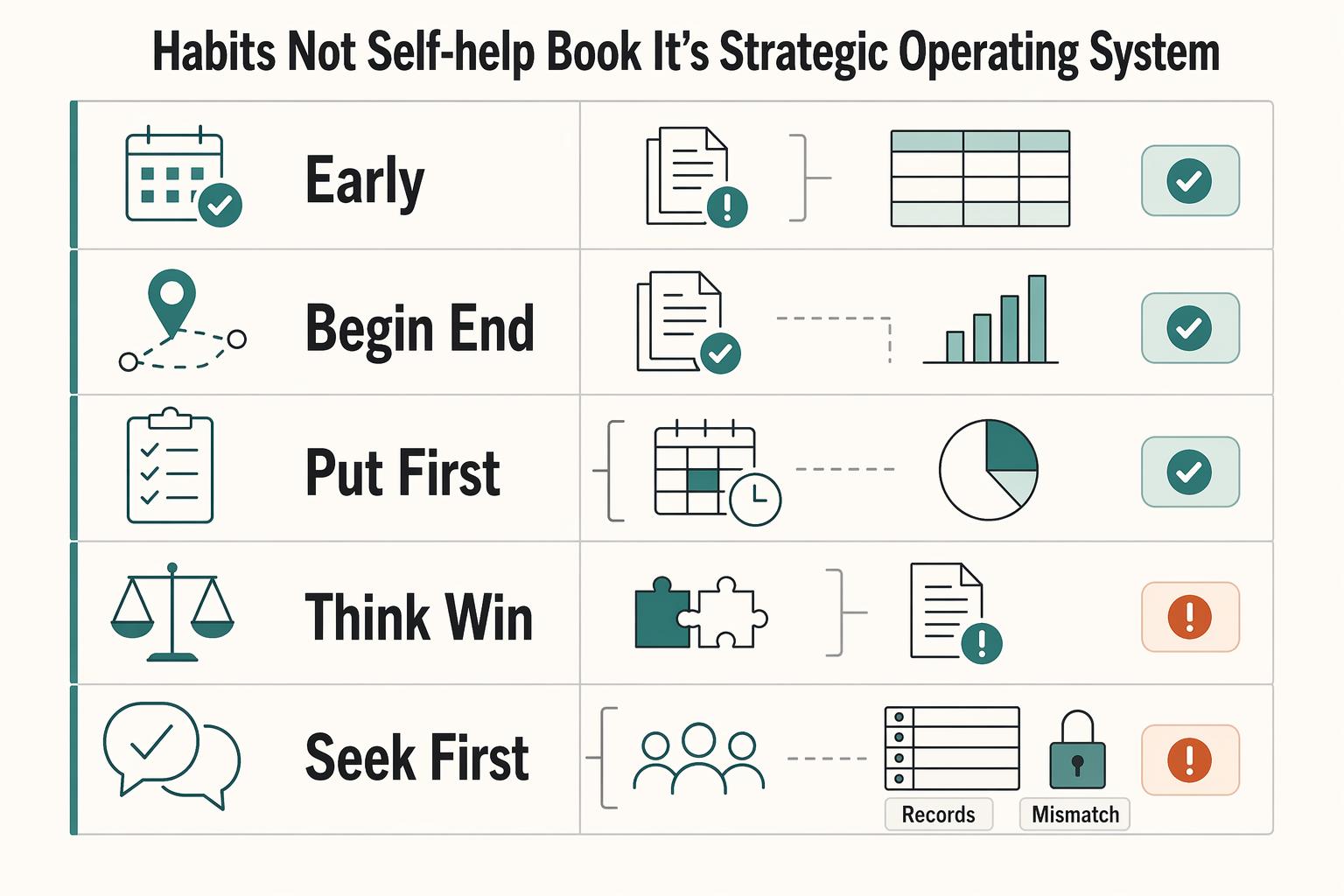
| Classic reading | Business-of-one behavior |
|---|---|
| Be early | Track exposure early, keep records, and check obligations before they become urgent |
| Begin with the end in mind | Use a clear decision filter for clients, countries, contracts, and pricing |
| Put first things first | Protect the boring essentials first: books, tax set-asides, invoicing accuracy, review cadence |
| Think win-win | Structure agreements so scope, payment terms, and responsibilities are explicit |
| Seek first to understand | Ask what jurisdiction, entity, and documentation the other side expects |
| Synergize | Bring in specialist help where your knowledge stops |
| Sharpen the saw | Improve the skills and habits that keep you effective under load |
The main failure mode is treating these habits like a short reset after a scare, a busy season, or a new year. If you only pilot them for a season, they are not really habits. Use this article as a working guide. Each section gives you a checklist, a decision filter, or a repeatable practice you can actually install. Done well, that means clearer decisions, fewer avoidable compliance surprises, and steadier execution.
If you want a deeper dive, read The Best Personal Productivity Systems for Freelancers (GTD).
Habit 1: Install a Proactive Risk Mitigation Protocol#
For your business-of-one, Habit 1 means this: prevent avoidable risk before it turns into cleanup. Focus on your Circle of Influence first, then run the same protocol every review cycle.
Use a simple control split to decide your response: direct-control issues need better habits, indirect-control issues need better influence and documentation, and no-control issues need acceptance plus clear contingency steps. This keeps you from reacting late and lets you act while options are still open.
| Situation | Reactive cleanup | Early protocol |
|---|---|---|
| Travel and residency exposure | Rebuild history from inboxes and statements after a deadline or question | Log travel in real time, note that the current threshold is pending tax-advisor verification, and escalate before you cross a trigger |
| Foreign-account monitoring | Discover balances late and guess what matters | Keep a live account register, track highest balances each cycle, and mark the current reporting rule as pending official verification |
| New client contract | Sign now, renegotiate when problems appear | Screen terms before signature, flag risk terms, and resolve in writing before kickoff |
Run this on a weekly or monthly cadence you can keep:
| Protocol pillar | What to track | Where to log it | Who reviews | Trigger action |
|---|---|---|---|---|
| Residency tracking | Work location, entry/exit dates, upcoming travel | One source-of-truth log (sheet or app export) with calendar/ticket backup | You first, then adviser/accountant when needed | Confirm the current threshold with a tax adviser, then request a formal review before more travel |
| Foreign-account monitoring | All non-home-jurisdiction accounts, balance snapshots, peak balance for period | One register with account owner, country, currency, and converted value | You first, then adviser/accountant at trigger points | Confirm the current threshold with a tax adviser and the current reporting rule from the official source, then assemble statements and escalate |
| Contract screening | Scope, payment timing, termination, IP, data handling, required compliance docs | Contract checklist stored with draft and comments | You before signature; legal review when terms are unclear or high risk | If terms are ambiguous or outside your risk tolerance, pause and redline before signing |
Done well, this protects focus and decision quality; it is not extra admin. That foundation makes the next step, your financial systems, easier to run with less stress. Need the full breakdown? Read How to Conduct a 'Weekly Review' for Your Freelance Business.
Habit 3: Clean Up Your Money Operations First#
If you want better choices later, clean up your money operations first. This habit is not about budgeting tips. It is about three repeatable workflows so cash is visible, compliance work is reviewable, and future obligations do not depend on motivation.
| Area | Ad hoc money handling | Systemized financial operations |
|---|---|---|
| Cash visibility | You check one balance and guess what is spendable | You can see operating cash, reserved cash, and items that still need review |
| Compliance readiness | You search emails and old drafts when a client or adviser asks for support | Each invoice and transfer has a traceable record, and any current requirement pending official verification is tracked before it matters |
| Decision speed | Pricing, hiring, and client choices feel reactive because the numbers are unclear | You decide faster because available cash and obligations are already separated |
What makes invoicing compliant?#
Set this up before you send, not after a client flags a problem. Owner: you. Trigger: any invoice moving from draft to sent. Review cadence: at send time, plus a weekly aging review so unpaid invoices stay visible.
| Pre-send check | What to verify |
|---|---|
| Business and client fields | Required business and client fields checked against current invoicing requirements from the official source |
| Client tax data | Validated using the current process for that jurisdiction |
| Payment terms | Matched to the signed agreement, not typed from memory |
| Documentation trail | Stored in one place: contract or statement of work, approval to proceed, delivery evidence, and final invoice copy |
Build those checks into your invoice template so you do not rely on memory.
The common miss is rushing because you want payment out quickly. Plan-first execution fixes that: decide when invoicing happens before the day gets noisy, and treat exceptions as exceptions. If client data handling is part of the engagement, this GDPR freelancer checklist is a useful related resource.
Cash segregation#
When money clears, do not leave it in one undifferentiated balance. Owner: you. Trigger: cleared client payment. Review cadence: simple and consistent; even a once-a-week pass helps.
Move incoming cash into separate buckets, whether that means separate accounts or clearly tracked sub-balances for tax, operating costs, owner pay, and near-term obligations. Do not copy someone else's fixed percentages. Base categories on your real commitments and any current requirements you confirm from official sources. Reconcile each payment against your invoice log the same day or during your weekly review. If a deposit does not match an invoice, pause and resolve it before spending.
Automated long-term reserves#
Treat reserves as a scheduled workflow, not a leftover decision. Owner: you. Trigger: a fixed transfer date or a minimum-cash rule set in advance. Review cadence: monthly, with a deeper quarterly check against your broader plan and any contribution rules confirmed from the official source.
This is where many solo operators stall because they wait until they feel ready. Difficult operational work is more reliable when it is systemized. Automate the transfer, confirm execution, and track reserves separately from operating cash. With these workflows in place, the next habit's mission filter becomes easier to apply: cleaner numbers lead to more disciplined pricing, client selection, and growth decisions.
For a related read, see A Guide to 'Deep Work' for Freelancers.
Habit 2: Define Your Mission as a Strategic Filter#
Use Habit 2 to make decisions before work makes them for you. Your mission is not identity language; it is a working filter you apply to leads, offers, and scope changes so short-term pressure does not override long-term direction.
"Begin with the End in Mind" becomes practical when you run the same workflow every time: define your positioning, set acceptance criteria, and test decisions against that filter.
How do you turn a mission into a working filter?#
Define positioning in plain terms: who you help, which problems you solve, which services you want to deepen, and which work you no longer want to sell. Keep it short enough to use during intake, proposal writing, and scope review.
Then codify acceptance criteria and apply them before a lead becomes a proposal, and before a proposal becomes signed work. If fit is unclear, treat that as a warning.
| Criterion | Green light | Yellow flag | Red flag |
|---|---|---|---|
| Fit | Matches your stated specialty and target client | Adjacent request outside your core service | One-off work outside your direction |
| Boundaries | Clear brief, clear owner, clear communication rules | Unclear brief or approvals | Always-on access, repeated urgency, informal scope creep |
| Profitability | Price matches effort and constraints | Works only with reduced scope | High expectations at low-price terms |
| Capability growth | Strengthens a service you want to build | Neutral to your direction | Pulls you back into work you are trying to sunset |
| Compliance exposure | Scope is straightforward to document and manage | Extra approvals or unclear handling requirements | Expectations you cannot manage cleanly within your operating setup |
To keep this usable under pressure, place the same criteria in three places you already use: lead notes, proposal template, and scope-change approval.
How should this filter shape services and pricing?#
Use your recent work to classify services into three lanes: deepen, maintain, sunset. Deepen services that repeatedly pass your filter. Maintain services that are still useful but not central. Sunset or restrict services that repeatedly create messy delivery, weak boundaries, or poor strategic fit.
Mission-fit also improves pricing conversations. You can describe the outcome you are responsible for, the constraints required to deliver it, and what the engagement includes, instead of defaulting to rate-only framing.
How often should you review it?#
Until the review cadence is verified for your business, test your mission against work you accepted, declined, expanded, or regretted. Update wording when direction changes, not whenever a new opportunity appears.
Once this filter is clear, collaboration habits get easier next: partner selection, referrals, and client communication become faster, cleaner, and more consistent.
For a step-by-step walkthrough, see Using the Eisenhower Matrix for Prioritization in a Solo Cross-Border Business.
Habits 4, 5, & 6: Engineer Your Ecosystem for Strategic Collaboration#
Treat collaboration as a system, not a personality trait. For a business of one, that system has three parts: better discovery, better agreements, and a small advisor bench.
Across these habits, the shared move is simple: stop treating client work as a series of handoffs. If one side "wins" early, friction usually shows up later. If you look for a workable "third alternative," you create room to solve the real problem together.
Habit 5: Run discovery before you write proposals#
Before you draft anything, diagnose the work with four checkpoints:
| Checkpoint | Question 1 | Question 2 |
|---|---|---|
| Problem diagnosis | What is happening now that made this urgent? | What have you already tried? |
| Success criteria | What has to be true for this to be successful? | How will you decide this was worth doing? |
| Stakeholder constraints | Who approves this? | What deadlines, tools, or policies do we need to work within? |
| Risk signals | What could block this once we start? | Where have similar projects gone wrong before? |
After the call, send a short recap before you propose. Confirm the problem, intended result, decision-maker, constraints, and open risks. If those basics cannot be confirmed, treat that as a risk signal, not an admin delay.
This is where prioritization discipline matters: schedule priorities and say no to work that is urgent but unimportant. Busyness can look productive while lowering actual effectiveness.
Habit 4: Design agreements for joint success, not handoff friction#
Once discovery is clear, write the agreement so both sides can run the work with fewer surprises.
| Area | Transactional proposal | Aligned agreement |
|---|---|---|
| Scope clarity | Lists tasks/deliverables only | States the problem, intended result, assumptions, and out-of-scope boundaries |
| Change handling | Handles expansion informally | Defines how changes are raised, reviewed, approved, or deferred |
| Incentive alignment | Treats work as purchased effort | Sets shared outcomes, decision rights, and client/provider responsibilities |
You do not need complex pricing language to do this well. You need clear boundaries, a visible change path, and explicit responsibilities so delays and dependencies are handled where they belong, inside each side's circle of influence.
Habit 6: Build a small advisor bench and use it early#
Your "personal board of directors" can stay informal, but the roles should be explicit:
| Role | Use for |
|---|---|
| Tax/accounting advisor | Setup, invoicing flow, and reporting-impact questions |
| Contract lawyer | Terms that create legal exposure or obligations you do not fully understand |
| Peer operator or mentor | Delivery judgment, pricing sanity checks, and client-fit decisions |
Use a simple escalation path so you do not improvise under pressure:
- Ask your peer first for commercial or delivery judgment.
- Escalate to legal or tax specialist when risk is legal/tax, not opinion.
- Pause commitment until the relevant specialist answer is clear.
The expensive mistake is usually not asking too early; it is committing first and discovering risk during delivery.
This collaboration system protects your time and judgment now, and it protects your long-term capacity next. Related: How to Apply Atomic Habits to Your Freelance Business.
Habit 7: Continuously Upgrade Your Core Asset: You, Inc.#
Once your agreements, advisors, and client boundaries are stronger, the next constraint is you. Habit 7, Sharpen the Saw, is recurring maintenance that preserves your capacity, and it is what keeps the other habits workable over time.
| Choice | Best use case | Expected business impact | Common mistake to avoid |
|---|---|---|---|
| Invest in a new capability | You keep hitting the same bottleneck in client decisions, scope, or communication | Better judgment, clearer scope, steadier stakeholder trust | Taking training because it sounds current instead of fixing a real constraint |
| Automate or delegate a workflow | Repetitive admin keeps pulling time from selling or delivery | More consistent follow-through and less mental drag | Automating a messy process with unclear ownership |
| Pause and recover | Your judgment, pace, or client experience is slipping | Protects continuity so you can return with usable capacity | Waiting until exhaustion forces an unplanned shutdown |
Which capabilities are worth building?#
Build capabilities that improve how you think with clients, define problems, communicate with stakeholders, and make decisions when the facts are incomplete. Those capabilities make your work more durable than output alone.
Do this now: pick one recurring friction point from the last quarter, then upgrade one behavior tied to one artifact you can review. Examples: a tighter discovery recap, a clearer stakeholder update template, or a short decision memo for ambiguous calls.
Use a simple checkpoint in the next few projects: can you point to one changed behavior and one improved document? If not, you likely consumed information without changing your system.
What does a lean technology setup look like?#
Use technology to reduce cognitive load, not add more. Keep your stack in three layers: finance ops, compliance reminders, and delivery admin.
- Finance ops: invoicing, payment follow-up, expense capture, and accountant handoff.
- Compliance reminders: filing dates, contract renewals, policy reviews, and client obligations.
- Delivery admin: scheduling, notes, templates, and routine status communication.
Pick categories first, then verify current tool options and pricing before publication or purchase. Run a monthly reliability check: one invoice, one reminder, and one client handoff from trigger to completion. If any step still depends on memory or buried messages, the system is not reliable yet.
Why treat renewal as continuity protection?#
Habit 7 is renewal across 4 dimensions: body, heart, mind, and spirit. In a business-of-one, that is continuity protection. If you skip regular renewal, burnout risk rises and judgment usually degrades first.
Watch for early signals: small decisions feel heavy, tone gets sharper, hard conversations get delayed, or exercise, nutrition, and stress management drop off. Pre-plan your response: pause new proposals, reduce meetings, extend noncritical timelines, or shift low-value admin before client quality slips.
Put minimum recovery into your operating routine: protected sleep, movement, deep-thinking time, and non-work time that actually restores attention. If multiple dimensions have been neglected for a stretch, treat it as an operating risk and adjust workload immediately.
This pairs well with our guide on Build a One-Page Business Continuity Plan for a Natural Disaster.
Conclusion: From Habits to High-Performance#
If you want these habits to matter, treat them as one operating layer, not seven separate tips. When they are working, they handle the basics in the background of your business. That means fewer avoidable surprises, cleaner execution, and more attention for high-value client work.
That only works when the habits become repeated practice. A common failure mode is treating them like a short campaign after a scare, a busy quarter, or a new year reset. Your verification check is practical. By the end of this week, you should be able to open the documents and reminders that prove each habit exists in real life, not just in intention. That might be a current contract template, a cash-allocation rule, a client-fit filter, an advisor contact list, and a recovery block already on your calendar. If a legal threshold, filing date, or privacy trigger still says "I'll check later," mark the exact item as pending adviser or official verification and assign that task now.
| Habit cluster | Risk reduced | Operational benefit | Next action this week |
|---|---|---|---|
| Habit 1 Early risk control | Missed obligations, preventable surprises | Earlier decisions, less reactive cleanup | Review one checklist and verify one date or threshold |
| Habit 3 Financial foundation | Cash confusion, sloppy follow-up | Better visibility, steadier execution | Separate incoming cash and test one invoice-to-payment path |
| Habit 2 Strategic filter | Bad-fit work, scattered priorities | Clearer yes/no decisions | Write or tighten your client acceptance rules |
| Habits 4 to 6 Collaboration | Weak approvals, avoidable friction | Faster decisions, cleaner handoffs | Identify one advisor or stakeholder gap and close it |
| Habit 7 Renewal and capability | Judgment drift, burnout, stalled growth | Better decisions and stronger delivery | Block one recovery session and one capability upgrade |
Choose one gap. Assign an owner, whether that is you, an advisor, or a tool, and schedule the first review checkpoint before the week ends.
You might also find this useful: Implementation Intentions for Goals in a Business of One.
Frequently Asked Questions
What makes invoicing compliant?
Set this up before you send, not after a client flags a problem. Owner: you. Trigger: any invoice moving from draft to sent. Review cadence: at send time, plus a weekly aging review so unpaid invoices stay visible. Pre-send check; What to verify Pre-send check: Business and client fields; What to verify: Required business and client fields checked against current invoicing requirements from the official source Pre-send check: Client tax data; What to verify: Validated using the current process for that jurisdiction Pre-send check: Payment terms; What to verify: Matched to the signed agreement, not typed from memory Pre-send check: Documentation trail; What to verify: Stored in one place: contract or statement of work, approval to proceed, delivery evidence, and final invoice copy Build those checks into your invoice template so you do not rely on memory. The common miss is rushing because you want payment out quickly. Plan-first execution fixes that: decide when invoicing happens before the day gets noisy, and treat exceptions as exceptions. If client data handling is part of the engagement, this GDPR freelancer checklist is a useful related resource.
How do you turn a mission into a working filter?
Define positioning in plain terms: who you help, which problems you solve, which services you want to deepen, and which work you no longer want to sell. Keep it short enough to use during intake, proposal writing, and scope review. Then codify acceptance criteria and apply them before a lead becomes a proposal, and before a proposal becomes signed work. If fit is unclear, treat that as a warning. Criterion; Green light; Yellow flag; Red flag Criterion: Fit; Green light: Matches your stated specialty and target client; Yellow flag: Adjacent request outside your core service; Red flag: One-off work outside your direction Criterion: Boundaries; Green light: Clear brief, clear owner, clear communication rules; Yellow flag: Unclear brief or approvals; Red flag: Always-on access, repeated urgency, informal scope creep Criterion: Profitability; Green light: Price matches effort and constraints; Yellow flag: Works only with reduced scope; Red flag: High expectations at low-price terms Criterion: Capability growth; Green light: Strengthens a service you want to build; Yellow flag: Neutral to your direction; Red flag: Pulls you back into work you are trying to sunset Criterion: Compliance exposure; Green light: Scope is straightforward to document and manage; Yellow flag: Extra approvals or unclear handling requirements; Red flag: Expectations you cannot manage cleanly within your operating setup To keep this usable under pressure, place the same criteria in three places you already use: lead notes, proposal template, and scope-change approval.
How should this filter shape services and pricing?
Use your recent work to classify services into three lanes: deepen, maintain, sunset. Deepen services that repeatedly pass your filter. Maintain services that are still useful but not central. Sunset or restrict services that repeatedly create messy delivery, weak boundaries, or poor strategic fit. Mission-fit also improves pricing conversations. You can describe the outcome you are responsible for, the constraints required to deliver it, and what the engagement includes, instead of defaulting to rate-only framing.
How often should you review it?
Until the review cadence is verified for your business, test your mission against work you accepted, declined, expanded, or regretted. Update wording when direction changes, not whenever a new opportunity appears. Once this filter is clear, collaboration habits get easier next: partner selection, referrals, and client communication become faster, cleaner, and more consistent. For a step-by-step walkthrough, see Using the Eisenhower Matrix for Prioritization in a Solo Cross-Border Business.
Which capabilities are worth building?
Build capabilities that improve how you think with clients, define problems, communicate with stakeholders, and make decisions when the facts are incomplete. Those capabilities make your work more durable than output alone. Do this now: pick one recurring friction point from the last quarter, then upgrade one behavior tied to one artifact you can review. Examples: a tighter discovery recap, a clearer stakeholder update template, or a short decision memo for ambiguous calls. Use a simple checkpoint in the next few projects: can you point to one changed behavior and one improved document? If not, you likely consumed information without changing your system.
What does a lean technology setup look like?
Use technology to reduce cognitive load, not add more. Keep your stack in three layers: finance ops, compliance reminders, and delivery admin. Finance ops: invoicing, payment follow-up, expense capture, and accountant handoff. Compliance reminders: filing dates, contract renewals, policy reviews, and client obligations. Delivery admin: scheduling, notes, templates, and routine status communication. Pick categories first, then verify current tool options and pricing before publication or purchase. Run a monthly reliability check: one invoice, one reminder, and one client handoff from trigger to completion. If any step still depends on memory or buried messages, the system is not reliable yet.
Why treat renewal as continuity protection?
Habit 7 is renewal across 4 dimensions: body, heart, mind, and spirit. In a business-of-one, that is continuity protection. If you skip regular renewal, burnout risk rises and judgment usually degrades first. Watch for early signals: small decisions feel heavy, tone gets sharper, hard conversations get delayed, or exercise, nutrition, and stress management drop off. Pre-plan your response: pause new proposals, reduce meetings, extend noncritical timelines, or shift low-value admin before client quality slips. Put minimum recovery into your operating routine: protected sleep, movement, deep-thinking time, and non-work time that actually restores attention. If multiple dimensions have been neglected for a stretch, treat it as an operating risk and adjust workload immediately. This pairs well with our guide on Build a One-Page Business Continuity Plan for a Natural Disaster.
Try a related tool
Researched and edited by the Gruv editorial team. Gruv builds cross-border billing, payouts, and finance-operations software for global businesses.
Sources
Includes 1 external source outside the trusted-domain allowlist.
- briarcliff.edu/filesimages/Future%20Chargers/Registration/2...trusted
- cdtfa.ca.gov/taxes-and-fees/manuals/am-04.pdftrusted
- dhcs.ca.gov/ar/provgovpart/Documents/CalAIM-Eval-Design-...trusted
- fac.gov/assets/compliance/2024-Compliance-Supplement...trusted
- justiceinnovation.law.stanford.edu/category/current-projects/ai-a2jtrusted
- nro.gov/Portals/135/documents/foia/docs/hosr/hosr-vo...trusted
- pmc.ncbi.nlm.nih.gov/articles/PMC9848739trusted
- addicted2success.com/success-advice/the-7-keys-to-incredible-life...external
Educational content only. Not legal, tax, or financial advice.
Related Posts

GDPR Compliance Checklist for Freelancers Working With EU Clients
Start by separating the decisions you are actually making. For a workable **GDPR setup**, run three distinct tracks and record each one in writing before the first invoice goes out: VAT treatment, GDPR scope and role, and daily privacy operations.

The Best Productivity Systems for Freelancers: GTD, PARA, and Second Brain
**Treat productivity as a system you can run under load, not a vibe you summon on demand.** Client work is messy by default: requests scattered across Gmail and Slack, scope shifting midstream, and the annoying truth that "done" does not always mean "paid."

The Freelance Payment Penalty: A Modeled Audit of Platform Fees, FX Spreads, and Payout Delays
The money rarely disappears through a single, easy-to-spot fee. The real loss is stacked. A marketplace takes its commission, a processor adds a charge for international cards, a bank or payment company converts the currency at a spread, a platform holds the funds before release, and a wire sheds a little to intermediaries on the way in. Each layer looks defensible on its own, but the worker feels the combined result as a smaller deposit and a later payday.