
Quick Answer
Yes - use day count as the deciding signal. In Thailand, the article treats 180 days or more in a calendar year as the residency trigger under a Section 41 framing, then requires income classification before tax estimates. Keep a live log tied to passport stamps, immigration records, transfer purpose notes, and invoices. If remittance treatment or Form 8938 versus FBAR scope is still unclear after monthly review, escalate to a tax professional early.
Why this guide exists for nomads in Thailand in 2026#
Low-stress compliance in Thailand comes from early decisions and clean records, not last-minute cleanup. Most costly problems start as small assumptions about visas, day counts, and money movement that stack up over time.
Thailand has several visa paths for remote workers, and extended stays require an appropriate visa. Some options, including the Destination Thailand Visa (DTV), can run up to five years. That long horizon makes it easy to delay planning unless you track presence and transfers from day one. Choose a visa that fits your plans, but do not use visa status as your only tax signal.
Use a simple sequence: set boundaries before arrival, verify facts during the year, and escalate once records stop being clear. This guide gives you a practical decision path for day counting and a checklist to validate facts before assumptions become expensive.
If you have to rebuild a full year from scattered emails, bank screenshots, and memory, pressure rises fast. The goal here is to avoid that rebuild cycle by creating clear records before you need them.
Build an evidence pack you can defend quickly:
- A live day log with each entry and exit date, reconciled regularly with passport stamps and travel bookings.
- A transfer ledger with date, amount, source account, and purpose for funds moved into Thailand.
- A client file with contracts and invoices so payment timing and work periods are easy to match.
- A short monthly note on what changed, what is unclear, and what needs review.
By the end, you should know what to decide before arrival, what to verify during the year, and what to document when your tax position needs review. If you want a location contrast, see London, UK: A Guide for Expats and Remote Workers. If you want a quick next step for thailand digital nomad tax residency, try the tax residency day counter.
The terms that decide your tax outcome#
Your outcome is driven by day count and income classification, not visa label.
| Term | What the article says | Record or factor mentioned |
|---|---|---|
| Thailand Tax Residency / Thai Tax Resident | 180 days or more in a calendar year can put you into resident treatment | physical presence |
| Day count discipline | weekends, holidays, and partial days are included | passport stamps, visa extensions, and immigration records |
| Non-resident status | non-residents are liable only for Thai-sourced income | Thai-sourced income |
| Income from a post held in Thailand | can be taxable in Thailand regardless of where payment is made and regardless of residency status | where the post is held in Thailand |
| Foreign-sourced income vs. remittance timing | keep these as separate labels in your records | separate labels in your records |
| Visa terms (DTV, LTR) | describe immigration permission, not the tax-residency test by themselves | visa terms |
| Double Taxation Agreement (DTA) | can affect double-tax outcomes, but treaty relief is not automatic | verify before you rely on it |
Keep these terms visible while reviewing your own file. Most confusion starts when one label is used to answer a different question, such as using visa type to infer tax treatment. If you want a deeper dive, read our guide to a defensible 2026 filing plan.
What current search results get right and where they stay vague#
Search results are useful for orientation, but they are not enough on their own for filing decisions.
Some results get the high-level frame right. You will see common tax-residency questions and practical visa mechanics. One DTV summary presents it as a five-year, multiple-entry visa. It also lists up to 180 days per entry plus one 180-day extension, along with variable pricing and savings-proof requirements.
The weak point is authority and decision detail. One visible expat-tax resource says it is independent and not an official government site. Its Expat Taxation page is a tagged question index with 40 questions, including tax ID questions for DTV holders. That can surface recurring confusion, but it is still discussion content, not primary authority.
Use a quick filter before you trust any claim:
- Identify source type first: official guidance, professional analysis, or community discussion.
- Check publication or update date.
- Keep visa logistics separate from tax conclusions.
- Ask what document in your file would support the claim.
A practical step is to keep a short claim log as you research. Capture the claim, mark it as confirmed or unconfirmed, and note which document in your own records would support it. That habit keeps online reading useful without letting one unverified line shape your filing decisions.
If a claim would change your residency position, remittance treatment, or DTA outcome, treat it as unverified until you confirm it against primary guidance and your records.
Decide your residency risk before you cross the 180-Day Rule#
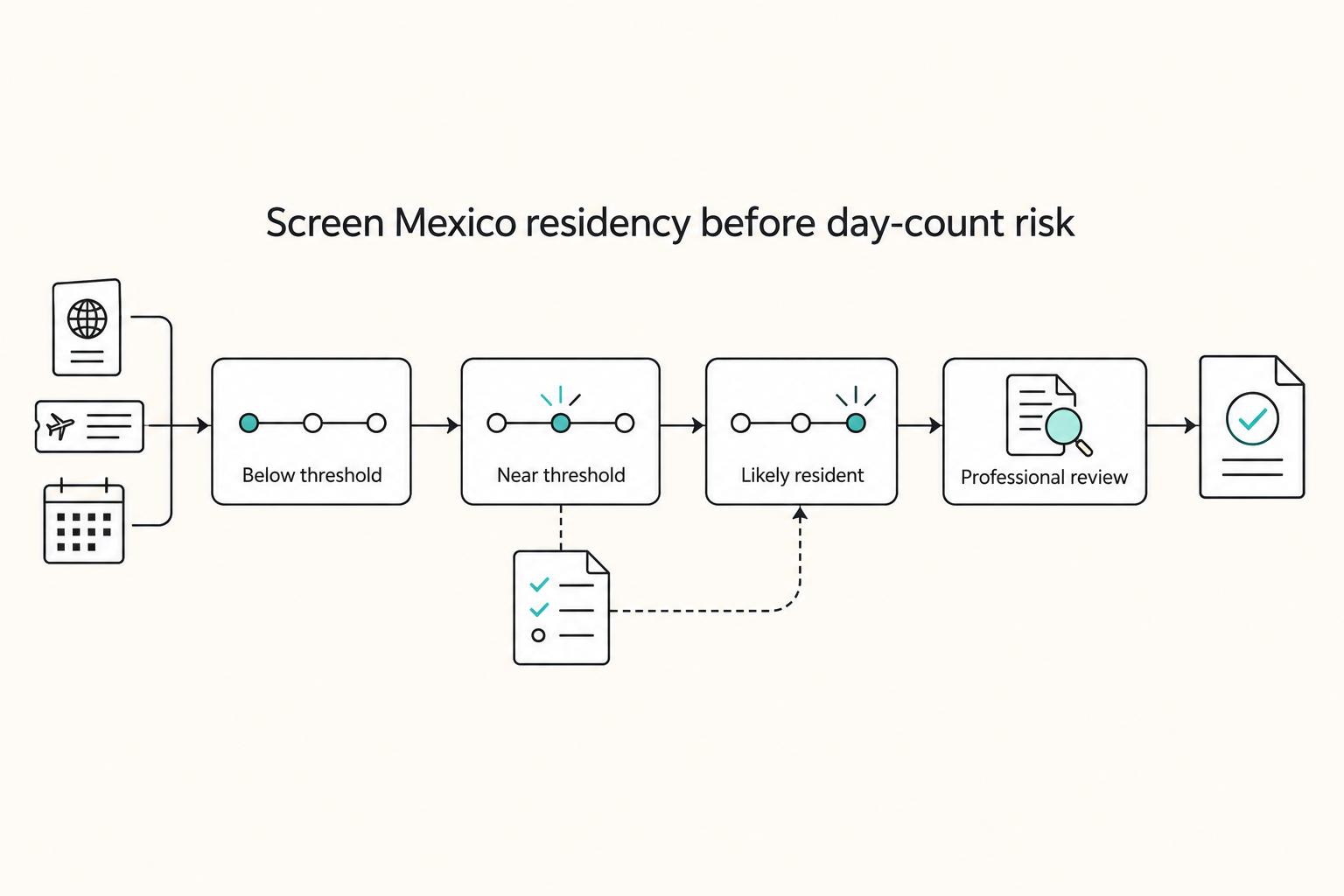
Choose your branch early: stay clearly below 180 days, or prepare for potential resident treatment. Waiting until year-end creates avoidable stress.
For Thailand tax residency, the test is generally framed around physical presence, not visa label. The threshold is generally described as 180 days or more in a calendar year, and the count is cumulative rather than consecutive. Short trips in and out still count, and this framing is described as applying regardless of visa type or nationality.
| Projected days by year-end | Branch to choose now | Immediate action | Main risk if you wait |
|---|---|---|---|
| Clearly below 180 | Stay below threshold | Lock travel dates and leave buffer days | An unplanned extra stay pushes you over late in the year |
| Near 180 with uncertain travel | Prepare as potential resident | Start full records now and pre-classify income flows | You cross the line with weak documentation |
| 180 or more likely | Assume potential resident exposure | Plan for Thai personal income tax analysis and filing support | Year-end reconstruction under deadline pressure |
A common friction point is a late travel change that looked minor when booked. One extra block of days near year-end can move you from low risk to high effort if your records are incomplete.
If most income is offshore, map when funds enter Thailand before you get close to the threshold. Public explainers differ on income scope, so track where income was earned separately from when money entered Thailand. That makes later transfers easier to classify.
Use one auditable log and update it monthly, not in December:
- Entry and exit dates, checked against passport stamps, visa extension records, and immigration records.
- Bank transfer date, amount, source account, destination account, and purpose note.
- Client invoice date, payment date, and contract period.
Decision rule: if your day count is uncertain and contracts are active, prepare now as a potential Thai tax resident. Treat income-scope and treaty outcomes as escalation items when public explainers do not align on a boundary that affects filing. You might also find this useful: Tax Residency in Costa Rica: A Guide for Pura Vida Nomads.
Understand what may be taxed after you become a Thai Tax Resident#
After resident treatment applies, define income scope before estimating tax. Start with Thai Personal Income Tax rules, not headline summaries.
Use two buckets in your records: income sourced in Thailand, and foreign-sourced income. Then track remittance timing as a separate layer: if, when, and how funds were brought into Thailand. Available guidance indicates that remitted foreign income may be in scope after residency, but treatment can depend on facts, so classify first and calculate second.
A simple contrast shows why this matters: two people earn the same offshore income, but only one remits part of it into Thailand during the year. Their practical risk profile can differ even with identical earnings because remittance timing may affect what is treated as taxable.
Apply progressive brackets only after scope is clear. The structure cited here is progressive from 0% to 35%, so do not assume one flat rate or assume the top rate applies to all taxable income.
| Topic | Known now | Unclear now | Action now |
|---|---|---|---|
| Residency status | 180 days or more in a calendar year, based on physical presence, can trigger resident treatment | Day-count and status timing details in specific cases | Reconcile day count monthly |
| Income scope | Thailand-sourced income is in scope; remitted foreign income may be in scope after residency | Exact treatment of each transfer | Tag each transfer with source, date, and purpose |
| Rate planning | Thai Personal Income Tax is progressive from 0% to 35% | Final bracket outcome before taxable base is finalized | Estimate only after classification is complete |
One practical safeguard is to run income classification before any tax estimate each month. If a transfer has no clear source link or purpose note, leave it flagged instead of forcing it into a category too early.
Use a monthly verification checkpoint: reconcile presence with passport stamps, visa extensions, and immigration records, then tie transfers to clear source records and dates. If you cannot clearly separate Thailand-sourced income, foreign-sourced income, and remittances, escalate before filing.
Compare DTV and LTR Visa through a tax-residency lens#
Once income scope is clear, compare visa paths by how they affect day count and remittance behavior. DTV and LTR are visa paths, not automatic tax outcomes.
As of 2025, the source guidance says there is no official visa category specifically named a Digital Nomad Visa in Thailand. In this material, DTV and LTR are the main visa labels discussed, so loose labeling is a risk signal before you make tax assumptions.
DTV has the strongest practical detail available. It is described as introduced in 2024, with multiple visits over a five-year period and a 180-day limit per visit. LTR is described in available coverage as aimed at investors and highly skilled professionals. The tax lens stays the same for both: residency status, income type, and remittance behavior.
| Visa path | Best fit | Main risk | What to verify first |
|---|---|---|---|
| Destination Thailand Visa (DTV) | People seeking repeat entries under a five-year structure with 180-day visit limits | Long repeat stays can increase residency exposure | Realistic annual day-count pattern, then whether inbound transfers could be treated as remittances tied to taxable income |
| LTR Visa | People who align with investor or highly skilled positioning | Assuming the visa label changes tax treatment by itself | Whether your planned stay pattern and banking flow differ from your DTV scenario |
When comparing options, keep the same checklist for both paths so you can see the real tradeoff. If one plan increases your days in country or changes transfer patterns, that is the practical tax difference to manage.
If your plan involves long continuous stays, treat this as a tax-planning decision, not only an immigration decision. Keep one monthly log that ties entry and exit dates, visa-validity periods, transfer dates, source accounts, and invoice months so classification remains defensible.
Be explicit about uncertainty when comparing DTV and LTR for tax outcomes. Public detail is stronger on DTV, and full cross-visa tax equivalence is not established. Some LTR visibility comes from syndicated third-party press content, which can show interest but is not tax-law authority.
Build your evidence pack before arrival and keep it current#
Your position is only as defensible as your records. Build one evidence pack before arrival, then update it monthly so day count, income timing, transfer logs, and reporting files stay aligned.
| Folder | Contents mentioned | Linked topic |
|---|---|---|
| 01_presence | passport stamps, boarding passes, visa pages, extension records, and your monthly day-count sheet | day count and presence |
| 02_income_docs | client contracts, invoices, payment confirmations, and notes on where work was performed | income timing and where work was performed |
| 03_transfers | bank statements plus a transfer log with date, source account, destination account, amount, currency, and one-line purpose | transfers and reporting |
| 04_tax_positions | home-country filing assumptions, DTA notes, and unresolved questions for a tax professional | tax positions and open questions |
| 05_us_reporting | Form 8938 drafts, FBAR support files, and year-end account value calculations | U.S. reporting |
Set up a core folder structure that mirrors those decisions:
01_presence: passport stamps, boarding passes, visa pages, extension records, and your monthly day-count sheet.02_income_docs: client contracts, invoices, payment confirmations, and notes on where work was performed.03_transfers: bank statements plus a transfer log with date, source account, destination account, amount, currency, and one-line purpose.04_tax_positions: home-country filing assumptions, DTA notes, and unresolved questions for a tax professional.05_us_reporting: Form 8938 drafts, FBAR support files, and year-end account value calculations.
For any transfer that could affect your tax reporting, record it the same day. Include transfer date, source account owner, receiving account, related invoice period, and purpose. A clean bank trail without purpose notes is exactly where classification slows down and costs more later.
If you are US-linked, treat Form 8938 and FBAR as separate obligations even when data overlaps. Form 8938 is attached to your income tax return. Higher thresholds may apply for joint filers or people residing abroad. Filing Form 8938 does not remove a FinCEN Form 114 requirement.
Build your annual account-value file monthly, not at year-end. FinCEN defines maximum account value as a reasonable approximation of the highest value during the calendar year. Record values in U.S. dollars rounded up to the next whole dollar, and convert non-U.S. currency using the Treasury Financial Management Service rate, so 15,265.25 becomes 15,266.
Consistency matters as much as completeness. Keep file names and note structure stable across months so you can find a document quickly when a question comes up.
Run one monthly reconciliation pass with three checks: presence ledger versus travel evidence, invoice ledger versus incoming payments, and account logs versus reporting files. If a payment cannot be tied to a contract period and purpose note, flag it and resolve it before month close.
Run a monthly compliance routine while living in Bangkok or elsewhere in Thailand#
Make month-end close a fixed routine. Updating records while details are fresh is what keeps compliance manageable and defensible.
| Check | When | Focus |
|---|---|---|
| Month-end close | each month | update your day-count ledger, classify new income entries, tag remittances, and review unresolved items against your current tax residency assumptions |
| Extra review after major events | within a few days of long stays in one country, large inbound transfers, or visa-status changes | capture the facts quickly and flag where prior assumptions may no longer hold |
| Light mid-month check | when activity is heavy | do enough review to keep unresolved items from piling up |
| Cross-border Social Security check | when U.S. coverage applies | use a Certificate of Coverage to support exemption from foreign Social Security taxes |
| Decision log | close each month | note what changed, what assumption you kept, what assumption you changed, and when uncertain items will be verified with a professional |
Use the same order each month:
- Update your day-count ledger and match it to travel proof.
- Classify new income entries and tie each payment to invoice period and contract notes.
- Tag remittances with source account, destination account, amount, currency, and purpose.
- Review unresolved items against your current tax residency assumptions and mark what needs professional confirmation.
Run an extra review after major events, not only at month-end. Long stays in one country, large inbound transfers, or visa-status changes should trigger a follow-up within a few days. Capture the facts quickly and flag where prior assumptions may no longer hold.
A light mid-month check can also help when activity is heavy. You do not need a full close each time, just enough review to keep unresolved items from piling up.
If you are self-employed, keep a separate U.S. file for Schedule SE (Form 1040). Schedule SE is used to calculate self-employment tax on net self-employment earnings, and that tax refers to Social Security and Medicare taxes. It applies regardless of age, and the Social Security Administration uses Schedule SE information to calculate benefits.
Add a separate cross-border Social Security check. Totalization agreements are designed to prevent dual Social Security taxation by assigning coverage to one country, but they do not apply to every country pair. When U.S. coverage applies, use a Certificate of Coverage to support exemption from foreign Social Security taxes. Employers and self-employed individuals can request certificates online.
Keep a plain-language red-flag queue:
- A transfer has no source-of-funds note or no linked invoice period.
- Residency indicators conflict across countries and no written tie-break assumption exists.
- Self-employment entries in your books do not reconcile to draft Schedule SE inputs.
- Prior-year forms or historical thresholds are being treated as current-year rules.
Close each month with a short decision log: what changed, what assumption you kept, what assumption you changed, and when uncertain items will be verified with a professional. If one unresolved item affects both local tax treatment and Schedule SE reporting, escalate before the next month closes.
Avoid the mistakes that lead to penalties and stress#
Penalties and stress often come from the same pattern: day count is treated as optional, visa labels are overread, fee figures are taken at face value, and source control is weak.
First mistake: treating day-count tracking as optional instead of a planning trigger. Tax residency can depend on days present, regardless of visa status. If your projected days drift from plan, recheck classification before month-end.
Second mistake: assuming one published DTV fee applies everywhere. Published fee figures vary: some list a standard 10,000 THB fee with a USD range that varies by embassy, while others list a different range. If fees differ across sources, treat the number as unconfirmed until you verify it through official channels.
Third mistake: relying on the DTV label alone as if it settles tax treatment. One DTV description presents a five-year, multiple-entry setup with up to 180 days per entry plus one 180-day extension. That still does not replace residency analysis. Immigration convenience and tax outcome are related, not identical.
Fourth mistake: weak records and weak source control. One DTV information site states it is not official and directs applicants to Thailand's official e-visa portal. When core facts conflict, log the conflict and verify through official channels before acting.
When two of these mistakes overlap, cleanup work expands quickly. A day-count issue plus unverified fee assumptions can create avoidable delays.
| Mistake | Why it creates stress later | First fix this month |
|---|---|---|
| Day-count tracking treated as optional | Day-count assumptions drift and get harder to unwind later | Reconcile day count to travel proof and update projections |
| One DTV fee treated as universal | Conflicting figures can distort planning | Treat published fees as provisional until verified |
| DTV label used as tax conclusion | Immigration status is mistaken for tax outcome | Recheck tax assumptions when stay pattern changes |
| Unofficial or mixed-quality sources treated as final | Decisions rest on unverified facts | Keep one decision log and confirm key items through official channels |
Close each month with a short decision entry: what changed, what you kept, what you revised, and what still needs professional confirmation. If one unresolved item touches day count, fee assumptions, and visa timing at once, escalate it immediately.
Know exactly when to bring in a tax professional#
Escalate as soon as a material uncertainty survives your month-end review, especially when one issue affects U.S. foreign-asset reporting and documentation at the same time. Use these hard triggers:
| Escalation trigger | Why it cannot wait | What to prepare first |
|---|---|---|
| You may be near or over a Form 8938 reporting threshold, but total specified foreign asset values are unclear | Form 8938 applies only when specified foreign assets exceed the applicable threshold, and thresholds vary by filer category | Draft asset inventory, valuation notes, and current-year filing assumptions |
| It is unclear whether you must file an income tax return for the year | Form 8938 is attached to an income tax return, and if no income tax return is required, Form 8938 is not required | Prior-year returns, current-year income summary, and unresolved filing questions |
| It is unclear whether both Form 8938 and FBAR apply | Filing Form 8938 does not remove separate FBAR filing obligations | Draft Form 8938 data and an FBAR account list |
Ask for deliverables, not general advice. Request a written position on Form 8938/FBAR scope, a filing calendar, a document checklist by return, and a short risk memo listing what is still uncertain.
Use a complete handoff packet to reduce billable back-and-forth:
- specified foreign asset inventory with valuation support
- draft Form 8938 data and threshold assumptions by filer category
- FBAR account list with maximum account values in U.S. dollars, rounded up to whole dollars
- prior-year filings and current-year draft assumptions
- exact open questions that need a written answer
Before the call, run one U.S. reporting checkpoint. Form 8938 is attached to your income tax return and applies only when specified foreign assets exceed the applicable threshold. For certain taxpayers, the IRS cites an aggregate value above $50,000, with higher thresholds for some filer categories. If no income tax return is required for the year, Form 8938 is not required. Filing Form 8938 does not replace FBAR. FBAR maximum account values are reported in U.S. dollars rounded up to whole dollars.
To get better advice faster, send your packet and your exact open questions before the meeting. Clear inputs usually produce clearer written conclusions.
Take the lowest-stress next step now#
Pick one path this week and run it with clean records. If your plan keeps you clearly below 180 days in Thailand in a calendar year, manage travel to stay below that line. If you may reach 180 days or more, operate now as potentially within Thai tax residency rules and document decisions as you go.
Day counting is your first control point because all days in the calendar year count, and they do not need to be consecutive. Short exits do not reset the count. Keep one running yearly total and review it monthly.
Visa type does not remove the threshold. The 180-day rule is described as applying regardless of visa type, including DTV. DTV can allow up to 180 days per entry, plus one 180-day extension, so long stays can move you across the residency threshold if you are not tracking totals.
Build a compact evidence pack before it becomes urgent:
- A calendar-year day-count ledger, updated monthly.
- A remittance log with transfer date, source account, destination account, amount, and purpose.
- Income notes separating what was earned from what was brought into Thailand.
- A short assumptions note listing open issues you still need confirmed.
Start with one practical move today: open your day-count ledger and remittance log, then backfill the current month while details are still clear. That single step makes next month easier and reduces year-end pressure.
Keep the monthly routine small and repeatable. Reconcile new transfers against your remittance log, then check whether any movement changes your likely status. Gaps are manageable in real time and expensive to reconstruct later.
Bring in professional help early when your case involves cross-border requirements or unclear remittance treatment. The trigger is uncertainty that can change filing decisions, not panic. Ask for written guidance on your specific facts so your next steps stay consistent.
Frequently Asked Questions
When does a digital nomad become a Thai Tax Resident in Thailand?
You are generally treated as a Thai tax resident once you are in Thailand for 180 days or more in a calendar year. The trigger is physical presence, not visa classification. Track your days against passport and immigration records throughout the year to avoid counting errors.
Does crossing the 180-Day Rule mean all income is taxed immediately?
Not necessarily. Crossing 180 days can change residency status, then income still needs classification before you estimate tax. Separate Thai-sourced income from foreign amounts and review remittances before building a payment plan.
Is only Income Remittance to Thailand potentially taxable for Foreign-Sourced Income?
Published guidance is not fully aligned on one framing. One view describes resident taxation more broadly, while another says remitted foreign-sourced income may be subject to Thai tax. Treat this as a clarification point and document your income-to-transfer trail.
What tax range should I expect under Thai Personal Income Tax and Progressive Tax Brackets?
The cited range is 0% to 35% under a progressive structure. That is not a single flat rate on all income. Your effective rate depends on what income is in scope after classification.
Are Destination Thailand Visa (DTV) holders treated differently from LTR Visa holders for tax residency?
Tax residency is a day-count question, not a visa-label question. DTV is a five-year multiple-entry visa with stays of up to 180 days per entry, plus one 180-day extension, so longer stays can push you over the threshold. Confirm specific LTR tax carve-out details with the relevant authority.
Is the 'three months makes you a tax resident' claim reliable?
No. The established threshold is 180 days or more in a calendar year. Treat the three-month claim as unreliable and keep a clear day ledger tied to travel evidence.
When should I involve a professional instead of self-managing my compliance?
Bring in a professional when your day count is near 180 and income-scope or remittance treatment is still unclear. Escalate early if your facts do not cleanly fit one interpretation from available guidance. Prepare a concise packet first: day-count log, remittance ledger, visa timeline, prior filings, and open questions.
Try a related tool
Researched and edited by the Gruv editorial team. Gruv builds cross-border billing, payouts, and finance-operations software for global businesses.
Sources
Includes 2 external sources outside the trusted-domain allowlist.
Educational content only. Not legal, tax, or financial advice.
Related Posts

Digital Nomad Taxes in 2026 With a Defensible Filing Plan
With digital nomad taxes, the first move is not optimization. It is figuring out where you may be taxable, where filings may be required, and what proof supports that position.

London, UK: A Guide for Expats and Remote Workers
Get two calls right early and the rest of the move gets easier: how you'll be in the UK, and where you'll work when conditions are less than ideal. Make those decisions before you lock dates or prepay a long stay. If you book first and sort the basics later, admin and work reliability usually collide in your first week.
Costa Rica Tax Residency for Pura Vida Nomads
A six-month day-count threshold is a useful starting filter, not the full test. A defensible position depends on both time in country and Costa Rica-source income, using definitions tied to Article 5 of the Costa Rican Income Tax Law Regulations and Article 2 of Administrative Regulation DGT-R-033-12.