
Quick Answer
Choose the filing position your records can prove, not the one with the lowest draft estimate. For poland tax residency for developers, the practical order is to compare ryczalt, podatek liniowy, and skala on real numbers, test whether IP Box eligibility and documentation are actually met, and keep a residency file that supports either day count or a life-center argument. Re-check after major changes in clients, countries, or tax form elections.
If you work as a senior developer on a B2B contract in Poland, treat yourself like a business, not just a contractor. Your job is to choose a tax position you can support, then keep records that hold up if questions come later. This guide follows that order: first your core tax base, then IP Box, then residency. The aim is simple: improve your after-tax result without building on assumptions you cannot defend.
Phase 1: Architect Your Core Profitability#
Start with the tax base#
Start with the tax method your records can support cleanly. If your records cannot support it, any later optimization is fragile. This choice determines what gets taxed, what you can deduct, and how much record-keeping you can realistically maintain through the year. In practice, the headline rate matters less than whether your books support the position. You are choosing between ryczałt od przychodów ewidencjonowanych, podatek liniowy, and, by default, skala podatkowa.
- Under ryczałt, the base is revenue, after eligible deductions, and you do not reduce that revenue by ordinary business expenses.
- Under podatek liniowy, the base is income: revenue minus deductible costs, taxed at 19% regardless of income size.
- Under skala podatkowa, the base is also income: revenue minus deductible costs, taxed at 12% up to 120,000 zł and 32% above 120,000 zł on the excess. It is the default if you do not elect another form.
| Regime | What is taxed | Deduction logic | Record burden | Current checkpoint (verify for your year) |
|---|---|---|---|---|
| Ryczałt | Revenue base | No reduction by ordinary business expenses | Ewidencja przychodów; if multiple rates apply, records must separate revenue by activity type | IT table includes a 12% line for some services; verify your exact activity classification and confirm prior-year revenue is within the 2 mln euro limit |
| Podatek liniowy | Income = revenue - deductible costs | Deductible costs can reduce base if properly documented | PKPiR or accounting books, plus fixed/intangible asset records | 19% flat rate; verify you can consistently maintain cost and asset evidence |
| Skala podatkowa | Income = revenue - deductible costs | Deductible costs can reduce base if properly documented | Bookkeeping that supports cost documentation; income combines with other scale-taxed income | 12% to 120,000 zł, 32% above; check impact of salary or other scale-taxed income |
Use this decision workflow#
The right answer usually appears once you model your real numbers and strip out costs you cannot prove. Use your own inputs, not rough assumptions.
- Map your recent cost pattern and keep only costs you can prove.
- Check whether your services split across activity types before you assume one ryczałt rate.
- Model each base with your own inputs:
Ryczałt: taxable revenue x verified rate*Linear: (revenue - documented deductible costs) x 19%*Scale: 12% up to 120,000 zł, then 32% on excess
- Choose the regime your evidence can defend, not just the one with the lowest draft estimate.
For ryczałt versus linear, use this planning test:
Documented costs needed for linear to match ryczałt = revenue - ((taxable ryczałt revenue x verified ryczałt rate) / 19%)
If your documented costs are clearly above that line, linear may be worth testing seriously. If they are clearly below it, ryczałt may be simpler to defend in practice. If your records are incomplete, use the conservative default: count only costs you can prove now, and do not assume one ryczałt rate until classification is confirmed.
Deadlines and guardrails#
These deadlines are simple but unforgiving. If you want linear or ryczałt, the election is generally due by the 20th day of the month after the month of your first business revenue. Miss it, and you may remain on scale by default for the year.
| Situation | Guidance |
|---|---|
| Election for linear or ryczałt | Generally due by the 20th day of the month after the month of your first business revenue |
| Mixed income, for example B2B plus employment | Escalate early to a tax advisor |
| Uncertain deductibility on major costs | Escalate early to a tax advisor |
| Cross-border residency exposure | Escalate early to a tax advisor |
| Two countries treat you as resident | Rely on treaty rules rather than day-count alone |
| Taxation appears inconsistent with a treaty | MAP may be available |
If you have mixed income, for example B2B plus employment, uncertain deductibility on major costs, or cross-border residency exposure, escalate early to a tax advisor. If two countries treat you as resident, rely on treaty rules rather than day-count alone. If taxation appears inconsistent with a treaty, MAP may be available. Related: The Best Digital Nomad Cities in Eastern Europe.
Phase 2: Qualify for the 5% Rate with the IP Box#
Once your base method is sound, test IP Box. Use it only after you clear four gates in order: a compatible PIT regime, qualifying IP activity, qualifying software-IP income, and records ready for scrutiny. The 5% rate applies to qualified income from qualified IP, not to all freelance revenue.
Pass the gates in order#
Work through these gates in sequence. If one fails, stop there instead of trying to rescue the claim later.
| Gate | What to confirm | If it fails |
|---|---|---|
| Regime gate | For PIT, this path covers skala podatkowa or podatek liniowy | If you are on ryczałt, treat this section as out of scope and verify separately before planning an IP Box claim |
| IP activity gate | Your work must involve creating, developing, or improving protected software copyright as part of B+R activity | Stop there instead of trying to rescue the claim later |
| Income gate | Your income must be tied to qualifying IP, for example licence-based income, IP value included in a product or service price, or qualifying infringement damages | Stop there instead of trying to rescue the claim later |
| Records gate | You must be able to show qualifying income, or loss, from qualifying IP through separate records | Fallback taxation under ordinary PIT rules applies |
In practice, confirm the regime first, then the B+R software activity, then the income link, and only then the records. If one gate fails, do not build the rest of the filing around IP Box.
Eligibility versus evidence#
Treat any unsupported claim as unready. The table below keeps the legal idea and the evidence file side by side.
| Claim | What must be true | Evidence to retain |
|---|---|---|
| Project qualifies | You created, developed, or improved software copyright within B+R work | Contract/SOW, technical project note, delivery/acceptance records, development history, project memo |
| Income qualifies | Payment is linked to licence-based qualifying IP income, IP value included in the price, or qualifying infringement damages | Signed contract terms, invoices, annexes/pricing docs, invoice-to-project mapping |
| Costs are usable in IP Box calculation | Costs are tied to the qualifying project and support the required nexus ratio workflow | Separate ledger entries, source cost documents, allocation memo, year-specific calculation file, and the current calculation figure confirmed against official tax records where rules require it |
| Annual reporting is complete | Qualified income/loss is shown by year and linked to qualifying IP | Annual summary, PIT/IP attachment, reconciliation to PKPiR/books, retained working papers |
Build the file before you claim#
The common failure mode is trying to rebuild the file at year-end. Build one operational file per qualifying project before you file, not after.
| File item | Article instruction |
|---|---|
| Odrębna ewidencja | Keep it aligned to each project's revenue, costs, and yearly qualified-income calculation |
| Project narrative | Write what you created, developed, or improved, and how the work was creative and systematic |
| Time logs | Keep them separate for qualifying development work and other workstreams |
| Nexus-support calculations | Store them with all source documents |
| Contract documents, annexes, delivery evidence, and invoices | Keep them together |
| Trace test | Run it on at least one invoice: contract term -> delivery/development evidence -> ledger entry -> annual summary |
Make each project traceable from contract and delivery evidence to the annual summary, so you're not rebuilding the story months later.
Use conservative risk controls#
Delay the relief if the contract does not clearly connect payment to qualifying software rights. Do the same if your records do not separate qualifying and non-qualifying work, or if documentation started too late to be reliable.
Get advisor review in your first claim year. Do the same if your invoices bundle mixed work, you plan to combine IP Box with ulga B+R, or your residency and tax position is cross-border.
Before filing, verify current-year form and rule details. Any live threshold, form version, or rule-dependent figure must be checked against official tax records before use. Related: Can Digital Nomads Claim the Home Office Deduction?.
Phase 3: Solidify Your Residency with a Compliance 'Moat'#
Treat residency as an evidence file, not a checkbox. In Poland, residency is generally assessed through two tests. One is spending more than 183 days in Poland in the fiscal year, the physical-presence test. The other is showing that your personal or economic life is centered there, the center-of-vital-interests test. If you are a resident, the guidance points to unlimited tax liability, meaning worldwide income reporting in Poland. If you are a non-resident, only Polish-source income is in scope.
Pick the path you can prove#
The strongest residency position is the one your documents support consistently. The physical-presence test is narrower: more than 183 days in Poland in the year. The center-of-vital-interests test is factual: where your personal and economic ties are actually anchored. Either test can be enough, and Ministry guidance is clear that residency depends on the full fact pattern, not a declaration alone.
If your year includes a move, build your timeline month by month and avoid telling a full-year story unless your facts support it. For day-count mechanics or live procedural details you have not re-verified, check the rule, window, or threshold against official tax or legal records before using it.
Keep one file and one story#
Contradictions across documents can weaken a residency file quickly. Keep one residency folder per tax year with dated subfolders for registration, banking, invoicing, housing, travel, and daily-life records. Prefer monthly PDFs over screenshots.
Once per quarter, run a trace test for one month. Match an invoice, bank receipt, housing record, and one daily-life or official record to the same address, country, and timeline.
Self-audit your ties before filing#
Before you file, look for mismatches between where you say you live and how your documents actually read. For mobile freelancers, one bad fact is often less damaging than a pattern that points in two directions.
| Tie type | Document to keep | Why it matters | Common mismatch risk |
|---|---|---|---|
| Economic ties | Invoices, contracts/SOWs, bank statements showing where client funds land | Can help show where your business and income flow are anchored | Invoice address in Poland, but most funds routed through foreign accounts with little Polish settlement trail |
| Economic ties | Consistent invoicing details (address/country) across the year | Can support one coherent operating base | Contracts from one country, invoices from another, banking in a third without a clear explanation |
| Personal ties | Lease/ownership records, utility/internet bills, occupancy evidence | Can support where daily life is actually centered | Short-term or split housing that makes Poland look temporary |
| Personal ties | Official correspondence and day-to-day records | Can reinforce lived presence, not just registration | No Polish official mail while most daily-life records remain abroad |
How the facts strengthen or weaken your case#
For mobile freelancers, the issue is usually whether the overall pattern points in one direction or two.
| Scenario | Strengthens your case | Weakens it or needs explanation |
|---|---|---|
| Travel-heavy work | Travel logs and records still point back to one consistent Polish base | Constant movement with no stable documentary base |
| Foreign accounts in use | Clear mapping from contracts/invoices to account flows and your Poland-based operating records | Most income and spending remain offshore with no coherent Poland story |
| Split living arrangement | Documents show where your household center actually sits during each period | Household remains abroad while Poland appears administrative only |
Use CFR-1 when facts are settled enough#
Use the tax residence certificate, CFR-1, when treaty or compliance workflows require official confirmation of residency. Request it at the tax office or via e-Urząd Skarbowy when you actually need that proof in a live process.
Do not use CFR-1 to patch contradictory facts. If both Poland and another country may treat you as resident, apply the relevant treaty conflict rules first. If you need certainty on your exact fact pattern, consider requesting an individual interpretation.
For a step-by-step walkthrough, see Malaysia Tax Residency for Digital Nomads. Before filing season, keep one timeline for travel days, address evidence, and documentation checkpoints so your residency position is easier to defend. Start with the Tax Residency Tracker.
Keep One Documented Tax Position and Re-Check It Each Period#
Use this as your operating rule: keep one tax position that matches your facts, meets deadlines, and is documented well enough to defend.
Your setup has three parts. First, tax-base choice. Ryczałt is based on revenue, so you do not deduct expenses from the tax base. Podatek liniowy applies a 19% rate to business income and continues in later years unless you resign or switch.
Second, IP Box workflow. Treat it as an eligibility test, not a label. PIT guidance ties it to scale tax or flat tax, plus B+R activity and income from qualified IP, with reporting in the PIT/IP annex.
Third, residency evidence management. Polish residency can be based on your center of vital interests or on spending more than 183 days in Poland in a fiscal year. Cross-border cases need to be assessed with the relevant treaty.
Re-check each filing period and immediately when facts change. Re-check as soon as you add foreign clients, split time across countries, or plan a tax-form switch. If you want flat tax for a period, the election deadline is the 20th day of the month after the month of your first income. If you miss it, you cannot use that method for that period. Keep evidence current, including records that support your residency and income position and, when needed, a CFR-1 residence certificate request.
| Reactive approach | CEO approach |
|---|---|
| Chooses a tax method once and stops checking | Revalidates tax form, IP Box fit, and residency facts through the year |
| Keeps limited records | Maintains records that support income, residency, and qualified-IP reporting |
| Treats 183 days as the whole residency test | Checks treaty conflict risk and documents the residency position |
| Finds issues at filing time | Catches deadline, documentation, and dual-residency risks early |
For your next cycle:
- Confirm your current tax form and whether any change needs action before the 20th-day deadline.
- Verify whether your records support a PIT/IP position.
- Refresh your residency file with up-to-date travel and income information.
- Escalate to a licensed tax adviser if you may be resident in two countries, have cross-border income complexity, or cannot support one clear filing position from your records.
If you want a deeper dive, read Digital Nomad Taxes in 2026 With a Defensible Filing Plan. If you want a cleaner setup for invoicing and getting paid across borders, review the freelancer flow and confirm market coverage for your case: Merchant of Record for Freelancers.
Frequently Asked Questions
What’s the final checklist for choosing my tax system?
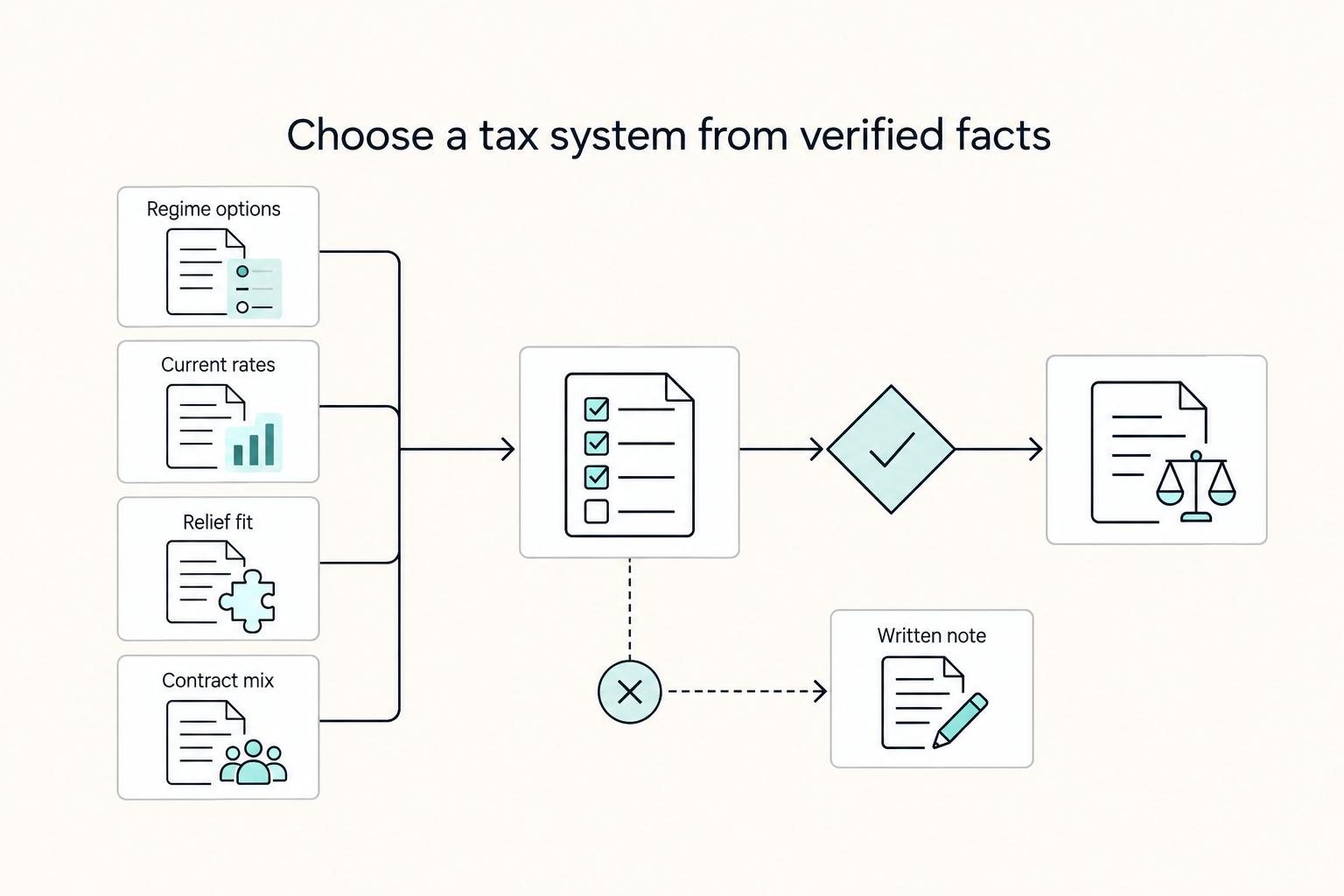
Choose only after you verify current regime options, current rates, and whether your target relief can be combined with your base method. If you have mixed contract types, foreign-source income, or copyright-based income, do not choose based on simplicity alone. Use your contract list, revenue by country, cost categories, and a written note of each rule you verified. Until confirmation is complete, budget as if no special relief applies.
How do I prove my center of life or residence facts in Poland?
Use this as a documentation workflow only. Build a year-long evidence story, not a declaration. If housing, income flows, family life, or travel point to more than one country, escalate before claiming exclusive residence anywhere. Use a dated yearly timeline, a travel log, an income map, and copies of official correspondence or records you already hold. Describe each period as it happened, and do not force a full-year single-country story when facts are split.
What are the key record-keeping requirements for an IP-based relief claim?
Your records should let someone trace work performed to income earned, project by project. If you cannot match a contract, invoice, work record, and payment to the same project, your file is not ready. Keep signed contracts or SOWs, invoices, payment records, dated development evidence, and a project ledger that ties them together. If qualification or income mapping is uncertain, escalate before filing.
Can I combine a simplified tax regime with an IP relief?
Do not assume compatibility without a current check. If you already elected a regime or started invoicing under it, verify combination rules before building your filing position around an IP benefit. Review your current regime election, the relief you want, and the rule text or adviser note that confirms compatibility. Until that check is done, model the year as if the relief is unavailable.
What is the tax-deductible cost rule for creative work?
Do not rely on the label alone without confirming the current rule and contract scope. If your agreement mixes salary, service fees, and copyright transfer, review the wording and compensation split before treating any part as eligible. Use the signed contract, annexes, payroll or invoice records, and the exact copyright-transfer language as your base file. Keep a note in your file until the rule details are verified.
Do I need a Polish accountant or tax adviser?
If your facts are cross-border, split across contract types, or unclear on residency or IP treatment, escalate to a specialist before filing. Share your country list, contract types, income sources, and draft evidence file so the reviewer can test consistency. A pre-filing review may reduce rework risk when the fact pattern is complex.
Try a related tool
Researched and edited by the Gruv editorial team. Gruv builds cross-border billing, payouts, and finance-operations software for global businesses.
Sources
- biznes.gov.pl/pl/portal/00253trusted
- biznes.gov.pl/pl/portal/00263trusted
- ecb.europa.eu/press/legconf/pdf/Legal_Conference_2025_(dig...trusted
- oecd.org/content/dam/oecd/en/publications/reports/201...trusted
- oecd.org/en/publications/compendium-of-good-practices...trusted
- podatki-arch.mf.gov.pl/en/residents/tax-residencetrusted
- podatki-arch.mf.gov.pl/media/6957/obja%C5%9Bnienia-podatkowe-rezyde...trusted
- podatki.gov.pl/ulgi-i-odliczenia/ip-box-cittrusted
Educational content only. Not legal, tax, or financial advice.
Related Posts

Digital Nomad Taxes in 2026 With a Defensible Filing Plan
With digital nomad taxes, the first move is not optimization. It is figuring out where you may be taxable, where filings may be required, and what proof supports that position.

Can Digital Nomads Claim the Home Office Deduction?
Claim the deduction only when your facts and records can carry it. With the home office deduction for digital nomads, the real decision is usually a three-way call: claim it, do not claim it, or pause and get help because your file is not ready.

The Best Digital Nomad Cities in Eastern Europe
If you are choosing among the **best digital nomad cities eastern europe** can offer, make the call in this order: legal path first, city second, spending last. That sequence helps you avoid the most expensive relocation mistake: paying deposits based on assumptions you have not verified.