
Quick Answer
Start with a year-specific day log for Ireland, then apply the 183-day test before the 280-day look-back rule. If your count is close, records conflict, or another country may also assert residence, keep your result provisional and escalate. Separate residence from ordinary residence and domicile, and anchor your memo to Taxes Consolidation Act 1997 Part 34 plus your evidence pack. Finalize only after unresolved points are reviewed.
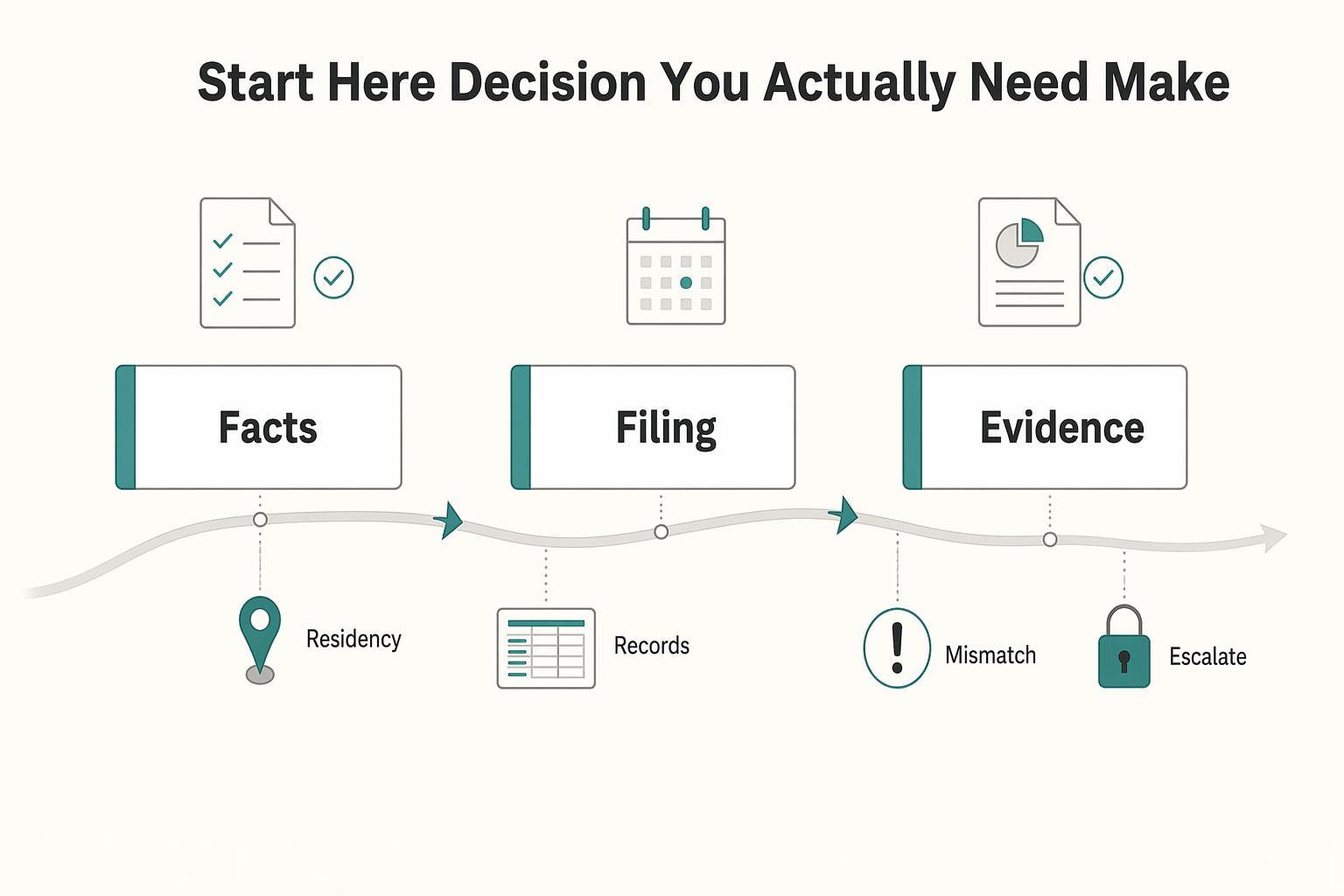
Start Here With the Decision You Actually Need to Make#
Pick one status for the current year in Ireland, then document it so you can defend it. The goal is a position built on records you can prove now, not a perfect answer to every edge case.
Start with compliance, not theory. Available data has increased rapidly, and compliance risks have continued to evolve since 2020. OECD compliance guidance starts with context, which is the right first move before detailed analysis.
Keep the output simple and reviewable:
- One clear status for this year in Ireland, written in plain language.
- One evidence pack that supports that status.
- One short list of unresolved points to take to a tax adviser before filing.
Treat the case as high risk early when facts are mixed, thresholds are close, or records span multiple countries. Do not force certainty from incomplete records. Write a provisional position, label what is uncertain, and escalate. If one day or one assumption could change your filing position, get adviser input before you treat the status as final.
Before you move on, write a two-line decision note in plain language. Line one states your current status. Line two states what could still change that status. That note keeps your file readable and can make adviser review faster because unresolved points are visible from the start. For a deeper dive, read the digital nomad tax guide. If you want a quick next step, try the tax residency day counter.
Define the Terms Before You Count a Single Day#
Define each label before you count days. A defensible Irish residence position depends on matching the right term to the right test.
Start with Irish tax residence because it is day-count based for individuals. Presence at any point in a day counts as a day. One statutory test is 183 days or more in the year. The 280-day look-back test applies across the current and previous year, but only when current-year presence is under 183 days. Guidance also states that periods of 30 days or less are ignored when determining residence.
| Term | What it answers | Why it matters |
|---|---|---|
| Irish tax residence | Are you resident for this year under day-count rules? | Sets your residence filing position for the year. |
| Ordinary residence | Are you treated as ordinarily resident after consecutive years of Irish residency? | Can still affect tax consequences after leaving, depending on your facts. |
| Domicile | Where is your permanent home in legal terms? | Different from residence and can change tax consequences. |
| Resident and domiciled status | Do both statuses apply at once? | A commonly cited consequence is wider exposure to worldwide income and gains. |
| Dual tax residency | Could two jurisdictions both have a tax claim based on where you live and work? | May mean tax exposure in more than one jurisdiction. |
Do not treat these terms as interchangeable. Day counts can look clean while domicile, ordinary residence, or dual residency still changes risk and next steps. If status is mixed or unclear, mark it as provisional, document assumptions, and escalate for adviser judgment.
A practical way to prevent mix-ups is to keep one short definition line for each term at the top of your memo. Then tag each conclusion to one term only. If a sentence starts to blend two terms, split it in two. This prevents the common error where a correct day count is treated as if it settles domicile or ordinary residence. Related: Can Digital Nomads Claim the Home Office Deduction?.
Determine Irish Tax Residence in a Strict Order#
Use one fixed sequence so you can reach a defensible result and keep your file easy to review.
- Confirm scope first: test one Irish year at a time.
- Build a day log using one counting method, apply it consistently, and flag uncertain days instead of guessing.
- Apply your residence checks in a fixed order, and move to additional checks only if the outcome is still unclear.
- If anything stays unclear, pause and verify the legal basis directly in current Irish legislation and official guidance before filing.
Keep a short audit trail as you go: what changed, when it changed, and why. That matters most in cross-border cases. Fragmented tax rules can increase economic and administrative costs, and date-stamped records matter. That includes the OECD Model Tax Convention update adopted on 18 November 2025. If one unresolved assumption could change your status, treat the result as provisional and get professional review before filing.
When you apply this order, add a brief checkpoint after each step. Note the documents used, what you confirmed, and what remains uncertain. That turns your analysis into a sequence another reviewer can replay. In practice, this is often the difference between a quick review and a long back-and-forth where basic assumptions have to be rebuilt from scratch.
Use the Look-Back Test Without Misclassifying Yourself#
If your framework uses a look-back step, use it as a second pass, not as your starting point. Run the primary analysis first, and move to look-back only if the first pass does not clearly settle the outcome. Keep employment-status analysis separate from residence analysis because they answer different questions.
After any material fact change, run the same checkpoint each time:
- Update your records using contemporaneous evidence, not memory.
- Re-run the analysis in the same order, and note when a look-back step is used.
- Mark changed facts and note why they changed so later review is traceable.
- If one uncertain fact could change your outcome, treat the result as provisional and escalate for review.
Do not rely on labels alone. Contract wording does not override the factual record, so your position should match what actually happened. What begins as a freelance engagement can evolve into employment under local law, and employment-status tests are country-specific.
A common failure mode is updating facts once, then carrying the result forward as if nothing else can move it. Avoid that. Re-run the same sequence after each material change and keep the prior version of your analysis. Keeping old and new versions side by side makes it clear what changed and whether that change matters.
Separate Residence, Ordinary Residence, and Domicile in One Comparison Table#
Use one comparison table before you file. Day count does not settle the full position. In Ireland, residence, ordinary residence, and domicile are separate tests, and their interaction can affect income tax and capital gains tax exposure.
| Status | What determines status | What it can affect | Evidence to keep | Known from published guidance vs needs adviser judgment |
|---|---|---|---|---|
| Irish tax residence | Day-count presence in the year. Any part of a day in Ireland counts. Common tests include 183 days in one year, or 280 days across the current and preceding year (look-back test); periods of 30 days or less in a tax year can be ignored in determining residence. | Your residence outcome for the year and the starting point for further analysis. | Dated day log, travel records, calendar entries, and correction notes. | Core counting rules are published; disputed travel days or weak records may need judgment. |
| Ordinary residence | Starts from the fourth year after three consecutive resident years; ends only after three consecutive years of non-residence. | Can keep tax consequences in scope after departure; still interacts with residence and domicile. | Multi-year residency timeline, prior returns, and year-by-year day summaries. | Start and stop timing are published; edge cases may need adviser review. |
| Domicile | A separate legal concept from residence, and not defined in Irish tax legislation. | Can change scope when combined with other statuses, including possible worldwide income and foreign gains exposure depending on the interaction. | Records supporting your fact pattern, plus a written legal analysis note. | Often a high-judgment area, especially when facts point in different directions. |
Keep this table live through the year and refresh it after material travel corrections and again at year-end. The Irish tax year runs from 1 January to 31 December. If an update shifts any row from clear to uncertain, treat the result as provisional and escalate before filing.
Plain-language caution: residence, ordinary residence, and domicile can widen potential worldwide income exposure. That is a risk trigger, not an automatic outcome. The result depends on how all three statuses interact in your facts.
Use the table as a decision tool, not decoration. At each checkpoint, mark each row as clear, provisional, or unresolved. If even one row is unresolved, list the specific document gap or judgment issue beside it. This gives you a clean escalation brief and keeps the final filing position tied to evidence instead of confidence alone.
Handle Dual Residency Without Guessing on Treaty Outcomes#
If two countries may both assert residence, treat it as a potential dual-residency issue and do not self-select a treaty result. Move from day counts to treaty analysis: identify the relevant Double Tax Agreement, confirm it is in force for the year under review, and log missing facts before filing.
| Article | Covers | Note |
|---|---|---|
| 4 | Residence | Shows where to analyze in the convention text for US-Ireland cases. |
| 24 | Relief from double taxation | Shows where to analyze in the convention text for US-Ireland cases. |
| 26 | Mutual Agreement Procedure | Shows where to analyze in the convention text for US-Ireland cases. |
| 29 | General effective date | States 1 January 1998. |
For US-Ireland cases, anchor analysis to the convention text. Article 4 covers residence, Article 24 covers relief from double taxation, and Article 26 covers the Mutual Agreement Procedure. Article 29 states a general effective date of 1 January 1998. These anchors show where to analyze, but they do not by themselves resolve a personal tie-breaker result.
Keep a one-page treaty triage note with your residency memo, then update it at year-end and again before filing:
- The two countries asserting residence and the exact year under review.
- The treaty and article numbers you rely on.
- Verified facts and filing positions already taken.
- Open questions that could change the outcome, marked as unresolved.
Use one hard rule: if the treaty outcome is uncertain, do not self-resolve from general content. Take the dual-residency file and treaty triage note to an adviser, request a written view, and keep that written rationale in your evidence pack.
Treat the triage note as a live control. Every time facts change, update the note first, then revisit your filing position. That helps keep the treaty analysis aligned with current facts.
Build an Evidence Pack You Could Defend in an Audit#
Build the evidence pack before you file so the position rests on dated records, not memory. Keep conflicts visible until resolved.
| Item | Purpose | When noted |
|---|---|---|
| Day log | Supports day-by-day presence decisions, including part-days. | Each year. |
| Short residency memo | Ties evidence to the filing position. | Each year. |
| Linking documents | Connect the memo to receipts, sales invoices, nominal ledgers, and accounting books. | Each year. |
| Irish tax registration details | Support authority requests about Irish tax registration status. | If requested by another authority. |
| Employment record in Ireland | Support authority requests about employment in Ireland. | If applicable. |
| Details of filed income tax returns | Support authority requests about filed returns. | If applicable. |
Use a practical working file set for each year, and assign an owner plus a last-updated date to each item:
- Day log, to support day-by-day presence decisions, including part-days.
- A short residency memo that ties evidence to your filing position.
- Linking documents, for example receipts, sales invoices, nominal ledgers, and accounting books.
- Irish tax registration details, if requested by another authority.
- Employment record in Ireland, if applicable.
- Details of filed income tax returns, if applicable.
Keep the memo easy to review and consistent in structure. Start with Revenue material and your own residency note. Add a legal reference line to the Taxes Consolidation Act 1997 and Part 34 Provisions Relating to the Residence of Individuals. State clearly that Part 34 guidance is a guide, not legal advice.
If cross-border authorities request proof, add a certification-readiness block. Revenue provides a Letter of Residence request path through myAccount, and certification depends on Revenue being satisfied you were resident in Ireland for the year in question. Some authorities may also request practical items such as Irish tax registration status, an employment record in Ireland, and details of filed income tax returns.
For internal control, keep everything retrievable by Irish tax year, 1 January to 31 December. Keep records continuously across transactions, and retain original documents for six years. If you keep a changelog, use it to explain what changed, when, and why.
Use consistent file naming so your memo and supporting records line up without guesswork. If the memo says a day changed, the linked record should show the date and why. If two records conflict, keep both, note which one you relied on, and explain the reason in one sentence. That is usually enough to make the decision trail clear.
Run a Three-Checkpoint Annual Compliance Cycle#
Run three checkpoints each year so you test early, lock facts at year-end, and validate before filing. Assign one owner and one target date to each checkpoint as an internal control.
| Checkpoint | Focus | Key items |
|---|---|---|
| Before year-end | Project the likely outcome while options remain. | Projected day count; apply the 183-day test first; use the 280-day current-plus-preceding-year test only if below 183; ignore periods of 30 days or less for that look-back determination; flag travel changes; run a treaty-risk screen. |
| At year-end | Lock facts before conclusions. | Archive the final day count; close corrections; update the status memo; keep conflicting records; add unresolved questions for professional review; freeze one final day log version. |
| Before filing | Check consistency against facts and current guidance. | Run a final consistency check; confirm the memo aligns with the Taxes Consolidation Act 1997, Part 34 Provisions Relating to the Residence of Individuals; escalate if material uncertainty remains. |
| Owner + date | Assign accountability to each checkpoint. | One named owner and one due date for each checkpoint. |
Before year-end#
Project the day count from the live log and stress-test the likely outcome while you still have options. Recalculate using the rule that any part of a day in Ireland counts. Apply the 183-day test first, then use the 280-day current-plus-preceding-year test only if you are below 183 days, with periods of 30 days or less ignored for that look-back determination. If a small travel change could flip the result, flag it for review.
Also run a treaty-risk screen here. Do not decide treaty outcomes at this stage. Identify cases where two countries could plausibly claim residence and mark them for professional Double Tax Agreement review before filing.
At this stage, focus on prevention. If the position is near a threshold, list exactly which planned travel days could move the result and who owns those plans. This gives you time to verify facts before they become filing problems.
At year-end#
Lock facts before conclusions. Archive the final day count, close corrections, and update the status memo with what changed since the projection pass. If records conflict, keep both records, note the mismatch, and add it to an unresolved-questions list for professional review.
Year-end is where you move from projection to evidence. Freeze one final day log version, then link each corrected entry to supporting records. This keeps your final count reviewable and prevents accidental changes after conclusions have been written.
Before filing#
Run a final consistency check against documented facts and current official guidance. Confirm the memo aligns with the Taxes Consolidation Act 1997, Part 34 Provisions Relating to the Residence of Individuals.
Use this minimum internal annual checkpoint log:
Before year-end: projected day count, threshold stress test, potential dual-residency flags.At year-end: locked final day count, updated status memo, unresolved questions list.Before filing: legal consistency check, guidance check, adviser escalation items.Owner + date: one named owner and one due date for each checkpoint.
Before submission, run one plain-language test: can a reviewer read your memo, open the linked records, and reproduce your conclusion without asking what you meant? If not, tighten wording and links before filing. If material uncertainty remains, pause and escalate instead of filing on assumptions.
Know the Escalation Triggers for Professional Advice#
Escalate when your file shifts from clear facts to judgment calls you cannot defend in writing. In compliance work, issues often come from small assumptions stacking up, not from one obvious error.
Start with proximity risk in key facts. If minor corrections, late updates, or disputed records could change the outcome, move to professional review before sign-off.
Escalate on status-interaction risk. If tax-status classifications could change how broadly income is in scope, you need professional interpretation, not just arithmetic checks.
Treat legal-interpretation risk as a separate trigger. If the correct treatment is not clear from documented facts, escalate instead of filling gaps with informal summaries.
Escalate for evidence-quality risk. If the evidence pack is incomplete, contradictory, or not traceable from records to conclusion, it is not ready to file. Revenue states its Code of Practice is guidance, not professional or legal advice. It also sets out structured compliance intervention levels (Level 1, Level 2, Level 3), including published escalation examples.
Use this pre-filing screen:
- A small factual correction could change your conclusion.
- Status interaction could widen scope and you cannot explain the boundary clearly.
- The correct treatment is still unclear from documented facts.
- Your evidence pack does not form one coherent line from records to conclusion.
Public 2026 commentary has also flagged faster discrepancy detection and increased Level 1 and Level 2 activity in employment tax. Treat that as caution, not a legal rule, and not as an exhaustive list of risk areas.
When you escalate, package the handoff so the adviser can work quickly. Include your working memo, key records, unresolved questions, and the specific decision you need confirmed. A precise handoff helps avoid a second round of clarification.
Contractors and Company Structures Need a Separate Check#
Keep personal and company residence as separate decisions, with two files and two conclusions. An individual result does not by itself determine where a company is resident for Irish corporation tax.
| Decision question | Individual file | Company file |
|---|---|---|
| Core test | Individual residence / ordinary residence | Company residence for corporation tax |
| Primary legal anchor | Part 34 including Section 819 for individuals | Incorporation, management and control, and treaty outcome |
| Common error | Mixing company facts into personal status | Reusing personal day-count logic for company status |
Keep the legal boundary explicit: Part 34 is for individual residence, not company residence. For company review, start with the general rule that an Ireland-incorporated company is generally Irish tax resident, then test whether management and control facts support or complicate that result.
Then run a treaty check. A treaty can assign an Ireland-incorporated company's residence to another territory. A non-Irish incorporated company can still be Irish tax resident if it is managed and controlled in Ireland. If management and control facts are split across countries, mark the position unresolved and escalate before filing.
Apply the same evidence discipline in both files: dated facts, named legal references, and an explicit unresolved-issues list. In the company memo, also flag potential Irish corporation tax exposure for non-resident companies, including Irish branch or agency trading profits and Irish rental profits where relevant.
A practical guardrail is to complete the individual memo and company memo separately before you compare them. Then check for conflicts only at the end. This sequence helps you avoid carrying assumptions from one file into the other, which can be a source of errors in cross-border contractor cases.
Use Gruv Records to Lower Admin Risk in Cross-Border Work#
Treat Gruv exports as corroboration, not determination. They can help document payment timelines and counterparties, but they do not determine Irish tax residence on their own.
Use a clear source hierarchy in the memo:
- Gruv operational records: evidence of what happened and when.
- Legal authority: authentic legal texts, for EU acts the Official Journal version.
- Interpretation aids: official guides such as the U.S. Treasury Technical Explanation.
- Archived pages: background only, not current guidance.
Be precise with legal texts. A consolidated EUR-Lex page is useful for reading, but it states that it has no legal effect by itself. The authentic versions are those published in the Official Journal. Apply the same discipline to treaty materials. They can guide interpretation and should be read alongside the year-specific fact record.
If you rely on Gruv data, add a short internal verification note:
- Data source and export timestamp.
- Year covered.
- Reconciliation status against primary accounting records.
- Known gaps, duplicates, or unmatched entries.
Where coverage varies by market or program, say so directly. If reconciliation is incomplete or dates conflict across invoices, payouts, and ledger postings, mark the point unresolved instead of using it to close a residency conclusion.
Keep this verification note short and explicit. If a payout date and ledger date differ, record both and explain which date your memo relies on. If unmatched entries remain, keep them visible as open items rather than forcing a clean narrative that your records do not support.
Make the Decision Defensible, Then Keep It Current#
Target a residence position you can defend, not the lowest number you can produce. For Irish residence, the durable outcome is a clear file: what you decided, what evidence supports it, and what is still unresolved.
Keep three annual deliverables and close each in writing:
- Status decision note: your conclusion, the facts behind it, and any assumptions that could change the result.
- Evidence pack: dated records in one place, with filenames that map to statements in your decision note.
- Escalation log: unresolved issues, owner, and when professional advice was requested or received.
Treat record quality as a control, not cleanup at filing time. Accurate record-keeping is linked to lower risk of long, costly investigations, and a strong evidence trail can speed enquiry handling. Before filing, run one verification pass and mark each key item as verified, unresolved, or replaced.
Keep scope discipline on deadline examples. In Irish DWT processes, document-category mismatch can cause rework and missed cut-offs, and missing event-specific dates can push you into slower reclaim routes. Use that as a process warning, not a personal residency rule.
Keep DWT timelines in DWT scope only. The four-year reclaim window, certificate validity through 31 December of the fifth year after issue, and 2024 pack updates are not personal residency filing deadlines.
If any key point is still uncertain, record that uncertainty and escalate before filing. This is especially important when outcomes could shift based on unresolved status questions. Do not treat the OECD material as the legal test for personal residence.
Good files stay useful after filing. Keep the final memo, linked records, and escalation outcomes together so next year starts from evidence, not from memory. That continuity can reduce rework, improve consistency across years, and make future reviews faster.
Frequently Asked Questions
What makes you tax resident in Ireland?
Irish tax residence for an individual is based on day count in the State during the year. You are resident if you are present for 183 days or more in one year, and there is also a look-back route when current-year days are lower. The OECD summary cited here points to the Taxes Consolidation Act 1997, Part 34 as the domestic legal provision. Use that as the starting test, then verify your day log against contemporaneous records before you finalize any conclusion.
How does the look-back test work in practice?
The 280-day look-back test applies only if current-year presence is under 183 days. It totals days across the current and preceding year, and 280 days or more can still make you resident. If presence is 30 days or less in a tax year, those days are ignored in determining residence. If you are near that threshold, accurate day records matter. In practice, run the same calculation order every time and keep prior versions of your count so changes stay traceable.
Does being in Ireland for part of a day count as a day?
Yes. Presence in the State at any time during a day counts as a day for residence purposes. Entry and exit timing can affect your total. That is why travel records should be logged as they happen, not rebuilt from memory later.
What is the difference between residence, ordinary residence, and domicile?
Residence is the day-count test described above. Ordinary residence and domicile are separate concepts, and this guide does not provide full legal definitions for either one. Do not infer ordinary residence or domicile from day counts alone. If those concepts could affect your scope, keep that point flagged as unresolved until you get legal confirmation.
Can you be tax resident in two countries at the same time?
Two countries can both have taxing rights over the same income, which creates a double-taxation risk. EU guidance says double tax agreements usually provide mechanisms to reduce double taxation. To claim relief, you may need proof of where you are resident and proof that tax was already paid. If both countries can plausibly claim residence, move to treaty analysis early and document open issues before filing.
If you are resident and domiciled, does worldwide income come into scope?
Confirm the full individual rule for resident-and-domiciled treatment against current Irish law before filing. For companies, residence can bring worldwide profits into corporation-tax scope. Treat this as a high-impact point and confirm the individual position before filing. Do not close this point with assumptions. Keep it on your escalation list until a written view is in the file.
When should a tech contractor stop self-assessing and hire a tax adviser?
Get advice when your day count is close to 183 days or close to the 280-day two-year total. Escalate when two countries may both tax the same income and you are relying on double-taxation relief. Also escalate when ordinary residence or domicile status is unclear before filing. As a rule, escalate as soon as one unresolved assumption can change the filing result.
Try a related tool
Researched and edited by the Gruv editorial team. Gruv builds cross-border billing, payouts, and finance-operations software for global businesses.
Sources
- europa.eu/youreurope/citizens/work/taxes/double-taxati...trusted
- home.treasury.gov/system/files/131/Treaty-Ireland-Protocol-TE-...trusted
- irs.gov/pub/irs-trty/ireland.pdftrusted
- oecd.org/content/dam/oecd/en/topics/policy-issue-focu...trusted
- taxation-customs.ec.europa.eu/system/files/2023-08/ART%20-%20Report%202023...trusted
Educational content only. Not legal, tax, or financial advice.
Related Posts

Digital Nomad Taxes in 2026 With a Defensible Filing Plan
With digital nomad taxes, the first move is not optimization. It is figuring out where you may be taxable, where filings may be required, and what proof supports that position.

Can Digital Nomads Claim the Home Office Deduction?
Claim the deduction only when your facts and records can carry it. With the home office deduction for digital nomads, the real decision is usually a three-way call: claim it, do not claim it, or pause and get help because your file is not ready.
How to Set Up a Donor-Advised Fund (DAF)
Running a small business means your generosity competes with payroll, taxes, and late-paying clients. If you're a business-of-one, you do not need another "good intention" that turns into a cash crunch. You want intentional charitable giving, not a new line item that spikes anxiety every time revenue dips.