
Quick Answer
Czech Republic tax residency is typically determined by domestic residence signals and day-count presence, then checked against treaty rules if two countries can claim you. The safest approach is to run a monthly decision framework, document permanent home and presence facts, and escalate only when evidence conflicts or treaty interpretation stays unclear. This keeps your position defensible without overcomplicating operations.
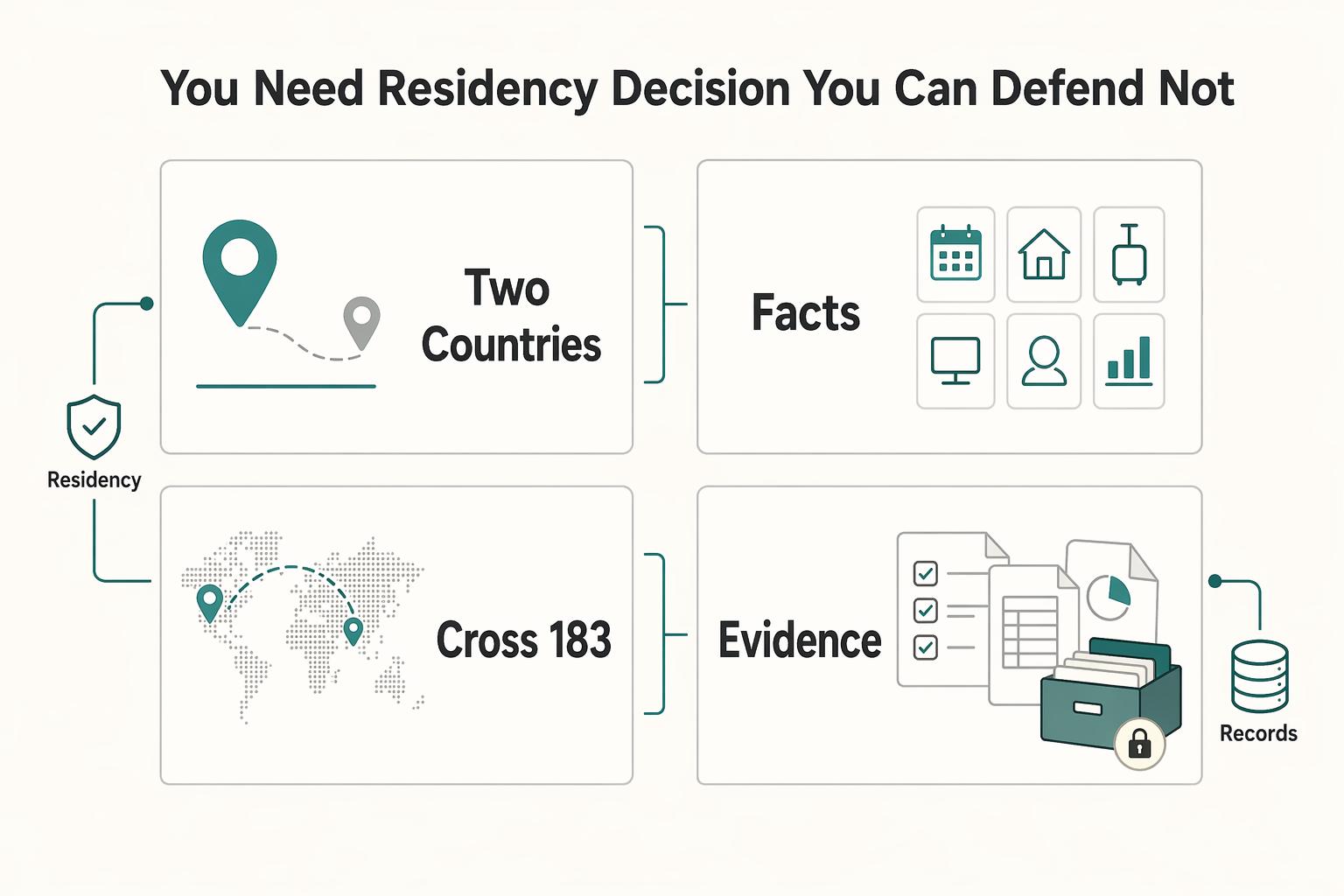
You Need a Residency Decision You Can Defend Not a Guess#
Use this guide to make a defensible Czech tax residency call, then back it with a simple documentation system. If you are a freelancer in Prague or a digital nomad moving between countries, start with compliance and use safe defaults that keep your expat tax risk low. Optimize only after your residency position holds up on paper.
Say you run a zivno, work with cross-border clients, and split your year across Czechia and your home country. You do not need aggressive hacks. You need a clear call, clean records, and a short list of moments when you stop self-managing and get professional review.
Use this decision order every month:
- Check Czech domestic signals first. Confirm whether you have a permanent home with facts that show intent to stay permanently at that address, or whether your presence crosses the more than 183 days threshold in a calendar year.
- Check treaty conflict second. If another country can also claim you, move to Double Tax Treaty Article 4 analysis instead of guessing.
- Set your operating mode. If facts are clean, run your plan. If facts conflict, treat yourself as a potential dual resident and escalate early.
Build a minimum documentation system you can maintain:
- A monthly residency log tied to where you actually lived and worked.
- A home status timeline that records access, control, and continuity in the Czech Republic.
- A short treaty position note for any country pair that might trigger Article 4.
- A filing assumptions note that keeps invoices, payout records, and residency logic aligned.
| Escalation trigger | Why it matters | Action |
|---|---|---|
| Two countries can both claim residency | Domestic rules alone will not settle the conflict | Get a treaty-focused review under Article 4 |
| Permanent home facts look mixed | Weak evidence creates audit risk | Strengthen records or seek advisor confirmation |
| You cross 183 days but your stay is study or treatment only | You may be treated as a tax non-resident even above 183 days in this narrow case | Document purpose clearly and validate treatment |
| Your records cannot support your timeline | You cannot defend the position later | Pause assumptions and rebuild evidence pack |
This guide gives you practical rule signals for Czech tax residency and a repeatable workflow. It does not decide country-by-country treaty outcomes for you. Treaty text and administrative interpretation differ, so use this framework to reach a working position quickly, then escalate only when risk is real.
If you want a deeper dive, read Can Digital Nomads Claim the Home Office Deduction?. Want a quick next step on day counting? Try the tax residency day counter.
The Core Mental Model for Czech Tax Residency#
Use a three-step model for Czech tax residency: run Czech domestic tests first, apply Double Tax Treaty Article 4 second, then execute compliance actions. Lock in the working definitions so each monthly decision stays consistent, especially if you split time between Prague and another country.
| Term | Meaning | Note |
|---|---|---|
| Tax residency | You qualify if you have a place of residence in Czechia or if you spend more than 183 days there in a calendar year | This is the foundation of your expat tax position |
| Place of residence (permanent home + intent) | A permanent home under circumstances showing intent to stay permanently at that address | Use it as a control check on your day-count logic, not as a shortcut that replaces the domestic test |
| Tax non-resident | Generally means you do not meet domestic residency tests | If you are present in Czechia only for study or treatment, you are treated as a tax non-resident even if your time goes above the 183-day threshold |
Tax residency is your legal status for tax obligations. Under Czech income tax rules, the domestic signal is straightforward. You qualify if you have a place of residence in Czechia or if you spend more than 183 days there in a calendar year. This is the foundation of your expat tax position.
Place of residence (permanent home + intent) means more than a registration detail. It points to a permanent home under circumstances showing intent to stay permanently at that address. Use it as a control check on your day-count logic, not as a shortcut that replaces the domestic test.
Tax non-resident generally means you do not meet domestic residency tests, though the general result can be influenced by the wording of Double Tax Treaties. One exception can matter for planning: if you are present in Czechia only for study or treatment, you are treated as a tax non-resident even if your time in Czechia goes above the 183-day threshold.
If you split time across borders, think like an operator. Your day count rises, and two countries may point to residency. Do not guess. Run the sequence, document your reasoning, and escalate when facts collide.
Run the sequence before tactics#
| Step | What you test | What you do next |
|---|---|---|
| 1 Domestic test | Place of residence (permanent home + intent) facts and 183-day presence in the Czech Republic | Set a provisional resident or non-resident position |
| 2 Treaty test | Whether another country can also claim residency | Review Article 4 in the relevant Double Tax Treaty |
| 3 Compliance action | Whether your evidence supports your position | File and document, or escalate for professional review |
Use this as your default system. It keeps your residency call repeatable and easier to explain when an authority or advisor asks how you reached it. Related: The Best Digital Nomad Cities in Eastern Europe.
Are You a Czech Tax Resident Yet#
Run a strict three-step decision tree: check permanent home first, check your day count second, then use Article 4 if two countries can claim you. Use it as a checklist you can run even in a busy month.
Run the decision tree in order#
Start with the permanent home test under Czech domestic logic. Ask one direct question: do your facts show a home in Czechia that you can use, with intent to stay tied to that address? If yes, treat that as a resident signal and move straight to documentation.
If permanent home facts stay unclear, run a day-count check. In practice, count each day you are present in Czechia, including arrival and departure days. Then compare your total against the 183-day rule threshold for the calendar year.
If Czechia and another country can both claim residency, stop domestic-only analysis and move to Double Tax Treaty Article 4. Treaty text decides the tie-breaker. Your preference and generic internet rules do not.
| Decision point | If yes | If no |
|---|---|---|
| Permanent home facts support Czechia | Treat as Czech resident signal and document your file | Move to day-count test |
| Presence reaches the 183-day threshold | Treat as Czech resident signal unless an exception applies | Treat as domestic non-resident signal |
| Another country also claims residency | Prepare Article 4 treaty analysis before filing | Continue with domestic conclusion and compliance steps |
Example: you run a zivno, keep a usable flat in Prague, and split time with your home country. Both countries may point to residency. Mark yourself as a potential dual resident, prepare treaty analysis, and avoid overconfident filing assumptions.
Use safe defaults when facts conflict#
When facts look mixed, use the safer default:
- Classify yourself as a potential dual resident.
- Draft a short treaty memo under your applicable Double Tax Treaty.
- Keep a monthly log so year-end decisions do not surprise you.
- Flag edge cases early, including study-only or treatment-only presence that may affect classification even above 183 days.
That is how you keep your residency decision defensible and audit-ready.
What Proves Permanent Home in Practice#
Prove permanent home with a consistent living pattern and ties, not a single document. Turn your decision into evidence you can defend later if someone asks how you reached it.
In practice, permanent home is shown through real, ongoing use of a home plus ties that make the story coherent. The test is simple: your records should point in the same direction when someone checks your address access, daily-life footprint, and economic center. That is why authorities look beyond the 183-day rule and also assess your centre of vital interests.
Separate strong from weak signals#
Use a weighted view instead of yes-or-no thinking. A single document can help, but your defense comes from the full pattern.
| Signal type | Stronger in practice | Weaker on its own |
|---|---|---|
| Home use in the Czech Republic | Ongoing access and a clear timeline of where you actually lived | One isolated paper with no matching timeline |
| Personal and economic ties | A consistent centre of vital interests story | Mixed ties with no explanation |
| Residency narrative | Tax domicile notes that match your monthly facts | Notes that conflict with travel and living records |
If you keep a base in Prague, travel for client work, and switch countries often, do not scatter this across apps and inboxes. Build one timeline that shows where you slept, where your core ties sat, and why your Czech residency call stayed consistent each month.
Build an audit ready file you can maintain#
Treat this as an operator control system, not a legal-formality checklist:
- Keep dated residency notes that map to your residency logic.
- Keep any housing-related records you already have, and keep them consistent with your timeline.
- Keep a month-by-month tie summary for personal and economic center signals.
- Add a risk-flag section for unclear facts and points that may need clarification.
One consequence matters. If you classify as Czech tax resident, your position generally points to taxation on worldwide income in the Czech Republic. That is why clean documentation is not admin busywork; it protects your filing stance before problems start.
What If Two Countries Claim You#
When two countries claim you, pause domestic-only analysis and resolve the conflict under your Double Tax Treaty, typically via Article 4 (where a treaty applies). Use your file to compare both residency claims side by side before you file, invoice, or lock in an expat tax position.
Dual-claim cases usually arise when Czech domestic signals and another country's domestic signals both point to residency. Czechia can treat you as resident if residence facts support it or your presence meets the 183-day signal in a calendar year, though wording and application can vary. In some situations, being present for study or treatment only can still be treated as tax non-resident even with a long stay. Another state can still claim you under its own rules. At that point, treaty logic is often used to break the tie, and treaty wording varies by country pair. Day count is not always the only factor, and authorities may also look at things like your centre of vital interests.
Run a practical dual claim triage#
| Step | What you do | What you produce |
|---|---|---|
| 1 Identify both claims | Write each country's residency basis in plain language | A two-column claim summary |
| 2 Map treaty issues | Review Article 4 language in your specific treaty and list the residency tie factors your treaty uses (for example, permanent home) | A treaty issue list with open questions |
| 3 Rate evidence strength | Mark each fact as clear, mixed, or contradictory | A risk-ranked evidence sheet |
| 4 Set a provisional position | Choose your filing stance and note uncertainty explicitly | A short position memo with escalation flags |
When facts conflict, use a safe default. Treat yourself as a potential dual resident until you close the gaps. If you run a zivno from Prague while keeping meaningful ties elsewhere, this default protects you from overconfident filings.
Escalate before filing when signals split#
Treaty outcomes are not one-size-fits-all. Administrative interpretation can differ, and published summaries do not always use identical 183-day wording. Escalate early when your record shows contradictions, weak home facts, or unresolved treaty language.
Use this escalation checklist:
- Flag contradictory residency facts in your memo.
- Document exactly which treaty points stay unclear.
- Log the business impact on tax filing and cash planning.
- Route unresolved cross-border questions to the General Financial Directorate, including the Direct Taxes International Cooperation Unit.
This workflow keeps your decision defensible and your compliance timeline under control.
Can You Still Owe Tax as a Non Resident#
Yes, being treated as a tax non-resident does not automatically mean you owe nothing or can skip paperwork. It is one decision point, not a full exemption, and you still need to sanity-check your residency conclusion against how your income and ties actually line up.
A tax non-resident label answers only part of the problem. Each country defines tax residence under its own rules, and there is no single EU rule that allocates every cross-border income case. Your resident country can usually tax worldwide income, while other countries may still assert taxing rights under local law and, where applicable, treaty terms. That is why non-resident status is not a free pass by itself.
Use this non resident checkpoint before filing#
| Trigger | Why it matters | Action |
|---|---|---|
| You have income with a clear in-country connection (work performed there, local payer, local customers) | Source-country questions can still arise even if you classify as non-resident | Flag for local source-income review |
| You operate through an in-country company, registration, or other formal setup | The "how" of your setup can change what gets looked at | Escalate for technical analysis before filing |
| You have income streams that do not match your main story (multiple roles, mixed compensation types, one-off payments) | Different income types can be treated differently depending on the country | Isolate each stream in your memo |
| Your reason for being in-country or your ties are unusual | Classification can differ from your default assumptions | Document facts clearly and confirm treatment |
| Your time in-country is close to the 6-month marker often used as an indicator | Small logging errors can flip your position | Reconcile travel logs and notes monthly |
Picture this: you operate from Prague, have clients in multiple countries, and your setup shifts during the year. Keep the non-resident label provisional until you clear each trigger. Then document the final position with explicit assumptions.
Run a safe default workflow#
| Workflow item | Action |
|---|---|
| Non-resident memo | Keep a one-page non-resident memo with open issues and next actions |
| Income streams | Track each income stream by country connection before year-end |
| Mandatory review items | Tag entity/setup, mixed-income, and long-stay items as mandatory review |
| Advisor input | Ask for advisor input when any trigger stays unresolved |
That gives you a workable baseline until you close the open issues.
If you want a broader cross-border checklist, use the digital nomad tax guide as a companion process guide.
Build Your Compliance File and Monthly Control Loop#
Build a lean compliance file and run it monthly so your Czechia tax residency position stays defensible before filing pressure starts. Convert your conclusion into operating controls. Your goal is simple: keep residency facts, treaty logic, and business records aligned every month so expat tax review becomes a confirmation step, not a rescue mission.
Start with a minimum viable evidence pack#
Treat this as an operator file, not paperwork theater. Keep four live items:
| File item | What it covers |
|---|---|
| Day log | Time in Czechia so you can monitor drift against the more-than-183-days (calendar year) signal |
| Home-status timeline | Where you had a permanent home available and when that changed |
| Treaty position memo | Whether Article 4 analysis is open, resolved, or pending |
| Placeholder checklist | Tax-residency documentation steps if a payer, bank, or foreign authority requests support for your residency position |
Keep the day log and home-status timeline current as facts change mid-year. Mark the treaty memo as open, resolved, or pending, and keep the placeholder checklist ready if a payer, bank, or foreign authority asks for support.
If you operate across borders from Prague, this file becomes your single source of truth when facts shift mid-year.
Run a monthly control loop with hard escalation gates#
Business-of-one compliance fails when invoicing and residency assumptions drift apart. Keep your client invoices and payout records consistent with the residency position in your memo. Then run this loop every month.
| Control area | Monthly action | Escalate now when |
|---|---|---|
| Residency facts | Reconcile day log and home-status timeline | Your status appears different from last month |
| Treaty position | Re-test whether an Article 4 conflict is still active | You may be treated as resident in more than one country based on the current facts |
| Documentation readiness | Check file completeness for filing support | Key records or your documentation steps stay incomplete |
Hypothetical example: you planned light time in Prague, then delivery work pulls you on site longer and your permanent home facts shift mid-year. Act in the same week. Update the memo, tag the risk, and talk to a pro if your Article 4 position remains unresolved. If cross-border residency uncertainty persists, ask your advisor whether the issue should be escalated through the General Financial Directorate Direct Taxes International Cooperation Unit.
Run the Framework Then Escalate Only Where Risk Is Real#
Run the framework now, lock your working decision, and escalate only the risks you cannot close with evidence. Move from theory to execution. Summaries do not protect you. A repeatable decision process, a clean file, and clear escalation gates do.
If you're applying this to Czech tax residency, treat your conclusion as an operating decision you can defend in plain language. Build your file, test your assumptions regularly, and escalate only what stays unclear after review. You do not need perfect certainty on every point. You need a strong record of how you reached your position.
Cross-border tax systems do not run on one universal playbook. Administrative practice can vary by jurisdiction, so confirm local details before you finalize filing positions in Czechia.
Use this closeout checklist today#
- Run your decision pass from this guide and write a one-paragraph conclusion.
- Assemble your evidence file so records, assumptions, and notes stay in one place.
- Label each open issue as
clear,monitor, orneeds advisor. - Escalate only
needs advisoritems, especially cross-border interpretation gaps. - Set a regular review block so surprises do not stack up at year end.
| Risk signal | Immediate action | Escalation gate |
|---|---|---|
| Your facts and records align | Keep your current position and monitor regularly | No immediate advisor review |
| Facts changed mid-year | Update memo and supporting records this week | Escalate if conclusions conflict |
| Cross-border interpretation stays unclear | Freeze assumptions and document both views | Book professional review now |
| Documentation remains incomplete near filing | Prioritize missing records immediately | Escalate if gaps remain after one cycle |
Hypothetical example: a solo consultant in Prague sees client payment flows change across borders. They update the file the same week, flag the unresolved issue, and escalate that edge case only.
Frequently Asked Questions
What makes you a tax resident in the Czech Republic?
For Czech Republic tax residency, you qualify as a resident if you have residence in Czechia or habitual abode there. Residence means a permanent home with facts showing intent to stay. Habitual abode means you stay at least 183 days in the calendar year, in one stretch or several periods.
Does the 183-day rule alone decide Czech tax residency?
No. The 183-day rule covers habitual abode, but residence can make you a resident even before you reach that count. In cross-border cases, an international treaty can also treat you as a Czech tax non-resident even if domestic criteria point the other way.
Do arrival and departure days count toward residency day totals?
Generally, yes. Czech day counting includes each started day of stay in the Czech Republic. Track every travel day consistently so your log stays defensible.
Can you stay over the threshold and still be a tax non-resident?
Yes, it can happen. Domestic rules can point to residency after at least 183 days, but an international treaty can still treat you as a tax non-resident. When that risk appears, treat your status as provisional and write down the assumptions you are relying on until you confirm treaty treatment.
What happens if two countries treat me as tax resident?
Treat it as a treaty question, not a guessing exercise. Summarize each country’s claim, then review the relevant Double Tax Treaty for your facts and document your working conclusion in your memo. If the result stays unclear, escalate before filing.
When should a freelancer stop self-managing and hire a tax advisor?
Stop self-managing when your facts no longer fit a clean yes-or-no under the residence or habitual abode tests. If the outcome depends on treaty interpretation (not simple logging), bring in an advisor before you file.
How do I handle residency decisions if treaty details are unclear for my home country?
Use a safe default. Apply domestic Czech tests first, keep your day log current, and treat the outcome as provisional until you confirm treaty wording for your home country. For broader expat tax process control, keep your checklist aligned with Digital Nomad Taxes in 2026 With a Defensible Filing Plan.
Try a related tool
Researched and edited by the Gruv editorial team. Gruv builds cross-border billing, payouts, and finance-operations software for global businesses.
Sources
Educational content only. Not legal, tax, or financial advice.
Related Posts

Digital Nomad Taxes in 2026 With a Defensible Filing Plan
With digital nomad taxes, the first move is not optimization. It is figuring out where you may be taxable, where filings may be required, and what proof supports that position.

Can Digital Nomads Claim the Home Office Deduction?
Claim the deduction only when your facts and records can carry it. With the home office deduction for digital nomads, the real decision is usually a three-way call: claim it, do not claim it, or pause and get help because your file is not ready.

The Best Digital Nomad Cities in Eastern Europe
If you are choosing among the **best digital nomad cities eastern europe** can offer, make the call in this order: legal path first, city second, spending last. That sequence helps you avoid the most expensive relocation mistake: paying deposits based on assumptions you have not verified.