
Quick Answer
Yes, stock options tax for contractors can arise at more than one point, so you need an event-by-event review at grant, exercise, and sale. The article’s core rule is to classify first, then test each event with documents before acting. It uses IRS Topic 427 and Publication 525 as organizing anchors, highlights Form 6251 for AMT screening in ISO cases, and recommends pausing when paperwork or residency facts are unclear.
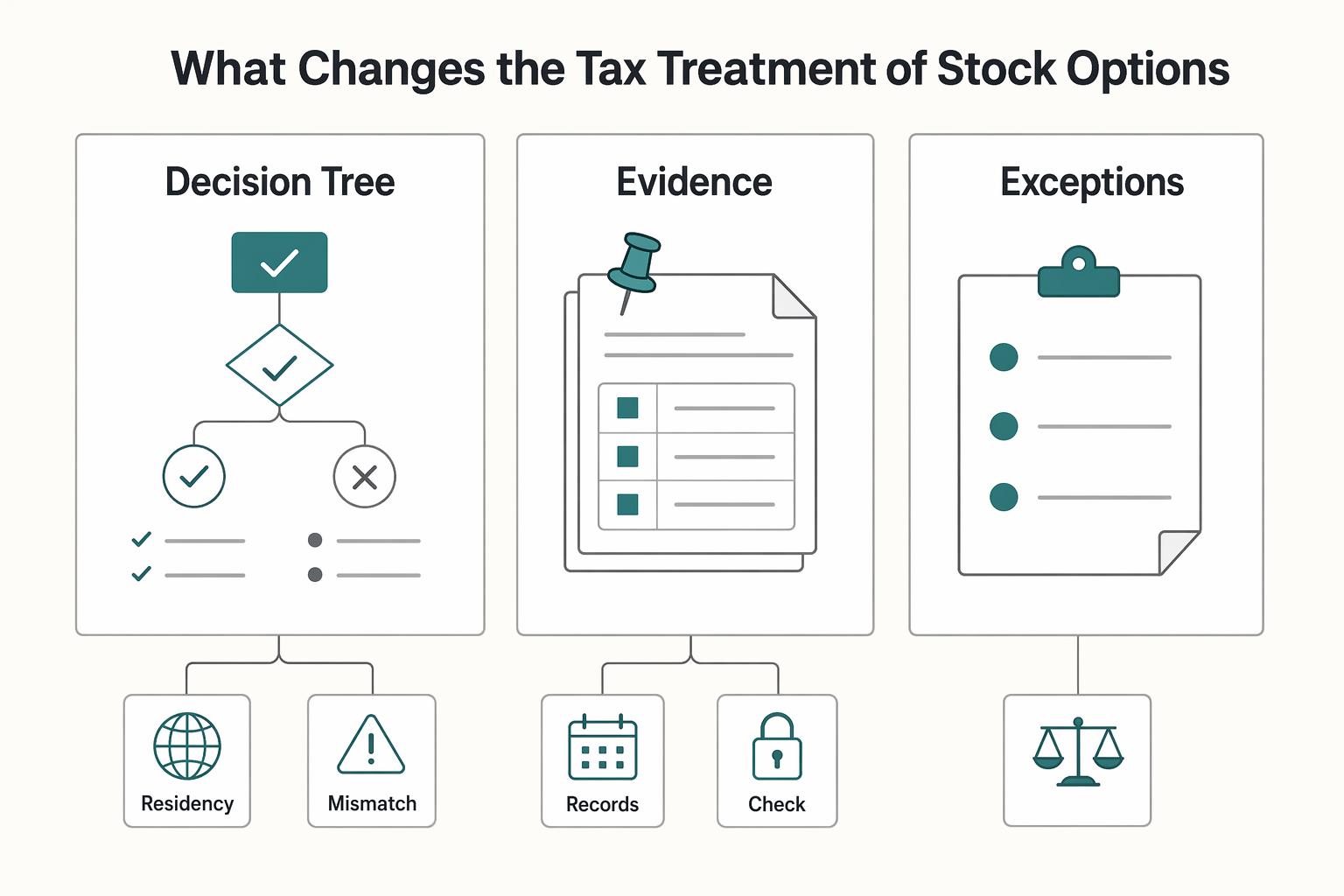
What Changes the Tax Treatment of Stock Options#
Stock options can create tax exposure at multiple moments, so sequence matters more than guesswork. Use a compliance-first order for grant, stock option exercise, and stock disposition so decisions are made before money moves.
Use this as a decision guide, not a theory review. US examples use general federal tax concepts to frame how timing and compensation may be treated. Those anchors help organize the analysis, but they do not replace local rules in every country or state.
Most filing problems here are not caused by an exotic rule. They come from doing the steps in the wrong order: estimating tax from a label before you know what the award is, exercising before you check residency, or selling before the earlier lot is documented. A clean workflow fixes that by forcing two early questions: what exactly is the award, and what document proves each date on the timeline?
Residency is often where filings break. Treatment can shift across periods and income source even inside one jurisdiction, and residency can be a facts-and-circumstances determination. California shows why: part-year residents may be taxed on worldwide income during resident periods. During nonresident periods, they may still be taxed on California-source income.
Use a conservative rule throughout: if status changes between grant, exercise, and sale, or documents do not clearly state option type and terms, stop and confirm treatment before acting. Early classification errors can lead to reclassification risk, amended returns, or conflicting positions across tax authorities. In practice, keep one working chronology from the first day you receive the grant materials and treat any unsupported step as unresolved rather than assumed. By the end, you should have three usable outputs:
- A decision tree for grant, exercise, and sale with clear if-then branches.
- A document checklist that ties each decision to evidence.
- Escalation triggers for when to involve a tax advisor before execution.
If you cannot produce those outputs from your file, you are not ready to treat the next step as a tax-planning decision.
If you are globally mobile, keep one lens from start to finish. US guidance can organize the questions. Cross-border compliance still depends on your facts, dates, and jurisdictions.
Build the mental model before you touch the options#
Before you estimate tax, do two things first: classify the option type, then map the timeline of events (grant or receipt, exercise, and sale).
Think of the analysis as three stacked layers. Classification tells you which rule set you are testing. The event timeline tells you when each rule could matter. Residency tells you where the answer may have to be reported or split. If you skip one layer, any estimate that follows can look precise while resting on the wrong premise.
IRS Topic 427 sets the baseline split. Statutory stock options are granted under an incentive stock option (ISO) plan or an employee stock purchase plan (ESPP). Nonstatutory stock options are outside those plans. That label controls how you evaluate each tax event.
Use this sequence before you model numbers:
Grant or receipt: income can arise here, so do not assume a zero-tax start until classification is clear.Exercise: this is often the key decision point; with ISOs, you may be subject to alternative minimum tax in the exercise year.Disposition (sale): selling stock acquired through exercise can create taxable income or deductible loss.Income character: sale treatment is generally capital gain or loss, but if special holding-period requirements are not met, some income is treated as ordinary income.
Publication 525 is the practical companion for option-type details and income reporting timing. If your grant documents do not clearly show whether the award is under an ISO or ESPP plan, pause planning until classification is resolved. For a deeper planning lens, see the digital nomad tax guide.
Build one chronology table now, even if some fields start out blank. For each event, note the date, the document that proves it, your residency status at that time, and any question that still needs confirmation. That table becomes the control sheet for every later decision. It also helps you spot the real problem quickly: sometimes the issue is tax treatment, and sometimes the issue is simply that the file does not yet support a treatment.
Do not ask what you will owe before you can answer what the award is and what happened when. That sequence prevents a large share of avoidable filing mistakes.
Classify your option correctly before any tax planning#
Do not model taxes until you have confirmed the award type. If classification is wrong, your treatment can be wrong across receipt, exercise, and sale.
| Document | Article detail |
|---|---|
| Grant agreement and governing plan document | Request before you project outcomes |
| Vesting terms and service-status language | Request before you project outcomes |
| Exercise terms | Include when exercise is allowed |
| Tax reporting references | Tie them to the award |
| Form 3921 references | Connected to ISO exercise transfers under Section 422(b) |
IRS Topic 427 sets the split: statutory stock options are granted under an ISO or ESPP plan, and options outside those plans are nonstatutory. Topic 427 also points to Publication 525 for help determining which category applies.
Treat classification as a document exercise, not an intuition exercise. A shorthand label in a portal or email is not enough if the governing plan language points elsewhere. The goal is to reach a written conclusion you could defend later: this award is being treated as statutory or nonstatutory because the plan and grant terms support that treatment, and any conflicting label has been resolved or clearly flagged.
Use the formal documents, not shorthand labels. If the paperwork uses ESPP or statutory language, check the plan terms against your independent contractor status before assuming ISO-style treatment.
Gather this information before you project outcomes:
- Grant agreement and governing plan document
- Vesting terms and service-status language
- Exercise terms, including when exercise is allowed
- Tax reporting references tied to the award
- Any Form 3921 references connected to ISO exercise transfers under Section 422(b)
Form 3921 is a classification signal, not the full analysis. Topic 427 says you should receive Form 3921 after exercising an ISO, and the form scope is tied to ISO exercise transfers. If one document says nonstatutory but later paperwork points to ISO artifacts, pause and resolve the mismatch before filing positions harden.
When the packet is mixed, compare documents in order rather than all at once. Start with the governing plan and grant agreement, then check whether the service-status language fits your contractor facts, then compare the expected tax paperwork. If the file still contains both nonstatutory language and ISO-style artifacts, freeze planning until the mismatch is resolved. It is easier to delay an estimate than to unwind a return position built on a bad label.
Finish this step with a short file note stating what you concluded, which documents support it, and what remains open. That one note will save time at exercise, at sale, and again if an advisor later reviews the file.
Handle the grant stage without creating avoidable risk#
At grant, do not assume tax treatment unless the documents clearly support it. IRS Topic 427 says option compensation may create income at receipt, exercise, or disposition, and it says statutory stock options generally are not included in gross income at receipt or exercise.
Start by confirming whether the award is statutory (under an ISO or ESPP plan) or nonstatutory, then use Publication 525 to validate that classification before you model outcomes. If grant language is vague on valuation, vesting, or service status, treat the grant as unresolved instead of relying on employee-focused summaries.
Grant-stage work is mostly control work. You are not trying to force a full tax answer from incomplete facts. You are trying to make sure later decisions do not rest on missing plan terms, an unclear service-status assumption, or a plan name you cannot reconstruct when exercise arrives.
Before moving to exercise planning, verify:
- Grant agreement and governing plan name
- Vesting terms and service-status language
- Any references to ISO, ESPP, statutory, or nonstatutory treatment
- Expected tax documentation for later events
If the packet uses employer-style statutory language while your contract status is independent contractor, pause and reconcile that mismatch before making projections. Related: How to Handle Revisions and Feedback Without Losing Profit.
Create a clean grant folder while the documents are easy to find. Save the final grant materials, note which plan version applies, and record any unresolved point in plain language. A later exercise analysis is much smoother when you can point to one packet and one note instead of rebuilding the story from scattered messages months later.
A common grant-stage failure mode is treating silence as clarity. If the grant packet does not clearly support the option type, that is not a low-risk result; it is an unresolved classification issue that follows you into exercise planning.
Make the exercise decision with AMT and cash exposure in view#
Your exercise call should be a filing-and-cash decision first, then a market decision.
| Pre-exercise step | What to confirm |
|---|---|
| Option type | Confirm from grant documents and classification notes |
| Residency | Confirm current tax residency and whether it changed during the year |
| Federal filing impact | Estimate federal filing impact, including a Form 6251 AMT check |
| State impact | Estimate state impact, including part-year or nonresident treatment where relevant |
| Liquidity | Stress-test exercise cost, expected tax due, and cash buffer if shares are not sold immediately |
| Execution | Execute only when estimates and documentation align |
Before you submit an exercise, write down the assumptions that make the decision workable: option type, expected residency status for the year, whether the shares will be held or sold without delay, and where the cash for exercise and tax will come from. That turns a vague decision into one you can review.
Start by confirming option type and mapping likely filing impact before you execute. If the award is in the ISO lane, run an AMT screen for the exercise year and review Form 6251 before placing the order. If it is nonstatutory, do not apply ISO assumptions.
That written check matters because exercise is the point where tax, timing, and liquidity stop being abstract. Once cash is committed, later document cleanup does not reduce the filing work or the exposure created by a bad assumption.
Form 6251 belongs in pre-exercise planning, not filing-season cleanup. The instructions include AMTI calculation flow, a "Who Must File" section, and guidance for nonresident aliens. If you cannot explain why Form 6251 does or does not apply, pause.
Residency can materially change the result even when the equity event looks the same. California treats residency as a facts-and-circumstances determination. Part-year residents may be taxed on worldwide income during resident periods, and nonresident periods may still include California-source items such as services performed in California. If residency changed during the year, rerun the analysis using dates.
Use this pre-exercise sequence:
- Confirm option type from grant documents and classification notes.
- Confirm current tax residency and whether it changed during the year.
- Estimate federal filing impact, including a Form 6251 AMT check.
- Estimate state impact, including part-year or nonresident treatment where relevant.
- Stress-test liquidity: exercise cost, expected tax due, and cash buffer if shares are not sold immediately.
- Execute only when estimates and documentation align.
If your planned exercise date changes, rerun the worksheet. If residency facts change, rerun it again. A stale pre-exercise estimate is almost as risky as skipping the estimate entirely.
Two practical contrasts help. A straightforward exercise with stable residency and full documentation is mainly a calculation and cash-management task. An exercise in a year with a move, conflicting paperwork, or uncertain classification is not a routine click-through step, even if the platform makes it feel routine.
Tradeoff: exercising earlier can improve future tax positioning in some cases, but it can also increase current-year complexity and cash pressure. If liquidity is tight or residency facts are moving, wait until the filing picture is coherent.
After execution, save the exercise confirmation immediately and update the chronology table while the details are still clear. Note the date, the lot, the related grant, and whether any assumption changed from your pre-exercise plan. That same-day update reduces the odds of matching a later sale to the wrong exercise or the wrong residency period.
Plan the sale stage so you do not lose treatment by mistake#
Sale-stage treatment depends on records. If holding status is unclear, do not assume the full result is capital gain.
| Sale-stage evidence | Article detail |
|---|---|
| Form 3921 | Where relevant to a prior ISO exercise |
| Broker trade confirmations | Keep for each lot sold |
| Internal timeline by lot | Record exercise, transfer, and sale dates |
| Lot-selection notes | Keep for any tranche sales |
| Draft gain/loss classification notes | Tie them to filing workpapers |
Treat disposition as documentation first, pricing second. Publication 550 is the practical anchor for sales and trades of investment property, including reporting capital gains and losses. If your timeline is incomplete, the ordinary-income versus capital-gain characterization is harder to support consistently.
A sale often feels simpler than exercise because it shows up cleanly on a broker statement and cash may be coming back in. In practice, it is where earlier gaps become visible. If you cannot tie the sold shares back to a specific exercise event and a clear holding status, the reporting position becomes harder to defend.
For ISO-related shares, use Form 3921 as evidence, not as a final conclusion. It is tied to transfers from exercises under Section 422(b). Keep it with broker statements and trade confirmations so your grant-to-sale path is auditable.
Decision rule: if holding status is not clearly supported, use conservative treatment until a tax professional confirms otherwise.
Minimum sale-stage evidence pack:
- Form 3921 (where relevant to a prior ISO exercise)
- Broker trade confirmations for each lot sold
- Internal timeline by lot (exercise, transfer, and sale dates)
- Lot-selection notes for any tranche sales
- Draft gain/loss classification notes tied to filing workpapers
Single-lot sales are easier to reconcile. Tranche sales are where discipline matters. As soon as each trade is reflected in your records, match it to the relevant lot, attach the confirmation, and note whether the classification depends on any unresolved holding-status question. Do not wait until filing season to remember which shares came from which exercise.
Common failure mode: selling in tranches without lot-level records. Missing dates or lot IDs can create conflicting positions across returns. Reconcile each sale promptly and flag unresolved classification questions before filing.
Another common failure mode is relying on a high-level broker summary instead of the lot trail. Summary views are useful for spotting that a sale happened; they are not a substitute for the lot-by-lot path from exercise to disposition. Your goal is a file where one sold lot can be traced backward through the exercise confirmation and, where relevant, the Form 3921 reference without guesswork.
Manage cross-border residency and reporting obligations#
If your country of residence changes during vesting, exercise, or sale, treat that as an automatic escalation trigger. The core mistake is blending two separate tracks: income-tax treatment and reporting obligations.
When residency changes, the safest move is to stop treating the option as one continuous domestic tax story. Grant, exercise, and sale may still fit neatly on one timeline, but the reporting and sourcing questions can split across periods. That is why a move is a process trigger as much as a tax trigger.
Keep those tracks separate as you file. Tax character may still be ordinary income or capital gain, while reporting duties can run in parallel. In U.S. filing contexts, Form 8938 is used to report specified foreign financial assets when total value is above the applicable threshold, is attached to the income tax return, and is generally not required if no income tax return is required for that year. IRS materials include a commonly cited $50,000 example for certain taxpayers and note higher thresholds for joint filers or taxpayers residing abroad.
In practical terms, keep one note for income characterization and a separate note for reporting obligations. Do not combine them into a single checkbox called handled. A clean answer on the income side does not mean the reporting side is done, and a completed reporting check does not resolve how the income should be characterized.
Use this sequence before filing:
- Confirm your residency timeline by date, including any mid-year moves.
- Keep income-classification notes separate from reporting notes.
- Check Form 8938 based on filing status, residence context, and aggregate asset value.
- Run separate checks for FATCA-related reporting and FBAR (FinCEN), since they are not interchangeable.
- Escalate immediately if residency changed during vesting, exercise, or sale windows.
If your year includes a move, make the dates do more work. Mark when residency changed, which period each event falls into, and which questions remain open because of that change. This also helps separate a simple documentation gap from a true cross-border issue. Missing paperwork can often be fixed with document collection; treaty and sourcing questions usually should not be guessed at.
Common failure mode: relying on generic stock-option explainers for cross-border decisions. Country-by-country sourcing and treaty effects are not reliably resolved in general overviews, so use targeted professional review when residency breaks or treaty questions appear.
Another failure mode is trying to force one country's stock-option explainer onto another country's filing calendar. Use the U.S. concepts here to organize your questions, then keep the answers narrow and jurisdiction-specific when residence or source changes are involved.
Build your evidence pack and annual filing checklist#
Build one chronology table first, then use it as your control document for filing. Link every event from grant through sale to supporting records so you can reconcile quickly and avoid last-minute rework.
A useful chronology table is simple enough to maintain after every event. Include the event, the date, your residency status at that time, the supporting document, the filing note, and any unresolved question. If a later review changes your conclusion, update the table rather than burying the current view in old notes. The control document should show both the answer and the path you used to reach it.
Use this minimum annual evidence pack:
- Grant documents and plan terms.
- Exercise confirmations.
- Sale confirmations and broker statements.
- Residency timeline by date, including mid-year moves.
- Advisor notes with open issues and final filing positions.
- One chronology table that maps each document to the related event.
Keep the file current as the year moves. Waiting until year-end turns small clarification tasks into reconstruction work. A saved exercise confirmation, a clearly labeled sale record, or a note about when residency changed takes minutes at the time and much longer when you are trying to rebuild the sequence later.
Run filing as a verification pass, not a drafting pass. If Form 6251 or Form 3921 was already identified in your case, verify those workpapers are complete; do not assume either form applies without that prior analysis. For freelancers, treat Schedule SE as a separate check tied to net earnings from self-employment: it is used to figure self-employment tax (Social Security and Medicare), and that information is also used to determine Social Security benefits.
Run a short verification routine before you file: check that every line in the chronology has a matching document, every open issue is either resolved or escalated, and every form mentioned in your notes has a reason for being included or excluded. This keeps the return from drifting away from the evidence pack.
Failure mode: collecting records only at year-end. Safe default: if a required document is missing, pause assumptions, request it, and keep the item unresolved until confirmed.
Also keep the final filing position alongside earlier estimates or drafts. If your view changed after new documents arrived or after professional review, that history makes the file easier to defend and easier to maintain next year.
Conclusion#
Treat this as an ordered sequence, not one tax question. Classify first, then evaluate grant, stock option exercise, and stock disposition as separate events with separate evidence.
Take one practical next step now: run the checklist before your next option action. Confirm the option label in writing, confirm event dates, and confirm which document supports each date. Keep one chronology that links grant terms, vesting status, exercise records, sale records, and advisor notes. That chronology is not just for this year's return; it is the file that keeps later sales, later reviews, and advisor handoffs from starting from zero.
Use tax residency as an early escalation trigger in cross-border cases. If residency changes mid-cycle, document the timing and get jurisdiction-specific advice before finalizing filing positions. Pair the residency timeline with the event timeline so each filing position is explainable. If one timeline changes, update the other so the file still reads as one coherent story.
Keep cross-border conclusions narrow. In the cited Canadian context, Section 7 rules are described for employee stock options. Contractor treatment is discussed under Subsection 9(1), including fair market value inclusion in business income in the year of grant. The same discussion also notes that unvested portions may affect immediate inclusion and that direct CRA guidance on vesting conditions is limited.
Conservative assumptions beat aggressive guesses when rules vary by jurisdiction and program. If classification is unclear, residency changed, or vesting terms are uncertain, escalate before execution. That habit keeps filings more consistent, defensible, and easier to maintain over time. The goal is not to predict every outcome from memory; it is to keep each filing position tied to a document, a date, and a clearly stated assumption.
Frequently Asked Questions
Are stock options for contractors taxed at grant, exercise, or sale?
There is no single universal trigger in this guidance. Tax treatment is commonly analyzed at exercise and sale, and outcomes can differ based on option type, timing, and jurisdiction. Treat each stage as a separate decision.
What is the practical difference between statutory stock options and nonstatutory stock options for freelancers?
The practical difference is tax treatment, not just naming. Common guidance separates non-qualified stock options and incentive stock options, and treatment can differ at exercise and sale. If your paperwork uses statutory language, verify classification before modeling outcomes.
Can independent contractors receive incentive stock options (ISOs), and when does alternative minimum tax (AMT) become a concern?
ISOs are typically offered to employees, so contractors should treat any ISO label as a review trigger. AMT is specifically linked to ISO taxation at exercise. If ISO treatment may apply, escalate before acting.
When does stock option income become ordinary income instead of capital gain?
The result depends on instrument type, timing, and holding-period facts. Exercise and sale are separate tax stages, and outcomes can change if dates or classification are wrong. When records are incomplete, use conservative assumptions until treatment is confirmed.
What documents should freelancers keep before a stock option exercise or stock disposition?
Keep one dated evidence pack tied to each stage. Include complete records for grant paperwork, exercise events, sale events, residency timelines, and unresolved classification questions.
How do tax residency changes affect cross-border tax compliance for contractor stock options?
A residence change can affect which tax treatment and reporting rules apply. The IRS has published material on U.S. taxation of stock-based compensation received by nonresident aliens, which reinforces the need for case-specific review. If residence changed before exercise or sale, escalate early.
When should I stop and hire a tax professional instead of self-filing?
Stop when you cannot confidently classify the option, map dates across stages, or reconcile records across jurisdictions. Escalate early if AMT may apply or residency changed during the option timeline. Professional review is warranted before filing in those cases.
Try a related tool
Researched and edited by the Gruv editorial team. Gruv builds cross-border billing, payouts, and finance-operations software for global businesses.
Sources
Includes 2 external sources outside the trusted-domain allowlist.
Educational content only. Not legal, tax, or financial advice.
Related Posts

Digital Nomad Taxes in 2026 With a Defensible Filing Plan
With digital nomad taxes, the first move is not optimization. It is figuring out where you may be taxable, where filings may be required, and what proof supports that position.
How to Handle Revisions and Feedback Without Losing Profit
Protect your margin before kickoff. Define what counts as a revision in the contract, and require written approval for anything outside that boundary.

The Freelance Payment Penalty: A Modeled Audit of Platform Fees, FX Spreads, and Payout Delays
The money rarely disappears through a single, easy-to-spot fee. The real loss is stacked. A marketplace takes its commission, a processor adds a charge for international cards, a bank or payment company converts the currency at a spread, a platform holds the funds before release, and a wire sheds a little to intermediaries on the way in. Each layer looks defensible on its own, but the worker feels the combined result as a smaller deposit and a later payday.