
Quick Answer
US citizens abroad generally use W-9, not W-8BEN, with a requesting US publisher. Living in the UK does not end US worldwide-income reporting. Determine UK residence and royalty classification, then coordinate the treaty's saving clause and double-tax relief; US credit and treaty resourcing may be needed rather than a blanket UK credit.
Start with citizenship and tax residence#
If you are a US citizen living in the UK, moving abroad does not make you a foreign person for US payer documentation. Your main tasks are to establish the right status, report royalties in each relevant country and coordinate relief from double taxation. A publisher's deduction is only one part of that process.
The IRS W-8BEN instructions expressly direct US citizens abroad and other US persons to Form W-9 instead. W-8BEN is generally for an eligible nonresident alien individual; W-8BEN-E is for an eligible foreign entity. Do not certify foreign-person status merely because your address is British.
Confirm citizenship, US tax status, UK domestic residence and any treaty-residence question separately. A US citizen who is UK treaty resident can still be taxed by the US under the treaty's saving clause. A green-card holder or dual-resident noncitizen may have a different and more complex position; do not change forms based on address alone.
This guide focuses on an individual US citizen author who is UK resident, then labels the non-US-person branch separately. Establish whether the receipts belong to an ongoing writing business, an acquired right or another arrangement. Keep the rights agreement and payment statements so that source, classification and deductions can be assessed.
- Confirm US-person status and UK residence for the relevant year.
- Choose payer documents appropriate to the actual owner and status.
- Determine royalty source and whether the receipts are business income.
- Reconcile gross royalties, withholding, fees and net cash.
- Prepare both countries' returns and the correct credit or correction process.
UK residents generally account for worldwide income, with specific reliefs where eligible. US citizens also generally report worldwide taxable income. UK Self Assessment pages depend on the income's classification; SA106 is not a universal substitute for the self-employment pages. Double-tax relief must follow the applicable treaty and domestic rules, not simply whichever country collected cash first.
Keep agreements, actual forms, submission dates, statements and payment matches. If the payer requests W-8BEN from a US citizen, ask it to correct the status path rather than using that form to obtain a zero withholding rate.
If you want the full breakdown, read How to Handle Royalty Income on Your US Tax Return.
Keep documentation, tax liability and deadlines separate#
Payer forms document status and, where applicable, withholding treatment. Your returns calculate reporting and liability. Correct onboarding does not mean that either country has no tax due, and a payer dispute does not suspend filing or payment dates.
That split matters in practice. Payment handling can still be moving, but your UK return process still has required steps and deadlines. If you mix the two, it is easy to tell yourself things are "handled" when your own filing path is not ready.
What stays on your side#
Determine whether you must notify HMRC and prepare Self Assessment. For the 6 April 2025–5 April 2026 year, applicable new or returning filers must notify by 5 October 2026. The usual paper return deadline is 31 October 2026 and online filing and balancing payment deadline is 31 January 2027. Payments on account can also be due, including 31 July.
You also need your Unique Taxpayer Reference (UTR). If you were previously registered but did not file last year, reactivate the account first, because HMRC warns that filing can be delayed without reactivation.
The practical checkpoint#
Check both countries' filing paths while resolving payer questions:
- UK: return obligation, UTR, active access and the supplementary pages required.
- US: return obligation, taxpayer ID, relevant schedules and any available filing extension.
- A calendar showing the separate UK tax year and US calendar year.
- A consistent ledger of gross receipts, deductions and currency conversions.
- A plan for estimated tax or UK payments on account where applicable.
If your facts are messy, keep the payer issue separate and still get your HMRC administration ready early. That helps prevent one unresolved tax issue from turning into a second, avoidable deadline problem. If you want a deeper dive, read our guide to a defensible 2026 filing plan.
Classify the author's receipts before choosing return pages#
HMRC's author and literary-profits guidance addresses receipts of the author's profession. Determine whether royalties form part of your writing trade or are income from separately held rights. That affects expenses and reporting. A foreign publisher or payment in dollars does not by itself determine the UK source or return page.
Use INTM342590 only for its overseas-author context#
INTM342590 discusses UK-source deduction for authors who usually live overseas. It is not the main income-tax exemption for an author living in the UK. Review these facts instead of treating that manual as a universal gate:
| Check | Question | Note |
|---|---|---|
| Residence | Do you usually live in the UK, and are you UK tax resident? | The overseas-professional-author passage does not establish exemption for UK-resident royalties. |
| Rights and activity | Are you the creator operating a writing trade, or an owner of acquired/inherited rights? | Classification affects reporting and potential expenses. |
| Nature of payment | Is it a copyright-use payment, an advance, a service fee or a rights sale? | Contract labels alone do not decide all tax treatment. |
The distinction between the originator and a later rights holder remains useful. It can affect whether particular professional-author treatment applies, but it does not make a UK resident's income automatically exempt.
Keep classification risk explicit#
Do not rely on labels alone. A contract or portal calling something a "royalty" does not by itself settle categorization in this context, so keep basic evidence ready, such as agreement wording on ownership or licensed rights and payout descriptions.
The manual includes historic statutory references and instructions for HMRC staff about categorization referrals. Preserve it when relevant, but use current substantive rules and the actual residence facts rather than presenting an internal referral as a taxpayer procedure.
If residence, business activity or the rights chain is unclear, ask a bounded classification question with the agreement and statements. Continue filing preparation while that issue is resolved.
Decide treaty path before the first royalty payment#
Choose status first, then source and classification, then any treaty relief and payer documentation. A missing form does not turn a US citizen into a nonresident alien. Budget for the treatment actually being applied, with unresolved deductions recorded separately.
Article 12 of the current US–UK treaty can give residence-country-only taxation to qualifying royalties. Article 1's saving clause preserves US citizenship taxation, subject to its exceptions. The zero source-country rule is therefore not a blanket zero-US-tax result for a US citizen.
Use this decision sequence, not guesswork#
For US copyright-royalty source rules, where the property is used matters. The publisher's residence, bank location and payment currency alone do not establish source. A statement covering several markets may require an allocation supported by the licensed rights and use.
For the main US-citizen case, coordinate Article 12 with the saving clause and double-tax relief rather than asking the publisher to treat you as foreign. For an eligible non-US individual who is UK treaty resident, Article 12 may support zero US source withholding, subject to actual conditions and exceptions.
A US citizen ordinarily documents US-person status to a US publisher with W-9. An eligible nonresident alien beneficial owner may use W-8BEN; a foreign entity may need W-8BEN-E or another appropriate route. Treaty residence evidence can be requested separately, but it does not replace correct status certification.
Eligibility is not the same as payer application#
This is where many setups go wrong. Your treaty analysis can be right while the payer still withholds at a domestic default rate because forms were missing, incomplete, or not validated in time.
What to expect in common scenarios#
| Payer scenario | Treaty/form status | Expected withholding behavior |
|---|---|---|
| US citizen, UK resident; US publisher | W-9 appropriate to US-person status | Not the foreign-person 30%/W-8 treaty-onboarding branch; backup withholding can apply in particular cases |
| Non-US individual, UK treaty resident; US-source royalties | Eligible W-8BEN treaty claim accepted | Qualifying source withholding may be reduced to zero; validate conditions |
| Non-US individual with incomplete documents | Appropriate foreign-owner documentation unresolved | 30% foreign-person withholding may apply to covered US-source royalties; do not generalize to citizens |
| UK-resident author; UK publisher | Domestic residence and income facts | Assess ordinary UK reporting; overseas-author manual is not a UK-resident exemption |
| Company or disregarded entity owns/receives income | Actual beneficial owner and entity status | Use entity-specific documentation; a company name alone does not select W-8BEN-E |
Use actual gross income and cash deductions in your budget. Keep a disputed deduction distinct from estimated income-tax liability, and do not assume a refund will arrive in time to fund another tax bill.
Verification checkpoint before money moves#
Before the first remittance, ask payer finance or tax operations for a short written confirmation so the treatment is explicit. Ask them to confirm:
| Payer confirmation | Ask them to confirm | Note |
|---|---|---|
| Status and owner | Which taxpayer and ownership status the payer has recorded | UK address alone does not imply foreign-person status |
| Source allocation | How rights use or markets support the royalty allocation | A US publisher does not make every royalty US-source |
| Deduction basis | Whether an amount is tax, fee, reserve or another adjustment | Ask for the applicable rule and correction route |
| Document relied on | W-9, eligible W-8 form or requested residence proof | Match documents to actual status |
| Unresolved issue | What remains pending and when it will be addressed | Plan from actual treatment; do not miss filing deadlines |
If country, owner, status or deductions do not align, record the issue and ask for correction. An internal documentation review does not itself authorize withholding the entire contractual payment.
File forms in the right order and to the right party#
Send withholding forms to the party that controls withholding, and send them before first payment processing. Keeping a form only in your own records does not help if the withholding agent has not received and validated it.
For the US-citizen branch, provide the requested W-9 to the US publisher or platform using a secure onboarding path. For the separate eligible non-US individual branch, provide W-8BEN to the withholding agent before payment where required. A possible foreign-person withholding rate is not a rate to impose on every American abroad.
Match the form to the beneficial owner#
Match the form to actual status and ownership. US-person individuals ordinarily use W-9. Eligible foreign individuals use W-8BEN; eligible foreign entities generally use W-8BEN-E. A disregarded entity, trust or partnership can require a different owner-based route, so do not select solely from the contract's company name.
Resolve a mismatch between the actual owner, contract and payer's taxpayer record before certifying a form. Avoid misrepresenting status; maintain contractual payment and filing obligations while obtaining the correction.
Keep residence proof on a separate track#
A Certificate of Residence supports a particular treaty claim when requested. It is not evidence that a US citizen is a foreign person for W-8BEN. Keep the request and relevant-year residence evidence separate from the payer's status form.
| Document | Who receives it | When to submit | Main risk if late or rejected |
|---|---|---|---|
| W-9 | US publisher or platform requesting US-person certification | Secure onboarding or correction of an erroneous foreign-status path | Incorrect taxpayer ID/status can create reporting or backup-withholding issues |
| W-8BEN | Withholding agent, for eligible non-US individual beneficial owner | Before relevant payment where required | Incorrect eligibility or late documentation can affect foreign-person withholding |
| W-8BEN-E or other entity form | Requester, according to actual foreign entity/owner rules | After owner and entity classification is confirmed | Wrong entity route can misstate beneficial ownership |
| Residence evidence | Party requiring treaty-residence support | For the relevant period and claim | Does not replace correct US-person documentation |
If forms are filed after first payment, do not assume they will automatically correct past over-withholding. For any payment already processed, ask the payer in writing what correction or reclaim path applies.
We covered this in detail in A Freelancer's Guide to the US-UK Tax Treaty.
A form generator is appropriate only after status and ownership are established. A US citizen should not use a W-8 draft to certify foreign status. Review any proposed document against the payer's actual request.
Validate the first payment like an operator, not a bystander#
Check the first remittance against the expected status, gross royalty and deductions. Query a mismatch promptly rather than treating it as permission to suspend every subsequent payment or filing task.
Compare what arrived with your own records: contract terms, onboarding or form-submission proof, payout statement, and the matching bank entry. If the statement shows tax labels, log the exact wording and query anything that does not match your expected setup. The GOV.UK material cited here does not by itself confirm royalty withholding rates or treaty outcomes, so clarify those points directly. If key detail is missing, treat that as a mismatch and ask for clarification.
Keep a compact confirmation pack for each royalty stream:
- signed contract or royalty terms
- form submission confirmations, such as screenshots, emails, or portal receipts
- first payout statement and matching bank statement
- written correspondence about tax handling
Keep the payer's wording as evidence, but do not treat wording alone as proof that the treatment is correct.
Keep registration and filing access ready. Use the dated UK calendar above rather than the expired October 2025 example. Also track the US calendar-year return; payer correction requests do not extend either country's deadlines.
The common failure mode is passivity. You spot a mismatch, let it continue, and repeat the same setup all year.
Fix over-withholding without creating a second compliance problem#
First identify whether tax was wrongly withheld or is a valid liability requiring double-tax relief. A US citizen's citizenship tax is not simply foreign-person over-withholding reclaimable by submitting W-8BEN.
Separate the UK credit claim from the reclaim#
HS263 for 2025–26 limits UK Foreign Tax Credit Relief by UK tax on the same income and applicable treaty limits. Creditability must be established before applying a numerical cap. In the main US-citizen case, the special treaty coordination below matters.
Do not credit all US citizenship tax against UK tax on royalties by default. Where the treaty gives an eligible non-US UK resident exemption from US source tax, UK credit for tax charged solely because of US citizenship is generally restricted accordingly. The corresponding US relief route is the key analysis, not automatically a UK credit or US refund.
Fix future withholding and past withholding separately#
For a wrongly documented US citizen, correct the payer's status with W-9 and request the appropriate statement/withholding correction. For an eligible non-US payee, an appropriate W-8 form may fix future treaty withholding. These are different processes; neither automatically reverses prior deductions.
Ask the payer which correction procedures and dates apply to the actual deduction and reporting form. A US citizen normally addresses income-tax liability through Form 1040; a qualifying nonresident's refund process may differ. Do not file a nonresident return merely to reclaim a deduction without confirming status.
Use this rule:
- Return relief: identify which country grants the credit and apply the correct limitations.
- Payer correction or refund: pursue an erroneous deduction through its applicable procedure.
- Keep the two tracks reconciled so the same tax is not claimed twice.
Reconcile inconsistencies and obtain advice if necessary. If facts remain unresolved near a deadline, use a lawful estimate, disclosure, extension or amendment route appropriate to that return; do not simply skip filing or payment.
Build the evidence bundle before requesting a refund#
Documentation gaps and missed follow-up are common reasons reclaims stall. Build one remediation bundle per royalty stream with:
- Statements showing gross royalty, actual tax, fees and dates.
- Status-form and correction submission records appropriate to the owner.
- Payer explanation and corrected reporting documents where available.
- Residence, rights-use and business-activity evidence for the relevant periods.
- Bank matches and applicable information statements, such as 1099-MISC for a US-person royalty payee or 1042-S in the foreign-payee branch.
Document the actual status and income, what was deducted, and the claim or correction being requested. Good records support that process; they do not guarantee a refund or make tax creditable.
Report the royalties in the US and coordinate UK tax#
A US citizen generally reports worldwide taxable income on Form 1040 even while UK resident. Under the Schedule E instructions, a self-employed writer reports business royalties and expenses on Schedule C; royalties outside that business may belong on Schedule E. Determine the activity rather than choosing from the payer's label. Self-employment tax, social-security coverage and any earned-income exclusion require their own applicable analysis.
For UK reporting, writing-trade receipts and separately held rights can use different supplementary pages. Use the current Foreign notes alongside the relevant self-employment pages when needed, particularly for foreign-tax relief. Do not report the same gross receipt twice merely because more than one supplementary page is involved.
The US–UK technical explanation of Article 24(6) specifically explains royalties received by US citizens resident in the UK. Where an equivalent non-US UK resident would be exempt from US source tax, the UK generally does not credit US tax imposed solely by citizenship. The US instead provides the applicable credit for UK income tax, with treaty resourcing where necessary to relieve double taxation.
Use Form 1116 instructions for the actual income category, limitation, tax timing and treaty-resourced income. Do not simply subtract the whole UK bill from US tax; expenses, excluded income, separate categories and timing can limit usable credit. Preserve the calculation and obtain advice on any required treaty disclosures.
| Illustrative item | Assumed amount | What it shows |
|---|---|---|
| Gross royalties | USD 10,000 | Report gross, not just bank cash |
| UK income tax on that income, translated to USD | USD 2,500 | Assumed tax for the example, not a UK rate quote |
| US income tax before applicable credit | USD 3,000 | Assumed attributable tax |
| Assumed fully usable US credit | USD 2,500 | Only if the actual limitation and treaty conditions permit |
| Illustrative residual US income tax | USD 500 | 3000−2500; combined income tax2500+500=3000 |
This invented illustration excludes expenses, other income, foreign exchange effects, social-insurance taxes and timing differences. It demonstrates the direction of relief under assumed conditions, not your tax liability or a guarantee that all UK tax is creditable. A royalty paid without source withholding can still leave a tax bill.
Check the UK regime and both tax calendars#
From 6 April 2025, the four-year foreign income and gains regime replaced the remittance basis. A qualifying new resident within the first four UK-resident years after at least ten consecutive nonresident tax years may claim relief on eligible foreign income. Claiming can forfeit allowances. A US publisher alone does not make a UK writing trade eligible foreign income, and UK relief does not erase US citizenship tax.
The IRS overseas-filer guidance describes the automatic two-month filing extension for qualifying citizens or resident aliens abroad, generally April 15 to June 15 for calendar-year returns, with weekend/holiday adjustments. Interest on unpaid tax runs from the regular due date. An additional requested filing extension and estimated-tax obligations require separate attention; UK January deadlines do not control the US return.
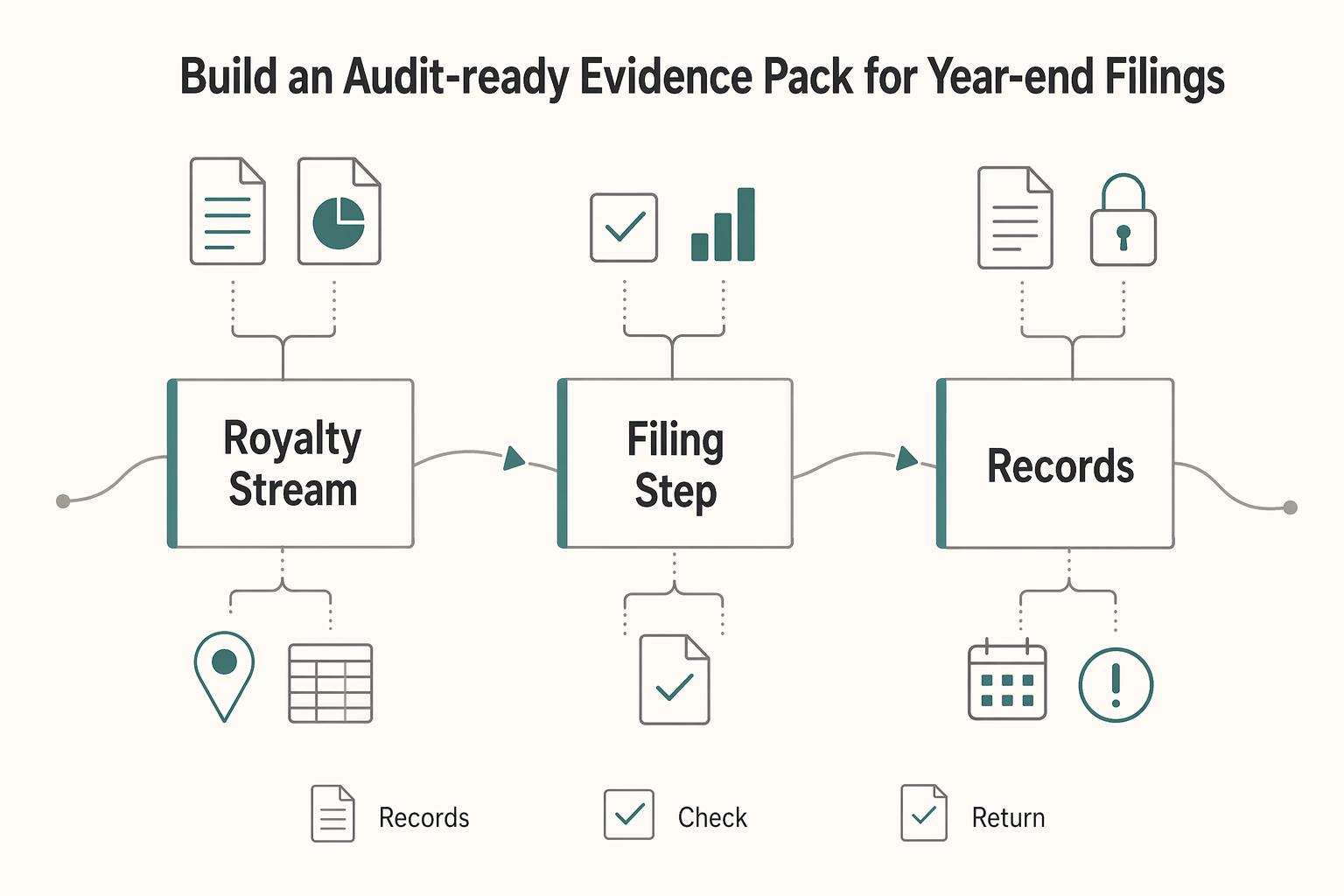
Build an audit-ready evidence pack for year-end filings#
Organize evidence by royalty stream and tax year. Distinguish payer deductions, UK return treatment, US return treatment and any correction request. Keep the underlying data exportable to your adviser.
For a self-employed writing business, HMRC requires business records for at least five years after the relevant 31 January submission deadline; very late returns have a different rule. Non-business pay and tax records have a separate retention period, generally 22 months after the tax year for an on-time return. Use the applicable business-record rule or non-business record rule, and retain evidence longer where an open enquiry requires it. Preserve source and ownership evidence while it remains relevant.
Tie each document to one royalty stream#
Anchor the folder to the agreement, then retain statements, bank matches, actual status forms and relevant residence evidence. Include territories of rights use and business expenses, rather than treating INTM342590 as proof of UK-resident exemption.
Tag by filing use case, not just document type#
Tag documents when they arrive so you do not have to infer their purpose at filing time.
| Document | Main filing use case | Why it matters |
|---|---|---|
| Agreement and rights schedule | Source and business/royalty classification | Shows ownership, markets and payment rights |
| Statements and bank matches | Both returns and correction requests | Separates gross income, tax, fees and cash received |
| Correct status form and submission record | Payer reporting/withholding | W-9 for main citizen case; appropriate W-8 only in eligible foreign-owner branch |
| Residence evidence | Relevant treaty position | Supports the actual period, not a blanket status conclusion |
| Tax paid and credit calculation | UK or US relief as applicable | Preserves tax type, year, limitation category and any treaty resourcing |
| Relevant authority | Position support | Use current treaty text and year-specific instructions |
Keep the current treaty passages and year-specific return instructions actually relied on. Record the status and income facts that make them applicable. A royalty-rate table alone omits the saving clause, owner conditions and special credit coordination.
Keep timing evidence, not just final forms#
Retain the correct completed status form and submission confirmation. For the citizen branch this is ordinarily W-9; a W-8 history matters only where foreign-person treatment was legitimately applicable or needs correction.
For Certificate of Residence, keep both the request details and the issued certificate. CoR requests require the income type and relevant treaty article, and HMRC may refuse a CoR where treaty entitlement is not met.
Use a monthly checkpoint to avoid year-end reconstruction#
A monthly reconciliation is not a legal requirement, but it is a practical control. Check that:
- Match each payment to gross income and itemized deductions.
- Check the payer's status and deductions against the actual owner and applicable rules.
- File corrections and any relevant residence evidence.
- Map receipts to the correct UK period, US year and return schedules.
- Track any credit or refund once, with later corrections reconciled.
Fix missing links quickly. Year-end reconstruction is where otherwise supportable positions often break down.
For a step-by-step walkthrough, see FEIE vs Foreign Tax Credit for High-Earning US Expats.
Watch the edge cases that change the answer fast#
When key facts are unclear, split the work immediately: escalate unresolved royalty or treaty points, and keep HMRC filing mechanics moving so you do not miss deadlines.
Treat royalty classification and treaty points as stop-and-verify flags#
Ask for substantive advice when citizenship, residence, source, business classification or treaty relief is unclear. Neither payer wording nor an internal HMRC passage can settle every case. Do not rely on historic ICTA references as the current answer for a UK-resident author.
If contract or statement wording is inconsistent, for example between "royalty," "licence fee," and "service fee," treat that as a material red flag and preserve the underlying documents.
Keep filing access and route checks moving in parallel#
Even while the substantive tax position is under review, finish the operational checks now:
| Check | Action | Note |
|---|---|---|
| First-time filer | Register for Self Assessment before using the online filing service. | Complete this now even while the substantive tax position is under review. |
| Existing filer | Reactivate an inactive account first. | HMRC says filing may be delayed without reactivation. |
| UTR | Confirm you have your Unique Taxpayer Reference (UTR). | This is one of the operational checks to complete now. |
| Online service eligibility | Verify your facts are eligible for HMRC's online service. | Some cases, including living abroad as a non-resident, must use commercial software or other forms. |
| Records | Keep records HMRC expects, for example bank statements or receipts. | This is part of the operational checks to complete now. |
Track timing risk as tightly as tax risk#
For 2025–26, track the applicable October 5, 2026 notification, October 31 paper and January 31, 2027 online/payment dates. Payer disputes do not postpone them. Check any HMRC notice with a different filing date and payments on account separately.
A writing trade may create self-employment reporting and social-insurance questions. The UK gross trading-income threshold can be relevant, but it is not a universal allowance or test for every acquired royalty. Coordinate US self-employment tax and applicable social-security agreement rules separately from income-tax credits.
Use an exportable record set for both countries#
Use one traceable record set for each royalty stream so your return prep is faster and errors are easier to catch. This will not resolve legal classification questions, but it can give you a cleaner audit trail for your UK tax return workflow and adviser handoff.
Use a ledger or document system that lets you export agreements, payment statements, fees, withholding and correction notes. Check whether your chosen tool supports each item; a ledger record does not determine treaty eligibility or substitute for the return.
A practical monthly pack can include:
- bank statements or receipts matched to the same payment period
- payout statements and other payment evidence for that period
- the related contract or platform terms you rely on
- notes on mismatches, correction requests, and payer responses
Before filing, check taxpayer IDs, access, required supplementary pages and the applicable year. A US calendar year and UK April-to-April year may allocate payments differently. Preserve the currency-conversion method and amounts used on each return instead of treating net bank cash as gross taxable royalties.
Know exactly when to escalate to a tax professional#
Escalate before filing if you cannot map each royalty payment to a clear, defensible treatment under HMRC guidance, the UK-US Double Taxation Treaty, and the payer's actual withholding process. Good records help, but they do not resolve fact-sensitive classification, treaty eligibility, or creditability calls on their own.
Escalate when classification or status is not clean#
Escalate if US-person status, domestic or treaty residence, source markets, writing-business treatment or rights ownership are unclear. INTM342590's overseas-author discussion is a narrower question and is not the main gate for a US citizen living in the UK.
If contract party, owner, payment recipient and taxpayer differ, get owner/entity-specific advice before certifying forms. A US citizen uses the appropriate US-person documentation; an eligible foreign owner may claim treaty withholding through the relevant W-8 route.
Escalate fast when withholding and your documentation diverge#
Raise mismatches between actual owner status and payer documentation immediately. Ask for corrected statements and deductions where justified, then determine the applicable return treatment. Do not submit a foreign-status form to fix a citizen's withholding discrepancy.
A second specialist question is which country grants relief for the particular royalty. The treaty's special US-citizen rules, source, income category and timing can matter more than the amount shown as withheld. Avoid assuming a UK lower-of calculation alone resolves the overlap.
Bring an adviser a dossier, not a story#
Bring a complete file so the adviser can answer the technical question quickly and defensibly. Include:
- Rights agreement and territories of use.
- Citizenship, US tax status and UK residence history.
- Statements, fees, tax paid and bank matches.
- Actual payer forms and correction correspondence.
- Proposed UK and US return classifications and tax years.
- The specific source, credit, treaty-resourcing or ownership issue requiring a decision.
Ask a bounded question tied to specific payments and documents. That is usually more useful than a broad "how does this work?" request.
You might also find this useful: How UK Authors Handle US-UK Tax Treaty Royalties Safely.
Final takeaway and next actions#
Treat this as an execution problem: set your approach early, make sure your HMRC filing access works, verify the first payment, and keep records current all year.
If the facts are straightforward#
Use this sequence to reduce administration gaps:
- Confirm US-person status and provide W-9 where appropriate; do not certify foreign status from a UK address.
- Determine UK domestic/treaty residence and the relevant tax years.
- Use the applicable current UK notification and filing dates, plus the US calendar.
- Check UTR, taxpayer ID and active access; reactivate only where needed.
- Choose the correct UK and US schedules for business royalties or separately held rights.
- Review double-tax credit, treaty-resourcing and correction procedures separately.
- Reconcile gross royalties, actual deductions and net bank receipts.
Keep one usable evidence pack#
Keep one folder per income stream so filing is a reporting task, not a reconstruction exercise. Include:
- contract or platform terms
- payout statements
- bank receipts or statements
- HMRC registration details, UTR, and any reactivation confirmation
- your first-payment reconciliation notes, including gross amount, deductions shown, net received, and payment date
Escalate early if anything is mixed or disputed#
If descriptions, deductions, or payment amounts do not line up, escalate early with a complete document pack. Consider a full handoff instead of trying to fix gaps near deadlines.
Obtain focused advice for uncertain source, residence, credit timing, entity ownership or treaty-resourcing. Continue lawful filing preparation; an unresolved payer issue is not an automatic deadline extension.
Final checkpoint: both returns, both tax calendars and each royalty's gross-to-net records must fit the actual taxpayer. Payment software can organize evidence where supported, but it cannot choose or certify the tax treatment.
Frequently Asked Questions
Do UK publishers withhold UK tax from royalties paid to overseas professional authors?
The HMRC overseas-professional-author passage can remove UK deduction at source for a qualifying author who usually lives overseas and is the originator. It does not establish an exemption for a US citizen who lives in the UK, and absence of source deduction does not itself mean no income tax is due.
Does the UK-US Double Taxation Treaty always reduce royalty withholding to zero?
No. Article 12 may exempt qualifying source-country royalties, but the saving clause preserves US citizenship taxation. A US citizen living in the UK must assess both returns and the applicable double-tax relief. An eligible non-US UK-resident payee follows a different foreign-owner withholding route.
Which form should a US author in the UK submit first to a US publisher?
A US citizen ordinarily gives Form W-9 to the requesting US publisher or platform, even with a UK address. W-8BEN is generally for an eligible nonresident alien individual. Confirm status first, especially for green-card, dual-resident or entity cases; moving abroad alone does not justify foreign-person certification.
If too much tax was withheld, can I offset all of it on my UK tax return?
No. First establish whether the deduction was valid, which country grants relief and the applicable treaty limit. US citizenship tax on qualifying royalties may need US credit and treaty resourcing rather than UK credit. Incorrect deductions may require payer correction or an appropriate refund claim; the same tax cannot be recovered twice.
What records should I keep to defend treaty-rate treatment in an audit?
Keep the agreement, rights-use allocation, actual status form, residence evidence, gross statements, tax paid, fees, bank matches and any corrections. Map records to each country's tax year and return position. A 1042-S or W-8 is not a universal document for a US-citizen payee.
What changes if I receive royalties as a rights holder but I am not the original author?
Acquired or inherited rights can differ from income earned in the author's writing trade and from the overseas-professional-author deduction treatment. Check the rights chain and reporting rules in both countries; do not assume identical schedules, expenses or treaty analysis.
Researched and edited by the Gruv editorial team. Gruv builds cross-border billing, payouts, and finance-operations software for global businesses.
Sources
Includes 2 external sources outside the trusted-domain allowlist.
Educational content only. Not legal, tax, or financial advice.
Related Posts

Digital Nomad Taxes in 2026 With a Defensible Filing Plan
With digital nomad taxes, the first move is not optimization. It is figuring out where you may be taxable, where filings may be required, and what proof supports that position.

The Freelance Payment Penalty: A Modeled Audit of Platform Fees, FX Spreads, and Payout Delays
The money rarely disappears through a single, easy-to-spot fee. The real loss is stacked. A marketplace takes its commission, a processor adds a charge for international cards, a bank or payment company converts the currency at a spread, a platform holds the funds before release, and a wire sheds a little to intermediaries on the way in. Each layer looks defensible on its own, but the worker feels the combined result as a smaller deposit and a later payday.

How to Respond to a Subpoena for Business Records
Move fast, but do not produce records on instinct. If you need to **respond to a subpoena for business records**, your immediate job is to control deadlines, preserve records, and make any later production defensible.