
Quick Answer
Use a single Grant-Vest-Sale workflow for rsu tax uk us company situations: set up W-8BEN and payroll reporting at grant, make a deliberate exposure decision at vest, and reconcile sale proceeds against the vested amount before filing. Keep the vest notice, payslip, broker confirmations, and P60 in one evidence file, and calendar UK Self Assessment checkpoints so registration, filing access, and payment timing do not become last-minute risks.
For global professionals in the UK, a grant of US company equity like Restricted Stock Units (RSUs) should feel like a career milestone. Instead, it often creates a knot of anxiety: US broker forms, UK tax obligations, and market risk all landing at once. The usual mistake is treating each event as a separate tax fire drill.
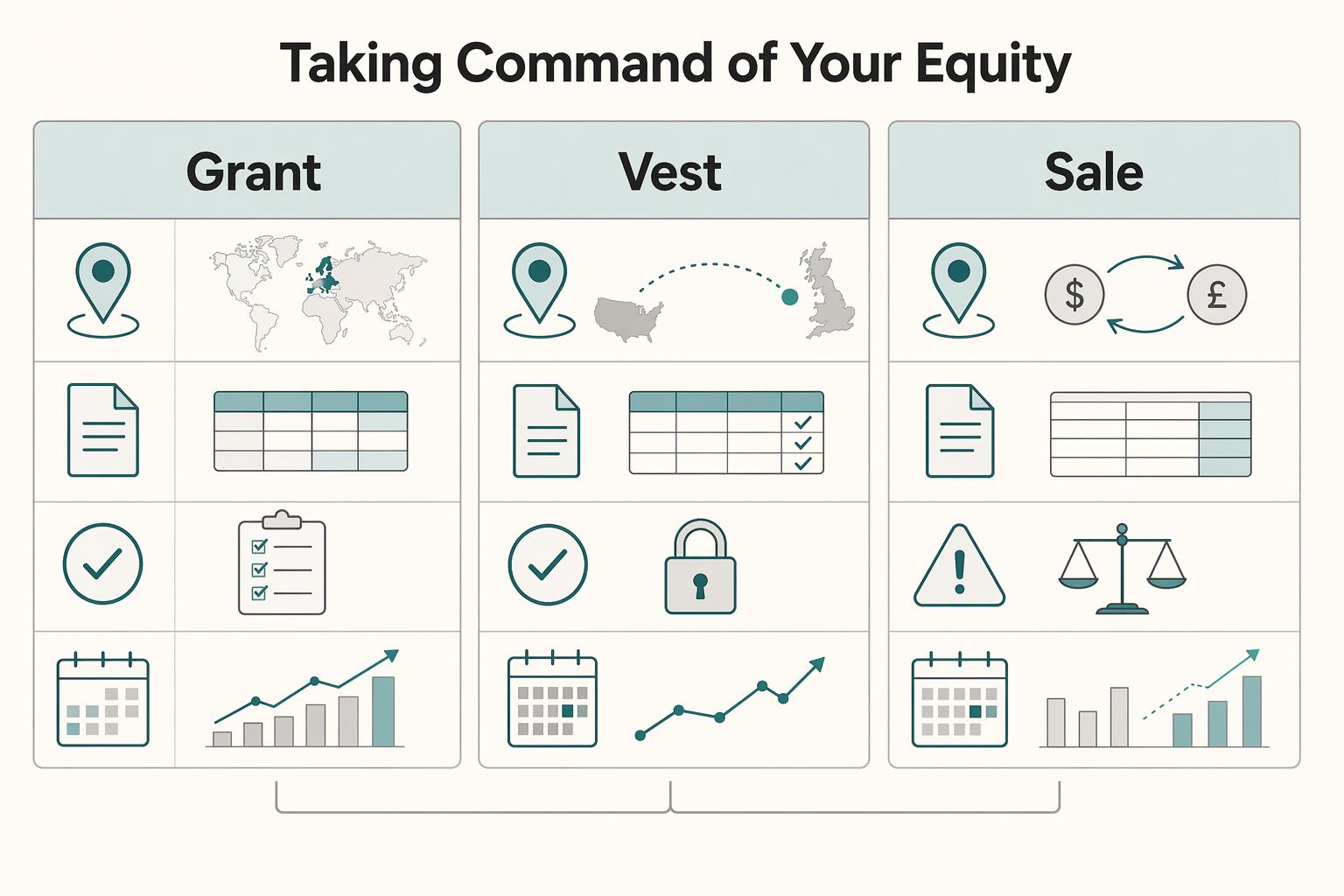
A better approach is to run the whole thing as one process. This guide gives you that process in three stages: Grant, Vest, and Sale. The aim is simple: move from being a passive recipient of shares to the person actively running an equity position with a clear plan, clean records, and fewer surprises.
Stage 1: The Grant - Set Up Admin and Reporting Before the First Vest#
At grant, set up the admin and reporting path before the first vest. That helps reduce withholding mistakes, cash-flow surprises, and HMRC reporting problems later.
Start with the grant packet, not the share price. Gather the award agreement, vesting schedule, broker onboarding messages, and any employer note on tax handling. Then map each vest date to the relevant UK tax year. For current planning, that means the current UK tax year is 6 April 2025 to 5 April 2026, and then onward by year.
Review the grant packet like an operator#
Get the core facts onto one page: grant date, units, vest dates, and the broker or plan administrator. Add your expected UK residence status for each vest year under the Statutory Residence Test. If there is any mid-year move complexity, resolve that first. It can change your reporting path.
Flag edge cases early. If remittance basis could be relevant, do not assume it changes treatment without checking your exact year and status. RSU and share-award receipts sit within UK employment-related securities rules, and HMRC materials show receipts can be taxed as employment income.
Build the vesting calendar and cash forecast#
A simple vesting calendar can do more for control than a detailed market forecast. Create one row per vest with the vest date, shares, placeholder vest value, expected payroll treatment, and document notes. The point is not to predict the number perfectly. It is to make sure no vest happens without a cash and reporting plan.
For each row, list the records you expect to have afterward: payslip, broker vest confirmation, sale confirmation if shares were sold to cover, and year-end payroll forms. This helps avoid a common failure mode where a vest happens, some shares are withheld or sold, and later you cannot reconstruct the values or the tax already collected.
Submit broker forms and confirm treaty positioning#
If your US broker asks for Form W-8BEN, submit it before the first vest and keep proof of submission or acceptance. W-8BEN documents foreign status in a treaty-claim context, and treaty positioning generally requires notifying the withholding agent of that status.
Do not read too much into this step. W-8BEN does not by itself guarantee that no US withholding will apply at vest. You still need to check what the broker actually processed and keep evidence of any foreign tax withheld for later foreign tax credit work if needed.
Confirm the reporting path before payroll guesses for you#
Do not leave this to assumptions. For UK purposes, assets that can be sold or cashed in, including shares, can require PAYE handling, and these awards sit within employment-related securities rules. Ask HR or payroll before the first vest: "Will this be fully taxed through UK payroll, or do I need to report part of it myself?"
| Reporting path | Who withholds or pays | What you must verify | Records to retain |
|---|---|---|---|
| PAYE | Employer payroll withholds through payroll when applicable | Check that the vest appears on your payslip, confirm sell-to-cover or share-withholding treatment, and make sure fully taxed amounts flow to P60 or P45 | Award agreement, vest notice, payslip, P60 or P45, employer calculation, broker statement |
| Self-Assessment | You may need to report and pay via tax return if payroll did not fully tax it | Use HMRC's checker to confirm return requirement. For ERS items, amounts generally go in Self Assessment "Share schemes" unless fully taxed by employer | Award agreement, vest statements, broker confirmations, working papers, proof of foreign tax withheld, filed return copy |
| Mixed or unclear | Employer taxes part and you report part | Reconcile payroll values to broker records so you neither miss income nor report the same amount twice | All records above, plus reconciliation notes and HR or payroll confirmation |
If your employer fully taxed an amount, HMRC guidance says do not also include that same amount in the Self Assessment share-schemes box.
Grant-stage done#
Before you move to vest decisions, make sure all five are true:
- You saved the full grant packet in one place.
- You mapped every vest date to a UK tax year.
- You submitted and evidenced W-8BEN status with the broker, if required.
- HR or payroll confirmed PAYE, Self-Assessment, or mixed treatment in writing.
- You know which records must exist after each vest: payslip, broker statement, and P60 or P45 or return support.
If you want a deeper dive, read the digital nomad tax guide.
Stage 2: The Vest - Choose Your Exposure and Capture the Records#
Vest day is not just an investment decision. It is also when you choose your post-vest exposure and create the records you may need for HMRC. Make that choice deliberately, then document what actually happened.
Separate the tax check from the investment choice#
Keep those as two separate decisions. You may hear immediate sale described as a "no-gain default." Treat that as a prompt to check the numbers, not as a rule to assume. Compare the vest confirmation, payroll records if relevant, and any broker sale confirmation, then save all three together.
For RSU-specific tax mechanics, rely on your own payroll and tax inputs rather than a generic rule. The dependable action on vest day is record capture. HMRC expects you to keep records, for example statements or receipts, so you can complete your return correctly.
Use a decision rule you can defend#
A defensible vest decision can start with concentration risk and cash. Use this as a risk-planning framework, not as a statement about tax outcomes:
- cash you may need available for filing or payroll reconciliation
- how concentrated you already are in your employer
- your conviction in holding more of the same stock
- your downside tolerance if income and equity both depend on one company
| Choice | What you do | Main upside | Main risk | Who this fits | Operational checklist before market close |
|---|---|---|---|---|---|
| Sell all | Sell all vested shares once you can trade | Simpler position and clearer cash picture | Less ongoing exposure to future upside | You want lower complexity and lower single-stock exposure | Confirm order status, check whether any automatic instruction already ran, save vest and sale confirmations |
| Sell to cover | Sell only part of the vest and keep the rest | Keeps some exposure while generating some cash | You may still end up overexposed without a clear cap | You want partial exposure and have a pre-set holding limit | Confirm shares sold versus shares kept, save both confirmations, note your post-vest concentration |
| Hold all | Keep all vested shares and use separate cash if needed | Full continued exposure | Highest concentration and cash-flow pressure | You have strong conviction, liquidity, and a defined risk limit | Confirm available cash, save vest confirmation, schedule a dated concentration review |
Keep filing access on track while details are fresh#
If treatment is mixed, incomplete, or still unclear after vest, check whether you need to register for Self Assessment. HMRC's example says that for the previous tax year (6 April 2024 to 5 April 2025), telling HMRC after 5 October 2025 could trigger a penalty.
| Filing item | What the article says | When or condition |
|---|---|---|
| Check Self Assessment need | Check whether you need to register for Self Assessment. | If treatment is mixed, incomplete, or still unclear after vest. |
| Tell HMRC | Telling HMRC after 5 October 2025 could trigger a penalty. | HMRC's example is for the previous tax year 6 April 2024 to 5 April 2025. |
| First-time filer | Register before using the online filing service. | If you are filing for the first time. |
| Inactive Self Assessment | Reactivate it first or your return may be delayed. | If you had Self Assessment before but it is inactive. |
| UTR | You need your UTR to sign in and file online. | Before online filing. |
| Online service limits | The online service is not available in some cases. | Including if you lived abroad as a non-resident. |
If you are filing for the first time, you must register before using the online filing service. If you had Self Assessment before but it is inactive, reactivate it first or your return may be delayed. You also need your UTR to sign in and file online. HMRC also notes the online service is not available in some cases, including if you lived abroad as a non-resident.
Vest-day execution checklist#
- Confirm what actually executed:
sell all,sell to cover, orhold all. - Ring-fence any cash you expect to need for filing or payroll reconciliation.
- Save your evidence pack in one folder: vest confirmation, broker statement or statements, payslip if available, and employer or payroll notes.
- Put compliance dates in the calendar now: register or tell HMRC by
5 Octoberif required, file online on or after6 Aprilafter year-end, and plan payment by31 January.
Related: Understanding the UK's Statutory Residence Test (SRT).
Stage 3: The Sale - Integrating Equity into Your Global Wealth Plan#
Once you sell, the work is not finished. Your next job is to lock the tax basis, avoid double counting, and then decide where the cash should go.
Lock the capital gains number first#
Do this before moving money around. Start with three steps:
- Confirm exactly what you sold and save the trade confirmation or contract note.
- Set your CGT base cost using the amount already taxed as employment income at vest.
- Compute gain or loss from post-vest movement, not from the full sale proceeds.
HMRC's position is that amounts already charged as employment income can be added to CGT cost so the same value is not charged to both Income Tax and CGT. If you sold immediately, verify rather than assume the gain is zero. Timing, fees, price movement, or FX can still create a difference. If payroll fully taxed the share-scheme amount, it is normally already reflected in your P60, so reconcile before you duplicate entries.
If you sold outside a wrapper, a gain can trigger CGT. The Annual Exempt Amount is £3,000 for 2025 to 2026, and published rates on most share gains from 6 April 2025 are 18% and 24% depending on your tax-band position. Verify current-year rates and thresholds before filing.
Put the proceeds somewhere with intent#
The right destination depends on access, tax treatment, and whether you may need cash for tax or a move.
| Destination | Tax treatment | Access and liquidity | When it is the safer default |
|---|---|---|---|
| ISA | Tax-advantaged wrapper. Subscription limit is £20,000 for 2025 to 2026. | You can usually withdraw at any time without losing ISA tax benefits, subject to provider terms. If you later become non-UK resident, you can keep the ISA but usually cannot keep contributing. | Use when you want tax shelter with flexibility and you are still UK resident while funding it. |
| SIPP | Contributions can receive UK tax relief, subject to limits, 100% of annual earnings; annual allowance £60,000 this tax year. | Low liquidity. Access is generally at normal minimum pension age, increasing to 57 from April 2028, subject to scheme rules or exceptions. | Use when retirement funding is the priority and you can lock money away. |
| Taxable account | No wrapper. Disposals can trigger CGT where there is a gain. | High liquidity. | Use when wrapper capacity is used or you need flexible investing beyond ISA or pension limits. |
| Cash buffer | No wrapper protection. Treatment depends on where cash is held and what return it earns. | Highest liquidity. | Use when you expect tax payments, payroll shortfalls, or near-term residency changes. |
If you moved countries during the vesting period#
Cross-border apportionment is not a side note. Treat it as its own filing workflow:
| Issue | What the article says |
|---|---|
| Apportionment method | HMRC expects just-and-reasonable apportionment between UK and non-UK duties. |
| Common basis | HMRC practice points to UK workdays in the grant-to-vest period as a common basis. |
| FTCR cap | FTCR is capped at the lower of foreign tax and UK tax on that doubly taxed item. |
| SA106 | Use SA106 where relevant to declare foreign income or gains or claim credit. |
| From 6 April 2025 | Remittance basis is abolished and UK residents are generally taxed on the arising basis. |
| Newly UK resident | Check whether the 4-year FIG regime applies. |
- map the full grant-to-vest timeline
- count workdays by location across that period
- keep evidence of where duties were performed, such as travel records and calendars
- reconcile payroll treatment in each jurisdiction
- coordinate treaty or credit treatment so the same item is not taxed twice
For internationally mobile employees, HMRC expects just-and-reasonable apportionment between UK and non-UK duties. HMRC practice points to UK workdays in the grant-to-vest period as a common basis. If foreign tax was paid on the same item, FTCR is capped at the lower of foreign tax and UK tax on that doubly taxed item. Where relevant, use SA106 to declare foreign income or gains or claim credit. From 6 April 2025, remittance basis is abolished and UK residents are generally taxed on the arising basis. If you are newly UK resident, check whether the 4-year FIG regime applies.
Speak to a cross-border adviser if any of these apply:
- you moved into or out of the UK between grant and vest
- more than one payroll or jurisdiction touched the award
- foreign tax was withheld and does not reconcile with UK payroll
- you expect to claim treaty relief or FTCR
- your workday or location evidence is incomplete
Build the evidence pack before year end#
If you wait until filing season, this gets much harder. Build one file that ties broker, payroll, and tax-return numbers together without guesswork.
| Item | What to do | Detail |
|---|---|---|
| Cost and proceeds evidence | Keep dated cost and proceeds evidence. | HMRC expects this. |
| Buying or selling contracts | Keep supporting buying or selling contracts. | HMRC expects this. |
| GBP conversion method | Document one consistent GBP conversion method. | If your broker reports in USD. |
| Disposal exchange rate | Use the exchange rate at disposal date. | For disposal. |
| FX-rate source | Keep your FX-rate source copy. | Example: HMRC monthly rates. |
| Retention period | Keep records for at least 5 years after the 31 January submission deadline for the relevant tax year. | If you file through Self Assessment. |
Keep:
- grant documents and vest schedule
- vest confirmation
- payslips and P60
- broker statements and sale confirmations
- fee records
- valuation support, where relevant
- proof of tax paid or withheld by country
HMRC expects dated cost and proceeds evidence and supporting buying or selling contracts. If your broker reports in USD, document one consistent GBP conversion method. For disposal, use the exchange rate at disposal date, and keep your FX-rate source copy, for example HMRC monthly rates. If you file through Self Assessment, keep records for at least 5 years after the 31 January submission deadline for the relevant tax year.
Sale-stage completion#
- Compute gain or loss using the income-taxed vest value as the starting basis.
- Reconcile P60, vest statement, and broker sale confirmation.
- Ring-fence tax cash, then allocate across ISA, SIPP, taxable investing, or a cash buffer.
- Confirm whether treaty or FTCR treatment and
SA106are needed. - Archive your evidence pack and note the record-retention date.
You might also find this useful: A Guide to Profit Sharing for Small Agencies.
Run Grant, Vest, and Sale as a Repeatable Control Loop#
The point of this process is not to make equity feel complicated. It is to make it manageable. Use Grant, Vest, and Sale as a repeatable control loop so you get fewer surprises, cleaner cash-flow planning, and records you can actually file from.
| Stage | Recipient mindset | CEO mindset |
|---|---|---|
| Grant | Files the award away and revisits it later. | Decision: confirm admin setup now. Default action: verify your filing setup is current. Artifact: note whether Self Assessment registration or reactivation and a UTR are in place. |
| Vest | Reacts when notifications arrive. | Decision: make an explicit sell-or-hold call. Default action: reconcile details immediately. Artifact: keep the vest notice, payroll record, and broker confirmation together. |
| Sale | Treats proceeds as extra cash and moves on. | Decision: choose where proceeds go next. Default action: execute and document the transfer path. Artifact: keep the sale confirmation, fee records, and bank statements or receipts in one file. |
Your main compliance gate is still UK Self Assessment. If you need to complete a return for the previous year, HMRC says you must tell it by 5 October, and late notification can trigger a penalty. If you were already registered, check whether your account needs reactivating, because filing without reactivation may delay your return. You can file online on or after 6 April after the tax year ends, you need your UTR, and the bill is due by 31 January.
Use this short next-step list:
- At grant: confirm Self Assessment registration or reactivation status and that your
UTRis in place, and set calendar triggers for 6 April, 5 October, and 31 January. - At vest: make the sell-or-hold decision deliberately, then reconcile vest, payroll, and broker records while the event is still fresh.
- At sale: document the transfer path and store that trail with the sale file.
One early check matters every cycle. If you lived abroad as a non-resident, HMRC says this online filing service cannot be used, so confirm your filing route before deadline pressure builds. Then repeat the same loop for every future grant and vest. Trigger the calendar, update the document pack, review the decision, and set monthly or weekly payments if that helps you budget for the bill.
For a step-by-step walkthrough, see Tax Implications of Earning Royalties for a US Author Living in the UK.
If your grant, vest, and sale timeline crosses tax years or residency changes, map your facts first so adviser conversations stay precise and fast: Track your tax residency timeline.
Frequently Asked Questions
Do you pay US tax on RSUs if you live in the UK?
Potentially. The approved sources here support that if the same income is taxed by both jurisdictions, you may be able to claim U.S. relief through a foreign tax credit or deduction. They do not provide a definitive RSU-specific outcome for every UK-resident case, so treat this as a mixed-jurisdiction issue and get cross-border advice before offsetting anything.
What is “sell to cover,” and should you rely on it?
Treat sell to cover as an execution step, not a complete tax answer. After the trade, reconcile the vest notice, payslip, and broker confirmation for the same vest date before you file.
How do you calculate capital gains when you later sell the shares?
Treat it as a reconciliation exercise, not a shortcut formula. The approved sources here do not provide UK RSU disposal formulas, rates, or thresholds, so verify current UK disposal reporting rules for your filing year. Pull the vest confirmation, sale confirmation, and fee records into one file so your figures tie out.
Where do you report the income in the UK?
Start by checking whether you need to file a Self Assessment return before you register. HMRC’s page shows 5 October 2025 as the notification example for the prior tax year 6 April 2024 to 5 April 2025, and says late notification can trigger a penalty, so verify the current deadline for your year. Reconcile P60, payroll year-end records, and vest documents before entry, and remember that UK Self Assessment is separate from a U.S. foreign tax credit claim.
What exchange rate should you use?
Verify the current HMRC foreign-exchange method for RSU reporting. Use one consistent, well-documented GBP conversion approach in your workpapers, and verify current HMRC guidance for your filing year before you file.
Does the US-UK treaty fix double taxation automatically?
No, not automatically. Use accurate filings and records in each jurisdiction, and get professional advice when your facts span more than one country.
If the same income is taxed in both countries, can you use a foreign tax credit?
Potentially yes. The IRS says you may be able to claim a credit or deduction when the same income is taxed by both jurisdictions, and it says the credit is usually more advantageous. Individuals generally claim via Form 1116, with amounts reported in U.S. dollars and a separate form per income category, while corporations use Form 1118. Before claiming, confirm the tax is creditable, note that some taxes fail even if basic tests look met, and remember you cannot claim credit for tax on excluded income.
What if you missed a credit or filed the wrong numbers earlier?
Do not guess. Rebuild the file and correct it methodically. The IRS says individuals generally have ten (10) years to file a refund claim for previously underclaimed creditable foreign taxes. Gather prior returns, payroll and broker records, and proof of foreign tax paid, then get advice before amending if your facts are mixed-jurisdiction or the income category is unclear.
Try a related tool
Researched and edited by the Gruv editorial team. Gruv builds cross-border billing, payouts, and finance-operations software for global businesses.
Sources
Includes 2 external sources outside the trusted-domain allowlist.
Educational content only. Not legal, tax, or financial advice.
Related Posts

Digital Nomad Taxes in 2026 With a Defensible Filing Plan
With digital nomad taxes, the first move is not optimization. It is figuring out where you may be taxable, where filings may be required, and what proof supports that position.

Understanding the UK's Statutory Residence Test (SRT)
Treat SRT like ops, not folklore. You want a repeatable workflow you can run monthly so your tax-year answer is boring, documented, and easy to defend.
Profit Sharing for Small Agencies Without Compliance Surprises
Run this as a system, not a morale perk. If you want profit sharing to support retention, alignment, and financial health, set it up with a written plan, clear ownership, and rules you can apply the same way every time.