
Quick Answer
Use MFS as your default, test HOH next, and move to MFJ only when you intentionally make the resident election and can document both spouses’ income from all sources. Publication 519 is the status checkpoint, while Publication 501 governs the HOH gates, including Worksheet 1 and Table 4. If those records are incomplete, file the position you can support and revisit after the file is complete.
Start Here if You Married a Nonresident Alien#
Use Married Filing Separately (MFS) as your default unless you can clearly support Head of Household (HOH) or you intentionally make the resident election and file jointly. The core tradeoff is straightforward: baseline filing treatment versus broader reporting while the election is in effect.
If you remember one rule, make it this: you cannot file Married Filing Jointly (MFJ) unless you choose to treat your nonresident spouse as a U.S. resident for tax purposes. If you make that choice, you must file a joint return for that year, and both spouses must report their combined income from all sources while the choice remains in effect. This is not just a filing-status decision. It is also a reporting-scope decision.
The first-pass decision path#
Follow this sequence instead of guessing:
- Confirm your spouse is a nonresident alien for U.S. tax purposes.
If yes, treat MFS as the baseline unless another rule clearly applies.
- Test HOH before considering MFJ.
HOH is not available just because your spouse is nonresident. You still need to meet the gate tests, including paying more than half the cost of keeping up your home for the year and having a qualifying person who lived with you for more than half of the year. Use Publication 501 Worksheet 1 for the home-cost test and Publication 501 Table Four for the qualifying-person test.
- If HOH does not apply, choose between MFS and the resident election plus MFJ.
No resident election means no MFJ. If you make the election, both spouses are treated as U.S. residents for federal income tax purposes for that year and later years while it remains in effect.
What usually drives the right answer#
MFS is the baseline when you do not make the resident election. MFJ can still be the right call, but only if you are ready for the broader reporting scope, because both spouses must report combined worldwide income while the election applies.
Two guardrails matter early. First, the resident election is a tax choice only. It does not change immigration status. Second, while the election is in effect, tax treaty benefits generally cannot be claimed by either spouse.
What you should gather before deciding#
Build the evidence pack before you choose:
- A clear statement of whether the spouse is treated as nonresident or under the resident election
- Your income records for the year
- If considering MFJ, the spouse's full-year income records from all sources
- If considering HOH, home-cost and qualifying-person support tied to Publication 501 Worksheet 1 and Table Four
If key pieces are missing, start with the conservative baseline and revisit once the file is complete. The next sections walk through the terms, the decision order, and the points where professional help is the safer move. We covered related cross-border issues in A Guide to Canada's 'Non-Resident Tax' on income earned in Canada.
The Terms That Drive Your Tax Outcome#
Most mistakes start with the wrong tax label. For U.S. federal income tax, nonresident alien and resident alien are different categories, and that classification drives whether MFS is the baseline, whether MFJ is available, and how broad your reporting becomes.
Tax residency is not the same as immigration shorthand#
Start by confirming your spouse's tax classification for the specific year. That answer changes your filing path, and tax-residency choices do not change immigration status.
The resident election is a tax choice#
The resident election is the choice to treat a nonresident spouse as a U.S. resident for tax purposes. If you make that choice, you must file a joint return for that year. While the choice is in effect, both spouses are treated as U.S. residents for federal income tax purposes.
This choice is tax-only. It does not change your spouse's U.S. immigration status. IRS guidance also shows making the choice by attaching a statement to the joint return.
Worldwide income reporting scope#
This scope split controls the rest of the decision. Under the election, each spouse must report entire worldwide income for the year you make the choice and later years while it remains in effect. If you do not treat your nonresident spouse as a tax resident, Married Filing Jointly is not available, and the baseline filing status is generally Married Filing Separately.
Another guardrail matters here too. While the election is in effect, tax treaty benefits as a resident of a foreign country are generally unavailable. If you want a deeper dive, read Digital Nomad Taxes in 2026 With a Defensible Filing Plan.
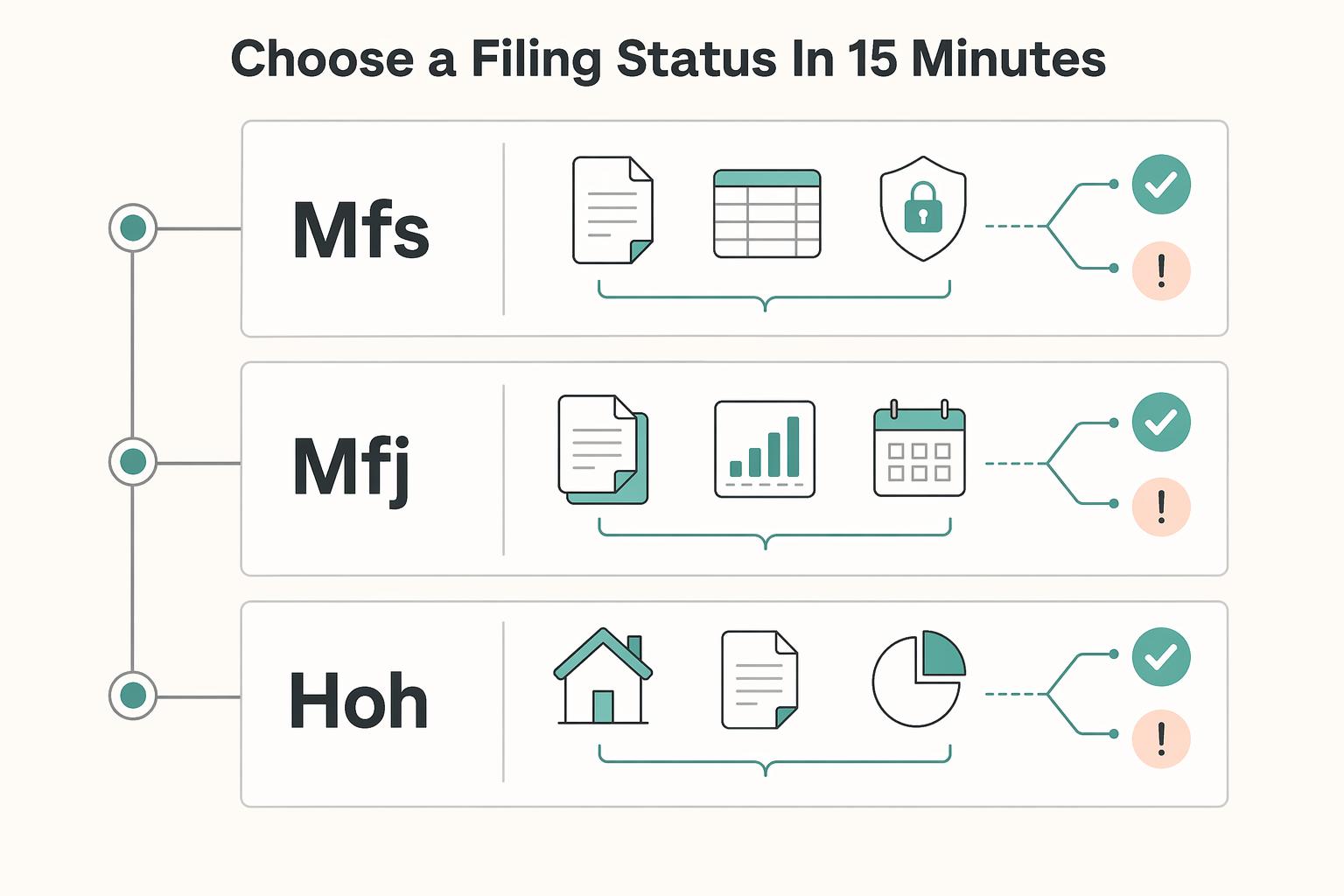
Choose a Filing Status in 15 Minutes#
For a fast, reliable path, use this order: confirm spouse tax status, test HOH, then choose MFS or a resident election for MFJ. If facts are incomplete or still changing, start with MFS until your documentation is complete.
| Filing status | Basic eligibility in this cross-border setup | Income scope | Operational burden |
|---|---|---|---|
| MFS | Common baseline option when your spouse is a nonresident alien and you do not make the resident-election choice | Does not require the resident-election joint-return treatment; a nonresident alien is generally taxed only on U.S.-source income | Often a lighter lift because you avoid the resident election and joint reporting of both spouses' worldwide income |
| MFJ | Available if you choose to treat the nonresident spouse as a U.S. resident for tax purposes; you must file jointly for the year you make that choice | Both spouses' worldwide income must be included while the choice is in effect | Can be a heavier lift because you need complete income records for both spouses and a broader reporting scope |
| HOH | Possible only if you are treated as unmarried for HOH, pay more than half the cost of keeping up a home, and have a qualifying person; your nonresident spouse is not the qualifying person | No resident-election expansion by itself | Documentation-heavy because you need support for home-cost and qualifying-person tests |
Use this order every time#
- Confirm spouse tax status for the year.
Use Publication 519 to verify whether your spouse is nonresident or resident for tax purposes. If spouse status is unclear, stop here and resolve it first.
- Test HOH eligibility.
You may be considered unmarried for HOH if your spouse was a nonresident at any time during the year and you do not make the resident election. Then confirm the full HOH tests: you paid more than half the cost of keeping up a home and you have a qualifying person who is not your spouse.
- Decide between MFS and resident-election MFJ.
Generally, you cannot file MFJ if either spouse was nonresident at any time during the year unless you make the resident election. If you make it, you must file jointly and include both spouses' income from all sources.
IRS checkpoints to verify before filing#
Use Publication 519 for the classification checkpoint. Use Publication 501 for the filing-status checkpoint, including Worksheet 1 for the "more than half the cost of keeping up a home" test.
If your status proof, HOH support, or full joint-income records are incomplete, file the position you can prove now. In uncertain cases, MFS is often the clean starting point, then revisit MFJ when records are complete. IRS guidance allows changing separate returns to a joint return within three years from the due date of the separate returns. If you need the full breakdown, read A Guide to Dual-Status Alien Tax Returns.
Why MFS Is the Compliance Baseline for Many Couples#
If your priority is low-stress compliance and your records are fragmented, first confirm the return context before you rely on filing-status labels. Treat online shorthand as a working note, not a tax rule.
In older, non-authoritative discussions, people sometimes use MFS language in nonresident-alien situations. Some excerpts frame Form 1040NR differently, including claims that MFS is not a valid status there, so context matters before you apply any rule to your own return.
Where this reduces compliance risk#
The main benefit is process control. You reduce the odds of applying the wrong rule set before your evidence is ready. Before moving forward, confirm:
- your exact return context, so you are not mixing up Form 1040 and Form 1040NR discussions
- whether your filing-status language came from an older online excerpt
- whether you have complete, usable records for the position you plan to file
If any of those points are unclear, that is a strong signal to pause and verify before finalizing your filing position.
The tradeoff#
A narrower, fully documented position can reduce rework, but it is not always the final answer once your facts are complete.
One common failure mode is borrowing filing-status language from the wrong return context. Older online excerpts about 1040NR are often quoted as general rules, so verify the context before you apply them to your case. Related: 183-Day Rule Explained: Stop the Tax Myths Before They Cost You.
What You Trigger When You Elect MFJ#
Electing Married Filing Jointly (MFJ) with a nonresident spouse is not just a rate choice. It generally means choosing to treat your spouse as a U.S. resident for tax purposes.
If one spouse is a U.S. citizen or resident and the other is a nonresident alien, this election treats both spouses as U.S. residents for U.S. federal income tax purposes while the choice is in effect. You must file a joint return for the year you make the choice.
The practical consequence is scope. Once elected, each spouse must report entire worldwide income for that year and later years while the election remains in effect. In practice, this can be a major documentation jump from a narrower filing position.
What to verify before you elect#
Make this call based on records, not optimism. Can you fully support both spouses' full-year income picture? If not, defer.
IRS examples show the choice is made by attaching a statement to the joint return. That means your file should support the joint return, that election statement, and full spouse-side income reporting.
The continuity risk most people miss#
This may not be a one-year move. The resident treatment applies for the election year and later years while the choice stays in effect, so it can reduce future flexibility.
A key tradeoff is treaty position. While the choice is in effect, generally neither spouse can claim tax treaty benefits as a resident of a foreign country, with limited exceptions noted by the IRS. If treaty treatment may matter for your facts, treat MFJ as a continuing position, not a quick filing shortcut.
| Criteria | Elect now | Defer election |
|---|---|---|
| Reporting scope | Both spouses treated as U.S. residents for federal income tax purposes while the choice is in effect; both spouses' entire income from all countries is reportable | Avoids broader joint-resident treatment for now and can preserve a narrower filing scope |
| Documentation load | Higher immediate burden: joint return and, in IRS examples, an election statement, plus complete spouse-side income support | Lower immediate burden when spouse-side records are incomplete or still being verified |
| Future optionality | Lower flexibility while the choice remains in effect, including generally limited foreign-resident treaty positions | More flexibility to decide later after records and cross-border implications are clearer |
If your facts are still uncertain, keep MFS until the spouse-side file is complete and defensible end to end.
For a step-by-step walkthrough, see How to Make the '6013(g) Election' to Treat a Non-Resident Spouse as a Resident for Tax Purposes.
Can You Use Head of Household Instead#
Yes, but only if you clear two real gates. If your spouse was a nonresident at any time during the year and you do not choose resident treatment, you may be treated as unmarried for Head of Household (HOH) purposes. That alone does not qualify you.
Start with these core HOH tests:
- You paid more than half the cost of keeping up the home.
- You have a qualifying person.
Your spouse is not a qualifying person for HOH, so marriage to a nonresident spouse by itself is not enough.
Use IRS HOH guidance to confirm both tests. If either test fails, stop evaluating HOH and go back to MFS versus MFJ.
The common miss is treating "considered unmarried" as automatic HOH eligibility. It is not. You still need another qualifying person, and you still have to meet the other tests. That can include timing rules such as a person living in your home for more than half the year, or a parent-based path tied to maintaining a principal home for the whole year.
Scenario Contrasts for Globally Mobile Freelancers#
For globally mobile couples, the filing call usually turns on two facts: whether you will treat your spouse as a U.S. tax resident, and whether that status may change under IRS residency tests. If either point is uncertain, use the filing position you can fully document.
| Scenario | Key point | Practical action |
|---|---|---|
| A | If your spouse remains a nonresident alien, start from MFS unless you intentionally make the resident election; if you do not treat your nonresident spouse as a tax resident, you cannot file MFJ | Use MFS as the default until you can verify complete spouse income records by source for the full year |
| B | Tax residency is a yearly recalculation under the green card test or the Substantial Presence Test; 120/120/120 days across three years totals 180 weighted days, so that does not meet substantial presence | Keep a dated travel log, entry and exit support, and a clear record of any green card status change |
| C | Compensation is sourced by where services are performed, not where the client is located; incomplete travel and work-location records are a reason to delay a resident election | Stay with MFS until your location and income documentation is complete |
Scenario A#
If your spouse remains a nonresident alien, start from MFS unless you are intentionally making the resident election. If you do not treat your nonresident spouse as a tax resident, you cannot file MFJ. If you do elect into MFJ, both spouses must report combined income from all sources.
Practical action: use MFS as the default until you can verify complete spouse income records by source for the full year. If that record is incomplete, do not make the resident election just to pursue a potential benefit you have not modeled.
Scenario B#
Treat tax residency as a yearly recalculation, not a one-time label. A spouse becomes a U.S. tax resident by meeting either the green card test or the Substantial Presence Test. That means at least 31 days in the current year and 183 days under the weighted 3-year formula, with 1/3 and 1/6 weighting for prior years.
The IRS example shows why this matters. 120/120/120 days across three years totals 180 weighted days, so that does not meet substantial presence. Also, a person can be both nonresident and resident in the same tax year, so next-year planning can change quickly.
Practical action: keep a dated travel log, entry and exit support, and a clear record of any green card status change so you can reassess filing scope before each season.
Scenario C#
For mixed-location freelance work, the sourcing rule that matters in practice is simple: compensation is sourced by where services are performed, not where the client is located. If your travel and work-location records are incomplete, delay a resident election.
Before electing, confirm these checkpoints:
- spouse tax status for the year, including day count and any green card change
- work-location support for major contracts, such as calendar, travel records, and invoices
- a documented split between U.S.-source income and non-U.S. earnings
- prior-year filing position, since an election can continue into later years unless changed
Practical action: if you are still reconstructing location and income records, stay with MFS until your documentation is complete. This pairs well with our guide on How to Handle a US-Sourced 1099 as a Non-Resident Alien.
Build Your Evidence Pack Before You File#
Do not finalize filing status until your evidence pack supports one consistent story from start to finish. In a mixed-residency marriage, the return should confirm documented facts, not fill factual gaps.
Build one working file that covers status, income scope, election history, and prior-year continuity:
| Evidence area | Owner | Proof artifact to keep |
|---|---|---|
| Status proof | Both spouses | Your status support for the year, plus a short note stating whether each spouse is treated as resident or nonresident for filing |
| Income summaries | Both spouses | Year summary by person and source, with supporting records |
| Election records | You | Filed return package and any statement or position showing whether a resident-election was made for joint filing |
| Prior-year filing position | You | Prior-year return and a short continuity note showing whether treatment is continued or changed |
If these documents conflict, your filing decision is still provisional. Reconcile the file first, then choose the return posture.
Keep IRS Form 8938 guidance open while you review#
Use IRS Form 8938 filing criteria and the form itself as working checks while you prepare the return. If your notes conflict with those checks, treat the notes as unverified until you resolve the gap.
Add the FATCA/Form 8938 screen before final sign-off#
Before you sign off, run an explicit FATCA/Form 8938 screen.
| Check | What to verify |
|---|---|
| Specified person status | Confirm whether you are a specified person |
| Specified foreign financial assets | Confirm whether you have an interest in specified foreign financial assets that must be reported |
| Applicable threshold | Confirm whether total specified foreign financial assets are above the applicable threshold; the article cites $50,000 for certain taxpayers and higher thresholds in some joint-filing or abroad cases |
| Attachment to return | If Form 8938 applies, confirm that it is attached to the income tax return |
| No-return exception | If no income tax return is required, Form 8938 is not required even if assets exceed the reporting threshold |
For Form 8938, verify each filing gate in order:
- Are you a specified person?
- Do you have an interest in specified foreign financial assets that must be reported?
- Are total specified foreign financial assets above the applicable threshold, with $50,000 cited for certain taxpayers and higher thresholds in some joint-filing or abroad cases?
- If Form 8938 applies, is it attached to the income tax return?
Also make sure your asset file can support form fields such as maximum values and whether assets were acquired or sold during the tax year.
One failure mode to catch before filing: if no income tax return is required, Form 8938 is not required even if assets exceed the reporting threshold. Document that conclusion clearly in your file.
The final verification checkpoint#
No filing-status choice is final until status proof, income scope, election record, prior-year position, and Form 8938 screening all line up. If a reviewer would have to guess at any step, stop and fix the evidence pack before you file.
You might also find this useful: A Guide to the K-1 Fiancé(e) Visa Process.
Red Flags That Mean Talk to a Tax Pro#
Escalate before filing when your facts are incomplete or your status decision could also trigger separate foreign-asset reporting duties. In this area, the main risk is filing on assumptions instead of records.
| Red flag | Why to escalate |
|---|---|
| You want MFJ but cannot map income end to end | Do not choose MFJ until you can map your spouse's full income picture by person, source, and year with supporting records |
| Your IRS guidance review does not lead to a clear filing position | Pause when the filing outcome depends on a residency classification call you cannot defend cleanly in writing |
| You need to revisit a prior resident election | If a prior return included a resident election for joint filing and you now plan to change that position, get advice before you file |
| Your foreign account reporting may overlap | Form 8938 and FBAR are separate requirements, and uncertainty about which applies is a pre-filing escalation trigger |
You want MFJ but cannot map income end to end#
Do not choose MFJ until you can map your spouse's full income picture by person, source, and year with supporting records. If you cannot clearly show what is included and why, your filing position is not ready.
Your IRS guidance review does not lead to a clear filing position#
If your review of applicable IRS guidance does not produce one clear status decision, treat that as a stop sign. This matters most when your filing outcome depends on a residency classification call you cannot defend cleanly in writing.
You need to revisit a prior resident election#
If a prior return included a resident election for joint filing and you now plan to change that position, get advice before you file. Bring the prior-year return, any election statement, and a short timeline of how each spouse was treated for tax purposes. If your own file cannot prove what was previously elected, do not guess.
Your foreign account reporting may overlap#
If you are unsure whether you need Form 8938, FBAR (FinCEN Form 114), or both, escalate before filing. These are separate requirements: filing Form 8938 does not replace FBAR, and FBAR is filed with FinCEN, not the IRS.
Use the thresholds as a hard check:
- FBAR trigger: aggregate foreign account value over $10,000 at any time during the calendar year.
- Form 8938 trigger depends on filing profile, including $50,000 / $75,000 for certain unmarried or MFS filers living in the U.S., and $100,000 / $150,000 for certain joint filers living in the U.S.
- Form 8938 must be attached to your annual return and filed by that return's due date, including extensions.
- A nonresident spouse who elects resident treatment to file jointly is treated as a specified individual for Form 8938 purposes.
If account inventories, maximum values, or ownership details are incomplete, treat that as a pre-filing escalation trigger. Related reading: How to Handle Taxes for a US Citizen Child Born Abroad.
Use Gruv Records to Reduce Filing Stress#
Use Gruv as one evidence workspace, not as proof that your filing position is correct. Filing stress usually comes from missing artifacts: no clear joint-return election statement, incomplete foreign-account maximum values for FBAR, or records that do not trace back to statements.
If your Gruv setup already includes usable records for this workflow, keep one year-specific package and reconcile it to bank or platform statements before filing season. If not, confirm that early and use a fallback process.
A practical evidence pack for this decision should include:
- your return posture for the year, including whether you made the resident election and filed jointly
- the statement attached to the joint return if you chose to treat a nonresident spouse as a U.S. resident
- records that show each spouse's income and how amounts were tracked across accounts
- foreign account statements used to approximate each account's maximum value for FBAR
For FBAR, keep records strong enough to determine whether any single foreign account or your aggregate foreign accounts exceeded $10,000 at any point in the calendar year. A reasonable approximation of each account's greatest value is allowed, and periodic statements can be used when they fairly reflect the year's maximum. Use the Treasury rate for the last day of the calendar year when available. If not, use another verifiable rate and keep the source. If you have fewer than 25 accounts and cannot determine aggregate maximum value, complete the account sections and mark amount unknown.
Good traceability will not choose your filing status for you, but it will make your position easier to substantiate.
What to Do Next Without Overcomplicating It#
Start by choosing a provisional filing status now, then pressure-test it against IRS guidance before you file. In general, that means using Married Filing Separately (MFS) as the baseline. Test Head of Household (HOH) only if you clearly meet the rules. Consider Married Filing Jointly (MFJ) only after confirming what the nonresident-spouse resident election would require.
Pick a provisional answer today#
Choose the status that matches this year's facts, not the status that feels easier later. A practical order:
- Confirm whether your spouse is still a nonresident alien for U.S. federal income tax purposes using Publication 519.
- If your spouse is nonresident, test HOH only if it is plausible: use Publication 501 Worksheet 1 for the more than half home-cost test and Table 4 for the qualifying-person test, including the more than half of the year timing rule where relevant.
- If HOH does not hold, your decision is usually MFS or making the resident election so you can file MFJ.
If you cannot document the status determination, home-cost math, or qualifying-person test, treat the decision as unresolved.
Build the evidence pack before you optimize#
Build the documentation first, then choose the filing path. If you make the resident election to file MFJ, both spouses must report combined worldwide income.
Before finalizing, assemble:
- your spouse's tax-status support used in your Publication 519 analysis
- your income records and your spouse's income summary if you are considering MFJ
- Worksheet 1 and Table 4 support if you may claim HOH
- prior-year return copies to confirm whether a resident election was already made and may still be continuing
- for the first year of the election, the signed statement attached to the joint return
Two avoidable mistakes are choosing MFJ before full-income records are ready and assuming HOH without passing the Publication 501 tests.
Escalate early when facts get messy#
If core facts are unclear, escalate before filing. Red flags include incomplete visibility into your spouse's full income picture, borderline HOH facts, an unclear prior-year filing position, or uncertainty applying Publication 519 and Publication 501 to your situation.
When needed, use the IRS directory of preparers with IRS-recognized professional credentials. Also verify that you are using current guidance on the IRS pages for Publication 519 and Publication 501.
If you want cleaner payout and ledger records before next filing season, talk to Gruv about your workflow.
Frequently Asked Questions
What is the default filing status when a U.S. citizen marries a nonresident alien?
In general, the default federal filing status is Married Filing Separately (MFS) when a U.S. citizen or resident alien is married to a nonresident alien. If you choose to treat your spouse as a U.S. resident for tax purposes, you can change from that default; in some cases, Head of Household may also be available if you meet the requirements.
Can I file jointly with a nonresident alien spouse?
Yes, if you make the resident-election choice. For the year you make that choice, you must file a joint income tax return, and your filing status is Married Filing Jointly (MFJ). If you do not make that choice, you cannot use MFJ.
If I elect joint filing, do I have to report my spouse’s foreign income?
Yes. When the choice is in effect, each spouse must report entire worldwide income, not only U.S.-source income.
Can I qualify for Head of Household if my spouse is a nonresident alien?
Possibly, if you do not choose resident treatment for your spouse and you meet HOH requirements. You must pay more than half the cost of keeping up the home, and a qualifying person must live with you for more than half of the year. Use Publication 501 Worksheet 1 for home costs and Publication 501 Table 4 for qualifying-person checks.
Does the resident election change my spouse’s immigration status?
No. This tax choice does not change your spouse’s U.S. immigration status. Also, for Social Security and Medicare withholding, a nonresident spouse may still be treated as a nonresident, and treaty-resident benefits are generally not available while the choice is in effect.
Is the resident election only for one year, or can it continue?
It can continue beyond one year. The choice applies for the year you make it and for later years unless it is ended or suspended. If you made the choice in a current or prior year and do not make any change, it continues. While eligibility conditions remain, you and your spouse may file joint or separate returns in later years.
Try a related tool
Researched and edited by the Gruv editorial team. Gruv builds cross-border billing, payouts, and finance-operations software for global businesses.
Sources
Educational content only. Not legal, tax, or financial advice.
Related Posts

Digital Nomad Taxes in 2026 With a Defensible Filing Plan
With digital nomad taxes, the first move is not optimization. It is figuring out where you may be taxable, where filings may be required, and what proof supports that position.

183-Day Rule Tax Myths That Trigger Residency Filing Mistakes
If you are a mobile freelancer or consultant, start here: the "183 day rule tax" idea is not a single universal test. It is a shortcut phrase people use for different residency rules that do not ask the same question. If you mix federal and non-federal residency logic, you can create filing risk even when your travel calendar looks clean.
K-1 Fiancé(e) Visa Process: Timeline, Eligibility, Filing, and 90-Day Marriage Rule
Think of the **K-1 path** as a series of gates, not a single application. The order is `Form I-129F` with `USCIS`, `DOS` visa processing, U.S. entry if a `K-1 nonimmigrant visa` is issued, marriage within `90 days` of admission, and then `Adjustment of Status` toward a `Green Card`.