
Quick Answer
Tax home vs abode is critical for FEIE because you need a foreign tax home, and a U.S.-centered abode can still block your claim. The article’s guidance is to run a defensibility framework before Form 2555: map work and living facts, score family/economic/personal ties, resolve contradictions, and use a conservative posture when facts are mixed or records are thin.
You Work Globally but One Misread Rule Can Break Your FEIE Claim#
If you earn across borders, FEIE only works when your facts support a foreign tax home and no U.S. abode for the period you claim on Form 2555.
Your clients can be in different countries, but the filing risk still stays with you. As the CEO of a business-of-one, you own the filing position, the documentation, and the consequences if your facts fail under IRS rules. That is why this issue belongs at the start of your process, not at the end.
A common operator setup looks like this. You deliver consulting work abroad, invoice foreign clients, and travel often. Meanwhile, your family routines and core financial life stay in the United States. Your work can look global while your U.S. abode facts still control the FEIE outcome.
What is clear and what needs judgment#
| Area | Clear rule you can use now | Fact-specific call that needs care |
|---|---|---|
| FEIE baseline | Code §911 and Form 2555 require a foreign tax home, plus either the Bona Fide Residence Test or the Physical Presence Test. | Which test gives you the stronger, cleaner filing position for your real timeline. |
| Abode constraint | IRC Section 911(d)(3) denies foreign tax-home treatment for periods when your abode sits in the United States. | How family, economic, and personal ties combine in your exact facts. |
| Tax home definition | IRS ties tax home to your main place of business or post of duty. | Whether your assignment pattern looks temporary or indefinite in practice. |
| Temporary absence | A temporary absence from a U.S. tax home does not qualify for FEIE. | Whether changing plans and extensions shift your risk profile. |
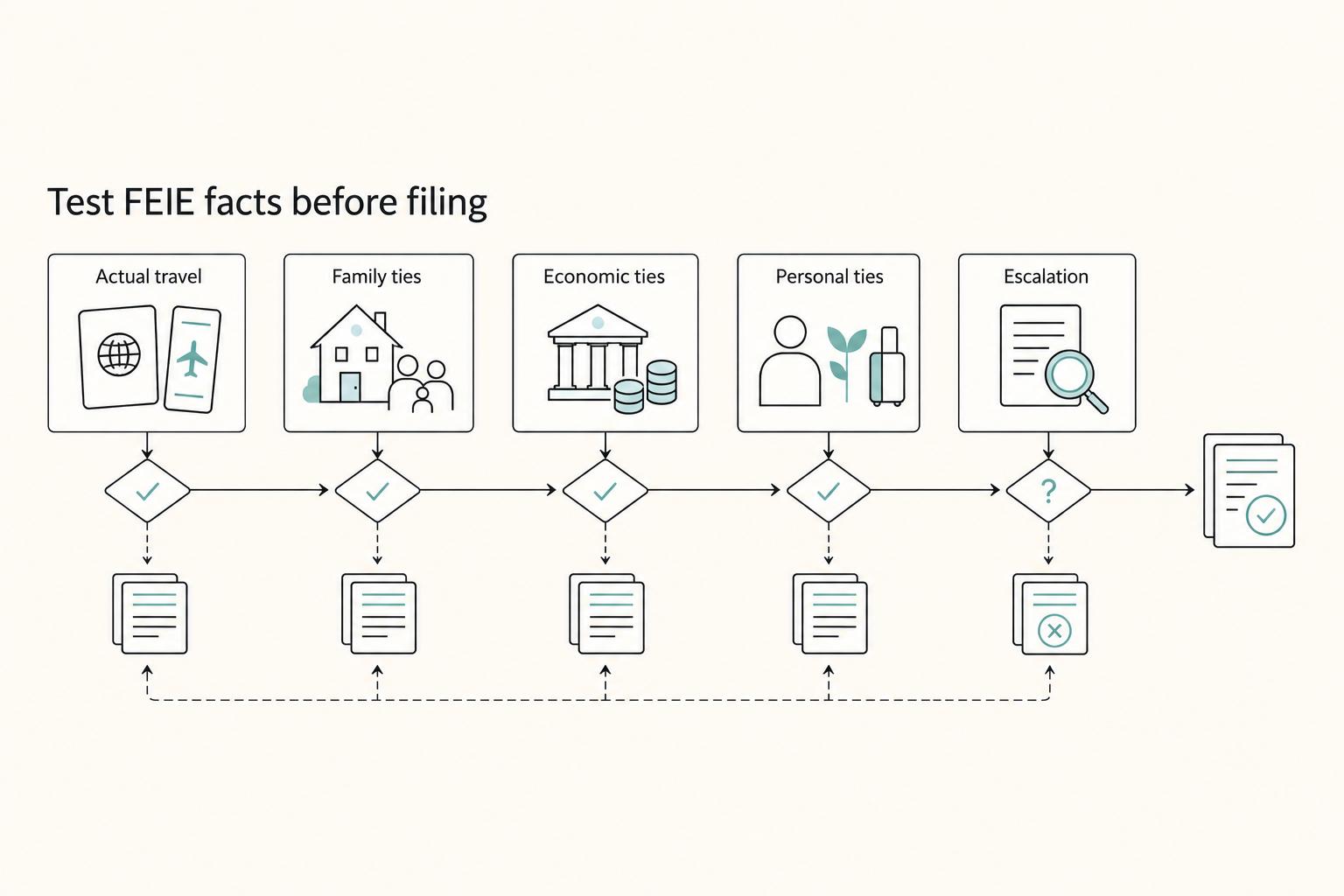
Your 10 minute defensibility framework before Form 2555#
| Step | Focus | Action |
|---|---|---|
| Step 1 | Work and living locations | Map where you actually worked and where you actually lived. |
| Step 2 | Family, economic, and personal ties | Review your ties in three buckets: family, economic, and personal. |
| Step 3 | Travel story and tie story | Check for contradictions between your travel story and your tie story. |
| Step 4 | Conflicting facts | If facts point both ways, treat FEIE as high risk and escalate before filing. |
- Step 1: Start with what actually happened, not what the year was supposed to look like.
- Step 2: Review your ties in three buckets: family, economic, and personal.
- Step 3: Look for places where your travel story says abroad but your ties still point to the United States.
- Step 4: If the facts still cut both ways, treat FEIE as high risk and escalate before filing.
Use this as your first screen. The Code gives you guardrails, but edge cases still need judgment. Run the framework first, then decide whether Form 2555 is even a fit. Want a quick next step? Try the FEIE calculator.
Tax Home vs Abode for FEIE at a Glance#
For FEIE, treat tax home as your work base and abode as your life center, because a U.S. abode can block your claim even when you work abroad.
You already mapped your facts. Now compare the two concepts side by side so your Form 2555 position stays defensible under IRC Section 911(d)(3) and IRS rules.
Compare the concepts before you file#
| Criteria | Tax home | Abode | FEIE impact |
|---|---|---|---|
| What it asks | Where do you run your main business activity? | Where do your family, economic, and personal ties center? | FEIE needs a foreign tax home, but a U.S. abode can still break eligibility. |
| Work location | Main post of duty drives this test. Assignment length also matters, with temporary assignments treated differently from indefinite ones. | Work travel alone does not control this test. | Working abroad helps, but it does not win by itself. |
| Family ties | Family location can support context, but this test focuses on work base. | Family location strongly shapes the result. | Strong U.S. family ties raise risk for your claim. |
| Economic ties | Main business activity and post of duty can support a foreign tax home. | Economic ties carry weight here. | U.S.-centered economic life can undermine FEIE. |
| Housing ties | A foreign base that matches your work pattern helps support tax home facts. | Your lived pattern and dwelling ties help show where your life actually centers. | Housing facts can support or weaken your position depending on the full tie pattern. |
| Domicile relationship | Tax home can differ from residence or domicile. | Abode language can overlap with domicile concepts, but you must still test facts directly. | Do not treat domicile as a shortcut for FEIE eligibility. |
| Filing consequence | You must have a foreign-country tax home to meet the tax home test on Form 2555. | If your abode is in the United States for a period, that period fails under IRC Section 911(d)(3). | A U.S. abode period can block the Foreign Earned Income Exclusion (FEIE). |
Imagine a consultant delivering projects overseas while keeping family routines, core economic ties, and daily personal ties in the United States. That operator may show foreign work activity yet still carry high FEIE risk if the abode facts stay U.S.-centered.
Safe default rule: when your evidence points both ways, treat FEIE as a high-risk position. Do not proceed until your records clearly support a foreign tax home and a non-U.S. abode.
If you want a deeper dive, read Opening a Bank Account in Europe as a Non-Resident.
Can You Work Abroad and Still Have a US Abode#
Yes. You can work abroad and still fail FEIE when your strongest family, economic, and personal ties keep your abode in the United States.
This is where Form 2555 positions break. People fixate on travel days, but IRS analysis can turn to ties quickly.
For the Foreign Earned Income Exclusion (FEIE), the logic stays simple. Tax home tracks your main work base, but abode tracks where your life centers. Under Code §911, a U.S. abode period can block foreign tax-home treatment for that period, even when your work happens abroad.
In practice, location starts the analysis, but tie intensity can decide the outcome.
How ties can outweigh location#
| Pattern | Work location | Tie center | FEIE pressure |
|---|---|---|---|
| Hypothetical U.S. and foreign operator | Consultant performs delivery work in a foreign country for cross-border clients. | Family routines, core spending, and personal base stay in the United States. | High risk. Foreign work facts help, but U.S.-centered abode facts can still undermine the claim. |
| Publicly summarized Illinois and Afghanistan pattern in Qunell v. Commissioner | Taxpayer worked in Afghanistan. | Public summaries describe spouse and children in Illinois, with Afghanistan ties described as transitory beyond job duties. | Shows how courts can treat strong U.S. ties as decisive in tax home vs abode FEIE disputes. |
Use Qunell v. Commissioner as a caution signal, not a template. The case appears in small-case Tax Court treatment, and small-case outcomes do not set binding precedent for other taxpayers. Public case pages can be incomplete, so snippet-only reading creates overconfidence fast.
Use this decision rule before filing:
- Build two separate files: a work-location file for tax home and a ties file for abode.
- Compare them line by line. Do not blend them into one narrative.
- If your ties file points to the United States, treat FEIE as high risk.
- Escalate before filing when facts conflict, especially when your travel story looks stronger than your ties story.
Bottom line: you do not win FEIE by proving travel alone. You win by proving a foreign tax home and a non-U.S. abode with consistent facts.
Which FEIE Path Fits Your Facts Right Now#
Choose your FEIE path only after you confirm a foreign tax home and that your abode does not remain in the United States, then use the test you can document cleanly.
You now know why tie intensity can beat a strong travel story. The next move is discipline: choose the FEIE test your facts and records can actually support.
Start with the threshold logic. You need foreign earned income, a foreign tax home, and qualifying status under either the Physical Presence Test or the Bona Fide Residence Test.
Decision branch you can run this week#
| Path | Qualifying trigger | Best fit right now | Documentation focus |
|---|---|---|---|
| Physical Presence Test | At least 330 full days in foreign countries during 12 consecutive months. | You move often but can prove day count with consistent travel records. | Build a clean day timeline plus work-location records that match it. |
| Bona Fide Residence Test | Bona fide residence in a foreign country for an uninterrupted period that includes an entire tax year. | You operate from one primary foreign base with continuity across the year. | Build a continuity file that shows sustained residence and business presence. |
Hypothetical example: a consultant spends most workdays abroad, but keeps mixed U.S. ties and fragmented records. That operator should not jump to the test that feels easiest. Choose the path your documents can defend.
Use this operator sequence every time:
- Assess facts first: where you worked, where you lived, and where your core ties sat.
- Score U.S. tie intensity as low, mixed, or high risk.
- Choose posture: proceed, proceed with caution, or escalate.
- Draft support notes that match your chosen test and timeline.
Guardrail on adjacent reporting FEIE does not remove FBAR or Form 8938 duties. File FBAR (FinCEN Form 114) separately from your tax return when your facts trigger it. Attach Form 8938 to your return when thresholds apply, and remember thresholds vary by filing status and residence pattern.
If your team confuses day counts with full eligibility, review 183-Day Rule Explained: Stop the Tax Myths Before They Cost You.
Safe default: if ties stay mixed and records stay thin, take a conservative position and escalate before you file.
If You Are This Type of Freelancer Choose This Filing Posture#
Match your FEIE filing posture to your tie pattern, because your strongest ties can drive risk more than your travel calendar.
You have the qualification logic. Now turn it into a filing posture that fits your actual pattern so your Form 2555 position matches your facts.
Profile posture map#
| Freelancer profile | Tax Home Test pressure | Abode pressure | Form 2555 documentation burden | Posture |
|---|---|---|---|---|
| Digital nomad | Frequent moves can blur your regular or principal work base. | Mixed personal and economic ties can pull back to the U.S. | High. Keep a tight work timeline, travel calendar, and business records that match each period abroad. | Use the Physical Presence Test only when you can prove 330 full days in 12 months and keep tie evidence consistent. Escalate if ties conflict. |
| Long-term country base | Stable foreign work base can support a foreign tax home. | Ties can support a non-U.S. abode when your life center stays abroad. | Moderate. Build continuity records for an uninterrupted period that includes an entire tax year. | Prefer the Bona Fide Residence Test when your facts show continuity. Keep day-count records as backup. |
| Commuter with U.S. family ties | Cross-border work may support foreign activity, but facts can look temporary. | Strong U.S. family and economic ties can keep abode in the U.S. | Very high. You need a clear tie matrix plus consistent conduct records. | Treat FEIE as high risk and escalate before filing. Do not rely on travel days alone. |
| Contractor rotating through assignments | Definite temporary assignments can weaken a long-term foreign position. | Rotations often leave personal and financial center in the U.S. | High. Keep assignment letters, location logs, and tie evidence by period. | Use conservative treatment unless records clearly support a foreign tax home and a non-U.S. abode. |
Imagine a rotating contractor who spends substantial time abroad but keeps banking, family routines, and core personal life in the United States. That operator may show enough days for a travel-based test on paper and still fail under tax-home and abode analysis if tie evidence points home.
California tie alert#
- California residency analysis stays fact-driven, and FTB does not pre-clear your status through written opinions.
- If California treats you as a resident, it taxes income from all sources, which can create state-level friction even when you discuss federal FEIE.
- If California is in play, map your ties, document the pattern, and align your filing posture before you file.
If you run a roaming model, review our guide to a defensible 2026 filing plan. Verdict: when facts point both ways, choose a conservative posture and escalate before you submit Form 2555.
What Records Make Your Position Audit Ready#
Build an audit-ready system where every FEIE claim on Form 2555 ties to verifiable records across tax home, abode, and parallel reporting streams.
You chose a filing posture. Now build the evidence stack to match it. In U.S. expat tax work, clean records beat confident explanations every time.
Treat this as an operations problem. Keep proof of where you worked, where your ties sat, and whether the timeline stays internally consistent.
Decision checklist you can run every month#
| Checklist area | Key records/actions | Purpose |
|---|---|---|
| Work pattern proof | Client engagement records, assignment terms, and location logs | Show your regular or principal place of business for the FEIE path you chose. |
| Tie location proof | Documents that show where family, economic, and personal ties actually center | Keep your abode position matched to your filing posture. |
| Timeline consistency for Form 2555 | Travel logs, work records, and return disclosures | Keep dates and facts aligned across the full filing period. |
| Operational control | Store records in a controlled repository, keep an audit trail of updates, and run reconciliations before filing. | Maintain operational control before filing. |
Run this monthly, not just at filing time:
- Work pattern proof: Keep client engagement records, assignment terms, and location logs that show your regular or principal place of business for the Foreign Earned Income Exclusion (FEIE) path you chose.
- Tie location proof: Keep documents showing where family, economic, and personal ties actually centered during each period.
- Timeline consistency for Form 2555: Reconcile travel logs, work records, and return disclosures so dates and facts align across the full filing period.
- Operational control: Store records in a controlled repository, keep an audit trail of updates, and run reconciliations before filing.
Documentation matrix by compliance stream#
| Stream | What it supports | Filing channel | Core records to retain |
|---|---|---|---|
| Form 2555 FEIE | Foreign tax home, qualifying test facts, and non-U.S. abode position | FEIE income tax filing workflow | Work-location records, tie evidence, and timeline reconciliations |
| FBAR (FinCEN Form 114) | Foreign account reporting when aggregate value exceeds $10,000 at any time | FinCEN BSA E-Filing System, separate from tax return | Account statements, account identifiers, and balances; retain records for the required period |
| Form 8938 (FATCA) | Specified foreign financial asset reporting when thresholds apply | Attached to federal income tax return | Asset statements and valuation support; apply the correct threshold set for your filing context |
Use an evidence-quality ladder to avoid weak files:
- Primary documents: Official statements, signed agreements, and filed forms.
- Secondary corroboration: Calendar exports, invoices, and payment records that confirm primary facts.
- Weak indicators: Informal narratives or memory-based summaries without supporting documents.
Hypothetical example: a consultant logs travel perfectly but cannot match account records and tie evidence to the same periods. The file looks busy, but it is still fragile.
Verdict: when records conflict or gaps remain, file conservatively and fix the record set before you submit.
Where Smart Filers Still Fail#
Smart filers fail when they treat Form 2555 like paperwork instead of a live position that must stay true through filing day.
Even with strong documentation, weak facts still lose. Temporary-assignment framing, stale timelines, and overconfident case summaries can break an otherwise careful U.S. expat tax plan.
Compare weak assumptions against rule-level reality#
| Failure mode | What filers assume | What the rule-level analysis checks | Hidden cost if wrong |
|---|---|---|---|
| Temporary assignment assumption | "I worked abroad, so I qualify." | Whether your stay reads as temporary versus extended in practice (and how that plays with your residence posture) | You may need to rework your FEIE position and handle amended filing steps |
| Stale facts at filing time | "My earlier facts are close enough." | Whether your qualifying timeline still supports the Physical Presence Test and your foreign tax home through filing | You may need additional review and potential return updates before closure |
| Overreliance on blog summaries | "A case summary says people like me win." | Whether your facts match current IRS instructions, and whether a Tax Court summary opinion is actually usable for your facts | You anchor to weak logic and create avoidable friction in review |
| Isolated FEIE analysis | "I can settle FEIE first and housing later." | Whether the same tax-home facts also support foreign housing exclusion treatment | A failed core position can disrupt both FEIE and housing benefits |
Hypothetical: you rotate across countries for projects, but your family life and core financial ties stay in the United States. You hit day-count goals and file fast. Review then shifts to abode, not travel volume, and your position reopens across FEIE and housing analysis.
Red flags that require immediate escalation#
| Red flag | Article signal |
|---|---|
| Your travel log, contracts, and Form 2555 dates tell different stories. | Dates and facts do not align across the full filing period. |
| Your family and economic center remains in the United States while you claim a foreign tax home. | Treat FEIE as high risk. |
| You rely on a short case summary and cannot explain how its facts match yours, especially for nonprecedential summary opinions. | Snippet-only reading creates overconfidence fast. |
| You are filing close to deadline windows and your qualifying facts still move. | Stale facts at filing time can break the position. |
| You built your decision around day-count myths instead of a full tie analysis. | Do not treat travel days as a win condition. |
If any of these appear, stop and review the position before filing. If needed, reset with 183-Day Rule Explained: Stop the Tax Myths Before They Cost You.
Verdict: if any red flag appears, choose a conservative filing posture, document your rationale, and escalate before you finalize FEIE.
Build Your Safe Default Filing System Before You Submit#
Definitions are only the starting point. Defensibility comes from a repeatable system that pressure-tests tax home, abode, and evidence before you submit Form 2555.
You have the moving parts. Now run a final decision gate under Code §911. Confirm a foreign tax home. Confirm your qualifying path. Confirm your records tell one consistent story under IRS rules. If your ties still point to the United States, pause and escalate.
Use this pre-submit gate#
| Decision gate | Pass standard | If you do not pass |
|---|---|---|
| Tax home and abode alignment | Your work location, family ties, and economic ties support the same filing posture | Treat FEIE as high risk and get targeted review before filing |
| FEIE qualifying path | You can prove bona fide residence or 330 full days in 12 months for physical presence | Do not force a claim. Rework timing or filing posture |
| Form 2555 detail quality | You captured the facts and records needed to support your qualifying period and travel chronology | Fix the record set first, then file |
| Overlap with other reporting | You separately checked FBAR and Form 8938 duties, including whether both apply | Run both checks before submission |
| Accountability | You reviewed every fact even if a preparer drafts the return | Correct gaps now. You still own filing accuracy |
Hypothetical: you clearly meet day-count timing, but your family, economic, and personal ties remain U.S.-anchored. Do not treat travel days as a win condition. Escalate the abode analysis first, then decide whether to claim the Foreign Earned Income Exclusion (FEIE).
Run your checklist now. If the facts trigger red flags under Code §911, get focused professional review before you file.
Then keep the process practical. Tighten your record workflow. Reserve advisor time for edge cases. Refresh your broader mobility playbook with Digital Nomad Taxes in 2026 With a Defensible Filing Plan.
Frequently Asked Questions
What is the difference between `tax home` and `abode` for `Foreign Earned Income Exclusion (FEIE)`?
Tax home is your regular or principal place of business or work post. Abode is where your family, personal, and economic ties actually center. For tax home vs abode FEIE analysis, you need a foreign tax home during the qualifying period, and a U.S.-centered abode can still block FEIE.
Can I claim FEIE if I work abroad but my spouse and financial life stay in the `United States`?
You can evaluate FEIE, but do not assume you qualify. The IRS weighs family, economic, and personal ties when it evaluates abode, so a U.S.-centered life can undermine your foreign tax home position. Treat this as a red flag and pressure-test your Form 2555 story before filing.
How do I evaluate whether my `abode` is in the U.S. before filing `Form 2555`?
Run a tie-based review, not an address-only check. List where your family life sits, where you run core money activity, and where you return between projects, then compare that against your foreign work pattern. If those signals conflict, separate your evidence into a work-location file and a ties file and escalate before you lock in Form 2555.
Does a temporary assignment versus an indefinite assignment change my `tax home` analysis?
Yes. A temporary assignment can weaken a foreign tax home position. An indefinite period of foreign employment can strengthen your tax home case.
What documents should I keep to support a foreign `tax home` position with the `IRS`?
Keep evidence that matches your FEIE path under IRS rules. For bona fide residence, capture visa type and the exact residence period you report. For physical presence, keep the start and end of each 12-month qualifying period plus arrival and departure records.
What happens if I fail the `Tax Home Test` after claiming FEIE?
You lose more than one benefit. A failed Tax Home Test can block the Foreign Earned Income Exclusion (FEIE) and the foreign housing exclusion or deduction. Then you must revisit the return position and correct course before you can close with confidence.
Do FEIE decisions change whether I still need `FBAR` or `Form 8938` reporting?
No. FEIE does not replace separate foreign account and asset reporting analysis. You still need to determine whether you must file FinCEN FBAR, Form 8938, or both based on your facts. Related reading: 183-Day Rule Explained: Stop the Tax Myths Before They Cost You.
Try a related tool
Researched and edited by the Gruv editorial team. Gruv builds cross-border billing, payouts, and finance-operations software for global businesses.
Sources
Educational content only. Not legal, tax, or financial advice.
Related Posts

Digital Nomad Taxes in 2026 With a Defensible Filing Plan
With digital nomad taxes, the first move is not optimization. It is figuring out where you may be taxable, where filings may be required, and what proof supports that position.

183-Day Rule Tax Myths That Trigger Residency Filing Mistakes
If you are a mobile freelancer or consultant, start here: the "183 day rule tax" idea is not a single universal test. It is a shortcut phrase people use for different residency rules that do not ask the same question. If you mix federal and non-federal residency logic, you can create filing risk even when your travel calendar looks clean.

Opening a Bank Account in Europe as a Non-Resident
If euros arrive on time, reconcile cleanly, and remain usable without constant support tickets, you have solved the real problem. The search phrase "open european bank account non resident" usually means one thing in practice: protect cashflow. Start there, not with prestige features.