
Quick Answer
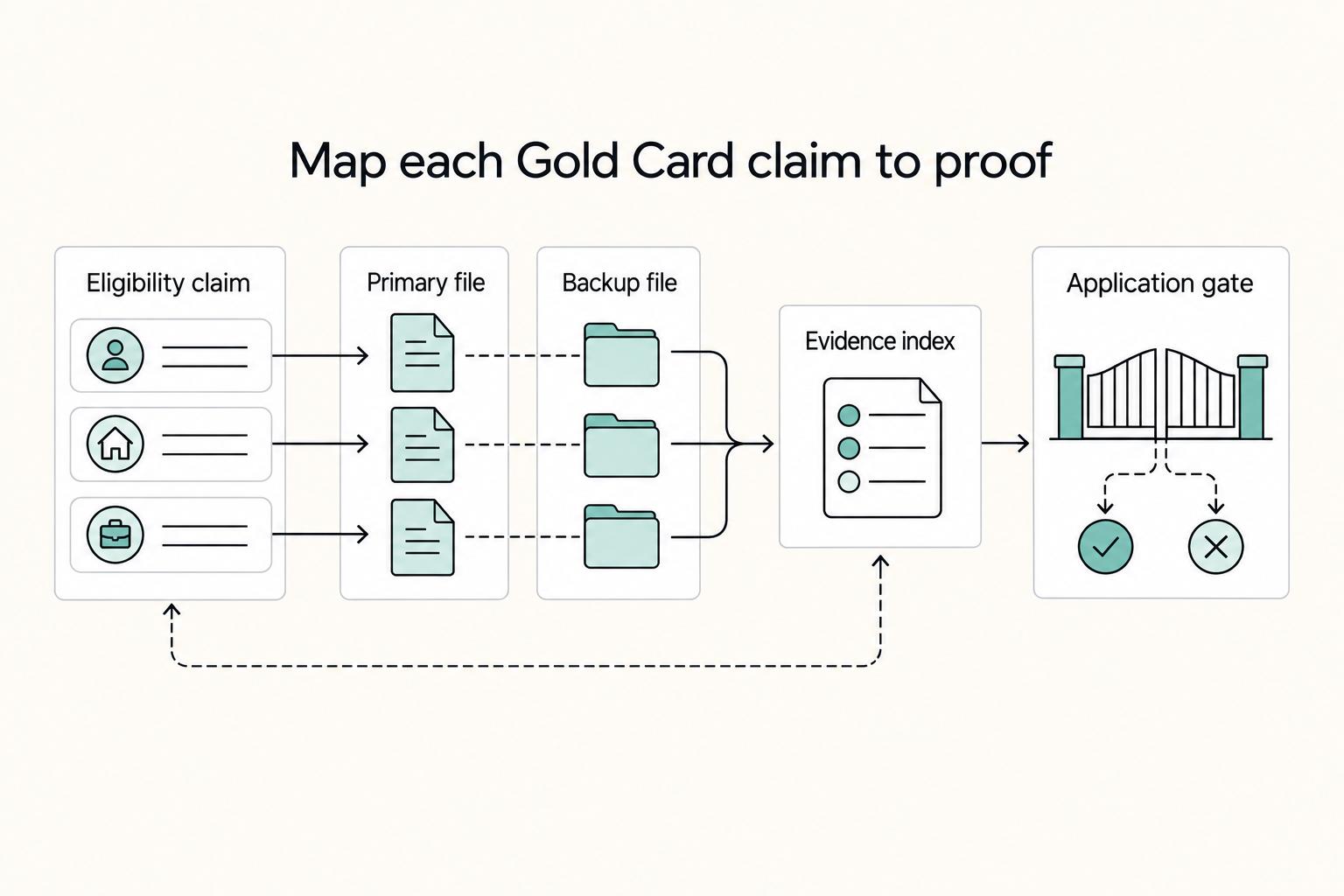
Build your evidence map first: match each eligibility claim to a file, then submit only after official wording confirms your route. For a taiwan gold card case, that means choosing the qualification field your documents actually support, not the one that sounds best. If you use salary criteria, include tax certification from one of the last three years against the NTD 160,000 monthly threshold. Keep timeline buffer because end-to-end processing can run past 60 business days.
How to approach your Taiwan Gold Card application as a remote professional#
Treat this process as a chain of linked decisions, not a race to submit. If you are planning a serious move or a long stay in Taiwan, the safer outcome usually comes from choosing the right route first and proving each core claim before you pay or file. The Taiwan Employment Gold Card rewards that discipline because it combines four functions in one status: a work permit, resident visa, Alien Resident Certificate (ARC), and re-entry permit.
For remote professionals, independent consultants, and freelancers, that bundled structure can be a real advantage. Official material describes an open work permit and the flexibility to work full-time, part-time, or start a business. If your income comes from mixed clients, changing contracts, or overlapping projects, evaluate this route early rather than treating it as a late fallback. For city-level context before route selection, use Taipei Digital Nomad Guide for 2026 Long-Stay Moves.
Start with a realistic view. You can begin online without sponsorship, but that does not mean every remote worker qualifies or that your preferred timeline is fixed. The safest way to stay accurate is to separate what is already confirmed from what still needs official confirmation in your case.
Use two rules from day one:
- Move forward only on points you can support with documents you already have or can obtain quickly.
- If a detail affects eligibility, status continuity, travel rights, or cost, verify it before submission.
Before you open the form, run the official Step-by-Step Application checkpoint and map every eligibility statement to a file in your evidence pack. Batch unclear questions and send them to the bilingual Help Desk during published support hours, 10:00-12:00 and 14:00-18:00 GMT+8. When a point affects money, timing, or legal status, treat official confirmation as mandatory.
Keep one living note from your first planning session. Label each key assumption as confirmed, unconfirmed, or pending check, then attach the page you relied on and the date you checked it. That single habit prevents drift when official pages, community summaries, and personal stories disagree in small but important ways.
Review that note at a few simple checkpoints. Recheck high-impact assumptions before each irreversible action: paying fees, booking flights, signing housing, ending your current status, or telling clients a fixed move date. If the assumption still holds, proceed. If it changed, update the plan first.
Most avoidable problems here do not come from one dramatic mistake. They come from small unchecked assumptions that pile up under time pressure. A clean note, updated at decision points, cuts that risk sharply.
By the time you finish this first setup, you should know three things clearly: which route you think fits, what proof you already have, and what still needs confirmation. That foundation makes the rest of the process much easier to manage.
Understand the Taiwan Gold Card before you plan your move#
Start with source relevance. It is a stricter filter than most people expect. Some pages in these materials are legitimate, but they still are not application guidance for Taiwan immigration decisions. If a page does not directly answer a Gold Card question you need to decide now, keep it as background and do not let it drive filing choices.
That distinction shapes everything that follows. When your source set is mixed, route selection becomes guesswork, document prep gets inconsistent, and timeline assumptions stop being reliable. Spending one focused hour cleaning up your source base is usually cheaper than trying to fix a confused case after submission.
Name overlap is a common trap. Different countries and programs can use labels that look close enough to mislead. Similar names are not evidence of similar rules. Keep routes separate unless an official Taiwan government page defines the exact path and requirement you need.
Use this relevance screen before relying on any page:
- Does this page name your target route directly?
- Does it answer the exact decision in front of you?
- Can you tie it to your current step in the process?
- Is the page current enough for a filing decision you are about to make?
If any answer is no, do not treat that page as a decision anchor. Keep it in your notes as context, then schedule a follow-up check on an official source that does match the question.
When relevance is uncertain, mark the claim as context and assign a concrete follow-up with an owner and date. That small habit keeps vague references from slipping into your application language later. It also gives you a cleaner handoff if a partner, assistant, or adviser is helping review documents.
A practical way to stay organized is to split your notes into two clear groups: decision-critical and informational. Decision-critical notes should tie to the route, the step, and the source date. Informational notes can still help with orientation, but they should never sit in the same bucket as criteria you plan to submit against.
Quick fit test#
Run this test before you take any major step:
- Can you point to a current official Taiwan government page that defines the route you plan to use?
- Can you list which parts of your case are still unconfirmed?
- Can you tie each major decision to a dated official page you can re-check later?
- Can you list open questions to send to official contacts before you submit anything?
If two or more answers are no, pause and strengthen your source set first. That is not wasted time. It prevents rework on route choice, document preparation, and timeline planning.
Keep a compact decision log while you do this. Track the claim, page title, domain check, HTTPS check, and last verified date. A .gov domain and HTTPS can signal an official and secure U.S. government page, but that still does not make it relevant to Taiwan immigration decisions. Real U.S. government pages can be clearly unrelated to this route, which is exactly why relevance checks have to come before planning.
Treat this first gate as your baseline. If a claim cannot pass relevance review, it does not belong in your filing logic yet. Once your source set is clean, comparing routes becomes much more straightforward.
Compare your visa path before committing to one application#
Choose your route based on confirmed constraints, not on labels that sound attractive. In these materials, route-comparison evidence is limited, so the practical move is a two-step filter: shortlist the path that appears to fit, then verify current official criteria before you pay or submit. If you need a cross-country baseline before that final check, compare with The 2026 Global Digital Nomad Visa Index for 50+ Countries.
For the Employment Gold Card route, the supported points are narrow but still useful. It is described as a resident visa path for skilled workers. One firsthand account also describes category-based evidence review and in-person passport and document checks at a Taiwan consulate after about two months. That same account reports friction when expected category documents were missing, which makes evidence fit a real risk signal rather than a theoretical one.
| Route | Sponsorship dependence | Flexibility | Document burden |
|---|---|---|---|
| Taiwan Employment Gold Card | Not fully confirmed in these materials. Verify on current official pages. | Work-rights details are not fully confirmed in these materials. Verify for your case. | One personal account reports category-specific proof and later consular verification. Use this as a risk signal, not a hard rule. |
| Employment Pass Card | No confirmed comparison data in these materials. | No confirmed comparison data in these materials. | No confirmed comparison data in these materials. |
| Entrepreneur Visa and Alien Resident Certificate | No confirmed comparison data in these materials. | No confirmed comparison data in these materials. | No confirmed comparison data in these materials. |
Read this table as a checkpoint, not a verdict. Mark each column as confirmed or unconfirmed for your case, and add the page you still need to verify. If any core column remains unclear, delay filing by a day and close the gap. A short delay here is usually cheaper than correcting the wrong route after submission.
Use a decision gate before you commit. If flexibility is your top priority, continue only after an official page states the exact work rights you need. If your setup may be employer-tied, review restriction language and required proof first. If either side is still unclear, stop and verify before you pay.
It helps to keep an assumptions list beside the table. For each unconfirmed point, note the official page you will verify and the latest acceptable date to verify it. That keeps uncertainty visible and stops open questions from quietly turning into assumed facts when deadlines tighten.
The main tradeoff is flexibility versus evidence burden. Do not assume there is a full ministry-by-ministry burden map; category proof can become the bottleneck. If long-term settlement matters in your plan, include APRC implications early: the National Immigration Agency is identified as the authority for permanent residency applications, APRC approval cancels the Employment Gold Card, and the cited FAQ notes conditions that include at least three years on the card and an average of 183 days or more per year.
When two routes still look close after this pass, choose the one your current documents can explain clearly. Clear evidence and coherent claims usually outperform an ambitious route supported by weak or inconsistent proof. Once the route is chosen, the next job is to select the qualification field that your evidence can actually carry.
Choose the right qualification field and ministry the first time#
Choose the field you can prove now, not the one that sounds most impressive. Reviewers assess evidence strength, and many avoidable delays start with claims that look broad on paper but map weakly to uploaded documents.
A common failure mode is choosing a category first and trying to backfill proof later. In practice, that reverses the real burden of review. Because review includes eligibility checks and identity verification, weak alignment between claim language and supporting files often leads to extra requests.
Use public category labels for orientation, not as a filing strategy. The stronger approach is to capture the exact qualification text active at filing time, then map each claim in your form to one document that directly supports that wording. If you use a qualification self-check tool, treat it as screening guidance, not as approval.
Before you submit, run this pass in order:
- Save the exact qualification text you are applying under and capture the date.
- Map every qualification claim to a specific supporting file.
- Create your account on the Foreign Professionals Online Application Platform and confirm verification emails arrive. If they do not arrive, switch email addresses.
- If applying from Taiwan, confirm your current visa has enough remaining time to avoid exit and re-entry disruption.
- Set timing expectations based on available guidance. Form submission can be quick when files are ready, but full processing can still take over 60 business days.
- Recheck current official updates, including BOCA, NIA, and Taiwan CDC channels.
Add one stop condition before you click submit: if any claim cannot be tied to one clear file, pause and revise. Narrow the claim language, replace the file, or switch to the field your evidence supports more cleanly.
Then run a consistency check across three elements: selected category, claim wording, and file naming. Those three pieces should tell the same story in the same order. When they drift, reviewers have to interpret more, and more interpretation usually means slower outcomes.
If more than one field looks plausible, compare them by proof clarity rather than perceived prestige. The field with fewer interpretation gaps is usually the lower-risk choice when your goal is approval without repeated rework. Keep the rule simple: evidence first, category second.
Build your document and evidence pack before opening the form#
Build the evidence pack before you start typing into the application form. The most reliable structure is one claim mapped to one primary file, with one backup file where possible. That setup reduces handling errors and makes follow-up requests much easier to answer.
Start with the salary-criteria core files because the requirement language is specific. The materials point to a personal resume and proof of service, plus additional salary evidence. If you are applying through salary criteria, include tax certification from one of the last three years and confirm it supports the cited average monthly threshold of NTD 160,000.
Run a quality check on proof-of-service files before upload. Each file should clearly show your name, company name, job title, and actual start and end dates. Where applicable, include issuer validation such as a signature or seal. Then check company-name consistency across proof-of-service files and tax records so reviewers do not have to reconcile naming conflicts on their own.
For freelance or self-employed cases, use records that clearly show work details, clients, and duration. Self-issued proof can still work when those details are explicit and consistent with the rest of the packet. Ambiguous files are what create avoidable questions, so remove ambiguity before submission.
Keep the file structure simple and easy to review:
- Maintain one claim map with claim, primary file, backup file, and notes.
- Use one folder per claim so uploads are grouped by meaning, not just by file type.
- Apply one naming pattern that keeps date and version visible.
- Keep originals and final upload versions separate so you can respond quickly if an updated file is requested.
This is not a formal requirement. It is a practical way to reduce confusion when you need to re-upload, amend, or explain a document under time pressure. If someone else is helping with the filing, it also makes the handoff cleaner because the logic of the packet is visible in the folder structure itself.
Minimum viable packet checklist#
- A claim map linking each qualification claim to one supporting file.
- Personal resume.
- Proof of service with name, company, title, and actual start and end dates.
- For salary criteria, at least one additional evidence file, such as tax certification from one of the last three years.
- File names that make date and document purpose obvious.
Strong packet checklist#
- Everything in the minimum packet, plus one backup file for each key claim.
- Company-name consistency checks across proof-of-service files and tax records.
- For self-employment, records listing clients, work details, and duration.
- A simple file index so uploads are easy to review and retrieve.
- A version note for any file you expect to update after first submission.
If support for a claim is weak, narrow the claim or choose a qualification path your current evidence can prove cleanly. Restraint here is better than broad language that creates avoidable doubt later.
Before you open the form, run a dry test using your own packet. Read each claim, open the linked file immediately, and ask one question: is the connection obvious in under a minute? If the answer is no, rewrite the claim, replace the file, or add a backup file that makes the link explicit.
If another person is helping review, hand them the claim map and ask where they had to guess. Every place that requires guesswork is a place to tighten wording, improve file naming, or reorder evidence. Once the packet reads as one consistent story, timing becomes the next risk to manage.
Follow the timeline that prevents avoidable delays#
Use a fixed sequence, but be honest about what you can and cannot forecast. The timeline describes an ID-card pathway, not a submission-to-approval timeline for this visa route. Do not assume an official Gold Card approval duration; treat it as unconfirmed.
To keep progress measurable, give each phase one owner and one output.
| Phase | Owner | Done looks like |
|---|---|---|
| Personal planning | You | Checklist, file index, and key dates captured |
| Taiwan Area Resident Certificate step (ID-card pathway) | Applicant | Taiwan Area Resident Certificate application submitted at NIA |
| Residency-condition checkpoint (ID-card pathway) | Applicant | Residency conditions met before applying for permanent residency |
| Household registration step (ID-card pathway) | Applicant | Registration completed at the household registration office before receiving a National ID card |
The sequence included here is specific: apply for a Taiwan Area Resident Certificate at NIA, meet residency conditions, apply for permanent residency, then complete household registration to receive a National ID card. The listed residency-condition options are one year with at least 335 days of residence, two years with at least 270 days each year, or five years with at least 183 days each year.
Even though this is not a live approval estimate for this route, it is still a useful planning boundary. It shows where long-term residency checkpoints may appear and where assumptions can get expensive if made too early.
Keep three controls ready before submission:
- A master file index with exact upload names.
- A case log with submission date, status checks, and follow-up notes.
- One folder containing originals and scans you can reuse quickly if more documents are requested.
When a document request arrives, answer the exact request first and attach only files tied to that request. Focused responses are usually easier to review than broad uploads that force extra interpretation.
Finally, build small buffers between major phases for missing files, email delays, or account access problems. A timeline is only useful if it can absorb interruptions without collapsing the whole plan.
Submit and track your case with fewer surprises#
Once your packet is ready, execution quality matters more than speed. The materials support an online application path, and they also show that detailed walkthroughs often come from firsthand, non-official accounts. Use those accounts to prepare, then let the live official portal control your final checks.
Before submission, lock ownership and handoffs so nothing falls between tasks:
- Decide who handles uploads, status checks, and follow-up responses.
- Align file naming and response timing if more than one person supports the case.
- Confirm who owns final review before each outbound reply.
Start one case log on day one and keep it complete. Record submission time, case reference, visible status changes, and outbound messages. That gives you a clean baseline if instructions shift or if you need to confirm whether the case has moved to approved.
If you receive a request for additional information, reply to the exact point and attach only directly related files. Add a short note explaining how each file addresses the request. That is a practical review tactic, not a formal requirement in the excerpts, but it reduces the chance of a misread.
A concise response note can follow this pattern:
- State the exact point being clarified.
- List attached file names.
- Add one sentence on how each file supports that point.
If multiple requests arrive at once, handle the one that blocks review first and log the rest with target response dates. Ordered responses keep momentum and reduce the chance that one unresolved item stalls the whole case.
Official escalation trigger rules are not defined in these materials. If status remains unclear or instructions conflict after a complete response, verify the current official contact path before escalating.
A simple internal communication standard prevents most avoidable confusion:
- Use one case reference across all notes and messages.
- Keep one dated update log with request, sender, and action taken.
- Track each resubmitted file with file name and revision date.
- Reuse one outbound note structure so responses stay consistent.
The benefit is straightforward. Consistent references, file names, and notes make follow-up faster and less error-prone for everyone involved.
Decide whether to apply from abroad or while already in Taiwan#
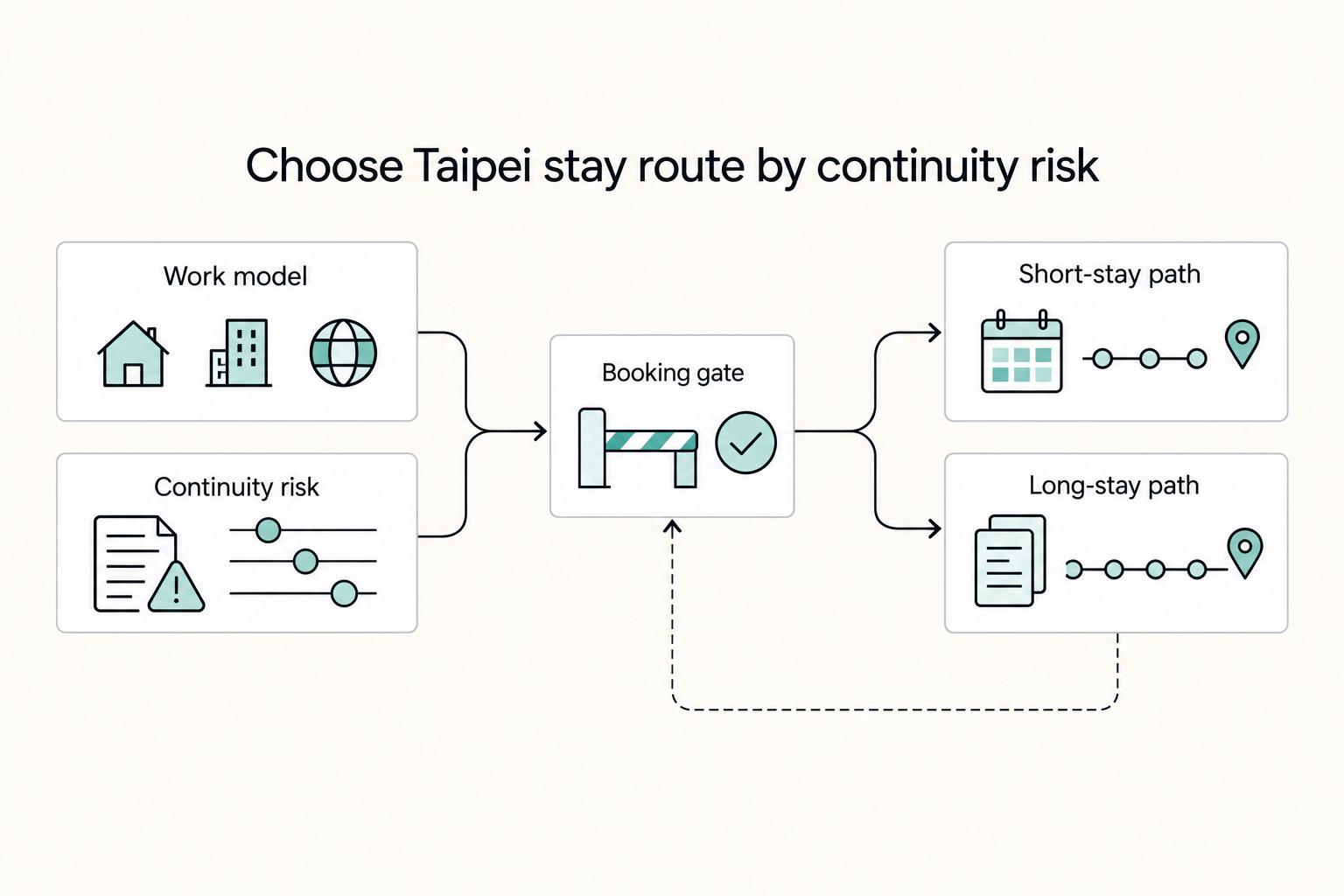
Base this choice on continuity risk, not convenience. Applying while already in Taiwan can work, but only if your current status has enough buffer for a potentially long review window.
Both scenarios begin on the Foreign Professionals Online Application Platform. Account creation is the same, and form completion can take around 15 minutes when files are ready. The larger constraint is review time, which can still exceed 60 business days, so status runway matters more than form speed.
| Scenario | Practical upside | Primary risk |
|---|---|---|
| Apply from outside Taiwan | Avoids reliance on remaining time on an existing in-country visa during processing | Move timing can slip if approval takes longer than planned |
| Apply while already in Taiwan | Can be practical when current visa time has clear buffer | If visa time runs short, you may need to leave and re-enter while the case is pending |
Use one in-country filing rule: if your current status cannot safely absorb a long review cycle, do not depend on in-country timing.
Keep prior-status claims narrow and documented. You may be asked for previous Taiwan visa and residence-permit records when applicable. The guidance here does not confirm automatic ARC replacement in every scenario and does not guarantee uninterrupted stay for tourist-visa cases.
A practical contrast helps with the decision. If your lease, client commitments, or family schedule cannot absorb sudden travel changes, applying from outside Taiwan may reduce continuity risk. If your in-country status has clear buffer and you can respond quickly to document requests, applying in Taiwan can still be workable. Base the choice on timeline tolerance, not optimism.
Run this checkpoint before locking travel or housing:
- Passport copy shows at least six months of remaining validity.
- Photo was taken within the last six months.
- Previous Taiwan visa and residence-permit records are ready to upload, when applicable.
- Your plan still works if processing goes beyond 60 business days.
- Your timeline does not depend on guaranteed re-entry while the case is pending.
If any item is uncertain, delay irreversible bookings. Waiting at this stage is usually cheaper than unwinding plans after a status surprise.
Plan costs, validity, and extension with a known vs unknown table#
Verify first, then pay. The strongest planning move in these materials is to keep confirmed points and unknown points separate all the way to payment.
From the excerpts here, you can treat the card as a bundled status that includes a work permit, resident visa, Alien Resident Certificate (ARC), and re-entry permit. The same excerpts also describe reduced dependence on employer sponsorship for eligible professionals. Several planning items still require same-day official confirmation before payment.
| Planning item | Known from this guide | Unknown until official check |
|---|---|---|
| What the status bundles | Includes work permit, resident visa, Alien Resident Certificate (ARC), and re-entry permit | No confirmed validity term in these materials |
| Cost planning inputs | No current official fee amounts are confirmed here | Full fee matrix by passport type is unverified here |
| Extension planning | No extension process details are confirmed here | Eligibility, timing, and required files are unverified here |
| Data freshness | Source is a commercial immigration publisher with 2020 and 2023 article dates | Whether details match current policy as of your filing date |
Use this table as a guardrail for irreversible decisions. Orientation material can help you frame questions, but payment decisions should wait until you confirm current fee, validity, and extension wording through official Taiwan immigration channels.
Keeping known and unknown items separate also helps when you discuss budgeting with partners or team members. Confirmed items can sit in a fixed budget bucket. Unconfirmed items stay in contingency. That prevents assumptions from being treated as commitments.
Budgeting checklist#
- Fixed filing bucket for filing-related costs verified on official pages before payment.
- Move bucket for relocation setup costs outside the scope of these materials.
- Timing buffer in case approvals take longer than expected, since timelines are unconfirmed here.
- Evidence control with dated notes or screenshots of official pages used for payment decisions.
Use one practical rule: treat validity and extension as unknown until official pages confirm them on the day you pay.
A short day-of-payment routine works well. Open the relevant official pages, confirm wording for fee and validity points, capture dated notes, then proceed. If wording is unclear, pause and request clarification before payment. This is not caution for its own sake. It is how you avoid tying money and travel plans to stale assumptions.
Avoid the mistakes that derail otherwise strong applications#
The biggest avoidable failure in this process is source confusion. Use this guide to check relevance and risk, then confirm final filing rules through Taiwan-specific official channels.
| Red flag | What goes wrong | Better move |
|---|---|---|
| Trusting official-looking but off-topic sources | Filing choices are made from rules unrelated to this route | Confirm every source is directly about Gold Card criteria before using it |
| Confusing recency with relevance | A recent update date creates false confidence in unrelated content | Check topic fit first, then date |
| Treating policy or geopolitical discussion as filing instruction | Context is misread as requirement, and document strategy goes off track | Use only explicit Gold Card criteria for application decisions |
Two examples make this concrete. One is U.S. Foreign Affairs Manual text on A, C-2, C-3, G, and NATO visa classes, including A-1 versus A-2 logic and Visa Waiver Program limits. Another is a U.S. congressional hearing transcript on CCP pressure toward Taiwan. Even with a transmittal date of 02-12-2026, neither source is application guidance for this route.
Run one final pre-submit test: can each eligibility statement in your draft be traced to a Gold Card-specific source in your working set? If not, remove the statement or mark it unknown until verified.
Final quality-control rule: unsupported claims do not enter your submitted file set. That single rule prevents most avoidable rework.
Conclusion#
Reliable outcomes come from disciplined sequencing, not rushed submission. Move checkpoint by checkpoint and proceed only when your documents clearly support the claims you are making.
Keep one boundary fixed from start to finish: community material can provide context, but official channels should control filing decisions. The 2023 community survey cited in these materials reports 1,021 respondents from more than 64 countries, with 81% card holders and 19% other foreign professionals. It also explicitly notes that the sample may not represent the full foreign population and should not be used out of context.
By now, the working note you started on day one should read like a clean case file rather than a pile of tabs and partial assumptions. Use this closeout checklist as practical guidance, not legal instruction:
- Define the case you plan to file based on what your current documents can support.
- Recheck current wording on official pages before filing, especially when office names vary.
- If you see both International Talent Taiwan Office and Taiwan Employment Gold Card Office, confirm the active contact path under the National Development Council.
- Build one evidence pack that maps each claim to a specific file, and remove claims you cannot prove.
- Submit only after the claim-to-file map is complete, then maintain a dated log of uploads, edits, and replies.
- Use official support channels tied to the Gold Card office and immigration authorities whenever clarification is needed.
- Plan first-month arrival tasks early, since banking has been reported as a recurring issue for foreign professionals in Taiwan.
If you want one high-value final check before filing, run your draft through three filters: source relevance, claim-to-file mapping, and timeline continuity. That pass usually surfaces issues early enough to fix without major delay.
The core message is straightforward: separate confirmed rules, directional context, and unvalidated assumptions, then act in that order. For deeper planning, continue with the 2026 Global Digital Nomad Visa Index, Taipei Digital Nomad Guide for 2026 Long-Stay Moves, and your Taiwan tax planning materials, then finalize high-impact decisions only after same-day official verification.
Frequently Asked Questions
What is the Taiwan Gold Card in one sentence?
The Taiwan Employment Gold Card is a single status that combines visa, residency, work authorization, and re-entry. It is designed as one bundled route rather than separate documents.
Who qualifies for a Taiwan Gold Card?
Community FAQ guidance describes the program as intended for skilled professionals. This guide does not provide complete field-by-field qualification thresholds, so treat that description as directional and confirm current criteria with official channels before filing. If your profile sits near category boundaries, verify wording before applying.
Can freelancers or remote workers use the Taiwan Gold Card?
The card includes an open work permit that allows work for any company. That can support flexible setups, including work across different companies. It does not mean every freelancer or remote worker is automatically eligible, so keep claim-to-document alignment tight.
How long is the Taiwan Employment Gold Card valid?
The official site states a stay period of up to 3 years. Use that as a planning ceiling, then recheck current terms before submission.
Can I apply while already in Taiwan?
Yes. People already in Taiwan can apply, including holders of an ARC or a tourist visa. The decision should still be based on timeline buffer and continuity risk, not convenience alone.
What does the Gold Card replace if I already hold an ARC or a tourist visa?
Once approved, the Employment Gold Card replaces your existing ARC or tourist visa. If replacement timing is unclear in your case, get written clarification before making travel or status changes. Keep prior-status records easy to retrieve in case follow-up is needed.
Where can I check status and get official application help?
Start with the official FAQ for common program and application questions, then use the Step-by-Step Application page for process checkpoints. For support, contact the Taiwan Employment Gold Card Office, which is described as a single contact point for assistance. Community FAQ pages can help with orientation, but verify high-impact decisions with officials.
Do tax benefits come automatically after approval?
No. Official FAQ language states that foreign professionals must still meet specific conditions after obtaining the card to receive tax benefits. Treat tax treatment as a separate verification step, and keep it outside your core filing assumptions until confirmed.
Try a related tool
Researched and edited by the Gruv editorial team. Gruv builds cross-border billing, payouts, and finance-operations software for global businesses.
Sources
Includes 1 external source outside the trusted-domain allowlist.
- boca.gov.twtrusted
- comptroller.war.gov/Portals/45/documents/afr/fy2012/DoD_FY12_Age...trusted
- goldcard.nat.gov.tw/entrusted
- goldcard.nat.gov.tw/en/faqtrusted
- immigration.gov.twtrusted
- ndc.gov.tw/entrusted
- travel.state.gov/content/travel/en/us-visas/Visa-Reciprocity-...trusted
- asialifestylemagazine.com/taiwan-gold-card-2025-expat-choiceexternal
Educational content only. Not legal, tax, or financial advice.
Related Posts
Taipei Digital Nomad Guide for 2026 Long-Stay Moves
Decide your legal stay path before you spend on flights, deposits, or a long coworking plan. In Taipei, that choice sets the timeline for everything else. If you treat the city like a casual base first and a regulated move second, you raise the odds of rework, document gaps, and avoidable continuity risk.

The 2026 Global Digital Nomad Visa Index for 50+ Countries
Start with legal fit, not lifestyle filters. The practical order is simple: choose a route you can actually document, then decide where you want to live. That single change cuts a lot of wasted comparison work and stops you from falling in love with places that were never a real filing option.

Taiwan Tax for Foreign Professionals With a Defensible Filing Path
Start with tax rules, not visa labels. A sequence that helps prevent common filing mistakes is: confirm residency status, classify each income stream by source, choose the filing route, then escalate only where facts stay unclear.