
Quick Answer
Choose your legal stay route first, then sequence every booking around it. For many remote workers, the practical comparison is short-stay entry versus the Taiwan digital nomad visa versus the Taiwan Gold Card. The guide highlights digital nomad visa planning anchors such as a 6-month initial stay, renewals up to 2 years, and age-based income thresholds ($20,000 USD for 20-29, $40,000 USD for 30+), while noting Gold Card health insurance timing is not automatic.
Taipei in 2026 for Remote Professionals#
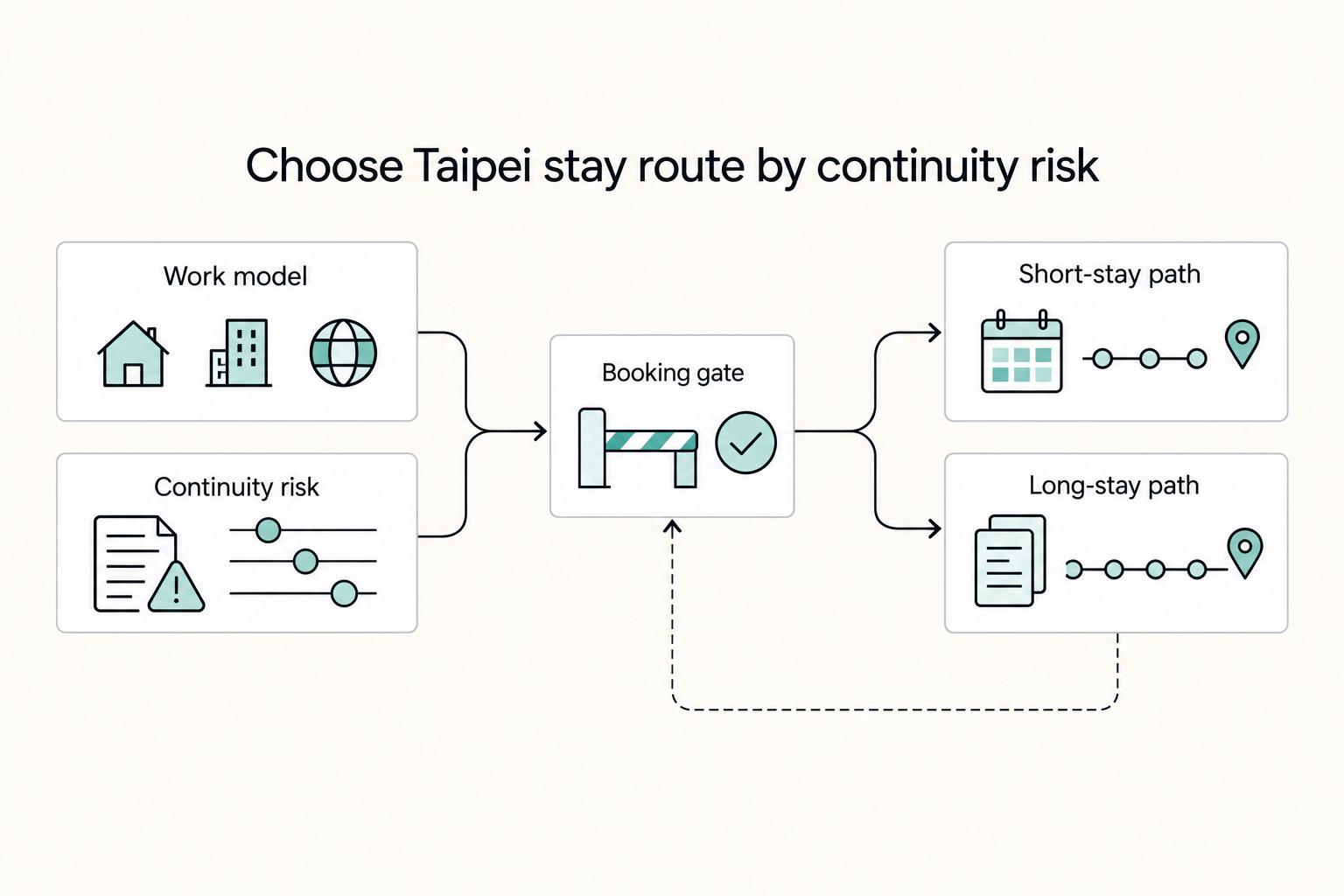
Decide your legal stay path before you spend on flights, deposits, or a long coworking plan. In Taipei, that choice sets the timeline for everything else. If you treat the city like a casual base first and a regulated move second, you raise the odds of rework, document gaps, and avoidable continuity risk.
Keep that frame throughout this guide. The useful question is not, "Can I make this work somehow?" Ask instead: "Which stay path matches how I actually earn, how long I need to stay, and how much interruption my clients can tolerate?" Once you answer that, the rest of the move gets much easier to sequence.
Stay paths at a glance#
Use these terms narrowly so each one leads to a real planning decision.
| Planning item | Article detail | Context |
|---|---|---|
| Initial duration | 6 months | Planning input |
| Renewal limit | Up to a total stay of 2 years | Planning input |
| Income threshold age 20 to 29 | $20,000 USD over the last two years | Planning input |
| Income threshold age 30+ | $40,000 USD over the last two years | Planning input |
| Passport validity | At least 6 months | Verify now |
| Passport pages | Blank pages | Verify now |
| Application form | Completed and signed | Verify now |
| Fee and processing rules | Current fee and processing rules | Verify now |
| Stay path | Best use | Continuity risk | What to verify now |
|---|---|---|---|
| Short stay entry | Testing Taipei before you commit to a longer move | High if your plan depends on repeated resets or gray-area assumptions | Whether your nationality gets 60 to 90 days, entry conditions, and whether a short test period is enough for your real decision |
| Taiwan digital nomad visa | Medium-term remote work for overseas employers or clients | Medium, lower than short stay, but still depends on meeting current visa rules and renewals | Current income threshold over the last two years, passport validity of at least 6 months, blank pages, completed and signed application form, current fee and processing rules |
| Taiwan Gold Card | Longer-stay stability if you qualify and want Taiwan work authorization | Lower operational risk once approved, but higher application difficulty upfront | Your eligibility category, current fee range, document requirements, and the fact that NHI timing is not automatic just because you hold the card |
The labels matter less than the operating consequences. Short-stay entry is a testing option, not a durable plan. The digital nomad visa is a visitor-visa route for remote work tied to overseas employers or clients, so it is the wrong fit if you need to work for Taiwan-based employers or clients. The Gold Card is harder to get, but it is the route here that is explicitly positioned with Taiwan work authorization for qualified professionals.
For the digital nomad visa, check the main numbers first. The cited figures are a 6 month initial duration, renewals up to a total stay of 2 years, and income thresholds of $20,000 USD for applicants aged 20 to 29 and $40,000 USD for applicants aged 30+. Treat all of those as planning inputs, not final policy, until you verify the current official rules and fee schedule for your application location. One more correction matters if you are comparing it with the Gold Card. Do not assume the Gold Card gives every holder immediate National Health Insurance access. The timing depends on employment or residence conditions.
Run the checkpoint now#
Before you price apartments or book a flight, write down these inputs:
- intended stay length in months
- your age bracket
- whether you work only for overseas clients or need Taiwan work authorization
- whether spouse or children need to move with you
- how much downtime your client delivery can absorb
- passport expiry date and whether you have enough blank pages
From that short list, produce three concrete outputs. First, a one-page decision note that names your preferred stay path and your fallback. Second, a document stack in dependency order, starting with passport validity, application form, income or eligibility evidence, and any family-related files if they apply. Third, a move timeline scaffold with a re-decision gate before any non-refundable spend.
That last piece matters because small arrival tasks can expose weak assumptions fast. Do not hard-code airport transfer times or first-day setup costs. Instead, create a verification prompt for arrival: confirm airport-to-neighborhood transit options, first 48-hour connectivity, and whether your first workspace choice can support a normal client day if housing check-in slips. If your plan breaks under a delay, it is not ready yet.
For tax consequences, read Taiwanese Tax Guide for Foreign Professionals. For visa-route detail, the next sections and the Taiwan Gold Card guide are the right places to go deeper.
Related: Bangkok Digital Nomad Guide for 2026 Long-Stay Moves.
Decide your legal stay path before you book anything#
Set your legal stay route before you spend on anything non-refundable. Once you lock the route, you can price flights, housing, and first-month commitments against a real timeline instead of assumptions.
| Route | Who it fits | Work-permission clarity | Continuity risk | What to verify now |
|---|---|---|---|---|
| Short-stay entry | You are testing Taipei for a limited period and can absorb uncertainty | Low. Do not assume entry permission alone answers remote-work questions | High if your plan depends on resets, extensions, or uniform treatment across nationalities | Your nationality's current entry terms, whether extension rules apply to you, and whether your actual stay length works without resets |
| Digital nomad visa | You want a medium-term route and your case may fit current rules | Clearer only if live official terms explicitly cover your situation | Medium, because rule changes or evidence gaps can still delay timing | Current eligibility rules, required evidence, fees, and application channel in official guidance |
| Taiwan Gold Card | You want a longer-stay route and may qualify under current rules | Do not infer scope from summaries; verify live official terms for your approved status | Potentially lower than short-stay if you qualify, but front-end rejection or weak evidence can still break the plan | Current eligibility category, required supporting evidence, fees, and application process in official guidance |
Short-stay entry is where people often overestimate flexibility. One Taipei nomad guide describes a 3-month visa-on-arrival style path for many countries, but the same guide says Canada and the UK can extend to 180 days. Treat that as a continuity warning: entry and extension treatment may be nationality-specific, not a universal template you can build contracts around.
If your plan only works through repeated exits and re-entries, treat that as a continuity failure, not a workaround. A visa-run-dependent route can collide with contract obligations, fixed meeting windows, and client expectations for uninterrupted delivery. Your test is simple: does your delivery calendar survive one denied assumption, one rule change, or one border-day delay?
Outdated rules are a real risk. At least one government source in this topic area is explicitly marked archived from January 20, 2021 to January 20, 2025, with a warning that content is not updated and links may not function. Taiwan entry controls also changed materially after COVID, including quarantine ending on October 13, 2022 and virtually all remaining restrictions ending on March 20, 2023. If your decision file depends on old screenshots, forum posts, or cached tables, pause and re-check live official requirements.
Your pre-booking gate#
Keep your one-page decision note simple:
- chosen route and one fallback route
- eligibility evidence already on hand
- unresolved gaps that could block approval or timing
- a clear go/no-go trigger before any non-refundable payment
Use this no-go trigger: if you still have an unresolved eligibility question, missing evidence, or a plan that depends on short-stay resets, do not book yet. Right before any application fee or deposit, re-verify current official requirements so you are not paying against outdated rules.
For a global comparison of digital nomad visa options, see the 2026 Global Digital Nomad Visa Index.
Choose between short-stay flexibility and long-stay stability#
If your income depends on predictable delivery, treat stability as the default. Use short stays as a test phase.
| Path style | Stay signal so far | Decision frequency | Admin burden | Housing risk | Client continuity impact |
|---|---|---|---|---|---|
| Short-stay entry | Visa-free entry or tourist visa is described as up to 90 days | High: you re-decide status and timing often | Repeated checks on current entry terms and stay limits | Highest: keep terms reversible because rental channels are scattered and lease terms can be confusing or inconsistent | Highest if your work needs uninterrupted availability |
| Medium-stay visa route | Digital Nomad Visa is described as up to six months; Visitor Visa is described as valid for 180 days | Medium | Current processing expectations, fees, and exact eligibility must be checked before treating this path as available | Moderate: enough time to test areas, but avoid hard commitments until status is confirmed | Medium when timing or approval details are still unverified |
| Long-stay stability route | Employment Gold Card is described as one to three years | Lower after approval | Front-loaded evidence burden; for the salary route, the excerpt cites TWD 160,000 monthly; other categories need live verification | Lower after approval because you can move out of temporary housing with less pressure | Lower once status is secured, with real front-end rejection risk if evidence is weak |
Use a two-phase housing plan. In your test phase, keep lodging and workspace reversible. A private room in a shared apartment can help because it is described as budget-friendly with flexible lease terms, but the tradeoff is limited privacy and possible roommate conflict. Move to commit-phase housing only after your stay path, work rhythm, and neighborhood fit are proven.
Before any non-refundable booking, run a Taipei-versus-alternatives checkpoint on legal fit, continuity risk, and setup friction.
Pre-commit verification checklist (no-go until confirmed):
- current processing expectation for your route
- current fee
- exact eligibility evidence required for your route, especially if you are planning around the Gold Card or a six-month stay
For a step-by-step walkthrough, see Lisbon Digital Nomad Guide 2026 for Long-Stay Move Sequencing.
Build your document pack in one pass#
Build one master pack first, then add route-specific documents only after you verify current requirements for your route that day. This keeps you from duplicating work and missing one blocking document.
| Check | Pass condition | Fail if |
|---|---|---|
| Completeness | Every required file for your chosen route is present | Any item is still "to confirm" |
| Exact name match | Passport name matches every supporting document | The mismatch is not corrected or clearly explained |
| Freshness tag | Each route-specific item is marked "verified" with today's date | The item is undated |
| Retrieval speed | You can open, send, and print files quickly from both phone and laptop | You cannot do this quickly from both phone and laptop |
Work in this order, and do not move forward until each stage passes:
- Identity and status basics: confirm your passport and exact name match across records, plus your current entry/approval document.
- Work and funds alignment: make sure your work proof and financial proof tell the same story under the same legal name.
- Backup access: store files on laptop, phone, and cloud, and keep printed copies of critical records.
| Pack layer | Applies to all routes | Route-specific add-on |
|---|---|---|
| Identity | Passport and name-matching ID records | Any route-specific identity proof currently required by your chosen route |
| Status | Entry or approval record for your chosen path | Short-stay entry: current entry proof if applicable |
| Work and funds | Core work/income evidence under the same legal name | Digital Nomad Visa: current financial-eligibility proof, work-proof documents, and any additional savings evidence required for your case |
| Backups | Digital copies plus printed copies of critical records | Taiwan Gold Card: current route-specific supporting proof for your eligibility category |
For the Taiwan Digital Nomad Visa scheme described as launched on 1 January 2025, the cited guide describes stays of up to 180 days and says applicants need both financial-eligibility proof and work-proof documents. It also says further bank-savings proof is needed, so one eligibility path by itself is not submission-ready.
Before you pay any application fee or housing deposit, run this pass/fail gate:
- Completeness: every required file for your chosen route is present. If any item is still "to confirm," fail.
- Exact name match: passport name matches every supporting document. If not, fail until corrected or clearly explained.
- Freshness tag: each route-specific item is marked "verified" with today's date. If undated, fail.
- Retrieval speed: you can open, send, and print files quickly from both phone and laptop. If not, fail.
Keep your first week in the same sequence. Do not assume downstream tasks, including local banking, are available before your status documents are active and accepted.
Follow a move timeline that prevents last-minute failures#
Run your move in phases with dependency gates. Only increase commitment after each gate is clearly passed.
| Phase | Primary objective | Critical checks | Commitment level |
|---|---|---|---|
| Phase 1 pre-booking | Confirm your stay path and core document readiness | Route selected, names consistent across files, route-specific items marked with the date you verified them | No non-refundable spend |
| Phase 2 booking-ready | Prepare first-arrival execution with proof | A visible checkpoint artifact exists for each next step (for example, a saved schedule link or dated verification note), cancellation terms saved, files open on phone and laptop | Flexible bookings only |
| Phase 3 pre-departure | Reduce preventable work disruption risk | Work setup tested, backup access ready, short initial stay arranged | Reversible commitments |
| Phase 4 arrival validation | Confirm your day-to-day setup works in practice | Connectivity live, local mobility usable, workspace tested with a real work block | No long commitments yet |
| Phase 5 stabilize | Expand commitments only after repeatable proof | No unresolved document or access issue, key assumptions rechecked after arrival | Longer commitments allowed |
Use deliverables, not memory. A step is complete only when you can open, show, or test the artifact that unlocks the next decision.
Keep arrival execution outcome-first: establish reliable connectivity, confirm local mobility, then test workspace performance with your real workload before longer housing or coworking terms.
If a milestone slips, follow one escalation path:
- Pause: longer housing terms, coworking memberships, and optional upgrades.
- Continue: status follow-ups, connectivity fixes, and basic transport setup.
- Re-validate before spending again: your verified files, saved checkpoint details, and whether the plan still holds if one more dependency slips.
Related reading: Amsterdam Digital Nomad Guide for a 2026 Move.
Pick your neighborhood and workspace by output, not vibes#
Pick your Taipei base by repeatable work performance, then commit only after your setup passes repeat tests. Broad, affordable public transit makes cross-area testing practical, but your results are only valid after Day 1-2 basics are in place: SIM, EasyCard, cash withdrawal, and a working LINE setup for landlord and delivery coordination.
| Trial check | Pass only if |
|---|---|
| Two real workdays at your normal start time | Commute, entry, seating, charging, and return work without improvising |
| One primary and one backup workspace under your real workload | Calls, uploads, noise, and seat access are stable enough for delivery |
| Evening coordination through LINE, not just map estimates | You can get home, receive deliveries, and clear routine admin cleanly |
| One logged failure retested on another day | If it repeats, treat it as a pattern |
| Area type | Commute reliability | Workspace backup density | Evening return ease | Coordination friction |
|---|---|---|---|---|
| Central business | Strong when meetings cluster in core office zones | Better for same-day fallback options | Usually simpler if you return late | Lower when meetings, errands, and deliveries stay in one zone |
| Mixed-use hub | Balanced when work and daily errands overlap | More resilient if you rotate between home and external work spots | Flexible for frequent short trips | Lower when daily tasks can be combined nearby |
| Quieter residential | Works if you prioritize home focus | Higher risk if you need many walkable backups | Must be tested after dark, not just midday | Higher if routine tasks require extra transfers and more coordination |
Run a short trial stay first, then treat Day 5-7 as a neighborhood orientation gate: learn the garbage schedule, confirm your work spots, and set up home basics. If an 8 PM garbage-truck routine disrupts your calls or reset time, count it as an operating issue, not a minor annoyance.
Use this pass/fail flow in each area:
- Verify two real workdays at your normal start time. Pass only if commute, entry, seating, charging, and return work without improvising.
- Verify one primary and one backup workspace under your real workload. Pass only if calls, uploads, noise, and seat access are stable enough for delivery.
- Verify evening coordination through LINE, not just map estimates. Pass only if you can get home, receive deliveries, and clear routine admin cleanly.
- Log one failure and retest it on another day. If it repeats, treat it as a pattern.
Avoid this failure mode: locking longer housing or prepaying work setup while a document-dependent step is still unresolved. On Day 3-4, set your payment strategy, and keep in mind one source warns that lacking an ARC residence card can block local bank account opening. If any dependency is still unverified, extend the trial, keep commitments reversible, and retest before you commit.
Build a realistic monthly operating budget#
Budget for a repeatable work month, not a headline "cheap Taipei" number. Split your plan into fixed costs you lock early and variable costs that move with your real week, and do not lock major fixed costs until your legal stay path and first-week neighborhood tests are working.
One grounded reality check: a traveler source reports about $22/day backpacking Taiwan, $35/day as a couple, and $50/day during a Taipei apartment month. Use these as style-dependent signals, not a city average. Your budget should prioritize operational reliability: stable housing, workable backup places to work, and room for routine admin friction.
| Line item | Fixed or variable | How to validate this line item before committing |
|---|---|---|
| Housing terms | Fixed | Confirm whether it is a month-long Airbnb, a shared-apartment room, or another setup. Capture listing terms, confirm roommate/utilities/move-in conditions, and cross-check with active Taipei rental Facebook groups before payment. |
| Coworking or backup workspace access | Usually fixed if membership, variable if ad hoc | Do not budget from a homepage alone. Test your real work block in the target district and confirm seat availability, call tolerance, and access rules on the days you will actually use it. |
| Transport pattern | Variable | Model this from your actual week, not map-only estimates. Run your likely route plus one backup route at your real travel times and note transfer/late-return frequency. |
| Admin friction | Variable | Reserve a monthly line for conversion losses, one-off setup costs, and service fees that appear after arrival. Track first-two-week receipts so you can replace estimates with real numbers. |
Housing needs extra caution. One source describes a month-long Airbnb as the easiest option, but also "the most expensive option, by far." The same source says affordable short-term options are mostly rooms in shared apartments, and this can be harder if you do not want roommates. If privacy is non-negotiable, plan for a higher housing line until you verify alternatives.
Unknowns#
Keep an Unknowns block and fill it with checks for your district and move month:
- Current rent or room price in your target area: unresolved until you check live listings for your move month
- Whether affordable supply is mostly shared rooms in your search area: unresolved until you compare current inventory
- Utilities, deposits, cleaning fees, or short-stay add-ons not clearly listed: unresolved until the listing or host confirms exact terms
- Current coworking or backup workspace terms: unresolved until the workspace confirms access rules and price
- Real card/cash/currency-conversion friction in month one: unresolved until you track first-two-week receipts
If a number comes from a guide marked April 2023, treat it as directional only, not a 2026 commitment value.
Use a three-case decision rule#
Run best-case, likely-case, and disruption-case versions of your month. If the likely-case is already tight, reduce fixed commitments first, usually by shortening housing commitments or delaying paid workspace plans until your pattern is proven. If the disruption-case breaks your buffer, keep flexibility longer and delay upgrades so one failed setup week does not derail the month.
Avoid the mistakes that make Taipei feel "overrated"#
If Taipei feels "overrated" to you, it is usually a fit or planning problem before it is a city problem. The pattern is predictable: unclear stay path, fragile continuity assumptions, and rushed housing decisions, then one crowded day or admin delay gets treated as proof the whole move was wrong.
Use a hard filter for advice before it changes your plan: prioritize inputs that are Taipei-specific, current, and verifiable, and treat social commentary as hypothesis only. A recent Jiufen account is a good example of mixed signal: it describes strong appeal (views, alleyways, teahouses) and also crowd pressure (queues at Ruifang, traffic, and dense crowds). That helps you plan excursion timing; it does not prove your weekday setup in Taipei will fail.
Before any claim affects your move, check three things: where it happened, when it was published, and whether you can verify the logistics yourself. Keep the URL, publication date, and a one-line note in your planning file. If a source is old, such as a CECC report dated October 31, 2008, use it as background, not as a 2026 relocation input.
| Risk | What goes wrong | What to do now |
|---|---|---|
| Legal path clarity is weak | You spend before you can clearly state what is verified versus unknown in your stay plan, then absorb expensive reversals later. | Hold major non-refundable spend until your stay path and core documents are internally consistent. If you cannot explain the route in one sentence, delay commitment. |
| Continuity depends on repeated resets | Your work month relies on repeated exit/re-entry assumptions instead of a stable operating path. | Treat this as a decision branch now. If your plan depends on resets, review a stability route such as the Taiwan Gold Card before locking housing or delivery commitments. |
| Housing timing is too aggressive | You rush a booking, then pay for convenience or accept a setup that disrupts focus. | Keep the first housing commitment short and flexible until your weekday commute and work blocks are proven. Save listing-term screenshots and compare live alternatives before paying. |
Pre-commit gate#
Before any major spend, pause and answer:
- Can you explain your legal stay path clearly, including what is still unverified?
- Does your plan still work if one timing assumption slips, with a dated buffer for the delay you can absorb?
- Are your key assumptions based on current, Taipei-specific, checkable inputs rather than commentary?
If any answer is no, keep flexibility longer. That is usually cheaper than rescuing a brittle plan after arrival.
Your next step this week#
Make one stay-path decision now, and keep every booking tied to what you have verified, not to hopeful assumptions.
Write a one-sentence decision note with exactly three fields: intended stay path, work setup, and re-decision trigger. Example: short-stay entry, overseas client work only, re-decide if current entry terms are still unverified by Friday. If your plan depends on a blog claim like a 3-month entry, a possible 180-day extension, or anything resembling repeated visa-run logic, set that trigger now before you pay for longer housing.
Run a quick integrity pass on your document pack before any major payment. Compile your passport copy, stay-path evidence, accommodation record, onward or flexible travel proof (if relevant), and work-supporting documents. Then check exact name order, passport number, issue and expiry dates, and matching addresses and travel dates across confirmations. Open every file on both phone and laptop. Because some non-tourist sites are reported to lack English translations, do not depend on live translation at checkout or check-in.
| Status | What it means right now | Commitment level this week | Cash protection behavior |
|---|---|---|---|
| Verified | Stay path checks are current, core documents match exactly, and first-arrival housing is identified | You can consider longer commitments | Pay only for items that still match your verified route; keep proof files saved offline |
| Partially verified | One key rule, document, or housing assumption is still open | Keep commitments short and reversible | Avoid non-refundable upgrades, deposits, or prepaid extras |
| Unverified | Route, work fit, or key documents are still assumptions | Book essentials only | Protect cash first, delay major spend, and keep flights and housing refundable |
Use housing as your final gate before weekend commitments. One source says short-term accommodation can be tricky to secure cheaply, and that Airbnb is the easiest month-long option but also the most expensive by far. The same source notes many affordable options are shared-apartment rooms. If that tradeoff does not fit your first month, do not assume it will fix itself after arrival. Keep two open checks in your notes: current stay-rule wording and current month-one housing terms.
Finish with a freshness check. A guide marked "currently updated April 2023" can still help orientation, but not 2026 spending decisions. A May 28, 2024 trip write-up can help with daily-life context, but it is still trip narrative, not policy guidance. If a source is old, anecdotal, or unclear on work rights, keep status at partially verified until you confirm live terms.
Frequently Asked Questions
Can you legally stay in Taipei long term?
Maybe, but do not treat any long-stay route as real until your passport, work model, and timing match a currently verified option. Some guides discuss short-stay entry and visa runs, and mention longer-stay options, but treat exact 2026 eligibility as unresolved until you check official immigration guidance for your nationality, any claimed 3-month short-stay or 180-day extension figures, and whether your work arrangement fits the route you want. If your plan depends on uninterrupted client delivery, choose the path with the lowest continuity risk, not the one that looks easiest this week.
How should you choose between short-stay entry and longer-stay routes?
Choose by work model first, then by continuity risk. Short-stay entry is the weakest fit when you need stable client delivery, longer housing, or local contracting certainty, because it can depend on repeats or extensions, and you should not assume local work rights from blog summaries alone. For any longer-stay route, treat eligibility and approval timing as uncertain until you verify them in current official guidance before you book.
What documents should you prepare before flying to Taiwan?
Build one evidence pack early and make every file agree on your identity and travel story. Keep your passport copy, stay-path evidence, accommodation record, onward or flexible travel proof if relevant, and work-supporting documents together in one folder with matching names and dates. Open every PDF and screenshot as if you had to show it from your phone at check-in or after a delay, and fix any mismatch before you fly. If your pack is incomplete, delay non-refundable commitments rather than trying to rebuild it under time pressure.
What should you do in your first week in Taipei?
Remove daily friction before you optimize anything. Test your internet where you actually sleep and work, because one guide cites an average of 24 Mbps for Taipei but that does not tell you what your building or room will deliver. Check SIM or Wi-Fi, run a live speed test, trial one backup workspace, and do one full weekday commute before you commit to longer housing or coworking. If your housing only works because you are tolerating a bad commute or weak connectivity, move early while your booking is still short.
Is Taipei a better fit for focused remote work than for a party-heavy nomad lifestyle?
Often yes, if your priority is steady output rather than built-in nomad nightlife. One source puts the fit risk plainly by noting that Taiwan does not attract many digital nomads, so you should not expect the same social pattern you might find in louder hubs. Test one normal workday, one grocery run, one evening out, and your recovery the next morning. If you need a dense party scene to enjoy a city, treat Taipei as a possible mismatch rather than a place you can force into that role.
How should you estimate your cost of living when online numbers conflict?
Do not plan off one headline number. A personal benchmark of US$1,500 for a comfortable month exists, but it is still one person’s month-to-month experience, and some guides in circulation were last updated in April 2023 or published as far back as May 2, 2021. Build three buckets called fixed, variable, and unknowns, then leave rent, coworking, and transit as unresolved lines until you can verify current local inputs. If your budget only works in the best-case version, keep housing short, expect Airbnb to be the easiest but most expensive option, and remember that many affordable listings are shared apartments and some local sites may not have English translations.
Try a related tool
Researched and edited by the Gruv editorial team. Gruv builds cross-border billing, payouts, and finance-operations software for global businesses.
Sources
Includes 1 external source outside the trusted-domain allowlist.
- 2021-2025.state.gov/report/custom/1586011bd9trusted
- cecc.gov/publications/annual-reports/2008-annual-reporttrusted
- oecd.org/content/dam/oecd/en/publications/reports/202...trusted
- pmc.ncbi.nlm.nih.gov/articles/PMC10181778trusted
- repository.library.northeastern.edu/files/neu:bz60wp35m/fulltext.pdftrusted
- state.gov/page/8trusted
- wise.com/gb/blog/taiwan-digital-nomad-visatrusted
- aclanthology.org/2025.finnlp-2.pdfexternal
Educational content only. Not legal, tax, or financial advice.
Related Posts
Taiwan Gold Card Application Strategy for Remote Professionals
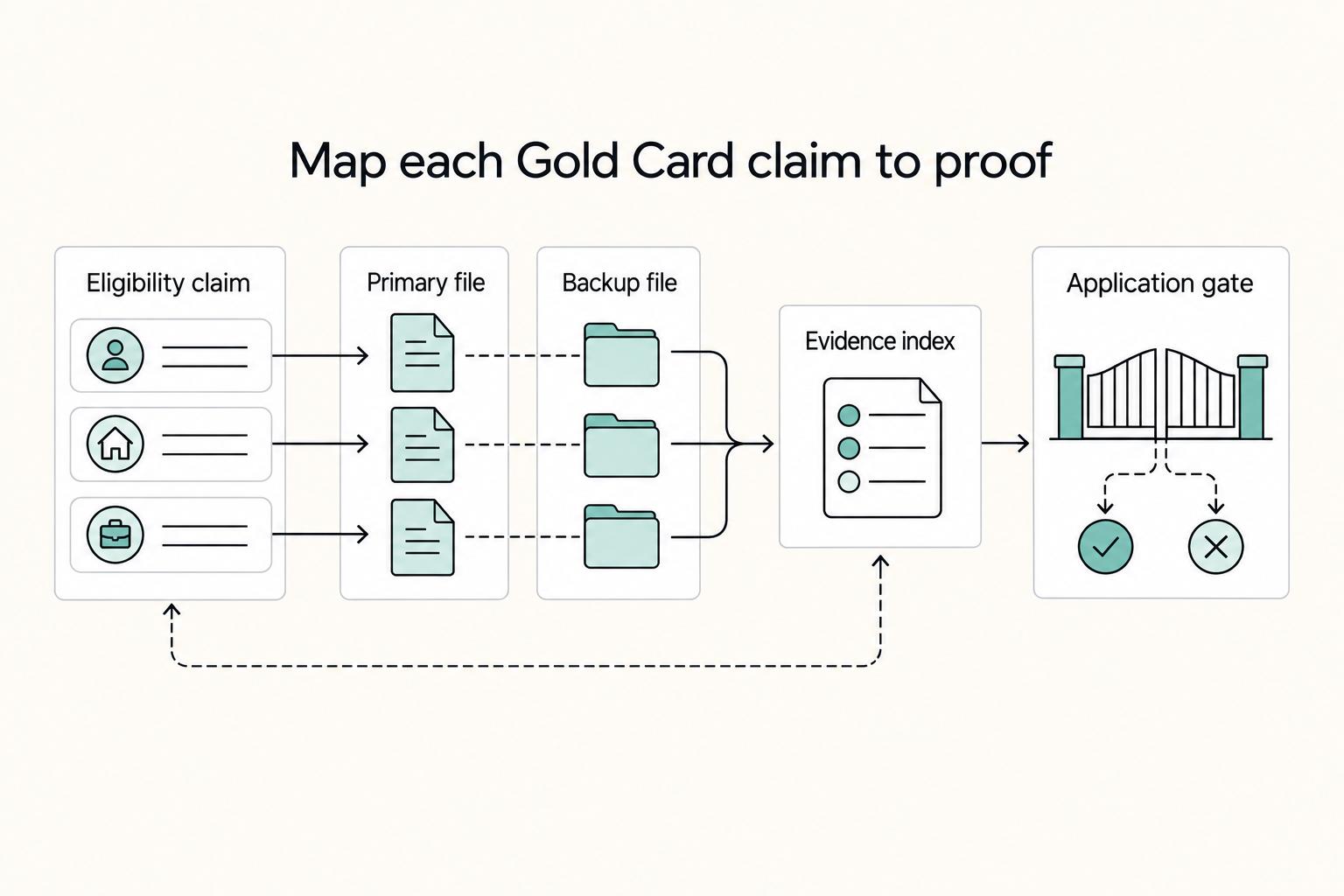
Treat this process as a chain of linked decisions, not a race to submit. If you are planning a serious move or a long stay in Taiwan, the safer outcome usually comes from choosing the right route first and proving each core claim before you pay or file. The Taiwan Employment Gold Card rewards that discipline because it combines four functions in one status: a work permit, resident visa, Alien Resident Certificate (ARC), and re-entry permit.

The 2026 Global Digital Nomad Visa Index for 50+ Countries
Start with legal fit, not lifestyle filters. The practical order is simple: choose a route you can actually document, then decide where you want to live. That single change cuts a lot of wasted comparison work and stops you from falling in love with places that were never a real filing option.

Taiwan Tax for Foreign Professionals With a Defensible Filing Path
Start with tax rules, not visa labels. A sequence that helps prevent common filing mistakes is: confirm residency status, classify each income stream by source, choose the filing route, then escalate only where facts stay unclear.