
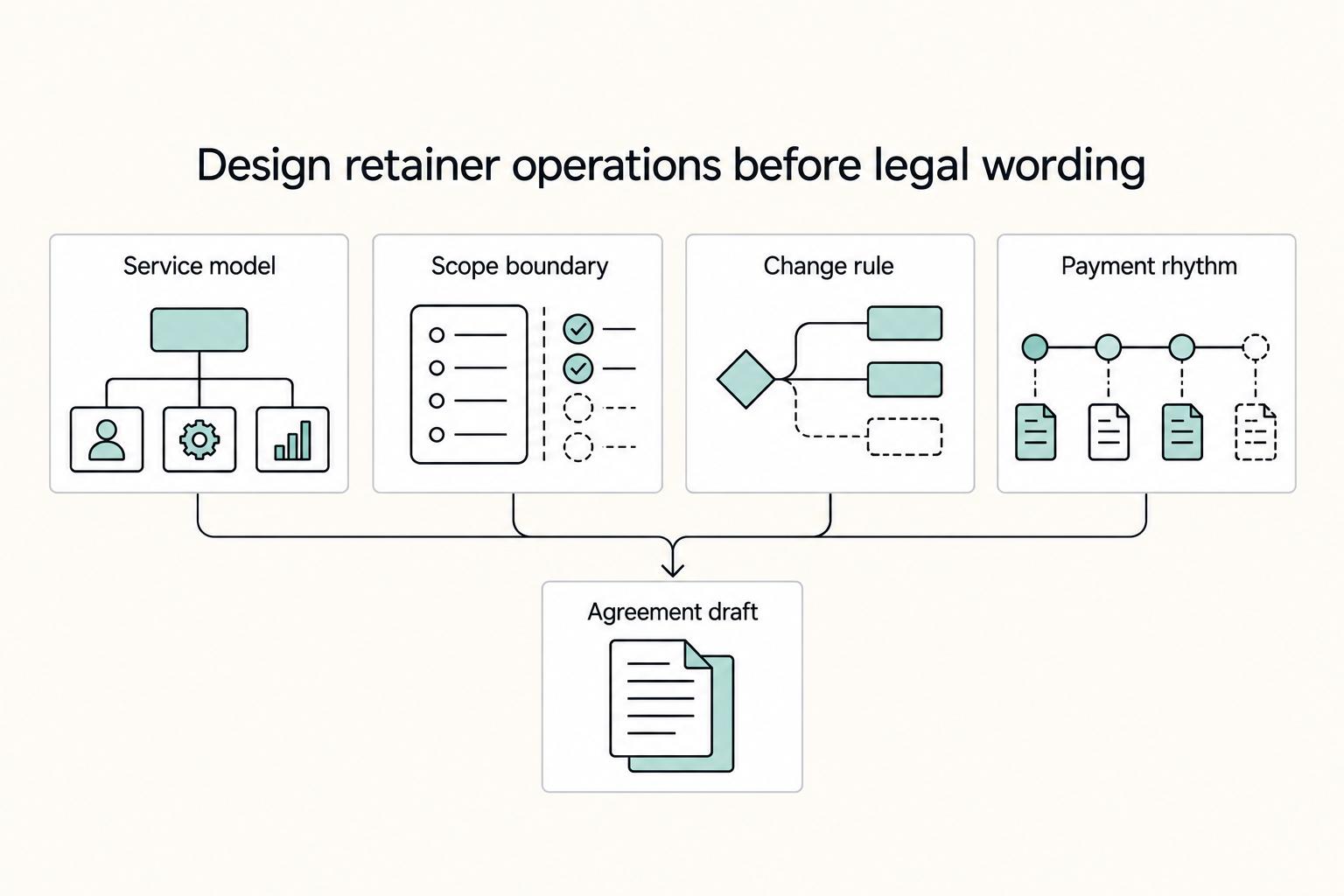
Quick Answer
State what the recurring fee buys: defined work, reserved availability or a clearly bounded mix. List included services, response expectations, usage limits and exclusions, then agree how extra work is priced and approved. Add billing dates, payment currency, late-payment steps, renewal and termination terms. A separate statement of work can carry the detail, but a simple engagement can put it in one agreement.
Stop Scope Creep Before It Starts#
A consulting retainer should give you recurring revenue and the client a clear service commitment. Define what the fee buys before agreeing to it: a set of deliverables, a block of time, reserved advisory access or a bounded combination. That choice keeps an extra request from quietly becoming unpaid work.
Retainers can stabilize cash flow, but only when the service commitment and payment schedule fit the work. Vague drafting makes it harder for either side to know whether a new request is included.
Start with a practical baseline#
Use this as your default checklist before you entertain custom edits:
| Area | What to define |
|---|---|
| Scope | Inclusions and exclusions in plain language |
| Payment terms | Retainer fee, reserved capacity, and clear request boundaries |
| Termination | The exit path so both sides know it |
| Statement of Work (SOW) | Deliverables, timing, and acceptance |
| Out-of-scope asks | How they are handled |
A common failure mode looks like this. The client asks for one extra strategy review "while you are in the account." If your retainer never names what sits outside scope, that request can start to become precedent. You lose leverage, and the client starts treating access as guaranteed output.
Run the risk tier check before signature#
Use simple triage so you can move quickly without sending avoidable risk:
| Risk tier | What you see in the draft | Action before you send |
|---|---|---|
| Low | Scope, payment terms, and termination read clearly | Proceed to the remaining ownership, liability and dispute-term review |
| Medium | One clause feels broad or vague | Rewrite in plain language and add a boundary in the SOW |
| High | Ambiguous terms or undefined scope boundaries | Escalate and resolve before signature |
You do not need a perfect template. You need clear definitions, explicit inclusions and exclusions, and a decision rule that treats ambiguity as risk.
Build the Mental Model Before You Touch Legal Language#
Build your consulting retainer agreement as a layered system first, then draft legal language that fits that system. If you want fewer renegotiations and fewer "but I thought that was included" moments, decide how the relationship runs before you polish clauses.
A consulting retainer agreement sets the recurring services or availability, scope boundaries and payment terms. The fee may buy defined work or reserved access, depending on the model. A statement of work can add delivery detail; it is useful for complex engagements but need not be a separate document for a simple retainer.
Define the contract stack before you negotiate wording#
| Layer | What it controls | What you define now |
|---|---|---|
| Consulting Retainer Agreement | Ongoing relationship rules | Access model, scope boundary logic, payment control rules |
| Retainer fee | Commercial price for the selected service model | Defined outputs or reserved capacity, usage limits and exclusions |
| Statement of Work (SOW) | Day to day execution | Work description, work location, performance period, deliverable schedule, performance standards |
If you use a master agreement and a statement of work, identify which one controls when their terms conflict. Keep the fee and scope descriptions consistent across both. A single agreement can serve the same purpose when the engagement is straightforward.
Use this sequence to reduce drafting errors#
Use this order as your default operating flow, then adjust for jurisdiction and deal context:
- Choose the service model you will deliver.
- Lock scope boundaries and explicit exclusions.
- Add risk clauses that match delivery reality.
- Set payment controls tied to approvals and timing.
- Run cross-border checks before signature.
- Prepare negotiation scripts for likely pushback.
If you start with legal phrasing before defining delivery mechanics, you risk leaving gaps that clients may read as additional requests. If you define model, scope, and SOW detail first, you keep expectations tight and negotiate from a clearer position.
Which Retainer Model Fits This Client#
Use these as working labels: choose Pay for Work when the client buys defined outputs, and choose Pay for Access when the client buys ongoing availability to your expertise. This decision keeps the rest of the agreement coherent under pressure.
A retainer reserves future professional services. Your client agreement should make one thing unmistakable: the Retainer Fee buys either scoped output or reserved availability, not unlimited work. That choice drives how you write scope boundaries, payment controls, and decision rights.
Compare the two models before you draft terms#
| Model | Best fit | SOW role | Payment logic | Core boundary |
|---|---|---|---|---|
| Pay for Work | Client wants specific, measurable deliverables | SOW defines work and delivery requirements | Agree a recurring billing schedule and any milestone or acceptance conditions | Keep requests inside agreed deliverables |
| Pay for Access | Client wants ongoing availability for future issues | SOW defines availability scope and exclusions | Retainer Fee reserves access and availability over the agreed period | Prevent access from turning into unlimited production |
For an illustrative advisory retainer, $2,000 per month could cover two 60-minute strategy calls and review of one monthly plan, with written replies within two business days. A new market-research report would be outside that scope and require a separate quote. State whether unused calls expire or roll over, when the monthly invoice is due and how much notice ends the arrangement. The numbers are examples; choose limits that fit your capacity and the client’s needs.
For a retainer with deliverables, name the client reviewer and agree a review window, such as five business days after delivery. Ask for any rejection to identify which agreed criterion was missed, and state the corrections or revision rounds included in the fee. Decide what happens if review is late and whether a disputed deliverable affects the whole monthly fee or only its allocated amount. A fee for reserved advisory access can be independent of deliverable acceptance; a fee conditioned on accepted outputs needs that payment condition written explicitly. These are terms to agree, not automatic acceptance rules.
Lock overages and exit terms at model selection#
Set change-management and pricing rules before kickoff. Define baseline coverage, what counts as out of scope work, how approval happens, and how additional billing is handled. If you wait, scope and payment drift shows up quickly.
A common mismatch is a Pay for Access retainer that turns into project execution. If the SOW boundaries and change controls are loose, both sides can end up arguing about what the original fee covered. If you define triggers early, you protect the relationship and your margin.
Add Renewal and Cancellation logic during model choice, not late in redlines. Align those terms with Termination mechanics so notice flow, outstanding fee settlement, and return of client materials stay clear before signature.
Use this sequence every time: choose model, define SOW boundaries, set change-management and additional-billing controls, then align renewal and cancellation with termination before signature.
What Must Your Agreement Include at Minimum#
Include a minimum clause set that defines exits, ownership, confidentiality, and risk allocation before you negotiate fine print. Once the retainer model is chosen, you need a legal floor that holds up when requests increase and timelines tighten. In strategic consulting, vague scope and vague extra-work payment language are common triggers for disputes, so treat clarity as a delivery control.
Lock exits before delivery starts#
Exit terms protect time, cash flow, and handoff quality. Write Termination, Renewal, and Cancellation as operational rules, not abstract legal text.
| Exit term | What to define |
|---|---|
| Termination | Engagement term, early-termination process, notice flow, fee settlement, and return of documents or property |
| Renewal | Whether renewal is automatic or explicit, and when each side must confirm |
| Cancellation | Stop-work timing, what fees remain due, and what handoff support you will provide |
A simple standard is this: if an exit event happens, both sides should know the next step without needing a meeting to interpret intent. If a client cancels right after requesting final files, clear handoff language helps reduce unpaid transition work and keeps the relationship professional.
Tie ownership confidentiality and risk to real events#
| Clause | What it should do | What it should not do |
|---|---|---|
| Intellectual Property, Work for Hire, Assignment of Rights | Define assignment or licence rights for specified deliverables; use work-for-hire wording only where legally applicable | Transfer every background method, template, or pre-existing asset by default |
| NDA and data-handling terms | Define what stays confidential and how each side handles client materials | Allow broad reuse of confidential information |
| Limitation of Liability | Set a damages-waiver and liability-cap structure so downside stays bounded | Remove all accountability for performance obligations |
| Indemnification | Assign responsibility for specified losses | Cover every possible claim regardless of cause |
| Force Majeure | Define relief for specified events and required notice and mitigation conditions | Leave the effect on services, payment or termination undefined |
Define the deliverables the client will own or be licensed to use, and reserve your pre-existing methods and templates where appropriate. Under US law, commissioned work qualifies as work made for hire only if it meets the statutory category and signed-agreement requirements. Do not rely on that label alone for every consulting output; specify an appropriate written assignment or licence and when it takes effect.
How Do You Set Payment Terms That Prevent Non Payment#
Set Payment Terms that remove ambiguity on timing, method, consequences, and change approval before work begins. This is where your agreement stops being "about money" and starts being about keeping work and payment aligned.
In a client agreement, Payment Terms should define billing cadence, invoice submission requirements, due dates, accepted payment rails, and Late Payment consequences. When any of those points are unclear, dispute risk rises because each side can interpret obligations differently. Keep this section operational.
Write payment controls that leave no gaps#
| Area | What to define | Safe default decision rule |
|---|---|---|
| Billing and due dates | Invoice cadence, due date trigger, accepted rails | No invoice leaves without a due date and payment path |
| Late payment handling | When an invoice becomes overdue, notice process, consequences | Pause new work after stated notice conditions are met |
| Service reactivation | What the client must clear before work resumes | Resume only after overdue amounts and restart conditions are satisfied |
| Retainer Fee coverage | Usage window and rollover policy | Treat unused capacity only as written, never implied |
| Overage Fees | Calculation method and approval flow in the Statement of Work (SOW) | Bill overages only after mutual written approval |
If your agreement uses a Retainer Fee, state the coverage window in plain language, then state whether unused time rolls forward or expires. Either approach can work if you write it clearly.
Put Overage Fees mechanics in the Statement of Work (SOW) and require a written change agreement before expanded scope starts. A change request should not move forward until both sides agree on revised scope, cost, or schedule.
Use the SOW generator to draft the included services, exclusions and approval process for additional work.
How Should Cross Border Consultants Handle Legal and Money Movement Risk#
State the legal forum, dispute path, payment currency rules, and tax document owners in your consulting retainer agreement before kickoff. Cross-border work adds friction in places that have nothing to do with delivery, so you want the rules written while everyone is still aligned.
Separate law forum and dispute path#
Governing Law and Jurisdiction do different jobs, so write both. Governing Law names the legal system that interprets the contract. Jurisdiction names the court and location for disputes. If you skip either one, you invite procedural conflict before anyone addresses the business issue.
Choose a dispute path both sides can use. You might begin with a named decision maker and a notice or cure period, then choose litigation or arbitration for unresolved disputes. If selecting arbitration, specify the institution or rules, seat, language and number of arbitrators as appropriate. Consider the likely dispute value and cost before requiring a process that may be disproportionate to a small unpaid invoice.
Lock money movement and tax ownership#
Cross-border payments break when teams assume different exchange-rate and fee logic. In a consulting retainer, specify invoice currency, payout currency, exchange-rate timing, and who absorbs transfer and currency-conversion friction. Require pre-transaction clarity on rate, markup, and fees so both sides can confirm expected send and receive amounts before payment moves.
Assign tax-document responsibilities by payer, payee status and payment type. If a US payer needs foreign-status documentation from an individual consultant, Form W-8BEN may apply; a foreign entity may instead need W-8BEN-E. US persons generally use Form W-9 in the relevant US reporting workflow. Agree who supplies the appropriate form, who determines withholding and how any deduction will appear in the payment record.
| Control area | What to define in writing | Who confirms |
|---|---|---|
| Governing Law and Jurisdiction | Applicable law and dispute forum | Both signatories |
| Dispute resolution | Negotiation or notice steps and chosen court or arbitration process | Both signatories |
| Cross Border Payments | Currencies, rate timing, transfer fee assumptions | Both finance contacts |
| Tax Documentation | Forms and submission timing by party | Payer and payee |
If payout arrives short because each side assumed different conversion and transfer costs, you will spend time resolving accounting friction instead of delivering. One explicit assumptions block prevents that avoidable conflict.
Use the 10 Minute Red Flag Review Before Sending#
Run a quick pre-send screen before you send any consulting retainer agreement, and pause send when unresolved risk stays open. This operator step helps prevent "we will fix it later" from turning into delay, unpaid work, or a messy dispute.
Pressure test the four high impact risk pairs#
Start with clause pairs, not isolated clauses. Risk can compound when one clause protects the client while another leaves you exposed.
| Red flag | Why it creates risk | Safe fallback you can apply now |
|---|---|---|
| One sided Limitation of Liability plus broad, uncapped Indemnification | The general cap may leave specified indemnity claims uncapped, depending on the carve-outs | Narrow indemnity scope to defined triggers and align liability limits to a deliberate commercial decision |
| Asymmetric Termination rights or Cancellation terms that force unpaid transition work | One party exits cleanly while the other party carries extra transition work or cost | Mirror exit rights, define notice mechanics, and require paid transition tasks in writing |
| Governing law, forum and dispute procedure are unclear | The parties may disagree on where and how to resolve a claim | Select workable terms; the governing law and forum need not be in the same country |
| Payment Terms omit Late Payment remedies or leave additional-work pricing undefined | You lose leverage on overdue invoices and can absorb scope growth without clear approval or pricing | Add service-pause terms for late payment, then define how additional work is approved and priced inside the SOW |
When a client pushes broad indemnity, requests unilateral termination rights, and leaves additional-work pricing vague, do not negotiate line by line first. Flag each issue, attach fallback wording, and ask the client to choose approved alternatives.
Use this decision rule on every retainer. Do not send until each red flag has accepted fallback language, or a named business owner signs off on the tradeoff.
Turn Your Agreement Into an Operating System#
Before kickoff, read the agreement as a delivery plan: what will you provide this month, what will the client pay, and how will you handle a change or an exit? Those answers should be clear enough for both sides to run the engagement without reopening the contract each week.
Write each decision into the agreement before kickoff#
Start with model selection, then lock execution details in a Statement of Work (SOW). Use Pay for Work when deliverables stay specific, and use Pay for Access when advisory availability creates the core value. In both models, define the Retainer Fee, scope boundaries, Renewal, Cancellation, and Overage Fees before kickoff.
| Step | What you decide | What you write |
|---|---|---|
| Model fit | Pay for Work or Pay for Access | Retainer model rules, response boundaries, renewal logic |
| SOW control | Objectives, tasks, deliverables, acceptance criteria | SOW that sets measurable completion standards |
| Risk layer | Termination, liability, indemnity, confidentiality | Clear triggers, limits, and responsibilities |
| Money controls | Billing cadence, due dates, late-payment actions | Payment Terms, pause rights, reactivation conditions |
| Cross-border check | Governing Law, Jurisdiction, dispute path, tax docs | Settlement-to-arbitration or court sequence, market-specific compliance notes |
A well-structured SOW gives you an operating baseline for contract management. It tells both sides what done looks like, how you measure performance, and when you move from debate to acceptance.
Use a no send gate before signature#
If a client approves scope but leaves dispute language vague and overage approval unclear, do not rush signature. Run the no send gate and request written fixes.
| Check | What to confirm |
|---|---|
| Termination and Cancellation | Mechanics, including handoff expectations |
| Payment Terms | Late-payment remedies and service pause logic where your contract and jurisdiction allow |
| Governing Law and Jurisdiction | They appear as separate, explicit choices |
| Dispute Resolution | When parties attempt settlement, then arbitrate or litigate if needed |
| Tax documentation | Country or client-program requirements in writing, for example Form W-8 BEN when a payer or withholding agent requests it |
Resolve any remaining mismatch between service scope, payment and exit terms before signature. Keep the agreed version with the invoice and change-approval records.
Frequently Asked Questions
What should a consulting retainer agreement include at minimum?
A consulting retainer agreement should define scope, payment terms, duration, termination, confidentiality, and dispute handling. Pair the master agreement with a written change process so updates happen deliberately. That helps prevent hallway requests from becoming commitments.
Retainer vs hourly vs project fee which is safer for consultants?
No single pricing model is safest in every engagement. Use Pay for Work when outputs stay specific and measurable, and use Pay for Access when you are selling availability and ongoing advice. Safety comes from matching the model to delivery reality, then writing boundaries and overage controls you will actually enforce.
How do I define scope without blocking flexibility?
Define the baseline in plain language: included services, excluded services, and response expectations. Then require a written change path for new requests, updated scope, and a revised fee or timeline. You keep flexibility, but you stop silent scope expansion.
How should overages and out of scope work be handled?
Define overage triggers before work starts. Tie overage fees to written approvals in the consulting retainer agreement and change documentation. Do not start expanded work until approval is in place.
Which payment terms reduce nonpayment risk the most?
Use payment terms that remove ambiguity on invoice cadence, due date trigger, payment rail, and late payment consequences. Add suspension and reactivation conditions so you can pause services when invoices remain unpaid. No single formula eliminates nonpayment risk across all countries, but explicit enforcement steps reduce avoidable losses.
How do I choose Governing Law and Jurisdiction for cross-border clients?
Treat Governing Law and Jurisdiction as separate choices. Governing Law selects which law controls the contract, and Jurisdiction tells you where a party files litigation. In cross-border work, write both terms explicitly and align them with your dispute path.
When should I use Arbitration versus court litigation for Dispute Resolution?
Arbitration may suit a cross-border engagement when both parties can agree a workable forum and the cost is proportionate to likely disputes. Courts may be more practical for smaller local claims. A foreign arbitral award may be recognized under the New York Convention in participating jurisdictions, subject to its conditions and refusal grounds; the clause alone does not guarantee enforcement. Choose the path before a dispute and keep any negotiation or notice steps clear.
Try a related tool
Researched and edited by the Gruv editorial team. Gruv builds cross-border billing, payouts, and finance-operations software for global businesses.
Sources
Includes 3 external sources outside the trusted-domain allowlist.
- copyright.gov/circs/circ30.pdftrusted
- irs.gov/individuals/international-taxpayers/forms-fo...trusted
- irs.gov/forms-pubs/about-form-w-8-bentrusted
- law.cornell.edu/wex/non-disclosure_agreement_%28nda%29trusted
- gov.uk/late-commercial-payments-interest-debt-recov...external
- mercury.com/blog/consulting-retainer-agreementexternal
- newyorkconvention.org/englishexternal
Educational content only. Not legal, tax, or financial advice.
Related Posts

The Freelance Payment Penalty: A Modeled Audit of Platform Fees, FX Spreads, and Payout Delays
The money rarely disappears through a single, easy-to-spot fee. The real loss is stacked. A marketplace takes its commission, a processor adds a charge for international cards, a bank or payment company converts the currency at a spread, a platform holds the funds before release, and a wire sheds a little to intermediaries on the way in. Each layer looks defensible on its own, but the worker feels the combined result as a smaller deposit and a later payday.

How to Respond to a Subpoena for Business Records
Move fast, but do not produce records on instinct. If you need to **respond to a subpoena for business records**, your immediate job is to control deadlines, preserve records, and make any later production defensible.

A US Expat's Guide to Investing in UCITS ETFs to Avoid PFIC Issues
The real problem is a two-system conflict. U.S. tax treatment can punish the wrong fund choice, while local product-access constraints can block the funds you want to buy in the first place. For **us expat ucits etfs**, the practical question is not "Which product is best?" It is "What can I access, report, and keep doing every year without guessing?" Use this four-part filter before any trade: