
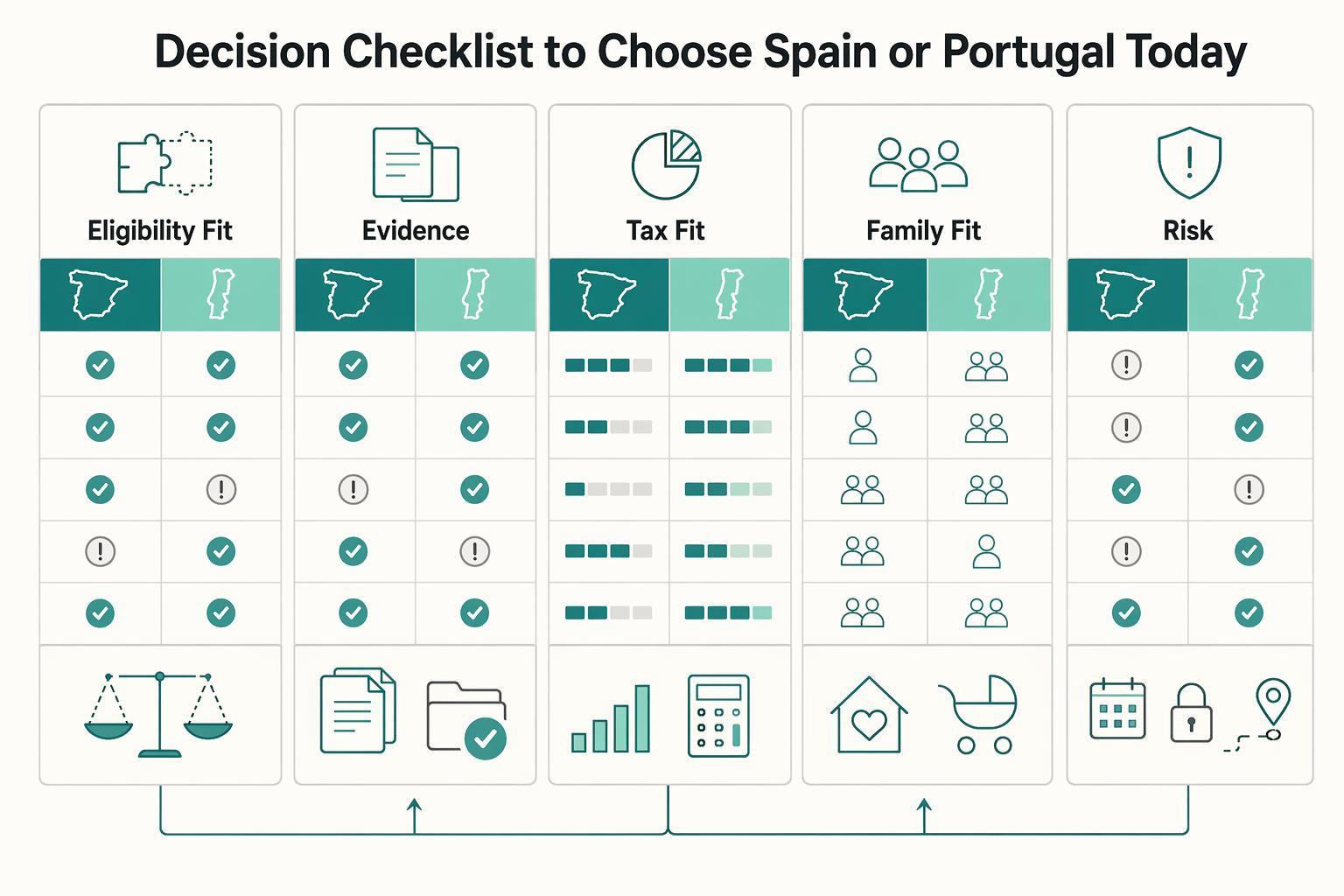
Quick Answer
Choose the route you can prove with fewer unknowns: in the spain vs portugal digital nomad visa decision, neither option is universally easier. The article recommends a two-pass approach: select a provisional country from eligibility fit and document quality, then verify unresolved items on income treatment, family inclusion, minimum stay, and submission path before filing. If one evidence pack is stronger now, proceed there instead of switching late.
Spain vs Portugal digital nomad visa in one sitting#
Choose the country where your case is easiest to prove and where the fewest details are still unclear. When you weigh Spain against Portugal for a digital nomad visa, both options can look similar at first, and there is no single best option for everyone. The better outcome usually depends on your situation and on how clearly you can evidence income, family inclusion, minimum stay, and process.
As of 10 March 2026, public comparison material still describes Spain and Portugal as close alternatives with practical differences in income framing, minimum-stay expectations, and filing steps. Spain Digital Nomad Visa guidance is often paired with the Spain Teleworking Visa label, launched in 2023. One transcript cites 2,762 Euro per month before taxes as a reference point.
Use that as rough screening context, not as a final filing rule.
| Decision lever | What is known now | What to verify before filing |
|---|---|---|
| Baseline fit | Spain and Portugal are often described as similar options for remote workers. | How rules are applied in your exact filing route. |
| Income | One transcript cites Spain at 2,762 Euro per month before taxes. | How your income maps across both routes on a consistent basis. |
| Eligibility | Eligibility is a core comparison category in public guides. | Whether your profile could trigger extra checks or clarifications. |
| Family inclusion | Family inclusion is consistently listed as a key factor. | Required supporting documents for your household. |
| Minimum stay | Minimum stay is repeatedly framed as a meaningful difference area. | Exact day-count expectations for your route. |
| Process | Application process is a stated comparison category. | Appointment timing and document requirements for your route. |
| Tax and long-term planning | Tax implications and long-term outcomes are central comparison themes. | Which outcomes are most likely for your income mix and timeline. |
Use a simple two-pass method:
- Pick a provisional country based on what is already clear in your file.
- Run a targeted verification pass on unresolved items before booking final steps.
By the end of this guide, you should have:
- One country choice tied to eligibility fit, tax exposure, family inclusion, and renewal considerations.
- A filing timeline that separates blockers from tasks that can run in parallel.
- A checklist split into ready now versus needs verification, so assumptions do not slip into your submission.
The common mistake is choosing on headline income alone and filing before you close unresolved items. Close the unknowns early and you reduce avoidable delays later.
If you want a deeper dive, read Portugal Digital Nomad (D8) Visa: A Complete Guide.
At-a-glance comparison table you can use in 10 minutes#
Use this as a triage table, not a filing instruction set. You are trying to pick the path with fewer unresolved items in your own file before you spend time on appointments, translations, or legalization.
| Criteria | Spain Digital Nomad Visa / Spain Teleworking Visa | Portugal D8 Visa / Portugal Digital Nomad Visa | What to do with this |
|---|---|---|---|
| Core eligibility shape | Public comparisons describe both routes as broadly similar for remote workers, with practical requirement differences. | Public comparisons describe both routes as broadly similar for remote workers, with practical requirement differences. | Known Match your profile first, then optimize for tax and lifestyle. |
| Income framing in excerpts | Public guides include minimum-income examples. | Public guides include minimum-income examples. | Unclear Recalculate on one consistent basis before comparing. |
| Validity and renewals | Validity is a stated comparison factor in current guides. | Validity is a stated comparison factor in current guides. | Needs verification Prepare renewal evidence from day one. |
| Family inclusion | Family inclusion is explicitly listed as a comparison factor, but mechanics are partial in excerpts. | Family inclusion is explicitly listed as a comparison factor, but mechanics are partial in excerpts. | Needs verification Confirm spouse and dependent requirements before filing. |
| Application speed claim | Excerpts do not establish Spain as universally easier or faster. | Excerpts do not establish Portugal as universally easier or faster. | Unclear Treat speed as case-specific until your document set is tested. |
| Tax angle | Beckham Law appears in tax framing, and one table describes a 6-year treatment window. | IFICI, often labeled NHR 2.0, appears in tax framing, and one table describes a 10-year access window. | Known Run a personalized tax model before final choice. |
| Long-term pathway | Long-term settlement outcomes are not fully resolved. | Long-term settlement outcomes are not fully resolved. | Needs verification Decide early whether your target is short stay or settlement. |
| Confidence level | Several details remain partial across excerpts. | Several details remain partial across excerpts. | Known Keep a known-versus-unknown log and close gaps before submission. |
As of 10 March 2026, comparison content still leaves key items open, so confidence comes from your verification trail, not from any single summary.
Run one 10-minute pass before booking anything:
- Mark each row as ready now, blocked, or pending confirmation.
- Assign one proof item to each row, such as income records, family documents, or tax assumptions.
- Set a deadline for each pending item before any time-sensitive step.
Approximate guide figures, including around $2,500 per month for Spain and around $3,500 per month for Portugal, are useful for rough screening only. If your timeline is tight, prioritize the country where your evidence pack is strongest today, not the one with the stronger marketing claim.
Eligibility fit by applicant type before you waste time on paperwork#
Pick the route where your profile is easiest to document cleanly from day one. The fastest way to lose time is collecting documents before you lock your applicant category.
| Applicant profile | Spain digital nomad visa likely friction | Portugal digital nomad route likely friction | Practical first move |
|---|---|---|---|
| Remote employee | Spain-focused guidance flags employee-versus-freelancer rules and visa-versus-residence authorization as common confusion points. | Portugal is framed as a remote-work route for non-EU and non-EEA citizens, but you need the right track early. | Lock your profile category first, then collect only matching evidence. |
| Freelancer | File consistency is a common risk: role labels, contracts, and payment records should align. | Documentable income quality can matter as much as stated earnings. | Build a month-by-month income trail before forms. |
| Business owner | Classification can blur when you are both owner and service provider. | Delaying the choice between temporary-stay and residency paths can create rework. | Choose the route first, then tailor documents to that route only. |
For Spain, the recurring friction is category clarity and paperwork quality, not a clearly settled degree-or-experience rule. The practical standard is consistency across forms and evidence. Saying you qualify is different from proving it in a file that is easy to review.
For Portugal, one comparison describes two routes. In one excerpt, the first is a temporary-stay route up to 1 year, and the second is a residency route with a 4-month initial validity used to apply for a 2-year residence permit. The same source set also includes a 1-to-5-year residence range claim, so treat duration assumptions as unresolved until you verify your exact path.
Use this checkpoint before you commit:
- Keep one profile label across forms, contracts, and supporting letters.
- Prove income with consistent records, not summary statements.
- Confirm the Portugal route before collecting validity or renewal paperwork.
Decision rule: if your file is cleaner and easier to document under a Portugal route, test Portugal first. If your employee-or-freelancer category and visa-versus-residence path are clearer to evidence for Spain, test Spain first. In both cases, confirm current rules on official immigration pages before submission.
You might also find this useful: How to Incorporate a Business in Canada as a Freelancer.
Income, family inclusion, and minimum-stay math without guesswork#
This is where rough comparisons break down fast. Treat income, family add-ons, and minimum-stay details as unresolved until you verify them in current official guidance. Not every filing detail is settled here in one place.
| Worksheet item | Detail |
|---|---|
| Applicant monthly income | Basis used: gross or net |
| Spouse included | yes or no, and condition for inclusion |
| Dependents | Number of dependents |
| Dependent add-on | Per person, placeholder until verified |
| Total required monthly amount | After household scaling |
| Supporting documents for each line | List what you have and what is still needed |
| Input to confirm before filing | Spain Digital Nomad Visa | Portugal D8 Visa | Current status |
|---|---|---|---|
| Income threshold amount | Not consistently settled across available excerpts | Not consistently settled across available excerpts | Needs verification |
| Threshold basis, gross or net | Not fully confirmed in available excerpts | Not fully confirmed in available excerpts | Needs verification |
| Spouse and dependent add-ons | Not fully specified in available excerpts | Not fully specified in available excerpts | Needs verification |
| Minimum-stay requirement | Confirm with the relevant authority | Confirm with the relevant authority | Needs verification |
| Visitor stay versus residency | Visitor permission is not the same as residency status | Visitor permission is not the same as residency status | Known |
| Policy stability | Policies can change quietly | Policies can change quietly | Known |
Comparison risk to avoid: align income basis and household assumptions before comparing headline amounts. If you do not, the math can look correct and still fail in review.
If you prefer a checklist, complete the same family-inclusion worksheet before choosing a route:
- Applicant monthly income and basis used,
grossornet. - Spouse included,
yesorno, and condition for inclusion. - Number of dependents.
- Dependent add-on per person, placeholder until verified.
- Total required monthly amount after household scaling.
- Supporting documents for each line, listing what you have and what is still needed.
Minimum-stay checkpoint list:
- Spain Digital Nomad Visa required presence threshold, verify.
- Spain day-count method, verify.
- Portugal D8 required presence threshold, verify.
- Whether different visa tracks use different presence logic, verify.
- Whether paid online work under visitor entry may trigger separate local rules before residency is active, verify.
Failure mode to prevent: comparing headline income only, skipping family scaling, and assuming stay rules are identical. Keep unresolved items visible until confirmed so you do not discover issues late.
Tax reality check with NHR and Beckham Law#
Visa approval is not a tax outcome. Treat NHR and Beckham Law as tax-planning decision points, and keep the visa decision separate from the tax decision.
A Spain Digital Nomad Visa or Portugal D8 Visa approval does not confirm your final tax position. Before you commit, verify your residency trigger date, reporting duties, and treatment of each income type in your case.
| Tax due-diligence item | Spain check, Beckham Law context | Portugal check, NHR context | Why this matters |
|---|---|---|---|
| Residency trigger | Confirm the exact date tax residency starts for your case. | Confirm the exact date tax residency starts for your route and move date. | Timing changes which tax year and income fall into scope. |
| Foreign-source income treatment | Do not infer treatment from visa approval; confirm applicable regime rules. | Available summaries describe replacement of the original NHR by a narrower route often labeled NHR 2.0 or IFICI; verify your eligibility under current rules. | Remote income treatment drives net outcome. |
| Social contributions | Check whether your setup creates local contribution exposure and from which date. | Check whether your setup creates local contribution exposure and from which date. | Contribution costs can materially change take-home income. |
| Treaty interaction | Confirm how treaty relief is claimed and which records are required. | Confirm how treaty relief is claimed and which records are required. | Incorrect filing can delay or block relief. |
| Compliance burden | Confirm filing cadence, recordkeeping, and payroll implications. | Confirm filing cadence, recordkeeping, and payroll implications. | Admin load affects cost and error risk in year one. |
One video description claims a Spain tax treatment and rate structure: non-resident treatment with 24% up to 600,000 EUR and 47% above. Treat that as a verification prompt, not a filing rule. Complete primary legal text or full regime mechanics aren't provided here.
Do not assume:
- Visa approval and tax treatment are the same decision.
- NHR still applies in its original form without checking current replacement criteria.
- A video rate claim is official without primary confirmation.
- One payroll or contractor setup will be treated the same in Spain and Portugal.
If you cannot document your residency trigger date, foreign-income treatment, and social-contribution position in writing before filing, pause and verify before choosing a country.
Relocation timeline from decision day to arrival#
Choose the route with stronger document readiness, not the louder speed claim. You want the country where critical-path documents are mostly ready by your T-90 planning checkpoint. Late switching can create more delay than fixing one weak document stream.
Most timelines break into pre-submission prep and post-submission processing. Across digital nomad visas, total timelines can range from a few weeks to several months, and processing examples can vary from about one week to six months depending on application volume and holiday schedules. Most avoidable delays happen before you submit, when documents are incomplete, inconsistent, or not ready for acceptance.
Use T-90/T-60/T-30 as a planning structure, not legal deadlines.
| Phase | Spain Digital Nomad Visa | Portugal D8 Visa | Parallel tasks | Blocking tasks | Verification checkpoint |
|---|---|---|---|---|---|
| T-90 | Open your document tracker, request a background check, and confirm passport validity for your move window. | Same setup: tracker, background check request, passport validity check. | Planning tasks that do not depend on final filing readiness. | Background check not requested or passport issue unresolved. | Request receipts saved and passport validity confirmed. |
| T-60 | Build proof-of-income and identity files; start any required country-specific document steps. | Build the same core file set and start any required country-specific document steps. | Insurance comparison and appointment monitoring. | Missing income evidence or required document steps not started. | Every file marked ready, in progress, or blocked. |
| T-30 | Run a full consistency check across names, dates, and addresses in forms and supporting files. | Run the same consistency check and close mismatches. | Move logistics that can shift without penalty. | Any mismatch across passport, forms, or supporting documents. | One clean packet with matching identity and date details. |
| Filing week | Submit only when the packet is complete; keep copies of all submissions and confirmations. | Same rule: complete packet first, then file. | Prepare responses for follow-up document requests. | Missing signed items, unresolved document requirements, or unclear insurance proof. | Submission checklist complete and insurance proof valid for destination and intended start period. |
| Pre-departure | Keep documents current and accessible until entry; avoid locking non-refundable plans too early. | Keep the same flexibility until approval timing is clear. | Final arrival planning that can still move by date. | Non-refundable commitments based on optimistic timelines. | Income and identity details remain consistent across your supporting documents. |
If one route has a single weak stream, fix it. If both are half built, finish one lane instead of switching late.
Want a quick next step on this decision? Try the digital nomad visa cheatsheet.
Document checklist that actually prevents rejections#
File only when each document is legally usable, not simply uploaded. Build one shared evidence pack for both routes, then confirm country- and filing-post-specific requirements before you submit.
| Audit check | What to confirm |
|---|---|
| Legal names | Match exactly across all files, including punctuation and middle names |
| Dates | Check consistency across letters, contracts, payments, and document validity |
| Addresses and issuing entities | Confirm they match in forms and attachments |
| Legalization evidence | Verify it is attached where required for each non-local official record |
| Funds trail | Reconcile so records align cleanly |
| Item status | Mark each item ready, blocked, or replace, and submit only when all are ready |
| Evidence item | Shared pack for Spain and Portugal | Spain Teleworking Visa check | Portugal D8 Visa check | Proof quality standard | Potential delay trigger |
|---|---|---|---|---|---|
| Work relationship evidence (if part of your filing) | Include current signed documents that identify the same person and legal entities across the file. | Confirm current translation and legalization expectations with your filing post before submission. | Confirm current translation and legalization expectations with your filing post before submission. | Signed, dated, complete, and consistent with the rest of the packet. | Name, entity, or date mismatch across documents. |
| Income continuity evidence (if requested) | Keep a clean month-by-month sequence of income records and matching credits. | Keep the sequence ready for possible follow-up requests. | Keep the same sequence ready for possible follow-up requests. | Each record is traceable and internally consistent. | Gaps or untraceable entries in the timeline. |
| Identity and official records | Passport and official records used in the application. | For UK-issued official documents, verify apostille and legalization steps before filing. | Verify the accepted legalization route for your issuing country before filing. | Documents valid for the filing window, with legalization attached when applicable. | Missing legalization evidence or expired documents. |
For UK official records, an apostille is a certificate attached by the FCDO to confirm a document is genuine for use abroad. Practical guidance also flags missing apostille certification as a common rejection driver, so treat legalization as an early gate, not a finishing touch.
Run this audit in one sitting before submission:
- Match legal names exactly across all files, including punctuation and middle names.
- Check date consistency across letters, contracts, payments, and document validity.
- Confirm addresses and issuing entities match in forms and attachments.
- Verify legalization evidence is attached where required for each non-local official record.
- Reconcile the funds trail so records align cleanly.
- Mark each item
ready,blocked, orreplace, and submit only when all areready.
Submission, processing, and the delays competitors skip#
Choose the route with fewer unresolved steps in your own case and a timeline your move can absorb. Published timelines are planning inputs, not promises.
| Decision point | Spain Digital Nomad Visa | Portugal Digital Nomad Visa, Portugal D8 Visa | Practical impact |
|---|---|---|---|
| Filing channel | Consulate or in-country UGE. | Consulate plus AIMA appointment in Portugal. | Portugal includes an extra post-consulate stage. |
| Processing signal | 16-20 business days through UGE, up to 3 months through consulate. | 45-60 days through consulate, then 6-12+ months for AIMA residence permit. | Build your plan around the branch you are most likely to use. |
| Pre-application gate | No equivalent pre-filing gate is listed in this comparison. | NIF plus Portuguese bank account required before applying. | If NIF or bank setup is incomplete, delays can start before submission. |
Use this quick screen before deciding:
- Will you file through UGE in-country or through a consulate?
- If Portugal, are your NIF and Portuguese bank account complete?
- Are your documents complete and internally consistent before submission?
- Can you respond quickly if a follow-up request arrives?
- Can your move plan absorb a second appointment stage after consular processing?
In this comparison, the main delay risks are unfinished pre-application steps and added stages after consular processing. Each extra handoff can increase follow-up risk and stretch timelines.
If processing slips, move to contingency mode early:
- Keep housing flexible until key milestones are confirmed.
- Keep travel changeable and avoid date-locked commitments.
- Align with your employer on a range of possible start dates.
- Keep a correction-ready packet so follow-ups can be answered quickly.
First 30 days after approval and entry#
Treat the first 30 days as evidence setup, not admin cleanup. In both Spain and Portugal, renewal-focused records are described as centering on proof of income, private health insurance, and clean records, so start building that trail immediately.
| First-month focus | Spain Digital Nomad Visa | Portugal D8 Visa | What to retain for renewals and Permanent Residency |
|---|---|---|---|
| Local registration | If local registration applies to your case, start it and save each submission confirmation. Spain is described as more digitized in one comparison, so keep portal receipts and timestamps. | If local registration applies to your case, keep appointment confirmations; Portugal is described as more in-person in that same comparison. | Confirmation receipts, appointment records, and stamped acknowledgments. |
| Tax-position file | Keep one dated file with arrival context, work status, contract status, and income basis used in your case records. | Keep the same dated file from entry onward. | One timeline log linking residency timeline, work status, and tax assumptions. |
| Income and contract trail | Store contracts, amendments, invoices or payroll records, and matching bank credits in monthly order. | Store the same monthly chain, with payer names aligned to contract entities. | Month-by-month payment trail traceable to a contract or invoice record. |
| Insurance and record continuity | Keep active policy proof and post-entry updates. | Keep active policy proof and post-entry updates ready for checks. | Current insurance documents and updated clean-record evidence if later requested. |
| Permit timeline control | Save approval notice and permit metadata as the controlling timeline for your case. | Do the same and flag timeline ambiguity early. | One master timeline note for renewal planning and document requests. |
A practical caution for Portugal: published comparisons are not fully consistent on D8 timeline framing. One describes a 4-month entry period leading to a 2-year permit renewable for 3 years, while another describes one-year visa length with extension. Use your own approval documents as the operational timeline for your file.
Use this records checklist during the first month:
- Create one folder per month for contracts, invoices or payroll, and matching bank credits.
- Reconcile legal names across contracts, payer names, and account statements.
- Save proof of active private health insurance with visible start and end dates.
- Keep each registration or appointment confirmation (if applicable) as PDF and screenshot.
- Maintain a dated change log when contract terms, address, or work arrangement change.
- Export a quarterly evidence bundle so renewal prep stays incremental.
Where supported, Gruv can reduce reconciliation friction with compliant invoicing, payout tracking, and exportable records that map cleanly to your evidence pack.
Renewals and long-term path to permanent residency or citizenship#
Run this phase on two tracks: keep your current status valid and build a clean record for later settlement. That means separating short-term maintenance from long-term permanent-residency and citizenship goals in both countries.
| Quarterly item | What to keep or track |
|---|---|
| Physical presence log | Keep entry and exit dates |
| Tax filings | Archive tax filings and confirmations by filing year |
| Monthly income proof | Maintain contracts, invoices or payroll records, and matching bank credits |
| Private health insurance | Store active private health insurance proof with visible coverage dates |
| Compliance history | Preserve renewals, registrations, and official correspondence |
| Language preparation | If citizenship is a goal, track language-prep evidence early, since one comparison references A2 Portuguese versus A2 Spanish plus a cultural exam |
| Planning layer | Portugal D8 Visa | Spain Digital Nomad Visa | What to do now |
|---|---|---|---|
| Initial validity and renewal cadence | Described as a 4-month entry period, then a 2-year residence permit, renewable for 3 years. | Described as 1-3 years initially, then renewable for 2 years at a time. | Save every approval and renewal notice as timeline anchors. |
| Renewal baseline evidence | Proof of income, private health insurance, and clean records. | Proof of income, private health insurance, and clean records. | Keep one rolling evidence file and update monthly. |
| Process handling style | Often described as more in-person paperwork. | Often described as more digitized handling. | Keep digital copies plus appointment confirmations. |
| Permanent Residency signal | One table shows eligibility after 5 years. | One table shows eligibility after 5 years. | Track continuity of lawful stay and compliance from day one. |
| Citizenship timeline signal | One table shows 5 years, with possible increase to 10. | One table shows 10 years, with exceptions. | Treat this as legal verification before action. |
The citizenship timeline row is useful for planning, but not enough for a final decision by itself. If naturalization timing is your tie-breaker, verify the current legal position for your profile before acting.
Use this renewal-readiness checklist each quarter:
- Keep a physical presence log with entry and exit dates.
- Archive tax filings and confirmations by filing year.
- Maintain monthly income proof, contracts, invoices or payroll records, and matching bank credits.
- Store active private health insurance proof with visible coverage dates.
- Preserve a clean compliance history file with renewals, registrations, and official correspondence.
- If citizenship is a goal, track language-prep evidence early, since one comparison references A2 Portuguese versus A2 Spanish plus a cultural exam.
The tradeoff is practical and direct. Short-term flexibility can weaken long-term settlement evidence if presence and compliance records are inconsistent.
Decision checklist to choose Spain or Portugal today#
Choose the country you can file cleanly now, unless long-term settlement is your top priority. Use one weighted scorecard across the same eight factors for both routes, and decide from resolved evidence, not momentum.
| Factor | Weight | Spain check today | Portugal check today | Score rule (1-5) |
|---|---|---|---|---|
| Eligibility fit | 15% | Role, contract type, and core profile evidence are coherent | Role, contract type, and core profile evidence are coherent | 5 if no gaps, 3 if one gap, 1 if major mismatch |
| Document readiness | 20% | Submission file is complete and internally consistent | Submission file is complete and internally consistent | 5 if ready to file now, 1 if key items are missing |
| Tax fit | 15% | Personal tax model is documented with assumptions | Personal tax model is documented with assumptions | 5 if assumptions are written and reviewed, 1 if still guesswork |
| Family fit | 10% | Dependent evidence and timing impacts are mapped | Dependent evidence and timing impacts are mapped | 5 if family impacts are verified, 1 if unknown |
| Timeline risk | 15% | Processing path and delay tolerance are realistic | Processing path and delay tolerance are realistic | 5 if delays are absorbable, 1 if one delay breaks the plan |
| Renewal confidence | 10% | Evidence habits support continuity; one source-level Spain summary lists an initial period up to 12 months and possible extension up to 5 years | Evidence habits support continuity under your route | 5 if monthly records are already disciplined, 1 if records are ad hoc |
| Settlement goal | 10% | Long-term residency and citizenship pathway requirements are verified for your profile | Long-term residency and citizenship pathway requirements are verified for your profile | 5 if verified from current official guidance, 1 if based on forum summaries |
| Lifestyle preference | 5% | Daily living setup supports your work output | Daily living setup supports your work output | 5 if tested against real constraints, 1 if purely aspirational |
Use two scenario rules. For fast execution, prioritize the higher combined score from document readiness + timeline risk + eligibility fit, then file where the record is complete now. For long-term settlement, prioritize verified long-term residency and citizenship pathway requirements for your profile, then confirm your renewal evidence plan can run without gaps.
Final checkpoint before submission:
- Mark each factor as
known,unclear, orunknown. - Resolve every
unknownwith current official guidance for the Spain or Portugal route. - If
document readinessorsettlement goalis below3, pause and close gaps before filing.
The best next step before you file#
Do one full pre-submission audit before you book anything, and treat every unresolved claim as risk rather than fact. Use the table below as a pass/fail check.
| Pre-filing gate | Spain route | Portugal route | Pass standard |
|---|---|---|---|
| Route definition | Spain Digital Nomad Visa is described as active in January 2026 under the Startup Act framework. | Portugal Digital Nomad Visa is described with temporary-stay and long-term residence pathways. | Pick one route and remove documents that belong to the other path. |
| Income checkpoint | One guide cites about €2,850-€2,860 monthly, 200% of SMI, but that still needs filing-week confirmation. | One final amount for all applicants is not set here. | Confirm the current official figure and hold matching proof from the same period. |
| Timing expectations | Typically 15-45 days, useful for planning but not guaranteed. | Faster processing is often claimed, but not universal. | Build timeline buffer and avoid non-refundable commitments based on best-case speed. |
| Long-term outcomes | Long-term residency and citizenship outcomes need legal verification for your profile. | Same caution applies. | Separate what is confirmed now from what still needs legal confirmation. |
If core items are still unresolved, wait to book. To reduce filing mistakes, avoid treating summary claims about speed or outcomes as settled facts.
Run the audit in this order:
- Lock one route first, then remove conflicting forms so your file tells one story.
- Build one evidence pack with a consistent timeline across contracts, income records, and identity documents.
- Track unresolved points, including tax outcomes, processing speed, and long-term status, with an owner and deadline.
- Use checklists or quizzes as prompts only, then replace each prompt with a currently verified requirement.
- Do a final consistency pass on names, numbers, and validity dates before booking.
Late switching can create avoidable friction. Starting one file and then pivoting after new claims appear can create duplicate paperwork and conflicting dates. If contradictions remain after the audit, delay filing and fix them first.
Keep operations clean from day one by storing monthly financial records and compliance evidence in one place. Renewals can depend on what you can prove later, so build a dated trail now instead of rebuilding under deadline. For adjacent tax planning context, see Tax Guide for Digital Nomads in Thailand.
Frequently Asked Questions
Which is easier, the Spain Digital Nomad Visa or the Portugal D8 Visa?
Neither is universally easier. Available comparisons describe Portugal renewals as simpler, while Spain is often described as more digitized but stricter on documentation and tax requirements. In practice, choose the route where your evidence is complete and your filing path is realistic for your timeline.
What income is required for Spain vs Portugal digital nomad visa applications?
Current comparison material does not settle one final threshold for every route and profile. Treat required amount, currency basis, and acceptable proof as filing-week checks against current official guidance. Match that requirement to income documents you can verify cleanly.
Can freelancers and employees both apply for the Spain Teleworking Visa and Portugal Digital Nomad Visa?
Available comparison material frames both as remote-work visa pathways, but freelancer-versus-employee criteria are not fully resolved in the summary material used here. Confirm your exact profile before filing. If your income structure is mixed, verify eligibility first and then build documents around that confirmed path.
How long can you stay on each visa, and how do renewals work in practice?
Portugal D8 is described as a 4-month entry period, then a 2-year residence permit renewable for 3 more years. Spain is described as 1 to 3 years initially, then renewals in 2-year increments. For renewals, both are described as requiring proof of income, private health insurance, and clean records.
Is Spain or Portugal better for long-term permanent residency and citizenship planning?
Both are described as visa paths that can lead to residency, and some comparison material states a permanent-residency application point after 5 years. Citizenship timing is less settled in the same comparisons: Portugal is shown as 5 years with a possible move to 10, while Spain is shown as 10 years with exceptions. Treat citizenship timelines as legal-verification items for your nationality and case details.
What documents cause the biggest delays in Spain and Portugal applications?
Recurring risk areas are income evidence, private health insurance evidence, and clean-record documentation. Spain is often described as stricter on documentation and tax-related checks, while Portugal is often described as relying more on in-person paperwork. A pre-submission consistency check across names, dates, and validity periods can help reduce avoidable delays.
How should I compare NHR vs Beckham Law without making tax planning mistakes?
Treat this as a tax-planning decision, not a shortcut for visa approval. Available summaries do not provide full mechanics for either regime, so avoid commitments based on headline comparisons alone. Separate visa timing from tax-election timing, then verify both under current rules before acting.
Try a related tool
Researched and edited by the Gruv editorial team. Gruv builds cross-border billing, payouts, and finance-operations software for global businesses.
Sources
Includes 5 external sources outside the trusted-domain allowlist.
- alibaba.com/product-insights/digital-nomad-visa-portugal...external
- bakerandco.ae/spain-vs-portugal-digital-nomad-visat-2026external
- globalcitizensolutions.com/spain-vs-portugal-digital-nomad-visaexternal
- nextnation.co/blog/comparison-spain-vs-portugal-digital-no...external
- nomadsembassy.com/spain-vs-portugal-digital-nomad-visaexternal
Educational content only. Not legal, tax, or financial advice.
Related Posts

Portugal Digital Nomad Visa Decisions That Prevent D8 Delays
Start with verification, not paperwork. In this research set, some material is useful only as EU VAT context, not as D8 instruction, and mixing those categories is one of the fastest ways to build the wrong plan. We use the same separation rule in [Global Digital Nomad Visa Index](/blog/global-digital-nomad-visa-index) comparisons.

Thailand Tax for Digital Nomads Without Residency Mistakes
The most expensive mistakes here happen before anyone opens a tax return. People pick a visa, assume the tax answer comes with it, then try to rebuild the year from scraps after the fact. By then, the damage is usually not one dramatic error. It is a pile of small gaps: an unverified day count, a transfer with no clear purpose note, invoices that do not line up cleanly with payments, and assumptions nobody wrote down when the facts were still fresh.
How to Incorporate a Business in Canada as a Freelancer
If you are deciding whether to incorporate in Canada as a freelancer, make one call first: stay a **Sole proprietorship** for now or move to a **Corporation** now. Decide that before you file anything. It helps keep your tax setup, entity records, and filing steps aligned and reduces rework once contracts and invoicing start.