
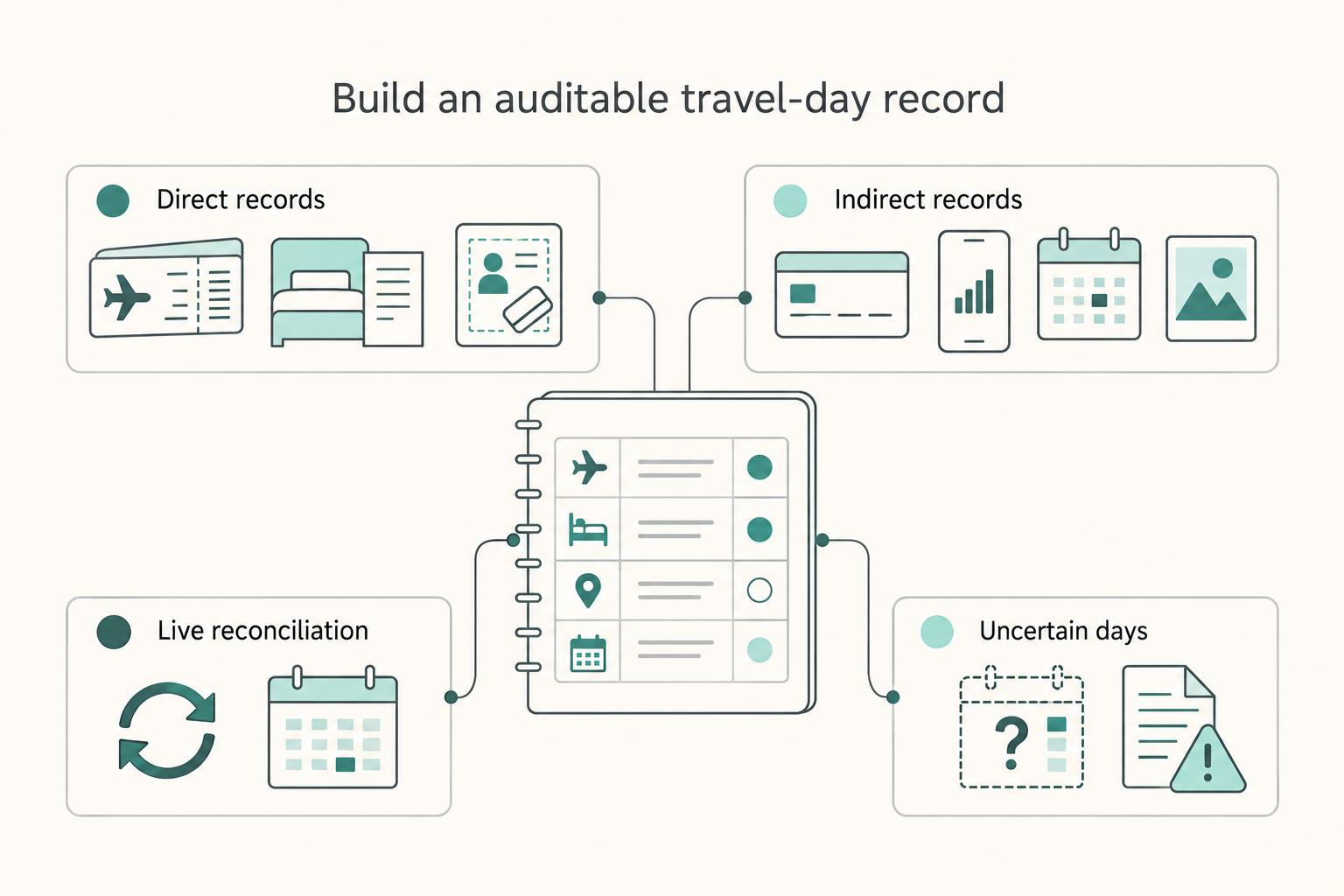
Quick Answer
Start by making a documented residency call now, not during filing season. For spain tax residency, day count is only one input; your economic center, family pattern, and cross-border conflicts also matter. Keep a dated memo, a reconciled calendar-year presence ledger, and supporting records in one file. If two countries could both claim you, move to treaty review early and document why your position is consistent before any return is prepared.
Start Here Before You Trigger Spain Tax Residency by Accident#
Decide early, while the facts are still clean. Once you hit a year where Spain could plausibly challenge your position, it gets much harder to rebuild a consistent story from old emails, half-complete calendars, and missing receipts.
Start with a simple framing: resident-style treatment vs non-resident-style treatment. These are different lanes with different filing and proof expectations. If you pick a provisional lane early, even if you label it uncertain, it becomes much easier to stay consistent as the year develops. The Shakira case is a public reminder that residency questions can become high-stakes and fact-intensive: ABAD Abogados notes she settled with Spanish prosecutors on November 20, 2023, and reports €7.3 million in fines on top of €14.5 million in previously unpaid taxes.
Early-warning signals that you might be drifting into a residency problem#
This is not a legal test list. It's a practical watch panel so you notice risk early enough to react while the evidence is still easy to capture.
| Signal | What to watch | Why it matters |
|---|---|---|
| Days in Spain | Trending toward "183-day rule" territory | Treat the year as live until you reconcile your count |
| Home and accommodation availability | Long bookings, a lease, or a place that's consistently available | Can make your situation look more anchored than your travel narrative |
| Where work is actually performed and managed | Where you physically do client work and where the business is run from | Tends to matter when residency is disputed |
| Family or household location | Where the household actually lives day-to-day | Can become relevant when your travel pattern is ambiguous |
ABAD Abogados calls the 183-day rule "a cornerstone of Spanish tax law," which is why your day trend deserves close attention.
If you want the day-count deep dive, read 183-Day Rule Explained: Stop the Tax Myths Before They Cost You. If you're also sorting immigration logistics, keep that thread separate and see Spain Digital Nomad Visa: Income Requirements and Application Process. Just don't assume an immigration answer settles your tax position.
Operator rule for "uncertain years" and conflicting ties#
When you might drift into 183-day-rule territory, treat the year as uncertain until you reconcile it. In practice, that means you avoid locking yourself into a position through filings, forms, or a "final" narrative before your day count and fact pattern line up.
If your ties point in different directions, open treaty-interaction analysis before you file rather than forcing a clean answer out of messy facts. Skybound Wealth flags "Treaty Interaction During Exit" and emphasizes "The Exit Year Is Critical," which is a useful mental model anytime your year looks like an entry/exit/split-life situation.
Recordkeeping that's worth doing before you "need" it#
A defensible file is less about a magic document list and more about building a timestamped record you can explain later without scrambling.
- Dated residency position memo: one page stating "resident / non-resident / uncertain" and the facts you relied on as of that date. If it changes mid-year, keep both memos and note what changed.
- Presence ledger inputs: keep the raw items that support your travel narrative, including transport confirmations, lodging invoices, and the records you used to reconstruct your calendar. Reconcile periodically, not at filing time.
- Work-location proof: contracts, invoices, and a simple work calendar showing where work was performed, not just where the client is.
- One folder with version history:
/Tax/Spain/YYYY/Residency/with subfolders forPresence,Home,Work,Family, andCorrespondence.
A common failure mode is the "informal exit." Skybound Wealth calls "Informal Exit" "The Most Common Risk," and also warns that "Physical Departure Is Not Administrative Closure." Even if you leave Spain, you want your paperwork trail and filings to tell the same story as your travel, because administrative alignment matters.
Build the Right Mental Model First#
This is a facts question first, especially around your presence and economic connections. Start there, because residence in Spain for tax purposes implies being taxed in Spain on worldwide income, and tax residents are required to file a Spanish income tax return.
A simple three-layer model you can reuse#
-
Residency indicators (what drives the answer): "Habitual residence" is described as the first and most relevant factor, and for natural persons it is determined by presence in Spanish territory for more than 183 days during the calendar year. Another major axis in the provided summaries is whether your main economic interests are in Spain.
-
Tax consequences (why the call matters): if you are tax resident, you're in worldwide-income territory and into resident-style filing expectations.
-
Execution and paperwork (what comes after): filings and admin paperwork should match, and be supported by, the position you can defend from layers 1 and 2. Immigration and lifestyle planning still matter, but they do not answer the tax-residency question on their own (see Spain Digital Nomad Visa: Income Requirements and Application Process and treat the Barcelona digital nomad guide for 2026 as lifestyle context, not tax authority).
Day-count takeaway (without making this the day-count section)#
Presence is a primary input, and the threshold you keep seeing is more than 183 days in the calendar year. Also note the wrinkle around "sporadic absences," which can trip up casual spreadsheet math. If your year is anywhere near the line, read /blog/183-day-rule-explained and treat your count as a live variable until reconciled.
Quick operator checklist (tag strong, weak, missing)#
Write one sentence for each bucket, tag it, and note what could still change before year-end:
- Presence ledger: your day count for the calendar year and what you used to reconstruct it, including what is missing.
- Sporadic absences note: where they appear in your timeline so you do not accidentally treat them as "days out" without thinking.
- Main economic interests: a plain-English statement of where your main economic interests are, plus the core documents that support that story.
- Resident vs non-resident memo: a dated one-pager stating your provisional position and the facts you relied on as of that date.
- Admin items (supporting context): visas, registrations, and other paperwork that may help corroborate your timeline, without assuming they settle the residency question.
If your presence story and your "main economic interests" story do not line up cleanly, label the year uncertain and get help before you file. The failure mode is waiting until return prep, then discovering your evidence is thin or contradictory.
Use This Decision Sequence in Order#
The highest-value move here is procedural: make the status call first, then let everything else follow. That keeps your filings, registrations, and evidence pack aligned instead of forcing you to improvise at return time.
Step 1: Presence first (because it's the cleanest fact pattern to verify)#
Start with physical presence because it is usually the easiest fact to prove or disprove. The 183-day concept shows up constantly, but the useful operator framing is "necessary but not sufficient." Treat your day count as the spine of your file, then build the rest of your facts around it.
Keep one dated presence ledger for the whole year you are analyzing, and store independent evidence alongside it as you go. The practical checkpoint is reconciliation: if a travel app says one thing and your tickets, emails, or calendar say another, your "truth" is the reconciled story, not the app total. If you are anywhere near the line, do not force certainty early. Tag the year "uncertain" until your evidence is complete. Companion explainer: /blog/183-day-rule-explained.
Also, do not treat "silence from Spain" as proof your position is accepted. Silence does not build a defensible file.
Step 2: Economic substance second (because freelancers accidentally contradict themselves)#
Next, pressure-test where your economic life is actually anchored. A useful framing here is "Centre of Vital Interests," described as "The Substantive Test." For a freelancer, this is where admin reality can quietly pull your story toward Spain or away from it, even when your travel is messy.
Stay practical: keep dated records showing how and where the business actually ran during the year, not where you felt based. If your actions imply one country while your filings imply another, fix the mismatch now, on paper, before it becomes a return-prep surprise.
Step 3: Family and living pattern last (because it can override your "nomad" narrative)#
Finally, check household facts and living pattern. The source flags "Family Presumption" as an "Overlooked Factor," and the operator takeaway is simple: family and routine can make a year look far more settled than your flight history suggests.
Do not rely on impressions like "we traveled a lot." Capture stable signals about where your household operated from and what recurring routines looked like during the year. And keep perspective: registration does not control residency, so do not build your whole position on "we registered" or "we didn't register." Your file should show what happened, not just what you told an office.
If two countries could reasonably claim you: open the treaty track before you file#
Dual residency is a real scenario: "when both countries consider you resident." In that situation, do not guess. Pull the relevant double tax treaty for the two countries involved and follow its tie-breaker structure as written, mapping each factor to dated evidence in your file before you choose a filing position.
Decision rules (use these to close the loop)#
| What your facts look like | What you do next | What you write down |
|---|---|---|
| One test strongly points to Spain | Hold Spain as your working position while you keep documenting | A dated conclusion memo plus the key evidence you relied on |
| Signals are mixed and another country also has a plausible claim | Open the treaty track now, before drafting returns | A factor-by-factor evidence map tied to dates |
| You can't support a coherent narrative yet | Mark the year "uncertain" and escalate for help | A short list of missing facts/documents and who will produce them |
Once you have reached a working position, keep it current. Update your memo whenever a big fact changes: a long stay, a move, a household shift, or a major change in how the business is run. If you are relocating under a visa, treat that as the next, separate implementation step after the decision, not the decision itself: Spain Digital Nomad Visa: Income Requirements and Application Process.
Count Days Like an Auditor Would#
Treat your day count as a control you may need to defend later, not a vibe check. For Spain, the clean anchored fact is the calendar-year 183-day test: staying longer than 183 days in Spanish territory. The practical move is to decide up front how you will handle edge cases so you are not renegotiating your rules at filing time.
Count like Spain will (conservative rule set)#
Use two conservative principles:
-
If you're physically in Spain, assume the day counts. A secondary summary also describes partial days as typically counting as a full day, so treat arrival and departure dates conservatively if any portion happens in Spain.
-
If you're outside Spain, don't assume the day "doesn't count." For determining permanence under the 183-day criterion, "occasional absences" are included unless you can accredit residency in another country. A secondary summary describes this even more aggressively, with days outside Spain counted unless you can prove tax residency elsewhere. The operator takeaway is the same: track absences cleanly and be ready to support what you are claiming.
Does this day count? (how to log it and avoid future arguments)#
This table is not a statement of Spain's official edge-case rules. It's a defensible ledger method that keeps you consistent.
| Scenario | What to record in your ledger | Safe default for your control file |
|---|---|---|
| Any day you're physically in Spain | Location (city/address) + timestamps you can support | Count it |
| Entry/exit day (arrive or depart) | Entry/exit point + timestamps + ticket reference | Count it and note it's a partial day |
| Travel within Spain | City-to-city movement + where you slept | Count it |
| Airport/port transit where Spain might argue presence | What happened (stayed airside vs. entered) + timestamps | Flag it; if unsure, count it |
| Days outside Spain that might be treated as "occasional absences" | Destination + reason + what you have to accredit other residency (if any) | Flag for review; don't assume it helps you |
Build an audit-ready presence file#
Keep one single source of truth day ledger, then attach evidence as you go.
- Direct records (strongest when you have them): travel tickets and itineraries, accommodation bookings and invoices, and any border- or boarding-related records you already receive.
- Indirect records (useful when direct records are missing): card transactions, mobile roaming logs, calendar entries, and other digital traces. One secondary source describes presence reconstruction hinging on indirect evidence like credit card payments and even social media posts.
Operationally: store originals, such as PDFs and emails, and add a short, dated reconciliation note whenever your ledger does not match what an app, calendar, or inbox thread suggests.
Decision rules for mobile freelancers#
Reconcile early. While the year is still moving, gaps are easy to fix. At year-end, they turn into guesswork.
- Reconcile as you go, not at year-end. The failure mode is "I'll fix it later" turning into guessing.
- If a day is uncertain, count it and flag it. Do not force a non-resident story; escalate to the treaty or tie-breaker path in "Handle Dual Residence Without Guessing."
- Read next: 183-Day Rule Explained: Stop the Tax Myths Before They Cost You.
Test Economic and Family Ties Before You Assume You Are Non-Resident#
Day count is necessary, not sufficient. Even if your ledger (from Count Days Like an Auditor Would) keeps you under 183 days, a non-resident position becomes a prove-it claim if either your center of economic interests points to Spain or the spouse/dependent minor children presumption points to Spain.
The summaries describe Spanish law as having three tests for tax residency, and meeting just one can be enough to make you tax resident in Spain, with the compliance risk that implies.
Economic ties (what to assess, and what to save)#
If you do not meet the 183-day test, Spain's analysis is described as looking for the "main nucleus" of your economic interests and comparing your ties in Spain against your ties in one other country. It also gives more weight to active interests, meaning ongoing activity, than to passive, mobile wealth.
| Economic factor | What to save | Notes |
|---|---|---|
| Where your revenue comes from | Invoices and an export you can sort by country | Even anonymized client IDs |
| Where you physically do the work | Tie projects to your day ledger with a simple monthly summary | Where your work is actually anchored |
| Where agreements are negotiated and signed | Signed contracts and the negotiation thread | Email/messages you already have |
| Where you run the business from | Dated notes showing where you set pricing, approve work, hire subcontractors, etc. | Day-to-day decisions |
| Where money flows | Bank statements and processor payout reports | Show where payments are received |
| Any fixed workspace commitments | Leases/memberships and invoices | If you maintain a steady base |
Use that as a pressure test, not an official list. You are not trying to predict what an inspector feels. You are building a file that explains, cleanly and consistently, where your work is actually anchored.
Operator detail that pays off later: keep a short, dated "business anchor memo" whenever your facts change, or on a cadence you can actually stick to, summarizing your current position and attaching a handful of documents that support it. The failure mode is trying to reverse-engineer your story from a messy trail of travel and payments.
Family and household patterns (signals that can override "but I travel")#
Spain also has a presumption tied to where your non-legally separated spouse and/or dependent minor children reside. That presumption is described as shifting the burden onto you to demonstrate your tax home is elsewhere, so do not minimize it.
Signals to review, with records you can usually pull together:
- Where your spouse and dependent minor children actually live: a dated timeline that matches travel and housing records.
- School and medical ties: enrollment and letters, plus appointment documentation you already receive.
- Long-term housing availability: leases, renewals, utilities, move-in and move-out documents.
Signals → risk level → safe default action#
| Signals you need to take seriously | Risk level | Safe default action |
|---|---|---|
| You're under 183 days, but your spouse and/or dependent minor children reside in Spain | High | Treat "non-resident" as a prove-it position; start a structured evidence pack showing your tax home elsewhere (a foreign tax residence certificate, if you can obtain one, is described as a powerful shield) |
| You're under 183 days, but your economic story is Spain-heavy (ongoing work activity based there) | Medium-High | Assume scrutiny; tighten your business narrative and document the one other country you're anchored to, if that's your claim |
| You can prove tax residence elsewhere and your travel file is clean | Medium | Keep the certificate and travel proofs together; avoid gaps that create "presumed days" exposure |
| Economic indicators point outside Spain, but household indicators point to Spain (or vice versa) | High | Don't "average" ties; treat this as a dual-country risk case and escalate before filing positions harden |
When indicators conflict, assume you are in an elevated-risk bucket. That is when you stop guessing and move into the treaty or tie-breaker path in: Handle Dual Residence Without Guessing.
Recheck triggers worth calendaring: household move, new major client, new long-term housing commitment, spouse/children relocation, change in where decisions are made.
Handle Dual Residence Without Guessing#
When Spain's domestic tests and another country's tests can both plausibly apply to you, treat it as dual-residence risk and go treaty-first before you draft a return position. The failure mode is locking in a "resident vs non-resident" story early, then realizing your own facts can support the other country too and you now need to unwind filings.
Any treaty case (use this workflow)#
Build a working set of primary documents for the specific country pair you are dealing with. Do not rely on blog summaries or memory, and do not mix versions across years.
- Double Tax Treaty text for the two countries
- Protocol(s) that amend the treaty, if any
- Official explanations or guidance where available, because some countries publish technical explanations or similar materials
US-Spain is a concrete example because the IRS hosts a clean document set. On the IRS "Spain tax treaty documents" page (last reviewed/updated 19-Sep-2025), you can pull the 1990 "Income Tax Treaty" PDF, the 1990 "Technical Explanation" PDF, the 2013 protocol amending the convention (signed in Madrid on February 22 1990, per the protocol title), and the 2014 technical explanation of that protocol. Keep one dated copy set and use that same set across your analysis and any preparer handoff.
Tie-breakers allocate treaty residence (don't treat them as automatic filing outcomes)#
Treaty tie-breaker language allocates residence for treaty purposes. It may not automatically change each country's domestic-law resident logic or filing mechanics, so do not assume "the treaty makes me non-resident" and move on.
Your don't-guess checkpoint:
- Confirm which treaty article/paragraph you are relying on for residence, based on the text in your working set.
- Confirm whether the treaty contains other rules you need to account for, based on that same text.
If you cannot point to the exact text you are applying, you are not done.
Build a defensible file before you pick a side#
Use a two-country comparison table to force clarity on the facts that get disputed in real life. Treat it as an evidence index so you can see what you have, what is missing, and what needs re-verification before you file.
| Disputed fact to pin down | Country A evidence | Country B evidence | Source doc stored? | Last verified date | Open issue to resolve |
|---|---|---|---|---|---|
| Home availability (is a home actually available to you, and when?) | Lease/title, move-in/out docs, utility start/stop | Lease/title, move-in/out docs, utility start/stop | Yes/No | YYYY-MM-DD | Is either home continuously available during the year? |
| Where work is directed/managed (day-to-day decisions) | Dated decision notes, contract signature trail, calendar + travel | Same | Yes/No | YYYY-MM-DD | Do your actions match where you claim management happens? |
| Where close family actually lives (not intentions) | Timeline + school/medical letters, housing records | Same | Yes/No | YYYY-MM-DD | Any periods where family location conflicts with your narrative? |
| Year-wide presence pattern (not just totals) | Reconciled day ledger + travel proofs | Reconciled day ledger + travel proofs | Yes/No | YYYY-MM-DD | Are there gaps you can't explain cleanly? |
If you are still fuzzy on presence mechanics, go back to Count Days Like an Auditor Would and sanity-check your approach against the myths in 183-Day Rule Explained: Stop the Tax Myths Before They Cost You. Dual-residence cases fall apart when the "simple" parts, especially days and housing availability, are undocumented.
Dual-residence recordkeeping checklist#
Keep this pack tight, dated, and internally consistent:
- A dated residency-position memo stating what you believe, what you are unsure about, and what would change your conclusion.
- A reconciled day-count ledger for both countries using the same inputs and the same method, plus travel proofs for gaps.
- Housing availability proof such as leases, renewals, utility bills, and termination letters.
- Contract/client location and invoicing trail that supports your work-and-income story.
- Banking/insurance/medical ties you can document without scrambling.
- A consistency checklist of what must match across filings: addresses used, residency claims, treaty references, and supporting statements.
If your file is heading toward unresolved conflicts, use Red Flags That Mean Talk to a Professional Now as your escalation trigger rather than forcing a fragile position.
Do the Compliance Steps That Keep Future Stress Low#
You reduce future stress by doing things in the right order: make your status call first, then make your admin and documentation match that story. The common failure mode is operating like a non-resident, in contracts, invoicing, and withholding assumptions, then realizing your facts point toward resident treatment and you are stuck explaining a year of mismatches.
Treat this as an execution order you can repeat each year:
-
Choose a provisional resident vs non-resident position, or "uncertain, treaty likely."
-
Align your day-to-day admin to that position so you are not creating contradictory signals.
-
Run a recurring evidence review so you are not reconstructing the year from memory at filing time.
That "status first, admin second" framing matters because residency questions rarely turn on one perfect document. They usually come down to whether your story stays consistent across presence, work, money flows, and where your life is actually anchored.
Turn your position into an evidence-backed file#
Use this as a working control sheet. It keeps you out of form-number rabbit holes while staying specific about what you are trying to prove and what to save while it is easy.
| Decision / action | What you're trying to prove | What to save (practical, not fancy) |
|---|---|---|
| Day-count position (whatever your method is) | Your actual presence pattern over the year, not just a total | A dated day ledger plus backups for gaps: travel bookings, transport receipts, border/air/train confirmations, accommodation invoices, utility start/stop emails if relevant |
| "Center of economic interests" position | Where your work is directed from and where your income is actually tied | Client contracts/SOWs, invoices, proof of delivery (email headers, project timestamps, repository activity), meeting calendar exports, payment statements showing payer country where available |
| Household and primary-home position | Where a home is available to you and where close ties actually sit | Lease/title docs, move-in/out docs, renewals/termination letters, insurance/medical/school letters where relevant, a simple dated timeline of where family members lived |
| Treaty-claim position (if dual-residence risk) | That your treaty story matches the treaty concepts and your facts | The treaty document set you used (treaty + protocol(s) + official explanations if available), residency certificates where applicable, foreign tax paid proof, a narrative memo mapping your facts to tie-breaker concepts |
Two operator notes that save pain later: (1) date everything and file it by tax year, and (2) don't "clean up" inconsistencies by deleting evidence. If you have a messy month, document it and explain it.
A defensible recordkeeping checklist for mobile freelancers#
This is not about collecting a specific pack because Spain demands it. It is about giving your future self, or your preparer, what they need to support a coherent story without improvising.
- Presence proof (day-count ledger + backups)
Keep one ledger, a spreadsheet is fine, as the single record. Back it with travel bookings, transport receipts, accommodation proof, and a short note for any day that looks ambiguous: same-day flights, last-minute reroutes, or extended stays with friends where there is no invoice.
- Work-location proof (what you did, where you did it)
Save signed contracts and SOWs, invoices, and deliverables metadata. "Metadata" can be as simple as exported email headers, dated handoff emails, version history screenshots, or calendar exports showing where you were when key work decisions happened.
- Income-source mapping (Spain vs non-Spain)
Create a simple list of clients and revenue streams and mark where the client is based and where the work was performed, as you understand it. Keep bank or payment processor statements that let you trace invoices to cash, because "I think I earned it abroad" is not evidence.
- Tie evidence (home, family, long stays)
If you have a primary home, keep the documents that show it was actually available to you during the periods you claim. If family location matters to your story, keep a dated timeline and 2 to 3 strong documents that corroborate it rather than a pile of weak signals.
Compliance hygiene that reduces future stress#
The goal is to make your file boring. Boring files survive scrutiny.
Keep a single "source of truth" folder, one per tax year, and store: (a) your day ledger, (b) a periodic snapshot memo, for example monthly or quarterly, and (c) the evidence packs referenced in the memo. Reconcile your day ledger against your calendar and receipts on that same cadence, because reconciliation is much harder once emails expire and apps lose history. At year-end, write one dated snapshot: your provisional status conclusion, what changed during the year (move, new long client, partner/kids relocating), and what would flip your conclusion.
Also retain proof of tax payments and withholding as you go, even if you think you are overpaying or will claim relief later. When you sell property, missing annual items can surface at the worst time: IberianTax notes that buyers or their lawyers will carry out due diligence, that the sale may be delayed until debts are cleared, and that Spanish authorities can place a lien on properties with unpaid taxes. If you own Spanish property, track recurring obligations like IBI (the annual local property tax based on cadastral value) and remember that even a non-rented property can be treated as generating "imputed income."
Treaty-ready file for dual-residence risk#
If Spain indicators and another country's indicators both look credible, pack your treaty file before filing season, not during it. Pre-pack the treaty text and any protocol(s) you are relying on, your residency certificate(s) where applicable (for the US, the IRS has a process titled "United States Certification for Reduced Tax Rates in Tax Treaty Countries" and references Form 8802 as an application for US residency certification), and proof of foreign tax paid if you expect relief.
Your "pause and escalate" trigger is simple: if your presence pattern points one way but your economic or household facts point another, stop trying to force a clean self-serve answer. The U.S. Senate materials on the U.S.-Spain Protocol explicitly mention protections against "treaty shopping" and provisions to ensure exchange of information between tax authorities, another reason to keep your narrative tight and document-backed.
If you need a reality check on day-count myths that create bad files, keep this bookmarked: 183-Day Rule Explained: Stop the Tax Myths Before They Cost You. If your legal stay or immigration admin is still in motion, read the Spain Digital Nomad Visa: Income Requirements and Application Process as well, because those steps tend to create, or destroy, the very documents you later rely on.
Red Flags That Mean Talk to a Professional Now#
If your position only works if everything breaks your way, stop and get advice before you file. The blow-ups for mobile freelancers are usually not exotic treaty theory. They are messy day evidence, real dual residence, Spain-source assumptions that do not match where you actually worked, and inconsistent filings across countries that create a paper trail you cannot defend later.
60-second decision rule#
Escalate now, not after you draft returns, if any of these are true:
| Red flag | What it looks like | Why escalate |
|---|---|---|
| Your days don't reconcile | You can't tie your day ledger to real evidence by year-end, or you're counting "sporadic absences" out without proof of foreign tax residence | Sporadic absences count unless you prove residence elsewhere, and each day counts in full |
| Your indicators conflict | Your days point non-resident, but your center of economic interests or family facts point resident | Spain treats residency as an all-year classification |
| You need a treaty tie-breaker | You can plausibly be resident in two states under domestic rules | You need treaty analysis instead of guesswork |
| Your source/PE story is shaky | You performed the work from Spain but are treating the income as non-Spain-source because the client is abroad, or you're unsure about permanent establishment exposure | If a treaty applies, the PE article can control, so guessing is risky |
| Your filings don't match across countries | You filed Spain as non-resident while living and working mostly in Spain, or you claim non-resident while your spouse and dependent minor children are habitually in Spain | Inconsistent filings across countries create a paper trail you can't defend later |
| Certificates or authorities collide | You have conflicting residency certificates, or you receive any notice or information request from a tax authority | Escalate now, not after you draft returns |
A few deserve special care:
- Your days don't reconcile. You can't tie your day ledger to real evidence by year-end, or you're counting "sporadic absences" out but can't back that up with proof of foreign tax residence. AEAT's position is that sporadic absences count unless you prove residence elsewhere, and each day counts in full with no minimum-hour rule.
- Your indicators conflict. Your days point non-resident, but your center of economic interests or family facts point resident. Spain also treats residency as an all-year classification, which makes mid-year "I changed later" stories harder to defend.
- Your source/PE story is shaky. You performed the work from Spain but are treating the income as non-Spain-source because the client is abroad, or you're unsure whether your setup creates permanent establishment exposure. If a treaty applies, the PE article can control, so guessing is risky.
- Certificates or authorities collide. You have, or are applying for, conflicting residency certificates such as an AEAT certificate versus a U.S. Form 6166 request, or you receive any notice or information request from a tax authority.
Next steps if you are stuck on mechanics: re-check Count Days Like an Auditor Would, and if you are in a two-country situation, go to Handle Dual Residence Without Guessing.
Bring this to your adviser#
- Dated day ledger + reconciliation notes for gaps and any "presumed days" issues
- Contracts/SOWs, invoices, and a note on where you performed the work by project
- Lease/title and "home available" evidence, with dates
- Family location facts and a dated timeline
- Bank/payment processor statements tied to invoices rather than just totals, plus key registrations
- A one-page residency position memo stating assumptions, what could flip the conclusion, and open questions
For U.S. cases, pull the treaty document set from the IRS "Spain tax treaty documents" page, including the treaty text and technical explanations plus the protocol and its technical explanation, and verify the current set before relying on summaries. If you're leaning on the 183-day simplification, re-read 183-Day Rule Explained: Stop the Tax Myths Before They Cost You and then re-check your file like an auditor would.
Make the Residency Call Early and Document It#
Make your residency position an operating decision you set, follow, and revisit, not a year-end guess you reverse-engineer from memory. Spain's approach is built on objective criteria, and Spain treats you as resident or non-resident for the entire calendar year, so "we'll see later" usually turns into messy reconstruction and inconsistent stories.
Use three provisional statuses and behave accordingly#
When your year is in motion, you need a status you can run the business on. Use these three buckets and write down which one you are in today, based on the facts you can actually evidence.
| Provisional status | When it fits | Safe-default behavior until next review |
|---|---|---|
| Resident (provisional) | Your facts clearly point to Spain (for example, you are already over 183 days, or your main core/base of activities or economic interests is in Spain) | Act as if you may be taxed in Spain on worldwide income (subject to treaty provisions). Focus on complete records and consistency across jurisdictions, rather than trying to undo residency later. |
| Non-resident (provisional) | You are clearly below the day threshold, your business and personal base are outside Spain, and you can support where you are tax resident when you are not in Spain | Avoid aggressive claims that rely on thin facts. Keep a tight day ledger and a ready-to-produce file showing why Spain is not your center of life or business. |
| Uncertain | You are near 183 days, your travel is fragmented, your spouse/minor children are in Spain, or your work footprint is shifting toward Spain | Don't make treaty claims, certificate requests, or "definitely non-resident" statements you can't defend. Reduce uncertainty fast: tighten evidence, clarify your base, and set a date for the next decision point. |
Cadence that works in practice: do a quick check monthly if you're mobile, and do a full review any time your facts change in a way that could move you across the tests: travel, contracts, home base, or family base. If you only do one deep check, do it before you start drafting returns, or telling any bank, payer, or adviser a definitive story.
One reminder that prevents a lot of category errors: administrative residence is not the same as tax residence. Spain's own guidance is explicit that you can have residence permission in a state and still not be considered tax resident there. If you're using a visa pathway, keep that separation clean in your notes and paperwork: Spain Digital Nomad Visa: Income Requirements and Application Process.
Day counting: write it like you expect to prove it#
For the day test, Spain's rule is more than 183 days during the calendar year, and the Tax Agency's commentary on day counting emphasizes objective criteria over intent. The TEAC summary the Tax Agency highlights also underlines what your ledger must reflect: days do not need to be consecutive, and once a day is counted, it's counted in its entirety with no minimum hours.
Build your day log auditor-style from the start:
- Be consistent all year. If you make judgment calls, for example how you treat travel days, write your method down and apply it the same way all year.
- Reconcile to objective proofs as you go, monthly is plenty, using third-party timestamps you did not create after the fact.
- Flag weak weeks immediately instead of filling gaps later from memory.
Sporadic absences are the other trap: Spain's guidance is that sporadic absences are taken into account unless you prove your tax residence in another country. If your calendar has lots of short exits, your day story is only as strong as your "where I was resident when I wasn't in Spain" proof. For a deeper walkthrough, use this: 183-Day Rule Explained: Stop the Tax Myths Before They Cost You.
Turn your decision memo into a reusable template#
The memo is the control. It's what you can hand to your future self, your accountant, or an auditor to show you made a reasonable call based on what was knowable at the time.
Use this structure and keep it to 1 to 2 pages:
- Conclusion and date: "As of YYYY-MM-DD, provisional status = resident / non-resident / uncertain."
- Facts relied on: presence summary (days so far, how counted), home base(s), where work is performed and where decisions are made, and family situation (spouse/minor children location if relevant).
- Facts that could flip the result: crossing 183 days, shifting your core economic activity to Spain, changing your home base, family relocation, or inability to prove tax residence elsewhere during absences.
- Actions and controls until next review: what you will track weekly, what you won't claim yet, what documents you will collect, and the next review date.
- One-paragraph "consistent story" summary: plain-English wording you can reuse across filings, bank onboarding, and visa paperwork so you do not accidentally create contradictions.
Failure mode to watch for: one story to Spain, a different story to your other country, and a third story to a bank. In dual-country years, inconsistency is often what turns a manageable situation into a dispute.
If two countries can claim you, outline your memo like a treaty tie-breaker#
Spain acknowledges that dual residence can happen when two states apply their internal rules, and its guidance is to consult the relevant treaty if one exists. Organize your memo and evidence file under the usual "in general" tie-breaker headings:
- Permanent home: documents that show where you have a home available to you, and from when.
- Centre of vital interests (closest personal/economic ties): where you actually manage work, where key clients are, and where your personal life is anchored.
- Habitual abode: your day ledger plus reconciled proof set.
- Nationality: passport evidence, if it becomes relevant under the specific treaty.
- Mutual agreement: a folder for correspondence and documents if authorities have to resolve it.
Keep certificate thinking realistic: Spain's guidance treats a tax-residence certificate from another state as the way to evidence non-residence, and it notes a one-year validity period for those certificates in that context. Escalate to a professional before drafting returns, making treaty claims, or requesting certificates if your memo stays "uncertain" after a review cycle.
For mobile freelancers, a practical minimum evidence pack, examples rather than an exhaustive list, is: a locked day ledger, travel and accommodation records, third-party time-stamped proofs that corroborate where you were, client contracts/invoices, business registration/management indicators, and family ties documentation where applicable, plus a checklist for any tax-residence certificate materials you may need to obtain.
Frequently Asked Questions
When am I considered a tax resident in Spain?
You are treated as resident if you meet at least one legal criterion. Common triggers are spending more than 183 days in a calendar year, having Spain as your main base of economic interests, or having a spouse and underage dependent children who permanently reside there. If none apply, you are generally treated as non-resident for Spanish tax purposes.
Does the 183-day rule include temporary or sporadic absences?
Temporary absences are generally included in the day count. The main exception is when you can prove tax residence in another country.
Can I be tax resident in Spain and another country at the same time?
Yes. Dual residence can happen. When it does, the relevant DTT should determine treaty residence priority, usually through factors such as permanent home, centre of vital interests, habitual dwelling, and nationality.
Is there part-year tax residency in Spain?
For individuals, Spain does not apply part-year tax residency. The resident or non-resident position applies for the entire tax year.
What happens if my spouse and children live in Spain but I travel constantly?
That pattern can trigger a presumption of residence. Constant travel alone does not automatically neutralize it. If your indicators point to more than one country, review treaty position before filing.
Do I need an NIE or Padron to be treated as a tax resident?
Based on the criteria above, tax residence is determined by legal tests (such as day count, centre of economic interests, and family-residence presumption), not by a single administrative step on its own.
When should I request professional treaty advice instead of self-filing?
Ask for advice when you may be dual resident, or when treaty tie-breaker factors are needed to determine residence (for example, permanent home, centre of vital interests, habitual dwelling, and nationality).
Try a related tool
Researched and edited by the Gruv editorial team. Gruv builds cross-border billing, payouts, and finance-operations software for global businesses.
Sources
Includes 1 external source outside the trusted-domain allowlist.
Educational content only. Not legal, tax, or financial advice.
Related Posts

Spain Digital Nomad Visa Guide: Requirements, Application & 2026 Updates
Stop collecting more PDFs. The lower-risk move is to lock your route, keep one control sheet, validate each evidence lane in order, and finish with a strict consistency check. If you cannot explain your file on one page, the pack is still too loose.
Barcelona, Spain: Digital Nomad Guide (2026)
**Use this guide to make one decision early: are you taking a short stay in Barcelona, or are you actually relocating?** That choice sets your legal pathway, paperwork timeline, housing options, and tax posture. Treat this as an operating plan, not vibes, and you will move faster by making fewer guesses.

183-Day Rule Tax Myths That Trigger Residency Filing Mistakes
If you are a mobile freelancer or consultant, start here: the "183 day rule tax" idea is not a single universal test. It is a shortcut phrase people use for different residency rules that do not ask the same question. If you mix federal and non-federal residency logic, you can create filing risk even when your travel calendar looks clean.