
Quick Answer
Choose Spain’s Article 93 route when your priority is flexibility and asset exposure tied to Spain, and choose Italy’s impatriati route when your upside is mostly Italian-produced work income and you can hold Italian tax residence for four years. For beckham law vs lavoratorio impatriati, decide from three modeled buckets: local earnings, foreign investment flows, and year-end assets, then verify entry filings before relocation.
--- If you are choosing between Madrid and Milan, do not treat it as a lifestyle tie-breaker. This is a balance-sheet decision. Spain and Italy both offer special tax regimes, and both can work well, but the outcome depends on more than a headline rate. The right answer turns on your income mix, asset location, move timeline, and how much flexibility you need if plans change.
This guide is built for that fuller analysis. We move past surface comparisons and use a three-phase framework to pressure-test each option against the realities of running a business-of-one.
Phase 1: Modeling Your Full Financial Picture#
Start with this assumption: headline income-tax comparisons are not enough. Between Spain and Italy, your result usually turns on four variables: how your income is classified, where your assets are located, whether you expect investment disposals, and how certain you are about your move timeline. Build the model item by item, not as one blended rate.
Compare the items that actually move your result#
| Modeling item | Spain Article 93 special regime | Italy impatriati regime from tax period 2024 |
|---|---|---|
| Local earned income | You remain an IRPF taxpayer but may elect Non-Resident Income Tax rules under Article 93. The AEAT 2025 manual table lists 24% up to €600,000 and 47% above €600,000.01; confirm current rates in official tax-authority or advisor records before use. | Relief applies to specified Italy-produced employment-like and self-employment income. Only 50% is included in taxable income, up to a €600,000 annual cap. Current ordinary rate application must be verified from official tax-authority or advisor records before use. |
| Foreign-source income | Do not assume all non-Spanish income is exempt. Treatment depends on source, category, and Article 93 treatment for that item. Verify the current rule and any exception. | The benefit is for specified Italy-produced income. Foreign-source and non-qualifying items need separate resident-tax analysis. Verify the current rule and any exception. |
| Foreign asset exposure | For wealth tax, Article 93 taxpayers are on a real-obligation basis, so exposure is tied to assets in Spain rather than a full worldwide base. Verify asset situs, valuation rules, and current exemption mechanics. | Model foreign-asset exposure separately under current Italian resident rules. Do not assume the earned-income benefit resolves this. Verify the current rule and any exception. |
| Investment gains | Spain's special-regime tables separately reference dividends, interest, and gains from asset transfers. Do not treat all gains the same without checking source and category. Current rates for each category must be verified from official tax-authority or advisor records before use. | The published 50% inclusion benefit is for qualifying Italy-produced work income. Model investment income and gains separately under current law and treaty position. Verify the current rule and any exception. |
Build your own model before choosing#
Do this before you trust any spreadsheet. Map your facts from the last 12 months and the next 24 months you can reasonably foresee. Most modeling mistakes come from wrong labels, not hard math.
| Model area | Items to map |
|---|---|
| Income mix | local client work, foreign client work, payroll, dividends, interest, royalties, one-off bonus, exit payments |
| Asset location | brokerage, bank accounts, property, equity grants, and where each asset or right is legally located or exercisable |
| Expected disposals | planned stock, crypto, property, or business sales during regime years |
| Family and legacy exposure | spouse or partner, children, planned gifts, shared ownership, trusts, cross-border property |
Use the table as a working checklist, and label each item before you compare rates.
Wealth tax and foreign assets need a separate pass#
Keep this separate from the earned-income analysis.
| Review point | Spain | Italy |
|---|---|---|
| Scope | Article 93 wealth-tax exposure is framed on a real-obligation basis, meaning assets in Spain. | Run a separate foreign-asset review. |
| Main verification focus | Verify current valuation rules and whether each asset is considered located, exercisable, or enforceable in Spanish territory. | The post-2024 impatriati materials focus on temporary relief for qualifying work income, not blanket treatment for all non-Italian assets. |
| Specific reminder | AEAT also states a €700,000 minimum exemption for non-residents subject to real obligation, so verify how that applies in your case. | Mark uncertain items as "Verify current rule and exception." |
For Spain, Article 93 wealth-tax exposure is framed on a real-obligation basis, meaning assets in Spain. AEAT also states a €700,000 minimum exemption for non-residents subject to real obligation, so verify how that applies in your case. You still need to check current valuation rules and whether each asset is considered located, exercisable, or enforceable in Spanish territory.
For Italy, run a separate foreign-asset review. The post-2024 impatriati materials focus on temporary relief for qualifying work income, not blanket treatment for all non-Italian assets. Mark uncertain items as "Verify current rule and exception."
Commitment risk changes the math#
Do not treat time commitment as a footnote. It can change the whole result.
Spain's Article 93 runs for the relocation tax year plus five following tax periods. Italy's post-2024 regime requires at least four years of Italian tax residence. If you do not meet that condition, benefits are lost and prior relief is recovered with interest.
Check entry conditions just as carefully. Italy generally requires three prior tax periods of non-residence, and in some same-employer or same-group scenarios the required foreign permanence can be six or seven tax periods.
Legacy exposure and when to escalate#
Do not make inheritance or gift decisions from a comparison article. These outcomes depend on residency status, asset situs, family structure, and current law.
Escalate to a licensed cross-border advisor before you choose if you have children or a non-married partner. Do the same if you have planned gifts, foreign real estate, company shares, trusts, or a likely business sale during the regime period.
You might also find this useful: Tax Residency in Italy: A Guide for Freelancers and Nomads.
Phase 2: Assessing the Hidden Risks#
Once you have the model, test whether you can qualify cleanly, maintain the position cleanly, and exit cleanly. If your move timing, client mix, or employer setup might change, treat Italy as the higher-proof, higher-commitment route until your documentation is complete.
Failure points and safeguards#
| Regime | Common failure point | Practical safeguard |
|---|---|---|
| Spain | You rely on outdated summaries and miss a timing or eligibility step. | Verify the current filing window and qualification test from official tax-authority or advisor records before any move step that starts the clock. |
| Italy | You assume payroll handling means your position is compliant. | Build your own evidence file because employer verification of declaration content is not guaranteed. |
| Italy | You submit the declaration without proof for each condition. | Keep a full file tied to the Dichiarazione regime impatriati 2024: qualification basis, non-residence history, and why your work is mainly performed in Italy for the relevant tax period. |
| Italy | You choose a visa or work model that conflicts with your operating plan. | If using Visto per Lavoratori da Remoto, verify fit early if you plan to serve Italian companies or clients. |
In Italy, validate these qualification checks before relocation:
- At least 3 years of no Italian tax residency before the move.
- Commitment to at least 4 consecutive years of Italian tax residence.
- High-level qualifications or specialization under Legislative Decrees No. 108/2012 and No. 206/2007.
- A new Italian employment relationship that generally is not with the same foreign employer or same group.
- If you are a returning Italian not registered with AIRE, proof of foreign fiscal residency for the prior three years under treaty context.
Early-exit guardrail (commitment-risk mindset)#
Use this as a hard filter. If there is a real chance you will leave Italy, restructure, or lose Italian tax residence before year four, treat the Italian route as higher risk and do not choose it on first-year tax math alone.
Keep documentation ready from day one: employment contract, group structure chart if relevant, qualification records, prior tax residency proof, payroll records, and a dated qualification memo. If your case turns on same-group facts, AIRE status, mixed remote work, or visa limits on Italian clients, get independent legal review before moving.
Transition planning after the regime ends#
The benefit period is only part of the decision. Model the first full year after it ends before you commit.
| Transition item | What to do now |
|---|---|
| Income scope | Model your first full year after expiry, not only benefit years. |
| Asset reporting | Build an inventory of foreign accounts, brokers, property, and ownership records. |
| Operational admin burden | Budget advisor time, filing workload, and document retention from the start. |
Quick pre-move risk checklist
- Confirm eligibility evidence before relocation, not after payroll starts.
- Track all filing and residency deadlines in one calendar, including items still marked for verification.
- Keep residency intent consistent across visa, lease, payroll, and tax records.
- Define an exit scenario now: reviewer, required records, and response plan if you leave earlier than expected.
If you want a deeper dive, read the digital nomad tax guide. Before you pick a regime, map your travel pattern, residency ties, and filing steps in the Tax Residency Tracker.
Phase 3: Integrating Your Business Structure#
After tax modeling and risk review, pressure-test your operating setup. The real question is whether your current structure can run compliantly on day one without rebuilding contracts, payroll, or filings after you arrive. If you operate through a foreign LLC or Ltd, Spain often offers a clearer administrative sequence. Italy can still work, but only if your visa category, income type, and tax-regime evidence line up from the start.
Match your operating model before you move#
If you are an employee of your own foreign company, Spain gives you named administrative steps: the teletrabajo de carácter internacional route for residence and work, and the Art. 93 IRPF option handled through Modelo 149 within 6 months of activity start, with Modelo 151 used for the regime return. That is a clearer process, not automatic approval.
| Profile | Spain | Italy |
|---|---|---|
| Employee of your own foreign company | the teletrabajo de carácter internacional route for residence and work; the Art. 93 IRPF option handled through Modelo 149 within 6 months of activity start; Modelo 151 used for the regime return | the impatriati regime, from 2024, is a tax regime, not an immigration status; it can apply to employment-type, employee-equivalent, and qualifying professional self-employment income produced in Italy; digital-nomad or remote-worker visas also allow the employer or client to be based in Italy or abroad |
| Contractor | the regime excludes income treated as earned through a Spanish PE, so your delivery model and decision-making footprint matter immediately | covered income is limited to 50% of eligible amounts up to 600,000 euro annually, so do not assume company-level profits or mixed compensation streams are automatically included |
| Founder-operator | confirm that your facts fit current eligibility boundaries for entrepreneurs and professionals | same-employer or same-group history can push prior non-residence requirements from 3 prior tax periods to 6 or 7 tax periods |
Italy's impatriati regime, from 2024, is a tax regime, not an immigration status. It can apply to employment-type, employee-equivalent, and qualifying professional self-employment income produced in Italy. Consular guidance for digital-nomad or remote-worker visas also allows the employer or client to be based in Italy or abroad. You still need to confirm category-level fit before filing.
For contractors, the key issue is factual alignment, not whether the entity is foreign. In Spain, the regime excludes income treated as earned through a Spanish PE, so your delivery model and decision-making footprint matter immediately. In Italy, covered income is limited to 50% of eligible amounts up to 600,000 euro annually, so do not assume company-level profits or mixed compensation streams are automatically included.
Founder-operators need the strictest pre-move review in both countries. In Spain, confirm that your facts fit current eligibility boundaries for entrepreneurs and professionals. In Italy, same-employer or same-group history can push prior non-residence requirements from 3 prior tax periods to 6 or 7 tax periods.
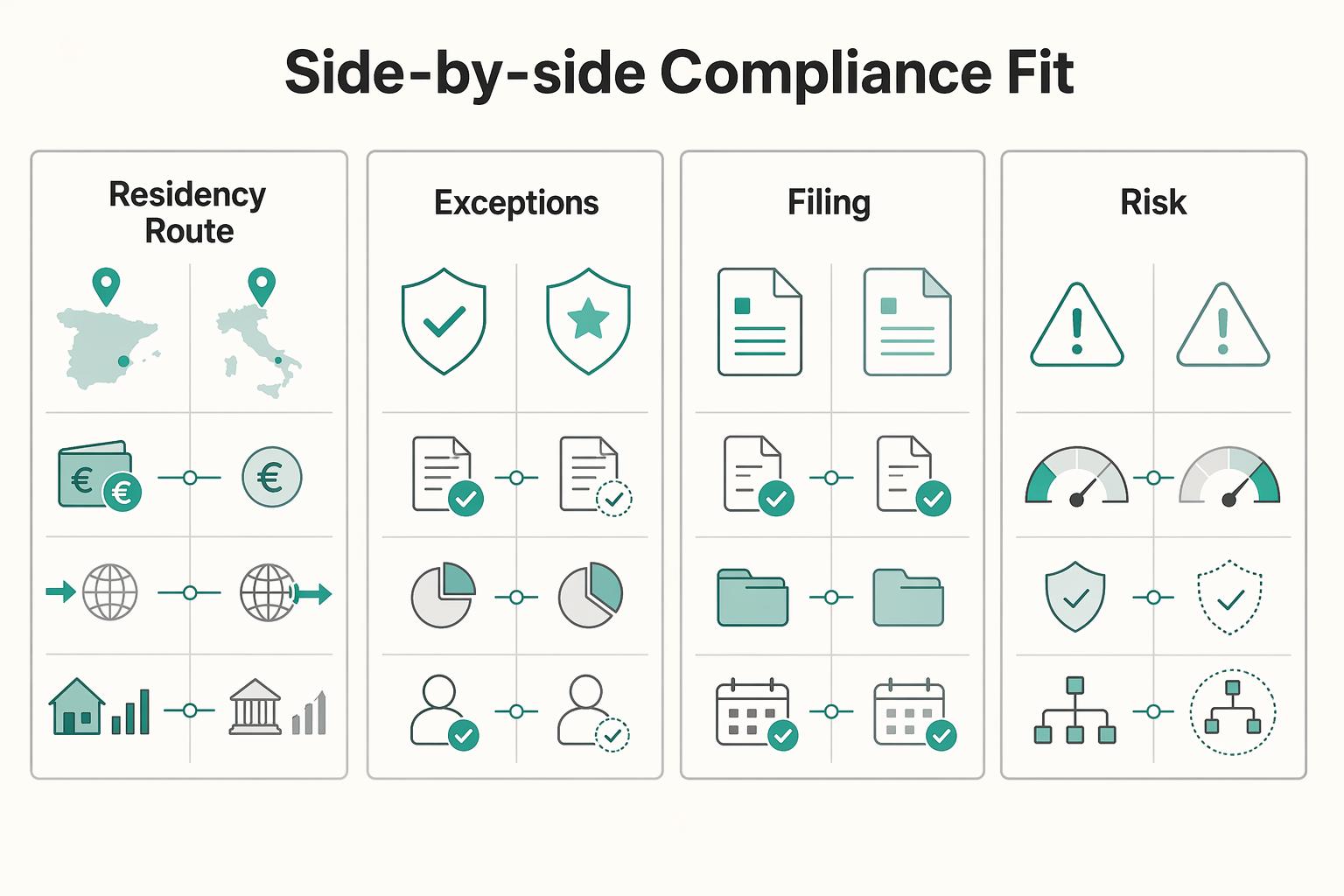
Side-by-side compliance fit#
| Compliance point | Spain | Italy |
|---|---|---|
| Residency route linkage | Telework visa is a direct residence route for remote work in Spain; cited consular guidance says no prior telework residence authorization is required. Tax option is separate under Art. 93 IRPF. | Visa route and tax regime are separate. Digital-nomad or remote-worker visas may fit Italian or foreign employer or client setups, but impatriati eligibility must be tested independently. |
| Documentation burden | Immigration + tax file: visa documents, social-security evidence, Modelo 149 for option, Modelo 151 for return. | Broader proof pack: visa file, non-residence history, income classification, and impatriati-condition support. Incomplete visa files may be rejected. |
| Approval uncertainty | AEAT lists 10 business days on the Modelo 149 procedure page, while visa processing can include prior central consultation. | Consular guidance states filing at least 15 days before travel; review can take up to 90 days (remote workers) or 120 days (digital nomads). |
| Ongoing admin obligations | Track PE-exclusion risk, keep social-security positioning coherent, and meet the 6-month option deadline. | Maintain Italian tax residence for at least 4 years or lose benefits with recovery and interest; apply for residence permit within 8 working days after entry. |
Your day-one operating checklist#
The safest approach is to build one file so your visa, payroll, and tax positions stay consistent from the start.
- Contract structure: Lock your role in writing first: employee, professional self-employed, or founder-operator through your own entity.
- Invoicing flow: Confirm who invoices, who receives funds, and whether amounts are personal income or company revenue.
- Social-security touchpoints: Spain telework documentation can require employer social-security registration evidence for employees or RETA proof for the self-employed.
- PE risk flags: If management, contracting, and delivery move onshore, treat PE exposure as a pre-move review item.
Build one evidence file that maps each step to one document. That file should include the employment or services contract, group chart if relevant, prior non-residence proof, social-security support, tax-option forms, and a short fit memo. A common failure point is mismatch across visa, payroll, and tax files.
Treat network factors as practical checks, not marketing points: advisor availability, English-language support, banking onboarding, and payment operations. For both countries, confirm current local process details directly with your actual consulate, municipality, bank, and advisor.
If your priority is a cleaner day-one path while keeping a foreign company in the picture, Spain may be the tighter operational fit. If you are truly re-basing to Italy with qualifying income and can commit to the 4-year residence requirement, Italy can be the right path. We covered this in detail in Spain Tax Residency for Mobile Freelancers Who Need Defensible Records.
At a Glance: Spain vs. Italy#
With tax, risk, and operating structure now on the table, you can use a shorter comparison. If mobility and optionality matter most, Spain may be the better starting point. If you expect qualifying Italian-produced work income and can maintain Italian tax residence for at least 4 years, Italy may be the better starting point. In practice, this is often a flexibility-versus-commitment decision tied to your mobility needs, asset profile, income-source mix, and compliance tolerance.
| Decision point | Spain Article 93 | Italy impatriati |
|---|---|---|
| Income treatment | AEAT shows 24% up to EUR 600,000 and 47% above EUR 600,000 under the special regime. Period: year of move + 5 following tax periods. | Qualifying Italian-produced employment or self-employment income up to EUR 600,000 is included at 50%. Period: transfer year + 4 following tax periods. |
| Foreign income and gains | Current Article 93 treatment for each foreign income stream or gain must be verified from official tax-authority or advisor records before use. Do not assume every foreign stream is excluded without checking treatment for your income type. | The verified benefit is tied to Italian-produced work income. For foreign income and gains, test under current ordinary Italian resident rules using official tax-authority or advisor records before use. |
| Foreign asset exposure | Wealth-tax guidance places Article 93 taxpayers in the real-obligation context, defined by assets or rights located or exercisable in Spain. Verify current treatment of foreign assets and any reporting duties. | Resident individuals with foreign financial assets may face IVAFE; resident individuals with foreign real estate may face IVIE. Check this before moving if you hold assets abroad. |
| Eligibility path | Article 93 was expanded from 1 January 2023 to include remote workers, entrepreneurs, and qualified professionals. You still need current condition-by-condition confirmation. | New regime applies to transfers from tax period 2024 and includes elevated qualification or specialization requirements. A 23 September 2025 amendment was later cited in 2026, so current-law checking is required. |
| Commitment and exit risk | No equivalent minimum-stay rule is verified here. If your plan depends on a clean exit, confirm the current position before relying on it. | You must keep Italian tax residence for at least 4 years, or benefits can be recovered with interest. This is the main downside risk. |
| Post-regime transition | Confirm the current post-regime transition with an advisor or official source. | Confirm the current post-regime transition with an advisor or official source. |
| Who this fits | Mobile consultant or founder profile (often): you expect changing locations or mixed cross-border facts and want to preserve flexibility while validating details. | Long-commitment local earner profile (often): you plan to stay put, produce qualifying income in Italy, and can document eligibility and manage foreign-asset exposure. |
Use this snapshot to prioritize your next checks, not to finish the decision. Choose only after verifying current rules, your personal facts, and your document set line by line. Related: A Guide to Spain's Beckham Law for High-Earning Expats.
Making the Call: Income Mix, Asset Location, and Exit Risk#
The short version: Spain is often the better fit when global assets and exit flexibility matter more than maximizing local-income tax outcomes. Italy can be the better fit when most of your income is expected to be Italian-source and you can accept a tighter commitment profile after verifying current rules.
Do not rely on headline rates alone. Base the call on three variables: income-source mix, asset location, and the cost of changing plans.
Quick self-selection#
| Decision factor | Spain read | Italy read |
|---|---|---|
| Income source mix | Better starting point when local-income tax minimization is not your only objective | Better starting point when most earnings are Italian-source and current law still supports a better local-income result |
| Global assets | Better starting point if a large share of wealth sits outside Spain, with asset-by-asset verification | Higher-friction starting point when you hold meaningful foreign property or financial assets because worldwide-asset exposure is part of the risk review |
| Mobility needs | Better fit if you may move again or want lower commitment risk | Better fit only if you can tolerate the verified current minimum-stay requirement and related recovery risk if plans change |
| Regime math | Verify current Spain rate/cap treatment against your facts | Verify current Italy rate/cap or exemption treatment against current law |
Before deciding, model one year using only three buckets: local earned income, foreign investment income, and year-end assets. If one option looks better only after ignoring assets or exit risk, the model is incomplete.
Profile A, asset-heavy and mobility-first#
This is often the Spain-leaning profile.
Choose this path if...
- Your assets are mostly outside your destination country.
- You want flexibility to relocate again.
- You want to reduce the chance that foreign holdings become the main tax-risk driver.
This comparison frames Spain as limiting wealth-tax exposure to Spanish assets, while Italian residency raises worldwide-asset questions, including IVIE and IVAFE exposure.
Pressure-test before deciding...
- You are assuming all foreign assets will be treated favorably without exceptions.
- You have not mapped assets by account, property, and holding location.
- You have not verified treatment category by category.
Profile B, local-income optimization and long-stay tolerance#
This is the Italy-leaning profile, but only if the commitment risk is real and manageable.
Choose this path if...
- Most of your upside is tied to Italian-source income.
- Your foreign asset base is modest enough that asset-side costs may not outweigh local-income benefits.
- You can operate with a longer commitment horizon.
The tradeoff here is straightforward: Italy can produce a better local-income result in some cases, but commitment risk comes with it.
Pressure-test before deciding...
- You may need relocation flexibility.
- Your plan could be disrupted by contract changes, client loss, funding shifts, or family moves.
- You have not verified the current minimum-stay requirement and any associated recovery risk under current law.
If the choice still feels close, get fact-specific advice before you move. Do that when you have cross-border assets, mixed client geographies, or relocation uncertainty. Keep an audit-ready file with your residency timeline, contracts, income-source breakdown, and year-end asset statements.
For a step-by-step walkthrough, see Portugal NHR vs Spain Beckham Law for High-Earning US Expats in 2026.
If your client mix or relocation timeline is still uncertain, talk to Gruv to confirm a low-risk operating setup for your cross-border payments flow.
Frequently Asked Questions
Is crypto taxed under these regimes?
Treat crypto as a verify-first item. This guide does not establish a blanket crypto rule for either Spain or Italy, so do not choose a regime based on assumed treatment of trading, staking, or DeFi. If disposals are large or frequent, get a fact-specific tax review and bring wallet histories, exchange exports, and disposal dates.
Do you pay wealth tax in Spain under the Beckham Law?
If global assets are central to your decision, Spain may be the cleaner starting point in this comparison, but only after an asset-by-asset review. In this guide, Spain's wealth-tax scope is limited to Spanish assets. Italian residents may face IVIE (1.06%) on foreign real estate and IVAFE (0.2%) on foreign financial assets. Build a year-end asset map before choosing, especially if you hold foreign property or multiple brokerage accounts. Bring statements, valuations, and ownership records.
What if you leave Italy before four years?
If you may relocate again, treat Italy's four-year commitment as a core risk. Breaking that residence period can trigger recovery of benefits. Italy carries a four-year clawback risk. If your work, family, or funding timeline is uncertain, optimize for flexibility first. Bring your move calendar, contract dates, and residency history to an advisor before you commit.
Which regime fits a self-employed consultant better?
For self-employed work, the better fit depends less on headlines and more on operating reality. On the Spain side, the compliance path includes filing Modelo 036/037 with Hacienda, then TGSS registration via Modelo TA0521. Missing the 60-day post-Hacienda window can cost initial tarifa plana eligibility and trigger penalties. Confirm that you can execute the sequence before relying on projected tax outcomes. If you have mixed client locations or a company structure, bring contracts, invoices, and activity records for review.
Can a remote worker use Spain's special regime?
Potentially, but treat eligibility as verify-first rather than automatic. This guide covers Spain's regime framing and income treatment, but not a full remote-worker checklist for your exact facts. Validate eligibility conditions before arrival, not after. If you split time across countries or work through your own entity, bring your contract, client or employer letters, and prior-residency timeline.
What current Italy rules should you verify right now?
Start with the currently applicable version of the regime, not older summaries. The key checks here are the 50% exemption on qualifying Italian-source income up to EUR 600,000 and the four-year residence condition tied to recovery risk if broken. Verify your exact eligibility line under current law before resigning, incorporating, or signing a lease. If your case depends on self-employment characterization or recent wording changes, bring residency certificates, income-source evidence, and draft engagement terms.
Try a related tool
Researched and edited by the Gruv editorial team. Gruv builds cross-border billing, payouts, and finance-operations software for global businesses.
Sources
Includes 3 external sources outside the trusted-domain allowlist.
- agenziaentrate.gov.it/portale/lavoratori-impatriati-209-2023/infog...trusted
- agenziaentrate.gov.it/portale/normativa-e-prassi-lavoratori-impatr...trusted
- exteriores.gob.es/Consulados/sydney/es/Comunicacion/Noticias/P...trusted
- sede.agenciatributaria.gob.es/Sede/ayuda/manuales-videos-folletos/manuales...trusted
- sede.agenciatributaria.gob.es/Sede/en_gb/ayuda/manuales-videos-folletos/ma...trusted
- ambpristina.esteri.it/it/servizi-consolari-e-visti/servizi-per-il-...external
- consparigi.esteri.it/it/servizi-consolari-e-visti/servizi-per-il-...external
- getwherenext.com/blog/italy-digital-nomad-visa-2026external
Educational content only. Not legal, tax, or financial advice.
Related Posts

Digital Nomad Taxes in 2026 With a Defensible Filing Plan
With digital nomad taxes, the first move is not optimization. It is figuring out where you may be taxable, where filings may be required, and what proof supports that position.

Spain Beckham Law Decisions for Freelancers on Tight Filing Windows
Make the go or no-go call early, then test it against dated checkpoints and records you can defend. The goal is predictable compliance, not aggressive tax engineering.

Tax Residency in Italy for Freelancers and Nomads
You can usually reach a defensible first view in one focused sitting: based on your facts, are you more likely tax resident in Italy right now or not. This draft is for freelancers and consultants who want a practical first pass on whether Italy tax residency is likely, then a low-stress routine to keep records aligned with that position.