
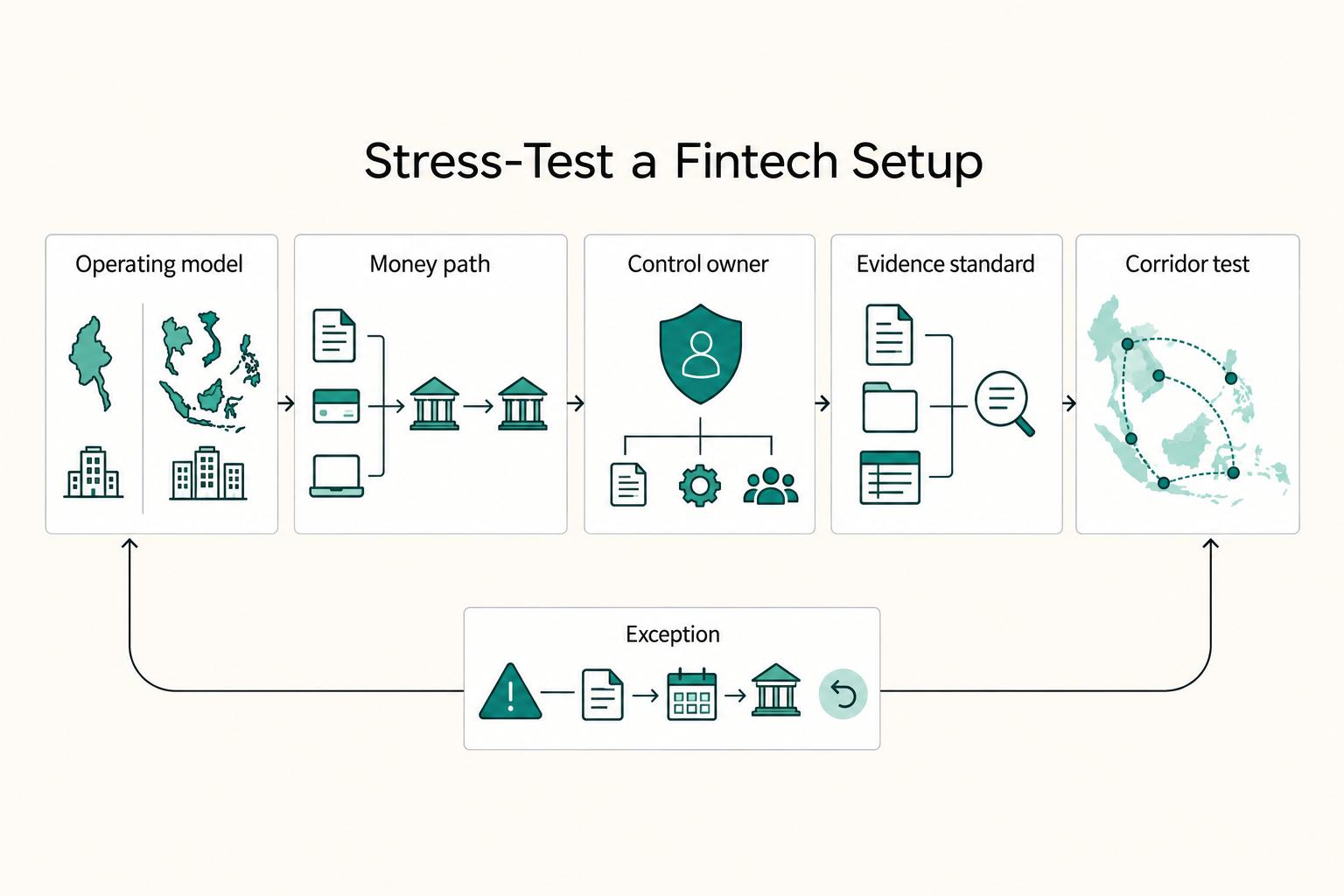
Quick Answer
Start with one actual corridor and verify the contractual provider, lawful account eligibility, money path, costs and recovery procedure. Review sandbox failures or documented simulations, then run a small genuine live transaction after permission. Keep collection, provider balance and bank cash separate, and expand only after repeatable reconciliation.
Southeast Asia fintech in 2026 for cross-border operators#
If you run cross-border work as a freelancer, consultant, or small team, the 2026 priority is simple: pick a setup that still works when exceptions happen, not only when everything goes smoothly. Adoption is real across the region, but day-to-day reliability matters more than product noise.
Regional links can help specific payments, but a domestic payment system, cross-border remittance link and merchant QR scheme are different products. Coverage depends on participating institutions, account type, currencies and permitted purpose. Confirm your actual business use instead of assuming an ASEAN-wide network.
Your setup needs to collect the agreed amount, preserve the FX and fee trail, and deliver funds through an eligible payout route. A provider’s growth announcement cannot establish those capabilities for a freelancer’s account.
Treat this as a decision guide. Lock the choices that control reliability before you compare fees:
- Operating model: start in one country or launch in several countries.
- Money path: how funds are collected, converted, and released.
- Control ownership: who handles identity, business, and risk checks.
- Evidence standard: which payout states and reconciliation exports are non-negotiable.
Before committing to launch, review provider documentation and test the intended corridor where access is available. Use sandbox fixtures or documented simulations for failures. After onboarding and permission, a small genuine live transaction can check the actual route. Do not create false invoices, deliberate live name mismatches or fake payments to force an exception.
Treat that test like a mini launch, not a product demo. Capture who approved each step, where statuses changed, and which export proved the final ledger impact. Those notes become your baseline for future provider reviews and reduce rework when traffic grows.
Across this region, cross-border adoption is shaped by regulation, market conditions, government initiatives, and customer behavior. Copy-paste setups can fail quickly across borders. By the end, you should be ready to choose an operating model, shortlist providers on evidence, and launch with fewer compliance surprises. For a broader location lens, read The Best Digital Nomad Cities in Southeast Asia.
Use Regional Payment Links as Specific Evidence#
Start with current primary payment-system information rather than a regional growth forecast. These examples show why the same country pair can support one type of payment and leave another unsupported.
| Regional example | What official guidance establishes | What you still need to verify |
|---|---|---|
| Singapore domestic PayNow Corporate | Entities link a Singapore-issued UEN to a participating Singapore bank or e-wallet account for SGD transfers. | Account eligibility, merchant use, references, limits and payout access; a foreign address alone does not create a Singapore account. |
| Singapore–Thailand PayNow/PromptPay linkage | Participating bank customers can use the cross-border mobile-number linkage. | Whether your account and business purpose are supported, limits and currencies; domestic corporate PayNow support does not prove cross-border corporate support. |
| Indonesia–Singapore QRIS/NETS QR | Participating apps support cross-border retail merchant QR payments. | Merchant enrollment and settlement terms; a retail QR link does not by itself provide invoice collection or bulk contractor payouts. |
| Project Nexus | BIS describes a blueprint and work toward live implementation linking domestic instant payment systems. | Actual launched service, participating provider, country and product eligibility; a project announcement is not a route commitment. |
Use the provider’s actual service terms to bridge these system-level examples to your business. Record which legal entity contracts with you, which institution holds or safeguards funds, who performs FX and which party pays the beneficiary. A shared brand or API can sit above several institutions.
When you compare providers, use a simple rule: even when firms lean on regional momentum narratives, prioritize resilience in day-to-day execution over funding-cycle claims.
- Ask for recent, appropriately redacted incident examples covering failed collections and payouts.
- Require request-to-ledger references for successful, pending and reversed transactions.
- Distinguish support acknowledgement from settlement resolution; record operating hours and the actual escalation commitment.
- Verify the contractual provider and its permitted activity in the relevant regulator register, without treating registration as a guarantee of performance.
If a provider is fragile, an invoice may show paid while settlement lags, or a payout can sit in pending with no clear recovery path. That can disrupt cash planning, strain contractor trust, and increase reconciliation work when capacity is already tight.
Ask for a standard flow and a failed or returned-flow demonstration using provider-approved test data. If a sandbox is unavailable before signing, review documented scenarios and make any necessary access or acceptance condition explicit. Run a permitted genuine live collection and payout after eligibility is confirmed; do not require a live failure before every contract.
Ask the provider to explain failure ownership, information requests, funds disposition and escalation before discussing the successful case. It may legitimately restrict sensitive compliance rules or customer case data; useful evidence is the procedure, your notice and support path, not access to another customer’s confidential file.
Define the fintech stack before choosing vendors#
Define your stack and ownership before vendor demos. If you pick tools before the language and controls are clear, comparisons get noisy and gaps can surface at filing time.
| Topic | Rule | Note |
|---|---|---|
| FEIE maximum exclusion | For qualifying individuals, the 2026 maximum is $132,900; the 2025 maximum is $130,000. | Not a platform benefit or an automatic exclusion for money received from overseas. Qualification includes foreign earned income, tax home and the applicable residence or presence test. |
| Foreign housing calculation | The general 2026 qualified-expense ceiling is $39,870 and annual base amount is $21,264; approved high-cost locations can have higher ceilings. | The ceiling is not the amount automatically excluded. Qualifying expenses minus the base determine the housing amount; employee/self-employed treatment differs. |
| U.S. filing and other taxes | An FEIE claim does not remove an otherwise applicable U.S. return filing duty or generally eliminate self-employment tax. | Attach tax-year context and keep the underlying income and work-location records. |
| Limited time-test waiver | Only designated adverse-country conditions and periods may support an IRS waiver, with required prior presence and reasonable expectation of qualifying. | War or unrest alone does not waive all eligibility conditions; verify the listed country, date and remaining requirements. |
| FBAR obligation and value | Applies to U.S. persons with financial interest in or signature authority over reportable foreign financial accounts when aggregate values exceed $10,000 at any time in the year. | A cross-border invoice alone does not create FBAR liability. For relevant accounts, reconstruct maximum value, round reported USD value up and apply the prescribed year-end conversion rate. |
Use explicit working definitions in your selection document, then confirm the wording with tax and legal advisors for terms like:
- Merchant of Record: the contractual seller to the customer for supported transactions, commonly with specified payment and transaction-tax responsibilities. Verify product eligibility and the responsibilities you retain.
- Virtual account: receiving details linked to a provider’s collection arrangement; confirm whose account it is, permitted incoming payments, fund custody and withdrawal rights. It is not automatically a bank deposit in your name.
- Payout: a transfer from provider or business funds to a beneficiary. Track the instruction, processing status, recipient receipt and any return separately.
Identify who performs customer identity (KYC), business verification (KYB) and AML checks under law and provider terms, and who supplies requested evidence. A freelancer using a provider does not automatically inherit that provider’s regulated role. Confirm the actual local license or permitted activity; Singapore authorization does not by itself authorize business in Indonesia or the Philippines.
For U.S. individuals who may qualify, preserve income and work-location records for FEIE. The 2026 exclusion maximum is $132,900, subject to eligibility and applicable day-based limitation. The general foreign-housing expense ceiling of $39,870 is not a flat extra exclusion: the base, qualifying expenses, locality and employee/self-employed rules matter. Keep this reporting branch separate from vendor-selection requirements for readers without U.S. obligations.
The IRS adverse-condition waiver has country, date and eligibility conditions. Preserve travel/residence evidence if relevant, but do not assume any conflict or a delayed payment waives the tests.
For U.S. persons with a reportable foreign account and an FBAR obligation, preserve the account-value history and account identity. FinCEN’s maximum-value method uses a reasonable approximation of the year’s highest value, with USD reporting rounded up and non-USD conversion using the prescribed last-day-of-year rate. Assess the actual financial account, not just the fintech brand or payment currency.
Use this sequence before you evaluate vendors and pricing:
- Lock definitions and ownership for money movement and control gates.
- Map reporting artifacts to required data fields.
- Test one month-end reporting pack with sample data.
- Then compare vendor fit, pricing, and expansion options.
Assign an owner to review a sample month-end pack before live launch, or make necessary export acceptance a documented contracting condition. Some providers grant full test access only after onboarding. Review what you can beforehand, then complete the agreed checks before increasing volume.
If your working location is still undecided, The Best Digital Nomad Cities in Southeast Asia is separate planning context; it does not establish account or business eligibility.
Why Singapore leads and when that should not decide your stack#
Singapore can still be a strong base, but it should not decide your stack by itself. A headquarters address does not prove corridor performance. If your revenue and payouts are multi-country, choose based on where money actually moves as expected.
| Corridor check | Requested evidence |
|---|---|
| Lane requirements | Onboarding and eligibility requirements by live lane |
| Settlement timing | Cutoff behavior and settlement windows by corridor |
| Return handling | How failed or returned payouts are classified, reversed, and communicated |
| Rejection handling | A rejection-code map and a named escalation path |
| Status history | Exports that preserve full status history for successful and failed transactions |
Singapore’s Payment Services Act regulates specified payment services, and MAS publishes a Financial Institutions Directory. Check the exact contractual entity, license type and authorized activity. Location and authorization are different questions, and neither establishes your account’s country coverage or unrestricted access to funds.
For Indonesia, use Bank Indonesia’s payment-service and QRIS guidance relevant to the product. For the Philippines, check applicable BSP payment-system registration and other required permissions. A registration is not a universal banking or remittance license. Ask which local institution and legal arrangement supports each lane, especially when several entities sit behind one provider brand.
Before commercial negotiation, run a corridor-first check:
- Ask for onboarding and eligibility requirements by live lane.
- Request cutoff behavior and settlement windows by corridor.
- Confirm how failed or returned payouts are classified, reversed, and communicated.
- Require a rejection-code map and a named escalation path.
- Verify exports preserve full status history for successful and failed transactions.
Use this decision rule: if collections and disbursements are multi-country, optimize for corridor reliability and exception handling, not for the claim that a provider is headquartered in Singapore.
If your first six months focus on one lane, keep procurement language tied to that lane. If your volume plan already spans Singapore, Indonesia, and the Philippines, require corridor-level evidence in the initial review instead of deferring it to post-signing meetings.
Choose your operating model by transaction pattern#
Let transaction reality decide your operating model, not the headquarters narrative. Execution usually improves when the model matches payment cadence, corridor spread, and exception volume.
For a small team, the relevant pattern is your actual transaction volume, currencies and destinations. Model what happens when one client pays late, a contractor payout returns and a provider balance becomes temporarily inaccessible.
| Model | Best fit | Main upside | Main tradeoff |
|---|---|---|---|
| Singapore-first, then expand | Lower monthly volume, concentrated counterparties, limited corridor count | One compliance profile and one payout rail can be simpler early | You may need redesign work as activity expands across ASEAN corridors |
| Regional from day one | Counterparties distributed across multiple markets from the start | Can reduce structural rework as volume spreads | Often higher onboarding and exception-management complexity from day one |
Choose a narrow first lane when most invoices and payouts share the same parties and currencies. If customers and beneficiaries already span countries, map the legal and operational responsibilities across those lanes before selecting products. This is an operating choice; opening a Singapore entity is not automatically required or sufficient.
A practical way to choose is to review your last 90 days of invoices and payout destinations. If one lane dominates volume, a staged model usually keeps execution cleaner. If payment destinations are already spread across several markets, delayed regional planning can create expensive rework.
If one route would stop the business, assess a genuinely independent, eligible fallback. Two apps may share the same processor or bank. Another route can serve permitted future payments or accessible funds; it cannot release a held balance, bypass sanctions or justify retrying a payment with an unknown outcome.
Before launch, verify each target corridor with the same checklist:
- Confirm onboarding requirements and document ownership.
- Confirm settlement windows, cutoff behavior, and non-business-day handling.
- Confirm return handling from first failure state through final reversal.
- Confirm retry ownership and failure-communication ownership.
A common failure mode is a payment that appears complete in one market, then the downstream payout fails and remains unresolved because ownership is unclear. If you see this in testing, pause and fix ownership before go-live.
Score providers with a pass fail matrix before demos#
Use a binary pass/fail matrix before any demo so you decide on evidence, not presentation quality. Execution can be complex, and the right configuration can vary by use case and user group.
Keep the scorecard explicit. Define hard gates up front, document how each gate is reviewed, and require traceable proof before you move deeper.
| Gate | Evidence to request before demo | Pass rule | Fail rule |
|---|---|---|---|
| Legal entity and corridor eligibility | Contractual provider identity, relevant registry entry and actual product/account/country requirements | Required permissions and your permitted business use are confirmed | Material legality or eligibility questions remain unresolved |
| Collection, custody and FX | Money-path diagram, fees/rate method, availability rules and fund-protection disclosures | Each institution and expected net amount is identifiable; required exports are available | Custody, fee deductions or payout availability is unexplained |
| Statuses, retries and recovery | API/file rules, original-outcome lookup, duplicate controls and return procedure | You can reconcile pending, failed and returned instructions before any retry | Unknown outcomes prompt blind resubmission or whole-file replay |
| Support and decision review | Reason/status notices, escalation ownership and operating hours | You understand permitted review and follow-up steps; confidential screening logic is not required | No accountable path for unresolved cases |
| Data and evidence handling | Required fields, secure document route, access/retention terms and export samples | Necessary evidence can be stored and retrieved with restricted access | Sensitive records enter broadly shared folders or unexplained logs |
Before negotiation, run one verification checkpoint. Request one complete standard-case workflow and one complete edge-case workflow from the same environment, then check whether the criteria, evidence, and final decision rationale are internally consistent. If the evidence does not hold up, stop there.
Assign the gate review to the appropriate owners: business fit and cash needs, technical status/retry behavior, and legal or compliance scope. A solo operator may own all three and seek specialist advice where needed. A demo can help collect evidence; the actual hard gate is unresolved material risk before affected live activity, not a ban on speaking to sales.
Prepare an onboarding evidence pack that avoids week-three delays#
Merchant onboarding is increasingly critical to activation. Treat it as a structured evidence handoff from day one.
Start with a core pack and tailor it to each provider program:
- Business-entity and beneficial-ownership records where required for the product.
- Identity evidence for the people the provider must verify.
- Tax or settlement documents required by law or actual provider terms; do not assume an account request replaces your own reporting obligations.
- A named owner for follow-up, secure submission and escalation.
Country variance matters here. Before you submit anything, request written program requirements for each target market. Map your documents to each path instead of sending one generic pack.
Use a low-rework plan that follows the provider's confirmed sequence. Document each step with traceable records, and keep one normal flow and one exception flow so status handling is clear before scale.
Keep version dates, review status and open questions in an accessible index. Store full identity and tax documents in a restricted location, with approved submission links; a shared team folder need not expose every sensitive document. Archive only what your applicable retention and privacy requirements justify.
If a provider cannot clearly explain its AML-CFT process for your corridors, treat onboarding as incomplete and pause go-live until that gap is closed.
Design collections for traceability, not just payment acceptance#
Design collections so every payment can be verified end to end, not just accepted. In cross-border activity, regulatory frictions and market fragmentation can make unclear records harder to resolve, so traceability should shape your intake choices.
Cross-border payments can benefit from recent fintech improvements, but collection paths still need interoperability across participants and strong trust controls.
| Collections path | Best fit | Risk to control |
|---|---|---|
| Invoice links and checkout | Collections that span multiple payer methods | Weak reference discipline can create mismatches between payment status and ledger status |
| Bank transfers with clear payment references | Collections with frequent bank-transfer usage | Unmatched deposits can slow resolution if investigation ownership is unclear |
Use a consistent operating sequence for incoming payments so finance, ops, and support stay aligned:
- Identify the parties and verified collection destination; complete required legal/provider checks.
- Issue the valid invoice or payment request with its reference and agreed billing trigger. Advance invoices can precede delivery.
- Confirm the rail’s actual collection state and amount, separately from payout and bank cash.
- Reconcile gross collection, fees, FX and net deposits; investigate unmatched records.
- Retain the required references, approvals and evidence in appropriately restricted storage.
Add one daily checkpoint during launch: review payments that reached a completed state but still have no matching ledger line. This catches reference mismatches early, before they turn into month-end cleanup.
Plan exception handling before go-live, especially for unmatched deposits. Define who triages, who approves adjustments, and when escalation starts if a case stays unresolved. If bank transfer is common client behavior, prioritize paths that preserve clear payment references and keep link or checkout paths as secondary coverage.
Build payout operations around failure handling and retries#
Treat payout design as a failure-handling discipline first, not just a send-money step. Cross-border payouts touch more institutions, currency conversions, and checks, so exception handling must be clear before volume scales.
Choose payout mode by control needs, then apply one status and closure standard to both modes.
| Payout mode | Practical upside | Practical risk |
|---|---|---|
| Automated payouts (API) | Programmatic transfers with tighter operational control | Requires tight retry controls to avoid duplicate submits |
| Batch payouts (file upload) | Simple spreadsheet-based release process | File-level errors can slow correction cycles and grow exception queues |
Use one fixed sequence so finance, support, and engineering reconcile the same event chain:
- Run required internal checks.
- Make the routing decision.
- Submit the payout.
- Monitor status updates.
- Reconcile final status to the ledger.
- Close the exception with clear ownership and disposition.
Plan for failure modes before go-live, including routing issues and duplicate-submit risk during retries. Failed payments create support load and debugging work, so ownership and closure criteria should be explicit.
Track exceptions in one queue with open date, current owner, and closure reason. That makes weekly trend review possible and helps you spot whether failures are mostly data quality, routing conditions, or retry behavior.
Use a stable business-instruction ID and supported duplicate controls for API or batch payouts. Before retrying, look up the original status and whether money was sent, returned or is still pending. A timeout is not proof of failure. For a partly accepted batch, resend only confirmed eligible failed lines, not the whole file. Logs show observed behavior; they cannot alone prove that every concurrent or later replay is safe.
Handle tax and reporting early so growth does not break compliance#
Set tax and reporting ownership before you scale, or compliance work will bottleneck even when payouts succeed. The practical move is clear artifact ownership plus proof that exports can reproduce the reporting data you need.
Use a simple ownership map with one primary owner, one backup, and one go-live checkpoint per artifact.
| Artifact | Primary owner | Go-live checkpoint |
|---|---|---|
| Tax validation records | Finance lead | Validation status, source document, and effective date are stored and exportable |
| Tax profile collection | Onboarding lead with finance review | Profile type and history are tied to each payee record |
| Year-end tax outputs | Finance lead with accounting backup | Totals are reproducible from ledger data without manual re-keying |
If you have U.S.-linked taxpayers, treat FEIE as an eligibility process, not a default assumption. The exclusion applies only to qualifying individuals with foreign earned income, and excluded income is still reported on a tax return. The maximum exclusion is inflation-adjusted by tax year: $130,000 for 2025 and $132,900 for 2026 per qualifying person. Keep tax-year context attached to each payment record.
Qualification may require a foreign tax home and a bona fide residence test or 330 full days in foreign countries during a consecutive 12-month period, alongside other applicable conditions. Payment from an overseas client is not itself foreign earned income; work location matters. Apply an IRS adverse-condition waiver only if its designated country, dates and remaining requirements fit.
FBAR concerns qualifying U.S. persons and actual reportable foreign financial accounts when the aggregate threshold is exceeded. Preserve maximum-account-value evidence where relevant, including the prescribed year-end conversion method and rounded-up USD reporting. Provider transaction exports may not supply a complete daily balance or signature-authority record, so check the missing evidence separately.
Run a dry month-end close before launch. Rebuild one sample reporting set from raw transaction records, then confirm every required field can be reproduced without manual assumptions. If that dry close fails, fix data mapping before adding volume.
Confirm current reporting requirements before go-live. If reporting exports cannot reliably join transaction IDs, beneficiary records, tax-profile snapshots, and account-value history, treat the integration as incomplete even if payments are processing.
Reconcile the gross collection and the net deposit#
Suppose a client pays USD 1,000 in full. In an illustrative quote, the provider converts the full amount at SGD 1.35 per USD, producing SGD 1,350, then deducts a stated SGD 27 fee. The bank deposit is SGD 1,323. Link the USD invoice and payment to the executed conversion, fee and SGD deposit. The invoice is fully collected; the fee is your cost unless the agreement makes it the client’s responsibility.
A second quote promising a higher net amount is comparable only if it covers the same account, route, amount, fee allocation and timing. Preserve the actual quote expiry and executed rate. If collection succeeds but payout is pending, record a provider receivable or balance as appropriate, not bank cash; a later return needs its own reversal and funds-disposition record.
Execute a 30-day launch plan with hard checkpoints#
Run this launch as four pass/fail weeks. Do not move forward until each checkpoint has complete evidence. The goal is not speed. It is proving you can collect, reconcile, and send funds with control at every handoff.
The four-week plan is an illustrative schedule for your chosen products and corridors. It is not a regulatory timetable or a guarantee of approval. Complete required account and legal checks, and extend the schedule when actual onboarding or test access takes longer.
| Week | Objective | Hard checkpoint before moving on |
|---|---|---|
| Week 1 | Finalize model, shortlist providers, run a pass/fail matrix on KYC, KYB, AML, Virtual Accounts, and Payouts | One scorecard per provider with explicit pass/fail evidence for every gate |
| Week 2 | Complete onboarding evidence pack, map policy gates, validate country scope for selected ASEAN corridors | Written corridor scope map, named owner per document set, and unresolved policy questions logged |
| Week 3 | Run sandbox or documented failure scenarios; after permission, a small genuine live collection, FX and payout check | Success and exception behavior documented per priority corridor, with live observations labeled separately from simulations |
| Week 4 | Go live with monitoring, reconciliation cadence, incident response document, and quarterly control review plan | Daily exception review active, reconciliation report reproducible, and first quarterly review date scheduled |
Use provider-approved sandbox fixtures for name mismatch, timeout, retry and return cases. Do not submit intentionally false live names or force a real return just to satisfy the checklist. After eligibility and consent, keep a genuine live test small. Preserve transaction IDs, status history, settlement/reversal references, approval and closure notes, noting which evidence came from simulation.
Use explicit no-go triggers so launch decisions stay objective:
- If any Week 1 compliance gate fails, remove the provider from launch scope.
- If Week 2 corridor mapping is incomplete, delay live traffic in that corridor.
- If documented controls and tests cannot establish safe handling of duplicate, pending or partially accepted instructions, keep that payout path out of live launch until resolved.
Freeze scope between weeks unless a blocker forces change. Mid-week feature additions often hide responsibility gaps and weaken pass/fail decisions. Keep a short change log so every adjustment has a reason, owner, and verification date.
Begin with one or two actual corridors and extend the illustrative 30-day schedule if required checks remain. Keep unresolved lanes out of live traffic; increase volume only when monitoring, support ownership and repeatable reconciliation work. Set aside accessible cash for already owed obligations rather than assuming a provider balance is immediately spendable.
The next best move is to pick a model and test it on one real corridor#
Use the FAQ as a filter, then commit to one real corridor test before you expand. Success here is less about trend-chasing and more about reliable execution under compliance and reconciliation constraints.
Regional connectivity initiatives show why legal, operational and institutional coordination matters alongside APIs. They do not promise that a freelancer’s chosen product is already connected. Distinguish a blueprint, pilot and launched eligible service before including a route in your cash forecast.
Run one corridor scorecard before adding volume:
- Confirm control ownership before funds move. Document who makes compliance decisions, who can place a hold, and who can release funds. If ownership is unclear, pause.
- Review or simulate success and exception paths with approved test data, then perform a genuine permitted live check after onboarding. Label simulations separately and verify original outcomes before any retry.
- Require reconciliation-ready records for each test transaction. Integration and reconciliation gaps become visible quickly when records cannot be matched after exceptions or manual review.
A common failure mode is treating fragmentation as only a rail issue. Teams can pass technical checks, then stall in production because regulatory alignment and institutional handoffs were never mapped. Project Nexus is a useful reminder: linking domestic instant payment rails across jurisdictions requires coordination beyond API connectivity. If a provider cannot explain where compliance, governance, and liquidity controls are applied during the transaction, treat that corridor as unready.
Keep expansion disciplined. Move to the next lane only after repeated controlled cycles in the first corridor show clean reconciliation and clear exception ownership. If tests still depend on ad hoc fixes, hold scope and close those gaps first.
Archive the scorecard, permitted test evidence, exceptions and reconciliation results so the next corridor receives the same review. Verify eligibility again when parties, products or country scope change.
Frequently Asked Questions
Is Southeast Asia fintech still growing in 2026 or is it slowing down?
Specific regional payment links have expanded, including participating retail QR and remittance routes, but that does not establish a single regional fintech growth rate or universal business coverage. Use current central-bank and payment-system guidance for your actual product, then obtain provider-specific eligibility, pricing and recovery evidence. Unsupported revenue and transaction projections do not help choose your route.
Why do so many fintech companies in Southeast Asia operate from Singapore?
Singapore provides a regulated financial-services base and domestic systems such as PayNow Corporate, but a provider’s headquarters does not establish performance or permission elsewhere. Verify the contractual entity, authorized activity and local partners, then check your exact account and corridor.
How should funding and consolidation news affect provider selection?
Funding or consolidation news is context, not evidence that your transaction will settle. For selection, ask what changed in the provider’s financial resilience, contractual entity, support, bank partners and fund-protection arrangements. Use actual disclosures and current terms rather than inferring stability from an investment announcement.
How should freelancers and small teams choose a fintech provider for cross-border payments?
Write down payer and beneficiary countries, account types, currencies, use case and expected volume. Verify the lawful supported product, request the full cost and availability terms, and review collections, payouts and exception exports. Use sandbox failures and, after permission, a genuine small live transaction; preserve existing obligations while testing.
What are the top operational risks when moving money across Southeast Asia?
Key risks include unsupported business use, unclear custody or safeguarding, FX and fee surprises, delayed bank cash, returned payouts, duplicate retries and records that cannot reconcile. Separate client collection from provider payout. Legal and operational checks vary by country; a Singapore product or a retail QR link does not automatically cover every ASEAN business payment.
What should be included in a due-diligence checklist before onboarding a provider?
Include contractual entity and permissions, your account/corridor eligibility, collection and beneficiary requirements, custody/fund protection, complete fees and FX method, status/return/retry rules, support escalation, data access and reconciliation exports. Test failures using approved fixtures and resolve material gaps before affected live use. Collect only necessary sensitive evidence.
Try a related tool
Where Gruv fits
See reconciliation and mismatch review
Compare ledger entries, provider payment records, and statement rows to see what matches and what finance needs to review.
See how FX quotes work
Request a quote, check the rate and expiry, and keep the quote details with the payment record for finance.
Researched and edited by the Gruv editorial team. Gruv builds cross-border billing, payouts, and finance-operations software for global businesses.
Sources
- bis.org/project/nexustrusted
- bsp.gov.ph/PaymentAndSettlement/FAQ_OPS_Registration.pdftrusted
- eservices.mas.gov.sg/fidtrusted
- fincen.gov/report-foreign-bank-and-financial-accountstrusted
- fincen.gov/reporting-maximum-account-valuetrusted
- irs.gov/individuals/international-taxpayers/figuring...trusted
- irs.gov/individuals/international-taxpayers/foreign-...trusted
- mas.gov.sg/regulation/payments/regulations-and-guidancetrusted
Educational content only. Not legal, tax, or financial advice.
Related Posts

The Best Digital Nomad Cities in Southeast Asia
Pick the city that can support a normal workweek, not the one that looks best across a dozen tabs. If you want one practical answer from this Southeast Asia shortlist, use these three gates in order and drop any city that fails one.

The Freelance Payment Penalty: A Modeled Audit of Platform Fees, FX Spreads, and Payout Delays
The money rarely disappears through a single, easy-to-spot fee. The real loss is stacked. A marketplace takes its commission, a processor adds a charge for international cards, a bank or payment company converts the currency at a spread, a platform holds the funds before release, and a wire sheds a little to intermediaries on the way in. Each layer looks defensible on its own, but the worker feels the combined result as a smaller deposit and a later payday.

How to Respond to a Subpoena for Business Records
Move fast, but do not produce records on instinct. If you need to **respond to a subpoena for business records**, your immediate job is to control deadlines, preserve records, and make any later production defensible.