
Quick Answer
Agree scope and payment terms before delivery, complete the obligations that apply to your engagement, and keep invoices, receipts, fees, and ledger entries linked. Review demand, capacity, and cash each month before adding tools or people. Use one accepted agreement or an MSA and SOW as the work requires.
Run a business of one with reliable contracts and cash records#
A business of one puts delivery, sales, administration, and cash decisions in the same person’s hands. A durable setup makes those responsibilities manageable as client work rises.
Census Nonemployer Statistics cover businesses with no paid employees that meet the program’s tax and receipts criteria. They include partnerships and corporations as well as sole proprietors, and may include side businesses. A nonemployer count is not a count of full-time solo founders, nor does total receipts equal GDP contribution. Use the dataset definition before interpreting a headline.
Use a simple test: can you add clients without creating contract disputes, compliance delays, or cash confusion? If growth still depends on memory, inbox threads, and disconnected tools, higher volume will expose gaps fast.
Use this basic sequence for the quarter:
- Agree the work: Record scope, payment timing, acceptance, and change handling before delivery.
- Check applicable obligations: Complete the onboarding, tax, and data-access requirements that apply to this engagement.
- Cash movement third: Map invoice date, receipt date, payout date, and ledger posting so each payment has one traceable path.
- Records always: Keep one client evidence packet with signed terms, tax docs, billing contact, invoices, and reconciliation proof.
Agree the obligations needed for the particular engagement before a rush start. A single accepted agreement may cover both scope and core terms; separate MSA and SOW documents are an option, not a universal prerequisite. Complete actual provider and data-access requirements at the point they apply, rather than imposing every possible check on every client.
At a monthly checkpoint, try retrieving the relevant client terms, invoice, receipt or settlement record, and ledger entry in five minutes. Add tax forms only where applicable. Investigate paid-but-unmatched activity and improve record access; one filing problem need not halt all sales work.
Keep one distinction in mind: freelancers are often paid task by task, while solopreneurs may target more repeatable revenue. Use that as a decision lens, not a purity test.
Read the market signal without over-reading the hype#
Check the original publication, definitions, date, and method before using a market claim. If you cannot inspect the evidence, leave the claim out of forecasts and use your own pipeline and delivery records.
Apply this filter before any claim goes into your operating plan:
- Write the claim in one sentence.
- Label the source type as primary data, reported summary, or opinion.
- Mark access state as full text, member-only, or error page.
- Record the publication date.
- Set status as usable now, context only, or hold.
| Claim type | Check before using it | Useful planning input |
|---|---|---|
| Number of solo businesses | Definition, year, geography, employee status, and counting unit | Market context rather than your conversion forecast |
| Industry receipts or economic contribution | Receipts versus value added; scope and method | Comparable segment data with the correct measure |
| Success or burnout story | Author context, evidence, and relevance to your work | A hypothesis to test against your own results |
Before you change targets, run a quick verification check. Review three claims in your notes and confirm each has a clear origin, date, and usable access state. If any element is missing, downgrade that claim to context only and keep commitments tied to your own pipeline and results.
Keep a short claim log so review is fast. One line per claim is enough: claim text, source type, access state, date, status, and what decision it affects. If a claim cannot pass that test, it does not belong in your plan.
Define your business model before you pick tools#
Pick how you win work and deliver it before you choose software. In a one-person business, the bigger risk is mixing channels and operating styles until scope, pricing, and expectations drift.
An owner-operated business may sell project services, retainers, subscriptions, or products. Freelancers also run businesses and can use repeatable offers. Choose the model from what customers buy, what you can deliver, and how cash arrives, rather than from a label or market-size headline.
Keep channels distinct:
- Platform work, for example Fiverr or Upwork.
- Direct client acquisition, such as referrals or outreach.
- Social discovery paths, including TikTok.
Each channel brings different expectations. Social discovery channels can offer low-cost access to potential customers, but lead quality still depends on how clearly you define your offer.
Then choose your operating identity deliberately. If work is mostly ad hoc, freelancer-style positioning can fit. If scopes repeat, shift toward a solo company approach with standardized offers, repeatable onboarding, and clear written terms when appropriate.
Set one rule and apply it consistently: as a default, document scope and payment expectations in writing before delivery. Once the model is clear, tool choices become simpler because each one supports a defined way of working.
A simple check helps prevent tool sprawl: for every tool you keep, state the single decision it supports and who checks its output monthly. If you cannot answer both, remove that tool from the stack. You might also find this useful: The Best Project Management Tools for Freelance Developers.
Build the legal and contract spine before revenue scale#
Set your contract baseline before you scale revenue, or growth can expose preventable disagreements on scope, timing, and delivery.
| Term area | Written detail |
|---|---|
| Scope changes | How scope changes are requested and approved. |
| Invoicing and payment | When invoices are issued, when payment is due, and what happens if payment is late. |
| Accepted delivery | What counts as accepted delivery. |
| Ownership | When ownership transfers for paid work, and what is excluded. |
| Disputes | How disputes are handled if direct resolution fails. |
Complexity can rise without employees. Each added client, collaborator, payment route, or product can introduce a new approval, deadline, or handoff. Document the responsibilities before the volume makes informal arrangements hard to manage.
Add practical detail where disagreements usually start. Spell out what a valid change request looks like, who can approve it, and when the delivery date resets. Define acceptance in plain terms so both sides know when a milestone is complete.
Use one verification checkpoint for every new client file:
- Agreed terms and scope, with the approval or signature required by that arrangement.
- Confirmed billing contact.
- Written acceptance of payment terms.
- Dated versions of key drafts and approvals so decisions are traceable.
If you see repeated scope renegotiation, pause new intake briefly and tighten your templates before taking more work. Speed can support growth, but clarity helps protect margin.
When a dispute appears, record the relevant promise, agreement version, facts, and decision. Use the result to clarify the template or process that caused confusion.
Set money movement and reconciliation rules from day one#
Set money movement rules before volume rises. Choose your rails early, and keep one traceable path from invoice to payout to ledger so month-end close stays reliable.
Choose collection and payout rails early#
An invoice communicates the charge; a bank transfer, card payment, or other supported method collects it. Virtual receiving-account details can help clients pay where available. Check supported payer countries, currencies, account ownership, references, fees, and settlement timing before adding a route.
Investigate unresolved payment matches before adding volume through the affected route. A new route may still be worthwhile if it fixes the existing problem; document how reconciliation will work before relying on it.
Before you add a new rail, test it with your bookkeeping in mind:
- Confirm where the payment reference appears in your records.
- Confirm who checks fee deductions and timing differences.
- Confirm how exceptions are logged when references are missing.
Set the cross-border ownership line#
For eligible products and sales, a Merchant of Record acts as the seller to the customer under its arrangement and can take responsibility for applicable transaction taxes and payment operations. Eligibility and exact responsibilities depend on the provider agreement. Compare this with selling directly; MoR support does not remove your own income-tax or business obligations.
Make these roles explicit:
- Who issues the final customer charge.
- Who keeps billing records and handles exceptions.
- Who investigates mismatched settlements, and by when.
This decision needs one owner and one written rule. If ownership is unclear, exceptions can sit unresolved while each party assumes someone else is handling them.
Reconcile from invoice to ledger with evidence#
Treat monthly close as a control checkpoint. If invoice data, payout data, and bookkeeping records live in different tools, close quality can drop unless you keep a consistent method to match each transaction across tools.
Link each paid invoice to its actual payment and settlement records and ledger entries. A payment can settle several invoices, and one invoice can have instalments, refunds, or split settlements. Bank-feed categorization is a starting point: check whether a receipt settles existing receivables before recording it as new revenue.
Use the same close sequence each month so problems are easier to spot:
- Confirm invoice status and collected amount.
- Match each payment to payout evidence.
- Post or verify ledger entries.
- Investigate unmatched items and assign ownership.
- Record final close notes with dated resolution details.
A hypothetical monthly close: three USD 2,000 invoices create USD 6,000 of charges. One remains unpaid, so receivables are USD 2,000. The other two settle as a combined USD 4,000 receipt less USD 120 in assumed fees, producing USD 3,880 in the bank. Match the two invoices to that settlement, record fees separately, and leave the unpaid invoice open. The USD 3,880 bank deposit is not another sale. Actual revenue recognition depends on your accounting method.
Prevent the same failure every month: paid but not matched with no owner assigned. Assign investigation ownership as soon as an exception appears, capture timestamped evidence, and log the resolution decision so your cash position stays trustworthy.
Add compliance gates early instead of retrofitting under pressure#
Identify the obligations that apply to your business, customer, data, and payment route. Keep necessary onboarding and reporting records without treating every solo operator as a regulated financial institution.
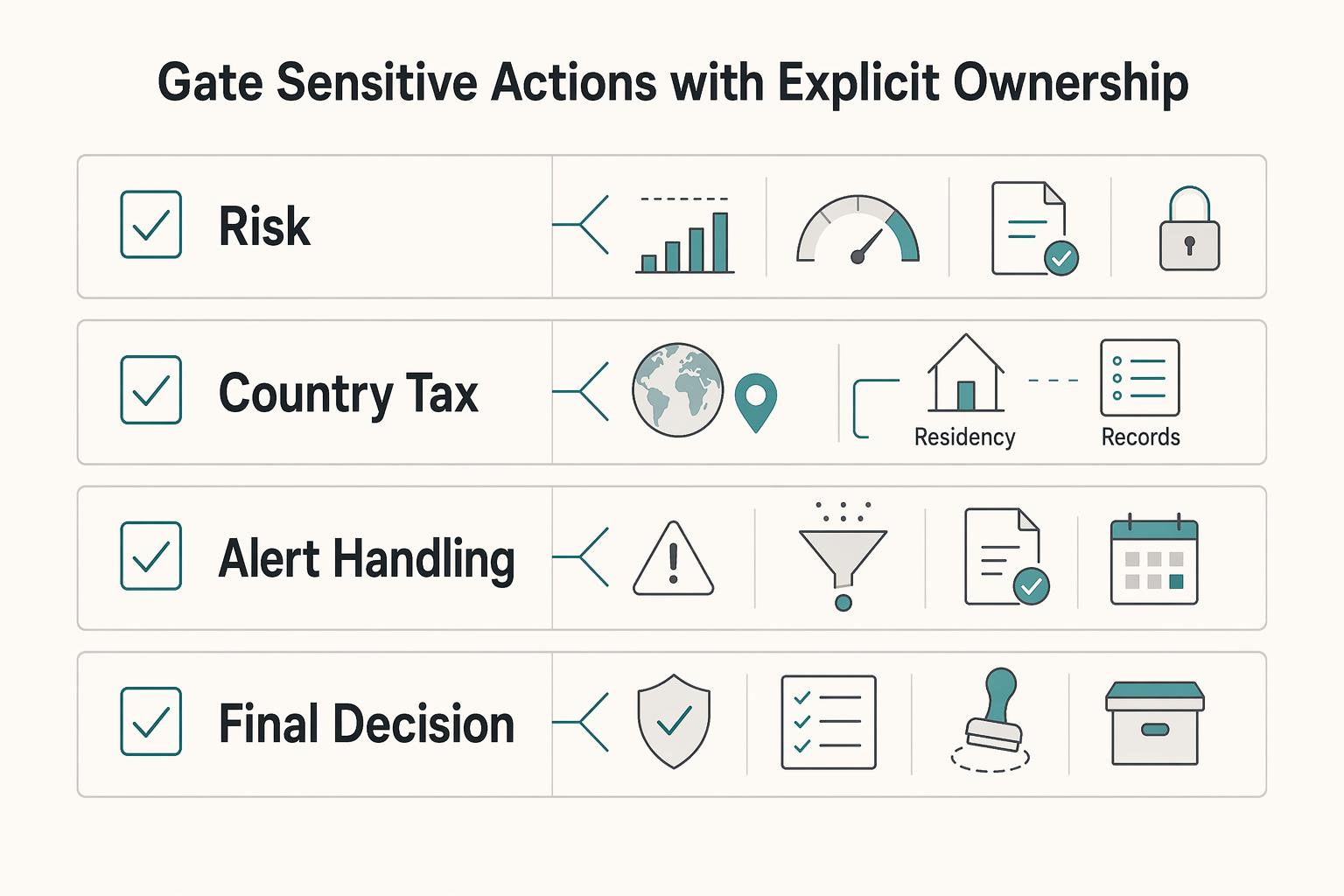
Gate sensitive actions with explicit ownership#
Use a clear internal sequence for sensitive actions that matches your policy and risk profile. This is an internal control rule for consistency, not a universal legal sequence.
| Approval record item | What to capture |
|---|---|
| Risk-check status | Required risk-check status with completion date. |
| Country and tax residency | Country of activity and declared tax residency. |
| Alert handling | Alert outcome, escalation owner, and resolution deadline. |
| Final decision | Final decision log with timestamped evidence. |
Investigate alerts according to the applicable law, provider requirements, and actual contract. A self-imposed unresolved check does not automatically justify withholding earned wages or fees. Keep the issue, decision, evidence, and next action together so a later review can reconstruct what happened.
Intake tax forms before cash leaves#
For U.S. reporting that requires a taxpayer name and TIN, request an appropriate W-9 from a U.S. person. Foreign-status documentation can involve W-8BEN for an individual or W-8BEN-E for an entity, subject to payment type and applicable rules. These are forms a payer may request from you or you may request as a payer; they are not a universal client-document list.
Add a recurring reporting-readiness review so filing decisions are made from complete records. If you cannot show who validated the documentation and when, quality drops and rework rises.
Track missing or expired documentation and apply the actual reporting or withholding rules. For specified reportable U.S. payments, a missing or incorrect TIN can require 24% backup withholding rather than withholding the entire payment. Resolve the form issue promptly and protect the sensitive records.
Keep an international review calendar for FEIE and FBAR#
For eligible U.S. taxpayers, FEIE limits are USD 130,000 for 2025 and USD 132,900 for 2026 per qualifying person, subject to foreign earned income and qualifying days. Qualification requires a foreign tax home and the applicable bona fide residence or physical-presence test. Foreign customers alone do not make income foreign earned. General full-year housing-expense caps are 30% of those maxima, or USD 39,000 and USD 39,870; locality limits, the base housing amount, actual eligible expenses, and qualification affect the exclusion or deduction. FEIE does not reduce self-employment tax.
FBAR generally concerns U.S. persons with a financial interest in or signature authority over foreign financial accounts when aggregate value exceeds USD 10,000 at any time in the calendar year, subject to exceptions. Keep each reportable account’s reasonable maximum annual value, convert foreign currency using the applicable Treasury year-end rate, and round up to a whole dollar: USD 15,265.25 becomes USD 15,266. It is a separate filing from an income-tax return.
A simple year-end prep routine helps. Verify each account's maximum value record. Verify currency conversion basis. Verify the rounding method in your worksheet before filing work begins. Confirm exact applicability before acting.
Choose growth path with explicit tradeoffs#
Compliance gates do not choose your staffing model. Keep core delivery solo first, use specialist contractors when demand spikes, and consider hiring only when demand is consistently stable enough to carry fixed payroll.
Use market signals as context, not command#
A market trend can suggest an offer to test, but it cannot establish your future demand or hiring budget. Compare conversion, repeat purchases, scope stability, and margin in your own records before adding recurring cost.
Separate market narrative from day-to-day reality: broad trends show momentum, while your pipeline, margins, and delivery rhythm are better guides for whether fixed headcount is sustainable.
Match capacity to volatility#
Use one simple rule tied to demand volatility:
| Demand shape | Better first move | Main cost of that choice |
|---|---|---|
| Spiky or seasonal demand | Stay solo and add contractors by project | More coordination and quality review effort |
| Stable, repeatable demand | Evaluate a hire | Higher fixed cost and admin load in slower months |
| Mixed demand with uncertain sales cycle | Keep a hybrid model | Slower standardization across delivery |
One person has finite delivery and review time. Staying solo protects flexibility but can limit throughput. Hiring raises management responsibilities and fixed costs. Contractor support can add capacity with coordination and quality-review costs; it does not guarantee independent-contractor status under applicable law.
Before delegating, check client permission, confidentiality, data access, and intellectual-property terms. Give a supplier a clear scope and review points, agree fees and payment timing, and retain responsibility for your promised client delivery. Classify workers from the actual relationship and applicable rules, not the contract label.
Run a monthly proof check before changing structure#
Before you change structure, run a monthly checkpoint and save the evidence in one dated file:
- Pipeline volatility by week, including delayed starts and canceled work.
- Delivery load versus available personal capacity.
- Margin after contractor spend for the same month.
- Rework or late-delivery incidents tied to capacity gaps.
- A one-page decision note with owner, decision date, and next review date.
If demand remains uneven, keep contractor capacity as the pressure valve. If demand stays stable across repeated reviews and work is becoming process-heavy, test a hiring plan with conservative assumptions. A frequent risk is hiring to solve a short spike, then carrying fixed cost when demand normalizes.
Review the last few decision notes before each structural change. If the same warning appears repeatedly and remains unresolved, fix that issue first instead of adding headcount. In a solo business, stronger growth decisions come from matching cost structure to operating evidence, not from copying headline trends.
Avoid the seven failure modes that sink durable solo businesses#
Most failures are avoidable when you catch them early and assign clear ownership. Use this as a monthly risk screen, not a one-time checklist.
Seven failure modes to catch early#
| Failure mode | Why it matters |
|---|---|
| Starting delivery without agreed scope and payment terms | Scope and payment disputes can be harder to unwind once work has started. |
| Treating Fiverr or Upwork cash flow as equal to direct contracted revenue quality | Channel volume can hide weak client quality. |
| Ignoring compliance until payout friction appears | Late remediation can create deadline pressure. |
| Letting tax and FBAR records drift across tools and inboxes | Missing ownership turns routine admin into cleanup mode. |
| Using market headlines as proof of demand in your niche | Market narrative is not the same as repeatable paid demand. |
| Handling FBAR account values loosely | For multiple accounts, each account must be valued separately, then converted and rounded correctly. |
| Applying special FBAR deadline relief to everyone | For 2025 FBARs, ordinary due date April 15, 2026 has an automatic extension to October 15, 2026. FinCEN Notice FIN-2025-NTC3 extends only the specified signature-authority filers to April 15, 2027; not everyone with signature authority qualifies. |
FinCEN Notice FIN-2025-NTC3 applies to specified filers already covered by the earlier notices. Check that coverage rather than assuming no financial interest is sufficient. The ordinary automatic extension requires no separate request.
For FBAR reporting, value each reportable account separately; the aggregate threshold determines whether filing is required, not whether an individual account exceeds USD 10,000. Preserve maximum-value evidence and the Treasury year-end conversion basis. Round reported dollar amounts upward, so USD 15,265.25 becomes USD 15,266.
When any failure mode appears, contain it before you optimize anything else:
- Stop creating new exceptions of the same type.
- Assign one owner and one dated next action.
- Capture the root cause and the template or rule change that prevents repeat errors.
At month end, review active-client terms, channel results, open obligations, and relevant tax-document status. If FBAR applies, update your account worksheet and check valuation and deadlines. Keep applicable reporting distinct from ordinary customer onboarding.
Use a monthly operator review to stay compliant and bankable#
Run one fixed monthly review on a single cutoff date, then make a clear continue-or-pause decision using criteria you define internally.
Use three packets so open issues are easy to scan:
- Financial packet: booked revenue, receivables aging, cash timing, and unresolved payout exceptions.
- Compliance packet: open verification actions, pending tax-validation checks, and missing client or vendor tax forms.
- Contract packet: renewals, expiring master-agreement terms, change-order count, and repeat scope-dispute patterns.
Build the packets before the meeting, not during it. If data is still being assembled while decisions are being made, unresolved items can drift into the next cycle.
For every open item, assign one owner and one dated next step before you close the review. If exceptions are rising, consider pausing new acquisition experiments until control gaps are addressed.
Use dated monthly operating records to assess your own revenue, capacity, and unresolved items. Keep the definitions stable so differences between months mean something.
Keep prior-month carryover visible. A short list of unresolved items from the last review makes trend direction clearer and prevents repeated discussion without resolution.
Execute a 30-60-90 day buildout with concrete deliverables#
Use the 30-60-90 plan as an adjustable implementation schedule. Build the urgent controls needed for live work immediately; use later reviews to test and improve them. Not every business needs to finish every phase before earning revenue.
During the first month, map your current work and fix immediate contract, access, or payment gaps. Use the next two months to test the process against real deliveries and receipts.
Phase gates#
| Phase | Build focus | Verify before moving on | Common failure signal |
|---|---|---|---|
| Days 1-30 | Listen, learn, and map how work actually moves end to end. Define your operating standards and owners. | You can pull dated records for each key step without guesswork. | You start optimizing before the baseline process is clear. |
| Days 31-60 | Run the standards in live work and log exceptions in a consistent format. | You can trace work items end to end and show who owns each open issue. | Exceptions pile up, but ownership and next actions stay unclear. |
| Days 61-90 | Complete the 3-month test and decide what to keep, tighten, or pause. | You can show trend lines for completion, exceptions, and lag, then make a clear keep-or-change decision. | New work is added before unresolved gaps are closed. |
Treat the full period as a 3-month test, not a guaranteed outcome. The point is measurement discipline: if you cannot measure completion, exception volume, and lag, you cannot manage them.
If a phase exposes a gap, fix the affected process and adjust the schedule. Continue unrelated work that can be performed safely and under agreed terms.
End-of-quarter output#
Produce one operating binder with your current standards, dated evidence logs, process records, and an unresolved-risk list with owners and next steps. Add a short decision memo on what changed, what is still failing, and what is paused next quarter.
Keep the binder useful for future review. Use clear version dates, keep one source of truth for each checklist, and archive replaced versions so past decisions remain auditable.
Make the next quarter manageable#
Choose changes from the problems your monthly records expose: unclear scope, repeated rework, weak demand, or cash that cannot be matched to invoices.
Protect time for both delivery and running the business. A repeatable review helps you notice capacity and cash problems before another commitment makes them harder to resolve.
Keep controls proportionate to the work. A clear agreement, reliable payment records, and a short unresolved-items list can serve a small solo business better than an elaborate process nobody maintains.
Evidence discipline is part of the same approach. If a claim cannot be retrieved or verified, do not treat it as planning input.
Use this next-step sequence to keep growth options open while reducing avoidable surprises:
- Complete the 30-60-90 checklist and document progress with dated evidence.
- Run one monthly review packet cycle so decisions are documented, not carried in memory.
- Re-check key assumptions and evidence before expanding.
If you want a deeper dive, read GDPR for Freelancers: A Step-by-Step Compliance Checklist for EU Clients, or, to confirm what is supported for your specific country or program, Talk to Gruv.
Frequently Asked Questions
What is the difference between a solopreneur and a freelancer in day-to-day operations?
A freelancer usually sells services; a solopreneur describes an owner-operated business that may sell services or products. The terms overlap. In either case, you need to manage sales, delivery, contracts, cash, and administration.
How reliable are current solopreneur economy statistics from the U.S. Census Bureau and SBA for planning my own business?
Census nonemployer statistics have explicit coverage rules and include some partnerships, corporations, and side businesses. Check the year, geography, industry, and measure before comparing them with your market. Industry totals can inform questions but cannot forecast your next quarter’s sales.
Can I build a durable business without hiring employees?
Yes. A durable business-of-one is possible. Common pressure points include isolation, financial instability, and time management. Durability usually depends on how early and consistently you manage those risks.
When do I need KYC, KYB, and AML checks as an independent professional?
Banks and payment providers may require identity or business verification when you open an account or use a service. Formal AML duties depend on your business activity and applicable law; ordinary independent professionals do not automatically have the duties of a regulated financial institution. Complete the provider’s actual requirements and identify any obligations that apply directly to your service.
Which tax documents should I collect first for U.S. and cross-border clients?
If a U.S. payer needs your name and TIN for reporting and you are a U.S. person, it may request W-9. Foreign individuals or entities may need an appropriate W-8 form depending on status, income, and payment type. As a payer, collect the forms required for your reporting or withholding obligations; do not require every foreign client to send a U.S. tax form.
How do I decide between platform work, direct contracts, and Merchant of Record support?
Use platforms when their discovery, workflow, and payment terms suit your offer; use direct contracts when you can acquire clients and manage those responsibilities yourself. For eligible product sales, compare an MoR’s seller, tax, refund, and settlement responsibilities under its agreement with direct selling. Measure net receipts, acquisition cost, review effort, and payment timing for each route.
What signals tell me to keep operating solo versus adding contractors or employees?
Stay solo when workload and quality remain stable without chronic strain. Repeated isolation, financial instability, or time-management breakdowns can signal that the current setup is under pressure. Make expansion decisions from trends over time, not one stressful week.
Try a related tool
Researched and edited by the Gruv editorial team. Gruv builds cross-border billing, payouts, and finance-operations software for global businesses.
Sources
- bsaefiling.fincen.gov/resources/XMLUserGuide_FinCENFBAR.pdftrusted
- census.gov/programs-surveys/nonemployer-statistics/abou...trusted
- fincen.gov/report-foreign-bank-and-financial-accountstrusted
- fincen.gov/system/files/2025-12/FBAR-FBAR-Filing-Requir...trusted
- irs.gov/instructions/iw9trusted
- irs.gov/instructions/iw8bentrusted
Educational content only. Not legal, tax, or financial advice.
Related Posts

GDPR Compliance Checklist for Freelancers Working With EU Clients
Start by separating the decisions you are actually making. For a workable **GDPR setup**, run three distinct tracks and record each one in writing before the first invoice goes out: VAT treatment, GDPR scope and role, and daily privacy operations.

Digital Nomad Health Insurance Comparison for Long-Stay Moves
Use focused time now to avoid expensive mistakes later. Start with a practical `digital nomad health insurance comparison`, then map your route in [Gruv's visa planner](/tools/visa-for-digital-nomads) so we anchor policy checks to your real plan before pricing pages pull you off course.
The Best Project Management Tools for Freelance Developers
Freelance delivery gets more predictable when planning and client updates follow one clear setup instead of improvised tickets and scattered chat threads. In practice, project management for developers means planning, scheduling, and organizing software work so scope, time, quality, and stakeholder expectations stay aligned.