
Quick Answer
Choose self-publishing when you want control over packaging, pricing, timing, and reuse, and choose traditional when publisher backing and external credibility matter more than control. In self-publishing vs traditional publishing, the practical split is clear: self-publishing puts execution and costs on you, while traditional often starts with agent querying and can include an advance against royalties. Use your own priorities for rights, timeline, and operating workload to make the final call.
Self-Publishing vs. Traditional: Rights Control, Timeline, and Revenue Model#
If your main goal is to build a reusable business asset, self-publishing is often worth evaluating first. If your main goal is a publisher-backed release, traditional publishing may fit better, but you need to accept slower timelines, gatekeepers, and less control.
Use three lenses from the start: rights control, process checkpoints and timeline, and revenue model fit. Rights control asks who gets to decide how the book is packaged, priced, timed, and reused. Process checkpoints and timeline ask whether you are prepared for the agent-query route and a longer path to publication. Revenue model fit asks whether you want a publisher-funded model with an advance against royalties, or a faster path where you fund production and keep more of the upside per sale.
| Path | What it optimizes | What you give up | Best fit if |
|---|---|---|---|
| Self-publishing | Speed, control, higher royalty potential | Upfront investment and responsibility for the publishing process | You want the book to support your broader business and you can manage execution |
| Traditional publishing | Publisher-funded production, advance against royalties | Control over title, cover, price, distribution strategy, and timeline | You want a publisher-backed path and are comfortable with gatekeepers and a longer path |
Here is the practical checkpoint. If you are considering traditional, ask whether you are ready to assemble a query letter and synopsis and spend 3 to 12 months querying agents before a deal is even possible. One source estimates 2 to 4 years from first query to publication. The failure mode is straightforward: if the book underperforms, rights can stay tied up in contract and may not return easily.
Before you read on, score yourself from 1 to 5 on these priorities:
- I need maximum control over rights and book decisions.
- I prefer a publisher-backed path more than speed.
- I can fund production now, or I need publisher funding first.
Your highest score should guide the rest of this comparison. Related: The Best Platforms for Self-Publishing Your Book.
Asset Control: Who Truly Owns Your Intellectual Property Moat?#
If you want your book to stay a reusable business asset, start by prioritizing control of rights, not just copyright ownership. In traditional publishing, you may keep copyright but still license rights that limit how fast and how widely you can reuse the content.
The key distinction is practical control: who decides what happens next. Traditional contracts can reduce your say over title, cover, marketing strategy, and publication timeline, and reported timelines from submission to publication can run two to three years.
Rights map to review before signing#
Check these rights buckets in plain language before you agree to any deal:
- Format rights: print, ebook, audiobook, workbook, large print, and future formats.
- Territory and language rights: where the book can be sold and in which languages.
- Derivative and adaptation rights: courses, workshops, speaking products, translations, film/TV, and excerpt licensing.
- Exclusivity scope: whether the grant is exclusive and how broadly it limits related work.
| Path | Control | Approval authority | Monetization flexibility | Re-use constraints |
|---|---|---|---|---|
| Traditional contract path | You may keep copyright while licensing core rights to the publisher. | Your say on cover, title, marketing strategy, and timeline may be limited. | Reuse can require consent, renegotiation, or revenue sharing when grants are broad. | Broad exclusivity, option language, or related-rights grants can restrict reuse. |
| Self-publishing path | You keep decision authority when you control accounts, files, and ISBN choices. | You approve title, cover, pricing, formats, and launch timing. | You can reuse and repackage on your own timeline, subject to terms you separately accept. | Limits are usually the ones you later agree to with vendors, distributors, or collaborators. |
Also separate true self-publishing from paid publishing services. If you pay a company to act as publisher, verify who owns the ISBN and who is listed as publisher of record; some services keep ISBN ownership and production assets such as cover or typesetting files, which can create problems if you later switch providers.
Contract review checklist#
Before you sign, confirm:
| Clause area | What to confirm |
|---|---|
| Rights reversion terms | When and how rights return to you |
| Non-compete language | Whether related books or content are restricted |
| Option clauses | Whether the publisher has priority on your next project |
| Carve-outs | Whether courses, speaking materials, and newsletter content are explicitly excluded |
We covered this in detail in How to format a manuscript for 'KDP' (Kindle Direct Publishing).
Channel Ownership: Are You Building Your Audience or Someone Else's?#
If you want your book to support your wider business, treat audience access as a core asset, not a side benefit. The practical question is simple: after someone buys, can you move them into a consented follow-up path you control?
When you compare the paths, use this channel model: discovery, transaction, data capture, and follow-up.
Traditional publishing can help with discovery through trade distribution, including bookstore and library reach through sales reps and wholesalers, and some publishers provide stronger marketing/publicity support. But gatekeepers still decide what moves forward, and your control over title, cover, pricing, and publication date may be limited. Self-publishing usually shifts more operational control to you, especially when your book is tied to services, education, or other offers.
| Channel criterion | Traditional route | Self-publishing route |
|---|---|---|
| Customer data access | Retail sale visibility is often limited to what your arrangement reports. | You may still not get buyer identity from retailers, but you can direct readers into your own opt-in flow. |
| Retargeting ability | Usually indirect unless you bring readers onto your own pages. | Stronger when your campaigns and book CTAs send readers to pages you control. |
| First-party list growth | Depends on whether your edition and workflow allow consent capture. | More controllable when you use a dedicated opt-in path tied to book-specific value. |
| Downstream offer conversion | Harder to attribute when discovery and transaction stay inside retailer channels. | Easier to attribute when email tags and inquiry forms map back to the book journey. |
A quick reader journey contrast#
On a retailer-owned path, a reader finishes a chapter, buys, and leaves with the book experience only. On an owned-channel path, a reader takes your in-book next step, lands on your page, opts into your newsletter with privacy-policy acceptance, verifies their email, and then receives the resource. Same reader intent, very different follow-up control.
If you choose traditional for reach or validation, verify early whether your edition can include your lead-magnet path and what approval is required. If you self-publish, build the follow-up bridge deliberately; it will not run itself.
Before launch, set up:
- Lead magnet flow tied to one clear benefit from the book
- Consent-compliant email capture with clear newsletter consent, privacy-policy acceptance, and inbox verification
- CRM tagging so book-origin contacts are separated from podcast, referral, and social traffic
- Attribution tracking connecting book-driven signups and service inquiries to the book entry path
This pairs well with our guide on How to get an 'ISBN' for your self-published book.
Financial ROI: A Capital Investment vs. Validation Capital#
Treat this as a capital allocation decision, not a milestone. Your decision is stronger when expected cash flows from the book and book-linked work are likely to exceed what you give up in money, time, and rights.
Growth alone is not enough. If activity increases but returns do not clear your real capital and effort costs, the project can still underperform.
Compare total economics first#
Use this side-by-side before you choose a path:
| Path | Upfront spend | Cash-flow timing | Royalty structure | Rights-linked upside | Indirect revenue potential |
|---|---|---|---|---|---|
| Self-publishing | Author-funded. Model with lean, standard, and premium bands using verified quotes. | You spend first; recovery depends on sales and any downstream business. | Varies by retailer, format, and channel; confirm actual terms before modeling. | Usually strongest when you retain rights and can reuse content across formats, offers, and updates. | Often strongest when the book supports services, courses, workshops, or speaking. |
| Traditional publishing | Usually lower direct production spend after deal; access can require significant front-end time. | Common flow: query letter and manuscript to agents, then possible advance against future royalties if a deal closes. | Lower author royalties are common; contextual cited range is 5-15% of net receipts. | More limited when the publisher acquires manuscript rights under contract. | Can be valuable if publisher-led production/distribution and external validation are central to your goal. |
| Hybrid publishing | Author-funded; you carry cost and financial risk. Model lean, standard, and premium bands using verified quotes. | Cash out occurs early; outcomes depend on contract terms and actual sales. | Contract-specific; verify splits, fees, and included services line by line. | Mixed: you may keep more control than traditional, but rights terms still decide upside. | Works only if the service package is clear and the capital at risk is justified in your model. |
Think of a traditional advance as validation capital: upfront cash tied to future royalties, not automatic proof of better long-term economics.
Separate your model into three buckets:
- Guaranteed cash: money due under the signed contract.
- Contingent earnings: money that depends on sales performance.
- Opportunity cost: value you give up if rights concessions limit future use.
Run a one-page ROI worksheet#
Model your own case instead of using generic averages:
| Worksheet part | What to model |
|---|---|
| Inputs | Your spend band, expected launch timeline, expected net book revenue by channel, expected book-linked leads, conversion rate to paid work, and average value per converted client/engagement |
| Break-even logic | total upfront spend / expected net cash per period (book sales + book-linked business); check monthly or quarterly |
| Sensitivity checks | Lower sales, lead volume, and conversion assumptions; if the case collapses under modest downside, the investment case is weak |
Before committing, verify the actual contract and vendor terms. For traditional deals, check rights grant, royalty clause, and advance triggers. For author-funded routes, verify quotes and distribution terms before labeling your plan lean, standard, or premium.
You might also find this useful: A guide to 'literary agents' and how to query them.
Mitigating Risk: Architecting Your Professional Publishing Operation#
Your publishing risk is operational before it is creative: if you sign contracts, pay contractors, and collect revenue without a clean structure, you carry more personal and administrative exposure than necessary.
Your publishing path changes where that risk sits. Traditional publishing can involve rights transfer and less creative control, and hybrid publishing has no universal definition and can require upfront author payment and shared financial risk. That is why your entity, records, and contract discipline matter as much as your manuscript quality.
Choose the structure you can defend and maintain#
Pick the setup you can run consistently, not the one that sounds most impressive.
| Entity decision lens | Sole proprietor | LLC |
|---|---|---|
| Liability separation | No legal separation between you and the business | Designed to separate personal and business assets, but not a blanket guarantee in every dispute |
| Tax treatment complexity | Usually simpler | Usually more complex; obligations vary by jurisdiction |
| Ongoing compliance | Lower formality, but recordkeeping still matters | Ongoing filings and fees may be required to stay in good standing |
| Cross-border practicality | Can be simpler in some situations | Practicality depends on where you live, where the entity is formed, and platform/banking handling |
Use this practical rule: stay simple only if your exposure is still limited and your records are clean; move to an LLC when personal asset separation is worth recurring filings, fees, and maintenance.
Treat ISBN choice as a control check, not a default click#
Do not assume ISBN outcomes. Verify the exact platform or distributor terms before launch.
| Control question to verify | Why it matters operationally | What to capture before launch |
|---|---|---|
| Who is listed as publisher of record | Affects how your edition is represented | The platform's exact listing language for your edition |
| How portable the edition setup is | Affects flexibility if you switch providers | Contract/terms language on transfer or re-setup requirements |
| Who can update metadata | Affects your ability to correct and manage listings | The account and role permissions for metadata changes |
| How imprint display is handled | Affects presentation in retailer/distributor contexts | Live preview or documentation of how imprint/publisher fields appear |
Build controls in sequence#
Build the basics in this order:
- Set up your operating identity first. Decide what legal name signs contracts, receives payments, and appears on publishing documents, then use it consistently.
- Create a rights file. Keep dated drafts, signed collaborator agreements, permissions, and any registration receipts you rely on.
- Separate banking early. Keep book income and expenses on a dedicated path, even if you remain a sole proprietor.
- Install accounting controls. Reconcile payouts, retain invoices, and track contractor costs and platform statements in one reviewable place.
- Harden contract hygiene. Use signed agreements for editors, designers, formatters, narrators, and marketers with clear deliverables, payment terms, revision scope, timeline, and rights terms.
| Common failure point | Preventive control | Review cadence |
|---|---|---|
| Co-mingled funds | Dedicated banking path and expense tracking | Monthly |
| Unclear rights chain | Signed agreements, permissions file, dated drafts | Before launch and before each new format |
| Platform lock-in surprises | Pre-launch terms review on portability and metadata controls | Before provider selection and before provider changes |
| Missing records | Central storage for contracts, invoices, payout statements, and tax docs | Monthly and at tax time |
If this book supports your long-term business, run it like one from day one: keep structure and records clean now, then upgrade complexity only when your risk profile justifies it. For traditional or hybrid deals, give the rights and contract terms your closest review, because that is where expensive surprises usually start.
If you want a deeper dive, read How to Write a Book to Establish Your Freelance Expertise.
Conclusion: The Right Choice is a Strategic One#
There is no universal winner here. The right choice depends on the tradeoff you can actually live with: more control, speed, and operational load on your side, or more external validation, slower timelines, and publisher support with lower direct upfront publishing costs.
Choose self-publishing if you want to move on your own timetable, keep more of the revenue from each sale, and make the production decisions yourself. It is often the cleaner fit when getting the book out in less than 1 year matters, or when your plan depends on running your own sales and outreach instead of waiting through a publisher process.
The checkpoint is simple: price the work before you commit. Get realistic estimates for the production and distribution work you will need to fund. The failure mode is assuming the book will reach stores or libraries without major extra time and money.
Choose traditional if third-party validation matters more than decision control, and you can tolerate waiting periods and rejection. This route can also fit if you want the publisher to absorb upfront publishing costs and you value the possibility of access to store and library networks. The red flag is expecting a deal to remove all launch work or guarantee placement.
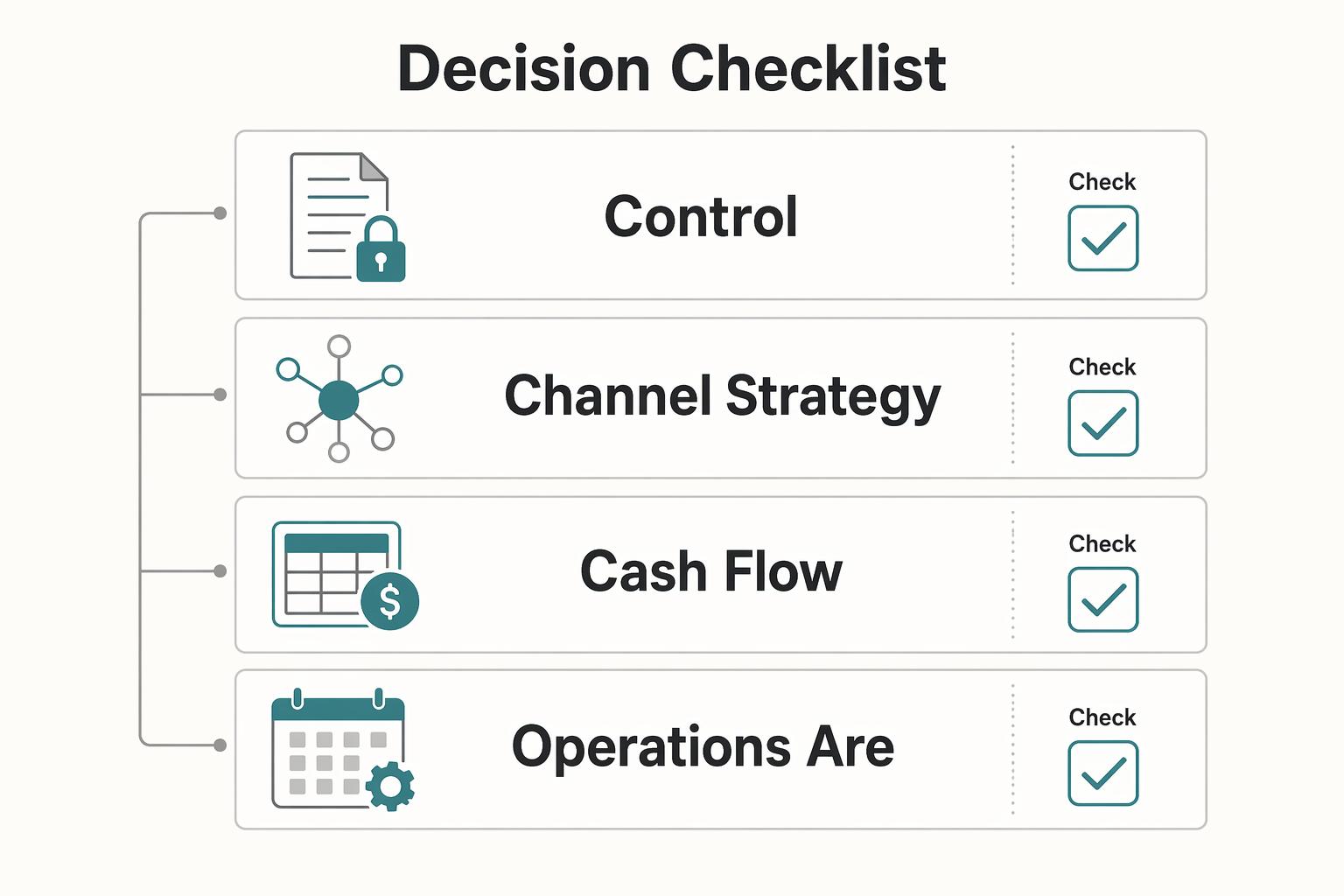
Decision checklist#
- Decision control: Do you want to retain full control over publishing decisions, or are you comfortable with a publisher-led process?
- Channel strategy: Are you pursuing publisher-backed store and library routes, or are you prepared to drive demand yourself?
- Cash flow: Can you pay production costs now, or do you need the publisher to carry that cost?
- Operations: Are you willing to manage the publishing work yourself?
Before you finalize the manuscript, write your path criteria on one page and rank them. If one factor clearly outranks the rest, build around that answer instead of hedging.
For a step-by-step walkthrough, see A guide to the 'Hollywood Accounting' of book publishing.
Frequently Asked Questions
Which path gives you more control?
If control is the priority, self-publishing usually gives you more of it. You act as the publisher, pick your team, set pricing and schedule, and can keep imprint control by buying your own ISBNs. With a traditional deal, you may give up scheduling power, pricing control, cover veto in many cases, and some rights for an agreed term. Start by listing the decisions you are not willing to hand over, then compare that list against any contract or platform terms.
Which path gets your book to market faster?
If speed matters most, self-publishing is often faster. A traditional route commonly starts with querying literary agents, then agent submission to publishers, and one grounded timeline example is twelve to twenty-four months from deal to shelf. Self-publishing moves on your schedule once the manuscript and production files are ready. Before you commit, verify your actual bottleneck: manuscript readiness, not just publishing method.
How does cash flow differ?
Traditional publishing may include an advance against royalties, which means some money can arrive before sales. Self-publishing usually means you fund editing, design, formatting, and distribution yourself. That makes the tradeoff clear: traditional can reduce upfront cash pressure, while self-publishing keeps you responsible for production spending. Build a one-page budget using real vendor quotes before you decide.
Will a traditional publisher handle marketing for you?
Do not choose traditional publishing because you think marketing disappears. You still market either way. The grounded difference is that a traditional launch may have publicist support during launch windows, while self-publishing leaves campaign ownership squarely with you. The practical check is whether you already have a newsletter, client audience, or speaking channel you can activate yourself.
What should you verify before signing a traditional contract or submitting to agents?
If you want a traditional path, treat the literary agent step as the default unless you have confirmed otherwise, because large publishers typically accept submissions through agents. Follow submission guidelines exactly, and when a contract appears, check which formats and territories the publisher is acquiring. Rights terms are where costly surprises can happen.
What are the minimum operational steps if you self-publish professionally?
Start by treating self-publishing as taking the publisher role: assemble your production team and plan distribution. A concrete setup example is Amazon KDP plus IngramSpark. If imprint control matters to you, buying your own ISBNs is part of that approach. Keep your platform terms and edition details organized before launch.
When should you choose a hybrid path?
Choose a hybrid approach when you want flexibility to move between self-publishing and traditional publishing across different books, formats, or markets. Keep a clean rights file and avoid giving away more rights than the current project actually needs.
Try a related tool
Researched and edited by the Gruv editorial team. Gruv builds cross-border billing, payouts, and finance-operations software for global businesses.
Sources
- adfg.alaska.gov/static/regulations/regprocess/fisheriesboard...trusted
- digitalcommons.mtech.edu/cgi/viewcontent.cgitrusted
- digitalcommons.usf.edu/cgi/viewcontent.cgitrusted
- pages.stern.nyu.edu/~adamodar/pdfiles/papers/returnmeasures.pdftrusted
- pmc.ncbi.nlm.nih.gov/articles/PMC12253997trusted
- pmc.ncbi.nlm.nih.gov/articles/PMC9361786trusted
- textbooks.lib.wvu.edu/badideas/badideasaboutwriting-book.pdftrusted
- utica.edu/academic/library/JAMA%20Network%20-%20AMA%20...trusted
Educational content only. Not legal, tax, or financial advice.
Related Posts

How to Write a Book as a Freelancer Without Scope Drift
The book needs a defined job and a defined boundary before you draft. In this cycle, give it one job: either support your client book services, or strengthen your own authority book so your niche, offer, and sales conversations become clearer.

The Best Platforms for Self-Publishing Your Book
If you run your publishing like a business-of-one, you need a repeatable system, not vibes.
How to Get a Literary Agent Through a Structured Query Process
To get a literary agent, start by changing the job you think you are doing. You are not asking for permission. You are choosing a business partner for a process that is exciting, subjective, slow, and often emotionally hard, with rejection, long response times, and silence as part of the reality. That shift can lead to better fit and clearer decisions under uncertainty.