
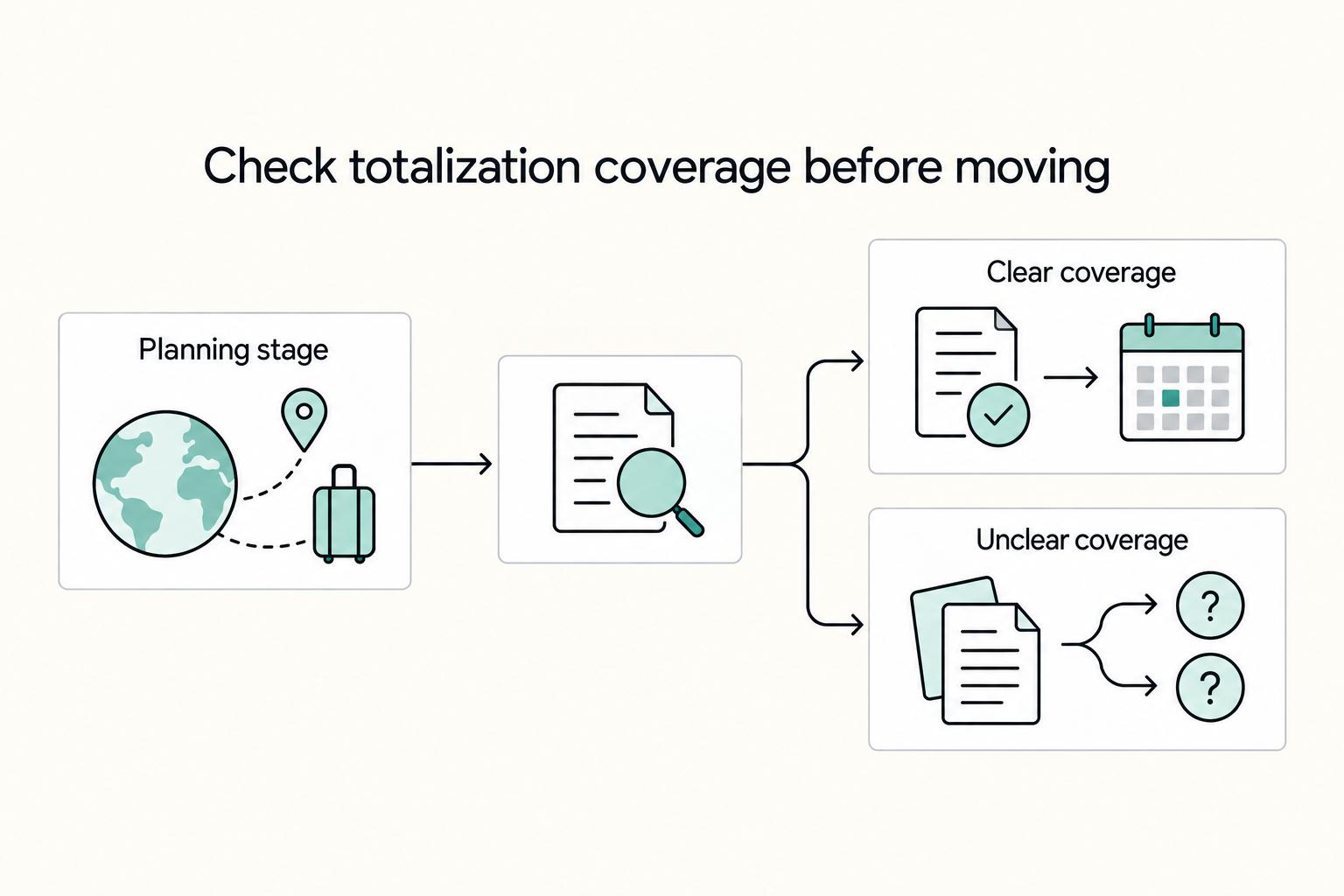
Quick Answer
US expat freelancers can still owe US self-employment tax even if the FEIE reduces their US income tax to low or zero. Self-employment tax is calculated on Schedule SE at 15.3% of net earnings, and it applies once you have $400 or more in net self-employment income. The main way to change the outcome is Social Security coverage coordination through a Totalization Agreement, supported by a Certificate of Coverage.
The Self-Employment Tax Trap: What Every US Expat Freelancer Must Know Before Choosing a Base#
Most US expat freelancers will spend weeks researching income tax in a new country, then spend zero minutes on the one tax that can still follow them even when their US income tax bill is low or zero.
That is the trap. It is not "I did not know taxes existed." It is "I assumed the rule that helped with income tax also helped with self-employment tax." Those are different systems. Self-employment tax, calculated on Schedule SE, and income tax are separate lanes. Different levers. Different paperwork. Mixing them up gets expensive.
Here is the framing to use before you pick a base:
- The Foreign Earned Income Exclusion (FEIE) can let qualifying individuals exclude foreign earned income from US federal income tax, up to $130,000 per person for tax year 2025, and $132,900 for 2026. It is powerful. It also does not reduce self-employment tax or your Schedule SE obligation.
- The foreign tax credit can reduce US income tax in some situations. It is not the same tool as self-employment tax planning.
- Bilateral Social Security coverage rules (when they apply) can change which country's social security system you pay into. This is where your self-employment tax outcome can change. It is also separate from the FEIE.
If you are building your location strategy around the FEIE, or other income tax moves, and ignoring Schedule SE entirely, you are optimizing the wrong line item.
What This Article Is - and Isn't#
This is a 10-minute decision framework, not background reading. By the end, you will know:
- Whether any cross-border Social Security coverage rules apply to your specific situation
- What documentation you may need to support your position, where applicable
- What it can cost, in concrete terms, to skip this filter before signing a lease or building a long-term client base in a country
This article covers self-employment tax and Schedule SE specifically, not income tax. Separate rules, separate mechanisms, separate planning moves.
Whether You're Planning a Move or Already Abroad#
Where you are in the process changes what "good" looks like. Use this to orient your next move:
| Your situation | Primary risk | First move |
|---|---|---|
| Planning a move | Choosing a country without checking how self-employment tax might apply | Run the "SE tax reality check" before you commit |
| Already abroad, clearer coverage position | Your paperwork and filings do not match your actual coverage | Align documentation and filings; file correctly |
| Already abroad, unclear coverage position | Potential overlap between systems | Assess your structure and professional support options now |
Both paths are covered below. If you want the broader picture on location-independent tax strategy first, Digital Nomad Taxes in 2026 With a Defensible Filing Plan is a good starting point.
The rest of this guide follows one principle: treat self-employment tax as its own system, use coverage rules when available to avoid paying into two systems, and back your position with documentation that can survive scrutiny.
Why Self-Employed Workers Face a Tax Burden Employees Don't#
As a freelancer, you pay the full 15.3% self-employment tax on your net earnings. The IRS describes this as equivalent to both the employee and employer shares of Social Security and Medicare taxes.
That is the structural gap. Employees split these taxes with an employer. Self-employed workers carry the combined burden through self-employment tax, calculated on net self-employment income.
In practice, this means you can make smart income tax moves abroad and still get hit with a meaningful Schedule SE bill if you do not handle coverage correctly.
Breaking Down the 15.3%#
Self-employment tax is the combined Social Security and Medicare levy calculated on your net self-employment income using Schedule SE, filed with Form 1040. It has two components:
| Component | Rate | Cap |
|---|---|---|
| Social Security (old-age, survivors, disability) | 12.4% | Subject to the annual Social Security wage base |
| Medicare | 2.9% | - |
| Total SE tax | 15.3% | - |
Two planning points matter here.
First, the cap is not on the total. The Social Security wage base is the annual ceiling on earnings subject to the 12.4% Social Security portion. It is indexed each year, so check the current figure before you plan.
Second, the trigger is low. If you had net earnings of $400 or more from self-employment, you owe SE tax. Age does not matter. Existing Social Security or Medicare enrollment does not matter. The obligation still applies.
The IRS and SSA: Two Agencies, Two Roles#
Think of this as a relay.
The IRS is where you calculate and report the tax. For self-employed individuals, Schedule SE is how you figure the tax due on net earnings from self-employment and report the result with your return.
The SSA is where that reporting ends up. It uses the information from Schedule SE to figure your benefits under the Social Security program.
That split matters later because the agency that controls coverage determinations is not the IRS.
Does the Foreign Earned Income Exclusion Reduce Your Self-Employment Tax?#
No. The Foreign Earned Income Exclusion reduces US federal income tax. It does nothing to your self-employment tax liability.
This is the single most common failure mode for US freelancers abroad. They do the work to qualify for the FEIE, sometimes get their income tax close to zero, then assume the job is done. It is not. Schedule SE can still apply.
You can qualify under either the Physical Presence Test or the Bona Fide Residence Test. You can exclude foreign earned income under the FEIE. You can still owe self-employment tax on your net self-employment income.
What the FEIE Actually Does#
The Foreign Earned Income Exclusion (FEIE) lets qualifying US citizens and resident aliens living and working abroad exclude foreign earned income from federal income tax, up to an annually adjusted cap ($130,000 for 2025; $132,900 for 2026). To claim it, you must meet three conditions:
- Foreign earned income: income that qualifies as foreign earned income under IRS rules
- Foreign tax home: your tax home must be in a foreign country
- Qualifying test: either the Physical Presence Test (330 full days in a foreign country during any 12-consecutive-month period) or the Bona Fide Residence Test (an uninterrupted period that includes an entire tax year)
Those requirements matter for income tax. They are just not the switch that turns self-employment tax on or off.
Why Your Self-Employment Tax Can Still Apply#
The FEIE is an income tax break. It does not wipe out self-employment tax.
So if you earn $100,000 abroad, qualify for the FEIE, and exclude that $100,000 for income tax purposes, you can still owe self-employment tax on that net self-employment income.
If you want to change the self-employment tax outcome, you have to work in the coverage lane, not the FEIE lane. That is where Totalization Agreements come in.
What Is a Totalization Agreement, and Who Controls It?#
A Totalization Agreement is a bilateral Social Security agreement between the United States and a partner country. It eliminates dual Social Security taxation by assigning a worker's coverage to one country's system.
For self-employed US expats, this can be the lever that changes your Schedule SE result. It operates where the FEIE cannot, because it is about coverage and contributions, not income tax.
The Core Mechanism: One Country, One System#
The foundational rule is simple: single-country coverage. Under a Totalization Agreement, you pay Social Security taxes to one country only, not both.
The agreement assigns your coverage based on where you have the greater economic attachment. If the assignment lands on the US, you remain subject to SECA taxes. If it lands on the host country, you are exempt from US SECA taxes on those earnings.
Totalization Agreements exempt earnings from FICA taxes (Social Security and Medicare) when a worker is subject to a foreign country's equivalent social security system. For self-employed workers, a parallel exemption applies to SECA (Self-Employment Contributions Act) taxes, which is the self-employment tax that Schedule SE calculates.
This is where many freelancers stop too early. The exemption is not something you "assume" into existence. To make it stick, you need documentation.
The Certificate of Coverage (COC) is an official document issued by the Social Security Administration that serves as proof you, and where applicable your employer, are exempt from paying Social Security taxes to the other country under the agreement. Self-employed workers must request this certificate to establish an exemption.
Who Actually Administers This - and Why It Matters#
Coverage determinations are not an IRS process. The SSA runs this.
Specifically, the SSA's Office of International Programs is the place to direct Totalization Agreement questions.
The IRS references the agreements. The SSA controls coverage determinations and issues the documentation you will rely on. That division of labor is not a minor technical detail. It changes how you solve problems when you are unsure which system applies, or when you need proof that your position is valid.
Each agreement also has country-specific rules for how coverage is assigned. Practical implication: you cannot treat "Totalization" as a generic checkbox. Your target country either has an active agreement or it does not, and the operative details live in that specific agreement text.
With that in mind, the next move is not "do I qualify for the FEIE?" It is "is this country covered, and what does the specific agreement do with self-employment?"
Is Your Target Country Covered? Use This as a Location Filter, Not a Footnote#
A target country's status on the SSA's active Totalization Agreement list is a major location variable for your self-employment tax position. Check it early, because it changes what "normal" looks like for your cash flow.
The question is binary: is your target country even in play? The US has Totalization Agreements with a limited set of foreign countries. The list is smaller than most people assume, and it deserves a place near the top of your location decision stack.
The SSA publishes the agreements and the agreement text. The IRS may reference them, but the SSA is where the active list and copies of the agreements live.
Run This Three-Step Check Before You Commit to a Location#
Use this sequence every time you evaluate a new base:
| Step | Check | Article note |
|---|---|---|
| 1 | Country on the SSA's international agreements page | If the country is not listed, the article says to use the no agreement path |
| 2 | Whether the agreement addresses self-employed individuals | Do not assume employee coverage means a parallel SECA exemption applies |
| 3 | What drives coverage assignment | Coverage is based on greater economic attachment, not just where a client contract says work is performed |
Step 1: Is the country on the list? Pull up the SSA's international agreements page and confirm your target country appears. If it does not, your self-employment tax position changes significantly. Skip ahead to the "no agreement" section of this guide.
Step 2: Does the agreement address self-employed individuals? This is where people get sloppy. Totalization Agreements cover FICA for employees, and there can be a parallel SECA exemption for self-employed individuals. Do not assume how it works in your case. Read the relevant provision in the specific agreement text, or confirm the scope with a cross-border CPA before you treat yourself as exempt.
Step 3: Understand what drives the coverage assignment. The agreement assigns coverage based on greater economic attachment, not just where a client contract says work is performed. That assignment generally determines whether you pay into the US system or the host country's comparable system. Get the assignment right before you claim anything on a return.
When You're Unsure, Contact the SSA Directly#
Sometimes the agreement text still leaves you with a "this depends" answer. When that happens, go to the source.
The SSA's Office of International Programs handles Totalization Agreement inquiries at 410-965-7306. If the treaty text does not answer your question cleanly, this is the next move.
For the broader location-independent tax picture, the digital nomad tax guide covers the broader decision stack.
Once you know your country is covered and how coverage is assigned, the next operational step is getting the documentation that turns "should be exempt" into "is exempt on paper."
How to Get a Certificate of Coverage as a Self-Employed Worker#
A Certificate of Coverage (COC) is the official document that proves your earnings are covered under one country's Social Security system and that you are exempt from Social Security tax obligations to the other country.
If you are relying on a Totalization Agreement to avoid dual Social Security taxation, the COC is not optional. It is your proof.
Who Issues Your COC Depends on Coverage Assignment#
A Totalization Agreement assigns coverage to just one country. The agreement generally assigns coverage based on where the worker has the greater economic attachment. That assignment determines which authority issues your certificate.
| Coverage Assigned To | Who Issues the COC | Your Action |
|---|---|---|
| United States | Social Security Administration (SSA) | Request through SSA's Certificate of Coverage service |
| Host Country | That country's social security authority | Contact the foreign agency directly |
If US Social Security covers you, the SSA issues a US Certificate of Coverage. The certificate serves as proof that you are exempt from paying Social Security taxes to the other country on the covered earnings.
If the host country's system covers you, you will need the equivalent certificate from that country's authority.
Think of it this way: coverage assignment is the decision; the certificate is the document that proves it. If you skip the document, you leave your position undefended.
Why You Need This (Even If You Live Abroad)#
Living abroad does not automatically change your US self-employment tax obligation. The rules are generally the same whether you live in the United States or abroad.
When a Totalization Agreement assigns your coverage to one country, the COC is what documents that assignment and supports the exemption from the other country's Social Security taxes. If questions come up later, "I thought I was covered" is not a defensible position. A certificate is.
Once you have it, store it with your tax records and related correspondence so you can produce it quickly if a bank, a foreign agency, or a US agency asks for proof of coverage.
Keeping your COC, invoices, and tax documents organized in one place helps when an exemption gets questioned. See how Gruv's tax document workflows help location-independent operators stay organized (where enabled).
With the covered-country path mapped, we can address the other branch. What changes when there is no agreement at all?
What If Your Country Has No Totalization Agreement?#
Without a Totalization Agreement in place, you may end up paying into both the US system and your host country's social insurance system on the same earnings, depending on how your host country treats freelancers and self-employed work.
This is not automatically a deal-breaker. It is a cost structure you need to understand before you commit to a base. The question is not "is this fair?" The question is "can my business absorb this and still make the location worth it?"
Treat it like any other margin decision. If the market is strong, your client pipeline is stable, and the lifestyle value is real, you might choose to accept the extra cost. If your margins are already thin, the same location can become a structural mistake.
What the Foreign Tax Credit Does (and Doesn't) Do#
The Foreign Tax Credit is the first tool most people reach for when they hear "double taxation." For this specific problem, it is usually the wrong tool.
| Payment type | FTC treatment | Article note |
|---|---|---|
| Foreign income taxes | Applies | One of the categories the credit applies to on Form 1116 |
| War profits taxes | Applies | One of the categories the credit applies to |
| Excess profits taxes | Applies | One of the categories the credit applies to |
| Foreign social security-type contributions | Generally do not fit cleanly | The credit reduces US income tax liability, not self-employment tax directly |
| French CSG and CRDS | Specific exception noted | In 2019 the IRS agreed not to challenge credits claimed for those specific payments; the article says this is narrow and jurisdiction-specific |
The Foreign Tax Credit, claimed on Form 1116, applies to foreign income taxes, war profits taxes, and excess profits taxes. The IRS position is clear: only those categories qualify for the credit. As a result, payments that function like foreign social security contributions generally do not fit cleanly into what the credit is designed to cover. Even when the credit applies, it reduces US income tax liability, not self-employment tax directly.
There is one documented exception worth flagging because it trips people up. In 2019, the US and France established through diplomatic communications that French CSG and CRDS taxes are not covered by the US-France Social Security Agreement, and the IRS agreed not to challenge foreign tax credits claimed for those specific payments. That is narrow and jurisdiction-specific, not a reusable strategy.
Also note: certain tax treaties have special rules that affect how you figure your foreign tax credit. This is where a competent cross-border pro earns their fee, because the interaction can change what you think you can claim.
How to Think About Your Structural Options#
When there is no agreement, you are not looking for a magic form. You are looking for a structure that matches your reality and minimizes avoidable overlap.
If you are planning a move, a cross-border CPA can help you pressure-test structural approaches like:
- Operating through a US entity while living abroad: this can change your reporting and compliance footprint in both countries.
- Incorporating locally: this can shift how your income is characterized and what filings you are responsible for.
- Accepting the dual system exposure: sometimes the market opportunity justifies the cost. That is a business decision, not a tax failure.
If you are already operating in a non-covered country, the conversation shifts from planning to remediation. Get professional advice before filing or restructuring. The variables, including whether there is an applicable tax treaty, local social insurance rules, your entity type, and how you have reported income, can interact in ways that demand a specialist read.
For the broader decision stack, see our guide to a defensible 2026 filing plan.
Whether you are covered or not, the last step is the same: make your position defensible. That takes documentation, not assumptions.
Building an Audit-Ready Position: Documentation That Holds Up#
Qualifying for a Totalization Agreement exemption and proving it under scrutiny are two different jobs. In an audit, the second job is the one that matters.
Treat documentation like any other business system. Build it once, keep it current, and stop relying on your future self to reconstruct the story under deadline pressure.
The standard you are aiming for is simple: a third party should be able to look at your records and understand (a) what you did, (b) where you did it, (c) which system covered you, and (d) why your return reflects that.
Your Core Record Stack#
An audit-ready self-employment tax position rests on four categories of documentation. You do not need a "perfect" system. You need a complete one.
| Record category | Examples | Why it matters |
|---|---|---|
| Coverage and exemption support | Certificate of Coverage; related correspondence | Supports a position that relies on formal paperwork |
| Proof of self-employment income by country | Contracts; invoices; bank records | Should map cleanly to what you reported |
| Evidence of physical work location | Travel records; lease agreements; utility bills | Corroborates where you actually worked |
| Annual tax filings and supporting calculations | Tax filings; supporting calculations | Your filed position needs to match the story your documents tell |
1) Coverage and exemption support. If your position relies on formal paperwork, keep originals and separate digital backups. This includes the Certificate of Coverage when you have one, plus related correspondence.
2) Proof of self-employment income by country. Contracts, invoices, and bank records should map cleanly to what you reported. If you cannot reconcile your invoices to deposits, and deposits to reported income, you are building friction into any future review.
3) Evidence of physical work location. Travel records, lease agreements, utility bills. These corroborate where you actually worked, which often matters for how your story is evaluated across systems.
4) Your annual tax filings and supporting calculations. Your filed position needs to match the story your documents tell. Inconsistencies create heat fast, especially when you are trying to explain why one tax applies and another does not.
Organize these in a folder structure you can export quickly. If a government agency sends correspondence, you do not want to be hunting for a lease PDF from two laptops ago.
FATCA and FBAR: Parallel Tracks, Not Afterthoughts#
If you hold foreign financial accounts, such as a local bank account where clients pay you or a brokerage in your host country, you may have FATCA and FBAR obligations running alongside your self-employment tax position.
FATCA (Foreign Account Tax Compliance Act) requires certain US taxpayers to report foreign financial assets to the IRS generally using Form 8938, attached to your annual tax return. The aggregate value of these assets must exceed $50,000 to be reportable in general, though the threshold may be higher depending on your situation.
Failure to file Form 8938 carries an initial penalty of $10,000, rising to up to $50,000 for continued non-compliance after IRS notification. Underpayments attributable to non-disclosed foreign assets face an additional 40% substantial understatement penalty.
FBAR (FinCEN Form 114) is a separate filing administered by FinCEN. Filing Form 8938 does not satisfy your FBAR obligation. These are distinct compliance tracks with distinct rules.
Audit-readiness means all tracks are clean, not just the Schedule SE one. A gap in FBAR or FATCA compliance can complicate an otherwise straightforward situation.
Your Pre-Move Checklist and When to Call a Pro#
Use this before you commit to a new base, not after you have already signed a lease.
The concepts are simple. The execution is where people usually lose money.
Pre-Move Compliance Checklist#
Work through each item before you start invoicing from a new country:
- Totalization Agreement status: Does a Totalization Agreement apply between the US and your target country?
- Self-employed coverage: If an agreement applies, does it address self-employed workers, not just employees?
- COC initiation: Do you need a Certificate of Coverage, and have you confirmed how and when it should be requested (processes can vary)?
- Documentation baseline: Are your physical presence records and business records strong enough to support your position if questioned?
- FBAR compliance: Are your FinCEN Form 114 (FBAR) obligations current for any foreign financial accounts?
- FATCA/Form 8938: Do your foreign financial assets exceed the reporting threshold (in general, reporting can start when aggregate specified foreign financial assets exceed $50,000)? If Form 8938 applies, is it attached to your annual tax return?
- Schedule SE treatment: Does your current filing approach reflect the correct self-employment tax position given your agreement status?
Each unchecked box is a risk you are carrying into the new location. Clear the list before you move, not while you are scrambling during tax season.
When to Stop DIYing and Call a Pro#
DIY is fine for clean situations: covered country, COC in hand, straightforward Schedule SE filings. Once complexity enters, a cross-border CPA or tax attorney can save you real money and prevent avoidable rework.
Engage a specialist when:
- You are relocating to a country with no Totalization Agreement and face potential dual social security exposure
- You have already filed without taking a position you may qualify for under a Totalization Agreement
- You are exploring incorporation abroad to restructure your self-employment tax position
- A government agency has questioned your coverage or exemption position
- Your foreign financial assets or accounts raise FATCA or FBAR reporting questions and you are unsure which forms apply
The penalty math alone justifies professional fees. A missed Form 8938 filing starts at $10,000. That is not a number to guess at.
For the operational layer, keeping invoices, tax documents, and cross-border payment records traceable and audit-ready, explore how Gruv's tax document workflows can support location-independent operators (where enabled) or book a demo. When your records are clean and exportable, defending a cross-border tax position takes less time and money. Explore Gruv's compliance infrastructure for globally mobile freelancers to see how the operational layer fits your setup.
Frequently Asked Questions
Can I use the Foreign Earned Income Exclusion to reduce my self-employment tax?
No. The FEIE reduces federal income tax only and does not reduce self-employment tax calculated on Schedule SE. Changing your self-employment tax outcome is usually a separate coverage question from the FEIE.
How do I get a Certificate of Coverage as a self-employed person?
You generally must request a Certificate of Coverage from the appropriate authority, and it is not necessarily automatic. Who issues it depends on which country the agreement assigns coverage to, either the SSA or the host country's social security authority. The process and terminology can vary with the countries involved and your facts.
Which countries have Totalization Agreements with the US?
Country coverage varies, and agreements can differ in how they treat self-employment. Use official government resources to confirm current agreement status and read the actual agreement text. Check the self-employment provisions rather than assuming they apply.
What happens if I live in a country with no Totalization Agreement?
You may be exposed to social security-type contributions in more than one system on the same earnings, depending on how US rules and the host country's rules apply to you. The outcome can be fact-specific, so it is worth modeling before committing to a location.
Does a Totalization Agreement reduce my income tax?
Not by itself. Totalization Agreements coordinate social security coverage, while the FEIE is an income tax provision and does not reduce self-employment tax. Treat social security coverage coordination and federal income tax planning as separate lanes.
What records do I need to defend a COC-based exemption if audited?
Keep the COC itself (if you have one) and any documentation supporting your coverage position. Maintain records showing where you worked and when, plus income records that match what you reported on your return. Claiming the FEIE does not mean you stop reporting foreign earned income on a US return.
Try a related tool
Researched and edited by the Gruv editorial team. Gruv builds cross-border billing, payouts, and finance-operations software for global businesses.
Sources
Includes 2 external sources outside the trusted-domain allowlist.
Educational content only. Not legal, tax, or financial advice.
Related Posts

Digital Nomad Taxes in 2026 With a Defensible Filing Plan
With digital nomad taxes, the first move is not optimization. It is figuring out where you may be taxable, where filings may be required, and what proof supports that position.

The Freelance Payment Penalty: A Modeled Audit of Platform Fees, FX Spreads, and Payout Delays
The money rarely disappears through a single, easy-to-spot fee. The real loss is stacked. A marketplace takes its commission, a processor adds a charge for international cards, a bank or payment company converts the currency at a spread, a platform holds the funds before release, and a wire sheds a little to intermediaries on the way in. Each layer looks defensible on its own, but the worker feels the combined result as a smaller deposit and a later payday.

How to Respond to a Subpoena for Business Records
Move fast, but do not produce records on instinct. If you need to **respond to a subpoena for business records**, your immediate job is to control deadlines, preserve records, and make any later production defensible.