
Quick Answer
For e-residency banking problems, separate provider eligibility from incorporation and tax status. Confirm the actual account functions, entity, protections and references, then test a primary route and a funded fallback for the flows you need. A bank change does not itself change OSS or SME authorization. Keep filing and payment deadlines intact and trace unknown transfers before sending replacements.
Learn from earlier account problems before committing new volume#
Before choosing an Estonian company structure, check likely provider eligibility and the collections, payouts and tax-payment routes you will need. A live company account may require incorporation first, so use pre-screening for the setup decision and actual account tests before routing material volume. The second-mover advantage here is learning from earlier problems, not a proven increase in approval odds.
e-Residency is digital access, not personal tax residency. Estonian tax guidance distinguishes the individual from an Estonian-incorporated company, which is resident under Estonian law. Managing or operating the company elsewhere can create additional foreign obligations; neither the digital ID nor the account resolves those questions.
That is where banking friction starts. Account opening is a separate, provider-led decision. Official guidance is clear that an e-resident digital ID does not guarantee company formation plus bank account opening, and banks run their own KYC checks. Your launch question is not just whether you can register online. It is whether a bank or EMI will accept your business and support the money flows you actually need.
Use these terms consistently as you read:
- Banking continuity: Your payment operations still work if one provider delays onboarding, asks follow-up questions, or restricts activity.
- Management and control: Where material decisions are actually made. The effect on residence or a permanent establishment depends on the relevant country and treaty, not an account label.
- Tax information: The entity and owner tax-residency details required by the provider and applicable reporting rules. Keep them separate from where the account is held.
Do not anchor your plan on getting an Estonian IBAN. Estonian companies are not required to hold an Estonian account or EE IBAN, and official guidance allows EEA business banking accounts, including fintechs. That gives you more options, but banks and fintechs still decide client acceptance case by case.
For setup, shortlist a credible primary provider and a feasible fallback, documenting what remains conditional on incorporation. Before depending on live banking, obtain approval for the necessary functions and test them. A backup should fit the same entity and actual activity; it cannot make frozen funds available by itself.
This article helps you make that call by comparing account options and tradeoffs, separating verified signals from unknowns, and giving you a practical path to launch, delay, or narrow scope. For account-opening mechanics, use How to Open a Business Bank Account for Your Estonian Company.
Use the article in this order:
- Continuity check: Confirm one primary route and one realistic backup before you depend on the company.
- Compliance alignment: Make sure onboarding facts, tax position, and where decisions are made tell one consistent story.
- Launch decision: Go live only when your account path, documentation, and cross-border assumptions can withstand routine review.
This sequence is intentionally conservative. It is usually easier to delay setup than to fix a structure that cannot bank cleanly once live.
The core problem is not incorporation but reliable banking access#
For launch, the main risk is banking continuity, not company registration speed. You can often complete e-Residency and incorporation quickly, but the business is not really launch-ready until you can reliably collect, pay, and reconcile through approved, usable accounts.
Digital-ID processing, company registration and account onboarding have separate requirements and timing. Obtain current estimates for your own application rather than promising a universal number of weeks or days. An approved account can still face review, limits or restrictions under its terms.
Separate the three decisions#
Keep these decisions distinct so you do not confuse legal setup with cashflow capability.
| Decision | What it means | What it does not guarantee |
|---|---|---|
| Company formation | Registering the Estonian company | You can complete formation and still face onboarding rejection from a provider |
| Account approval | A provider decision | e-Residency status alone does not guarantee banking access |
| Operational readiness | Ability to receive funds, send funds, and reconcile records reliably | You can pass onboarding and still be fragile if one provider restricts or closes access |
These decisions are not interchangeable: you can complete formation and still face onboarding rejection, and you can pass onboarding yet remain fragile if one provider restricts or closes access.
It is also true that you do not need an Estonian IBAN to run an Estonian company, and EEA business accounts, including fintechs, are allowed. That widens the field, but it does not remove provider discretion or case-by-case approval.
Use evidence in this order#
Use a simple evidence hierarchy when deciding whether to proceed:
- Official program guidance: sets the baseline rules. Digital identity, company setup, and banking are separate decisions.
- Provider policies and terms: define the real acceptance and continuity constraints, including verification requirements, onboarding criteria, and possible account closure for policy violations.
- Community and operator signals: useful for spotting friction patterns, but not proof of policy outcomes.
Quick launch checklist#
| Checkpoint | Pass if | Fail if |
|---|---|---|
| Primary rail | You have one named bank or EMI path that matches your real activity and verification expectations | You assume approval because registration is complete or someone else succeeded |
| Backup rail | You have a second realistic route that can carry critical transactions if the first route stalls | One restriction, rejection, or review would stop collections, payouts, or invoicing |
| Documentation readiness | Your business narrative, expected flows, and associated-person details are consistent across submissions | Your story changes by provider or leaves gaps on who pays you and where money goes |
| Pause trigger ownership | One owner is accountable for pausing launch when banking is unresolved | No clear owner, so commercial steps start before rails are ready |
Use one go/no-go rule: proceed only when you can collect, pay, and reconcile through a primary path plus a credible fallback. If not, delay any launch step that assumes live banking.
What banks and EMIs actually screen for before opening accounts#
You cannot know a provider's exact approval model in advance. What you can control is whether your application tells one consistent, review-ready story about ownership, activity, money flows, and tax treatment. In practice, inconsistency creates friction.
Check the provider’s legal entity and regulated category. A bank may hold deposits; an electronic-money institution issues e-money; a payment institution provides payment services and may offer account details without being a bank or EMI. IBAN features alone do not establish deposit insurance, credit facilities or regulatory category. Compare the actual product and funds protections.
What reviewers are trying to confirm#
Reviewers test coherence across a few core points. e-Residency does not guarantee account access, and provider decisions remain case by case.
| Review area | What reviewers confirm | What can trigger follow-up |
|---|---|---|
| Beneficial ownership | Who in the end owns or controls the company, and whether identity can be verified | Registry records, shareholder details, ID documents, and signatory information do not line up |
| Transaction profile | What you sell, who pays you, customer locations, typical ticket sizes, expected volume, and where funds go next | The relationship purpose and intended nature are not supported by a credible transaction picture |
| Source and use of funds | Source-of-funds or source-of-wealth information and reasons for transactions in higher-risk or more complex cases | Your form says one model but your invoices show another |
Start with beneficial ownership: who in the end owns or controls the company, and whether identity can be verified. If registry records, shareholder details, ID documents, and signatory information do not line up, you should expect delays or follow-up checks.
Then transaction profile: the purpose and intended nature of the relationship. Reviewers want a credible picture of what you sell, who pays you, customer locations, typical ticket sizes, expected volume, and where funds go next.
Then source and use of funds. In higher-risk or more complex cases, enhanced checks may ask for source-of-funds or source-of-wealth information and reasons for transactions. If your form says one model but your invoices show another, reviewers may reassess the risk profile.
Make VAT part of the same story#
Your VAT note should match your invoices and customer geography. Use a simple coherence test: do invoices, customer type and location, and filing route describe the same business?
OSS is an optional reporting route for supplies within the selected scheme, not all EU consumer sales or a bank-account requirement. The combined €10,000 place-of-supply threshold concerns qualifying cross-border B2C telecommunications, broadcasting and electronic services plus intra-EU distance sales of goods. It requires the specified single-Member-State establishment and current/prior-year conditions; it does not cover other services generally. Record the actual sale type, customer status, place of supply and applicable route.
Estonian registration guidance sets a separate €40,000 trigger for the specified turnover whose place of supply is Estonia, measured from the start of the year. It is not a ceiling for all worldwide sales or a replacement for OSS. Other registration obligations can arise. Keep the invoice treatment and accountant’s route note consistent with the actual business, and use the Estonian account-opening guide for the application steps.
A compact evidence pack for coherent review#
Build one evidence pack and keep the core facts identical across submissions.
| Evidence item | Why reviewers ask for it | Common mismatch that causes delays |
|---|---|---|
| Company registry extract and formation details | Helps confirm the legal entity in the application | Company name, registration number, or directors differ across documents |
| Beneficial owner and signatory ID documents | Verifies who owns or controls the company and who can act for it | Registry, shareholder details, and ID records do not align |
| One-page business and fund-flow summary | Supports the stated purpose and intended nature of the relationship | Form says consulting, summary describes marketplace or client-money handling |
| Invoice samples or draft commercial documents | Helps test whether transactions match the stated model | Customer type, pricing, or geography differs from the application |
| Customer geography and expected volume note | Helps assess incoming funds and transaction patterns | "Global customers" with no country split, average ticket, or monthly range |
| Tax-treatment note | Confirms VAT route and invoice logic | OSS claim conflicts with customer mix, invoices, or registration status |
Before submission, read the pack in order as a reviewer would. Your company description, invoice sample, and tax note should all point to the same customer type and money path.
The channel-choice rule#
Compare actual provider terms, costs, functions and protection rather than assuming a bank is always more durable or a fintech easier to enter. For an EEA account, check the regulated entity and applicable deposit-guarantee or safeguarding arrangements. UK FSCS statements are relevant to UK products; they do not establish protection for an Estonian company’s EEA product.
Submit only when your one-page flow narrative, supporting documents, and tax-treatment notes tell the same story with no unresolved contradictions. If ownership, invoices, geography, or VAT handling still conflict, pause and fix that first.
Where the promise breaks in day-to-day operations#
The breakdown often starts in coordination, not setup. Your billing cycle can move ahead before status checks, evidence, and signoff are aligned. That is where routine admin turns into payment friction.
In day-to-day work, delivery, finance, and compliance can move on different clocks. If delivery is ready, finance is working to invoice timing, and status verification is still pending, the mismatch usually shows up later as account friction.
Separate account restrictions from internal readiness status#
Give each readiness issue a specific object: a provider function, a proposed transaction, an invoice treatment or a tax filing. Record the basis, affected amount, owner and next action. Internal labels help coordinate work; they do not create legal authority to withhold payment or miss an invoice deadline.
If a provider has restricted a function, record the actual notice and permitted actions. If only an internal fact or tax assumption is unresolved, investigate the affected treatment and preserve contractual and statutory deadlines. Do not stop all invoicing or collaborator payments merely because finance and delivery have not synchronized their notes.
What is known and what is unknown#
Known from current evidence:
- A digital ID, company registration and provider account decision answer different questions.
- A provider approval applies to its stated product, entity and functions, not every currency or future activity.
- Protection follows the actual regulated entity and product, rather than the presence of an IBAN.
- Your own receipt and payment records can establish what completed; an initiation screenshot alone cannot.
Unknown from current evidence:
- Bank or EMI rejection, freeze, or failure rates.
- Provider-by-provider reliability rankings.
- Any claim that one provider will fail less often in your daily operation.
The weekly readiness page#
Keep one page that finance and delivery both check before billing runs.
| Dependency | Status owner | Last check | Blocker | Decision | Next review |
|---|---|---|---|---|---|
| Provider function | Operations owner | Dated notice or terms | Actual restriction or missing capability | Use permitted alternative or resolve with provider | Specific date |
| Invoice treatment | Tax/finance owner | Transaction facts and rule checked | Affected treatment unresolved | Resolve or correct affected invoice within applicable deadlines | Specific date |
| Required account detail | Finance owner | Account-holder and beneficiary record | Missing or inconsistent required field | Verify the affected instruction; do not defer unrelated obligations | Specific date |
| Unknown transfer | Payments owner | Provider status and reference | Completion cannot be established | Trace before replacement to avoid duplicate payment | Specific date |
| Reporting item | Tax owner | Authority and filing record | Missing fact or overdue review | Correct reporting and meet actual deadlines | Specific date |
Review the affected dependency and next action without turning every gap into an operational stop. Limit new exposure when material readiness is uncertain, arrange lawful funding for existing obligations, and escalate deadlines you may miss. Filing access and return submission should remain available even when the payment account is unavailable.
A pre-setup checklist that pressure-tests your plan#
Use pre-screening before incorporation and a separate operational check before material routing. Resolve the actual VAT treatment and applicable registration requirements before relying on an exemption. A fallback account is a continuity choice under this framework, not a universal legal prerequisite for forming a company.
To keep the review clean, use these terms consistently on one shared sheet:
- Transaction map: your expected inflows, outflows, counterparties, and payment routes, written so planned activity matches your stated customer and risk profile.
- VAT path: the filing route for each sale type, such as a domestic route or OSS, applied consistently.
- SME scheme eligibility: whether the cross-border SME route is implemented where you need it and whether your turnover fits the currently verified limits.
- Prior notification: the filing to your Member State of establishment before using the cross-border SME exemption.
- Cross-border ruling (CBR): an advance VAT ruling request for complex cross-border transactions between participating EU countries, where available, requested where you are VAT-registered.
Start with unresolved fields. Replace each one only after confirming current rules with the relevant tax authority in each country.
| Checkpoint | Required evidence | Pass/Fail rule | Owner | Review date |
|---|---|---|---|---|
| Transaction map | Flow map, sample invoice, named counterparties, payment routes, fallback provider | Pass only if every planned inflow and outflow is mapped and coherent. Fail if any planned transaction is still vague. | Named person | Date |
| VAT path | Country-by-country treatment note, OSS scope check, local-rule field marked unresolved until verified from the relevant authority | Fail if any planned sale has no assigned filing path, or OSS is selected without confirming scheme coverage and reporting obligations for supplies in that OSS scheme. | Named person | Date |
| SME scheme eligibility | Proof the scheme is implemented in your Member State of establishment and target countries, Union turnover threshold check, national threshold check, with any unverified values marked unresolved | Fail if you assume the exemption without verified country availability and current threshold checks. | Named person | Date |
| Prior notification and EX number | Prior-notification filing proof or status from your Member State of establishment, EX status proof, contingency if delayed | Fail if exemption-dependent launch is planned before EX use is granted and confirmed. | Named person | Date |
| CBR need | Memo of complex cross-border transactions, participating-country check, ruling request or written not needed decision | Fail if a complex planned transaction still has unresolved VAT treatment. | Named person | Date |
| Primary and backup account path | Primary provider plan, backup provider plan, onboarding evidence pack | Fail if no fallback path is documented before launch. | Named person | Date |
Assign filing owners and actual deadlines for whichever routes apply. An unused optional scheme is not a launch blocker. If you use the cross-border SME scheme, its quarterly report is due within one month of quarter end; confirm country-specific procedures. Union and non-Union OSS returns are quarterly, while IOSS is monthly, and returns/payment are due by the end of the following month. A missing internal sign-off does not extend those deadlines.
Use the Tax Residency Tracker to organize travel days as one input. It cannot validate company residence, treaty entitlement, management and control or permanent establishment. Keep the factual decision history and jurisdiction-specific advice in the evidence file.
Decision checkpoints for freelancers, small teams, and finance-led operators#
Use one shared go/no-go sheet across roles. Launch only when VAT handling and payment handling both work in real, testable operations. The pressure differs by role, but the discipline is the same.
Keep terms fixed on that sheet:
- Verification of Payee: A check of account identifier and intended payee name before a transfer; it is not proof of completed receipt.
- Instant euro transfer: A specific supported service, with availability and regulatory timing distinct from ordinary transfers.
- Incident handling: A documented way to identify affected functions, deadlines, available funds and recovery owners.
- Independent fallback: An approved alternative whose provider dependencies and usable balance are understood.
The ECB implementation table distinguishes provider type and location: euro-area bank sending and payee-verification duties began in October 2025; receiving/sending deadlines for euro-area payment and e-money institutions extend to April 2027. VoP covers ordinary and instant credit transfers. Check the actual product today rather than assuming every EEA account already provides every instant-payment function.
| Role | Checkpoint | What you must confirm | Fail trigger | Owner/date |
|---|---|---|---|---|
| Freelancer | VAT scope and route | Confirm every planned sale has one assigned VAT path, with unresolved fields completed only once verified. | Any sale type has no confirmed VAT path, or eligibility is assumed without verification. | Named person / review date |
| Freelancer | Primary and backup payments | Confirm one primary payment route and one backup route, with onboarding evidence and a test step saved. | You have only one untested route, or backup exists only as an idea. | Named person / review date |
| Small team | Filing and operations ownership | Assign named owners for filings, payment operations, and record retention. One person can hold multiple roles. | A deadline or account issue is owned by "the team" instead of a named person. | Named person / review date |
| Small team | Registration and timing assumptions | Keep assumed timelines marked unresolved until proof is attached for each item. | Launch timing depends on unverified VAT, compliance, or account-readiness assumptions. | Named person / review date |
| Finance-led operator | Control evidence and approvals | Require a dated approval trail for the transaction map, VAT position, account path, fallback route, and any accepted unresolved item. | A material launch decision is verbal only, or the file set cannot show why risk was accepted. | Named person / review date |
| Finance-led operator | Payment integrity and resilience | Confirm payee-name checks (including Verification of Payee where relevant), reconciliation, incident handling, and whether your route supports expected 24/7 instant euro transfer behavior. | Payments can be initiated but not reliably checked, matched, or rerouted when the primary route fails. | Named person / review date |
Keep a weekly review cadence with explicit outcomes:
- Move forward: VAT path verified, primary and backup routes documented, and at least one real test step is complete or evidenced.
- Limit new exposure: A material readiness item is incomplete; resolve the affected setup while preserving existing payment and filing duties.
- Escalate: the issue can change structure, such as unresolved VAT treatment on a core flow, no evidenced backup path, or a failed payee-name check or reconciliation process.
Wise and non-bank setups: capabilities and exposure#
Wise or another non-bank provider can be a primary or supplementary payment route when the product fits the business. It need not be temporary, and changing to a bank does not eliminate review or closure risk. Choose based on capabilities, protection, dependencies, funding and recovery, rather than treating every EMI as a bridge that must be replaced.
Start by classifying the setup you are actually using:
- Bank deposit account: Check which entity accepts the deposit, eligibility and the applicable guarantee scheme and limits.
- Non-bank route: Identify whether the entity is a payment institution or EMI, which services it offers and how relevant funds are safeguarded.
- Transition setup: A temporary arrangement if chosen for your needs, with explicit conditions and a tested exit; temporary status is not inherent in fintech use.
Wise Europe SA identifies itself as an authorized payment institution and describes safeguarding, rather than Belgian deposit-guarantee coverage for its payment services. Verify your own servicing entity and product. The FCA’s UK guidance distinguishes safeguarding from FSCS protection and notes that recovery after a non-bank failure can take time and incur deductions. That UK explanation is context, not a determination of EEA protection.
Account location does not make the company more or less resident by itself. Use the actual provider’s eligibility, account-holder details, supported currencies, tax-payment references and transfer limits to compare workable routes. An account application must describe the actual business rather than a modified story designed to pass screening.
| When a non-bank route helps | Exposure to check | Control evidence |
|---|---|---|
| You need a live route for collections and payouts while bank onboarding is pending. | It becomes your only live route for receipts, supplier payments, or other critical flows. | Onboarding approval, entity-name match, and one saved inbound plus one saved outbound test |
| You need online access quickly for early operations. | Compliance checks interrupt key money flows. Wise states suspension can block adding money, receiving money, and paying Direct Debit bills. | Dated test logs, invoice-to-payment reconciliation proof, and a live backup route |
| You are operating one legal entity with clean account scope. | Separate legal entities need their own authorized business account profiles. Wise’s business-account guidance requires distinct legal entities for distinct business accounts; trading names do not create new entities. | Account-to-entity mapping and onboarding or KYC file set per entity |
Pass/fail checkpoints before routing volume#
Before you route real volume, review the setup weekly and record an owner and date for every check.
| Checkpoint | Pass | Fail | Owner and cadence | Documented trigger to shift volume |
|---|---|---|---|---|
| Rail scope | All required flows are confirmed and tested | Any core flow is assumed, not tested | Named finance owner or founder, weekly review | One blocked or rejected production-critical flow |
| Control evidence | File includes onboarding approval, current terms, entity match, and reconciliation evidence | Evidence is fragmented across inboxes or verbal only | Named finance owner, weekly review | Missing or stale evidence for a live flow |
| Continuity | Separate backup route is live and tested | Backup exists only on paper | Named operations owner, weekly review | Suspension, stalled document review, or missed payment window |
| Legal-entity hygiene | Each legal entity has its own account path | One account carries multiple entities | Named compliance or finance owner, weekly review | Unexplained cross-entity collection or unauthorized use; legitimate intercompany flows need their own basis and records |
When to review or replace a temporary setup#
Review the architecture when restrictions repeatedly interrupt critical functions or reconciliation requires uncontrolled workarounds. Compare an additional provider, better funding or narrower supported flows before assuming a bank upgrade fixes the problem. For a closure, follow the provider’s current appeal and permitted balance-return process; do not route around a restriction to conceal activity.
| Trigger | What is happening | Action |
|---|---|---|
| Review interrupts a core flow | Identify the actual restriction and deadlines | Resolve with provider or use a permitted alternative with independent funds |
| Recurring restrictions | Current model may exceed product scope | Recheck eligibility, flow and other providers before new exposure |
| Repeated manual matching | References or exports cannot support reliable allocation | Fix records and reconcile exceptions before volume grows |
| Closure notice | Access or balance return may be limited | Follow current appeal/return process and authenticate new remittance instructions |
Keep tax residency, management, permanent establishment, account tax-information reporting and VAT analysis separate from provider-product decisions.
Cross-border tax and control risks that can reclassify your setup#
Misalignment between your records and day-to-day operations raises review risk. If approvals, contracts, and money movement do not match the structure you describe, you may face follow-up evidence requests and possible risk reassessment.
Use the terms in this section as a practical control check:
- Management and control: where material decisions are actually made and approved in practice.
- Operating narrative: the version of your business model shown across onboarding forms, contracts, invoices, tax registrations, website copy, and customer-facing communications.
- Evidence set: the file that ties those records together so a reviewer sees one consistent story.
Most of the proof is already in your workflow: board or founder approvals, signing-authority records, approval trails, contract sign-off records, and instructions sent to your bank or EMI.
Refresh the provider and adviser files when ownership, signatories, actual business activity, operating locations or material money flows change. A cyber incident also needs an operational response. Determine what the provider actually requires and when, rather than treating commentary on supervisory consultations as a universal onboarding rule.
| Document type | What must stay consistent | Drift signal | Corrective action owner |
|---|---|---|---|
| Account onboarding file | Legal entity, business activity, controllers, operating countries | Bank or EMI asks why live flows differ from onboarding disclosures | Finance and compliance owner |
| Contracts and order forms | Contracting entity, signing authority, service location | Deals are signed by a different entity or approver than onboarding records show | Legal owner |
| Invoices and payment records | Seller name, account-holder name, customer geography | Invoice issuer, authorized recipient and account details cannot be reconciled to the agreed payment arrangement | Finance owner |
| Internal approvals and board records | Who approves material decisions and from where | Material decisions live only in chat or personal inboxes, not retained records | Founder or company secretary |
Retain factual evidence of where decisions and work occur. Consistent documents are useful, but they do not create substance or prevent foreign tax obligations. If reality differs from the application or tax position, correct the disclosure and obtain the relevant assessment instead of making only the paperwork match.
Pre-scale decision rule: proceed only when legal, tax, payment, and internal approval records tell one consistent control story across jurisdictions. If they do not, pause, reconcile the file, mark any multijurisdiction reporting question as unresolved, and get adviser confirmation in each relevant jurisdiction before adding volume.
Fallback design when your primary account is delayed, frozen, or rejected#
When an account is delayed or restricted, list filings and payments by actual deadline. Preserve portal access and submit returns when due even if tax payment is delayed. Determine what cash is accessible elsewhere, and use only permitted fallback instructions. An account restriction does not automatically defer tax, payroll or supplier obligations.
That order matters because disruption is rarely clean. e-Residency does not guarantee banking access, access depends on provider terms, there is no single provider that fits every company, and compliance actions at some providers can suspend accounts or cancel pending transfers. If you design fallback only after a freeze, you are already late.
Triage by obligation, not by panic#
| Obligation | Deadline risk | Routing option | Required evidence | Owner |
|---|---|---|---|---|
| OSS VAT return | Union/non-Union OSS quarterly, IOSS monthly; return and payment due by the end of the following month. Nil returns required when the relevant scheme remains active. | Keep filing route unchanged where possible. Use backup rail only for related payment if needed | Sales ledger by period, VAT treatment file, OSS submission copy, payment confirmation if tax is due | Tax owner |
| Estonian VAT payment (if registered) | Payable by the 20th day of the following month | Secondary EEA business account or live-tested EMI rail in the same entity name | VAT calculation, liability approval, payment proof, account-holder match to legal entity | Finance owner |
| Customer collections under active contracts | Settlement delays, invoice mismatch, customer confusion | Pre-approved secondary business account in the same entity. Send remittance-change notice before new invoices | Updated invoice template, client notice, approval log, counterparty list, timestamp of change | Finance + sales owner |
| Supplier or contractor payments | Late-payment claims, service interruption | Verify any already-initiated payment before replacement; use authorized fallback with accessible funds | Invoice, approver record, beneficiary verification, reason for exception routing | Finance owner |
| Cross-border SME VAT exemption usage | Misapplied eligibility or start date if exemption is assumed too early | Verify exemption eligibility/status for affected supplies; changing the payment account neither grants nor removes the exemption | Prior notification file, current cross-border threshold check, current scheme timing check, EX number status, with unresolved values flagged | Tax owner |
The optional cross-border SME scheme requires Union turnover not exceeding €100,000 in the current and previous calendar year, plus the applicable national limits and look-back rules. File prior notification in the Member State of establishment. Exemption starts only when the EX number is granted and its use is confirmed for the selected countries. The process is generally within 35 working days but can take longer for investigations; application alone is not approval. SME exemption and Union OSS can apply in different countries, with the appropriate conditions, rather than to the same supplies in the same jurisdiction.
Pass/fail controls before rerouting#
Before you move live flows, confirm four controls:
- Secondary route tested: Save lawful small inbound/outbound results for the required functions, entity/account details, limits and actual usable balance; a test does not guarantee future availability.
- Remittance change authenticated: Use an established contact channel, verify the new account independently and state the effective invoice/payment range.
- Unknown transfers resolved: Link original instruction, provider reference and terminal result before replacement; track confirmed partial payments separately.
- Single evidence pack aligned: Pass only if onboarding records, ownership records, invoices, and tax files still show one consistent entity story.
A live backup with no accessible balance may not cover an immediate obligation. Assume €6,000 of tax and supplier payments is due, the primary €8,000 balance is frozen, and the backup holds €1,000 usable cash: the immediate funding gap is €5,000, not zero. Identify lawful accessible funding or contact the authority/counterparty about permitted arrangements. You cannot assume frozen funds can be moved to the backup. These are planning assumptions, not actual account balances.
Escalation states#
Use explicit states so routing decisions stay controlled:
- Temporary workaround: Backup rail works, deadlines are still met, and records remain aligned.
- Escalate to structural change: Fallback is becoming permanent, broad remittance details must change, or the onboarding narrative no longer matches live flows.
- Contain the affected instruction: Resolve actual ownership, tax treatment or unknown transfer status while maintaining deadlines and unaffected obligations; internal review alone is not a universal payment hold.
Resume the affected route when its actual restriction is resolved and the necessary records match. Example: a €3,000 outgoing transfer has an unknown status, so a new provider must not send another €3,000 merely because the first account is unavailable. Obtain completion, confirmed cancellation or other reliable non-completion evidence first; if partial completion is confirmed, reconcile that amount before authorizing any remaining balance.
Comparing platform architectures instead of betting on one bank#
Choose your setup for continuity and auditability, not just onboarding speed. If one provider failure can interrupt filings, collections, or payouts, the risk is architectural, not just an account-opening problem.
Official guidance is clear: e-Residency does not guarantee banking access, no single provider fits every company, and using a combination is valid. The real question is whether your setup can absorb one provider failure without breaking tax operations or audit evidence.
Separate the moving parts#
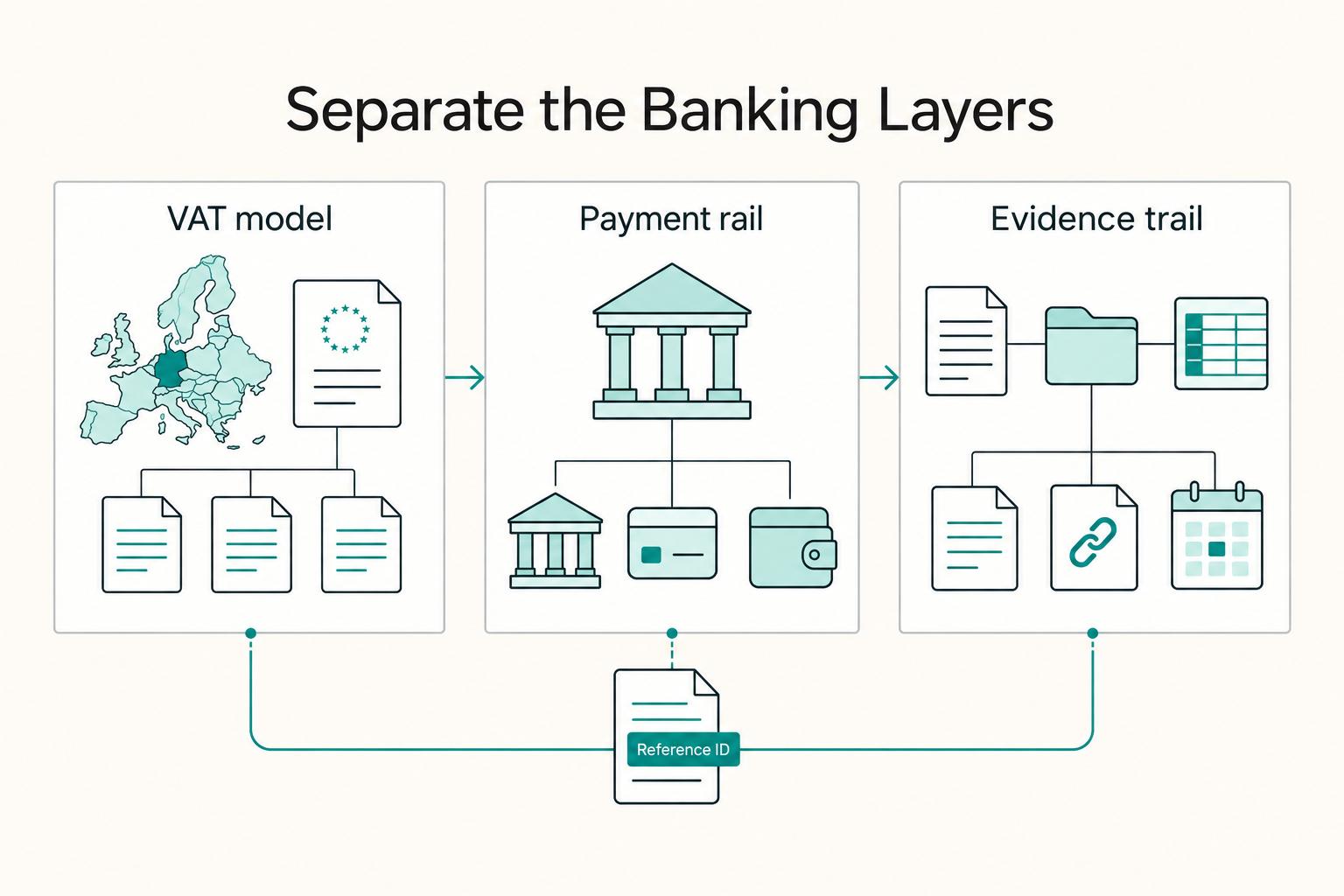
Keep these three terms separate in your operating documents:
- Registration model (OSS): Your VAT filing structure. If you use OSS, you register in one Member State of identification and use one return flow there for supplies reported under that scheme. OSS is optional.
- Payment rail: The provider path you use to collect and pay out, whether bank, EMI, or a combination.
- Evidence trail: Retain the required OSS records for 10 years from the end of the transaction year and link the return’s unique reference number to payment proof. Keep invoice, transfer and tax references distinct so a bank change does not create a second sale or a second tax payment.
CBR is an optional advance-ruling mechanism for complex VAT transactions involving participating EU countries, requested in the participating country where you are VAT-registered. It is not a mandatory launch approval for every cross-border sale or a substitute for funding and payment controls.
For thresholds and process timing, avoid hardcoded legacy numbers. Keep the threshold and process-timeline fields unresolved until you validate them for the specific scheme and countries.
Single dependency versus modular design#
| Decision point | Single-provider dependency | Modular architecture | Pass/fail test | Evidence artifact for sign-off |
|---|---|---|---|---|
| Registration continuity | One provider is expected to support filing-related payments and admin access | Filing route stays stable even if the payment rail changes | Pass only if a rail change does not alter OSS portal access, return ownership, or Member State of identification | OSS registration record, named portal owner, access log |
| Collections and payouts | One provider handles both inbound and outbound flows | Primary and backup rails are pre-approved | Pass only if each active rail has one completed inbound test and one outbound test in the same legal-entity name | Test transfer proofs, beneficiary confirmation, account-holder match |
| Reconciliation | One ledger holds most activity | One accounting ledger reconciles all active provider statements | Pass only if invoice ID, statement line, approver, and reconciliation note are linked for each exception-routed payment | Reconciliation export, invoice ledger, approval record |
| VAT payment traceability | Tax payment depends on one provider being available at filing time | Backup rail can fund tax without changing filing logic | Pass only if payment proof matches the OSS return's unique reference number | OSS return copy, unique reference number, payment confirmation |
A single provider can support a small operation, but it cannot pass this framework’s separate live-backup test. If you accept concentration temporarily, record it explicitly, cap new exposure and keep a funded recovery plan. Multiple brands may still share an underlying bank or service dependency, so check whether the fallback is actually independent.
Modular design adds overhead, so control it early. Standardize remittance fields, legal-entity naming, and approval ownership across rails.
Redesign trigger: if one provider failure can stop filings, collections, or payouts, treat the setup as structural risk and move to a modular control model before scaling.
What evidence is solid today and what is still unknown#
Before any go or no-go decision, use a simple rule: trust source-verified claims, treat anecdotes as prompts to investigate, and keep real gaps labeled as unknown until you verify them.
Use this evidence hierarchy:
- Solid evidence: explicit statements in official program or regulator sources.
- Directional signal: community chatter or anecdotal reports that may flag friction but do not show prevalence.
- Unknown: data is historical, partial, or volatile, so it cannot support a current comparative conclusion.
| Claim type | What you can rely on | What you cannot infer | Your next validation step |
|---|---|---|---|
| Solid evidence | e-Residency does not guarantee banking access | Incorporation or digital ID approval guarantees account approval | Get provider pre-screen decisions before launch |
| Solid evidence | An Estonian bank account is not required if you use an eligible EEA business account | Any single bank or fintech will accept your company | Confirm eligibility with each shortlisted provider |
| Solid evidence | Estonian bank onboarding is case by case and can require in-person steps | Uniform approval criteria or timelines across banks | Request exact document and meeting requirements in writing before relying on that route |
| Protection context | The relevant provider/product has its own safeguarding or deposit-guarantee terms | A UK FSCS statement automatically determines an EEA product’s protection | Identify the servicing legal entity and read its current protection disclosures |
| Directional signal | Community discussions indicate banking friction exists | Frequency, severity, or causality from discussion volume alone | Treat anecdotes as hypotheses, then verify against official provider terms and policies |
| Unknown comparative outcomes | The reviewed sources do not establish current rejection or closure rates | Provider rankings or 2026 approval odds from anecdotes or old surveys | Use current eligibility responses and your own dated results |
| Unknown (volatile pricing) | Fee schedules change over time | A fee quoted in older content is still accurate now | Current fee example unresolved until provider verification is complete |
If a payments claim starts being used as a tax or legal conclusion, stop and separate it. Banking and safeguarding facts alone do not establish tax residency conclusions.
Go or no-go checks#
Proceed only when all three are true:
- the claim is source-verified, not just repeated in forums
- the claim is scoped to the correct jurisdiction and provider type
- the claim is separated from legal and tax conclusions unless you have separate jurisdiction-specific advice
If any check fails, treat that claim as planning input, not decision evidence.
Use a tested route and a funded recovery plan#
Before routing material volume, verify the primary account’s actual functions and a feasible fallback with accessible funding. The full continuity standard in this guide includes a tested independent backup; if that is not yet available, record concentration risk and limit new commitments. Do not treat a readiness gap as permission to stop payments or filings already due.
Keep evidence in two lanes. For legal and tax conclusions, verify against the applicable authority source in each country. EU-level summaries do not set national tax rates, and VAT rules can be applied differently by country. For operations, rely on current provider terms, written support replies, and your own test results. Treat help pages and forum anecdotes as inputs, not proof.
Choose the setup that still works if your primary bank or payments/e-money route is delayed, rejected, or unavailable. There is no single provider that fits every company, so continuity matters more than provider brand. Your stress test is simple: can you still receive funds, pay from a business route, and reconcile transactions to invoices and books without switching to a personal account? If you depend on a payments or e-money firm, remember that safeguarded funds are not deposit-insured balances, and returns can be delayed if a firm fails.
Before go-live, confirm:
- Evidence pack complete: current entity and beneficial-owner details, business activity and fund-flow narrative, and dated provider correspondence.
- Open risks logged: unresolved items tied to the authority or provider source you still need.
- Recovery triggers defined: Identify actual account restrictions, unknown payments, funding gaps and failed matching; preserve existing obligations and use lawful alternatives.
For implementation detail, use How to Open a Business Bank Account for Your Estonian Company as your companion checklist. If you want a second pass on what is supported for your country or provider mix, contact Gruv.
If your final go/no-go depends on market coverage or compliance gating for payouts, talk to Gruv to confirm fit for your exact flow.
Frequently Asked Questions
Does e-Residency approval guarantee a business account?
No. Official e-Residency guidance states that banking access is not guaranteed and providers decide whom they onboard. Incorporation and digital ID do not substitute for a company’s account application. Pre-screen likely eligibility before setup, then test approved functions before relying on them.
Can you use forum posts or founder anecdotes to choose a bank or EMI?
You can use anecdotes as risk signals to investigate, not as decision evidence. Community reports do not prove current acceptance criteria, likely outcomes, or fit for your company profile. Get current eligibility, scope, and restriction details directly from each provider and keep those responses with your application notes.
Does an EMI or payment institution have to be replaced by a bank?
No. A suitable non-bank product can be a primary or supplementary route. Check its regulated entity, supported activity, protection, references, limits and recovery process. Deposit insurance and safeguarding differ, and neither a bank nor fintech label guarantees uninterrupted access.
Does changing the account change OSS or SME exemption status?
Changing the payment provider does not itself change VAT treatment, OSS registration or EX authorization. Keep filing access, the applicable deadlines and payment references intact. A business change that affects establishment, supply type or eligibility requires a separate tax review; a provider change is not a tax ruling.
How should you separate entity-level risk from provider-level risk when making a go or no-go decision?
Keep separate records for company and owner tax position, actual activity and management; provider eligibility, account functions and protections; and dated invoices, tax filings and completed payments. A coherent application helps review, but document consistency alone does not establish a legal or tax outcome.
Can you rely on fees, document-validity tips, or old setup guides when you reapply?
No. Treat current fees, limits, thresholds, and document-validity windows as unresolved until you verify them in current provider pages or written support replies. Older screenshots, forum checklists, and legacy guides can help form questions, but they do not prove current requirements.
Try a related tool
Researched and edited by the Gruv editorial team. Gruv builds cross-border billing, payouts, and finance-operations software for global businesses.
Sources
- ecb.europa.eu/paym/retail/instant_payments/html/instant_pa...trusted
- learn.e-resident.gov.ee/hc/en-gb/articles/360000700918-Banking-basicstrusted
- sme-vat-rules.ec.europa.eu/sme-scheme/cross-border-sme-scheme_entrusted
- taxation-customs.ec.europa.eu/archives/taxable-persons/vat-cross-border-ru...trusted
- vat-one-stop-shop.ec.europa.eu/one-stop-shop_entrusted
- vat-one-stop-shop.ec.europa.eu/one-stop-shop/declare-and-pay-oss_entrusted
- wise.com/help/articles/50VrYRVwHcsYeKzvWbjf3n/how-our...trusted
- wise.com/help/articles/2932130/can-i-have-more-than-o...trusted
Educational content only. Not legal, tax, or financial advice.
Related Posts
Open an Estonian Company Bank Account With Fewer Delays
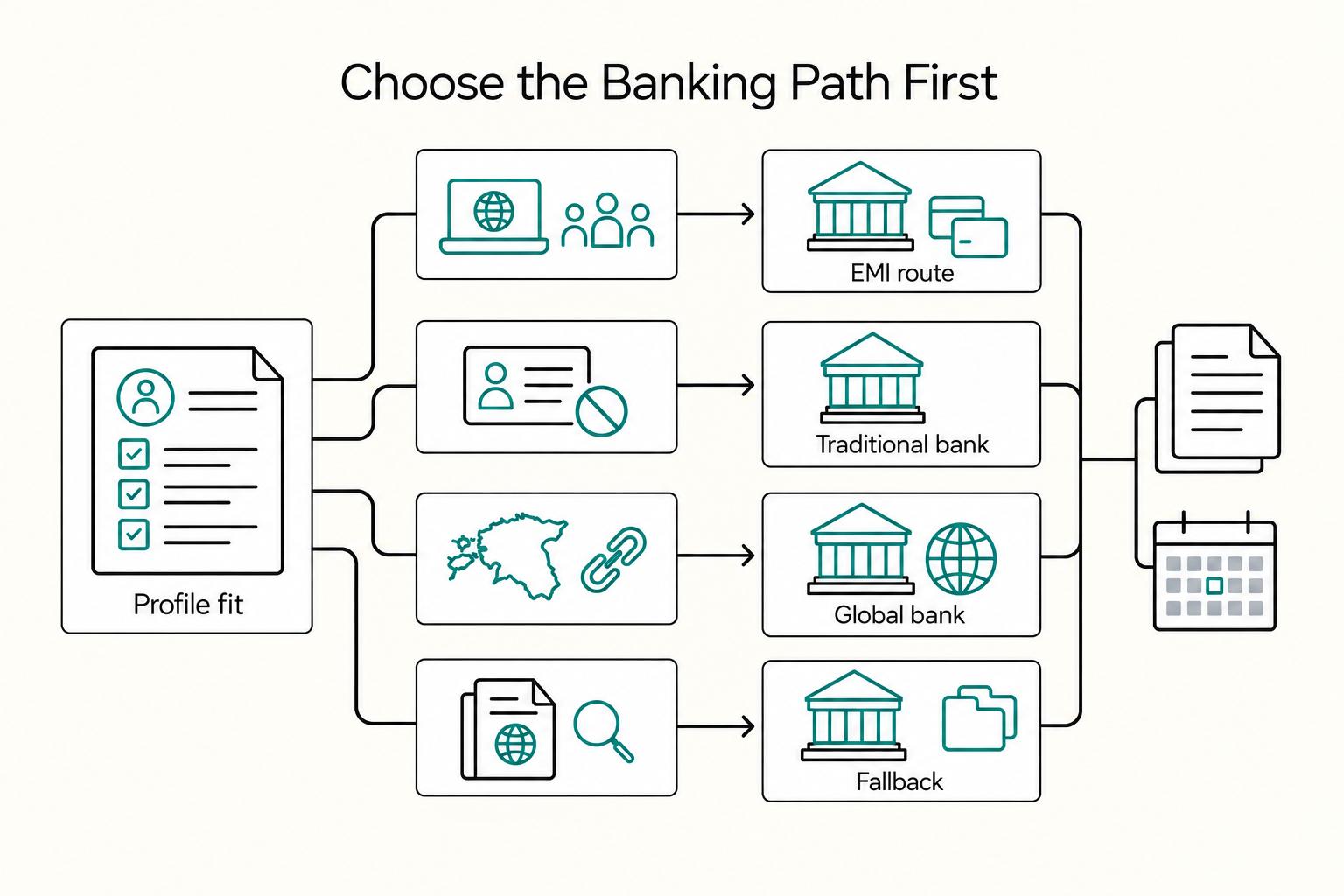
The most common way to waste time is comparing providers before you have decided which route actually fits your company. Start with route fit, then build one evidence pack that stays consistent from the first form through the last follow-up. Most avoidable problems do not come from missing a feature on a pricing page. They come from choosing a route that was never realistic for the ownership profile, then answering the same compliance questions in slightly different ways as the application drags on.

The Freelance Payment Penalty: A Modeled Audit of Platform Fees, FX Spreads, and Payout Delays
The money rarely disappears through a single, easy-to-spot fee. The real loss is stacked. A marketplace takes its commission, a processor adds a charge for international cards, a bank or payment company converts the currency at a spread, a platform holds the funds before release, and a wire sheds a little to intermediaries on the way in. Each layer looks defensible on its own, but the worker feels the combined result as a smaller deposit and a later payday.

How to Respond to a Subpoena for Business Records
Move fast, but do not produce records on instinct. If you need to **respond to a subpoena for business records**, your immediate job is to control deadlines, preserve records, and make any later production defensible.