
Quick Answer
Decide only after three checks: legal route, cost buffer, and call reliability under your real schedule. For non-EU moves, the sequence matters: secure the national visa, then file for the permesso di soggiorno within the first eight working days after arrival. Treat Rome as a fit test, not an assumption, and avoid non-refundable bookings until your document pack is coherent. If your plan works only in a best-case month, run a short pilot stay before making long commitments.
Commit in the right order or pay for it later#
Rome is a good base only if your legal route, budget, and work setup still make sense after normal friction shows up. If your plan works only when every step goes right, the city can become an expensive mismatch fast.
Before you commit serious money, make three decisions in order. First, confirm that Rome fits the way you actually work. Second, choose a stay path that matches your timeline and tolerance for uncertainty. Third, decide how much admin load you can realistically absorb in month one. That order gives you room to adjust when appointment timing shifts, housing changes, or your first-choice plan slows down.
For non-EU readers, the long-stay path is usually staged rather than one clean move. The common sequence is entry on a national visa, followed by local formalities after arrival, including applying for the permesso di soggiorno within the first eight working days. EU/EEA citizens often face fewer hurdles, but fewer hurdles still does not mean no checks. Either way, verify current requirements before you make non-refundable bookings.
Your document pack matters almost as much as the destination. Proof of qualification, proof that your work is genuinely remote, accommodation evidence, and health insurance valid in Italy are often reviewed closely. That is why your own consulate website should remain the final authority, especially where requirements vary between consulates.
The practical order is simple: confirm the route, assemble the documents, then make irreversible payments. People get into trouble when they reverse that order. A small delay then turns into rushed housing choices, flight changes, or overlap costs they never planned for.
The right mindset is to treat the move like a staged rollout. Each checkpoint should remove uncertainty before the next commitment. That is what keeps an ordinary delay from turning into a chain reaction across housing, flights, and client delivery.
Early warning signs are usually easy to spot:
- You picked a move month but do not have a confirmed appointment window.
- Your eligibility story is still unclear on qualification level or remote-work proof.
- You are booking flights or housing before your document pack is consistent.
- Your budget has no room for delay or overlap.
This guide is about living and working from Rome, not sightseeing. If you want deeper visa context while reading, keep this companion open: Italy Digital Nomad Visa: Your Guide to La Dolce Vita.
Decide if Rome is the right base for your work and lifestyle#
Treat Rome as a tradeoff decision, not a default. It can work very well, but it is usually a higher-friction choice if your week depends on stable high-bandwidth calls, low monthly volatility, or minimal admin overhead.
Start with a practical definition of success. You are not looking for a city that feels exciting for a few days. You want reliable weekly output, paperwork that stays manageable, and a routine that still works once the novelty wears off. If success depends on perfect housing, perfect internet, and perfect timing, the risk will show up quickly on your calendar and in your spend.
A quick fit test helps separate preference from reality:
- Work reliability: if your role is call-heavy, assume interruptions are possible in some areas and identify backup work locations before arrival.
- Cost pressure: treat published ranges as orientation, not guarantees. One guide estimates about
$2,000 to $3,000per month. - Lifestyle durability: if community matters to your mental bandwidth, plan recurring activities early because social setup can take longer than expected.
If you are still unsure, run a short test using your normal meeting load and normal spending habits. Do not judge the city during a travel-week version of your life. Judge it during an ordinary week with deadlines, calls, errands, and recovery time. That is the version of Rome you will actually have to live in.
It also helps to think in neighborhoods, not just in city labels. Trastevere, Monti, Testaccio, and Pigneto are often recommended, but daily convenience and connection quality can vary a lot by area. Workspace options exist, though many remote workers find the supply thinner than in some other hubs.
If your budget has little slack and your work depends on frequent client calls, Rome is a higher-risk first base. A useful checkpoint is to test two shortlisted neighborhoods against your real weekly schedule before signing anything longer. Once the city passes that test, the next question is legal sequencing.
Understand the legal baseline before you book anything#
Get the legal route straight before you book anything non-refundable. Tourist presence and work authorization are not the same thing, and confusion here is expensive to clean up later.
Use the right terms early. The Italy Digital Nomad Visa, officially Visto per nomadi digitali e lavoratori da remoto, is aimed at highly qualified non-EU remote professionals working for foreign employers or clients and is described as launched in 2024. Some explainers also frame it as quota-free and relatively fast compared with other routes, but that should shape expectations, not promise a timeline.
Before you spend money, make a one-page legal map for your own case. Keep it updated and make sure it answers four questions:
- What is your entry route, including whether you need a long-stay visa?
- How long do you intend to stay?
- What is your work setup, such as a foreign employer or foreign clients?
- What is your post-arrival permit step and expected filing timing for
Permesso di Soggiorno?
Any unresolved line in that map is an active risk. If one key point is still fuzzy, avoid fixed commitments tied to it. This is where many moves start drifting. People feel close enough to proceed, then discover that one unclear assumption affects housing, travel dates, and document timing at the same time.
For non-EU moves, order matters. Secure the long-stay route before departure, then handle the residence-permit step promptly after arrival. Midstream changes usually mean more paperwork, more interpretation risk, and more stress under time pressure.
Comparison content can still help, but only as background. The Global Digital Nomad Visa Index is useful for broad country framing. Your final call should still rely on current, Italy-specific official guidance for your exact case.
The working rule is simple: if your stay length or work pattern is still unclear, delay non-refundable bookings. Legal clarity makes every later step easier, including the choice between a short test stay and a deeper setup.
Choose your stay path with clear tradeoffs#
Pick your stay path based on certainty, not optimism. Stay flexible while the key inputs are still moving, then move to a deeper setup only when your documents, budget assumptions, and timeline have stabilized.
A short exploratory stay is usually the better option when your client mix, income rhythm, or move timing is still in flux. A longer setup makes more sense when continuity matters and you can absorb more paperwork early in exchange for fewer surprises later. Neither path is automatically better. The right one depends on how much is already known and how expensive it would be to change course.
| Decision point | Short stay with minimal setup | Longer stay with deeper setup |
|---|---|---|
| Main goal | Test fit before committing | Secure stability for a longer period |
| Commitments | Flexible housing and refundable bookings where possible | Structured documentation and longer planning horizon |
| Admin load | Lower at first, but may rise if you extend | Higher at the start, then more predictable |
| Risk pattern | Drift into long-stay behavior without the right path | Underestimate prep time and stall critical bookings |
Use a switch rule you can actually enforce. Stay flexible while the inputs are changing, then move to a deeper setup when they stop changing. Put that rule in plain language and attach a review date. If the same unresolved item appears at two reviews in a row, keep flexibility and push long commitments back. That small discipline prevents a lot of avoidable overcommitment.
If you need long-stay certainty, prioritize the digital nomad route early. Current guidance describes it as launched in 2024, aimed at highly qualified non-EU remote professionals working for foreign employers or clients, and quota-free. Some guidance also presents it as relatively fast versus other Italian routes, but treat that as directional context, not a service-level promise.
Before any large payment, write down your fallback for delay or rejection:
- Where you will live if plan A stalls.
- Where you will work if housing changes at short notice.
- How you will keep accessible funds during a longer wait.
A common failure mode is treating relocation like an extended vacation. A real long stay means ongoing paperwork, local process differences, and repeated coordination. Once the path is chosen, the next leverage point is the evidence pack that supports it.
Build your document pack in the right order#
A clean document pack saves more trouble than almost any other prep step. Build one versioned evidence pack first, then lock in final bookings. That order cuts rework and gives you a cleaner response path if an office asks for an updated file.
Use city guides for orientation, not as filing templates. They can help frame tradeoffs, but freshness varies. One Rome guide is dated 9 April 2025, while another is dated September 15, 2021. For 2026 decisions, treat those as context and confirm current requirements for your specific case.
The simplest way to reduce churn is to build the pack in layers. Start with core records you are likely to reuse across steps, such as qualification evidence and proof that your work is genuinely remote. Then add appointment-dependent items and any case-specific formatting. After that, add stay-related files for your Italy base, including accommodation evidence and health insurance valid in Italy, once the earlier layers are coherent. Add final booking confirmations last, after you have checked that the rest of the pack is internally consistent.
That sequencing is process logic, not a legal mandate. Early files are usually reusable. Later files are often the most expensive to change, especially when they involve travel dates, deposits, or housing overlap.
It also helps to keep file naming boring and explicit. Name documents by type, date, and status so retrieval stays fast under pressure. That small habit prevents a surprising amount of confusion when you are asked for a revised copy or need to prove what was submitted.
Track each file in clear states: draft, submission-ready, and submitted, with date. Add a short change note every time you revise something so follow-ups stay traceable and you do not lose time reconstructing which version is current.
Before submission, run one alignment check across your stay plan and tax assumptions. A quick pass through Taxes in Italy for Expats and Freelancers can prevent downstream rebuilds. If you want a final planning sweep before major payments, run your case through the Digital Nomad Visa Cheatsheet and flag missing items early.
If you cannot explain your pack order or point to which files are still provisional, pause non-refundable commitments. A cleaner document trail makes the next big decision, budgeting, much easier to do honestly.
Plan your Rome budget with scenario ranges not one number#
Use a range-based budget and make decisions from stress cases, not best cases. One monthly number hides the pressure points that usually force rushed choices later.
Rome is often cited at about $2,000 to $3,000 per month across accommodation, food, transportation, and entertainment. Use that as a reference band, not a guarantee. Italy-wide examples such as 500-1,000 euros/month for a one-bedroom, 30-70 euros/night for short stays, and 500-1,000 euros/month for co-living are directional and can move with location and lifestyle.
| Scenario | Housing standard | Work pattern | Budget stance |
|---|---|---|---|
| Lean | Smaller or shared setup, flexible on space | Mostly async work, fewer high-bandwidth meetings | Built near lower bound with tighter discretionary spend |
| Steady | Private setup that supports normal weekly output | Regular meetings and predictable routines | Uses realistic averages across core spend drivers |
| Comfort | Higher privacy, convenience, and backup options | Frequent video calls, low tolerance for disruptions | Adds buffer for premium location and paid workspace fallback |
Build the budget from cost drivers, not just the total. Neighborhood choice, transport habits, and reliability needs for your work setup can change the outcome quickly. Trastevere and Testaccio are common shortlists, but location-driven pricing means your monthly total can shift meaningfully based on where and how you live.
Connection quality belongs in the budget too. If your work is bandwidth-sensitive, price in fallback options instead of assuming one connection path will hold every day. This is especially important in arrival month, when you are still validating housing, learning routes, and absorbing admin tasks at the same time.
Use one hard rule before you accept long commitments: if your steady-case budget works only under perfect assumptions, the move is underfunded.
Also watch overlap costs, not just headline costs. Temporary housing, delayed paperwork, and backup workspace needs often stack in the same month even when no single line item looks extreme. That is why otherwise sensible budgets often break early. The problem is rarely one dramatic overspend. It is several moderate costs landing together.
For the first few months, run a simple monthly variance review and separate arrival effects from normal living costs:
- Compare planned versus actual spend in accommodation, food, transportation, and entertainment.
- Note the main cause of variance in one line.
- Update next month's baseline instead of carrying assumptions forward unchanged.
If variance stays high after several months, revisit stay length and planning assumptions before renewals. Keep that review aligned with Taxes in Italy for Expats and Freelancers so budget choices and compliance choices do not drift apart. Once your range holds up on paper, the next decision is where that money buys you the most reliable week.
Choose a neighborhood based on work constraints#
Choose the neighborhood for workday reliability first and aesthetics second. In Rome, Trastevere and Monti are often compared, but a useful shortlist starts with the constraints of your week, not the reputation of the area.
Testaccio is also a credible option, and it gives you one concrete transit anchor: Piramide on metro line B. If Pigneto is on your list, treat it as a field-check choice — verify noise levels, internet reliability, commute times, and rent on the ground before committing. It belongs on a shortlist, not on a pedestal.
Central convenience can create work friction. Crowding in tourist-heavy zones and higher central pricing are documented risks, so a place that looks efficient on paper can still cost you focus during the week. That tradeoff matters more when your work depends on predictable call windows or fast shifts between home, errands, and a backup location.
| Neighborhood | Grounded signal you can use | What to verify yourself |
|---|---|---|
| Trastevere | Commonly compared with Monti | Call-hour noise, evening disruption, and backup work options |
| Monti | Commonly compared with Trastevere | Daytime rhythm and route friction for your recurring schedule |
| Testaccio | Often framed around food and family routines; Piramide on line B is a concrete checkpoint | Whether that transit point supports your real workweek |
| Pigneto | Included often in remote-worker shortlists, but evidence here is limited | Call quality, comfort, and routine stability over several days |
If video calls are central to your role, put predictable daytime conditions ahead of nightlife density. Country-level claims about infrastructure are too broad to pick one neighborhood with confidence.
Run a short trial in your top two areas before signing anything long. Work normal blocks from the apartment and one backup location. Test sound and connection quality at your actual meeting times. Run your most common route, including Piramide if Testaccio is shortlisted. Treat this as a work simulation, not a scouting tour. If you cannot run normal meetings and errands with low friction, the area is not ready for a long commitment. Once the neighborhood works on paper and in practice, prove the technical side in week one.
Set up your work infrastructure in week one#
Week one is for proving reliability, not just settling in. You need one primary setup and one fallback for both location and connectivity before any high-stakes work starts.
A simple 2x2 structure is enough:
- Two work locations: your apartment and one backup you can reach on a normal workday.
- Two connection paths: one primary and one fallback.
That setup is simple on purpose. Under pressure, simple plans are the ones people actually use. It also matches how Rome planning content usually presents options, with coworking spaces and public places treated as distinct fallback categories.
Build a short critical-call protocol before your first important meeting:
- Primary location.
- Backup location.
- One failover trigger, such as repeated audio or video instability during a rehearsal call.
If that trigger appears, switch immediately. Do not spend the live meeting troubleshooting a connection that has already failed once.
Use a practical week-one checklist:
- Primary connection path is active and tested where you actually take calls.
- Fallback connection path is tested during your real meeting windows.
- One coworking fallback and one public-place fallback are checked in person.
- Calendar buffers are added around critical meetings for route friction and minor delays.
Write your failover order down and keep it visible. Decisions made before pressure are usually better than decisions made during pressure. During week one, rehearse the fallback path at the same hours you usually meet clients. A backup that looks fine at noon but fails during your peak call window is not a real backup.
Freshness still matters. One Rome guide entry is dated 9 April 2025, while a broader Italy nomad reference is updated Feb 03, 2026. Treat online lists as candidate options, then verify them at your own call times after arrival.
If the setup fails repeatedly in week one, change housing or your daily base quickly instead of waiting for conditions to improve on their own. Once work reliability is in place, the next risk is usually admin drift.
Handle tax and admin checkpoints before they become urgent#
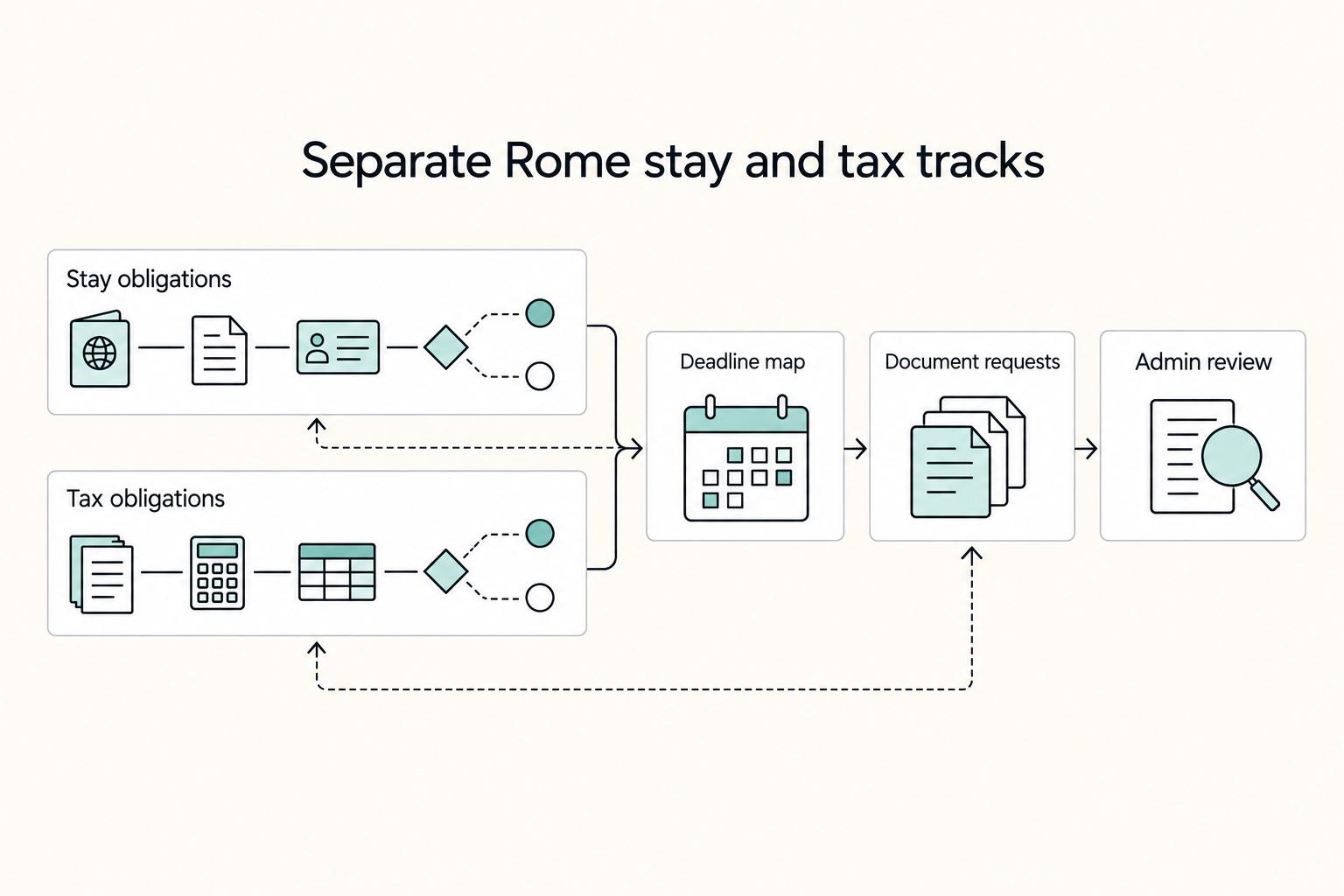
Split compliance into two tracks from the start: stay and visa obligations on one side, tax and reporting obligations on the other. When those tracks live only in memory, deadlines and document requests start colliding.
For stay compliance, anchor your records to the route you actually hold. The Italy Digital Nomad Visa is described as a national visa (Visto D), fully implemented in 2024, valid for one year, and renewable if conditions continue. It is framed for non-EU remote workers tied to foreign employers or clients, not local Italian employment. That tells you where to focus your recordkeeping. Keep the documents that support the route you are actually using, not a generic folder of everything you have ever collected.
In practice, the safest move is to turn requirements into a dated document trail. In this material, practical checkpoints include criminal-record screening, employer-side compliance evidence for employees, and post-approval residence-permit steps. The same material also includes general guidance of at least three years of industry experience for high-specialization proof, so keep related records accessible if that applies to your case.
Maintain a dated compliance log and update it weekly:
- Arrival and address changes, and when they were reported.
- Visa and permit submissions, including what was sent and where.
- Tax-relevant milestones, such as contract changes or shifts in income source.
- Requests from offices or advisors, with response dates and attached documents.
- Open items, each with one owner and one next target date.
Logs reduce avoidable rework. Memory compresses details, especially once several offices or advisors are involved. A dated trail makes follow-ups easier when similar information is requested in different formats.
Handle tax setup early when income spans countries or contract types. One reported friction point is the immediate weight of tax registration and compliance duties. Use that as a warning signal, not a universal outcome. Early alignment with Taxes in Italy for Expats and Freelancers is usually easier than repairing drift close to renewal.
Outcomes can vary by office and case details, so confirm critical points with qualified advisors before acting on generic guidance. Family-related permit outcomes are described as inconsistent in anecdotal reporting, which is another reason to keep expectations case-specific.
If you cannot produce a current log, a complete document trail, and advisor-checked next steps for both tracks, pause optional commitments until the records are clean. That discipline prevents most of the mistakes that derail otherwise workable moves.
Avoid the mistakes that derail Rome relocations#
Most Rome relocation failures do not start with one dramatic event. They start as small shortcuts, then compound when legal timing, housing commitments, and work reliability are handled out of order.
Mistake 1: Running a long stay like a short trip#
The most common process error is treating a long stay like rolling travel. Long stays require an explicit legal path and ongoing admin follow-through, not monthly workarounds.
One relocation account describes the pattern clearly: short-term rentals, recurring visa runs, and delayed action on visa, residency, or tax compliance until the situation is harder to fix. The cost is rarely one single fine or denial. More often, it is months of instability, repeated rebooking, and constant rework that pulls attention away from paid work.
Set the correction before arrival:
- Choose your route.
- Assign dates to each required step.
- Track completed and pending actions in one place.
If your route is the Italy Digital Nomad Visa: Your Guide to La Dolce Vita, treat paperwork and ongoing compliance as core move work from day one, not as cleanup for later.
Mistake 2: Using generic city advice as legal guidance#
City guides are useful for lifestyle context, but they are weak legal authority. Advice that works for one profile or one office can be wrong for your case.
Relocation content keeps returning to the same practical point: moving to Italy requires clarity on first steps and realistic expectations for daily execution. Use that as a filter. If guidance does not clearly match your nationality, stay length, and work setup, treat it as unverified until qualified advice confirms it.
This matters even more when timelines are tight. Generic confidence is how people end up making non-refundable commitments before core requirements are actually stable. A guide can help you ask better questions. It should not replace the official checklist for your consulate or the advice you rely on for your own facts.
Mistake 3: Choosing housing for looks before testing workday fit#
Housing decisions go wrong when visual appeal outruns workday testing. A place can look ideal and still break your week if call conditions, route friction, or backup options are weak.
The problem is not liking scenic or central neighborhoods. The problem is signing too early, before your real schedule has been tested in that environment. That is how a place that feels perfect on arrival turns into a daily drain once normal work starts.
Before any longer commitment:
- Create a dated timeline for visa, residency, and tax actions.
- Keep one folder for submitted documents and one for pending fixes.
- Run one full workday test from the intended setup.
- Confirm who will advise you if a rule is unclear for your case.
If your plan still looks like short-term travel now and paperwork later, delay commitments until legal status, admin timing, and workday reliability line up.
Your next steps before moving to Rome#
Make one clear decision this week: proceed, delay, or run a short pilot. Rome can be a great base for some remote workers, but high living costs, administrative friction, and variable connectivity can break plans that look solid on paper.
Use the next 30 days to validate three things in order: legal route clarity, budget resilience, and work reliability. When those three hold, commitments become safer and easier to manage. Each decision should produce one action list with owners and dates, so progress comes from completed checkpoints rather than booking pressure.
| Decision | Choose it when | Switch if this happens |
|---|---|---|
| Proceed | Stay path is clear, budget includes buffer, and setup passes real call tests | You are still guessing on requirements or relying on one fragile connection path |
| Delay | Key items are unresolved and fixing them now is cheaper than repairing mistakes later | You start locking non-refundable commitments just to maintain momentum |
| Pilot stay | You need real-world proof before committing long term | Pilot reveals repeated call interruptions or sustained budget strain |
Run this 30-day checklist in order:
- Confirm stay path and key checkpoints. Verify exact requirements through official channels and keep one dated checklist.
- Stress-test budget as a range, not a single target. A common anchor is about
$2,000 to $3,000per month, but outcomes vary by housing and lifestyle. - Shortlist neighborhoods by workday fit, then test before a longer lease. Start with Trastevere, Monti, Testaccio, and Pigneto and check whether routines are repeatable.
- Test connectivity before committing. Internet quality varies by area, and high-bandwidth calls can slow down or drop.
- Pre-identify backup work options. Keep multiple viable choices such as coworking spaces, cafes, libraries, or parks with free Wi-Fi.
Run the sequence as written and resist the urge to jump straight to bookings for a sense of progress. The goal is not to make the move feel real as fast as possible. The goal is to make the move hold up once ordinary life begins.
For focused next actions, use one guide per decision type: Italy Digital Nomad Visa: Your Guide to La Dolce Vita for stay-path planning, the 2026 Global Digital Nomad Visa Index for country comparison, and Taxes in Italy for Expats and Freelancers for tax planning context.
Once your move date is set, track filing exposure and day counts from day one with the Tax Residency Tracker.
Frequently Asked Questions
Is Rome a strong choice for digital nomads in 2026, or a mixed bag?
Rome is a mixed bag for remote workers. It can be a strong fit if you plan for administrative friction, higher living costs, and variable internet performance. It is a riskier fit if your setup depends on consistently stable high-bandwidth calls.
What budget should I plan for a realistic month in Rome?
A commonly cited baseline is about $2,000 to $3,000 per month for accommodation, food, transportation, and entertainment. Treat that as a planning range, not a guarantee. Keep extra buffer so slower local appointments or paperwork do not force rushed decisions.
Which neighborhoods are best for remote workers: Trastevere, Monti, Testaccio, or Pigneto?
Trastevere, Monti, Testaccio, and Pigneto are all commonly recommended. None is universally best for every remote-work setup. Pick based on your own workday needs, and test before making a longer housing commitment.
How reliable is internet in Rome for video-call-heavy work?
Internet quality in Rome varies by area and venue, so treat performance as location-specific. One source reports around 20 Mbps average broadband, while some coworking spaces and modern cafes may offer 100 Mbps or more. For video-call-heavy work, plan for occasional slowdowns and keep a local data backup instead of relying only on public Wi-Fi.
What are the most common mistakes people make when relocating to Italy for remote work?
The most common mistakes are process-related: delaying visa and residence-permit steps and underestimating how long local procedures can take. A dated checklist and early admin follow-through can reduce avoidable rework.
What key visa, legal, or tax details are still unclear in most Rome digital nomad guides?
The most missed detail is sequence: for non-EU readers, one common framing is entry on a national visa, then applying for a permesso di soggiorno within the first eight working days after arrival. Timing can still vary because local processes may move slower than expected. You may also see figures like €28,000 annual income in explainers, but consular requirements can differ, so confirm your exact checklist with your consulate and use Italy Digital Nomad Visa: Your Guide to La Dolce Vita for deeper planning.
Try a related tool
Researched and edited by the Gruv editorial team. Gruv builds cross-border billing, payouts, and finance-operations software for global businesses.
Sources
Includes 4 external sources outside the trusted-domain allowlist.
- pmc.ncbi.nlm.nih.gov/articles/PMC11107943trusted
- brighttax.com/blog/italy-digital-nomad-visaexternal
- jetpacglobal.com/blog/digital-nomad-italy-cost-of-living-work...external
- punta.app/digital-nomad-guides/rome-metropolitan-city-...external
- thetraveler.org/italy-digital-nomad-visa-tax-bonus-guideexternal
Educational content only. Not legal, tax, or financial advice.
Related Posts
Italy Digital Nomad Visa in 2026 for Remote Professionals
Treat this as a filing decision before you treat it as a lifestyle move. The appeal of living in Italy is obvious. Whether this works comes down to document quality, clear classification, and whether your file tells the same story from the first page to the last.

The 2026 Global Digital Nomad Visa Index for 50+ Countries
Start with legal fit, not lifestyle filters. The practical order is simple: choose a route you can actually document, then decide where you want to live. That single change cuts a lot of wasted comparison work and stops you from falling in love with places that were never a real filing option.
Taxes in Italy for Expats and Freelancers
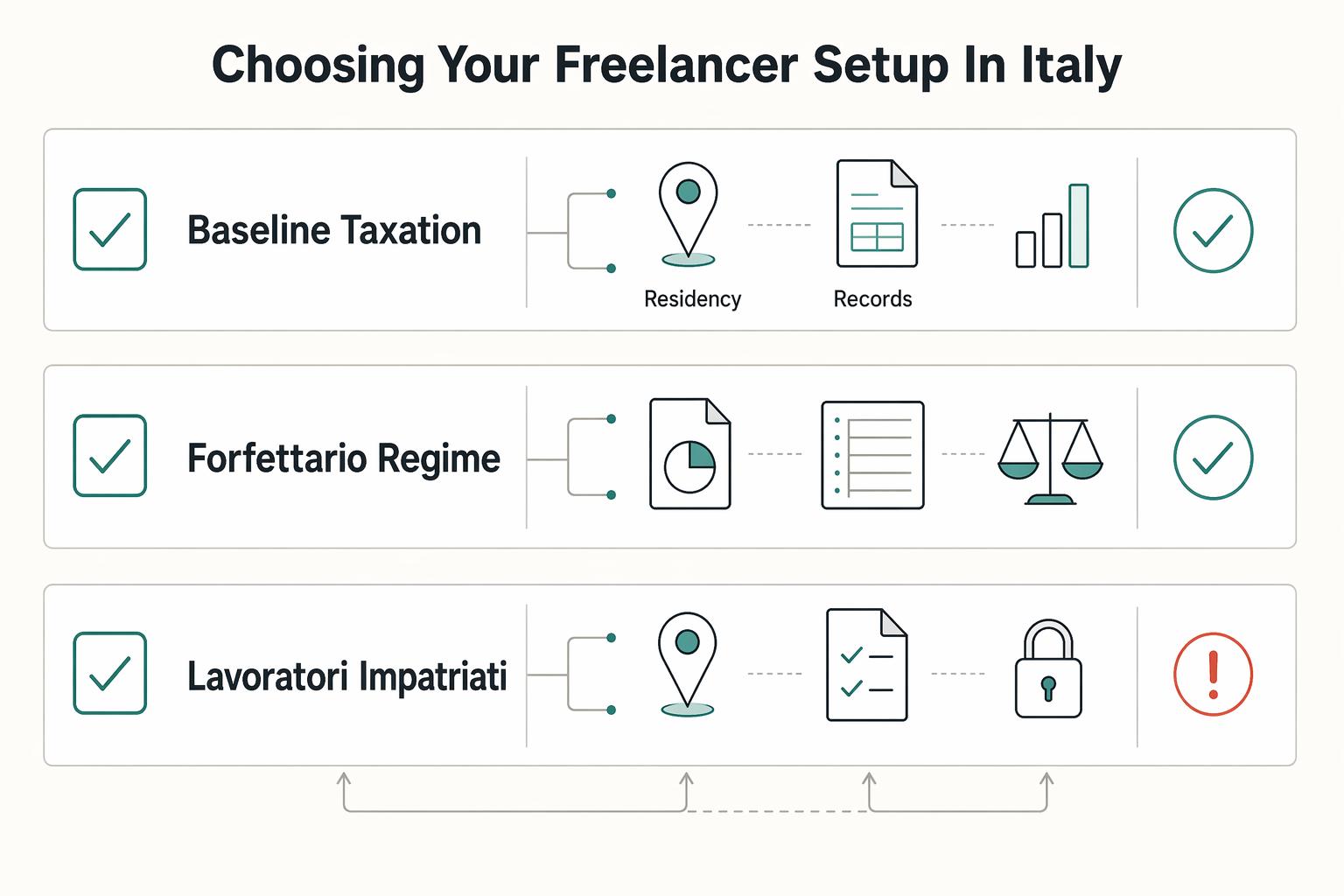
Start with one objective: make filing choices you can defend with records, not assumptions. As a freelancer or consultant, you do not need to predict every line item on day one. You need a position that stays consistent from client onboarding to invoicing to return prep. The avoidable mistake is signing work or claiming a benefit first, then trying to explain the tax result later. You are aiming for a position that holds together all year, not a best-case assumption that falls apart when forms and bank records have to match.