
Quick Answer
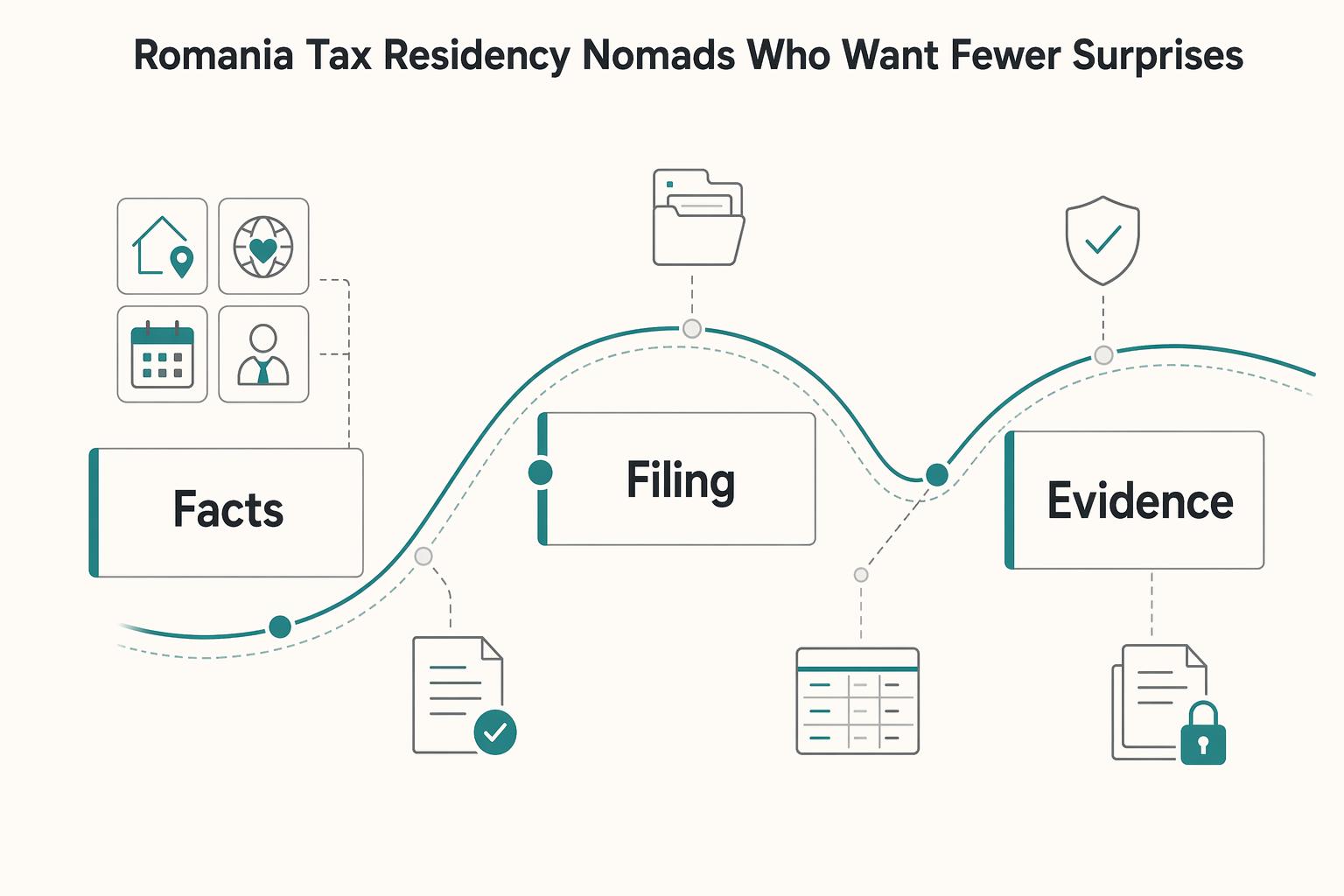
Start by classifying your facts before relocating, then build records that can defend that classification. For romania tax residency, the draft anchors planning to Fiscal Code Article 7(28), weekly day-count tracking from first arrival, and questionnaire timing tied to 30-day windows in cited guidance. Write two scenarios in advance (residency later than expected and earlier than expected), and keep treaty issues marked as unresolved until confirmed. If your travel, housing, and invoicing records do not align, pause and seek licensed advice.
Romania Tax Residency for Nomads Who Want Fewer Surprises#
Decide your tax position before you move money, sign leases, or change billing addresses. This guide is for a non-resident individual who wants a clear sequence to classify residence, document facts, and avoid filing surprises in Romania.
The baseline is Fiscal Code Article 7(28) of Law 227/2015, as amended. A person can be treated as resident when at least one path applies. The paths are domicile in Romania, centre of vital interests in Romania, presence in Romania for more than 183 days in any 12 consecutive months, and the specific case of Romanian citizens working abroad as Romanian officials or employees.
Treat your pre-move planning as filing prep, not just admin. If you wait until after relocation to sort records, you may be making tax decisions with incomplete evidence. Cross-border filing issues often start with facts that were never assembled into one coherent record.
Decision sequence before committing to the move#
| Step | Action | Detail |
|---|---|---|
| 1 | Map current facts against each trigger | Do this on one page before major life or business changes |
| 2 | Track physical presence from first arrival | Update it weekly; threshold is more than 183 days in any 12 consecutive months interval |
| 3 | Set reminders around the questionnaire obligations | Guidance references the Questionnaire for setting out the tax residence of an individual, including a 30-day deadline after exceeding 183 days and a 30-day pre-departure timing in departure cases |
| 4 | Prepare for treaty-based analysis if another country may claim your residence | Use the applicable DTT before assuming one-country residence |
Do those four steps before you commit to the move. If another country may still claim your residence, pause assumptions and move to treaty-based analysis under the applicable DTT.
If residency applies, your tax scope changes quickly: resident individuals are taxed on worldwide income, with a stated exception for some work performed abroad when conditions are met. The key decision is which trigger is likely to apply first and whether your records can support that position.
Before you relocate, write out two scenarios. Scenario one assumes you remain non-resident for longer than planned. Scenario two assumes resident treatment starts earlier than planned. That contrast can surface hidden gaps, especially around day count, invoice timing, and how quickly a dual-residency question could appear.
Minimum evidence checklist#
| Record | What to keep | Detail |
|---|---|---|
| Travel history | Dated travel log | Entry and exit proof |
| Housing availability | Home-availability records | Lease terms and occupancy dates |
| Personal and economic ties | Month-by-month notes | Where personal life and economic activity were centered |
| Commercial and banking records | Contracts, invoices, and bank records | Consistent address details |
| Classification note | Short written note | Current classification and what would change it |
Keep these from day one and update them as facts change.
Inconsistent records across countries can trigger avoidable disputes. Keep your decision sequence explicit, align documents to it, and escalate early when facts are mixed or potentially dual-claimed. If you want a deeper dive, read Digital Nomad Taxes in 2026 With a Defensible Filing Plan.
Build the Mental Model Before You Plan the Move#
Before you do anything else, separate immigration status from tax status. They can influence each other, but they are not the same decision.
Visa and residence permit terms describe permission to stay. Tax residence terms describe how income may be taxed, and that classification can change when your facts change. A permit on its own does not settle tax treatment.
Use a practical labeling rule for documents: mark each item as immigration, tax, or both. This keeps your file readable and lowers the chance that one administrative step is mistaken for a tax conclusion.
General relocation resources still help with setup. UK guidance for living in Romania covers visas, work, healthcare, and driving, and it states that the UK government and the British Embassy in Bucharest cannot provide personalized advice. It also points readers toward English-speaking professionals in Romania for personalized support. EURES notes that ANOFM and county agencies provide free employment services, which can help with job-market tasks but are separate from tax-residency analysis.
For tax-residency classification, stop there: ANAF-specific criteria or thresholds are not included here. Treat any tax conclusion as provisional until you verify it against official ANAF guidance.
One practical safeguard is to keep an assumptions page at the front of your file. Split it into three columns: confirmed facts, unconfirmed facts, and facts likely to change in the next 90 days. This prevents a common planning error where provisional assumptions quietly become final.
When you review documents each month, ask one plain question: does this record prove status, or does it only describe intention? Intent is useful, but filing positions are usually defended with dated facts. Keeping that distinction clear improves both compliance quality and adviser efficiency. If you want a quick next step, try the tax residency day counter.
The Three Triggers That Make You Tax Resident in Romania#
Treat this section as a risk checkpoint before major commitments. Residence status changes your tax scope, so classification is not paperwork trivia.
Planning turns on three practical triggers: domicile in Romania, centre of vital interests in Romania, and presence in Romania for more than 183 days in any 12 consecutive months. Keep a separate note for the specific case of Romanian citizens working abroad as state employees if it could apply to you.
A resident is generally taxed on worldwide income. A non-resident is generally taxed on Romanian-source income, including services performed on Romanian territory. The legal detail behind the residency tests is not fully established here, so treat this as a confirm-and-plan exercise.
| Decision area | What this evidence supports | What to do now |
|---|---|---|
| Residence status impact | Tax treatment changes based on resident versus non-resident status | Build two scenarios now: resident treatment and non-resident treatment |
| Filing anchors | Annual return deadline is 25 May; some cases file monthly by the 25th for the previous month; tax year-end is 31 December | Put these dates in your compliance calendar |
| Residency criteria in planning | Confirm the full legal residency tests with the relevant authority | Verify residency criteria in primary Romanian guidance before relying on them |
| Special edge case | Verify the rule for Romanian citizens working abroad as state employees with the relevant authority | Treat this as unresolved and get licensed advice early if relevant |
Create a one-page tracker and update it monthly:
- List current facts and supporting documents under each residency criterion you are tracking.
- Log planned changes that could shift classification.
- Tie date logs to filing deadlines.
- Mark unresolved points that need professional confirmation.
If your facts can reasonably support more than one outcome, stop treating any single assumption as final. Also keep separate files per spouse, because married individuals are taxed separately in Romania.
A useful way to stress-test your tracker is to label each fact by evidence strength: strong, partial, or weak. Strong means the record is dated and directly relevant. Partial means it supports context but not the conclusion by itself. Weak means it depends on interpretation or is missing supporting records. This gives you a fast risk view before filing windows open.
Another common gap appears when you track travel days carefully but ignore where services were performed. Because Romanian-source treatment can depend on service location, your calendar, invoice notes, and contract records should align. If they do not, you can end up with a classification file that is tidy but not actually persuasive.
Residency Start Date Changes Your Tax Exposure Window#
Your assumed start date can widen or narrow the period under review, so treat it as provisional until the full fact pattern is tested.
The safer takeaway is treaty-level caution, not Romania-specific start-date mechanics. OECD Secretariat guidance on COVID-19 cross-border working arrangements addressed residence-change scenarios. The practical point is narrower: treaty provisions remain critical to double-taxation outcomes, and final determinations are made by domestic tax authorities based on case-specific facts. Model timing risk before filing, not after.
Treat timing rules as claims to verify before filing#
| Timing topic in planning conversations | What this section can support | Practical action now |
|---|---|---|
center of vital interests start timing | Not established in this evidence | Record your assumed shift date and label it provisional pending professional confirmation |
183-day rule start timing | Not established in this evidence | Keep a day-count record, but do not lock filing logic to one start date too early |
| Start of broader tax exposure period | Outcomes depend on treaty application plus your fact pattern | Model earlier and later effective-date scenarios |
An earlier or later effective date may change the review window. Overlap risk can still exist if another jurisdiction applies a different timeline.
Keep a checkpoint pack before filing#
Keep one dated planning pack per month from arrival through first filing:
- Travel log with entry and exit records.
- Contract timeline with signature, service, and payment dates.
- Location-change records for when work and living arrangements shifted.
- Income spike tracker tied to invoice and payout dates.
- Open-issues note for unresolved timing assumptions.
If arrival dates and major income spikes land in the same period, consider professional review before filing. Timing disputes may be harder to fix later when records are complete but scattered. Keep your timing file in chronological order and freeze a monthly version at month-end close so later review is easier and retroactive edits are clearer.
If your payment schedule is uneven, mark high-value months in advance. A concentrated payout month near a potential status change can trigger deeper review.
Tax Residency and Immigration Status Are Related but Not Equivalent#
A residence document is not a tax verdict. Run immigration and tax compliance as separate tracks from day one.
A Romania digital nomad visa, residence permit Romania, or temporary residency permit should not be treated as a tax-residency determination on its own. It is possible to hold valid immigration status while tax treatment remains unsettled.
Use one red-flag rule: if your plan depends on permit equals tax resident, or tax resident equals permit, pause and verify before filing. Run a monthly reconciliation across immigration documents, income records, and treaty assumptions. If those files do not align, escalate early for licensed advice.
For U.S. persons, keep the U.S. lane separate from Romania's determination. IRS filing obligations are a different compliance track. Treaty relief can apply to some U.S.-source income in specific cases, but coverage depends on income type, and ordinary U.S. rules apply when no treaty rule covers that income.
Treaty claims also require paperwork discipline. Many treaty partners require a U.S. residency certificate Form 6166, requested through Form 8802, and a processing fee applies. State and federal treatment may diverge, so check both before filing.
A practical review rhythm helps here. At month-end, compare four items side by side: immigration status updates, income events, U.S. filing obligations, and treaty assumptions. If one item changes and the others are not revisited, your file can drift into internal conflict without anyone noticing.
Also keep your adviser questions separate by lane. Immigration questions should be answered with immigration records. Tax-residence questions should be answered with the applicable tax framework and dated records. Mixing those question sets usually leads to longer reviews and weaker conclusions.
Build a Center of Vital Interests Evidence Pack#
Treat center of vital interests as a monthly documentation habit, not a year-end reconstruction. A legal status label on its own may not show where life and work actually happened.
A useful reminder from EU policy analysis is that legal status and factual ties can diverge. Some residence or citizenship-by-investment schemes link status to financial contribution, with at least 130,000 participants and over EUR 21.4 billion reported across participating countries. Policy options discussed in that context include phase-out, taxation, tighter regulation, and minimum physical-presence requirements. For tax planning, the takeaway is simple: status labels do not automatically replace evidence of real ties.
Use a simple monthly evidence pack:
- Keep one folder per month with dated records tied to where you lived and worked.
- Keep addresses, dates, and identity details as consistent as possible across documents.
- Add a short month-end note that explains key moves, work activity, and material changes.
- Resolve conflicting records before position-sensitive filings, and seek licensed cross-border advice when gaps remain.
To make the pack more usable, add a one-page index in each monthly folder. List every key document, what it supports, and where it might be weak. This can turn a pile of files into a workable evidence set and make adviser review faster.
Watch for two practical problems in your file: records that are complete but inconsistent on location details, and records that are consistent but too generic to show ties in context. A short month-end narrative can help connect dates, locations, and activity in plain language.
If your activity shifts during the year, capture that shift when it happens. Do not wait for filing season. A delayed reconstruction may miss why a change occurred and whether it was temporary or structural, and that context can matter in a residence analysis.
Handling Dual Residency Without Guesswork#
When two countries may both treat you as resident, start with the treaty text and document your reasoning before filing in either place.
Your evidence file is the base layer, so rely on dated records rather than memory. For U.S. exposure, IRS Publication 519 is a practical anchor: resident aliens are generally taxed on worldwide income, nonresident aliens on U.S.-source income, and a dual-status year can occur.
For the Romanian side, use the applicable tax treaty for your country pair and work from the treaty text itself. IRS Publication 519 also includes a chapter on Tax Treaty Benefits. Avoid assuming a generic tie-breaker sequence unless the treaty article in your case states it clearly.
Before filing, prepare a one-page residency position memo:
- Facts timeline with arrival and departure dates, home-availability periods, and major income events.
- Treaty path used, including the specific article and tests applied.
- Evidence map showing which records support each test by month and document name.
- Provisional conclusion stating where you are treated as resident and what fact would change that view.
Use one hard checkpoint: every key statement in the memo should map to a dated document in your monthly folder. If it does not, label it as an assumption and resolve it before filing.
If your first pass still supports residency in both countries, escalate early to licensed cross-border advice rather than self-interpreting an unresolved tie.
When a tie remains unresolved, avoid filing narratives that overstate certainty. A measured memo with clearly marked assumptions is usually stronger than a confident memo that cannot be evidenced. The goal is not to sound definitive. The goal is to be accurate, consistent, and reviewable.
A practical sequencing rule also helps: finish domestic fact mapping before drafting treaty conclusions. If you reverse that order, you may end up fitting facts to a preferred outcome rather than testing facts first and letting the treaty path follow.
Your First 90 Days in Romania Checklist#
Use the first 90 days to build a clean record trail for your residence-registration file.
| Period | Task | Detail |
|---|---|---|
| Week 1-2 | Write your intended administrative position on one page | Note your 3-month date and start a document tracker |
| Week 3-6 | Build your residence-registration file month by month | Use a valid ID and category-specific evidence |
| Week 7-10 | Pre-check likely registration requirements | List missing records and assign owners and dates so each statement ties to dated evidence |
| Week 11-13 | Submit if registration is required after month 3 | Submit your file to the relevant authority and update your memo |
Use that schedule as your default workflow, then adjust it if your facts change.
For EU nationals, one timing marker matters for planning. During the first 3 months in a new EU country, a residence document cannot be required. Registration may be required after month 3. Treat this as an administrative checkpoint, not a tax conclusion.
If EU registration rules apply, prepare the document pack before month 3: valid ID plus category-specific evidence such as proof of self-employed status. The rule set also says no additional documents should be required beyond listed items. It also says the registration certificate should be issued immediately at a cost no higher than what nationals pay for identity cards.
If core registration records conflict for more than one monthly check, pause submission decisions and reconcile first. If conflicts remain, escalate to licensed local advice.
Treat this 90-day period as your foundation window. Decisions made here reduce pressure later, especially around registration timelines. A clear first-quarter record often determines whether follow-up review is straightforward or difficult.
At the end of each month, run a 20-minute file health check. Confirm that new records are dated, named consistently, and connected to the right section of your memo. If a file cannot be tied to a concrete registration question, either label it as context or remove it from the core folder to keep the pack clean.
Filing Reality and Unknowns You Must Verify#
You cannot finalize a Romanian filing from this guide alone. Use it as a screening layer, then verify every material point in current primary guidance before filing.
What this guide covers#
- Some sources here are context, not filing manuals.
- The EURES Romania excerpt covers living and working conditions plus employment formalities.
- The EU Tax Observatory report is EU-wide tax competition analysis, not a Romania filing procedure guide.
- The IRS IRM excerpt is structured around international returns and U.S. income reporting.
- The Publication 515 excerpt shown is for withholding in 2002, so it should not be used as current-rate guidance.
What to verify further#
- Romania-specific filing forms, form numbers, or deadlines.
- Romania-specific residency start-date rules.
- Treaty tie-breaker order for your applicable convention.
- Edge-case status-change rules — verify with a qualified adviser.
- Current withholding rates inferred from older foreign excerpts.
Keep draft labels as placeholders, but do not file on that basis until current Romanian primary guidance confirms how they apply to your facts.
Verification sequence before filing#
- Check the latest Romanian primary tax publications and record publication dates.
- Confirm criteria and start-date logic against those current materials.
- Check the specific bilateral treaty text for your two-country case and confirm tie-breaker order there.
- Have a licensed adviser confirm your fact pattern before submission.
If your plan depends on assumptions not visible in current primary guidance, pause and verify before filing. A useful discipline at this stage is to separate unresolved items by risk level. High-risk items are assumptions that could change residence classification or scope of taxable income. Medium-risk items affect forms or timing but not core classification. Low-risk items are wording or presentation details. Review high-risk items first and do not let administrative cleanup distract from them.
Red Flags That Mean You Should Talk to a Pro Now#
Talk to a licensed adviser now if your position is inconsistent or depends on treaty interpretation you cannot prove with clean records.
Escalate if any of these are true:
- Your residency indicators and day-count records conflict for the same period.
- You may have dual-residency exposure, and your treaty outcome is not clear from your current documentation.
- You have material foreign income in a period where residency treatment may differ across jurisdictions.
- Your U.S. filing assumptions (including treaty-benefit treatment on
Form 1040-NR) and your state/local residency assumptions are being built separately.
Use primary documents as inputs, not as substitutes for case-specific advice. The IRS Romania treaty page includes an Income Tax Treaty PDF and a Technical Explanation PDF, both identified as 1973 and reviewed on 01-Oct-2025. Publication 4011 Rev. 10-2025 includes a resident versus nonresident decision tree and treaty-benefit filing content for Form 1040-NR.
Bring this packet to the first adviser call:
- One-page day-count timeline with entry and exit dates.
- Address history and housing records for each country.
- Contract and invoice dates mapped to where work was performed.
- Treaty clauses you think apply, clearly labeled as assumptions to confirm.
You will get more value from that call if you include a short cover note. Include three items: your current conclusion, your top unresolved questions, and the filing deadline pressure points you are trying to manage. That helps the adviser focus quickly on what is decision-critical instead of spending the first session sorting documents.
The Practical Next Step Before You Relocate#
Turn relocation planning into a written tax position before you move. If your facts can support more than one outcome, pause and resolve that first because individual taxation in Romania depends on residence status.
Start with a one-page note you can hand to an adviser. Include trigger areas such as center of vital interests and day count, and state where facts remain uncertain. For day count, record both interpretations. One is more than 183 days in a calendar year. The other is more than 183 days in any 12 consecutive months ending in the calendar year. If the methods produce different outcomes, treat that as an escalation flag.
Build the evidence file before relocation and before filing pressure sets in:
- Identity and local setup records, including passport and proof of address in Romania.
- Personal and economic tie records supporting your center of vital interests analysis.
- A dated travel log with every entry and exit day in one place.
- A short assumptions page showing what is verified and what still needs direct confirmation from ANAF.
Keep the file consistent month by month. Mismatched records across contracts, banking, and housing documents, or rebuilding travel days from memory, can make residency analysis harder. If you plan to request a fiscal code Cod de Identificare Fiscală, keep that request aligned with the same facts in your residency file.
Use summary dates and rates as planning markers, not fixed truths. One summary lists a 31 December year-end and annual returns due by 25 May. It also notes that some monthly returns are due by the 25th day of each month, and cites a 10 percent personal income tax rate for 2023. Use those markers to plan timeline risk, then confirm current-year mechanics before submission.
Before relocation, run one final pre-move check with your memo and evidence file open side by side. For each conclusion, confirm there is a dated record behind it. For each assumption, assign an owner and target date for verification. This final check turns good intentions into a usable filing position.
If facts are mixed or incomplete, choose certainty over speed and get professional confirmation before you relocate or file.
Frequently Asked Questions
How do you become a tax resident in Romania?
ANAF guidance is written for resident and non-resident individuals arriving in or leaving Romania to establish or change fiscal residence. Build a documented facts review and escalate when indicators point in different directions.
When does Romanian tax residency start in practice?
The start point depends on which criterion is met and how well your timeline supports it. One secondary source states more than 183 days in any 12-month period and stresses travel-date records. Treat that as directional and confirm the final rule in current ANAF primary guidance before filing.
What changes once you are treated as a Romanian tax resident?
Verify the exact filing impact for your case directly with ANAF or a qualified Romanian tax adviser. Exact Romanian forms and filing deadlines should be confirmed through official sources before you file.
How is dual residency resolved under a tax treaty?
If both countries can treat you as resident, ANAF guidance moves the determination to treaty criteria under the Convention for avoidance of double taxation. In the excerpts used here, the sequence starts with permanent home and then moves to centre of vital interests when permanent homes exist in both states. Build a side-by-side file for both countries so that comparison is evidence-based.
Does a residence permit in Romania automatically make you tax resident?
No automatic permit-to-tax rule is established in these materials. This guide does not establish that permit status alone determines fiscal residence. If your plan depends on permit status alone, verify directly before filing.
What should a nomad document to support center of vital interests?
Document personal and economic ties that show where connections are closer. Keep records consistent across housing, financial activity, and travel dates. Internal consistency helps make your file defensible.
What key details are still unknown from public summaries and must be verified directly?
You still need current primary confirmation for the full treaty tie-breaker chain beyond the first steps shown here. You also need direct confirmation of Romanian forms, deadlines, and day-count edge cases for your facts. Treaty metadata helps locate texts, but it does not replace current filing guidance.
Try a related tool
Researched and edited by the Gruv editorial team. Gruv builds cross-border billing, payouts, and finance-operations software for global businesses.
Sources
Educational content only. Not legal, tax, or financial advice.
Related Posts

Digital Nomad Taxes in 2026 With a Defensible Filing Plan
With digital nomad taxes, the first move is not optimization. It is figuring out where you may be taxable, where filings may be required, and what proof supports that position.

Use OKRs to Run Your Freelance Business Week to Week
You know the pattern: you work all week, stay busy, ship client work, and still end Friday unsure whether the business actually moved forward. That is not a motivation problem. It is a visibility problem. A freelancer-grade system works when you stop judging yourself by effort and start running the business on decisions, evidence, and measurable outcomes.

The Freelance Payment Penalty: A Modeled Audit of Platform Fees, FX Spreads, and Payout Delays
The money rarely disappears through a single, easy-to-spot fee. The real loss is stacked. A marketplace takes its commission, a processor adds a charge for international cards, a bank or payment company converts the currency at a spread, a platform holds the funds before release, and a wire sheds a little to intermediaries on the way in. Each layer looks defensible on its own, but the worker feels the combined result as a smaller deposit and a later payday.