
Quick Answer
Confirm your filing-post checklist first, then build a D8 packet that proves income continuity: work agreement, matching invoices or payslips, payment records, and full bank statements. Use savings as reinforcement, not as the main argument. If your case relies mostly on passive income, compare D7 before submission. Keep route wording consistent across appointment, cover note, and document labels so the reviewer sees one clear path.
Route fit first: how to build your D8 sufficient-funds case#
If you are trying to assess portugal d8 visa sufficient funds, start with route fit, not a copied number. Build a means-of-subsistence case that matches your route, your filing post, and how your income reaches you.
Begin with a route-and-post check. Do not assume one financial test applies everywhere; confirm the exact checklist for your filing location and route, then verify the current threshold from official route and post records before using it.
If your freelance income fluctuates, make the proof chain easy to follow: work link -> payment trail -> account activity -> available funds. A practical way to organize the file is to align contracts or service records with invoices or payout records, then align those with incoming transfers and current account balances. Include any savings evidence so it stays consistent with the rest of your file.
Use this early route warning. If your profile is mainly stable passive income, D7 is described for that type of case, including retirees and people living on investment income. If that sounds closer to your facts, compare routes before you build your package: Portugal D7 vs. D8 Visa: Which is Right for You?
How to use this guide#
- Choose your route first. Confirm the exact route and filing-post checklist before collecting evidence.
- Assemble the evidence chain. Build documents in the same order a reviewer can use to assess your means-of-subsistence story.
- Run a consistency check. Make sure names, dates, amounts, and account records tell one consistent story across the full file.
For a step-by-step walkthrough, see A Guide to Portugal's D7 Visa for Passive Income Earners.
Start with the terms that drive approval decisions#
Choose the route label before you collect documents. A common risk is route mismatch, not just missing paperwork. If you prepare evidence for the wrong track, even strong financial proof can look inconsistent.
What these terms mean in this section#
D8 is commonly described as a route for remote workers seeking legal residence in Portugal. Use that as the route family, then verify the exact track name your filing post uses before you label files.
"Sufficient funds" is often treated as more than a single headline number. Exact evidence standards can vary by filing post, so make sure your income and available funds are documented in the format your checklist requests.
A non-official source dated 29 Dec 2025 lists a 2026 minimum income of €3,680/month, with +€1,840/month for a spouse and +€920/month per child. Treat those figures as a planning checkpoint, not a universal rule, until your consulate checklist confirms them.
Decide by intent before packaging#
Decide your track based on the stay you are actually planning, then package the file to match that choice.
- If your plan is a shorter stay, confirm whether your filing post uses a temporary-stay route. Current route validity details remain pending until official route and post records confirm them.
- If your plan is long-term residence, confirm whether your filing post uses a residence route. Current route validity details remain pending until official route and post records confirm them.
Choosing the wrong track can create avoidable evidence mismatch. Different tracks can be framed differently, so mixed signals can trigger follow-up or doubt.
Before you finalize folder names, headings, or cover-letter wording, mirror your consulate's current checklist language exactly. Save a copy of the version you used. If you need a route refresher first, use Portugal Digital Nomad (D8) Visa: A Complete Guide.
What is known now and what still needs confirmation#
Separate filing facts from planning input early. Build your packet from your filing post's live checklist, and treat outside figures as budgeting help only.
| Decision area | Planning baseline | Varies by post | Action before filing |
|---|---|---|---|
| Route naming and packet logic | A route family can be identified during planning. | Labels and document grouping can differ by post. | Mirror your filing post's exact wording in forms, filenames, and checklist tracking. |
| Financial threshold | Planning sources indicate a financial threshold. | The threshold expression and whether income, balances, or both are emphasized can differ. | Confirm the current threshold with your consulate before filing. |
| Income framing | You need a coherent funds story tied to your real situation. | Posts may weigh recurring income and available balances differently. | Connect work evidence, payment trail, and account access, then verify local emphasis. |
| Supporting evidence | Internal consistency matters. | Document labels and evidence formatting can vary. | Save the exact checklist version you are filing against before final packaging. |
| Family calculations | Family-related add-ons may apply. | Scaling method and add-ons are post-specific. | Mark family math as Verify first before final totals. |
Evidence confidence tiers#
Treat your materials in three groups so you know what can be prepared now and what still needs confirmation.
| Tier | What it covers | Next action |
|---|---|---|
| Base packet | Identity, form, work, payment, and account documents required by your filing post's checklist | Collect and reconcile these first |
| Planning input | Outside materials used for direction, not filing authority | Use planning sources to test viability, not to lock submission numbers |
| Verify first | Threshold wording, family scaling, statement window, and income-type fit treated as decision points | Confirm these on the live post checklist before finalizing labels, cover letter, and summary sheet |
Use the table in order: collect the Base packet first, use Planning input only to test viability, and leave every Verify first item open until the live checklist confirms it. The Digital Nomad Visa Index 2026 (17 March 2026) can help you pressure-test the budget, but final filing values still require post-level confirmation, including the current threshold.
Do not infer#
Do not fill gaps with forum logic or another post's practice. If any of these points is unclear, pause packaging and verify first.
- Bank-statement window: Do not assume a standard lookback period. Confirm what your post accepts.
- Family scaling: Do not reuse another post's or year's formula. Confirm your post's method first.
- Passive vs active income fit: Do not assume amount alone is enough. Confirm how your post interprets income type.
Decide your funds strategy when income is irregular#
If your income is uneven, build the case around documented continuity, not just balance. A practical order is: work link first, payment trail second, savings third.
Before you calculate targets, confirm the route wording in the official checklist. Use that exact label throughout your packet: Remote Work visa (D8), Temporary Stay Visa for Remote Work, or Residency Visa for Remote Work. Then verify the current threshold on the live checklist before you finalize numbers. If you calculate first and label later, you may end up proving the wrong thing very clearly.
Match your file to your cash-flow pattern#
Use one test: can a reviewer follow your story on paper without extra explanation? This route is about what you can document cleanly, not only what you earn.
| Cash-flow pattern | What it means for your case | What to submit first |
|---|---|---|
| Irregular but recurring payments from ongoing work | Can be workable when continuity is visible across clients, employer, or ongoing services | Contract, employer letter, or service agreement, then matching payment records |
| Recent contract with limited settled payments | Can be possible, but more fragile because income history is still thin | Signed work document, then any invoices, payslips, or transfers already received, with savings as support only |
| One large recent transfer carrying most of the case | Often borderline, because a single spike is harder to read as stable remote earnings | Underlying work document for that transfer, then the bank entry, then surrounding account activity |
| Savings doing most of the work | Usually a weak fit for a remote-work route | Do not lead with balances. First confirm you can prove remote income |
Choose the right lead document for your profile#
Your first document should explain why the money exists.
If you are a remote employee, lead with proof of the employment relationship and remote-work setup. Then connect it to pay evidence and account entries.
If you are an independent contractor, lead with service-side proof tied to paying clients. Then link that to invoices and received payments. A dashboard screenshot alone is weak because it does not show the full chain from work to payment to accessible funds.
If your file is mostly savings and remote-income proof is thin, pause and reframe early rather than forcing a savings-heavy narrative into the remote-work route.
Run this fail-check before you submit#
Stop and fix the packet if any of these are true:
- One recent payment carries the story, and you cannot support it with underlying work records.
- Statement history is too thin to show a believable pattern.
- Your income narrative depends on explanation that is not visible in the documents.
- Route naming in forms and supporting documents does not match the official checklist wording.
Once your strategy is set, build the evidence pack in that same order so the packaging matches the story from first page to last.
Related: Proving 'Stable and Regular Income' for Portugal's D8 Visa with Lumpy Freelance Payments.
Build the evidence pack in the order reviewers actually read it#
Build the file as one coherent chain, not a document dump: identity/status -> remote-work activity proof -> payment trail -> bank continuity -> dependents support (if relevant). If each layer explains the next one, the case is easier to review. Before you submit, confirm your packet against the route-specific sections on required documents, minimum income requirements, and application fee/processing time.
Define each evidence layer before you compile#
Start by deciding what each layer has to prove.
identity/status: Documents that confirm who you are and your filing context. Keep route wording, names, and identifiers consistent here.remote-work activity proof: Documents that show real remote work arrangements, for example employer or client-side work documents.payment trail: Documents that connect work to money received: work record -> payment record -> account entry.bank continuity: Account evidence that shows funds are accessible over time, not only at one moment.dependents support: Relationship and support documentation only when your application includes family support claims.
Reviewer-first document map#
| Document | Why it matters | What must match across files | Common failure trigger | Fix before submission |
|---|---|---|---|---|
| Identity/status documents | Anchors the whole file to you and the route | Name, identifiers, route wording | Name or label mismatch across packet | Add a short clarification note and align labels |
| Remote-work activity proof | Shows the work relationship is real | Party names, role or service, dates | Vague or incomplete work record | Replace with clearer signed records |
| Payment trail records | Shows work became income | Dates, payer name, amounts, currency | Payment cannot be traced to work docs | Add a reconciliation sheet linking each item |
| Bank continuity records | Shows accessible funds pattern | Account holder, statement period, entries | Partial or cropped history or unexplained spikes | Use complete statements and annotate anomalies |
| Dependents support records | Supports family-related funding claims | Names, relationship, support linkage | Relationship proof separated from funding proof | Group and cross-reference in summary sheet |
Choose the right branch when income fluctuates#
When income moves around, organize by the pattern that best proves continuity.
Stable retainers: Lead with ongoing work records, then matching payment and account history. Verify the post-specific minimum-income rules and whether a coverage period is expected before final packaging.Project-based spikes: Organize by project, using work record + payment proof + matching account entries, not by calendar month.Recent large transfer: Do not let one transfer carry the case unless it is fully traceable to underlying work and supported by broader account continuity.
Run the same-story test before filing#
Cross-check these fields across work records, payment records, statements, and your summary sheet: names, dates, payer identity, amounts, and currency.
Then do one out-of-order test. Start from a bank credit and confirm you can trace it back to the matching payment record and the underlying work record without guesswork.
If any link breaks, fix the packet before submission. A pre-submission document check is most useful here because it can catch mismatches early, and appeal support exists if an application is later challenged or refused.
Use a 90-day prep timeline to avoid last-minute weak spots#
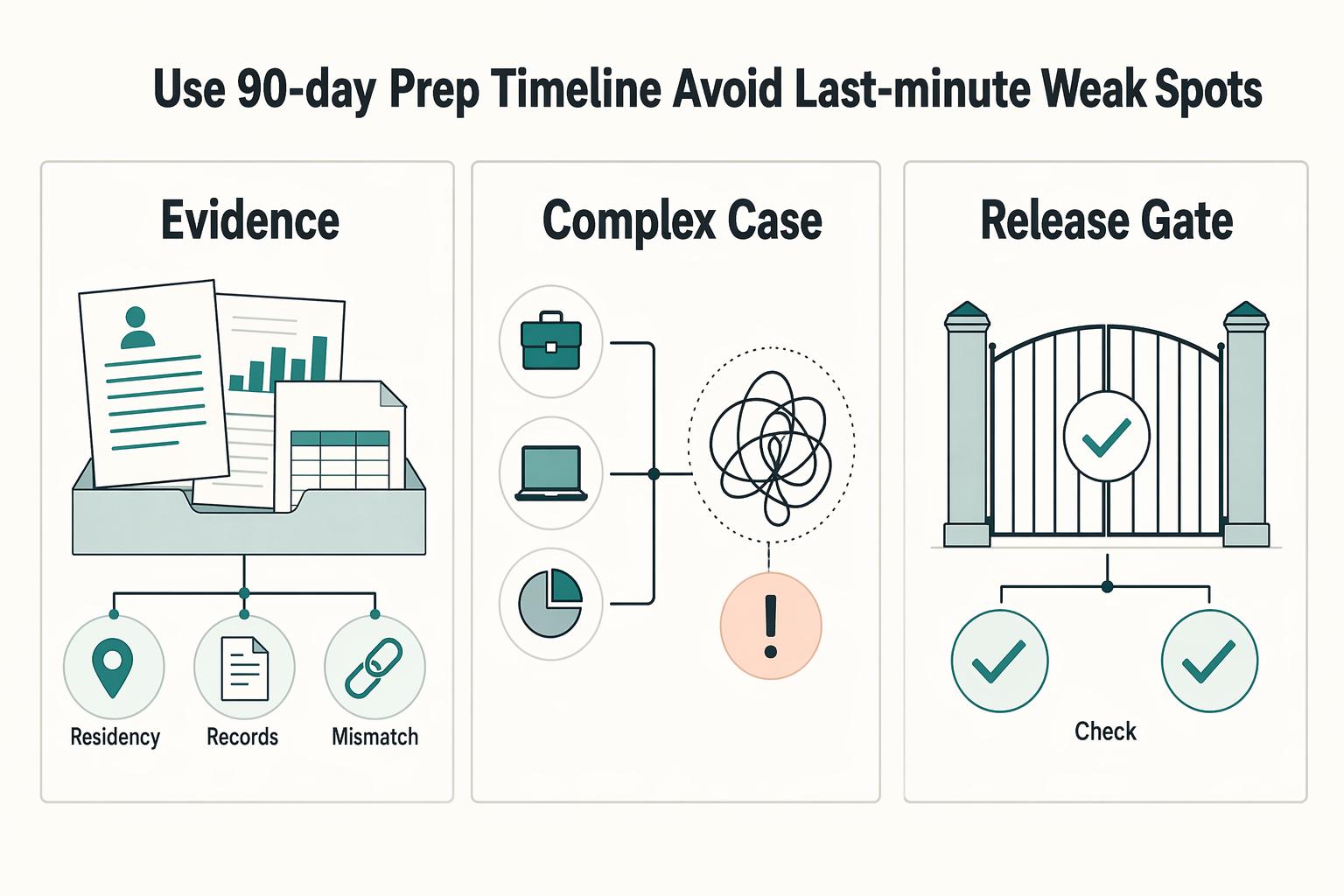
A 90-day window is a practical way to prepare. Collect first, repair second, verify last, and do not submit until those three steps hold together. It is not an official deadline, but it gives you room for AIMA delays and shifting documentation standards, and it helps you catch consistency gaps between work records, payment records, and bank statements.
Keep two checks in place from the start. D8 is framed as an active-income route, including salary, freelance work, or business profits, while passive-income cases fit a different route. Also treat thresholds and validity windows as post-specific items to verify, not assumptions; keep the current income requirement and document-validity window pending until official post-level or consulate records confirm them. As a reference point from one January 2026 summary, active monthly income is listed as 4x Portuguese Minimum Wage (€3,480) and financial reserves as 12x Portuguese Minimum Wage (€10,440), but confirm current post-level requirements before filing.
Define your evidence types before you assemble the packet:
work basis: a notarized employment contract (for remote employees) or a service contract with international clients that explains why payment is duepayment trail: records showing that the employer or client actually paid you (for employees, recent payslips are often listed for3-6 months)statement continuity: complete bank statement history showing funds were accessible over time, not just on one date
Run one mandatory cross-reference step. Build a reconciliation sheet with one row per contract or invoice, linking contract/invoice reference -> payer name -> payment date -> matching bank credit.
| Phase | Priority task | Failure signal | Fix action |
|---|---|---|---|
| Collect | Gather work-basis, payment-trail, and full-statement records together | You have contracts without matching credits, or credits without clear work basis | Obtain the missing record type first, then complete the reconciliation sheet |
| Repair | Resolve gaps, naming mismatches, timing issues, and isolated spikes | Late or irregular payments, payer-name mismatch, or one large recent transfer with no context | Add supporting invoices or company docs where relevant, explain entity or timing differences, and show broader statement continuity |
| Verify | Confirm current post rules and run a full consistency gate | You still rely on assumed thresholds, assumed validity windows, or copied family rules | Replace assumptions with verified post entries and pause submission until every field aligns |
In the verify phase, keep the current family-funds calculation pending until the post-level checklist confirms it. If you are filing with dependents, proceed only when names, statement periods, account-holder details, and post-specific family handling rules all match the main applicant file (one January 2026 reference formula is +50% for spouse and +30% per dependent child, but verify your post's current rules).
For accommodation, treat pre-approval lease commitments cautiously. A 12-month lease before approval can create direct loss risk if the visa is refused. If your post accepts alternatives such as a Termo de Responsabilidade, confirm that option before you take on lease risk.
Your pre-submission gate should be strict. File only when contracts, service proof, payment records, and bank activity cross-reference cleanly, and all post-specific open items are replaced with verified entries. If not, you are still in repair, not verify.
Handle edge cases before they become refusal risks#
Edge cases are still consistency problems: state the change, show when it happened, and attach records that match that timeline. Problems usually start when dates, names, and route logic stop lining up across the file.
Portugal's route split makes this step unavoidable. Short Schengen stays, up to 90 days, are for tourism or business and are not general work authorization. For non-EU nationals, working in Portugal requires both a visa and a work permit. Long-term stays over six months fall into Type D national-visa territory. For long-term stays, local registration can include obtaining a Residence Certificate. If a change affects route fit, treat it as a filing decision before submission.
| Trigger | Required evidence | Reviewer red flag | Fix before filing |
|---|---|---|---|
| You switched clients recently | A clear note on what changed and when, plus supporting documents that match your timeline | Gaps or inconsistencies that make the sequence hard to follow | Build a one-page timeline and resolve mismatches before filing |
| One month dropped sharply | A plain-language explanation and supporting records that clarify timing | Activity that appears out of sequence or unexplained | Extend the timeline view and label delayed or combined activity clearly |
| Your family situation changed | Updated identity or relationship records and a fresh check of current requirements for your filing post | Household details no longer match the names, dates, or figures in the file | Rebuild this portion against current documents and recheck all dates and statement periods |
| Your route fit now looks unclear (D7 vs D8) | A short note on why your facts match your chosen route, plus consistent supporting records | The route label and the evidence no longer align | Pause packaging and confirm route logic before filing |
For a client switch, the goal is continuity, not a perfect pattern. A reviewer should be able to follow what changed without guessing.
For an income dip, the issue is usually not the dip itself but an unclear sequence. If timing changed, say that directly and make sure the records tell the same story.
For family updates, do not reuse old assumptions. Re-check the latest post-level checklist before you file.
For route-fit doubts, decide early. If your stay and work plan now point to a different path, reset the filing logic before you submit.
If your main question is route selection right now, use Portugal D7 vs. D8 Visa: Which is Right for You?.
Compare D8, D7, and temporary stay paths when funds are borderline#
When funds are borderline, choose the route that requires the least narrative stretch between your income type, your evidence, and your real stay plan.
| Path | Best-fit income pattern | Must-have proof | Common refusal trigger | Best use case |
|---|---|---|---|---|
| Remote-work residence route (label varies by post, including D9 or DR) | Ongoing remote salary or service income you can trace clearly | Work-link documents and bank statements for the last three months showing declared income, based on your post checklist | Money is visible, but the work relationship is weak, unclear, or unsupported | You plan residence and your strongest case is active remote work |
| D7 route | Income that is better framed as individual revenues than active client work | Evidence of income framed as individual revenues, plus the residence documents your post requires | File is labeled D7, but the packet still reads like a remote-work case | You want residence and individual revenues are what actually carry the case |
| Temporary-stay remote-work route | Real remote-work income with a genuinely short-term stay plan | Remote-work proof, income evidence for the last three months, and exit evidence, for example return-ticket evidence where listed | Temporary stay is used to cover what is really a residence plan | You have a defined short stay and credible departure evidence |
Use clear switch triggers before final packaging#
Make the switch before you draft explanations, not after.
If active remote work carries the case, keep the remote-work residence route and prove the work-to-payment chain clearly. If individual revenues carry the case, switch from remote-work route labeling to D7 before you finalize the packet.
Choose temporary stay only when your plan is truly short-term and your exit evidence is real.
Verify route label and checklist before drafting your final packet#
Route labels vary by post, so confirm your exact checklist first, then map your file to that wording.
- Pull the exact checklist for your consular post and record the route label used there.
- Confirm whether your stay plan fits temporary entry or residence under that post's current wording.
- Map each document to checklist language before writing explanations.
- Confirm current thresholds against your post-level checklist before filing.
This step prevents avoidable mismatches. Consular services can request supplementary documents, and incomplete files may be rejected.
For a deeper side-by-side route comparison, see Portugal D7 vs. D8 Visa: Which is Right for You?.
Plan for post-approval obligations from day one#
Approval is only the start. For D8, post-arrival step-by-step obligations are not confirmed, so do not write specifics into your planning until you verify them.
Use this year-one frame before submission:
- Permit follow-through: keep every verified post-approval step, date, copy, and status note in one place.
- Tax-position setup: decide tax handling with case-specific advice if needed, and add only verified requirements to your tracker.
- Evidence continuity: make sure your live records tell the same story as your application file once requirements are confirmed.
Your pre-filing checkpoint is simple: if you cannot maintain that continuity without improvising, fix the recordkeeping before you apply.
Use a simple year-one operating table#
This is not an official government checklist. It is a control to keep records consistent while D8 operational requirements are being verified.
| Task | Owner | Cadence | Proof artifact |
|---|---|---|---|
| Save the exact application packet and final submitted versions | You | Once, before filing and after submission | Complete PDF set, submission receipt, file index |
| Track permit follow-through items | You | Confirm the required cadence from the official source | Verified requirement notes, appointment confirmations, notices, copies of submitted forms |
| Keep an income record that matches work to payment | You or your bookkeeper | Confirm the required cadence from the official source | Invoice list, client name map, payment reference log |
| Store contract and scope updates for each active client | You | Event-based | Signed contract, renewal email, statement of work |
| Review tax-position documents and advice | You and adviser if used | Confirm the required cadence from the official source | Written advice, any completed filings or registrations, notes of assumptions |
| Reconcile naming and amounts across files | You | Confirm the required cadence from the official source | Reconciliation sheet showing invoice, payer name, amount, date |
Fix complexity before it becomes a year-one problem#
The same issues that weaken an application can create problems after approval, so fix them early.
- Multi-client naming differences
If contract, invoice, and payer names do not match cleanly, create a client-name crosswalk before filing and keep it with your records.
- Mixed payment rails
If you use multiple payout routes, keep reports that tie each transfer to the underlying invoice, and simplify routes where possible.
- Irregular billing
If billing is uneven, keep a service-period log showing when work happened, when you invoiced, and why payment timing varies.
Do not import D7 thresholds into D8 planning. The excerpted D7 source frames D7 as a long-stay route for people with stable passive-type income and states €12,000.00 per year, plus 50% for a spouse and 30% for dependent children, for D7 passive-income cases. It does not confirm D8 operational requirements. For D8-specific follow-through details, use only requirements verified from official D8 route and post records.
If you want broader D8 route context before final checks, see Portugal Digital Nomad (D8) Visa: A Complete Guide.
Run a final pre-submission quality control pass#
Use a strict internal go-or-no-go rule: submit only if the packet works without verbal explanation. If a reviewer cannot clearly tell who pays you, how your income recurs, and what funds are available now from the file alone, consider waiting to file.
Treat this as your internal QC pass, not an official consular checklist or legal pass/fail standard.
| Check | How to verify | Failure signal | Fix action |
|---|---|---|---|
| Name consistency | Compare your passport name, contract party names, invoice issuer, payer names in statements, and your summary line by line | The same client appears under different names, or your own name differs across records | Correct the summary, add a one-page name crosswalk, and replace vague labels with exact payer names |
| Payment traceability | Trace each income line in your summary to an invoice, payment proof, and bank statement entry | A contract exists but payment is not visible, or a large deposit cannot be matched | Add the missing invoice or transfer record, or remove that line until documentation is complete |
| Statement completeness | Check every page of every statement for the period shown, including account holder name, dates, and page sequence | Missing pages, cropped exports, month gaps, or unexplained account switches | Re-download full PDF statements and include every account actually used in the case |
| Summary-to-document mapping | Mark each summary line with the exact supporting file and page | Totals look right, but the source document is unclear | Add file and page mapping in the summary and split overly broad categories |
Run a third-party read test before submission. Pass only if someone unfamiliar with the file can identify, from the documents alone, your income source, whether income is recurring or irregular, and your currently available funds.
Finish with one scope check: keep your route label consistent across your cover note, summary, and appointment booking. The D8 is described as a residence visa for remote workers, freelancers, and independent contractors with income from outside Portugal, and there are two versions, including temporary stay (up to 1 year). As a baseline fit check, the same source lists D8 applicants as non-EU/EEA/Swiss and shows a source-listed application timeline of 3-4 months and an income benchmark of four times Portuguese minimum wage (€920), so verify current requirements before submission.
Related reading: Should You Choose Portugal's Golden Visa Fund Route?.
Before you lock your application pack, sanity-check route fit and supporting documents with the Visa Cheatsheet for Digital Nomads.
Conclusion#
Treat the file as one coherent, checkable story. If a reviewer has to guess how your documents connect, it is not ready.
Before submission, lock the route you are filing under and use that same label everywhere: appointment record, cover note, summaries, and supporting files. If the evidence does not fit the route you selected, switch routes before packaging instead of forcing a weak match.
Also keep your sources straight. One excerpted document in this material is a European Parliament study on asylum and migration funding in third countries, requested by the LIBE Committee and completed in December 2022. It is explicitly not the Parliament's official position. Use that as a reminder to verify current, route-specific visa requirements directly with your filing post. Portugal D8 financial thresholds and household-scaling details are unverified here.
Final submission gate#
- Every claim links cleanly from work record to invoice or contract to payment proof to bank entry.
- Names, dates, route labels, and amounts match across forms, statements, summaries, and cover note.
- Any household-member requirements are confirmed with your filing post, then reflected in one household summary.
- A third party can read the packet in order and explain your case in two minutes without extra context.
Once your visa strategy is fixed, hand off to post-arrival execution and map your tax and compliance timeline in the tax residency tracker.
Frequently Asked Questions
How much do I need to show?
Use a formula-led check, not an old euro number. Start with the guide-stated baseline (4x Portuguese minimum wage), then confirm the current multiplier and wage figure with your consulate before filing. If your file only clears the line because of one unusually strong month, treat it as higher risk and strengthen continuity evidence before filing.
Can I qualify using savings only?
Usually not as a standalone primary case. D8 is framed around remote-work or independent income from outside Portugal, so your file should read as an income case first. Use savings to reinforce liquidity and stability, not to replace work-linked proof.
What if my freelance income goes up and down?
You can still qualify if your evidence chain is clean. A reviewer should be able to follow each line from work record, to payment proof, to bank entry without gaps. If deposits are unexplained or payer names do not match, pause and fix that before submission.
How much bank history should I include?
Follow the post instruction exactly, not forum averages. Use the statement window from the current consulate instructions, and provide complete statements for every account you rely on. Avoid cropped screenshots, partial exports, or unexplained account switching.
How should I handle a family application?
Recalculate at post level before you file. Family handling varies by checklist version, so do not reuse someone else’s formula without confirmation. Keep one clear household-funds summary so coverage is explicit and easy to review.
Does passive income count for D8?
Do not assume passive income alone will carry a D8 case. The route is presented for remote workers, freelancers, and independent contractors with income from outside Portugal, so passive-income-heavy files may fit poorly. If that is your profile, confirm route fit before filing and compare with Portugal D7 vs. D8 Visa: Which is Right for You?.
Should I choose the residence route or temporary stay version first?
Yes, decide this early and keep that label consistent across booking, cover note, and financial summary. D8 is described as having two versions, and the Temporary Stay version is described as valid for up to 1 year. Mixed route labels are avoidable and create review friction.
Try a related tool
Researched and edited by the Gruv editorial team. Gruv builds cross-border billing, payouts, and finance-operations software for global businesses.
Sources
- cia.gov/readingroom/document/cia-rdp78t03194a0002000...trusted
- cs.unm.edu/~chris2d/papers/freq2.txttrusted
- dol.gov/sites/dolgov/files/OFCCP/foia/files/DOL01003...trusted
- ec.europa.eu/research/participants/documents/downloadPublictrusted
- govinfo.gov/content/pkg/GPO-UA-2003-12-22/html/GPO-UA-20...trusted
- govinfo.gov/content/pkg/GOVPUB-GP3-1e13b34cce4065a23d3ea...trusted
- op.europa.eu/webpub/easo/annual-report-2016/entrusted
- pasadena.edu/academics/docs/catalog18-19.pdftrusted
Educational content only. Not legal, tax, or financial advice.
Related Posts

The 2026 Global Digital Nomad Visa Index for 50+ Countries
Start with legal fit, not lifestyle filters. The practical order is simple: choose a route you can actually document, then decide where you want to live. That single change cuts a lot of wasted comparison work and stops you from falling in love with places that were never a real filing option.

Portugal Digital Nomad Visa Decisions That Prevent D8 Delays
Start with verification, not paperwork. In this research set, some material is useful only as EU VAT context, not as D8 instruction, and mixing those categories is one of the fastest ways to build the wrong plan. We use the same separation rule in [Global Digital Nomad Visa Index](/blog/global-digital-nomad-visa-index) comparisons.
Portugal D7 vs. D8 Visa: Which is Right for You?
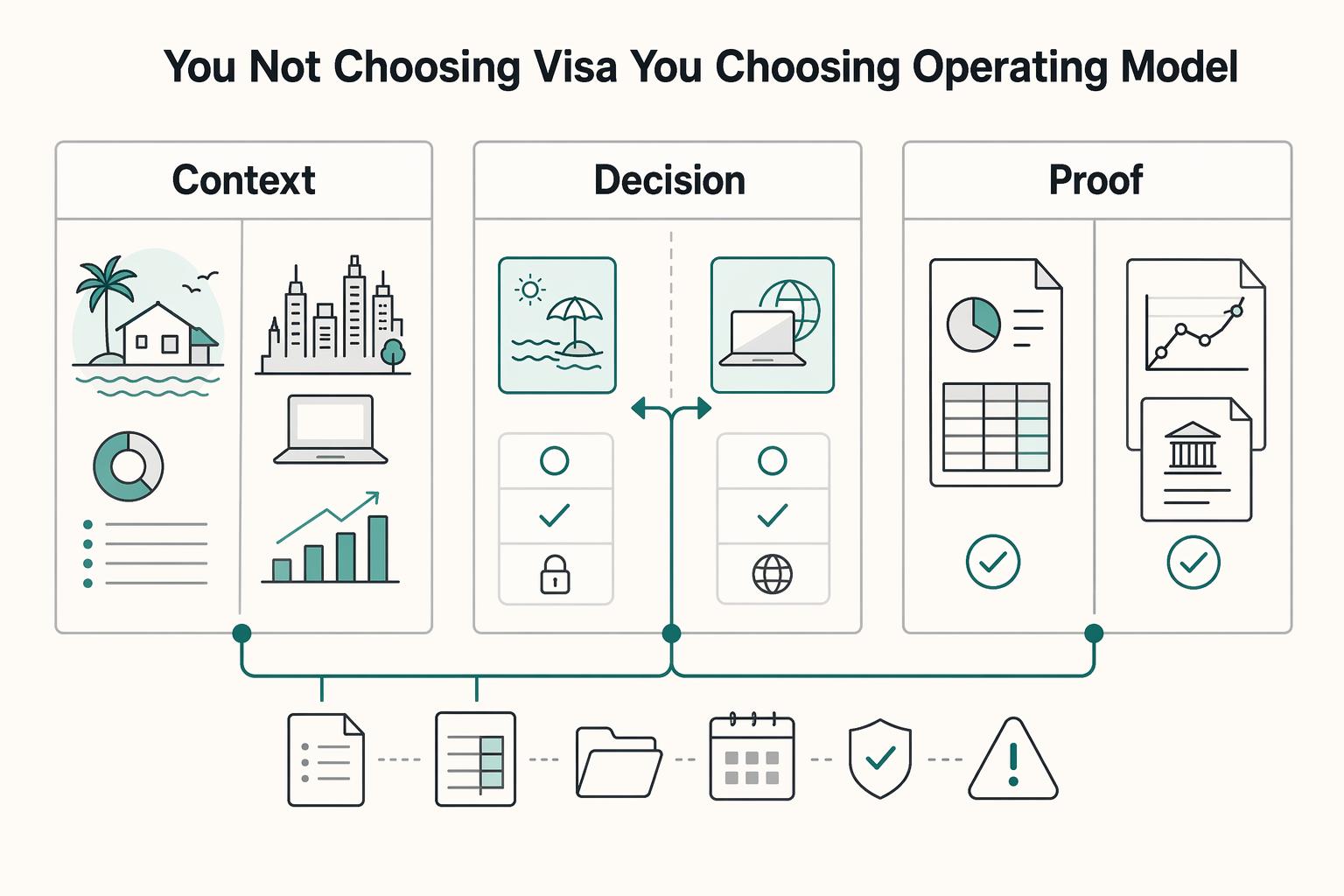
**Treat Portugal D7 vs D8 as an operating decision first, then choose the visa that matches your income narrative and proof quality.** If you treat this like form-filling, you will collect the wrong evidence and end up in a rework loop. If you treat it like operations, you set a default path early, sequence documents on purpose, and keep a fallback ready.