
Quick Answer
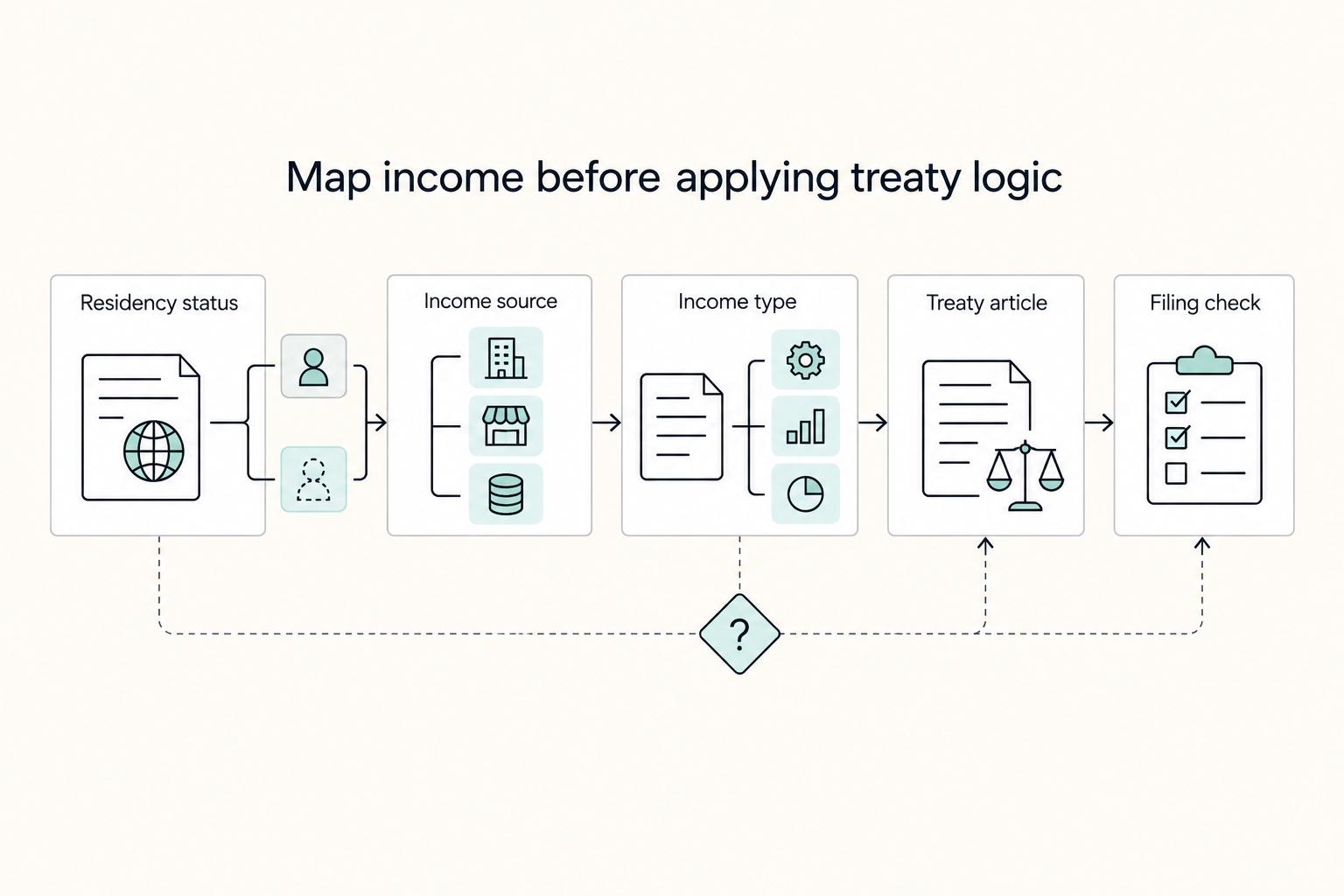
Start by placing yourself in one lane (legacy holder, transition claimant, or new applicant) and verify the legal program name before assuming benefits under the portugal nhr tax regime. Treat NHR, IFICI, and ITS as potentially overlapping labels rather than automatic equivalence. Build an income map by source and type, test treaty wording for each category, and pause pricing or filing when eligibility rests on unproven transition facts.
What 2026 Freelancers Need to Decide#
If you are planning around Portugal NHR in 2026, start by checking which legal path actually applies to you. Public pages still mix the legacy regime with newer labels, and that overlap is enough to push people into the wrong assumptions before they file a return, issue an invoice, or set pricing for the year.
Non-Habitual Resident, or NHR, is the legacy label. One source in these materials describes a 2009 start and a 10-year benefit window. More recent commentary also uses newer labels, including NHR 2.0 and IFICI. Treat those names as prompts to verify your position, not as proof that the old and new routes are interchangeable.
A safer anchor is the income itself, then the treaty mechanics that may apply. That means looking at income type, source, Portugal's Double Taxation Agreements, and OECD-model logic where no treaty applies. Article 10 in the UK-Portugal DTA for dividends is a useful reminder that broad exemption stories often fail once you test a specific category.
Use this guide as a conservative filter before you file, invoice, or forecast:
- Separate confirmed facts from assumptions about the current rules.
- Validate treatment by income category and treaty context.
- Keep residency and document records consistent before relying on any preferential outcome.
This guide also flags blacklisted tax-haven jurisdictions as a higher-risk area. The practical goal is simple: make residency and tax decisions on facts another reviewer can follow, not on recycled shorthand.
That conservative approach matters because early assumptions tend to spread. A label picked up from a blog post can shape invoice pricing, tax reserve levels, and even whether you think a filing is needed in another country. If the starting label is wrong, the error rarely stays contained. It moves through the whole year.
Understand what changed from NHR to the replacement regimes#
What changed was not just the label. Public tax commentary describes legacy NHR as terminated and a newer, narrower incentive as introduced. If you treat that shift as a simple rename, you can misclassify your position before you ever get to the return.
Legacy summaries often described the regime as offering broader incentives, including foreign-source income exemptions and a 20% flat rate for qualifying employment or self-employment income. The replacement descriptions are tighter. IFICI, also described as the Tax Incentive for Scientific Research and Innovation, is presented as tied to specific activities and entities rather than broad access.
Much of the confusion comes from naming. Public explainers use NHR 2.0, IFICI, and ITS in overlapping ways, but overlap in wording is not the same thing as legal equivalence.
| Label you may see | How it is used in public content | How to treat it now |
|---|---|---|
| Tax Incentive for Scientific Research and Innovation (IFICI) | Formal name used for the newer incentive | Use this as the anchor term, then verify the legal conditions for your case |
| NHR 2.0 | Common shorthand for the post-NHR transition | Treat it as shorthand until mapped to the legal term |
| ITS | Alternate shorthand, sometimes used alongside IFICI language | Treat it as potentially overlapping wording, not proof of eligibility |
The working default is simple: assume label overlap and confirm the legal mapping before you act. Validate the legal program name, the qualifying activity category, and any entity condition in your setup. Then check whether the commonly cited five-year non-residency lookback applies to you.
A practical continuity rule helps keep this organized:
- Legacy NHR holders should verify ongoing obligations and assumptions against their own records.
- New entrants should not rely on older, broader NHR summaries and should instead validate replacement eligibility against activity and entity criteria before pricing or forecasting.
- Anyone receiving mixed labels in advice notes should pause and ask for legal-term clarification in writing before filing.
In practice, the rename assumption creates operational problems long before return season. Someone reads a legacy summary, assumes a fixed rate or a broad foreign-income outcome still applies, and then sets client pricing or cash withdrawals around that assumption. Later, when the actual route turns out to be narrower, the shortfall is no longer just technical. It becomes a cash problem.
The main failure mode is straightforward: people import legacy assumptions into a narrower route. Once you separate the names, the next task is to sort what is actually known from what is still moving.
If you want a deeper dive, read the digital nomad tax guide.
Separate what is known from what is still uncertain in 2026#
For 2026 planning, separate what public explainers consistently support from what they do not. That keeps you from building a filing position on commentary that may only be partly aligned with the current legal route.
| Known | Uncertain |
|---|---|
| Legacy Non-Habitual Resident, or NHR, is described in public commentary as phased out, and one source says existing participants could continue benefiting. | Exact continuity conditions for legacy participants are not fully detailed in the public summaries provided here. |
| The replacement is described as narrower and more targeted, and public explainers use labels such as NHR 2.0, IFICI, and ITS. | It remains unclear from those explainers whether those labels always map to one identical legal term in every context. |
| One source describes favorable treatment for some foreign-source income, with pensions treated differently. | Detailed treatment by income type, including pensions, is described inconsistently and should not be assumed from one article. |
| Some explainers provide concrete dates and filing windows. | Rollout timing remains uncertain in public explainers, and at least one source explicitly notes implementation uncertainty. |
That split matters because the known items are enough to build a conservative plan. The uncertain items are where you stop short of forecasting on favorable treatment or filing on a label you have not pinned down.
Use one verification checkpoint before acting: confirm your tax residency position for the relevant year, then map your case to the legal program term used in your own documents. If those two do not align, pause and escalate before filing, invoicing, or cash planning.
A practical way to use this section is to keep a short internal note with three labels next to every assumption you plan to rely on: confirmed, assumed, or unresolved. If a point stays in the assumed or unresolved category, it should not drive pricing, cash extraction, or treaty claims. That is especially useful when advice from different sources sounds similar but is not actually saying the same thing.
That known-versus-uncertain split leads straight to the practical question: which lane are you actually in right now?
Decide where you fit right now#
Work out your lane before you use any tax rate, exemption, or forecast. In practice, many avoidable mistakes start with people using the wrong label for their own position.
Public explainers describe legacy NHR as closed to new applicants around January 2024, with a transitional phase ending by 2025, while existing beneficiaries may keep benefits for the remainder of their original 10-year period. Use that as a working map, not a final legal answer, because the timeline is not presented consistently across every summary.
| Your lane | First question to answer | Evidence to gather before acting |
|---|---|---|
| Legacy NHR holder | Is your original status still active, and how much of your original term remains? | Prior approval records, recent filings, and proof of your current Portugal tax residency position |
| Transitional claimant | Can you prove you met a transition route when legacy access narrowed? | Dated move records, residence permit records, and official correspondence on status |
| New applicant | Do you qualify under replacement incentive conditions, or are you under standard domestic rules? | Residency facts, activity details, and any required employer or activity certification |
If you are a legacy holder, start by checking whether your status history and current residency facts still line up. A commonly cited trigger is more than 183 days in Portugal in a calendar year, or habitual residence there. Immigration permission and tax residency often point in the same direction, but a permit by itself is not a complete tax answer.
If you are claiming a transition path, proof is the whole issue. That means dated records showing where you were in the process when legacy access narrowed, and whether those records actually match the route you are now relying on.
If you are a new applicant, assume legacy access is closed unless you can document a valid transition route. At least one replacement guide describes a targeted path tied to activity or employer certification. If your profile does not clearly fit those narrower conditions, budget under standard domestic taxation until eligibility is confirmed.
Use a hard stop here: if eligibility depends on older transition-era facts, get professional review before filing. Pre-closure documents can support your case, but they are not the same thing as automatic qualification.
There are also practical warning signs that your lane may be misidentified. If your file uses both a legacy label and a replacement label without explaining why, that is a warning sign. If you are relying on a transition route but do not have dated records that show where you stood when the rules shifted, that is another. If your expected outcome depends on an activity or entity requirement that is only described in broad terms in the materials you have seen, treat that as unresolved, not solved.
Once your lane is clear, shift from labels to cash flow. Tax treatment usually turns on income type, source, and timing before it turns on the headline name of the regime.
Map your income before you assume any tax treatment#
Map the income before you do any tax math. Treatment starts with residency status, then moves to source, then to treaty logic by income type.
| Income bucket | What to log now | Why it matters |
|---|---|---|
| Portugal-source income | Client name, service dates, invoice dates, and where the work is performed | Non-residents are taxed only on Portuguese-source income, so source tagging is a core gate |
| Foreign-source income | Country of payer, income type, gross amount, withholding details | Treatment can change by treaty and income type, not by one headline rule |
| Pension income | Payer country, pension type, payment dates, and annual totals | Pension treatment can differ from service and investment income |
One rule runs through the whole article: if your income mixes client services, investment income, and pensions, do not rely on one summary statement about status. A Portuguese tax resident is taxed on worldwide income, while a non-resident is taxed only on Portuguese-source income. If residency is wrong, every later assumption built on top of it is wrong too.
A single-country freelance setup is usually simpler. If you have one payer country, no pension income, and no investment income, you still need to classify source and status, but the treaty analysis may be narrower. A multi-country profile is different. Consulting invoices from several countries, plus dividends or interest, plus pension receipts, usually means bucket-by-bucket treatment and treaty checks for each income type under the relevant DTA.
Set a checkpoint before pricing, cash planning, or filing prep. Confirm whether you are resident or non-resident for the year, including partial-year facts if you moved. Then align your records with Portugal's tax calendar: the tax year runs from 1 January to 31 December, with personal returns normally filed between April and June of the following year.
In cross-border cases, treaty exposure is often where the complexity sits. Portugal has DTAs with more than 70 countries, but those outcomes are not interchangeable across income categories. One replacement-program source also flags mixed income streams and the wrong business structure as a failure mode, so keep records separated by bucket and by country from the start.
A useful discipline is to tag each payment when it arrives, not later from memory. Record the payer country, service period, invoice date, payment date, and any withholding information at the time of posting. If work was carried out in one place but paid from another, keep a short note explaining the fact pattern instead of leaving it to memory at filing time. Do not collapse all non-Portugal revenue into one broad foreign-income line when the underlying income types differ.
Timing matters too. If you move during the year, it is easy to end up with records showing cash received after the move for work largely performed before it, or payments linked to contracts that span more than one residence position. Even if the final treatment needs review, the file is much easier to work with if the timeline is captured as the year unfolds rather than reconstructed at the end.
After the income map, you can test treaty positions with much less guesswork.
Use treaty logic carefully before claiming exemptions#
This is where broad summaries usually start to fail. The sequence matters: establish your residency position for the year, identify the treaty article that matches the payment, and then check whether either country still expects a filing or reporting step. An exemption story that skips those steps is not a reliable basis for filing.
Before you rely on a treaty outcome, build the reasoning from documents rather than headlines. Keep the contract or payment support that shows what the income actually is, the invoice trail, any withholding details already applied, and a short note on why you think a particular treaty article is relevant. If that chain is weak, the treaty conclusion is weak too.
It also helps to separate two questions people often blend together. One question is whether a treaty may change the ultimate tax treatment. The other is whether you still need to file, report, or document something in one or both countries while claiming that treatment. Skipping the second question is a common way to create compliance problems even when the first question might eventually be answered in your favor.
If the treaty position is still unclear when you are invoicing, use the conservative cash answer rather than the optimistic one. Reserve funds as though relief may not apply until you can support the favorable outcome with documents and reasoning that hold together.
UK/Portugal example in practice#
Assume you are tax resident in Portugal with UK-linked consulting income. Do not assume the UK-Portugal treaty removes UK filing steps. If UK Self Assessment is required, keep these checkpoints in view: HMRC notification by 5 October 2025 for the previous tax year, online filing on or after 6 April, and possible penalties for late notification.
Before claiming relief, keep a compact file that another reviewer could understand quickly:
- Residence-position notes for the tax year, including move dates.
- UK filing readiness items such as UTR, account status, and service limits, including the point that the online filing service cannot be used if you lived abroad as a non-resident.
- Return-support records such as bank statements and receipts.
- A short note on what treaty text might support for that income type, and what remains uncertain.
The Portuguese treaty-exemption outcome for that scenario is not established, so the safer move is to file conservatively and escalate before asserting exemption treatment. Whether the treaty ends up helping or not, the discipline is the same: keep the reasoning and the filing steps in one place.
The useful lesson is not just about the treaty article. It is also about process. Your Portugal analysis and your UK administrative readiness should sit in the same working file, because a treaty claim is harder to defend when the tax logic lives in one place and the filing evidence lives somewhere else.
That same discipline carries directly into your Portugal setup file.
Build your Portugal evidence pack before first invoice#
Before the first serious invoice goes out, make sure your file tells a coherent story about residence, timing, and the route you think applies. The point is not to build a perfect legal dossier on day one. It is to have enough organized evidence that you are not pricing work on assumptions you cannot later support.
Transition guidance is mixed. Some public sources describe legacy NHR as closed to new applicants in 2024, while IFICI, often called NHR 2.0, is presented as applying to people who become Portuguese tax residents from 1 January 2024. Other reporting discusses planned incentive changes. Your internal file should say which route you are relying on and what remains uncertain.
Keep the file readable. A short cover note that states your current view, the documents that support it, and the points still awaiting confirmation can save hours later. If a reviewer has to infer your theory from a pile of PDFs, the file is not doing its job yet.
Build a minimum internal evidence file#
Start with the minimum file you would want to hand a reviewer tomorrow. This is an internal control list, not an official legal checklist.
- Identity records: a clear ID copy and consistent personal details across filings.
- Tax registration records: proof of registration and effective date.
- Immigration records: residence visa or residence permit, with issue and validity dates.
- Portugal tax residency support: timeline notes and records supporting your residency position, including the five-year non-residency lookback if your IFICI position depends on it.
If your case depends on transition-era facts, keep those records in the same file and add a short explanation of why they matter. Do not rely on any single document as stand-alone proof of eligibility without tax or legal confirmation.
It is also worth adding a simple timeline note that links the documents together in plain language. State when you moved, when you registered, when your status changed, and which record supports each point. That note does not replace the documents, but it makes the documents usable.
Check setup risk before pricing on preferential treatment#
Structure matters more than most people expect. Some summaries describe IFICI eligibility as tied to working for or owning a qualifying Portuguese company, including examples such as forming a Portuguese Unipessoal LDA and serving foreign clients. Those same summaries say a remote employee paid only through a US W-2 without a Portuguese entity is non-qualifying.
That distinction should change how you price your work and how much cash you reserve. If your setup looks more like the second case, do not build your numbers around preferential treatment until someone confirms the activity and entity conditions in writing.
This is especially important for proposals, retainers, and annual client agreements. Once you quote based on an assumed lower tax cost, it is difficult to repair the commercial impact later if the tax treatment turns out to be less favorable. Conservative pricing is usually less painful than trying to recover a bad assumption after work has already started.
Set document hygiene before go-live#
Messy files create avoidable disputes later. Keep signed copies where signatures exist, along with submission receipts and filing confirmations, dated when available. Add a one-page status note that shows what is confirmed, what is pending, and who will resolve each open point.
Before issuing your first major invoice, run these internal checks:
- Your residence visa or permit file is complete and aligned with your tax registration timeline.
- Your chosen route is explicit and consistent with the guidance you are relying on, such as IFICI.
- Any dependency on a qualifying Portuguese company is documented with entity records and ownership or employment records.
- Open transition risks are written down where policy language is still moving.
Consistency matters more than polish here. Use the same name format, the same address format, and the same status language across your records where possible. If a later reviewer sees different labels for the same status in different parts of the file, they may assume the underlying facts were unclear even when they were not.
For the immigration side, see Portugal Digital Nomad (D8) Visa: A Complete Guide.
Before you send major invoices, set a repeatable timeline for residency milestones and filing deadlines: Use the tax residency tracker.
Once the file exists, the next job is sequencing your first three months so the paperwork lands in the right order.
Sequence your first 90 days in Portugal#
The first 90 days are mostly about order, not volume. A conservative sequence is to document immigration status first, complete resident and taxpayer registration next, and then confirm your incentive path. That order will not solve every issue, but it does prevent a lot of avoidable misalignment.
In the first phase, make sure your residence visa or permit records are complete, dated, and easy to verify. Add Portuguese address proof early, since it is cited as part of NHR application expectations. If your position depends on grandfathering, keep dated evidence that a visa or permit process was initiated by 31 December 2023.
Then move to tax registration and deadline control. One excerpt says you must be registered as a resident before applying for NHR status, and that the request must be submitted by March 31 of the year after becoming resident. Keep a day-count log as well, since one excerpt summarizes residency with a more-than-183-days test in a 12-month period.
Set bookkeeping categories from day one so later filings are easier to support:
- Core tax documents: prior returns, income statements, account summaries, and pension records.
- Income mapping: each income stream before and after the move, including payer country and income type.
- Residency evidence log: entry dates, housing records, and tax-registration milestones.
In practice, many of the biggest tax mistakes happen before arrival, not after. If departure-country issues are still unresolved, cross-border exposure can widen quickly.
If eligibility is still pending, run pricing and cash planning without assuming preferential treatment. Before your first major invoice, apply one hard checkpoint: immigration file complete, resident and taxpayer registration complete, incentive path documented, and open questions assigned to a named reviewer.
The order matters because each later step depends on the previous one making sense. If you invoice before your residence and registration records are organized, you can end up trying to explain source, status, and timing all at once. If you wait to map income streams until after payments start landing, the first clean review of the year becomes much harder. A disciplined start does not guarantee the best tax result, but it usually prevents the worst administrative mess.
That is why the common failures are basic, but expensive.
Avoid the mistakes that trigger compliance pain#
Most compliance pain starts with assumptions you could have caught earlier. The pattern is familiar: the label is fuzzy, the income is mixed, the records are thin, and the favorable result gets assumed anyway.
Start with labels. Legacy NHR and the newer labels are often grouped together, but that does not make them interchangeable. One source says the older regime is closed to newcomers, and commentary dated August 25, 2025 still described operational gaps in the replacement track, including angel investor certification and regional criteria decrees in Madeira and the Azores. If the mapping is unclear, pause and confirm which route actually applies.
Next comes treaty relief. Double taxation risk is real, and high-level summaries are not enough for filing decisions. Use DTAs as document-level checks and test each income category separately before you price work or forecast net cash.
Another common error is leaning on old online timelines when your current-year facts have changed. A planning note from a prior year can be useful background, but it should not override this year's residency position, visa path, or income mix. If the facts changed this year, the filing posture may have changed too.
Then come weak records. Practical steps such as signing a lease or opening a Portuguese bank account can affect cross-border exposure, so informal notes are not enough. Keep records that support your income classification decisions, with dates, counterparties, and the document trail behind them.
A quieter failure mode is letting different files tell different versions of the story. Your immigration documents may suggest one timeline, your tax registration another, and your invoices a third. That mismatch does not always mean your position is wrong, but it does mean you need a written explanation before you rely on a favorable treatment. Otherwise, the reviewer is left to resolve contradictions you should have resolved first.
Use this pre-filing checkpoint before any large invoice or return submission:
- Confirm your status label and route in writing, including unresolved points.
- Confirm treaty-dependent positions only after reviewing DTA text for each income type.
- Confirm current-year residency facts against your filing calendar.
- Confirm records for income classification and key timeline events are complete and dated.
If any of those checks fail, do not assume preferential treatment in pricing or cash planning. Close the evidence gap first.
If you are also filing in the United States, add that reporting layer now rather than trying to bolt it on at year end.
Handle US reporting overlap if you are a US person#
If you are a US person, run Portugal filings and US reporting in parallel, not as substitutes for each other. Your Portuguese status path, including any NHR planning, does not replace US reporting checks for FBAR and Form 8938.
Form 8938 is threshold-based for specified foreign financial assets, and the thresholds are not one-size-fits-all. IRS guidance says higher thresholds can apply to joint filers and taxpayers residing abroad, so do not rely on one headline number. If you are not required to file a US income tax return for the year, Form 8938 is not required. If it is required, attach it to your annual return and file it by that return due date, including extensions.
FBAR is separate. If one foreign account, or your aggregate maximum across foreign accounts, exceeds $10,000 at any time in the calendar year, FBAR is required. Filing Form 8938 does not satisfy that requirement.
Use this overlap checkpoint:
- Keep an account and asset register for Form 8938 review.
- Track FBAR maximum values for each account separately, then test the aggregate.
- Record FBAR amounts in US dollars, rounded up to the next whole dollar.
- For non-US currency accounts, keep the exchange-rate source used.
- Track FinCEN timeline tasks in parallel with your Portugal filing calendar.
A simple decision rule helps here: if your account structure changes, re-check FBAR and Form 8938 scope immediately. Escalate early when Portugal planning intersects with US cross-border reporting and you are unsure what is reportable.
It also helps to use the same operating file for Portugal and US reporting inputs, even if the forms are different. Account openings, closures, ownership changes, and foreign payment flows should not live in separate silos if the same data supports both jurisdictions. Parallel tracking usually feels slower in the moment, but it is much easier than trying to rebuild the year from scratch for US reporting after focusing only on Portugal.
Whether or not you have US filings, the operating standard is the same: keep records that let someone else rebuild the year without guesswork.
Keep payment and tax records audit-ready as you operate#
Once you are live, the goal is not perfect paperwork. It is a file someone else can follow. Each transaction should trace from invoice to payout to ledger, with the income-source decision documented when you post it. That is what keeps your Portugal and non-Portugal tax narratives consistent if anyone reviews them later.
Portugal gives you a concrete compliance anchor. Issuing an invoice is mandatory for every transaction, and VAT taxpayers must report each issued invoice to the Tax and Customs Authority through the e-Fatura system. If your books only show totals, it is much harder to defend why a line was treated as Portugal-source or foreign-source income.
Build a routine while the facts are still fresh. When a payment lands, match it, classify it, and save the supporting record. When a classification remains uncertain, record the uncertainty at that point instead of silently choosing a category you plan to revisit later. Unresolved items are easier to manage than invisible ones.
Build a monthly reconciliation that can be rechecked#
Monthly is the right pace for most cross-border operators. If you leave the reconciliation until filing season, you end up reclassifying from memory, and that is where small mistakes become expensive ones.
Use one reference ID across the invoice, payout, and ledger entry so a reviewer can follow the chain without guesswork. Classify each line when posted, not at year end.
- Tie each invoice to its payout record and ledger line as it lands.
- Tag each entry as Portugal-source income or foreign-source income, with a short reason.
- Keep exception notes for mixed facts, such as one location for service delivery and another for payment origin.
- Resolve open items monthly so classification debt does not build into filing season.
Use one verification checkpoint: test whether someone else can rebuild the path from contract to tax category quickly and consistently. If they cannot, the file is not audit-ready.
Do not quietly rewrite history. If a line needs to move from one category to another after review, keep the change note with the reason and date. That makes later review much easier than finding that labels changed with no record of why.
Keep an evidence pack for residency and treaty decisions#
Do not wait until year end to assemble the logic behind your residency and treaty calls. Keep three document sets together for the fiscal year you are reporting, often January 1 to December 31: residency evidence, DTA reasoning notes, and filing confirmations with submission receipts.
Those notes do not need to be long. A concise record of the income type, the treaty article reviewed, and the treatment chosen can be enough to show good-faith reasoning. What matters is that the logic is dated and tied to the documents behind it.
A common failure mode is late recoding after totals are finalized. That may clean up the reports, but it can weaken credibility because the logic starts to look retroactive. This can matter even more outside VAT, where the same compliance-gap visibility is not produced for CIT and PIT, so your own records may carry more weight.
Another useful habit is to keep the version of the reasoning that existed when the decision was made, even if the analysis later changes. That shows the decision was made on the basis of the facts available at the time, rather than written backward to justify a result.
Use platform logs as evidence, not as a substitute for judgment#
Platform logs help when they support your reasoning, not when they replace it. If you use Gruv, treat its status logs, audit trails, and exportable records as supporting evidence you reconcile monthly. Platform data is useful when it can be matched back to invoices, payouts, and category decisions. It does not remove your responsibility to verify the final classification.
Exports are most useful when they are part of a regular close process. Save them in a way that lets you trace them back to the source month, then match them to invoices, bank movements, and ledger treatment. A clean platform export can strengthen your file, but only if the underlying classification logic is still yours and still documented.
Before annual filing prep, run a dry reconstruction of your full-year tax story from documents alone. If a third party can rebuild what happened without verbal explanation, your records are in a defensible state.
Conclusion#
The practical way through 2026 is straightforward: identify your lane, map your income, document your facts, and only then test whether any preferential treatment survives review. Published guidance does not all point in the same direction. One guidance source says new applications closed in 2024, while another says eligible people relocating in 2026 can still benefit. That is exactly why evidence has to come before assumptions.
If your path depends on a 2024 transition route, keep proof of pre-existing relocation plans before assuming any benefit. If you already hold NHR status, one source indicates continuity through the 10-year period, but you should still plan for possible higher exposure afterward. For some taxpayers, that shift can be material, especially where retirement distributions may be treated as ordinary income at higher rates.
Use this closeout plan before filing decisions:
- Confirm your residency and eligibility record first, including registration history and the five-calendar-year lookback.
- Finalize your income map by bucket and clearly flag unresolved classifications.
- Build a third-party-readable evidence pack with residency documents, transition evidence where relevant, treaty notes, and filing records.
- Set escalation triggers now for unclear treaty language, mixed-country income patterns, or conflicts between current records and prior assumptions.
If eligibility or income classification depends on an assumption you cannot prove with documents, pause and get professional review before submission. The low-stress path is to act on what is known, label what is uncertain, and escalate early when the facts are mixed.
Conservative planning is not the same as pessimistic planning. It simply means you do not spend, price, or file on the strength of an outcome you have not yet supported. In a year where public explanations still overlap and sometimes conflict, that discipline is often the difference between a manageable review and a painful correction.
If you want a cleaner operational setup for cross-border invoicing, payouts, and records as you scale, see Gruv for freelancers.
Frequently Asked Questions
Is Portugal NHR still available in 2026?
The legacy regime is closed to new applicants. Existing holders keep advantages until their 10-year term ends. If your plan depends on new entry, verify current eligibility before filing.
What replaced the Portuguese Non-Habitual Resident (NHR) regime?
Replacement-program labels are unverified until you confirm the exact program text for your case. Do not rely on naming overlap alone.
Are ITS, Tax Incentive for Scientific Research and Innovation, and NHR 2.0 (IFICI) the same thing?
No confirmed equivalence is supported here. Use these as potentially overlapping labels, not proof of the same legal regime. If your eligibility or tax outcome changes by label, get written advice before submission.
Does the preferential rate still apply, and to which income types?
Legacy descriptions include a 20% fixed IRS rate for qualifying high-value activities and favorable treatment for some foreign-source income for up to 10 consecutive years. Those outcomes are conditional on income type, category checks, and treaty facts. If you cannot document each condition, treat the lower rate as unconfirmed.
Can existing NHR holders keep their benefits for the full period?
One source says existing holders keep advantages until the 10-year term ends. It also says Portuguese tax can apply to worldwide income and gains after that period. Plan for that shift before the final year.
What should I verify before relying on treaty-based relief under a DTA?
Start by confirming that a relevant treaty exists and that your income type fits the treaty wording. Treaty relief is presented here as conditional, not automatic. Treat unclear outcomes as unconfirmed until reviewed.
When should a freelancer stop DIY and hire a tax professional?
Escalate early if you may have had partial Portuguese residence in the prior five years, if residency records conflict, or if your tax position depends on treaty claims. This pack also stresses that NHR is a tax regime, not an immigration status. That mismatch can lead to surprises down the road.
Try a related tool
Researched and edited by the Gruv editorial team. Gruv builds cross-border billing, payouts, and finance-operations software for global businesses.
Sources
Includes 2 external sources outside the trusted-domain allowlist.
Educational content only. Not legal, tax, or financial advice.
Related Posts

Digital Nomad Taxes in 2026 With a Defensible Filing Plan
With digital nomad taxes, the first move is not optimization. It is figuring out where you may be taxable, where filings may be required, and what proof supports that position.

Portugal Digital Nomad Visa Decisions That Prevent D8 Delays
Start with verification, not paperwork. In this research set, some material is useful only as EU VAT context, not as D8 instruction, and mixing those categories is one of the fastest ways to build the wrong plan. We use the same separation rule in [Global Digital Nomad Visa Index](/blog/global-digital-nomad-visa-index) comparisons.

Build a Freelance Marketing Plan You Can Run Every Week
A usable **freelance marketing plan** starts with one business result, not a pile of activity. If a task cannot be tied to pipeline movement, client acquisition, or revenue, cut it before it takes up calendar space.