

Quick Answer
Start with one anchor service and build your freelance portfolio career by adding only income lines you can operate cleanly. The article’s core approach is to test each stream with a keep-or-cut review, lock contract and invoice standards early, and use explicit payment terms before scaling. It also emphasizes traceable cross-border records and clear pause criteria so weak streams do not drain your strongest work.
Why this freelance portfolio career guide is different#
A portfolio career is deliberate: multiple income streams chosen to work together, not random jobs accepted whenever they appear. It is also different from gig economy work you pick up only as needed.
The priority here is execution, not motivation. You can blend part-time roles, freelance projects, consulting, and entrepreneurial offers, but each stream should justify its overhead and be realistic for you to run.
Use a keep-or-cut review before scaling any stream:
- Demand: Is work coming from a repeatable source or only one-off referrals?
- Delivery: Can you deliver consistently without hurting your anchor offer?
- Cash flow: Are payment terms clear and actually followed?
- Admin load: Can you handle contracts, payouts, and tax documents without constant exceptions?
If a stream keeps failing this review, pause it, fix the failure point, and test again before you add anything new. A practical way to make this concrete is to write one short operating note for each stream before you expand it. Capture what the stream sells, who signs off on scope, how payment is confirmed, and what would trigger a pause.
The upside is flexibility and more than one source of income, but only when the mix matches your skills, interests, and long-term direction. As you expand, keep a scope note for each stream: define payout rules and tax-document requirements before you scale.
Portfolio career, freelance career, and traditional career are not the same#
These paths are not interchangeable, and treating them that way can push you into poor growth choices.
A portfolio career combines multiple income streams instead of relying on one full-time role. A traditional path usually centers on one employer, where responsibilities, identity, and income stay tied to that organization. A freelance career is independent client work that can center on one main offer or several. A portfolio career is also different from gig work accepted only when needed.
| Career model | Control | Volatility | Admin burden | Growth ceiling |
|---|---|---|---|---|
| Portfolio career | Can be higher when you choose your own income mix | Can vary as different income lines expand or contract | Can be higher when multiple lines need terms, tracking, and review | Depends on how intentionally the mix is built |
| Freelance career | Varies with client mix and scope | Varies with pipeline depth and concentration | Varies with the number of clients and offers | Depends on pricing, positioning, and demand |
| Traditional career | Usually shaped by one employer's role design and pay structure | Can be steadier month to month in many full-time roles | Usually lower personal billing and client-ops admin | Depends on one employer path and available roles |
Recent behavior data helps explain why this matters: a 2024 survey cited in Forbes reported that 36% of U.S. adults earn money beyond their primary income, and half of those respondents started in the prior two years. That shows diversification is common, not that one model fits everyone.
The practical mistake is not choosing one model over another. It is running one model while planning as if you are in another. If you are building a portfolio, you need capacity, contract, and cash checks for each line. If your freelance work depends heavily on one core offer, your main risk is concentration rather than cross-offer complexity.
A contract role can be one slice of a broader portfolio or your main independent work for a season. Use one decision rule: if a new slice creates extra admin and confusion without improving margin or direction, treat it as distraction, not diversification.
Choose a revenue mix you can actually operate#
Choose the mix you can run every week, not the widest mix you can imagine. Diversification works when each line fits your time, strengths, priorities, and real delivery capacity.
| Review point | Question |
|---|---|
| Client demand | Is demand recurring or mostly one-off? |
| Delivery effort | Can you fulfill the work reliably without overload? |
| Admin load | Can you scope, price, bill, and follow up without constant exceptions? |
| Brand fit | Does this line reinforce how clients understand your value? |
One practical way to keep this manageable is to use a small set of buckets, for example: an anchor stream, an adjacent productized service, and one limited-risk experiment. Start there, then adjust based on what stays sustainable.
Reporting points to rising portfolio-style job search behavior. Treat that as a prompt to choose carefully, not a reason to copy what everyone else is doing.
If you need a quick screen, use the same four questions for each line:
- Client demand: Is demand recurring or mostly one-off?
- Delivery effort: Can you fulfill the work reliably without overload?
- Admin load: Can you scope, price, bill, and follow up without constant exceptions?
- Brand fit: Does this line reinforce how clients understand your value?
Keep a simple revenue map and review dates for each line. Track offer type, expected monthly hours, and the next review point so drag shows up early.
To keep the map practical, attach a current status to each line: stable, under test, or at risk. Stable lines should show predictable delivery and payment behavior. Lines under test should have a clear success condition and a clear stop condition. At-risk lines should get corrective action with a date, not indefinite debate.
Treat a side hustle as tactical until it becomes repeatable. If it stays custom-heavy after a defined trial period, cap it or retire it so your core offers stay clear.
When possible, phase in new lines so you can see what changed in margin, workload, or positioning.
When in doubt, protect continuity over novelty. A narrower mix with clean execution can beat a broader mix that creates missed deadlines, unpaid scope, and weak positioning.
Design offers that do not cannibalize each other#
Give each offer a distinct job for a distinct buying context. If two offers solve the same problem with fuzzy scope, they will compete with each other.
| Offer layer | Primary use |
|---|---|
| Flagship custom service | for higher-complexity outcomes |
| Scoped productized service | for repeatable needs |
| Selective contract role work | as an additional income stream |
A simple three-part architecture usually covers enough ground:
- A flagship custom service for higher-complexity outcomes.
- A scoped productized service for repeatable needs.
- Selective contract role work as an additional income stream.
Set boundaries in writing before you sell. Be explicit about scope so a scoped offer does not drift into custom work.
Create a one-page offer map for each stream:
- Buyer: who it is for, and who it is not for.
- Promise: the outcome you can deliver consistently.
- Capacity: how many active commitments you can realistically carry.
Before launch, pressure-test overlap with three questions. Are two offers targeting the same buyer with only minor scope differences? Are you quoting both offers in the same sales conversation without a clear reason? Are clients choosing the lower-priced offer and asking for higher-priced outcomes? If yes, tighten boundaries before you scale outreach.
Keep the paid path explicit. Prioritize paid work early, even at a lower starting rate, instead of normalizing unpaid projects. Job boards like UpWork and Fiverr can be one way to get initial traction.
Make one tradeoff call upfront: every offer type has tradeoffs in effort, pricing, and fit. If a new offer targets the same buyer with less strategic upside, fold it into the main service or cut it.
A clean offer set makes client conversations easier. You spend less time explaining what is included and more time qualifying fit.
Lock contracts, invoices, and payment terms before you scale#
Lock your commercial documents before volume rises. Use a standard proposal, contract, and invoice set, and tie each one to explicit payment terms.
Freelancing often means handling invoicing yourself, and income can be unpredictable while momentum builds. Standard templates help keep terms consistent and reduce avoidable scope, timing, and payment confusion.
Set baseline terms by offer type before you send any agreement.
| Offer type | Terms to define upfront | Scope-change trigger |
|---|---|---|
| Flagship custom service | If you use deposits or milestones, define them in writing, plus any late-payment language that applies to your context | New objective, added stakeholder group, or deliverable not listed in contract |
| Productized service | Payment structure (for example, prepayment or milestone split), revision cap, and due-date language | Any request outside the fixed package boundary |
| Contract role work | Billing cadence, approval contact, invoice format, and payment timing expectations | Added duties beyond listed role responsibilities |
If a client asks for an exception, decide it in writing before work starts. Frequent exceptions can make collection and dispute handling less consistent as you grow.
Use a verification checkpoint for every active client:
- Signed terms on file, including version date and legal entity.
- Invoice log with unique number, issue date, due date, currency, and amount.
- Payment confirmation linked to the invoice, including remittance or transaction reference.
- Reconciliation note showing status and remaining balance.
If you grant an exception, log it the same day with reason, owner, and review date. That makes it easier to spot repeat issues and adjust terms early.
Another practical guardrail is a pre-send check for every proposal and contract package. Confirm the legal entity name, scope language, billing cadence, and acceptance path before delivery starts. Small mismatches at this stage can turn into avoidable follow-up later.
For cross-border work, prioritize traceability in your process. Choose payment rails and records that help you connect contract, invoice, payment event, and ledger entry where possible. As complexity rises, consider involving an accountant familiar with your field so billed amounts can be tracked and closed cleanly.
Build one career portfolio that sells all your offers clearly#
Build one portfolio narrative across all offers. Buyers often compare strangers, so they need clear proof quickly.
Treat the portfolio as a curated catalog of relevant skills and projects, not a complete archive. Keep one throughline across every profile: who you help, what outcome you deliver, and under what constraints.
There is no universal format, so organize proof by profession and format in a way buyers can scan quickly. If you use multiple formats, give each one a clear job without changing your core promise.
| Format | Practical role | What to show |
|---|---|---|
| Social media profile (for example, LinkedIn) | Present selected work to potential clients | Concise examples with outcome, constraint, and delivery context |
| Profession-focused portfolio | Make your specialization easy to assess | Project examples tied to the services you want to sell |
| Sample projects | Build early proof when paid work is limited | Clearly labeled self-initiated projects tied to a real offer |
Run a simple consistency check:
- Your core value promise says the same thing across formats.
- Each offer includes specific proof, not generic claims.
- Sample projects are clearly labeled as samples and tied to a paid offer.
Go one step further and standardize how you write proof. Keep each example short: starting constraint, scope delivered, and result context. That structure helps buyers compare your work quickly and helps you avoid vague claims.
As offers expand, avoid profile drift. Keep your message specific and consistent so inquiries are more likely to match the work you want to deliver.
If inquiries get noisy, treat that as a signal to tighten your positioning language rather than adding more offer pages.
Run cross-border money operations with traceable records#
Handle cross-border money as a strict sequence with records at each step: invoice, payment confirmation, reconciliation, then payout or withdrawal. Treat each payment as a chain, not a single event.
If one link is missing, keep the transaction open and visible until it is resolved. This matters most across borders, where provider processes can change over time.
| Stage | Record required | Check before moving on |
|---|---|---|
| Invoice issued | Invoice ID, client name, project tag, currency, due date | Terms and amount match the signed agreement |
| Payment confirmed | Provider reference, posted amount, posted date | Receipt matches invoice, or variance is documented |
| Reconciled | Link between invoice, client, project, and ledger line | Balance is closed or flagged for follow-up |
| Payout scheduled | Withdrawal date, destination account, payout reference | Payout is traceable back to the original invoice |
Where your provider supports it, keep exportable records so traceability carries into your ledger process. Cross-border providers continue to change through consolidation and partnerships, so recheck required record fields after any provider or program change.
Create explicit exception lanes so issues surface early:
- Returned funds: reopen the invoice, log the return reason, and set the next action.
- Held payments: record hold status, owner, and next review date before releasing related payout.
- Unmatched receipts: place funds in a separate queue and block closure until invoice mapping is complete.
To keep this practical, assign an owner to each open item and review it on a fixed cadence. Open items without an owner tend to linger until month-end pressure forces rushed decisions. A clear owner and next action date make unresolved money events visible before they become reporting gaps.
For hourly work, keep weekly time records tied to project and date, using a consistent grain such as half-hour entries. That is not a legal standard by itself, but it improves dispute readiness. Operate like an independent contractor running a small business: traceability first, then scale.
Put compliance and tax tasks on a fixed operating cadence#
Keep compliance work on a fixed rhythm as you grow: regular reconciliation, periodic setup review, and gate checks before new offers or country expansion. Treat this as internal discipline, not a universal legal timetable.
A client contract should anchor every revenue stream. A freelance B2B contract defines the relationship between business owner and client, and when used properly it helps protect both sides. Build your compliance rhythm around that anchor so records, money movement, and signed terms stay aligned.
| Cadence | Core check | Evidence to retain |
|---|---|---|
| Regular | Reconcile each invoice, payment receipt, and payout record by client and project | Reconciliation log, open-item list, and status owner |
| Periodic | Review whether your current operating setup still fits your service mix | Decision notes, updated document checklist, and policy notes |
| New offer or country expansion | Confirm policy gates before first sale | Required forms list, contract template updates, and owner signoff |
| Every contract role start | Confirm documentation standards and responsibility split | Signed agreement, scope record, and reporting trail |
Keep artifacts organized by client and jurisdiction so checks do not depend on memory. Maintain a complete pack for each stream: signed agreements, invoice trail, payout confirmations, required forms, and notes on who approved changes.
Keep regular reviews short and specific. Check what closed cleanly, what stayed open, what was missing, and who will resolve each gap. Then use the periodic setup review to ask a different question: does your current setup still match the way revenue is actually earned today?
Do not assume one market approach transfers to another. Check local policy gates and client requirements before you expand service lines. If a contract role is delivered through a nearshore partner, responsibilities may be split across structured onboarding, legal frameworks, and partner-handled payroll. Your records should show who owns each task.
Use one red-flag rule: if a stream cannot pass regular reconciliation and fast document retrieval, pause expansion in that stream until records are back under control.
Before reopening a paused stream, run a retrieval check on your own files. If you can quickly produce signed terms, invoice trail, payout evidence, and change approvals, restart is reasonable. If not, fix document hygiene first.
Know when to cut a stream before it hurts the business#
Consider cutting or pausing a stream when it repeatedly weakens delivery, cash flow reliability, or focus, even when top-line revenue still looks healthy. One stream can look productive while quietly draining capacity from stronger work.
Start with red flags you can verify in your own records:
- Missed deadlines that keep recurring.
- Rising admin load, including slower invoicing, more follow-ups, and longer reconciliation.
- Unstable collections, with aging invoices that keep rolling forward.
- Offer confusion that makes your positioning less clear.
Decide from patterns, not one rough week. Then use this test:
| Test | Keep the stream when... | Pause the stream when... |
|---|---|---|
| Margin | It still creates clear net value after delivery and admin effort | Rework and support load keep canceling out the benefit |
| Reliability | Delivery and collections stay consistent over time | Delays and payment instability keep repeating |
| Focus | It supports a clear market position | It blurs your message and distracts from core offers |
A lower-margin stream can still be worth keeping if it consistently feeds higher-value work. If it mostly creates support debt, context switching, and payment uncertainty, consider cutting it faster and protecting your strongest lines first.
When you pause a stream, define what must be true before you restart. For example: scope boundaries are clear again, payment behavior is stable again, and the stream supports your positioning again. Without restart criteria, pauses can become long limbo periods that keep draining attention.
Portfolio careers have been around for more than three decades, and recent reporting suggests interest is growing. Pruning is not failure. It is how you keep multiple income streams durable as conditions change. If you want a deeper dive, read The Best Crypto Wallets for Freelancers.
Execute your first 90 days in the right order#
Treat your first 90 days as a working sequence: clarify first, validate second, then prune and reinvest. This order helps you avoid scaling offers you will not keep.
Use online 90-day stories as directional input, not promises. One commercial guide describes a six-step path. It says beginners may spend 70 of 90 days on personal-brand work, and it claims faster movement for people with a stronger existing brand foundation.
| Window | Primary goal | Verification checkpoint | Failure mode to watch |
|---|---|---|---|
| Days 1-30 | Define your mix and package each offer clearly | You can explain each offer in one sentence, and your onboarding process is ready to use | Too many offer variants, unclear scope, delayed outreach |
| Days 31-60 | Onboard first clients and stress-test delivery | You have completed work in each approved stream and logged friction points | Custom exceptions pile up, and recurring friction stays unresolved |
| Days 61-90 | Score streams, cut one weak slice, and reinvest | A simple scorecard shows what to pause and where to focus next | Keeping weak-fit work because top-line revenue still looks fine |
In Days 1-30, keep the mix narrow: one anchor stream, one productized service, and one controlled experiment. Align your offer map with your outreach language so people understand quickly what you sell.
In this first window, draft your core client-facing docs before outreach accelerates. You want clear proposal and onboarding language ready before demand rises. That sequence reduces early negotiation drag and prevents ad hoc promises.
In Days 31-60, prioritize proof over scale. Track where delivery slows, tighten weak language in your process, and test again.
During this window, review every active engagement for the same signals: where scope drift started, where approvals slowed, and where handoffs became unclear. Small fixes now prevent recurring friction later.
By Days 61-90, move from activity to decisions. Review each stream for demand signal, delivery load, repeatability, and strategic fit. Then cut one weak slice and reinvest in the strongest line, often the anchor or a clearer productized offer. If you want a packaging model for that reinvestment, How to Create a Productized Service for Your Freelance Business is a practical next read.
Use LinkedIn and relevant professional communities to pressure-test your positioning language. If a stream needs constant explanation, rework it or remove it before Day 90.
Build diversification you can defend#
Diversification works when it protects cohesion, not when it maximizes variety. Each new stream should support resilience while keeping operations clear. If a line makes work harder to manage or your positioning harder to explain, pause expansion until you have better evidence.
| Gate | Check |
|---|---|
| Anchor | your primary commitment still gets protected time and remains stable |
| Cohesion | each offer supports one clear market story |
| Traceability | you can track effort and outcomes by stream |
| Complexity cost | added admin earns its place in durability and focus |
Your portfolio should read as one professional narrative across multiple roles and income streams. Start with an anchor: one primary commitment that grounds you financially and professionally, then build outward. The goal is a cohesive mix, not a busy schedule.
Before you scale, check four gates:
- Anchor: your primary commitment still gets protected time and remains stable.
- Cohesion: each offer supports one clear market story.
- Traceability: you can track effort and outcomes by stream.
- Complexity cost: added admin earns its place in durability and focus.
Keep a short monthly note for each stream: what improved, what degraded, and why. That habit supports clearer keep, pause, or cut decisions instead of reactive changes.
When a stream weakens one of the four gates, decide quickly. Either tighten scope and terms, or reduce effort and reallocate capacity. Waiting too long can make both offers and collections harder to manage.
Recent coverage of portfolio-style job search also shows why discipline matters: only 22% of U.S. workers wanted to work exclusively in an office, and 53% reported feeling strongly optimistic about job security. Those figures do not prove one model, but they do support adding streams deliberately.
Start narrow, scale slowly, and raise your proof standard as complexity rises. Keep investing in lines that improve margin, focus, and traceability, and cut lines that weaken your anchor. For practical expansion ideas after that filter, read The Best Ways to Diversify Your Income as a Freelancer.
Frequently Asked Questions
What is a freelance portfolio career in plain language?
A freelance portfolio career means earning income from multiple kinds of work instead of one full-time role. The mix can include freelancing, consultancy, and employment. The goal is flexibility with control, not doing everything at once. Keep the mix intentional. Multiple streams only help when each one has a clear role and a clear message.
How many income streams should a freelancer manage at once?
There is no single number that fits everyone. Your limit is the point where positioning stays clear and delivery stays consistent. If your week becomes hard to manage, simplify before adding another stream. A useful check is whether you can explain each active offer quickly and still deliver it consistently.
What is the difference between a portfolio career and a freelance career?
A freelance career can be one core service sold to multiple clients. A portfolio career is broader and combines different work types and income streams. The portfolio life framing has been around since 1989, so this is an established model. In practice, a portfolio career can add complexity, so regular review helps.
How do I choose which revenue stream to add first?
Start with transferable skills and marketable strengths you can already deliver. Then write a clear 30 second summary of who you help and what outcome you deliver. If that summary is fuzzy, tighten positioning before adding a new stream. Choose the line you can run clearly and consistently, not just the line that sounds most exciting.
What are the biggest risks when managing multiple income streams?
A common risk is moving from structured corporate work to self-directed work, which can feel unsettling at first. Another is unclear positioning, where buyers cannot quickly tell what you do. Adaptability matters too, because conditions can shift. A related risk is losing structure over time. Keeping a simple time diary and clear operating rhythm helps prevent drift.
What systems do I need to track invoices, payouts, and records cleanly?
You do not need one specific platform. You need one consistent method, plus a simple time diary so workload stays visible. The priority is clarity and consistency, not tool complexity. Use consistent record-keeping across all streams so day-to-day operations stay manageable as the portfolio grows.
When should I stop offering a service line?
Pause or stop a line when it repeatedly weakens positioning or delivery quality across your portfolio. Make that call from recurring patterns, not one difficult week. Then redirect effort to lines that are clearer and easier to run. Set restart criteria before pausing so the decision stays practical and does not become an open-ended debate.
Try a related tool
Researched and edited by the Gruv editorial team. Gruv builds cross-border billing, payouts, and finance-operations software for global businesses.
Sources
Includes 4 external sources outside the trusted-domain allowlist.
- phoenix.edu/blog/the-rise-of-the-portfolio-career.htmltrusted
- askamanager.org/2026/03/ask-the-readers-what-do-i-need-to-kn...external
- careershifters.org/expert-advice/what-to-do-when-you-want-to-do...external
- interaction-design.org/literature/article/9-step-guide-to-creating-...external
- portfolioprofessionals.org/beyond-the-book/your-portfolio-life/faq-on-p...external
Educational content only. Not legal, tax, or financial advice.
Related Posts
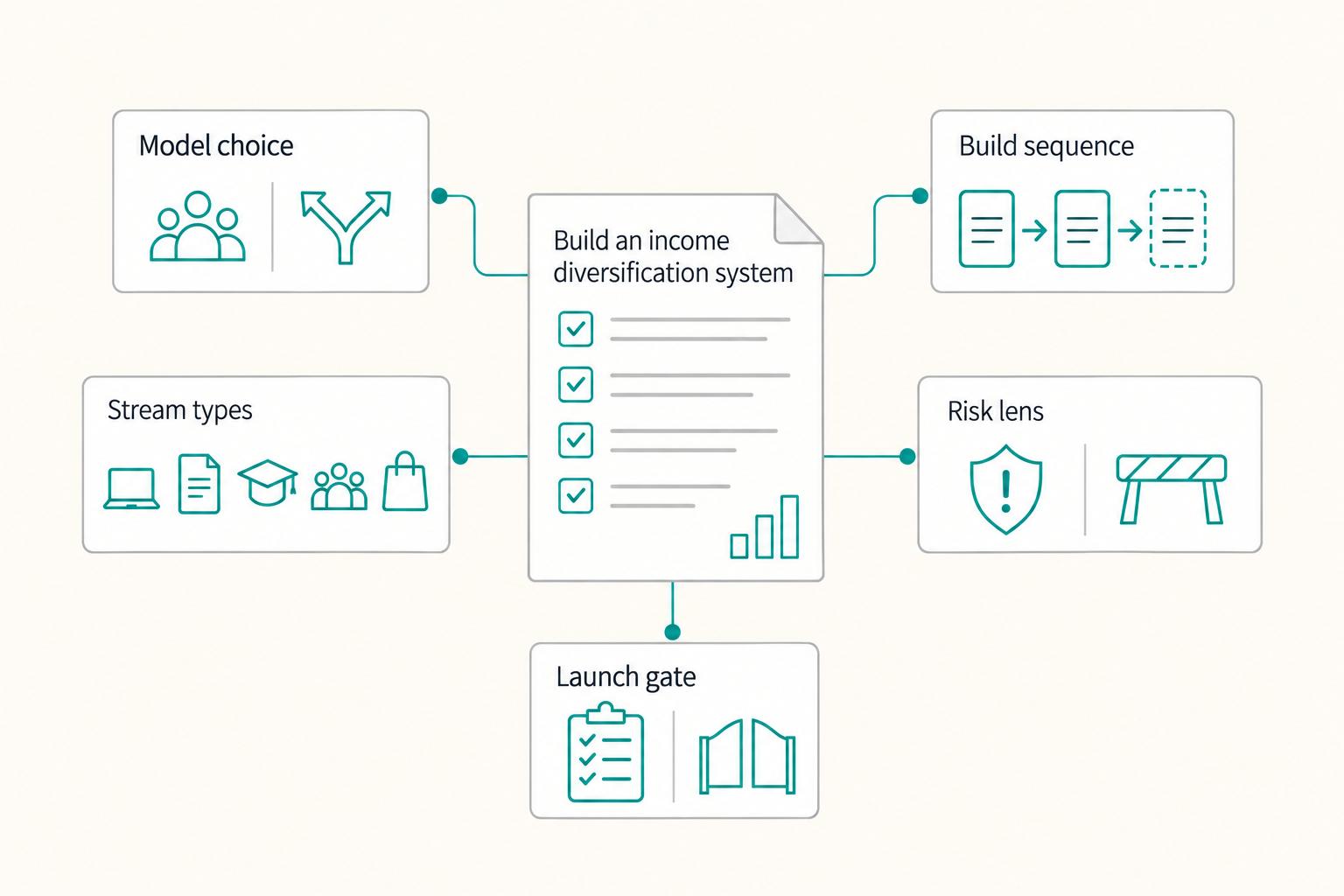
The Best Ways to Diversify Your Freelance Income: A Risk-First Framework
Most freelancers add new revenue lines reactively: a course after a slow month, an affiliate link because someone else said it works, a consulting offer because one client asked for it once. The result is usually the same: more moving parts, unclear priorities, and no real protection when one major client or platform wobbles.

How to Create a Productized Service for Your Freelance Business
If your recent client work produces similar results from similar inputs, you may be ready to turn it into a defined offer. The shift is operational, not cosmetic. You are deciding what you sell, what the client gets, what it costs, and how delivery happens, instead of rebuilding every job from scratch.

Best Crypto Wallets for Freelancers: Four Practical Options
For a freelancer, a useful crypto setup has three parts: a way to receive the agreed asset, control over access to it, and a tested route into money you can spend. Choose the wallet only after deciding which token and network your client will use and which withdrawal service accepts that same combination in your country. A wallet download alone does not establish bank access.