
Quick Answer
Plan your move in sequence: confirm entry status, validate arrival logistics, then commit to housing only after internet checks pass. A practical playa del carmen digital nomad guide treats the FMM record as the real deadline, because reported grants are often 30, 60, or 90 days even when 180 days is discussed. Keep onward travel and funds proof ready for Cancun arrival, test connectivity in week one, and make a day-90 choice to continue, change path, or exit cleanly.
Playa del Carmen can work well if you plan it in the right order#
Playa del Carmen can be a solid remote-work base, but it tends to reward people who make decisions in sequence instead of all at once. The order that usually works is simple. First, sort out the entry terms that actually control how long you can stay. Next, make arrival week stable enough that you are not solving housing, transport, and work setup while tired and offline. Then use short-term flexibility to test neighborhoods, internet, and daily routine before you commit to anything longer. That sequence keeps one bad assumption from spilling into every other choice.
This guide uses a 90-day planning horizon for a reason. It is long enough to show whether the city fits your real routine, not just a good first impression. It is also short enough to keep major commitments staged. You do not need a perfect answer on day one. You need a plan that lets you learn in order, keep work running, and make an explicit continue, switch, or exit decision before small issues become expensive ones.
The most common planning error is treating the headline stay length as if it were the stay you will actually get. Visitor entry is often described as up to 180 days for travelers from many countries, but officials often record 30, 60, or 90 days on the Forma Migratoria Multiple, or FMM. That recorded stay is the timer that matters. If you build housing, billing cycles, client commitments, or onward travel around the broadest number you saw online, you are planning against the wrong constraint.
A better approach is to assume that entry, housing, and work setup depend on each other. If the stay granted on arrival is shorter than expected, long housing becomes riskier. If arrival week is sloppy, you are more likely to overpay for convenience or accept a unit that cannot handle your work. If you sign a place before testing internet during your real meeting hours, you may end up paying twice: once for the bad unit and again for the coworking you suddenly need to make it workable.
Before you fly, keep both digital and printed copies of the documents that matter most if questions come up. The essentials are straightforward:
- An onward ticket and proof of funds, since travelers may be asked to show both.
- A reminder to verify the recorded FMM stay details on arrival before you leave the airport area.
- A week-one plan for testing internet and workspace reliability before you commit to longer housing.
Even arrival-day transport is worth deciding before you land. A common route from Cancun airport to Playa is the ADO bus. One guide gives about 250 pesos for roughly one hour, while a taxi example in that same source is around 800 pesos. Treat those as reference points, not promises. The point is not the exact fare. It is knowing your likely transport branch before you hit the curb with luggage, no mobile data, and no patience left.
Housing is the next place new arrivals usually pay for speed with later frustration. Airbnb is often the fastest way to get stable, even if it is not the cheapest. Local search channels can produce better value, but they also come with stale listings, silence, and more verification work. That is why short-term flexibility at the start is usually the safer call. It buys you time to see the block, hear the noise, test the internet during work hours, and decide from evidence instead of listing photos.
Connectivity is one of the main reasons people look at this city, but it still has to be checked unit by unit. One source reports home download speeds around 10 Mbps as common, while many coworking spaces may be much faster. For some workloads, that gap is manageable. For others, it decides the whole setup. What matters is whether your exact apartment and your exact fallback can carry your actual work.
By day 90, you should make one explicit call: continue under a valid path, start a change path, or leave cleanly. If the stay granted on arrival is shorter than planned, act early and check options with the local immigration office instead of waiting for the last weeks. This is practical planning guidance, not legal advice.
If you want a deeper city-by-city comparison, read Mexico City Digital Nomad Guide for a 30/60/90 Move Plan (2026).
Start with the terms that control your stay#
Get the language straight first, because casual wording leads to casual planning. In practice, your real deadline is set at entry, not by the broad maximum stay you may have seen repeated online. If you treat those two things as interchangeable, you can make several reasonable-looking decisions that do not actually fit together.
Use these terms early so the rest of the plan stays grounded:
- Visitor Visa (Tourist Visa): the common short-stay route, often described as allowing travelers from many countries to stay in Mexico for up to 180 days without a visa.
- Forma Migratoria Multiple (FMM): the arrival document where officials generally record the days granted, often 30, 60, or 90.
For planning purposes, treat the FMM day count as the controlling timer. That is the number your housing plan, work calendar, and onward decisions need to respect. If a shorter grant would disrupt a project schedule, force a last-minute housing change, or turn a trial stay into a scramble, delay nonrefundable commitments until those details are confirmed. That one habit prevents a surprising number of avoidable problems.
It also helps to build one simple evidence pack before departure. The goal is not an oversized stack of papers. The goal is to answer questions quickly and consistently if they come up. Keep these ready:
- Onward travel proof that matches your stated stay.
- Proof of funds for that same period.
- Other documents that support the same timeline.
Consistency matters more than volume. If your booking dates, onward travel, and stated plan all point in the same direction, your plan is easier to understand. If the dates conflict, or if your explanation shifts while the documents say something else, you create friction that did not need to exist. In practice, people often spend more time hunting for mismatched confirmations than preparing the few items they actually need.
Another useful rule is to pressure-test your plan against the short-stay outcome, not the best-case one. Ask yourself a blunt question before you book: if the granted stay is shorter than hoped, does the rest of the plan still work? If the answer is no, then the problem is not one airport interaction. The problem is that too many downstream decisions depend on a number you do not control.
That is why a plan that works only if later flexibility appears is usually weak. The cited options after arrival include contacting the local immigration office or exiting and re-entering for a new FMM, but neither should be treated as guaranteed. If you already know a short stay would not work for you, do not file that away as something to sort out later. Handle it before you tie housing, work, and cash flow to an assumption.
For a deeper overview of the longer-stay route, see Mexico's Temporary Resident Visa: The Unofficial Nomad Visa.
Related: the 2026 Global Digital Nomad Visa Index.
Choose your entry path based on timeline and risk tolerance#
This is mostly a downside-risk decision. If losing a few weeks would only shorten a trial stay, the visitor route may be workable. If losing those weeks would disrupt a lease, delivery schedule, or cash flow plan, you need the path with fewer in-country dependencies, even if it asks for more work before departure.
A short trial stay can work on a short-entry visitor route if you build the whole plan around what is granted on arrival. That means flexible housing, backup connectivity, and no major commitments that assume the longest possible stay. The visitor route gets much harder when you load it with more than it should carry, such as a longer lease, fixed work obligations, or a budget that only works if nothing changes.
If your plan is longer, or if you expect to repeat the stay, evaluate the residency-track option before departure instead of assuming repeat entries will protect your timeline. Some guides describe Mexico as allowing six months on a tourist visa. Use that as orientation, not as a promise of what you will receive. The practical issue is not whether a long stay is sometimes possible. It is whether your specific plan can absorb uncertainty if you do not get the broadest outcome.
A clean way to think about the split is this. For a one-season test, treat the granted entry time as the hard limit and keep everything else flexible. For a one-year move in Riviera Maya, predictability carries more weight. If lease timing, work delivery, or income planning cannot absorb uncertainty around the stay recorded at entry, the longer-stay decision should happen earlier, before flights and housing start closing your options.
| Reader scenario | Path that usually fits better | Checkpoint before committing | Red flag |
|---|---|---|---|
| Testing Playa del Carmen for one season | Short-entry visitor route with a buffer | Confirm what was granted at entry, then commit in stages | Prepaying long housing before entry details are clear |
| Relocating to Riviera Maya for a year | Evaluate a residency-track route before departure | Decide whether your work plan can absorb in-country uncertainty | Assuming repeat entries will reliably protect your timeline |
The table gives you the quick answer, but it becomes useful only if you add three operating rules.
- Set a realistic budget range before choosing the entry path.
- Define a pivot trigger in advance. If a short delay would break delivery, move to the lower-dependency route.
- Keep a tested backup for connectivity before you sign long housing.
Those guardrails matter because entry choice is not just a paperwork decision. A short-entry route can still be perfectly workable if your housing is flexible and your work setup has redundancy. It becomes much riskier when uncertain stay length is paired with long housing commitments, weak records, or no real fallback for calls and uploads.
The other thing to watch is false confidence from partial planning. It is easy to think the route is settled because flights are booked and a temporary place is reserved. That is not the same as a stable plan. A stable plan survives the less convenient version of events: a shorter stay granted at entry, a week of poor apartment internet, a listing that does not check out in person, or a first-month budget that runs hotter than expected.
Before you book flights, pressure-test your route against a simple planning reference: Visa Cheatsheet for Digital Nomads
Build your document pack 30 days before departure#
Do not assemble your documents in fragments during the week of travel. Build one complete pack about 30 days out, then use the last weeks only to update and check it. That approach makes entry smoother and makes the first week easier, especially if you need to confirm dates, booking terms, or proof of funds under time pressure.
A lot of people stop planning once they see that a long stay may be possible. That is not the same as being ready. The useful move is to create one master folder for entry and first-week admin so you can retrieve what you need quickly, in the same form, without guessing which version is current. Include:
- Identity documents and backup copies.
- Onward travel details aligned with your stated timeline, in case you are asked.
- Accommodation proof for arrival.
- Funds evidence for your planned stay, in case you are asked.
For Cancun airport processing and early admin, keep printed and digital versions of the same core set. One official printed-versus-digital checklist is not provided here, so the safer move is a practical split between what you may need to show quickly and what you want stored in full.
- Printed: key identity, travel, and accommodation pages that may need to be shown quickly.
- Digital: full copies stored in two places, with one offline option.
Thirty days out is also the right time for a consistency check. Make sure every file is current, readable, and aligned in name format across IDs and bookings. Small mismatches can create outsized hassle. If an onward ticket shows one version of your name, lodging uses another, and an old booking confirmation is still sitting in the folder, fix that at home. You do not want to sort it out from an airport queue or from a phone screen after landing.
This is also when you should test whether your folder actually works under stress. Open it on the devices you will carry. Make sure the files load, the scans are legible, and the offline copy is really offline. A document pack that exists only in theory is not much help when airport Wi-Fi is slow or your phone battery is low.
If you use paid relocation support, get specific about the scope before you pay. Some services provide useful checklists but exclude tasks like apostille or translation. That does not make them useless. It just means checklist support may not finish the job. Before you rely on outside help, be clear on what remains yours to handle.
One final habit is worth keeping: put your arrival proof and your first-week proof in the same pack. The same folder that helps at entry should also help with the next decisions, such as checking booking terms, reviewing cancellation windows, or pulling up the accommodation confirmation when a host messages you. Good prep is not about producing more paperwork. It is about reducing the number of moving parts you have to manage when travel day gets messy.
Handle arrival week like an operations sprint#
Week one should be about validation, not commitment. The right mindset is simple: get stable, protect work continuity, and keep decisions reversible until you have tested what matters in person. That keeps the first week from turning into a chain of rushed decisions you later have to undo.
The order matters more than people think. Secure the first night. Get online. Confirm the basics of your local mobile setup. Then start testing the conditions that will decide whether the city works for your routine. If you rush into a longer booking before you know how the area sounds at night or how the internet behaves during your meeting window, you are turning a small inconvenience into a bigger one.
Treat arrival week like a focused setup period, not like the start of settled life. You are not trying to optimize everything at once. You are trying to establish a workable base from which the next decisions become easier. The city may be a good fit, but the first week is too early to assume that a convenient-looking unit, a good daytime cafe, or a host's internet claim tells you enough.
A practical rule here is to separate comfort from proof. It is fine if the temporary place is not ideal. It only needs to give you a stable start while you test the things that matter more over the next 90 days. A smooth first week does not require a perfect room. It requires a bed, connectivity, and enough flexibility that you can keep moving if a listing, neighborhood, or backup plan fails inspection.
Day 1 to day 7 checklist#
Use the first seven days to turn assumptions into checked facts:
- Day 1: Complete arrival logistics, reach temporary accommodation, and secure basic mobile access.
- Day 2: Set up local mobile data and test it inside and outside your accommodation.
- Day 3: Run internet checks during your real work window.
- Day 4: Confirm which cellphone networks can serve as a backup in your area.
- Day 5: Retest connection reliability from a second location.
- Day 6: Repeat Wi-Fi and mobile fallback tests at another time of day.
- Day 7: Review notes and choose next steps based on work-critical connectivity first.
This checklist works best if you write down actual results instead of trusting memory. Note what held up, what failed, and what changed by time of day. A connection that seems fine at noon and struggles during your normal meeting window is not fine for your routine. The same goes for a mobile backup that works outside but becomes weak inside the building where you plan to stay.
One non-negotiable rule should carry through the whole week: do not commit to a long lease until both your primary connection and your mobile fallback pass in-person checks. Paying a short-term premium can be annoying, but it is often cheaper than being trapped in unreliable work conditions.
If transit or lodging fails on arrival day#
Arrival-day failures are usually manageable if you keep the priorities straight. The first goal is not to solve every problem immediately. It is to get to a workable base, rest, and restore connectivity so the next decisions are made with a clear head.
- Transit disruption: Prioritize reaching a temporary base where you can get online, then adjust plans.
- Check-in issue: Book a one-night fallback, then resolve disputes after rest and connectivity are secured.
- Connectivity failure: Shift your next work block to your backup connection plan and keep mobile data ready.
The useful mindset is triage. Get sheltered, get connected, then sort the details. Most bad arrival days become much worse because people try to solve the wrong problem first, such as arguing over a booking while they still have no reliable way to look up alternatives or message anyone clearly.
Final checkpoint for the week: you should have two independent ways to get online if one fails. Older nomad advice mentions checking for at least 3G backup; treat that as older continuity guidance, not a performance target. The real point is redundancy.
Use a two-stage housing strategy for the first 14 days#
Housing is where early mistakes start to get expensive. For the first 14 days, flexibility usually matters more than getting the best nominal monthly rate. A short-term premium up front is often cheaper than discovering, after you have paid a deposit, that the block is too noisy, the building rules are a problem, or the internet cannot support your work.
This is the natural next step after arrival week. Once you know your stay window and have started testing connectivity, you can judge apartments against real standards instead of desperation. That shift matters. The wrong unit is not just a housing issue. It affects sleep, meeting quality, budget, and how much time you spend working around your own setup.
The two-stage approach keeps the decision reversible while you gather the information listings usually hide: noise patterns, building behavior, internet reality, and how the area feels during a normal week rather than a quick daytime walk-through.
Stage 1 (days 1 to 7): temporary base#
Start with a short stay while you test daily life in person. The goal in this first stage is not to find the perfect apartment immediately. It is to learn how the area behaves in the hours that matter to you and to build a short list based on firsthand experience rather than urgency.
Check noise, workability, and walking flow block by block. See how easy it is to pick up groceries, reach a cafe, or move between home and a fallback workspace. A place can look central on a map and still create friction in practice if errands, food, or backup workspace all pull you in different directions.
Treat 5th Avenue carefully. It is busy, and listings there are often priced higher. That does not mean it never works. It means you should assume more activity and more price pressure until a specific block proves otherwise. Also test the 10th to 30th Avenues area, where prices and cafe crowding are often lower and the beach can still be about a 10 to 20 minute walk.
The short-term base is not wasted money if it helps you avoid a bad longer fit. In practice, what you are buying in week one is not just a bed. You are buying the ability to say no.
Stage 2 (days 8 to 14): verify before committing#
Once you have a local feel, start gathering real options through local channels and communities. Use local searches, but verify every listing yourself before sending money. Stale posts and no replies are common enough that patience is part of the process, not a sign that you are doing it wrong.
Use the same screening questions for every option so price differences are easier to judge. That discipline helps you compare tradeoffs instead of reacting to photos or sales language. If a cheaper unit adds commute drag, late-night noise, or weak backup internet, the lower price is not a clean win. It is simply a different bundle of problems.
This second stage is when fatigue can push people into the wrong decision. By then, short-term lodging may feel expensive and you may just want the search to end. Resist that urge until the basics are verified in person. Extending a short stay by a few days is usually far less painful than committing to a place that makes every workday harder.
Lease screening checkpoint#
Before any longer commitment, get clear written answers on:
- Internet performance in the exact unit.
- Electricity reliability, and what happens during outages.
- Building rules that affect daily work.
- Checkout and early-exit terms.
- Full move-in costs broken out by item.
The most expensive surprise is often not the rent itself. A place can look affordable until street activity, delivery friction, or building rules show up in real life. January to March can raise prices with tourism pressure. June to October can increase electricity and Wi-Fi disruption risk with weather. If your checks are incomplete or the answers stay vague, keep the decision reversible and extend short-term lodging.
That may feel cautious, but it is usually the cheaper form of caution. Deposits, move-in fees, poor sleep, missed calls, and extra coworking days add up quickly once you are in the wrong place.
Pick the right area by your working style, not Instagram appeal#
Neighborhood choice should start with work consistency, not image. In this city, the most photogenic block is not automatically the one that supports reliable weekdays, quiet calls, or an easy routine. The right area is the one that lowers friction across a normal week.
Use two anchors before you score anything else. Treat 5th Avenue as the activity spine, and assume listings on that strip can carry higher cost risk. Then test the 10th to 30th Avenues corridor, which one Playa-focused source describes as a stronger remote-work fit with lower prices, less crowded cafes, and roughly a 10 to 20 minute walk to the beach. Playacar is the classic tradeoff case, with a more upscale feel and a premium cost profile.
| Area | Commute and walkability | Noise and activity | Daily cost signal |
|---|---|---|---|
| 10th to 30th Avenues corridor | Practical for walk-based routines; beach can be about a 10 to 20 minute walk | Cafes are described as less busy | Lower-price signal in this corridor |
| Playacar | Check real routes by block before committing | Verify in person at midday and evening | Premium profile; costs are characterized as much higher |
| Coco Beach | Score in person | Confirm with locals | Confirm with locals |
| Little Italy | Score in person | Confirm with locals | Confirm with locals |
| Colonia Hollywood | Score in person | Confirm with locals | Confirm with locals |
Where the table is thin, that is useful information. If there is no grounded baseline in the material you have, do not fill the gap with social media assumptions. Score those areas in person and judge them by the same standards you are using everywhere else.
A practical way to do that is a two-day test across your shortlist:
- Score 1 to 5 on commute drag, night noise, walkability for errands, and total day cost.
- Add a work-readiness check: can a typical apartment setup support real calls and focused work.
- Do one midday pass and one evening pass in each area.
- Reject areas below 3 on work-readiness or night noise, even if rent looks attractive.
- Keep notes in one sheet so each area is judged the same way.
This kind of scoring sounds simple because it is. That is the point. You want a method that keeps you from talking yourself into a place because the photos are good or because one lunch walk felt fun. The decision gets better when every area has to answer the same questions: How loud is it when you need to sleep? How easy is it to run errands? How much daily drag does it add? Would a normal apartment there likely support your workload?
A low-friction starter zone is the band between 10th and 30th Avenues. A value-first alternative is to look farther from 5th Avenue before you consider premium zones. For 2026 planning, treat neighborhood price labels from older sources as directional, not fixed. If your scores are close, extend short-term housing a few days and run one more evening check before signing.
Verify internet and workspace before signing anything long#
Internet claims are cheap. Proof in the exact unit, during your actual work hours, is what matters. Apartment style, price, and location become secondary very quickly if calls drop, uploads stall, or weather disruptions force daily workarounds.
Keep the same location lens from the area section. The activity around 5th Avenue can raise housing cost exposure, while the 10th to 30th Avenues area is often framed as lower friction for work, with lower prices and less crowded cafes. But location logic is only a starting point. A reassuring host message or a broad statement that the city has good internet does not replace a real test.
This is one of the easiest places to be disciplined. Do not ask whether the internet is "good." Ask whether the exact unit supports your workload when you are actually on the clock. Casual browsing, streaming, and paid remote work are not the same thing. Plenty of apartments can handle the first two and still make the third frustrating.
Internet proof before deposit#
Ask every host for the same proof, then verify it yourself:
- Recent in-unit test evidence from the exact spot where you plan to work.
- Router placement details relative to your desk.
- A live video-call test during your meeting window.
- An upload-heavy task test during that same window.
- Written terms for what happens if core services fail in your first days.
Run this twice, including during your real work hours. If video reliability or upload stability fails in either pass, do not treat the unit as ready for a longer lease. What you want is repeatability, not one lucky result.
A good host response is still useful. It just is not enough on its own. In practice, the gap between "internet included" and "internet usable for paid work" is where a lot of avoidable housing mistakes happen.
Validate workspace fallback in person#
A fallback workspace is only real if you have already used it. Before you commit, visit one or more coworking spaces with your own laptop and run the same video and upload checks you used for the apartment. That keeps the comparison honest and gives you a tested backup instead of a hopeful idea.
Local guidance often describes coworking in Playa del Carmen as fast, and those spaces may be much faster than typical home setups. Even so, your own results should drive the decision. The key question is not whether a space is generally praised. It is whether it supports your workload at the times you need it.
That matters because fallback plans fail in ordinary ways. A space may be fast but inconveniently placed, crowded at the wrong times, or simply not the place you want to depend on every day if the apartment network goes bad. You are not just testing speed. You are testing whether the fallback is practical enough to save a real workday.
Fallback rule#
Use fallback options as proven backups, not assumptions. Run side-by-side checks in all three places that matter:
- Inside the unit.
- At street level outside.
- At your coworking fallback location.
Keep short notes on where each option degrades during your actual work window. That gives you a usable answer when one layer fails. If home Wi-Fi struggles, you should already know whether street-level mobile data holds up and whether your coworking option can take over without derailing the day.
Decision rule: if your tested fallback setup is not viable, do not sign a longer lease yet. A practical pair is home Wi-Fi plus a tested coworking option. If mobile data is part of the chain, test that too, but do not confuse having a signal with having a dependable backup.
June to October needs stricter proof because rain and hurricanes can affect electricity and Wi-Fi. October to November is generally less rainy and less hurricane-prone, but not always. January to March can raise prices, so fallback workspace and extension flexibility may cost more. If results are mixed, extend a short stay and rerun the same tests before you commit.
Build a monthly budget that can survive surprises#
A workable budget here is less about finding one perfect number and more about surviving a month when things do not go perfectly. One early-2026 guide frames Playa del Carmen as a better-services but higher-cost tradeoff, with rent pressure in areas like Centro and Playacar. The practical answer is to budget in ranges, not in one optimistic target.
Month one is where people usually misread their own costs. They treat convenience spending as if it were their long-term baseline, or they underestimate how quickly small decisions around transport, coworking, and food add up. Split spending into fixed and variable costs before you make longer commitments, then track the variable side weekly until your pattern is clear.
| Category | Bucket | What to track weekly |
|---|---|---|
| Rent and core utilities | Fixed | Committed amount and any add-on fees |
| Coworking | Fixed or variable | Days used versus pass type |
| Mobile data and backup internet | Variable | Top-ups and emergency usage |
| Food and coffee | Variable | At-home versus out-of-home split |
| Local transport | Variable | Walk days versus paid rides |
| Side trips (Tulum, Cozumel) | Variable | Total spend per outing |
The value of this split is that it shows you where adjustment is actually possible. Rent usually needs a slower decision and a longer commitment. Food, coworking, transport, and side trips can drift much faster and often explain why the month feels more expensive than planned. If you are only looking at the total, you miss the part you can still correct.
Stress-test the plan before you lock in a longer stay. Model a normal month, then add pressure for extra coworking days, more paid transport on days outside downtown, and short trips in the Riviera Maya. One nomad guide describes downtown Playa as very walkable, but weather and travel disruptions can still move totals faster than expected. Keep a larger travel buffer from June to November, when storms can disrupt plans.
The main budgeting rule is simple: avoid annual-style commitments until month-one actuals are reconciled. Do not prepay long housing, coworking, or lifestyle bundles based on estimates alone. Compare planned ranges with actuals, then decide whether you need to change neighborhood, trip frequency, or your home-versus-coworking mix.
A short weekly review catches drift earlier than a month-end surprise:
- Housing and utility charges posted this week.
- Coworking and backup workspace days used.
- Mobile data top-ups or hotspot overuse.
- Local transport spend versus a walkable routine.
- Food split between groceries and eating out.
- Tulum, Cozumel, or other short-trip spend.
- Weather-related extra costs or rescheduled travel.
If you do this for the first month, the second month becomes much easier to price honestly. The goal is not to build a perfect spreadsheet. It is to make sure your stay still works if transport costs rise, the apartment Wi-Fi underperforms for a week, or the housing you liked turns out to be in a pricier pocket than expected.
Set up payment and recordkeeping before admin debt piles up#
Admin debt builds quietly. It usually starts with one missing receipt, one unclear transfer, or one payment app that seemed fine when you used it twice and becomes painful when you need to reconcile a month of mixed housing and work transactions. Fixing that later is much harder than setting it up cleanly in week one.
Treat the setup below as general organization guidance, and confirm legal or tax requirements with official sources or a qualified local advisor. The point is not to invent complexity. It is to keep money movement understandable before volume goes up.
Use one ledger for all money movement and keep the fields consistent from day one:
| Field | Why it matters in practice |
|---|---|
| Date and currency | Can reduce confusion during conversion checks |
| Amount sent and amount received | Can surface fee or conversion gaps quickly |
| Counterparty legal name | Can reduce unknown-recipient disputes |
| Purpose tag | Links each transfer to rent, income, or admin spend |
| Status timeline | Shows pending, completed, reversed, or failed |
| Expected payout date | Can help catch delays before a cash crunch |
| Evidence file name | Connects each row to an invoice, receipt, or contract |
This kind of recordkeeping matters more in a setup like this because the categories overlap. Rent may move through one channel, work income through another, and travel or immigration-related costs through a third. Without a single ledger, you end up rebuilding the story later from fragments, which is where mistakes and missing items usually appear.
Run a weekly spot-check, then reconcile at month end against exported statements where available. If a provider cannot export transaction history in a sortable format, treat that as an early red flag. A tool that hides details may be tolerable at low volume. Once rent, client payments, transport, and housing admin all overlap, that same tool becomes a drag on every review.
It also helps to mirror the ledger in an evidence folder so later checks are faster:
- Income: contracts, invoices, payment confirmations.
- Housing: lease terms, deposits, utility receipts, refund records.
- Immigration and travel admin: fee receipts and appointment confirmations.
- Tax-related documents you receive during the stay.
- Monthly exports from each payment app or bank, when available.
The practical win here is not elegance. It is recovery speed. If a transfer is delayed, a deposit is disputed, or you need to check what was actually paid and when, the answer should take minutes to find, not an afternoon of scrolling through messages and screenshots.
Decision rule: if any payment app obscures transaction status or hides counterparty details, consider replacing it before volume increases. Early replacement is annoying. Late replacement usually means rebuilding your records by hand, which is where admin debt turns into real stress.
Track your 90-day checkpoints and pivot early#
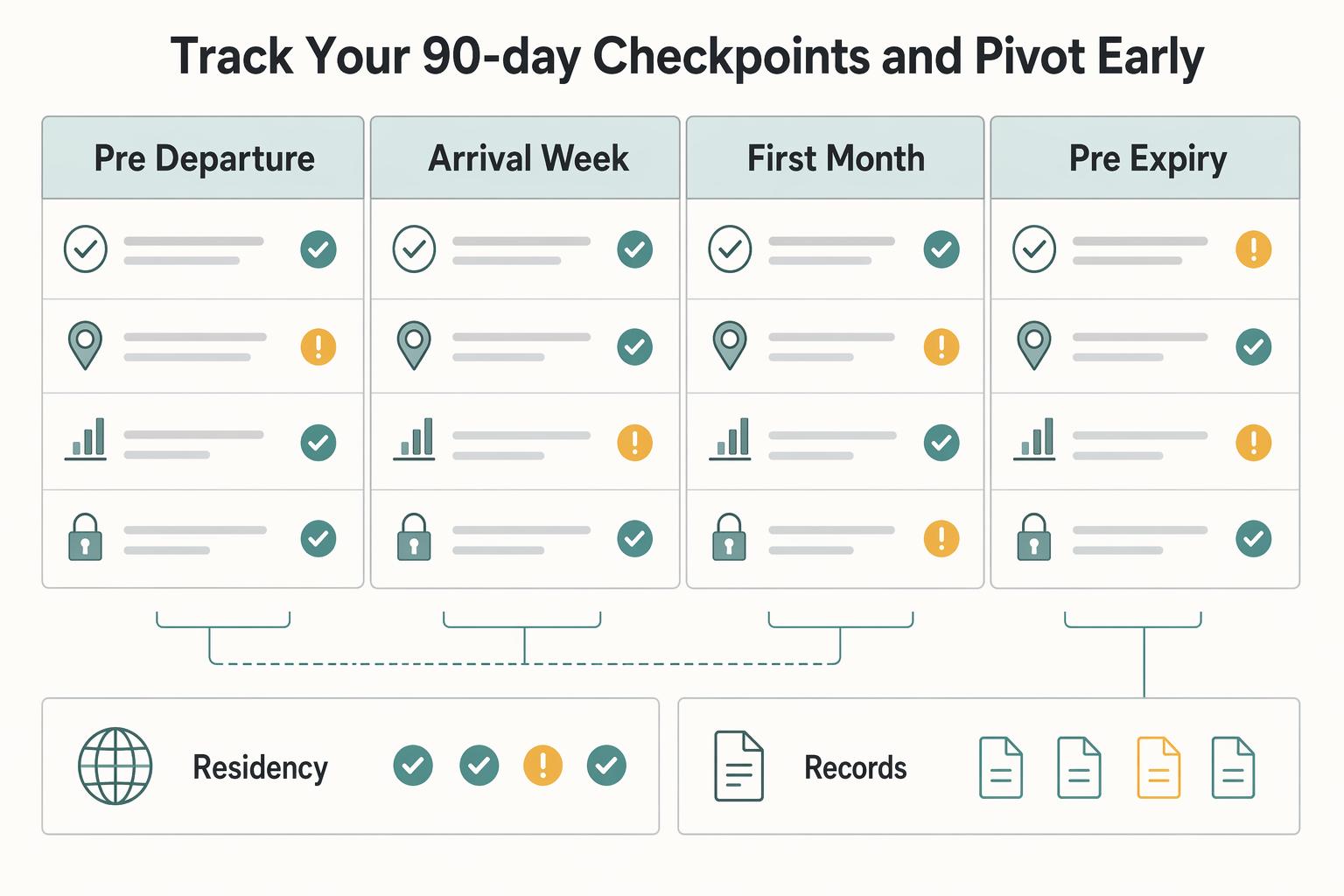
Do not wait until the last part of your stay to learn that the plan no longer fits reality. The safer approach is a simple checkpoint rhythm that starts before departure and continues through arrival week, month one, and the pre-expiry window. If the facts change, pivot while the choices are still easier.
This is a risk checklist, not legal guidance. The material summarized here does not establish Mexico- or FMM-specific legal rules. What it does offer is a practical way to keep your plan tied to evidence rather than mood, guesses, or last-minute scrambling.
Tie each phase to documents or conditions you can actually verify. That keeps the process grounded and gives you a clear reason to act when something is off track.
| Phase | What to verify | Evidence to check | Pivot if off track |
|---|---|---|---|
| Pre-departure | Intended stay length versus risk tolerance | Entry docs, onward plan, cash buffer, fallback home-base plan | Delay commitment-heavy bookings until gaps are closed |
| Arrival week | What was recorded at entry and first housing timeline | Legible entry records, booking terms, cancellation windows | Keep housing short and flexible |
| First month | Whether real life matches the original plan | Spend trend, work stability, housing noise and internet results | Start contingency prep or shorten commitments |
| Pre-expiry | Remaining documented stay window versus obligations | Contract end dates, travel plan, complete record pack | Choose contingency prep or clean exit and re-plan |
The logic here is straightforward. Each checkpoint asks a different question. Before departure, the question is whether the plan is internally consistent. On arrival, the question is whether the stay recorded at entry matches what the rest of the plan assumed. In month one, the question is whether daily life in the city actually works on budget, housing, and connectivity. Near expiry, the question is whether your remaining time and your obligations still line up.
Set trigger points in advance for getting qualified immigration guidance. Three obvious ones are unclear entry records, a material change to intended stay, or housing commitments that could outlast your documented stay window. If one of those appears, act early instead of waiting for the final weeks.
From there, choose one pivot path explicitly instead of half-committing to several at once:
- Extend planning window: keep housing flexible and postpone long commitments until your next-step path is clear.
- Path clarification prep: gather records early and confirm what is possible before assuming in-country changes.
- Clean exit and re-plan: leave on a controlled timeline, then return with a better-aligned entry and housing sequence.
The common failure mode is delay. If month-one checkpoints show mismatch risk, pivot in month one rather than hoping a final-week fix will hold. A short written review helps: entry record status, housing end date, cash runway, and next legal decision date. If any one of those lines is unclear, treat it as an immediate action item.
Take the next step before you book#
If you only keep one idea from this guide, keep the order. Make booking decisions in this sequence: entry status, then housing, then work setup. That sequence lowers the odds of locking nonrefundable plans around a stay length you may not actually receive on arrival.
Treat the FMM record as the real timeline. Reported outcomes at entry are often 30, 60, or 90 days, while the widely cited 180-day window is not guaranteed for every traveler. If questions come up at entry, keep an onward ticket and proof of funds ready because you may be asked for both.
A one-page plan is enough if it covers the three branches that matter:
- Entry branch: what you will do if the granted stay is shorter than expected.
- Housing branch: start flexible and avoid long commitments until your status window is clear.
- Connectivity branch: move critical calls to coworking and delay long leases until internet is proven during real work hours.
If your stay is more than a short trial, consider reviewing the Mexico Temporary Resident Visa path before departure. If you still enter as a visitor, fallback options can be uncertain and may include explaining your plan on arrival, speaking with the local immigration office, or exiting and re-entering for a new FMM.
For housing, use the two-stage approach: short-term first, then longer-term after local checks. Many people start with Airbnb, then move to rooms or apartments for longer stays. For work setup, verify reliability before committing. Home internet around 10 Mbps is commonly reported, coworking can be faster, and some guidance describes AT&T or Unefon 4G in the center as patchy.
Book only what survives those branches. That is how you arrive with fewer unknowns, cleaner decision points, and a much better chance that Playa del Carmen works for the way you actually live and work.
When your timeline is drafted, you can explore Gruv tools.
Frequently Asked Questions
How long can I stay in Playa del Carmen on a Visitor Visa (Tourist Visa), and what affects the time granted on arrival?
For many travelers, visitor entry is commonly described as up to 180 days, about six months. Exactly which factors determine the final duration granted on arrival is not settled, and that maximum is not guaranteed in every case. Plan housing and travel around the duration granted at entry, not the headline number.
When should I choose the Mexico Temporary Resident Visa instead of entering as a visitor?
Choose the visitor route when your plan is short and flexible. If you expect a longer stay, review the Temporary Resident Visa path before departure. Mexico is commonly described as not having an official digital nomad visa, so this is the longer-stay route often discussed for remote workers.
What documents should I prepare before flying into Cancun for a remote-work stay?
This guide does not provide a definitive pre-flight document checklist for Cancun entry. Keep documents organized, legible, and easy to retrieve if questions come up, and keep both digital and offline copies.
Is Playa del Carmen internet reliable for daily video calls, and how should I verify it before signing a lease?
Internet is generally described as good in central and expat-friendly areas and often sufficient for video calls. Before you commit, confirm specific speeds directly with the accommodation or coworking operator.
Should I start with Airbnb or go straight to long-term rental groups like Mexpats?
Starting with Airbnb is usually the lower-hassle option and easier to arrange before arrival. Local groups like Mexpats can offer better value in some cases, including reports of better places at similar prices. A practical approach is to weigh convenience upfront against potential value from local search.
Which neighborhoods are best for remote workers choosing between Centro, Playacar, and Coco Beach?
There is no universal best choice for every remote worker. Centro, Playacar, and Coco Beach are all commonly recommended. Pick based on your work pattern and what you verify on the ground.
What should I complete in my first week, first month, and before my FMM window runs out?
This guide does not provide a verified first-week, first-month, and pre-expiry/FMM checklist with exact deadlines. Use your documented stay window as the constraint and revisit your plan as housing and internet decisions become clearer.
Try a related tool
Researched and edited by the Gruv editorial team. Gruv builds cross-border billing, payouts, and finance-operations software for global businesses.
Sources
Includes 4 external sources outside the trusted-domain allowlist.
Educational content only. Not legal, tax, or financial advice.
Related Posts

Mexico City Digital Nomad Guide for a 30/60/90 Move Plan (2026)
Mexico City works better when you make the big decisions in the right order before you spend nonrefundable money. If you lock in flights, housing, or work commitments too early, you can end up forcing your legal path and daily routine around choices that are hard to undo.

Mexico Temporary Resident Visa for Nomads Planning a 90-Day Move
Start with one assumption: this process does not end at the consulate. First, you apply at a **Consulado de México** for the visa that lets you travel for this process. After arrival, additional in-country steps may apply. A visa lets you travel to Mexico, but it does not guarantee entry at the border.

The 2026 Global Digital Nomad Visa Index for 50+ Countries
Start with legal fit, not lifestyle filters. The practical order is simple: choose a route you can actually document, then decide where you want to live. That single change cuts a lot of wasted comparison work and stops you from falling in love with places that were never a real filing option.