
Quick Answer
Start by locking your visa route first, then keep early housing flexible while you verify paperwork and day-to-day fit. In this phuket digital nomad guide, the practical sequence is route selection (such as LTR vs DTV framing), a three-layer document pack, a week-by-week setup through day 60, and only then longer commitments. Run payment operations and reporting duties in parallel so invoicing, payouts, and records do not lag behind your move.
Start here and decide your Phuket plan in one sitting#
You can make most of this move in one sitting if you keep the sequence straight. The order is simple: choose your legal stay path first, pick the area that fits your actual workweek second, then run a 60-day setup plan. That order keeps housing, budget, and logistics flexible while the highest-risk decisions are still being checked.
Treat any Thailand stay route, including the Long-Term Resident (LTR) Visa, as its own verification project. Do not compare options from memory, nicknames, or forum shorthand. Compare them only after you confirm the current official requirements that apply to your situation. If paperwork is still uncertain close to departure, keep flights and your first stay refundable so one unresolved issue does not force the rest of the move.
The logic through the rest of this guide is intentionally boring: reduce legal uncertainty first, test day-to-day work fit second, then extend commitments once both are holding up in real life.
Decide legal path before deposits#
This decision comes first because deposits are where uncertainty becomes real cost. Spend in layers, not all at once.
| Decision | Why it comes first | What to verify before spending |
|---|---|---|
| Potential LTR path vs other stay routes | It sets your risk level for timing and housing | Current eligibility, required evidence, and whether your intended work arrangement is permitted under current rules |
| First 4 to 6 weeks housing | Keeps risk low while legal and admin details settle | Cancellation terms and extension terms |
| Initial setup budget | Helps absorb early friction | Buffer for duplicate first-month costs, including temporary accommodation and setup admin |
That sequence matters because legal clarity affects everything downstream. If your stay path shifts, housing terms, document timing, and even how much flexibility you need in month one can change with it. If you want a deeper LTR breakdown before locking plans, review Thailand's Long-Term Resident (LTR) Visa for Professionals.
Pick your area by work pattern#
Choose your area by what a normal Tuesday looks like, not by vacation photos or what sounds good on a weekend. Patong is commonly framed as lively and central. Kata and Karon are often described as quieter alternatives. Chalong is usually positioned as more residential, while Rawai is presented as more laid-back.
Use those labels as starting points, not conclusions. A neighborhood that feels great on arrival can still fail once you start taking calls, running errands, and repeating the same route five days in a row. Your first practical checkpoint is connectivity. Confirm SIM and internet setup before your first full workday, then test whether your daily loop works from morning through evening.
Online guides can help you build a shortlist, but they are only directional. Date-check concrete claims before you use them to make expensive choices, especially if the claim affects noise, commute, Wi-Fi, or work access.
Run a timed execution plan to day 60#
Keep the first 60 days reversible. Front-load verification, then extend commitments only after an ordinary workweek feels stable.
- Pre-departure: Finalize a provisional visa-path choice, gather your evidence pack, and keep one dated checklist with document versions and submission records. Red flag: signing a long lease while legal-status details are unresolved.
- Arrival week: Set up connectivity first, then test your weekly loop between accommodation, workspace options, and errands. If noise or commute friction hurts focus, switch areas early while commitments are short.
- First 30 days: Keep commitments flexible and close admin gaps quickly. Once a week, confirm names, document dates, and reference numbers match across forms, confirmations, and saved files.
- Day 31 to 60: Stabilize only after month one is workable. If your first neighborhood repeatedly causes focus loss or long transit times, move before taking a longer housing term.
Seasonality changes crowd levels and day-to-day friction, so plan your base around your workweek first and treat excursions as a bonus. That mindset makes the later decisions much easier, because you are building around repeatable conditions instead of best-case moments.
Understand the terms before you act#
The terminology problem is not academic. A lot of bad planning starts with fuzzy labels, and in Thailand those labels are often used loosely enough to create real confusion. Define your route by the exact program name and its limits before you commit money or dates.
Thailand Long-Term Resident (LTR) Visa is a specific long-stay program with tax and non-tax benefits, while "digital nomad visa" is used inconsistently across public guides. Some sources describe Destination Thailand Visa (DTV) as that route, while others say Thailand has no dedicated digital nomad visa. Treat that phrase as a prompt to verify details, not as a settled answer.
Once you clean up the labels, planning gets easier. You can build the right document pack, judge housing risk more accurately, and stop mixing advice that belongs to different programs.
Treat LTR as a named program#
Do not treat LTR as a generic long-stay idea. It is a named program, and your notes, comparison sheet, and document folder should use the full label every time. That may sound picky, but it prevents a simple category mistake later when you are matching requirements, forms, and timelines.
The LTR portal presents a 10-year renewable structure, with initial permission for five years and a possible five-year extension if qualifications are met. That structure matters because it changes how you think about timing, evidence, and early housing risk. A route built around a longer program should not be planned the same way as a shorter or less settled path.
Use official channels before any submission or payment. The LTR portal warns about fraudulent entities claiming authorization, so add one anti-fraud check before you share documents or send money. In practice, that small habit can save you from a messy clean-up later.
"Digital nomad visa" is a label you must decode#
That phrase is too loose to make decisions from. When someone says "digital nomad visa," ask which program they mean and what the per-entry limit is.
One common Thailand explanation describes DTV as valid for up to five years, with up to 180 days per entry and a possible additional 180-day extension. That is useful only if you confirm they are actually talking about DTV and that the guidance is current for your move window.
Before relying on advice from r/digitalnomad or any forum thread, confirm:
- The exact visa name, not a nickname.
- Validity and per-entry stay limits.
- Whether the post date is current for your move window.
The rule is simple: if the label is vague, the advice is incomplete. Once you adopt that rule, a lot of noisy online guidance becomes much easier to sort.
Operational reality means three tracks must align#
A Phuket move stays manageable only when legal status, document readiness, and local admin move together. If one drifts, the other two usually get harder.
If your long-stay path is still unresolved, use short-term status carefully and treat allowed stay dates as hard deadlines. Overstaying is explicitly flagged as a penalty risk, so calendar your entry and expiry dates immediately on arrival and keep them visible. Do not leave that information buried in an email or booking thread.
This is also why flexible month-one housing matters so much. It gives you room to fix paperwork or area-fit problems without turning every fix into a contract problem. Once those three tracks are aligned, you can make better decisions on where to live, how long to commit, and what to lock down next. If you want another Thailand planning reference, read Chiang Mai Digital Nomad Move Plan for 2026.
Choose your legal stay path before you book housing#
A long housing commitment only makes sense when your stay path is clear enough to support it. If key details are still unconfirmed, keep your first stay flexible and delay anything that is hard to unwind.
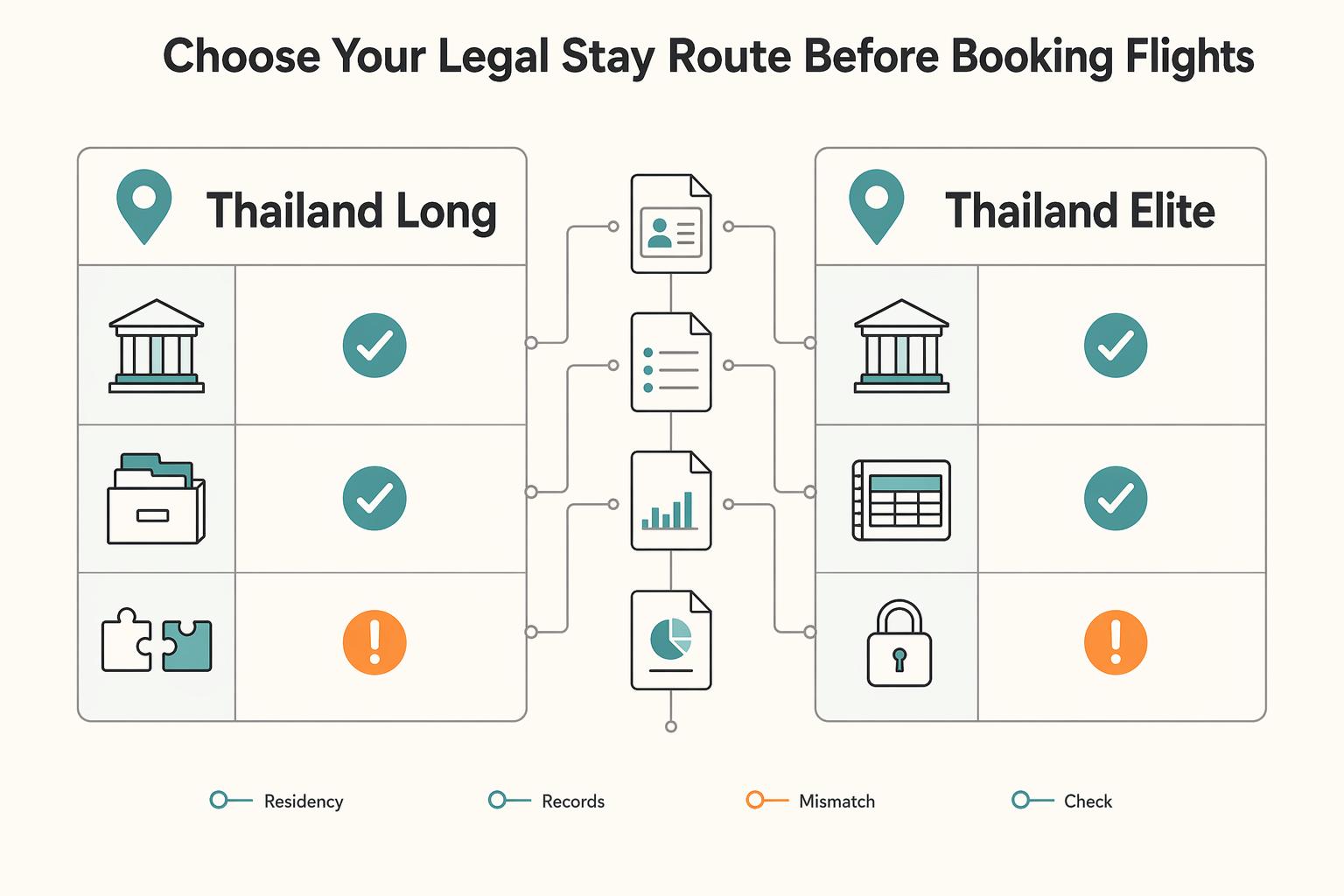
Start with a side-by-side check using the exact names of the stay options you are considering. Treat each path separately, then mark what is confirmed and what is still unclear. In practice, that one page tells you whether you are ready to commit or still in hold mode. It also keeps you from mixing assumptions from one route into another.
Once you can see the uncertainty clearly, the housing decision becomes less emotional. You are no longer choosing between a nice place and a less nice place. You are choosing between reversible and irreversible commitments while the legal picture is still forming.
Build the two-column comparison before paying a deposit#
Before you pay anything meaningful, force the decision onto one page. The goal is not to predict every outcome. The goal is to see where the real uncertainty sits before you add housing risk on top of it.
| Decision factor | Path A | Path B |
|---|---|---|
| What is confirmed | Requirements you can verify now | Same check for the second option |
| What is unclear | Items you still need to confirm | Same uncertainty check |
| Timing risk | Steps that depend on outside review | Same timing check |
| Backup plan | Your fallback if timing slips | Your second fallback plan |
If major fields are still unclear, keep housing commitments short until your route is clearer. This comparison sounds basic, but it prevents a common failure mode: spending as if the legal path is settled when it is still partly assumption.
Use a simple test: if you cannot explain your primary route and fallback route in a few lines each, you are not ready to add more fixed commitments.
Apply a hold-or-commit check to housing#
Use a simple rule here: hold when the route is still moving, commit only when the unknowns are boxed in.
Before you sign a longer-term place, confirm:
- Your primary route and backup route are written down clearly.
- The details you still need to confirm are listed and time-boxed.
- The area matches your work rhythm, not only your weekend preferences.
- You can confirm reliable Wi-Fi and at least one backup place to work nearby.
Area fit matters just as much as lease terms. Patong is known for energetic nightlife, Kata is quieter, and Rawai is often described as a blend of tranquility and convenience. Reliable Wi-Fi is a primary concern for remote workers. Phuket has coworking spaces and cafes for remote work, but you should test your setup before extending your stay rather than assuming an area label fits your schedule.
The practical question is not whether a place looks good online. It is whether it still works after a few normal workdays, with calls, errands, and recovery time all happening in the same neighborhood.
Build your document pack in the only order that reduces delays#
Once your stay path is narrowed down, document prep should become mechanical. The usual mistake is not missing one dramatic item. It is collecting things in the wrong order and then redoing later pieces because the foundation changed.
Build documents in a practical sequence: identity and status first, financial and employment proof second, accommodation and travel evidence last. That order reduces rework because your entry path determines what you need to carry, how long you may stay, and when onward-travel proof matters.
Documents may be checked at e-visa upload, airline check-in, and arrival, so keep the full set consistent across all three stages. A good pack is not just complete. It is internally aligned.
Pack in three layers first#
Start with the documents that anchor who you are and which route you are actually using. Then build outward.
| Pack layer | What to gather first | Why this order helps |
|---|---|---|
| Identity and status | Passport identity details and route-linked status records | Confirms who you are and which route you are using |
| Financial and employment proof | Income and work evidence tied to your plan | Supports the credibility of your stay plan |
| Accommodation and travel evidence | Lodging details plus verifiable entry/exit intent | Aligns travel proof with the rest of your file set |
This sequence makes later checks easier. If identity details or route details are wrong, you want to catch that before you start updating booking records and travel dates around a flawed file set. It also helps if you need to pivot, because the core identity and route material usually carries across better than last-mile travel documents do.
Think of the third layer as the one most likely to change. That is exactly why it belongs last.
Keep one source-of-truth folder with versions#
Version control is not glamorous, but it prevents a lot of avoidable delay. Use one master folder for all files tied to Thailand entry and early local setup. Add simple date versioning to filenames and archive older versions instead of deleting them.
Before submission, run one verification pass:
- Name spelling matches your passport across all forms.
- Passport number and expiry match across files.
- Date formats are consistent across forms and evidence.
- Entry and exit dates align across travel and accommodation documents.
A single source-of-truth folder also helps once you arrive. If immigration, airline staff, a workspace, or a landlord asks for a file again, you are not rebuilding your own history from screenshots and message threads. You know which version is current, which one was submitted, and what changed.
That clarity matters more than most people expect, especially in the first weeks when small mismatches consume time you would rather spend getting settled.
Build a fallback pack and revalidate current rules#
A backup route only helps if you can switch without starting from zero. Prepare a lighter fallback pack before you need it, then keep that backup updated while your primary route is in progress.
Right before submission, revalidate current requirements instead of trusting saved screenshots or older summaries. Some Thailand entry pages still include older Phuket Sandbox-era details and explicitly note that parts may no longer be relevant. That is a useful reminder that archived guidance can stay online long after it stops being good enough to act on.
This is the right place to be skeptical. Screenshots, old explainers, and cached summaries are handy for orientation, but they are a weak basis for a filing decision. Re-check the live rule set before you act.
Pick the right Phuket base using work-first criteria#
Most area advice is really lifestyle advice. For remote work, the better base is the one that fails least often during an ordinary week: stable calls, manageable noise, and a backup place to work when your first option falls short. Lifestyle is a tie-breaker only after those basics are proven.
Patong is commonly described as nightlife-heavy, Kata as quieter, and Rawai as a blend of calm and convenience. Those differences can materially affect focused work and meeting quality, which is why area choice belongs inside the move plan rather than as an afterthought.
Once the legal and document side is under control, this becomes the next real decision. A neighborhood is not just where you sleep. It shapes commute friction, work quality, and how much flexibility you still have if something is off.
Compare areas by work friction first#
Use public area descriptions as hypotheses, then test them yourself before you commit to anything longer.
| Area | Grounded signal | What to verify yourself before committing |
|---|---|---|
| Patong | Energetic nightlife profile | Whether evening noise conflicts with your call windows |
| Kata | Quieter profile than Patong | Reliable nearby workspace access for full workdays |
| Rawai | Tranquility-plus-convenience framing | Commute practicality and daily workspace fit |
| Phuket Town | No verified profile here | Test fit before signing long term |
| Chalong | No verified profile here | Test fit before signing long term |
| Karon | No verified profile here | Field-test noise, commute, and workspace access |
If your week is meeting-heavy, stable workspace access usually matters more than nightlife proximity. Do not assume a nightlife-heavy area fits a call-heavy schedule just because it is popular or convenient on paper.
Run a short trial before a longer lease. Test calls from home during real working hours, check a nearby workspace for desk access and meeting privacy, and confirm one backup location. Beach preference can improve off-hours life, but it is not a productivity guarantee.
Lock housing and workspace with hard verification checkpoints#
If you evaluate home and work separately, one weak point usually shows up after you have already committed. Treat housing and workspace as one decision, and keep terms reversible until the key checks are done.
Before any deposit or long-term commitment, run one checklist across both your home base and work setup:
- Verification status: mark each item as confirmed or pending.
- Access check: if a source is access-limited, treat the related detail as unverified for now.
- Deferred follow-up: if you only have visible page pointers such as pages 69-73 and 76, schedule a targeted re-check when access returns.
- Source quality check: remove inputs that are not relocation evidence, such as generic word-frequency lists.
- Commitment control: do not finalize non-reversible terms until pending items are verified.
Keep an evidence log as you verify. If a reference is access-limited or summary-only, mark that item as pending and defer final decisions until you can verify the full details. The point is not paperwork for its own sake. It is making sure your housing choice can survive a real workweek, not just a good first impression.
This is where soft assumptions get exposed. A place may photograph well, a cafe may be pleasant for an hour, and an area may sound right in a guide, but none of that proves repeatable workability. Use hard checkpoints instead.
Plan the move timeline from 90 days out to day 60#
Now put everything on a calendar. Use this 90-days-out to day-60 timeline as a control system, not as a claim about official Thailand processing speed. The practical goal is to avoid long commitments until the highest-impact checks are confirmed.
Set a stop rule for each window. If the rule is not met, keep terms short and move to the next checkpoint without forcing a bigger commitment.
| Window | Primary objective | What to verify before moving forward | Hold position if this is incomplete |
|---|---|---|---|
| 90-60 days out | Define your primary plan and fallback plan | One primary route selected, one fallback route identified, and required documents tracked in one place | Do not lock long housing terms |
| 60-30 days out | Stage temporary accommodation and first-month operations | Temporary stay terms are readable, cancellation terms are clear, and first-month workspace options are testable | Keep accommodation cancellable |
| Arrival week | Complete local setup in a fixed order and run your weekly loop | Home, workspace, and errand loop tested during your real working hours | Avoid extending any contract yet |
| Day 8-60 | Stabilize routines and close admin gaps | Repeated workweeks run without major friction, with one backup workspace in a second area | Delay longer lease commitments |
Treat location shortlists as labels, not assumptions. Test real work blocks before treating any area as your default. The same discipline applies to references: preview text is not enough. If a source is access-gated or only shows a summary page, mark it as pending until the full document is open and reviewed.
Use two if-then rules to stay disciplined:
- If key paperwork is still uncertain in the 60-30 day window, use temporary stays only and postpone long lease signatures.
- If your weekly loop breaks in arrival week, fix location or workspace first, then revisit contract length during day 8-60.
Short commitments add some admin in month one, but they reduce downside while facts are still being checked. Longer terms make sense only after your paperwork, weekly loop, and backup option hold under normal workload.
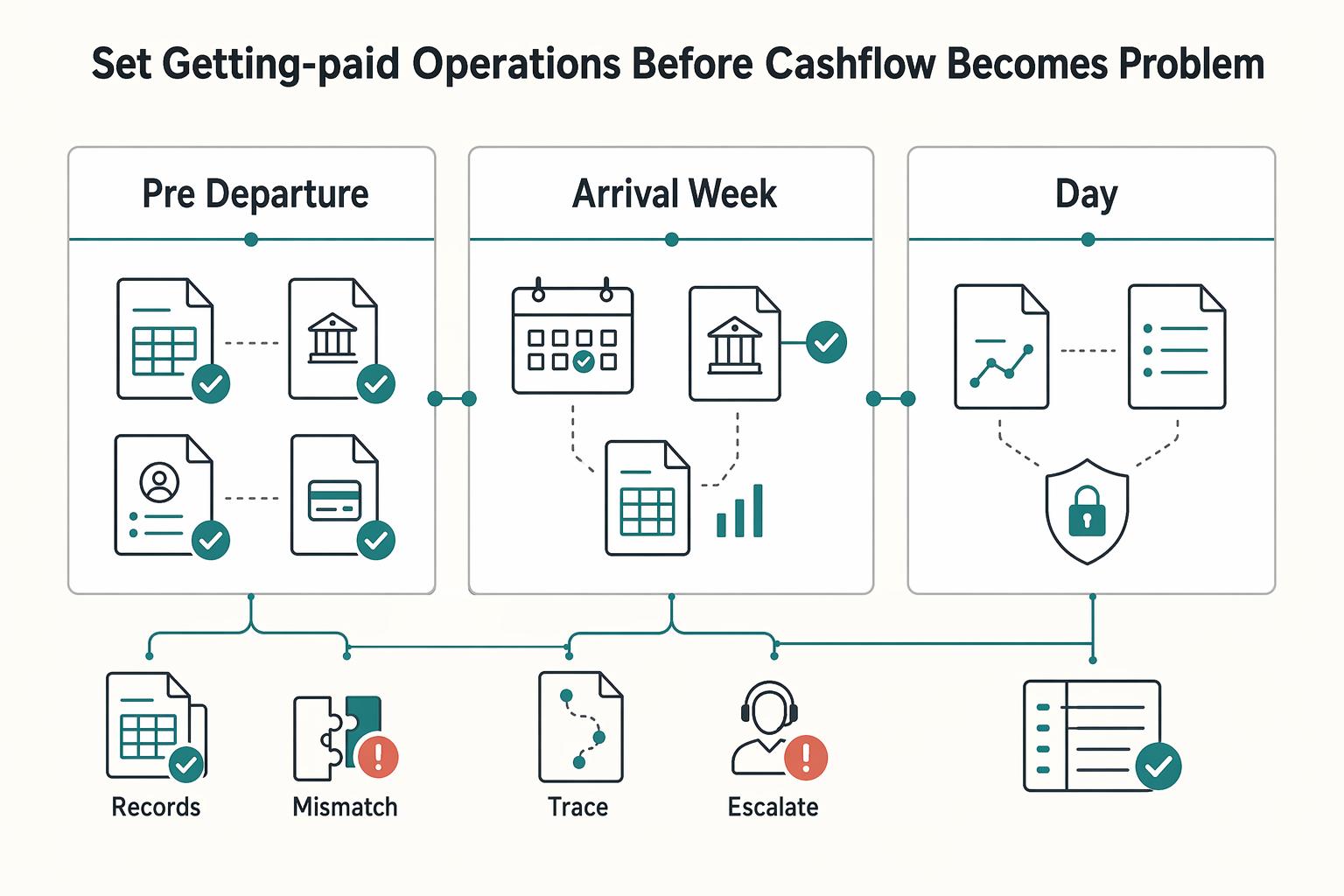
Set up getting-paid operations before cashflow becomes a problem#
Once the move sequence is set, protect cashflow with the same discipline. A relocation can look organized while payment operations are still fragile, and that gap usually shows up in the first month.
One published nomad account describes being in month 2 in Buenos Aires and month 6 in Prague while still undecided on where to settle. The lesson is simple: your location can keep changing while billing admin still needs to be finished. If you wait to sort payment mechanics until after arrival, you are letting a basic operational risk drift into the period when you need the most stability.
Use the move windows to stage your income operations as well:
| Stage | Relocation focus | Getting-paid checkpoint |
|---|---|---|
| Pre-departure | Finalize move sequence | Confirm client billing requirements, required invoice fields, and payment approver |
| Arrival week | Set up housing and workdays | Send one low-risk test invoice and confirm status tracking from issued to paid |
| Day 8-30 | Stabilize weekly routine | Reconcile each invoice against confirmation and payout status in one tracker |
| Day 31-60 | Extend what is working | Review backup payout options before increasing fixed commitments |
If you use Gruv where supported, complete onboarding, invoicing setup, payout routing, and compliance gating before your first high-value invoice. The goal is traceability: you should be able to see what was billed, who confirmed it, where payout status stands, and what action is pending.
Keep a compact evidence trail for each income event:
- Invoice record: invoice ID, issue date, amount, currency, and service period.
- Confirmation record: client acknowledgment tied to the same invoice ID.
- Payout record: payout reference, destination label, and final status.
- Exception record: delay reason, owner, and next follow-up date.
If payout timing is mission-critical in your first month, avoid relying on a single payout route when you have a viable alternative. A second route adds setup effort, but it can reduce single-point-of-failure risk while payment operations stabilize. Pressure-test your plan with Gruv Payouts.
Handle tax and reporting obligations in parallel with relocation#
Once money starts moving, reporting starts too. Run tax and reporting work in parallel from day one, not as a year-end cleanup. When records spread across accounts, currencies, and months, reconstruction gets slow fast, and the first filing cycle becomes harder than it needs to be.
If you are a U.S. filer, treat Form 8938 and FBAR as separate obligations. Filing Form 8938 does not remove a possible FBAR requirement. Form 8938 is attached to your annual return and follows that return due date, including extensions. That distinction needs to stay clear in your records, your reminders, and your filing prep.
Use these checkpoints early, while the account picture is still easy to map:
| Item | Concrete checkpoint you can use now | Why it matters |
|---|---|---|
| Form 8938 timing | Attach it to your annual return and file by that return deadline, including extensions | Keeps reporting aligned with your normal tax calendar |
| Form 8938 applicability | Confirm whether you are a specified person, whether assets exceed the applicable threshold, and whether you are required to file an income tax return | Avoids assumptions based on someone else's filing status |
| FBAR trigger | If a single account or aggregate maximum account values exceed $10,000 during the calendar year, FBAR is required | The threshold can be crossed across accounts, not just in one large account |
| Form 8938 and FBAR tracking | Keep separate checklists for each filing path | Reduces the risk of missing a separate filing duty |
Good reporting hygiene is mostly about consistency. Keep one running log with fields you can maintain throughout the year instead of trying to reconstruct them later:
- Account owner and account label for each account.
- Periodic account statements for each reporting period.
- Highest observed balance during the year and final reported maximum value.
- Account currency and converted USD value using the Treasury rate for the last day of the calendar year.
- Reported value rounded to whole U.S. dollars for FBAR reporting.
- Form-year marker tied to the correct calendar year or tax year.
If you cannot determine whether aggregate maximum values exceeded the threshold and are eligible to use amount-unknown handling, document that uncertainty and use the item 15a amount-unknown path instead of guessing.
Once your Phuket stay pattern is clearer, add a country-specific review point to reassess any home-country reporting exposure for the rest of the year. If your status or account footprint changes mid-year, rerun the same checks immediately. The key is to keep reporting in motion while the relocation is still unfolding, not after the fact.
Avoid the failures that derail most Phuket relocations#
Most bad outcomes here are sequencing failures, not single dramatic mistakes. Housing, legal status, workspace, and reporting all compete for attention in the same stretch of time, so the safer move is to manage them on one timeline instead of solving them in isolation.
This guide does not establish Phuket-specific housing, legal-status, and workspace failure rates, so treat those checks as assumptions to verify before you commit. That is not a reason to stall. It is a reason to avoid false confidence.
The pattern to watch for is simple: people lock a cost before they have locked the condition that justifies it. The table below is a practical check against that habit.
| Failure pattern | Early check to reduce risk | Commit only when this is true |
|---|---|---|
| Long housing commitment before legal certainty | Track legal-status milestones and keep terms reversible early | Your legal path is confirmed and your routine is stable |
| Acting on generalized online advice | Turn each claim into a current rule or document check | You can point to the current rule text you are relying on |
| Choosing workspace on name recognition alone | Test your real work pattern before committing | Commute, call quality, and backup access work during your actual hours |
| Deferring tax reporting admin until year-end | Start records in month one | You can reconcile accounts and payouts without guesswork |
For U.S. filers, keep the reporting split clear all the way through: Form 8938 and FBAR are separate tasks, and FBAR can be triggered when a single account maximum or aggregate maximum exceeds $10,000 during the calendar year.
Keep a minimum evidence pack from day one:
- A clear form-year marker for each record set.
- Account records that support maximum account value tracking.
- A documented note when valuation is uncertain and you use the FBAR amount-unknown path in item 15a.
Use one final check to avoid assumption-driven errors: if you are not required to file an income tax return for the year, Form 8938 is not required for that year, and that determination should be documented.
Use this first-30-days checklist to stay on track#
Month one is where the move either becomes routine or stays noisy. Keep terms flexible until your records, reminders, and reporting controls are actually working, not just planned.
Create one searchable archive on day one. Store tax records and submission receipts with a consistent filename pattern, and keep a short index with approved, pending, and next action date. That gives you one place to check when something needs follow-up, and it keeps administrative drift from piling up while you are still settling into a new area and schedule.
Run this checklist once a week through day 30:
- Keep Form 8938 and FBAR as separate tasks. Filing Form 8938 does not remove a possible FinCEN Form 114 requirement.
- Update your running log of maximum account values so you are not reconstructing peaks at year-end.
- Retain periodic account statements that fairly reflect each account's maximum value.
- Verify each Form 8938 record set is labeled with the correct calendar year or tax year.
Set recurring reminders with evidence requirements:
- Monthly: review single-account and aggregate highs for FBAR risk. If the maximum value of one account or the aggregate maximum exceeds
$10,000during the calendar year, an FBAR is required. - Monthly: retain periodic account statements that fairly reflect maximum account value support.
- Quarterly: verify each Form 8938 record set is labeled with the correct calendar year or tax year.
- Tax-return prep: confirm Form 8938 is attached to the annual return and filed by that return's due date, including extensions.
- Annual decision note: if you are not required to file an income tax return for the year, document that determination because Form 8938 is not required for that year.
By day 30, you should be able to produce three items quickly: your maximum-value log, your account-statement archive, and your Form 8938 or FinCEN reminder trail. If any one of those is incomplete, keep short commitments in place and close that gap first. A stable first month is less about feeling fully settled and more about being able to retrieve what you need without scrambling.
Make your move boring in the best way#
A low-drama move comes from sequence, not luck. Pick the legal path first, verify the key details next, then choose your neighborhood and longer commitments only when the earlier pieces hold up. If a decision is still uncertain, shorten the commitment until you can verify it in real life.
Keep a strict filter between travel inspiration and relocation planning. One source calls Phuket an easy, convenient holiday destination, while another says living in Phuket is not a typical holiday experience. That gap is useful. It reminds you that general destination appeal is not enough to lock in a lease, a workspace routine, or a stay strategy.
For high-impact decisions, log recency before you trust the advice. One DTV explainer is dated 04 Apr 2025, and one Phuket guide shows last updated March 11, 2026. Recency does not make a source official, but it does help you avoid acting on stale guidance.
Test fit before lock-in. A documented trial pattern is an 18-night split stay, 10 nights in Karon and 8 in Surin, before committing to a longer base. Copy the method, not the exact neighborhoods. Short trials reveal the things listings and forum posts tend to hide: noise at your call time, errand friction, and whether the place still works after the novelty wears off.
Use a simple commitment gate:
- If your legal path in Thailand is still unclear, avoid long leases.
- If key details are missing, pause bookings that are expensive to change.
- If claims are broad but recency is weak, verify before acting.
- If an area only works on weekend rhythm, test it on a full workweek before committing.
For visa planning, compare DTV with alternatives only after you define your non-negotiables. DTV, as described here, applies to extended stays that may include remote work, but not to exact rights, outcomes, or one best path for everyone. The goal is boring execution: fewer surprises, fewer reversals, and clearer decisions.
Related: The 2026 Global Digital Nomad Visa Index: 50+ Countries Compared.
Before you lock longer commitments, if compliance tracking matters for your situation, build a simple calendar and residency log with the Tax Residency Tracker.
Frequently Asked Questions
What visa options should remote professionals compare first for Phuket in 2026?
Start with the Destination Thailand Visa (DTV), which is presented as a five-year, multiple-entry option for remote workers. Then compare it with any other route you may qualify for based on your profile. Apply one early filter: DTV is described as remote work for foreign companies, not Thai employers or Thai clients.
How early should I start the Thailand visa and paperwork process before moving?
There is no supported fixed timeline like "start exactly X days before departure." Start as soon as you choose a visa path, because DTV is described as an outside-Thailand e-visa process and document gaps can slow you down. Keep housing and other commitments flexible until your status is confirmed.
What documents should I prepare first to avoid application delays?
For DTV, prepare clear proof that you meet the stated 500,000 THB savings requirement. Keep those records current and easy to provide again if requested. Then follow the official requirements for your selected route rather than generic online checklists.
Which Phuket area is best for productivity versus nightlife versus budget?
There is no grounded evidence here for a reliable neighborhood-by-neighborhood ranking in Phuket across those tradeoffs. What is supported is the broader point that Phuket is popular for amenities and accessibility. Treat local area advice as unverified until you test it against your work routine and budget.
What should I complete in my first 30 days after arriving in Phuket?
No grounded first-30-days task sequence is supported here. Add an early tax check if your stay may reach 180+ days in a calendar year, since that threshold is flagged as a Thai tax-residency trigger in the cited guidance. If your timeline is unclear, plan for the stricter case first.
What are the biggest relocation mistakes people make, and how can I prevent them?
A common error is treating DTV like an in-country filing when it is described as an outside-Thailand e-visa process. Another is assuming DTV allows local Thai client or employer work, when the stated scope is remote work for foreign companies. A third is budgeting from one fixed USD fee figure even though the visa is described as 10,000 THB with embassy-dependent USD variation.
Which parts of Phuket nomad advice are reliable, and what should I treat as unverified?
Prioritize claims you can verify directly: where you must apply, fee structure, savings threshold, stay limits, and work-scope limits. Treat broad cost and internet claims as directional, especially when they are Thailand-wide rather than Phuket-specific. Discard sources that fail basic validation and re-check high-impact rules before you commit.
Try a related tool
Researched and edited by the Gruv editorial team. Gruv builds cross-border billing, payouts, and finance-operations software for global businesses.
Sources
Includes 1 external source outside the trusted-domain allowlist.
Educational content only. Not legal, tax, or financial advice.
Related Posts
Chiang Mai Digital Nomad Move Plan for 2026
Set the move date first, then plan backward from the decisions that can block legal stay or interrupt paid work. That order removes most avoidable chaos because it forces you to solve the high-impact risks before you spend money on comfort or convenience.

Thailand's Long-Term Resident (LTR) Visa for Professionals
For a long stay in Thailand, the biggest avoidable risk is doing the right steps in the wrong order. Pick the LTR track first, build the evidence pack that matches it second, and verify live official checkpoints right before every submission or payment. That extra day of discipline usually saves far more time than it costs.

The 2026 Global Digital Nomad Visa Index for 50+ Countries
Start with legal fit, not lifestyle filters. The practical order is simple: choose a route you can actually document, then decide where you want to live. That single change cuts a lot of wasted comparison work and stops you from falling in love with places that were never a real filing option.