
Quick Answer
Define one task, its acceptance criteria, and the person who reviews it. Compare providers using role-matched evidence, agree paid pilot and data-handling terms before work starts, and test delivery and payment records before increasing volume. Contact-center experience does not establish software or specialist capability.
Outsourcing Without Losing Control#
You are not deciding whether the Philippines is "good for outsourcing" in the abstract. You are deciding what work you can hand off now, which type of provider fits that work, and what controls you need before the decision starts costing you time, margin, or client trust.
For a small team, this is an execution choice, not a long procurement exercise. The useful outcome today is simple: a narrower scope, a cleaner shortlist, and a clearer sense of what must stay under your direct review until delivery is stable.
Before you start#
Bring one task you want off your plate, your review capacity, and a definition of good output. Discovery calls can help you clarify the work; before commissioning a pilot, decide what will be delivered, who checks it, and how you will judge it.
Step 1. Separate lanes before you compare providers#
Treat the philippines bpo industry as separate lanes, not one talent pool with interchangeable skills. In Philippine industry language, the umbrella term is IT-BPM, which covers both traditional outsourcing and more complex services. That includes front-office work like customer support, back-office functions like accounting, IT services, sourcing, procurement, quality assurance, and HR, plus higher-complexity lanes such as healthcare information management, KPO, engineering, animation, and software development.
That split matters because strength in one lane does not automatically transfer to another. A provider that is excellent at contact-center operations may still be unproven for KPO, engineering, or software-heavy work. If you skip that distinction, the common failure mode is buying "capacity" when you actually need judgment, domain knowledge, or technical depth.
A practical rule is this: if the work affects revenue, compliance exposure, product quality, or customer outcomes, ask for lane-specific proof before you assume competence. Contact-center scale is not evidence of engineering quality. Back-office throughput is not evidence of analytical work.
Step 2. Use market numbers as filters#
Use market numbers as filters, not as reasons to outsource. There is real scale here, but scale alone does not make your first hire or vendor choice safer.
| Check | What to verify | How to use it |
|---|---|---|
| Recency | Use current sources for current decisions; confirm what period the figure measures and whether anything material has changed | Use only when the period is clear |
| Scope alignment | Confirm whether the claim refers to all IT-BPM, only contact centers, only back-office support, or a narrower segment | Do not let a broad market number hide a concentrated service mix |
| Decision relevance | Ask whether the number changes a real choice you need to make in the next 90 days | If it does not affect scope, provider type, pricing expectations, or control design, treat it as background |
AMRO’s analysis reports 1.8 million workers and USD 38 billion in revenue for 2024. Contact centers accounted for 83% of revenue and 89% of employment that year. Check rounding and coverage before comparing figures from different publications. These totals describe an industry concentrated in contact centers; they do not establish a vendor’s technical capability.
Before a claim changes your plan, run those three checks in order. Use current sources for current decisions. A 2024 or 2025 figure may still help in 2026, but only if you know what period it measures and whether anything material has changed. Confirm whether the claim refers to all IT-BPM, only contact centers, only back-office support, or a narrower segment. Then ask whether the number changes a real choice you need to make in the next 90 days. If it does not affect scope, provider type, pricing expectations, or control design, it is background, not decision input.
A good checkpoint is whether you can point from a claim to one concrete action. If you cannot, do not let it shape your shortlist.
Step 3. Follow the execution sequence#
Choose a scope, examine provider evidence, agree limited pilot terms and applicable privacy controls, then run the paid pilot. Use its results to negotiate the larger engagement and test the payment process before increasing volume.
Sourcing without a defined task makes comparison difficult. Committing to a large engagement before seeing delivery evidence exposes you to untested promises. A paid pilot still needs agreed fees, scope, confidentiality, and lawful data access before work starts; testing is not a reason to defer those terms.
The later sections turn that sequence into operating choices you can use. They cover what to outsource first, what proof to request, what terms to lock in before work starts, and what checkpoints to verify once money and documents begin moving. By the end, you should have a checklist, scorecard-ready criteria, and a short set of controls you can inspect, not just hope for.
If you're still comparing destinations, our guide to outsourcing IT work in Southeast Asia can help you weigh the Philippines against other options in the region.
Build the right mental model of the Philippines BPO market#
Choose your lane before you choose your vendor. In this market, the costly mistake is treating providers as interchangeable when your real limit is how much judgment, QA, and exception handling your team can manage.
Step 1 Choose a lane by review burden, not vendor breadth#
Start with the umbrella term: IT-BPM. Inside it, lanes behave differently once delivery starts. As a working rule, the more the output depends on judgment, domain context, or technical decisions, the more proof you need and the tighter your review should be before you scale.
Historically, simple rules-based work moved first. If your team has limited review capacity, begin with repeatable work that has clear inputs, outputs, and visible error states.
| Lane | Lane fit | Early warning sign | Control required before scale |
|---|---|---|---|
| Contact center or scripted support | Scripted interactions, stable scenarios, measurable QA | A provider uses contact-center success as proof for analytics, software, or specialist work | Review QA method, escalation ownership, and live sample scoring before increasing volume |
| Repeatable back-office support | Rules-based processing, documentation, structured updates | "We can handle edge cases later" before acceptance rules exist | Approve a one-page scope spec, exception notes, and rework tracking in trial tasks |
| Technical delivery | Software, QA, implementation support, defect-sensitive output | Generic BPO credentials replace role-matched delivery proof | Run a paid role-matched test, keep reviewer notes, and define defect/revision sign-off |
| Specialized knowledge work | Research, analytics, knowledge management, judgment-heavy outputs | Samples look polished but do not match your brief or acceptance standard | Require a role-specific sample, revision trail, and named internal reviewer before expansion |
Use this table to narrow your first move. Judge providers on domain fluency, service reliability, and experience quality, not hourly rate alone.
Step 2 Apply a transferability checkpoint before shortlisting#
Do not assume transferability. Contact-center maturity is not proof of readiness for KPO, software, or other technical lanes.
Before you keep a vendor on your shortlist, confirm:
- Same lane: They can show delivery in the exact lane you need, not only broad IT-BPM experience.
- Same artifact: They can produce the output type you need reviewed, for example processed records, a research memo, or a role-matched task sample.
- Same QA logic: They can explain quality checks, rework handling, and exception ownership.
If any answer is no, keep the vendor in pilot-only status or remove them. Also pressure-test contact-center scopes for automation risk: ask which parts stay human-owned and how quality is measured after automation touches the workflow.
Step 3 Use a lane-fit mini framework with go/hold logic#
Before you add seats, volume, or adjacent tasks, build a four-part evidence file:
| Evidence file part | What it includes |
|---|---|
| Scope spec | One page covering inputs, outputs, tools, handoffs, and unacceptable output |
| Role-matched sample test | A paid trial that mirrors real work |
| QA scorecard | Your actual review sheet with error types, revision notes, and pass/fail comments |
| Evidence pack | Sample outputs, reviewer feedback, rework history, and escalation notes in one place |
Use explicit go/hold logic:
- Go when role-matched quality is consistent and your review load stays manageable.
- Hold when you keep rewriting instructions, correcting repeat errors, or acting as the provider's full-time editor.
Why the Philippines is attractive and where that advantage can fail#
Consider the Philippines for English-heavy, process-led work you can review consistently. Test communication and delivery with the actual team. Contact-center experience alone does not establish KPO or software quality.
Step 1 Match the country advantage to your actual task#
AMRO’s 2024 figures explain the market’s scale and contact-center concentration. For a small buyer, the useful question is whether the proposed team has experience with your queue, document type, or technical task, and whether you can review its output.
Use that strength where it fits: customer support, queue handling, documentation, and structured back-office support. For non-voice and complex BPO lanes, including KPO and software development, treat market maturity as a signal to test, not proof to scale.
| Advantage | Failure mode | Control to add |
|---|---|---|
| Strong English fit for voice-based work | You assume spoken fluency also means strong written reasoning or domain judgment | Require role-matched written samples, not interviews alone |
| Mature contact-center operations | You treat call-center proof as transferable to KPO or software | Run a paid pilot on the exact artifact you need |
| Large IT-BPM scale and repeatable process experience | You buy capacity before your brief and QA logic are stable | Lock a one-page brief and score first live samples before adding seats |
Step 2 Compare regional options by workflow, not by brand#
Use rankings as a lens, not a verdict. Kearney's 2023 benchmark ranks 78 countries across 52 metrics, keeps India, China, and Malaysia in the top three, and notes the Philippines dropped out of the top 10. That is a competitiveness signal, not a universal pass/fail for your use case.
EF EPI 2025 reports scores of Malaysia 581, Philippines 569, Vietnam 500, and India 484. These results come from participating test takers, not a representative assessment of every worker or provider. Compare communication clarity, reviewer effort, and task quality with your actual shortlisted teams.
Step 3 Gate expansion with explicit pilot triggers#
Keep one pilot evidence pack and use it as your decision file: brief, sample outputs, QA scorecard, revision log, and escalation notes. Expand only when your brief stays stable, sample performance holds on real work, revisions narrow over time, and one named owner handles escalation end to end.
Hold expansion when briefs keep changing, similar tasks produce inconsistent results, errors recur after feedback, or escalation ownership keeps bouncing between sales and delivery. Weak software or KPO samples are a reason to seek better evidence or another provider for that task. Switch to support work only if that is work you actually need and the provider proves competence there.
Where Philippine privacy law applies, identify the actual data roles. A provider processing personal information on the controller’s instructions is a personal information processor (PIP); the personal information controller (PIC) remains responsible for safeguards. Independent controllers can require a different arrangement. Do not infer these roles merely from the word outsourcing.
For a step-by-step walkthrough, see Philippines Freelance Market Analysis for Cross-Border Teams.
Read market numbers without getting misled#
Treat market numbers as directional until you normalize them, or they will distort your staffing and pricing decisions. Before any figure enters your model, match its metric type, reporting period, and scope.
Step 1 Normalize each claim before reuse#
Record figures with their original scope and period. For example, AMRO’s USD 38 billion is 2024 industry revenue, not your achievable savings or a supplier’s price. Its employment and contact-center shares describe a different metric from revenue. Store the source link beside each figure so a later reviewer can check the comparison.
Use this triage checklist for every source before you use a figure:
- Source class: vendor blog, newsroom, academic, industry body, or other
- Scope definition: IT-BPM, contact centers, cold calling, or another segment
- Segment relevance: directly relevant, partly relevant, or not relevant to your actual scope
- Decision impact: context only, scenario planning, or operational input
If a figure omits its year, scope, or metric, ask for those details before using it in a budget. Do not silently turn an annual industry total into a monthly forecast or vendor rate.
| Claim status | What belongs here | What you can do with this claim now |
|---|---|---|
| Known | Recent claim with clear source class, year, metric type, and scope | Use for scenario ranges and fit checks, not final budget lock-in |
| Likely | Plausible claim missing one key definition, for example segment scope or comparison basis | Keep in notes, label caveats, and test through pilot economics before pricing or hiring decisions |
| Unknown | Secondhand, blocked, unreconciled, or anecdotal material | Keep out of seat plans and budgets; convert into a diligence question or mark as current figure pending source-record verification |
Step 2 Separate structural insight from operating inputs#
Use older analysis for structural insight, not for current execution inputs. It can help you understand why voice and process-led work are strong, but it should not set your 2026 rates, volumes, or timelines.
If you cannot inspect the source behind a claim, ask for the original publication or leave the claim out of your decision. For recruiting diligence, check the proposed team’s availability and who will actually perform the work; unsupported allegations about the wider market cannot answer that question.
Step 3 Enforce comparability before it reaches your budget#
Use dated market totals to understand the supplier landscape. Build your cost model from the proposed scope, quoted fees, owner review time, and observed rework. Contact-center concentration does not establish specialist capability or task-level savings.
For a deeper look at first-time subcontractor risk, read Hiring a Subcontractor for the First Time Without Costly Surprises.
Pick the right outsourcing scope for your first 90 days#
Choose a scope you can control, measure, and stabilize before you chase scale. If you cannot define what good looks like, who fixes misses, and when you review results, your first 90 days are too broad.
Step 1 Start with work you can judge quickly#
Start with work your team can assess. A support queue may suit a team with established macros and QA; a bounded software feature may suit a team with technical review capacity. Choose the task from your needs and review skills, not a rule that one industry segment is always safer. Confirm the provider’s actual setup window rather than reusing historical onboarding estimates.
| Work type | Recommended pilot scope | Owner-side effort required | Do-not-expand signal |
|---|---|---|---|
| Customer support | One queue, one channel, one shift window | Daily QA sampling and clear macros | Repeat handling errors or inconsistent tone |
| Back-office processing | One document type or one transaction class | Rule writing, exception review, spot checks | Rework rises because rules are still unclear |
| Research or specialist analysis | Very narrow template-based output only | Heavy review by subject expert | Output needs frequent interpretation or rewriting |
| Software delivery | One bounded feature with tests and reviewable code | Technical reviewer, test environment, agreed repository access | Unexplained test failures, security defects, or repeated review misses |
Step 2 Lock first-cycle controls before kickoff#
Write your first-cycle rules before work starts. Keep one-page controls for: in-scope vs out-of-scope tasks, acceptance and rework rules, escalation ownership, and a weekly review cadence tied to a clear go/hold decision.
Use one test question for acceptance clarity: "How do I know it's good when I get it?" If your answer is not explicit pass/fail criteria, tighten the scope before launch.
For PIC-to-PIP processing covered by Philippine law, IRR Section 44 requires binding terms covering processing subject, duration, purpose, data types, data-subject categories, controller rights and obligations, and processing location. Include documented instructions and transfers, staff confidentiality, security, prior instructions for subprocessors with equivalent obligations, assistance with data-subject rights and legal compliance, return or deletion including copies unless lawful retention applies, compliance information and audits, and immediate notice of unlawful instructions. Agree these terms before the pilot receives personal data.
Step 3 Expand only when control is proven#
Do not scale because projected savings look good. Expand when observed quality stays stable, revision behavior improves instead of getting hidden, and reporting gives you real operational oversight. If monitoring cannot catch misses early, hold scope and fix control gaps first.
Vet providers using evidence packs, not sales decks#
After you narrow scope, advance providers only on execution proof for your exact task, not presentation quality about the broader market.
Step 1 Ask for an evidence pack before scale discussions#
Request a short evidence pack early, then verify control clarity in each artifact rather than slide quality.
| Required artifact | What you verify |
|---|---|
| Process map | Who owns each step and where handoffs happen |
| QA rubric | How work is judged pass/fail for your task type |
| Anonymized sample handoffs | Whether output quality matches your real workflow |
| Escalation matrix | Who can decide fixes when quality misses happen |
| Continuity coverage | Who takes over during absence or outage |
If a provider sends generic call-center material when you asked for back-office or document-processing work, treat that as a scope-fit warning.
Step 2 Score shortlist providers on proof, not capability language#
Use one scoring sheet across finalists so you compare evidence, not sales confidence.
| Dimension | What you review | Score 1 to 3 |
|---|---|---|
| Evidence quality | Task-matched samples, clear owners, pass/fail logic, usable handoff docs | 1 vague, 2 partial, 3 specific |
| Issue-resolution behavior | How misses are explained, rework is handled, and escalation authority is shown | 1 evasive, 2 reactive, 3 concrete |
| Pilot readiness | Willingness to run a paid limited trial against your acceptance criteria | 1 resists, 2 negotiates loosely, 3 agrees clearly |
Step 3 Treat reports and advisors as inputs, then run a paid pilot#
Use reports and sourcing advisors to build a shortlist when you lack time or local context. Verify the proposed delivery team through interviews, sample handoffs, and, where useful, a site visit or walkthrough. Ask who owns quality decisions and whether subcontractors will be involved. A market report cannot establish how that particular team will deliver.
Run a paid, limited-scope pilot under agreed service terms and QA criteria. Pay the agreed pilot fee even if the results do not justify a larger engagement, subject to the actual contract’s remedies. Review errors and rework before expanding. Related reading: How to Delegate Work to a Virtual Assistant.
A hypothetical pilot: 100 anonymized support tickets for a fixed USD 300 fee over five business days. Agree at least 92 first-pass QA passes, no critical data-handling errors, and at least 95 replies within the stated turnaround window. If only 80 tickets pass QA, the first-pass rate is 80%, so hold expansion and investigate the misses. If your reviewer spends four hours valued internally at USD 50 per hour, pilot cost including review is USD 500, or USD 5 per attempted ticket, before other overhead. Separate defects from new requests and keep the original sample and rubric stable.
Lock in contract and operating controls before kickoff#
Agree controls before launch and check whether the team can perform them. A contractual remedy and an operational test serve different purposes: neither proves the other automatically. Test escalation and handoff behavior before adding headcount.
Step 1 Write the non-negotiables into task terms#
Write acceptance into task language, not generic "high quality" wording. For each task, define the pass/fail rule, who signs off, what counts as rework, when the rework clock starts, and how incidents are classified. Tie service terms to measurable outcomes that fit the work, such as resolution, first-contact closure, or cycle time.
Document data handling in the same way your team will actually operate: which tools are used, who gets access, who approves access, what can be viewed or exported, and how access is removed during offboarding. Add exit terms before kickoff so handoff is enforceable: work in progress, files, logs, account access, and deletion or return proof.
| Clause on paper | How you verify in operations |
|---|---|
| Acceptance criteria | Review live samples and confirm pass/fail decisions match the written rule |
| Rework and incident terms | Run a controlled test miss and confirm response ownership, decision ownership, and log trail |
| Data handling | Compare written limits against actual tool permissions and export rights |
| Exit handoff | Request a mock offboarding run and confirm required artifacts can be produced |
Step 2 Remove two red flags before signing#
Run a pre-signing red-flag check:
- Replace vague quality promises with task-level criteria where outcomes can be measured. A best-efforts obligation may still be appropriate for work whose result cannot be guaranteed; specify what effort and reporting are expected.
- Require one named escalation decision owner with clear authority to approve exceptions, pause work, and accept remediation.
Missing metrics or authority leave an operational gap. Resolve that gap before committing to volume; whether a clause is legally enforceable depends on the agreement and applicable law.
Step 3 Set the failure sequence and compliance checkpoint#
Agree on the failure sequence before kickoff:
- Log the incident.
- Contain access or process exposure.
- Assign remediation ownership and timeline.
- Review root cause before expanding volume.
Before live work, identify the privacy and marketing rules that apply to your data, customers, channels, and markets. GDPR, CCPA, and TCPA have different scopes; a list of acronyms does not show compliance. Map applicable obligations to permissions, consent or other lawful grounds, retention, incident handling, and the provider’s actual tasks.
Make cross-border payments and compliance operational from day one#
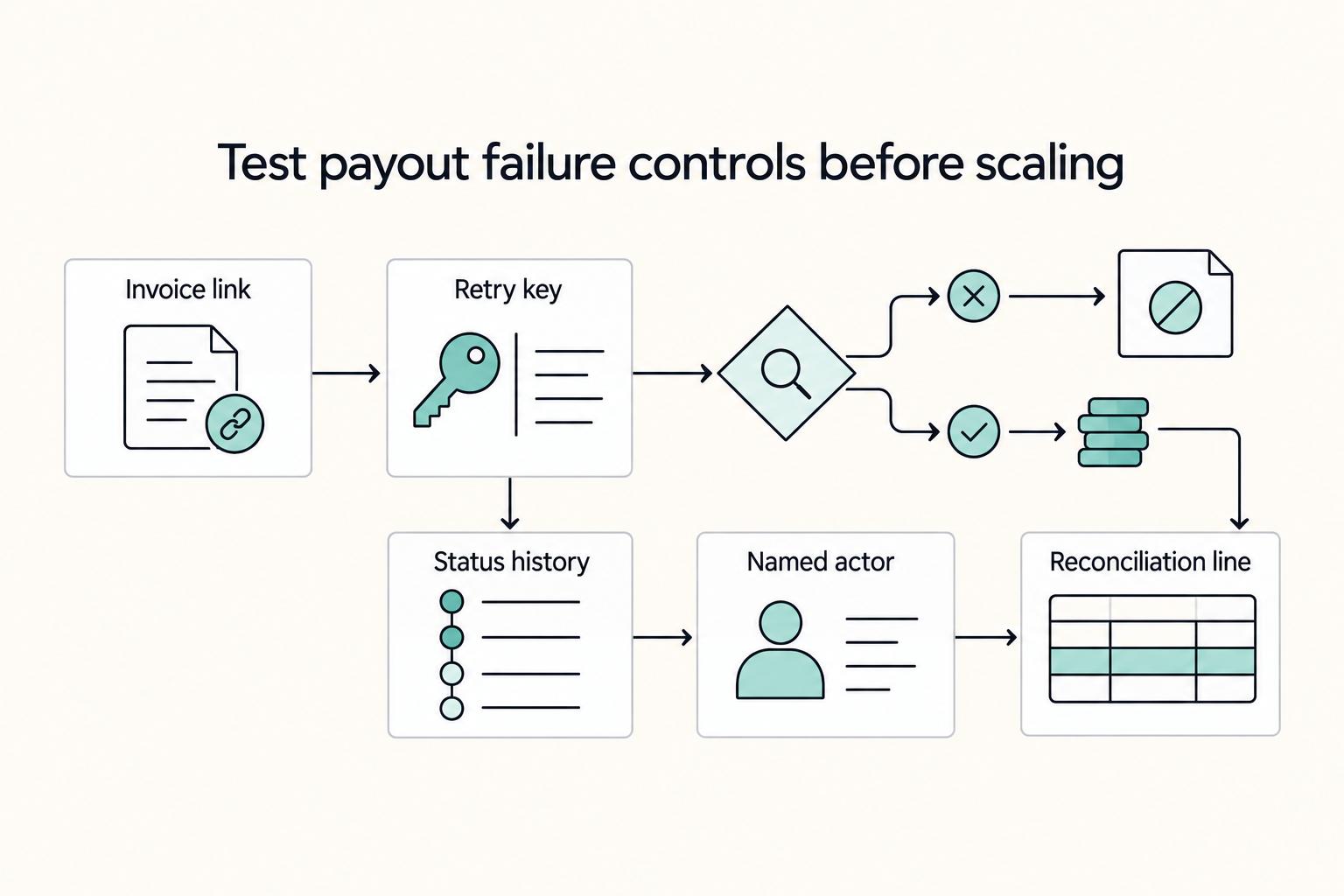
Link supplier invoices, approvals, transfers, and ledger entries so you can trace a payment across tools. A spreadsheet can do this at small volume if references and ownership are clear. Paying a BPO supplier is distinct from running payroll: determine whether the supplier employs its staff or whether you are directly engaging workers or using an EOR.
Step 1 Build the preflight checklist before the first live payout#
Assign a responsible owner for each handoff and arrange backup coverage where practical. Include only the steps your chosen payment route actually uses:
| Payout step | What to confirm |
|---|---|
| Invoice collection | Confirm approved supplier, invoice, amount, due date, and independently verified recipient details |
| Wallet posting, if used | Link posting amount and reference to invoice; omit this step for direct-bank routes |
| FX conversion, if used | Save quote, currencies, rate, fees, and actual converted amount |
| Payout execution | Store supported idempotency key and transfer reference; inspect uncertain status before retry |
| Reconciliation | Link invoice, final transfer status, fees, FX differences, and ledger entry; explain legitimate amount differences |
Keep the source invoice, payment reference, and settlement or failure evidence linked. Some steps share a record rather than generating three separate artifacts. Investigate missing or inconsistent evidence before repeating a transfer or increasing volume.
| Control lane | Visibility | Error recovery | Reconciliation speed | Accountability |
|---|---|---|---|---|
| Disconnected workflow | Status is split across email, spreadsheets, and provider dashboards | Retries can create uncertainty or duplicate work | Slow, because records must be stitched together manually | Ownership blurs across finance, ops, and vendor |
| Linked workflow | One sequence runs from invoice through payout and export | Retries, exceptions, and manual interventions are logged in one place | Faster, because invoice, payout, and reconciliation references stay linked | Named responsibility and practical backup coverage |
Step 2 Test retry and reconciliation controls before you add volume#
Test the provider’s supported retry mechanism in a safe test environment or documented simulation. Check endpoint support, key scope, retention period, and request parameters. A successful HTTP response or queued status does not prove funds reached the recipient. Reconcile the invoice, final transfer status, fees, currencies, and ledger entry.
Stripe’s idempotency documentation describes keys for POST requests; keys may be removed after at least 24 hours, and reusing a key after removal can create a new request. PayPal supports PayPal-Request-Id on specified APIs, with API-specific retention. A request reference alone does not provide duplicate protection. Check the actual payout endpoint before retrying an uncertain result.
Webhook retries deliver notifications; they do not establish settlement or authorize another payment. Stripe retries live-mode delivery for up to three days. Adyen makes initial retries and then queues failures for up to 30 days. Handle duplicates and out-of-order messages, retrieve current transfer status when needed, and assign unmatched items to an exception owner with an escalation path.
Step 3 Embed compliance in approval, not after payout#
Verify the supplier and payment details, then complete the onboarding checks actually required by your bank or payment provider. Formal KYC, KYB, AML, and CDD obligations depend on who is regulated and the service being provided; ordinary buyers do not inherit every financial-institution duty. If using an EOR, establish its employment, payroll, onboarding, and data responsibilities in the actual agreement.
U.S. beneficial-ownership CDD rules address covered financial institutions. Follow applicable provider requirements before a new transaction, but do not use generic compliance uncertainty to withhold already owed wages or supplier fees. Tax forms depend on payer, payee, source of income, and applicable rules: U.S. foreign-status documentation can include W-8BEN-E for entities or W-8BEN for individuals; it is not required for every Philippine outsourcing payment worldwide. Distinguish paying a Philippine supplier from a Philippine business paying a nonresident service provider when assessing local tax rules.
Keep data governance explicit: restrict full-record access by role, mask routine views, log access to identity and financial data, and name an incident owner plus backup. If invoice-to-payout-to-reconciliation evidence is incomplete, do not expand volume until that proof is complete.
For the full payment breakdown, read The Best Way to Send Money to the Philippines from the US.
Conclusion#
You do not win here by picking a popular market or repeating big industry claims. You win by controlling scope, keeping evidence visible, and refusing to scale until execution is clean.
The March 2007 ADB analysis identified contact centers as a growth driver and found limited production linkages into other Philippine sectors. Read that as historical analysis, not a 2026 hiring or pricing benchmark. Keep dated industry context alongside, rather than inside, your task-level cost and quality model.
Assign one owner for the first phase.#
Put one person in charge of discovery, pilot setup, stabilization, and the decision to expand or stop. The outcome you want is simple: no ambiguity about who approves scope changes, who reviews output, and who handles escalations. A good checkpoint is whether one decision file can tell the whole story without hunting through chat threads.
That file should keep the same core records from first call to first invoice: scope, QA rubric, sample outputs, escalation ownership, and review notes. If any of those live only in someone's inbox or memory, you are already losing control.
Run one paid pilot and score it the same way every time.#
Keep the pilot narrow enough that you can review every delivery without drowning in QA. Score first-pass quality, turnaround time, revision count, and response handling when something goes wrong. The verification point is not whether the provider sounds responsive on calls. It is whether the actual work arrives in scope, on time, and with a clear trail from request to approval.
A common failure mode is mistaking flexibility for capability. If the scope keeps changing mid-pilot, or if exceptions are handled through informal promises instead of named ownership and written notes, your test data is already compromised.
Make the go or no-go call from evidence, not optimism.#
Decide in advance what would cause you to pause, renegotiate, or expand. Your end state should be explicit: either the provider met the evidence standard you set, or they did not. If revisions stay high, review notes keep repeating the same miss, or escalation ownership remains vague, do not add seats just because the relationship feels promising.
Before you scale, validate compliance and operating fit as carefully as delivery quality. That means confirming your payment path, document requirements, approval ownership, and whether the arrangement works for your country and program, not just in theory but in live operations. If you want to confirm what is supported for your specific setup before committing larger volume, Talk to Gruv.
Frequently Asked Questions
What does the Philippines BPO industry mean for a small team?
For a small team, BPO means handing a specific business function to an external provider in the Philippines. Treat that as an operating-model definition, not proof of specific cost, quality, or speed outcomes.
Which service should you outsource first if this is your first time?
Start with a task you need and can assess: one support queue with approved macros, one document type with clear exception rules, or a bounded technical feature with competent code review. Agree a paid pilot and review its output before committing to recurring volume.
Why do market numbers for this sector often conflict?
Figures can cover different years, services, units, and rounding conventions. AMRO reports 2024 IT-BPM revenue of USD 38 billion and employment of 1.8 million; those are separate annual metrics. Check the original source and period before comparing either with a vendor’s price or a narrower segment.
Is the Philippines better than India for your team?
Compare providers for the same task in both locations. Give each the same brief, permitted data, deadline, and QA rubric, then compare quoted fees, first-pass quality, communication, and your review time. National rankings can inform a shortlist but cannot choose a supplier for your workflow.
What are the biggest risks when choosing a provider in the Philippines?
Common engagement risks include a mismatch between sales claims and the delivery team, unclear acceptance rules, repeated errors, outages or staff absence without coverage, excessive data access, undisclosed subcontractors, and payments that cannot be reconciled. Ask for task-matched evidence, assign escalation authority, and test a limited paid engagement.
How should you run a low-risk first pilot?
Agree a fixed scope, fee, timetable, QA rubric, and data controls before work starts. For example, review 100 anonymized support tickets against defined criteria, with a stated quality threshold, no critical data-handling errors, and a turnaround target. Pay the pilot fee under the agreed terms and expand only if the evidence meets your criteria.
Try a related tool
Researched and edited by the Gruv editorial team. Gruv builds cross-border billing, payouts, and finance-operations software for global businesses.
Sources
Includes 1 external source outside the trusted-domain allowlist.
- developer.paypal.com/api/rest/reference/idempotencytrusted
- docs.stripe.com/api/idempotent_requeststrusted
- docs.stripe.com/webhookstrusted
- ecfr.gov/current/title-31/subtitle-B/chapter-X/part-1...trusted
- irs.gov/instructions/iw8benetrusted
- irs.gov/forms-pubs/about-form-w-8-bentrusted
- privacy.gov.ph/implementing-rules-regulations-data-privacy-...trusted
- adb.org/publications/analysis-philippine-business-pr...external
Educational content only. Not legal, tax, or financial advice.
Related Posts

The Best Digital Nomad Cities in Southeast Asia
Pick the city that can support a normal workweek, not the one that looks best across a dozen tabs. If you want one practical answer from this Southeast Asia shortlist, use these three gates in order and drop any city that fails one.

How to Build a 'Glocal' Marketing Strategy for Your SaaS Product
You're not just localizing pages. You're deciding whether buyers in a target market can discover you, trust you, buy, get onboarded, and renew with minimal friction. If checkout, invoicing, support, or legal review breaks, a launch can stall even when clicks and trials look healthy.
How to Form and Run a Cayman Islands LLC
A founder needs more than a registration certificate: the entity must work for client contracts, banking, payouts and tax reporting. Prepare the formation pack, authority controls and recurring compliance record around the actual international business. Regulated activities need their own licensing assessment.