
Quick Answer
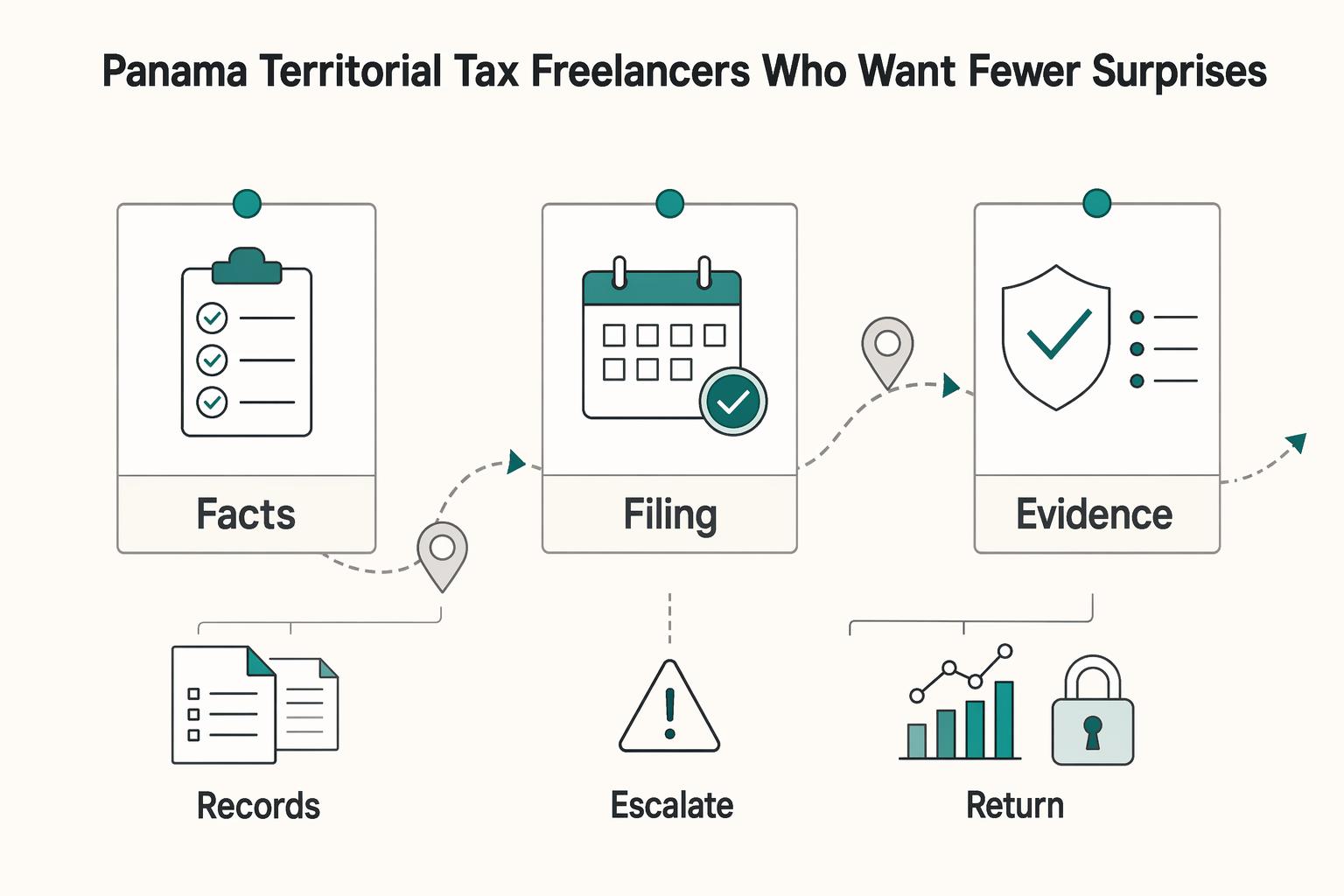
Yes, panama territorial tax can lower friction for cross-border freelancers, but only when your source classification is defensible. Income treated as Panama-source may be taxed, while income treated as foreign-source is generally outside Panama tax in the article’s framing. The practical rule is to classify each line item, keep a dated memo, and match that memo to contracts, invoices, and payment proof. If Article 694 facts are mixed, escalate before filing rather than guessing.
Panama territorial tax for freelancers who want fewer surprises#
Panama's territorial approach can reduce tax friction, but it is not a no-tax shortcut. Treat it as a source-classification exercise, not as proof that moving removes compliance work.
In simple terms, income treated as earned in Panama is taxed there, while income treated as earned outside Panama is generally not taxed there. That helps many cross-border freelancers, but it does not make Panama a zero-tax jurisdiction for everyone. When income is treated as Panama-source personal income, commonly cited bands are 0% up to USD 11,000, 15% from USD 11,000 to USD 50,000, and 25% above USD 50,000.
As of 2026, this is a compliance-first guide for freelancers and consultants earning across Panama and the United States. The goal is practical: classify income correctly, document your position, and escalate early when facts are mixed.
That sequence matters because tax errors often start as record errors. If your contract language, invoicing details, and source memo drift apart, the tax result gets harder to defend even when the underlying work was legitimate. You can reduce that stress by making classification and evidence capture part of monthly operations, not a year-end scramble.
Start building a small evidence pack on day one.
- Contract and scope showing who bought the service and where the benefit lands
- Invoice and payment trail tied to each contract
- A one-line memo per revenue stream explaining Panama-source or foreign-source treatment, plus the date of that decision
For U.S. citizens, local treatment does not replace U.S. filing obligations. Moving abroad does not cancel IRS duties, so Panama classification and U.S. reporting should be handled together. If you cannot defend a source position in writing, escalate before filing.
Build the mental model before you optimize anything#
Start with source classification before any tax optimization. If you cannot explain why a revenue line is treated as Panama-source or foreign-source in one sentence, treat it as a review item.
Use two labels consistently. "Panama-source income" and "foreign-source income" are working source labels until you confirm the legal treatment. Territorial taxation is about where income is sourced, not where you would prefer the result to land.
A practical way to keep this clean is to assign each line one status: provisional, reviewed, or final. Provisional means you need more facts. Reviewed means the documents support your working position. Final means the line is ready for filing. This keeps uncertainty visible and prevents unresolved items from disappearing until deadline week.
Keep tax layers separate so your decisions do not get mixed:
- Individual-level income tax (where applicable)
- Entity-level income tax (where applicable)
- Withholding at payment time (where applicable)
- Consumption-tax questions (including VAT/ITBMS terminology) kept separate from income-tax sourcing
Use a monthly source sheet that follows one format: contract, payer, service reality, source position. In service reality, describe where value was actually delivered in business terms. Then add one short source-position sentence that another reviewer can test quickly.
Legal confidence should match evidence quality. Territorial language in international tax discussions is useful orientation, but it is not a filing position by itself. Final positions should be confirmed against current applicable law and filing guidance before submission.
Apply one escalation rule every month: if contract facts, bookkeeping labels, and tax labels do not match, pause and review. The goal is a position you can defend with records. For U.S.-side document detail, see The Complete Guide to Form W-9 for Independent Contractors.
Who gets taxed in Panama and where people get this wrong#
Start with income source, not taxpayer label. Citizens, resident expats, and non-residents can all face tax exposure when income is Panama-source, while foreign-source income is generally outside Panamanian tax.
Status still matters, but it is not a shortcut. Visa status alone does not tell you whether a line is foreign-source or Panama-source.
This confusion often shows up when someone mixes immigration and tax logic. A person can hold a visa that permits residence and still need to classify each revenue line under source rules. Treat visa details as context, then run the source test separately and document it per line.
Execution risk often appears in non-resident payments. Payment-time tax treatment should be confirmed separately, not assumed from immigration status alone.
Use this year-end checkpoint to keep positions defensible.
- List each income stream separately
- Tag taxpayer status for the period when income was earned
- Record the facts used to classify each line as Panama-source or foreign-source
- Note any payment-time tax treatment assumptions and the document that supports your treatment
If contracts, invoices, and source notes tell different stories, treat that as a review trigger before filing. For a broader cross-border checklist, read our guide to a defensible 2026 filing plan.
Classify each income stream with an order of operations#
Classify each revenue line before year-end cleanup. Waiting until filing season makes source positions harder to defend and harder to document.
| Step | What to do |
|---|---|
| 1 | Inventory revenue by contract, payer, client geography, and beneficiary location, including whether activity was supported inside the Republic of Panama |
| 2 | Classify each line as likely Panama-source or foreign-source, then record one sentence explaining why |
| 3 | Flag remote services, royalties, and licensing for legal review, especially where withholding-tax treatment for nonresident corporations may apply |
| 4 | Attach evidence before close so classification is supported by documents, not memory |
Use the same sequence each month to control avoidable risk. Services, royalties, and licensing can require closer review under withholding-focused treatment.
For each classified line, keep a compact evidence set: contract terms, invoice, payment proof, and a dated source memo. Under the territorial framework described here, foreign operations are treated as outside Panama tax only when accounting, transparency, and due-diligence duties are met, so documentation is part of the position itself.
A useful discipline is to review borderline lines twice: once when the invoice is issued and once when payment clears. Facts sometimes change between invoicing and settlement, especially when the beneficiary or payment route changes. Capturing that change in your memo reduces later disputes about intent or source.
Use older summaries as orientation only. If you cannot defend a line with one clear reason and supporting records, pause and escalate.
The exceptions that can reverse your assumption#
A foreign touch does not automatically make income exempt. For cross-border services, treat Article 694 as a legal source question, not a bookkeeping shortcut.
Article 694 frames taxable income around income produced within Panama. In service cases, a contract signed abroad, delivered remotely, and paid from abroad can still be treated as Panama-source when the benefit lands with people or entities in Panama.
This is where you need to slow down. The practical test is not only where work happened, but who in Panama benefited and whether the service affected production or conservation of Panama-source income.
Law 27 of 2015 reinforces the operational side of this issue. Certain non-resident income became taxable and may be subject to withholding in defined payer scenarios. Even without a single universal rate, that can change pricing, cash timing, and contract terms.
Use one checkpoint for each borderline line.
- Write a one-sentence benefit statement naming who in Panama received value
- Mark whether payer or beneficiary is located in Panama
- Flag remittances abroad for professional services and commissions for review
- Attach records supporting business purpose and source position before month-end close
When a line stays ambiguous, prepare an escalation memo before you contact a tax adviser. Include the contract excerpt, invoice summary, payment path, and your one-sentence benefit statement. Asking a narrow question can produce a more practical response than a generic request for full review.
A 2024 tribunal record on remittances abroad for professional services shows that source disputes can become income-tax demands. Panama tax enforcement also includes penalty authority for non-compliance. Aggressive classification may reduce near-term tax but raise challenge and penalty risk, so escalate when you cannot defend the position in writing.
Rates, withholding, and what you actually pay when income is Panama-source#
If income is Panama-source, separate two tracks at the start: annual personal income tax outcomes and payer-side withholding at payment. Mixing those tracks is where cash receipts and pricing assumptions drift apart. For individual filing outcomes, the referenced personal income tax bands are shown below.
| Taxable income (USD) | How tax is computed |
|---|---|
| 0 to 11,000 | 0% |
| 11,000 to 50,000 | 15% on the excess in this bracket |
| Over 50,000 | USD 5,850 plus 25% on the excess over 50,000 |
These bands describe annual taxable-income treatment. They do not replace withholding mechanics for non-resident payees. Citizens and residents are taxed on Panama-source income, and non-residents are taxed only on Panama-source income, but collection mechanics can differ.
For non-resident income, tax is generally withheld by the payer at payment. In the referenced withholding approach, royalties and commissions paid to foreign entities can be computed as 25% applied to 50% of the remittance, for an effective 12.5%. The same schedule lists headline foreign-corporation rates by payment type, including dividends at 5%, 10%, or 20%, interest at 12.5%, and royalties at 12.5%. If the beneficiary is registered as a taxpayer in Panama, withholding may not be required.
Exemptions are category-specific. Listed exempt items include certain interest categories, such as interest on Panamanian government securities, savings accounts, and time deposits with banks established in Panama. Do not extend those exemptions to services, commissions, or royalties without category-specific support.
A practical pricing mistake is quoting a net figure before withholding treatment is clear. If withholding applies and the contract is silent, your margin can shrink unexpectedly. Set pricing assumptions before work starts, then mirror the same assumption in the contract, invoice, and bookkeeping notes.
Before you invoice, run this checkpoint.
- Confirm the line is Panama-source and record the reason in one sentence
- Confirm whether non-resident withholding applies at payment
- Verify whether beneficiary taxpayer registration in Panama changes withholding treatment
- Set gross-versus-net pricing and state withholding responsibility in contract and invoice terms
The main execution risk is still classification discipline, so build withholding into pricing before you send the invoice.
If you are tied to the United States or Canada your risk profile changes#
If you have U.S. or Canadian ties, treat Panama tax treatment as one layer of the plan, not the whole plan.
For U.S. citizens and resident aliens, worldwide income taxation is the baseline. U.S. reporting can still apply even when Panama treatment is favorable, so keep Panama source classification and U.S. reporting as separate tracks.
FEIE can reduce U.S. tax exposure, but only for qualifying individuals with foreign earned income, and it must be claimed on a filed U.S. return that reports that income. The stated maximum is USD 130,000 for 2025 and USD 132,900 for 2026 per qualifying person. If housing exclusion is used, the general limit is 30% of the FEIE maximum, with a 2026 amount of USD 39,870.
Two failure points create avoidable risk. First, claiming FEIE without records that support residence or physical presence. Second, treating narrow exceptions as broad rules: waivers of minimum time requirements are tied to specified war or civil unrest scenarios, and services performed while present in a country in violation of U.S. law do not qualify as foreign earned income.
Another execution risk is timing. If Panama classifications are finalized early while U.S. form prep is postponed, rework can follow when categories do not reconcile. Close both tracks monthly, even if one feels less urgent, so your year-end return is a reconciliation exercise rather than a reconstruction project.
Before year-end, keep one cross-border evidence set:
- Travel calendar with entry and exit dates
- U.S. return workpapers showing foreign earned income, FEIE claimed, and any housing calculation
- Account tracking that records each account's maximum value during the year using a reasonable approximation for FinCEN reporting
- A reconciliation note mapping Panama source decisions to U.S. reporting categories so the same income is not classified inconsistently
For Canadian ties, apply the same caution. Panama treatment alone does not determine Canadian outcomes. Treat meaningful Canadian residential links as an escalation trigger before final pricing and cash-planning decisions, and confirm Canada-specific residency or reporting rules with a qualified adviser.
Entity and contract choices that create or reduce tax friction#
Entity and contract choices reduce friction only when they match how work is actually delivered. Labels alone do not control source treatment. Source characterization still matters: one planning source states that Panama taxes Panama-sourced income while foreign-source income is exempt from Panamanian income tax.
A sole freelancer structure can work when your contracts are simple and ownership is single-person. A corporation can fit better when you need a vehicle for operating activity, holdings, or multi-party ownership. One planning source says many foreign founders weigh S.A. against S.R.L.; in practice, more separation and governance can mean more onboarding and documentation effort.
| Path | Where it helps | Where friction shows up |
|---|---|---|
| Sole freelancer | Direct client contracting and fewer setup moving parts | Documentation can be harder to standardize when banks or reviewers request proof |
| Corporation (often S.A.; sometimes S.R.L.) | Better fit for multi-party ownership or broader operating scope | Added corporate records, bank onboarding demands, and potential Panama-source corporate tax exposure |
Contract language is often the fastest place to prevent avoidable tax friction. In your contracts, keep three points explicit: where services are performed, who receives the benefit, and how taxes or deductions are handled in the payment chain. When those points are vague, source classification weakens and cash outcomes can drift.
A second risk sits outside Panama. Contract and operating facts may also need review for potential Permanent Establishment questions in another country. One planning source describes Panama as having a limited treaty network, cited as 18 treaties, so do not assume treaty relief will fix poor contract drafting. If PE risk appears, review core concepts early: The Role of a 'Permanent Establishment' in International Tax.
Bank onboarding is often where weak documentation gets exposed first. If key records do not align, account approvals can slow down and payment flows can be interrupted. Cleaner setup and migration documentation reduce rework later.
Before you sign, use this checkpoint for each new client or migrated contract.
- Confirm contract counterparty, invoice issuer, and receiving bank account align to the same legal person where possible
- Add one sentence in the contract file on service location and one on customer benefit location
- State whether pricing is gross or net of any tax deductions in the payment chain
- Keep a contract migration log with effective dates so revenue continuity is documented
- Maintain an onboarding packet that can satisfy bank requests and cross-border fund movement questions
If contracts, banking flow, and tax classification tell different stories, fix the contract layer first.
Build an evidence pack before filing season#
Build the evidence pack before filing season so each income line tells one consistent story from contract through filing inputs. The goal is traceability: contract to invoice to payment to return workpapers, with no contradictions.
| Record | Detail |
|---|---|
| Signed contracts | And amendments |
| Invoices | Matched to payment confirmations |
| Work logs | Or delivery records |
| Classification memos | For each revenue stream |
| FBAR support files | And Form 8938 inputs |
| Red-flag folder | Lines that required judgment calls, with a final decision note |
Keep two record lanes, then reconcile them monthly:
- Source-classification lane: contracts, invoices, work logs, and classification memos that document how each revenue stream is treated
- U.S. reporting lane: income tax return inputs, plus support files for FBAR and Form 8938
For Form 8938, keep mechanics tight. It is attached to an income tax return, and if no income tax return is required, Form 8938 is not required. Filing depends on whether specified foreign financial assets exceed the applicable reporting threshold.
Do not treat Form 8938 as a replacement for FBAR. FinCEN Form 114 may still be required, so use one account inventory and reconcile both forms to that same list.
Set file hygiene rules early so your evidence pack remains usable under pressure. Use consistent file names with date, counterparty, and document type. Keep one folder for final documents and one for drafts, so filing inputs are not mixed with working notes. Small organization rules prevent large errors when deadlines compress.
Run this monthly verification checkpoint.
- Reconcile booked income to invoices and cleared payments.
- Reconcile the source-classification map to that same invoice set.
- Reconcile Form 8938 inputs to the FBAR account inventory.
- Clear each variance or log it as an open item with an owner and due date.
If reconciliation fails, pause optimization and repair the evidence chain first.
Use a practical annual checklist and clear escalation triggers#
Use a fixed annual cadence at quarter-start, mid-year, and year-end. That keeps residency and source positions current before filing pressure builds.
| Checkpoint | Included actions |
|---|---|
| Quarter-start | Reconfirm where you lived and worked; recheck visa status, domicile facts, and client geography; refresh the source-income map; verify contracts, invoicing entity, and receiving account details still align |
| Mid-year | Reclassify each new revenue type before the second invoice is issued; confirm tax treatment assumptions across contracts, invoices, and bookkeeping; trace one sample payment per client from contract to settlement record; recheck California steps for nonresident or part-year cases |
| Year-end | Freeze the final source-income map and lock support for each line; build filing inputs from one reconciled dataset, including cross-border forms; resolve or formally escalate every red-flag item before filing; archive payment proofs and classification notes in one audit trail |
California is a useful stress test for U.S. state exposure because residency is fact-specific and based on all circumstances. A person may be treated as resident, part-year resident, or nonresident. Part-year treatment can include worldwide income during the resident period and California-source income during the nonresident period, while nonresidents are taxed on California-source taxable income. Services performed in California are California-source, so location records matter.
The checklist below works best when each item has an owner and a due date. Without ownership, unresolved issues get pushed to year-end and become urgent at the worst time. Assign one person to records, one to reconciliation, and one to escalation follow-up if you work with a small team.
- Quarter-start checklist
- Reconfirm where you lived and worked since the prior quarter, including California days if relevant
- Recheck visa status, domicile facts, and client geography across relevant jurisdictions
- Refresh the source-income map and flag lines that still depend on judgment
- Verify contracts, invoicing entity, and receiving account details still align
- Mid-year checklist
- Reclassify each new revenue type before the second invoice is issued
- Confirm tax treatment assumptions are applied consistently across contracts, invoices, and bookkeeping
- Trace one sample payment per client from contract to settlement record
- Recheck state steps; for California nonresident or part-year cases, tax is determined by applying an effective rate to California taxable income
- Year-end checklist
- Freeze the final source-income map and lock support for each line
- Build filing inputs from one reconciled dataset, including cross-border forms
- Resolve or formally escalate every red-flag item before filing
- Archive payment proofs and classification notes in one audit trail
Escalate immediately when facts conflict or you cannot defend a classification in writing. This is especially important for residency questions, since California treats residency as factual and does not issue written residency opinions for a specific period. If local legal interpretation is needed, move it to a qualified advisor early.
If you use Gruv where enabled, keep audit-ready exports and tax artifacts with payment history so each checkpoint is easier to defend.
What to do next if you want low-stress compliance#
Use one operating order for every filing cycle: classify, verify, document, then optimize.
Use this workflow as planning guidance only. It draws on non-government, marketing-style content, so key positions still need official or professional confirmation.
Start this week with a written source-classification sheet for every income stream in the current year. Treat any unclear label as an escalation trigger, not a decision to postpone.
Build the sheet at invoice level so each line is easy to review. For each line, include:
- Income line ID linked to contract and invoice
- Client country and payer legal entity
- Where the service benefit was delivered
- Provisional source label with a one-sentence rationale
- Evidence on file and an escalation flag for source-rule ambiguity
Run one monthly checkpoint: reconcile sheet totals to bookkeeping and bank deposits, then confirm whether any new contract changes your source position. If you are tied to the United States, one private expat-tax guide says annual filing expectations still apply, so keep that check visible in the same tracker. If you hold assets abroad, that same guide says FBAR and FATCA filings may be needed, so keep both as explicit yes-or-no checks so they are handled early.
Build your evidence pack now, not in filing week. Keep contracts, invoices, payment confirmations, and work logs mapped to each sheet line, then save short draft memos for judgment calls with the exact question you need answered. Keep those memos short and dated so you can see what changed and why.
Keep immigration marketing claims separate from tax filing decisions. Some public writeups describe low-presence pathways as conditional rather than guaranteed, so use them as planning context only. Model tax residency and reporting outcomes across all relevant jurisdictions before you optimize anything.
Frequently Asked Questions
Is Panama tax-free for freelancers?
No reliable yes-or-no answer applies as a blanket rule. Treat any tax-free claim as unverified until you confirm current Panama rules against your facts. If pricing or cash planning depends on the answer, verify before invoicing.
Do residents and non-residents both pay tax in Panama?
A final resident-versus-non-resident conclusion for Panama depends on your specific facts. Treat residency status and income source as facts to document, not assumptions from summaries. If your facts are mixed, escalate before filing.
Is all foreign income automatically exempt in Panama?
Do not assume automatic exemption from these materials. This guide does not provide an Article 694 interpretation or a complete Panama source test. For any material income line, keep a written classification memo and get local review.
What are the main Panama personal income tax rates I should know?
This section cannot confirm Panama personal income tax bands from the current materials. Use a current Panama tax reference before relying on any published rate table. If pricing or projections depend on a rate, verify it first.
Are there local income taxes in Panama?
The current materials do not provide a supported answer to this question. Keep it as an explicit verification item in your filing checklist rather than carrying forward an assumption.
If I am a U.S. citizen in Panama, do I still file U.S. reports?
Possibly. Form 8938 is attached to an annual income tax return when specified foreign financial assets exceed applicable thresholds, and higher thresholds can apply in some cases, including joint filers or taxpayers abroad. Filing Form 8938 does not replace FBAR when FBAR is otherwise required, and if no income tax return is required for the year, Form 8938 is not required.
Try a related tool
Researched and edited by the Gruv editorial team. Gruv builds cross-border billing, payouts, and finance-operations software for global businesses.
Sources
Educational content only. Not legal, tax, or financial advice.
Related Posts

Digital Nomad Taxes in 2026 With a Defensible Filing Plan
With digital nomad taxes, the first move is not optimization. It is figuring out where you may be taxable, where filings may be required, and what proof supports that position.
Form W-9 for Freelancers Working Across Borders
Treat **Form W-9** as an onboarding control point, not an admin afterthought. Before you sign, confirm the identity record you are certifying. This form gives your correct TIN to the person who may need to file an information return with the IRS.
The Role of a Permanent Establishment in International Tax
Start with the decision that changes your next move: is PE risk active now, or are you still in monitor mode?