
Quick Answer
Check product eligibility, prepare genuine company and activity evidence, compare current fees and complete activation. Interim collections require an authorized route for the UAE company; otherwise agree payment timing and forecast the cash gap.
Prepare a UAE free zone business bank application and collection plan#
A usable company account supports client receipts, expenses and traceable records. Separate eligibility, approval and activation: a trade licence does not guarantee banking access, and an issued account number does not necessarily mean its balance is spendable.
Banks complete identity, ownership and financial-crime checks. RAKBANK's digital guidance describes an initial debit freeze until validated signatures are received. Ask whether incoming funding is permitted and when outgoing payments will work for your exact product.
Plan essential expenses around uncertain opening dates. A backup route helps only if it supports the actual UAE company and intended receipts; otherwise agree revised payment timing and forecast the cash gap.
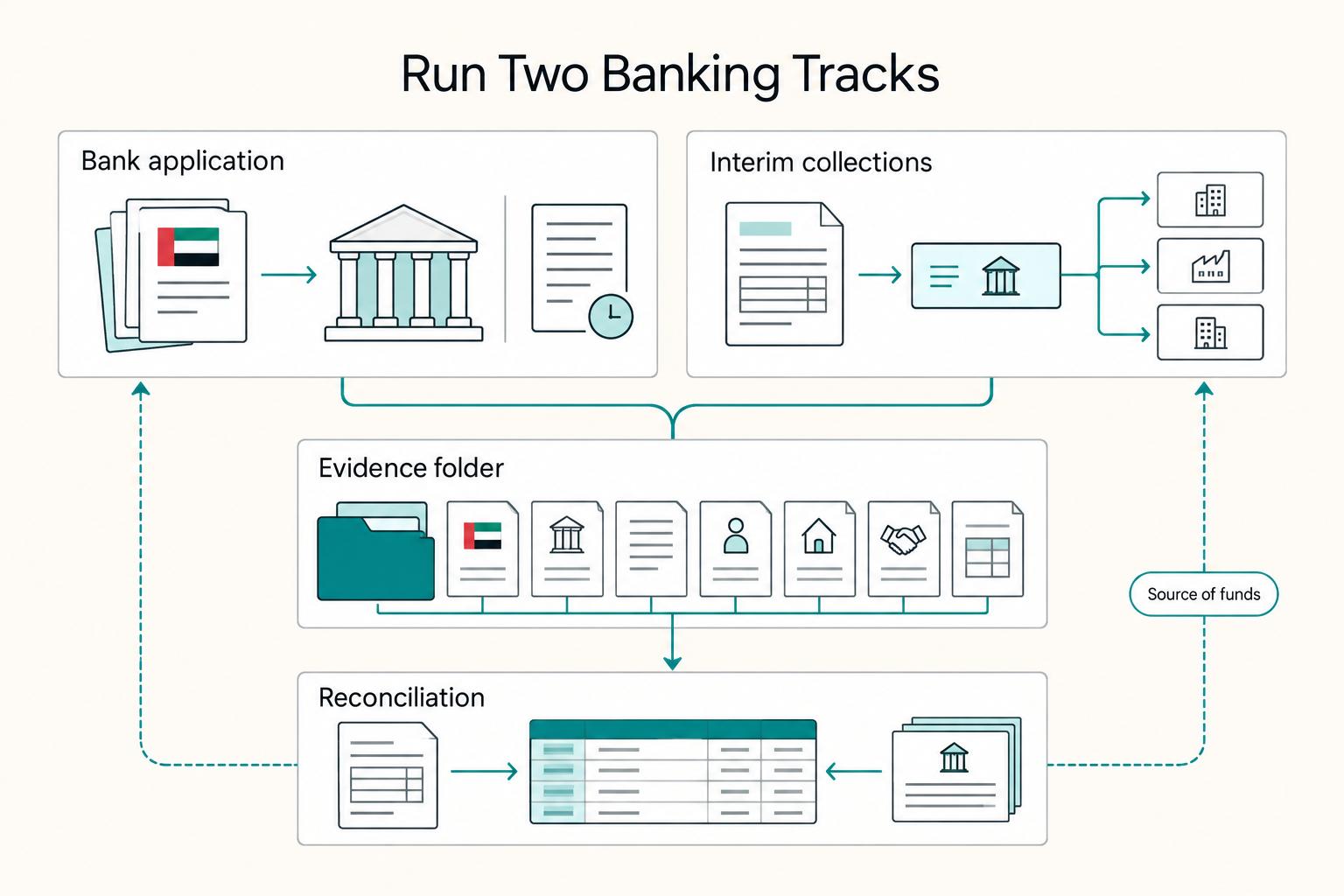
Run the application alongside a conditional collection plan
- Track A: apply for a product supporting your company and payment needs.
- Track B: verify an existing or alternative company receiving route before sharing details.
- If none is available, agree revised payment timing and forecast the gap rather than improvising account ownership.
The audit-ready mental model (so you stop guessing)#
KYC identifies customers and controlling people. Banks also assess ownership, account purpose and expected transactions, then review actual activity against that profile. Consistent names help review but do not determine approval.
Non-resident shareholders and non-resident account signatories are different cases. Ask about both, including travel, physical verification and resident identity requirements.
What can interrupt cashflow (and how to design around it)#
Bank friction usually shows up in four places. Build safe defaults around each.
| Failure point | What it looks like operationally | Safe default you implement |
|---|---|---|
| Eligibility | Company or signatory profile outside product criteria | Confirm the actual structure before a full application |
| Balance and fees | Named product has subscription or balance-related charges | Use its current dated schedule, including transfer and FX costs |
| Activation | Account number issued while debits remain frozen | Confirm permitted funding and requirements for spending access |
| Further information | Additional activity or source-of-funds evidence requested | Answer the actual question with current genuine documents |
An alternative route requires its own eligibility and authorization checks. A tidy ledger cannot make an unsupported receiving account acceptable.
The mental model: formation ≠ banking ≠ getting paid (define the terms before you pick tools)#
Formation, banking, and getting paid are three separate systems, and confusing them creates the delays you're trying to avoid. Once you treat cashflow as the goal, not "getting an account," you need clean definitions so you can pick the right bank setup, set expectations with clients, and handle compliance questions without spiraling.
A UAE free zone company is the legal entity you register inside a free zone. Free-trade zones in the UAE operate under special regimes, and examples include Dubai Multi Commodities Centre (DMCC) (a commodities exchange and free-trade zone), International Free Zone Authority (IFZA) (a free zone community in Dubai), and RAKEZ (a hub for free zone and non-free zone companies). This entity will have a trade license, which is a mandatory permit issued by the relevant authority (Department of Economic Development or a Free Zone Authority).
Bank setup includes choosing a product, submitting formation and authority evidence, completing due diligence and activating access. An incorporation certificate proves formation; it is one part of the assessment.
Compliance terms that decide your timeline (KYC, KYB, AML, sanctions)#
The bank reviews identity, ownership, intended use and relevant financial-crime risk. Explain the actual business even when that leads to more questions.
- Customer and beneficial-owner identification.
- Sanctions and risk checks appropriate to the customer and transactions.
- Ongoing assessment of actual activity against declared account purpose.
The operator takeaway: build a consistent chain of evidence#
You do not need a magic checklist. You need consistency across what you formed, what you do, and how money will move, including international payments initiated via SWIFT, the main messaging network through which international payments are initiated.
Use this as your internal pre-flight:
| What the bank tries to understand | What you should prepare (examples) |
|---|---|
| Who owns/controls the company | UBO (ultimate beneficial owner) declaration, shareholder/manager details |
| What the company is allowed to do | Trade license activity, MOA (foundational company document), AOA (rules and regulations) |
| Why funds will move as stated | Sample invoices/contracts, expected counterparties, basic projections |
Dubai tenancy arrangements may use Ejari registration; free zone leases and flexi-desks can have different evidence. Ask what the bank accepts. Resident people may require Emirates IDs; non-residents need the product's specified identity and verification documents.
Provide legible, current documents through the bank's accepted channel. Scans, app-read original IDs and physical verification differ by product. Retain separate originals instead of assuming one merged PDF is mandatory.
A new company can explain expected activity with a realistic plan, genuine commitments where available and founders' relevant history. Label projections clearly; do not fabricate completed sales.
Do you actually need a UAE free zone bank account-or just better rails for getting paid?#
A UAE free zone bank account can be worth it when your clients, contracts, or payment flows expect UAE bank coordinates and you want tighter control over inbound wires. Treat this as a rails decision. Pick the minimum setup that keeps cash moving and keeps your evidence trail clean for future KYC, KYB, and AML scrutiny.
Start with the trigger conditions. A UAE corporate account can earn its keep when a client's procurement team insists on UAE bank details, when you need local UAE transfers for clients in Dubai or the wider UAE, or when you want direct visibility and control over incoming SWIFT payments and how they line up with your contracts and invoices.
A multi-currency provider must support the company's registered country and receiving function. Wise's supported holding-country list excludes the UAE, and its USD-details policy excludes UAE addresses. A client using Wise to send to an eligible company bank account is different from your UAE company obtaining Wise receiving balances.
Map your "get paid" requirements to capabilities (then choose tools)#
Use this table as your decision filter. You want the option that matches how your clients actually send money.
| Requirement you must support | What to check for | Why it matters for reconciliation and potential reviews |
|---|---|---|
| Incoming SWIFT wires | Ability to receive SWIFT and provide wire tracking details | Use the receiving bank's current receipt confirmation and tracing process, including UETR where supplied. Retain a legacy MT103 only if the bank provides it; it is not a universal proof requirement. |
| International bank receipt | Invoice remittance data and bank trace/reference, including UETR where supplied | Use the bank's current confirmation and trace process; FI-to-FI Swift instructions migrated to ISO 20022 in November 2025, so MT103 and Field 70 are not universal current requirements. |
| Local UAE transfers | UAE local transfer capability and client acceptance | Some UAE clients prefer local rails over international wires. Confirm their requirement before you optimize. |
| Team access and approvals | Multi-user access, roles, approvals | Reduces operational risk when a small team runs collections. |
| Multi-currency and FX clarity | Hold multiple currencies, transparent conversion | Keeps margin predictable and reduces "fee surprise" disputes. |
Risk-first default: optimize for evidence, not the lowest advertised fee#
Match the beneficiary name to the receiving account holder and company documents. The payer is the client or an authorized third-party payer, not your own company. Record that person's identity and relationship separately; provider acceptance is still required.
Hard confirmation step: ask each key client which rail they can send (SWIFT vs local), what payer name will appear, and whether they require UAE bank coordinates. Capture the answers in a one-page "Collections Requirements" doc and file it with your KYB pack. This reduces ambiguity later when a bank asks you to explain inbound transfers.
Build a bank shortlist before completing applications#
Pick your bank setup by scoring your constraints first, then shortlisting banks that publish a matching onboarding checklist and fee structure. Once you know the rails you need, such as SWIFT, local transfers, and clean referencing, turn "bank shopping" into a controlled selection process.
Step 1: Lock your constraints (the stuff that triggers KYC friction)#
Don't start with bank names. Start with the inputs that drive KYC and eligibility decisions.
| Constraint | What to confirm | Grounded note |
|---|---|---|
| Founder status and ID set | Passport and, if applicable, Emirates ID for signatories | Some onboarding packs explicitly ask for Emirates ID and passport copies for shareholders and signatories. |
| Entity and ownership shape | Single founder, multiple partners, or a corporate shareholder | Be ready to explain beneficial ownership (UBO) and provide any required authorizations or resolutions; documentation requirements vary by bank and entity type. |
| Activity and counterparties | Activity code, what you sell, and where money comes from | Banks may run sanctions screening and review geographies; some payment corridors can trigger extra RFIs. |
| Free zone paperwork readiness | Core formation documents such as trade license and MOA | Some bank onboarding flows list a trade license and Memorandum of Association (MOA) as essential. |
Step 2: Choose the account type and fee shape before you choose the bank#
Use current named-product pages and dated schedules. Wio's business schedule illustrates subscription pricing. ADCB's Silver page states that new onboarding, upgrades and downgrades were discontinued from 20 May 2026, although older prices remain visible.
- Corporate current account for invoicing, bill pay, and payroll-type flows. Add savings only if you truly park cash.
- Single-currency vs multi-currency: Multi-currency can simplify collections but complicate reconciliation. If you stay single-currency, define your FX process.
- Access and controls: Do you need cards, multiple users, approvals, beneficiary management, and outbound wires, including SWIFT? Treat these as requirements to confirm per product.
Fee traps usually come in a few common shapes. Verify which one you can tolerate:
| Product/status | Published example checked October 2026 | What to verify |
|---|---|---|
| Wio Business Essential, September 2026 schedule | AED 99 monthly; no minimum average balance | Eligibility, included transactions, users, transfer and FX charges |
| Wio Business Grow, September 2026 schedule | AED 249 monthly; no minimum average balance | Included features and extra charges; schedule fees include 5% VAT where applicable |
| ADCB Business Choice Silver | AED 10,000 average balance and AED 150 fall-below terms still displayed; closed to new onboarding from 20 May 2026 | Ask about available packages rather than applying for this discontinued product |
Optional bank-fit score: first mark eligibility, activity, ownership/signatory profile and required rails as pass, fail or unconfirmed. Exclude failed products and clarify unconfirmed ones. Then score convenience from 1 to 5 using your own priorities. A high convenience score cannot override an eligibility failure.
| Category | Your requirement | Score (1-5) | Notes to confirm |
|---|---|---|---|
| Documentation fit | Trade license, MOA/AOA (where applicable), required resolutions, identity documents, and other formation/ownership documents the bank requests | Request the product onboarding checklist | |
| Fee tolerance | Minimum balance, monthly fees, per-transfer fees | Model your worst month cash balance | |
| Payment footprint | Inbound geographies and payer profiles | Flag anything likely to trigger extra review | |
| Channel fit | Digital-first onboarding vs branch-led process | Timeline, who owns follow-ups | |
| Ops controls | Users, approvals, cards, wires | Confirm in the product terms |
Final rule: confirm for your exact free zone and activity code by requesting the bank's onboarding checklist before you commit time or capital. Even within UAE banking, this one step prevents week-long loops and keeps your non-resident banking plan realistic.
Want a quick next step? Try the free invoice generator.
Can you open a UAE free zone company bank account as a non-resident?#
Yes, sometimes, but you should expect a higher evidence bar and more variability across UAE banking programs. Your operator move is to pressure-test whether your non-resident profile fits the bank's appetite before you burn cycles on applications.
Safe default: approval often comes down to the bank's current risk appetite for non-resident banking, your company structure and documentation quality, how clearly you can explain source of funds, and, in some cases, whether you can attend a compliance interview, remote or in person.
What usually gates non-residents (and how to de-risk it)#
Banks start with identity and authority, then move to substance and flow-of-funds.
| Gate | What banks look for | Article guidance |
|---|---|---|
| Emirates ID / UAE residency status | Emirates ID as a core ID artifact | Check shareholder and signatory requirements separately, including Emirates ID and physical verification for this product. |
| Substance and address proof | Proof of address during account opening or verification | Ejari can document tenancy contracts when you have a physical lease; lighter-weight setups should be ready for additional document requests. |
| UBO clarity and ownership chain | Who in the end owns or controls the company | If you have layered ownership, expect deeper questions and requests for supporting documents. |
Your control lever: make your story match your paperwork#
Banks assess documentary consistency and the substance and risk of the business. A coherent explanation helps review; it does not compel approval.
Use this consistency check before you submit:
| Item | What the bank compares | Your job |
|---|---|---|
| Trade license activity | What you are licensed to do | Keep services and wording aligned everywhere |
| Website and marketing copy | Does your public footprint match the license | Describe real work accurately; correct erroneous claims without concealing activities |
| Invoices/contracts | Who pays you, for what, and under what terms | Use consistent descriptions and clean references |
| Expected transaction volumes | Typical payment sizes, frequency, geographies | Provide realistic ranges you can defend |
For a fallback, verify that the provider supports the UAE entity, signatory and intended transactions. Establish who legally receives the payment and whether the client accepts the arrangement. Good reconciliation alone is not permission.
Finally, confirm safely in writing. Email the bank: "Do you onboard non-resident shareholders for a free zone company, and what minimum documents do you require (trade license/certificate of incorporation, UBO information, proof of address, passports-and Emirates IDs where applicable)?" Save the reply in your compliance folder.
Prepare company, people and activity evidence#
Build one clean "evidence pack" (company, people, and activity) and you can cut rework, shorten KYC back-and-forth, and improve your odds of approval for the account. Your goal is to ship a file that a compliance team can review quickly, without chasing you for basics.
Think in three layers. KYC (Know Your Customer) verifies the identity of customers. KYB (Know Your Business) verifies the business entity. Your job is to make both easy: consistent names, dates, addresses, and ownership across every document.
1) Assemble the pack (one bundle + clean originals)#
Organize current formation, ownership, authority and identity documents. Prepare a merged index or PDF only if it suits the bank's process; retain separate originals. RAKBANK's cited digital route lists company documents, signatory IDs and address and income evidence, with its own activation steps.
| Pack | Include | Notes that prevent delays |
|---|---|---|
| Company | trade license and/or certificate of incorporation, MOA (scope and incorporation conditions), AOA (company constitution), share certificate(s), shareholder/ownership details (incl. UBO details where requested), plus any bank-requested authority document (POA or board resolution) | Keep entity name and license activity wording identical across all docs and your website |
| Office / address | Proof of business address such as Ejari (Dubai's DLD rental registration) where applicable, or other accepted proof (e.g., tenancy contract or utility bill) | Do not assume Ejari always applies. Provide the best address proof you have and what your bank accepts |
| People | passport, visa page and Emirates ID (if resident), proof of address, any bank onboarding/KYC/KYB forms they provide | Use one spelling format for names everywhere. Match signatures to passport names |
2) Proof-of-activity (what banks actually mean)#
Use genuine contracts and invoices where available, a business description, client information and requested statements to explain operations and funding. Label projections and unsigned opportunities. Ask before redacting prices, counterparty names or other requested information; do not conceal material due-diligence evidence.
Adaptable templates: replace placeholders with actual facts and the bank's requested information. These are preparation aids, not official bank forms.
1-page business model summary (paste into a doc):
- Services: [exact wording aligned to trade license]
- Delivery: [remote/on-site], tools, typical turnaround
- Client locations: [countries], industries
- Expected monthly volume: [range], currencies, avg invoice size
- Payment rails: SWIFT, card, platform payouts (what you expect)
- Why UAE: [commercial reason], operational presence, counterparties
Source of funds / source of wealth statement (freelancer version):
- Timeline: prior employment or clients, year-by-year highlights
- Primary income sources: retainers, project invoices, royalties, etc.
- Supporting evidence: prior statements, contracts, tax filings (if available)
- Explanation: "Funds used to capitalize the UAE company come from [source], earned through [work], received into [account], transferred on [dates]."
Client list format (table):
| Client country | Payer name | Typical invoice size | Frequency | Rail (e.g., SWIFT) | Expected payment reference |
|---|---|---|---|---|---|
| [AE/US/UK] | [Client Legal Name] | [USD 3,000] | [Monthly] | [SWIFT] | "INV-2026-001 Services" |
If you run payments through tools like Stripe, automate clean reconciliation now so future KYB reviews stay painless. A simple workflow from Automating Your Freelance Finances: A Zapier Workflow for Connecting Stripe can help.
The real process (step-by-step) + the failure points that cause delays, holds, or rejection#
Pre-qualify the product, submit requested evidence, answer follow-up questions and complete activation. Keep the file current: the bank may request additional material after the first submission.
Step-by-step: what to do, in what order#
Step 1 (Pre-qualification): shortlist by fit, then confirm deal-breakers upfront. Before you "apply," ask two direct questions on the call or in writing: (1) do you support my free zone entity type (examples: DMCC, IFZA, RAKEZ), and (2) do you require an Emirates ID for all signatories, if applicable for my setup? This avoids wasting time on a path the bank may not support for your situation.
| Step | Focus | Key details |
|---|---|---|
| 1. Pre-qualification | Shortlist by fit and confirm deal-breakers | Ask whether the bank supports your free zone entity type and whether it requires an Emirates ID for all signatories, if applicable for your setup. |
| 2. Submission | Deliver the full bundle once | Common items include trade license, incorporation documents, MOA/AOA, authority to open or operate, UBO information, proof of address, and supporting activity documents. |
| 3. CDD questions | Answer with specifics that match the pack | Bring top 3 client countries, average invoice size, currencies, and the exact license-aligned service description. |
| 4. Approval + activation | Set up controls on day one | Complete online banking setup, token/2FA, and user permissions, then define who can add beneficiaries, approve transfers, and store invoice, contract, and delivery proof. |
Step 2 (Submission): provide the requested file through the bank's verified channel. RAKBANK's cited digital guidance asks for company documents, authorized signatory IDs, address and income evidence. Constitutional formats, authority documents and further ownership evidence depend on structure and product.
Your submission will often include:
- trade license
- incorporation documents (as issued for your entity)
- MOA/AOA
- authority to open/operate (e.g., board resolution or POA)
- beneficial owner (UBO) information and supporting ownership chain (as requested)
- proof of address (e.g., tenancy contract or other address proof your bank accepts)
- supporting documents that help explain your activity (e.g., contracts, invoices, website/deck, prior statements if available)
Step 3 (CDD questions): answer like an operator, not a marketer. CDD includes more than IDs. It also includes understanding the purpose and intended nature of the relationship. Banks may ask questions to understand what you do and how you expect to use the account, including why you will use SWIFT, the standardized way banks communicate about transactions.
Bring specifics: top 3 client countries, average invoice size, currencies, and the exact license-aligned service description you used in your pack.
Step 4 (Approval + activation): treat setup as internal control design. Complete online banking setup, token/2FA, and user permissions, especially if you run a small team. Lock in safe defaults on day one:
- Who can add beneficiaries
- Who can approve transfers
- Where you store invoice, contract, and delivery proof per payment, with a plan for ongoing scrutiny of transactions to ensure consistency with what the bank knows about you, including, where necessary, source of funds
Failure points to preempt (use this checklist)#
| Failure point | What it looks like | Preempt it with |
|---|---|---|
| License mismatch | Invoices describe work outside trade license scope | Check the actual work is licensed; correct inaccurate descriptions or obtain the required licence change before undertaking unsupported activity |
| Ownership ambiguity | Missing links in the UBO chain, unsigned declarations | Provide signed UBO forms plus share certificates and a clear org chart (as applicable) |
| Unclear address/substance | No acceptable proof of address | Submit a tenancy contract or other address proof your bank accepts |
| Higher-friction counterparties | Certain geographies or flows trigger extra questions | Disclose client countries and payment rails upfront during pre-qualification |
Timelines and costs: don't model promises. Model categories. Build a simple "cost stack" sheet with monthly fees, minimum balance rules, SWIFT receiving and intermediary bank fees, and FX spread, then validate each item against the specific business bank account terms you choose.
Two-track plan while the bank application is pending#
Progress the application while checking an eligible existing or alternative company receiving account. The second track may produce a working route, or agreed delayed payment and a cash-gap plan. Documentation cannot make an unsupported account eligible.
Track A: progress the application and plan activation#
Treat every RFI (request for information) like a ticket in your ops queue. You already built the evidence pack. Now keep it coherent.
- Create one master folder for the application, then subfolders by topic: trade license, certificate of incorporation, MOA/AOA, UBO declaration, address proof, contracts/invoices, and "RFI responses."
- For every RFI response, save (1) the bank question, (2) your answer, (3) the exact documents you attached, as a single PDF bundle. Consistency beats eloquence.
- Keep names and descriptors identical across documents. If your legal entity name differs between your invoice header and your certificate of incorporation, fix it before the next invoice goes out.
Track B: verify collections or agree payment timing#
Wise is not a general UAE-company receiving-account fallback under its current holding and USD-details policies. Verify any alternative provider's country/entity eligibility, account holder, currencies, business-use permissions and settlement access. Do not borrow personal, nominee or unrelated-company details merely to collect an invoice. If no eligible route exists, agree revised dates or another legally documented arrangement with the client before payment is sent.
Client payment instruction block (copy/paste into every invoice email):
- Beneficiary: bank/provider-issued account-holder name for the approved company route.
- Receiving details: correct currency and rail; verify changes through a trusted channel.
- Reference: invoice number first, followed by a descriptor if length and character limits permit.
- International transfer evidence: current confirmation and trace/reference or UETR where supplied; follow remittance instructions instead of insisting on a legacy field.
| Element | Safe default | Why it reduces investigation friction |
|---|---|---|
| Reference | Invoice-number-led | Payment reference numbers can simplify reconciliation and reduce manual errors. |
| Descriptor | Short, license-aligned | Lowers ambiguity when ops teams review transactions. |
| Storage | One folder per invoice | Structured information improves reconciliation and makes it easier to match investigation cases to underlying transactions. |
Payment reliability playbook:
- Invoice standard: scope line (license-aligned), milestones, payment term, late fee language (where enforceable), and a deliverable acceptance checkpoint.
- Proof-of-delivery bundle per invoice: contract, invoice PDF, delivery link/screenshot, and acceptance email stored together.
Match receipts to invoices while allowing partial payments, combined invoices, fees and conversion. Record gross debt, net receipts, fees and outstanding balances separately. A sent-payment confirmation or released payout is not proof that spendable cash has reached the company account.
Post-approval monitoring, updates and payment holds#
Approval is not the finish line for your account. It is the start of continuous monitoring. Your job shifts from getting approved to staying predictable.
UAE banks run ongoing monitoring throughout the business relationship, using transaction monitoring and, where relevant, sanctions screening to identify activity that may not match your KYC/CDD profile and stated expectations. Monitoring depends on the CDD and KYC information you gave them, including what transaction types they should expect from you. Your best defense is operational consistency, not clever explanations after a hold hits.
Set safe defaults that lower review risk#
Keep identity, ownership, licence and expected transaction information current. Describe actual activity; repeating the same label should not hide a material change.
- Accurate descriptions: state actual work and confirm licence coverage. Rewording an invoice does not authorize another activity.
- Keep payer details consistent with your client records, especially on SWIFT. Ask clients to pay from the legal entity that signed the contract, using the same name that appears on the invoice. When you work with agencies paying on behalf of end-clients, document the relationship upfront.
- Material changes: update the bank about ownership, activity, countries or expected flows through its required process. A heads-up cannot guarantee there will be no hold.
| Potential review flag | Safe default | What you can do the same day |
|---|---|---|
| Vague memos like "services" | Use scope-led descriptors | Update invoice template and payment instructions |
| Payer differs from contracting party | Prefer pay-from entity match (or document third-party payer) | Document the actual payer relationship and client authority; confirm provider acceptance rather than assuming a contract clause cures it |
| Meaningful activity shift vs your KYC/CDD profile | Early heads-up to RM | Email context and attach relevant supporting docs |
Build a rapid-response RFI kit (so holds do not become outages)#
Banks can request additional documents during compliance review, including contracts and invoices. In higher-risk cases, they may ask for enhanced due diligence details like source of funds, nature of business, and purpose of transaction. Your goal is to answer RFIs with a clean bundle fast, not with a scramble over days.
RFI kit per incoming transfer (one folder, one PDF bundle):
- Invoice (final PDF) + contract/SOW
- Proof of delivery (handover email, acceptance note, link or screenshot), where applicable
- Client info (legal name, website, signatory, country)
- One-paragraph explanation: what you delivered, why they paid, how it matches the trade license
- Stored alongside your KYC pack: your current core company/KYC documents (as applicable)
Set retention periods under the tax, company, free zone and regulated-activity rules applicable to your entity. Article 25 of Cabinet Resolution 134 of 2025 sets at least five-year AML obligations for financial institutions, designated non-financial businesses/professions and virtual asset service providers, with record-specific trigger dates. This is not a blanket five-years-from-each-invoice rule for every freelancer. Preserve records longer when applicable obligations or ongoing matters require it.
When rules vary, and they will, don't guess. "High-risk geography" lists and escalation triggers change by bank. Ask your relationship manager what documentation they expect for new client countries, and save the email as proof of good-faith compliance.
Keep a named contact and next action for each bank question, and preserve the response with its supporting documents.
Worked example: application pending, invoice due and a debit freeze#
Suppose a newly formed consultancy has a genuine USD 3,000 client invoice due in ten days and AED 8,000 of essential expenses due in two weeks. These invented numbers illustrate planning, not a quoted bank service. The founder has no UAE Emirates ID. A product requiring that ID for the signatory is unconfirmed or unsuitable until the bank establishes an acceptable route; scoring its app highly does not change that.
The company first asks its shortlisted bank about non-resident signatories, permitted funding and activation. It also checks whether any existing company account supports these receipts. It does not put a personal Wise USD balance on the company invoice: UAE USD-details eligibility is a separate limitation. If no authorized receiving route is available, it tells the client before the due date and agrees revised payment timing. It separately plans how the AED 8,000 expenses will be funded; the USD invoice is a receivable, not available cash.
If the bank issues an account number but retains a debit freeze, incoming funding permitted by that bank still may not pay the expenses. Wait for confirmation of activation and spending access before treating the balance as usable. After collection, if the USD 3,000 invoice produces USD 2,975 net because of a USD 25 transfer deduction, record invoice principal, receipt and fee separately. Whether the client still owes USD 25 depends on the agreed fee allocation; do not silently declare the invoice short or paid in full.
Next steps for a usable UAE business account#
Confirm eligibility, prepare real business evidence, compare current fees and complete activation. Plan the cash gap while approval is uncertain. An alternative account can help only after eligibility and authority are established.
Maintain an organized application and payment record#
Banks underwrite clarity. Whether you target a traditional Dubai business bank account or a digital-first option, the structure is the same:
- Formation docs (baseline truth): documents banks commonly ask for include a trade license, MOA, AOA, and, depending on the entity structure, a certificate of incorporation/registration-plus beneficial owner (UBO) details as part of identity checks.
- Evidence pack (commercial reality): contracts, invoices, client list, website, and a plain-language description of what you sell, to whom, and how money moves.
- Current payment references: use receiving-provider instructions and match receipts to invoices. FI-to-FI Swift instructions migrated to ISO 20022 in November 2025; legacy MT103 evidence is not universally required.
- Reconciliation discipline (your defense file): one ledger, one invoice sequence, one source of truth for "what this payment was for."
Two-track plan: apply while you keep collections KYC/AML-ready#
You cannot bet payroll or rent on underwriting timelines. Run two tracks:
| Track | Goal | What "good" looks like |
|---|---|---|
| UAE corporate account application | Get the primary operating account approved | One complete doc set, same-day responses to RFIs, no contradictions across license, invoices, and counterparties |
| Conditional alternative collections | Receive through an eligible company route, or agree timing | Provider supports the company and transaction; instructions are authorized; receipts, fees and balances are traceable |
Next steps (fast operator checklist):
- Score bank fit (onboarding friction, minimum balance risk, online banking, support) against your payment needs.
- Build one evidence folder: trade license, MOA, AOA, certificate of incorporation/registration (where applicable), beneficial owner/UBO details, proof of address (e.g., a tenancy contract if required), plus a small set of recent contracts and invoices that match your license activity.
- Write a one-page business summary and a source-of-funds statement (plain language, consistent).
- Standardize invoice numbering and transfer memos so reconciliation stays clean across SWIFT and internal tools.
- If an eligible interim route exists, record its authority and reconciliation. If none exists, agree payment timing and forecast the gap.
- If you want a modular "collect, track, convert, pay out" workflow, start with process design first, then validate tooling and coverage before you depend on it.
For reconciliation ideas, see Automating Your Freelance Finances: A Zapier Workflow for Connecting Stripe. Check every tool's coverage for the actual entity.
Frequently Asked Questions
Can you open a UAE free zone company bank account as a non-resident?
Some banks accept non-resident ownership, but signatory eligibility and procedures vary. RAKBANK's cited digital route requires in-person signature collection in the UAE and physical Emirates ID validation before activation; it does not establish a route for a wholly non-resident team. Ask separately about shareholders, beneficial owners and signatories. Confirm travel, identity and activation requirements before relying on the account.
What documents are required to open a UAE free zone business bank account?
Expect the trade licence, relevant formation or constitutional documents, ownership and signatory information. RAKBANK's cited route also requests address and income evidence. The exact checklist controls; MOA/AOA formats and authority documents depend on structure. In practice, banks also ask for KYC/KYB materials for signatories and UBOs, and they can request supporting commercial documents during review.
How long does it take to open a business bank account for a UAE free zone company?
There is no universal opening time. RAKBANK's cited route gives a two-business-day processing target for complete information, subject to its policies, and separately requires physical signature/ID steps before activation. Processing, approval and outgoing payment access are different milestones. Respond promptly with genuine evidence and track the next bank action. A processing target is not an approval guarantee or a safe date for essential expenses.
What is the minimum balance for a UAE business bank account?
There is no single minimum balance. Wio's September 2026 schedule lists no minimum average monthly balance for Essential and Grow, with AED 99 and AED 249 subscriptions respectively. Transfer, FX and other usage charges still matter. ADCB's Silver page displays AED 10,000 average-balance and AED 150 fall-below terms but states that new onboarding was discontinued from 20 May 2026. Check an available product's current schedule.
Which UAE bank is best for free zone companies or freelancers?
No bank wins universally. Choose based on your operating model: onboarding friction, online banking quality, fees tied to minimum balance, and how well the bank handles your transaction pattern (currencies, counterparties, volumes). If you consider digital-first options, pressure-test support responsiveness and RFI handling before you commit.
Why do UAE banks reject or delay free zone bank account applications?
Banks can reject or delay applications for a range of reasons, and the exact triggers aren't consistent across the market. What you can control is submission quality: keep your trade licence and constitutional documents organized, answer questions consistently, and be ready to provide supporting commercial documents if requested.
Can a UAE free zone company use Wise to receive client payments?
Do not assume a UAE company can obtain Wise receiving balances or USD account details. Its current holding-country list excludes the UAE, and its USD-details policy excludes UAE addresses. A client sending through Wise to an eligible company bank account is a different transaction. You may issue an invoice before an account is ready, depending on licence, tax invoicing obligations and client requirements. Collection still needs an authorized route; otherwise agree timing. Do not substitute personal or unrelated-company details without a properly authorized arrangement.
Try a related tool
Researched and edited by the Gruv editorial team. Gruv builds cross-border billing, payouts, and finance-operations software for global businesses.
Sources
Includes 4 external sources outside the trusted-domain allowlist.
- dubaidet.gov.ae/-/media/Files/invest-in-dubai/corporate-legi...trusted
- wise.com/help/articles/2813542/where-do-i-need-to-liv...trusted
- wise.com/help/articles/2810318/can-i-get-usd-account-...trusted
- adcb.com/en/personal/business-accounts/bca-silver.aspxexternal
- quickapply.rakbank.ae/digitalbank/business/accounts/current-accoun...external
- swift.com/swift-resource/252381/downloadexternal
- wio.io/file/business-fees.pdfexternal
Educational content only. Not legal, tax, or financial advice.
Related Posts
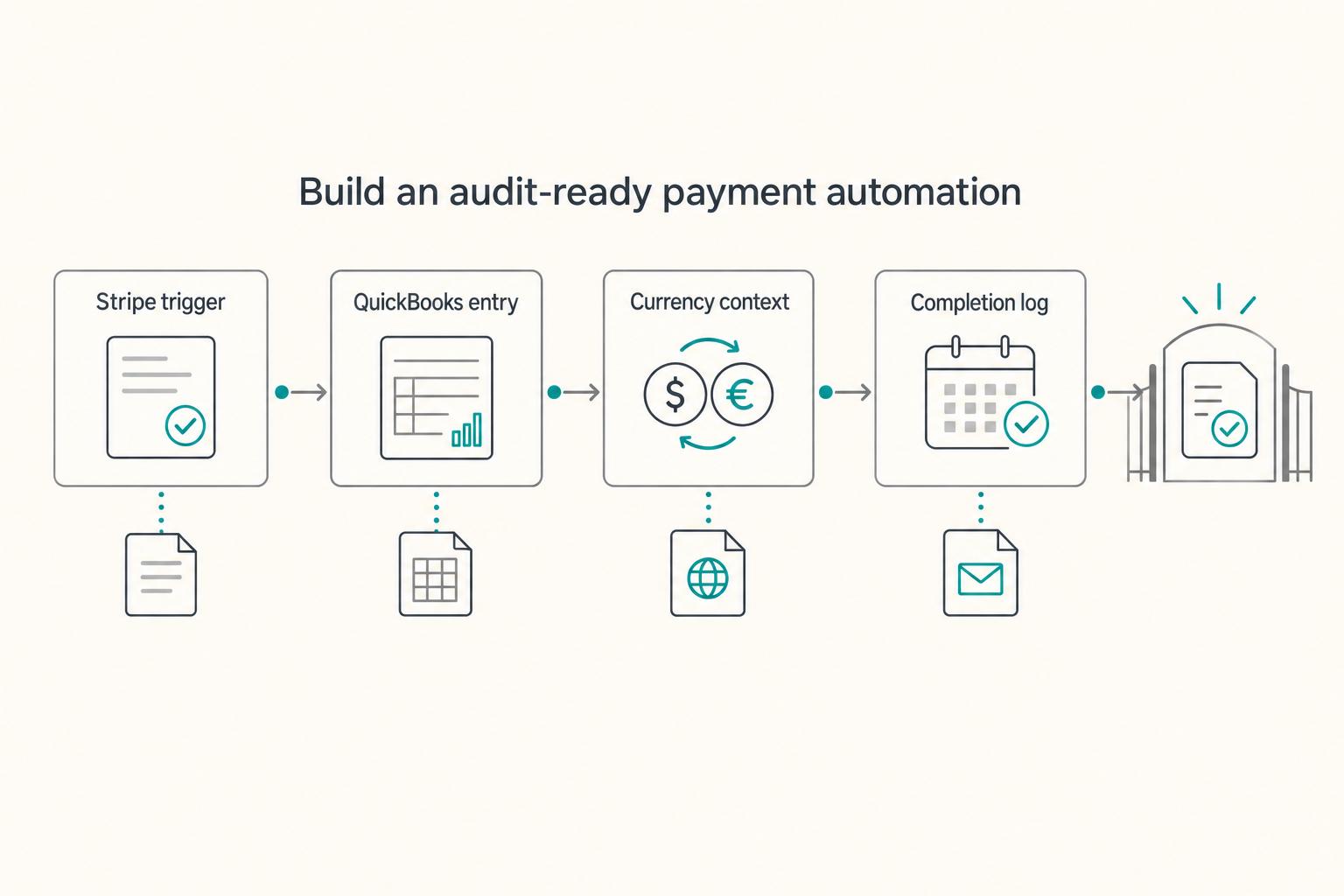
Automating Your Freelance Finances: A Zapier Workflow for Connecting Stripe, QuickBooks, and Wise
Start with one payment flow you understand, then automate its accounting record without losing the source reference. Stripe captures payments, QuickBooks holds the books, Zapier connects the selected steps, and Wise records any separate cross-border balance or conversion activity.

The Freelance Payment Penalty: A Modeled Audit of Platform Fees, FX Spreads, and Payout Delays
The money rarely disappears through a single, easy-to-spot fee. The real loss is stacked. A marketplace takes its commission, a processor adds a charge for international cards, a bank or payment company converts the currency at a spread, a platform holds the funds before release, and a wire sheds a little to intermediaries on the way in. Each layer looks defensible on its own, but the worker feels the combined result as a smaller deposit and a later payday.

How to Respond to a Subpoena for Business Records
Move fast, but do not produce records on instinct. If you need to **respond to a subpoena for business records**, your immediate job is to control deadlines, preserve records, and make any later production defensible.