
Quick Answer
Yes, a nominee director offshore setup can work without losing control if you narrow authority in writing, keep the beneficial owner approval trail intact, and supervise continuously. Put the Nominee Director Agreement, Power of Attorney, and reserved-matters rules in sync before go-live, then test real permissions against those documents on a fixed review cadence. If records, filings, or signing rights drift, pause expansion and move to controlled replacement.
What a Nominee Director Does and How to Keep Control#
Privacy and cleaner operations are valid goals, but control and compliance come first. A structure only helps if authority, approvals, and records are clear enough to survive outside review.
Make the decision in sequence, not by instinct. First, confirm whether a nominee director structure is truly necessary. Second, document authority limits before you operate, typically through a Nominee Director Agreement and a Power of Attorney that defines representation boundaries. Third, review responsibilities on a fixed cadence after go live. If privacy is the only driver, pause and test whether your governance is strong enough before you add another layer.
Structure choice changes obligations. A nominee director may be officially listed while acting for the ultimate beneficial owner, and private arrangements often restrict decision power. That does not remove director-type legal duties, which can still include fiduciary, conflict, KYC, and disclosure expectations depending on jurisdiction.
The practical point is simple: appointing a nominee does not remove filing, disclosure, or oversight duties. Failure modes can include authority misuse, legal exposure, confidentiality issues, and reputational harm, so mitigation should be explicit: tighter agreements, limited powers, and regular oversight.
Do not treat one country's rules as universal. Requirements vary by jurisdiction, so confirm local rules with qualified local counsel for each jurisdiction, then reflect that advice in your operating documents and approval boundaries. As a practical onboarding checkpoint, keep identity documentation for nominee appointments in your records. If guidance is generic or unclear on filing duties, stop and clarify before implementation. A short pause before filing is cheaper than months of corrective work later. If you need a practical starting point, Browse Gruv tools.
Need the full breakdown? Read How to Incorporate a Company in the British Virgin Islands (BVI).
What a nominee director is and is not#
A nominee title is not a control system on its own. Control and compliance come from your structure, your documented authority, and your records.
| Point | What the article says |
|---|---|
| Structure choice | Affects tax, control, and debt outcomes |
| Private limited company | Separate legal entity, and a director is appointed to run it |
| Limited company filings | Must register with Companies House and file annual accounts and statements that are published online |
| Recordkeeping and Self Assessment | Accurate filing depends on recordkeeping, and Self Assessment administration still has to be handled correctly |
In UK context, keep these grounded baseline points in view:
- The structure you choose affects tax, control, and debt outcomes.
- A private limited company is a separate legal entity, and a director is appointed to run it.
- A limited company must register with Companies House and file annual accounts and statements that are published online.
- Accurate filing depends on recordkeeping, and Self Assessment administration still has to be handled correctly.
Public visibility and administrative convenience can be part of why owners consider this setup. But privacy alone is not a governance plan, and a title alone does not create clear decision rights or reporting lines.
Treat role labels carefully. In practice, decisions are judged through what was approved, signed, and recorded, so documentation quality matters more than terminology.
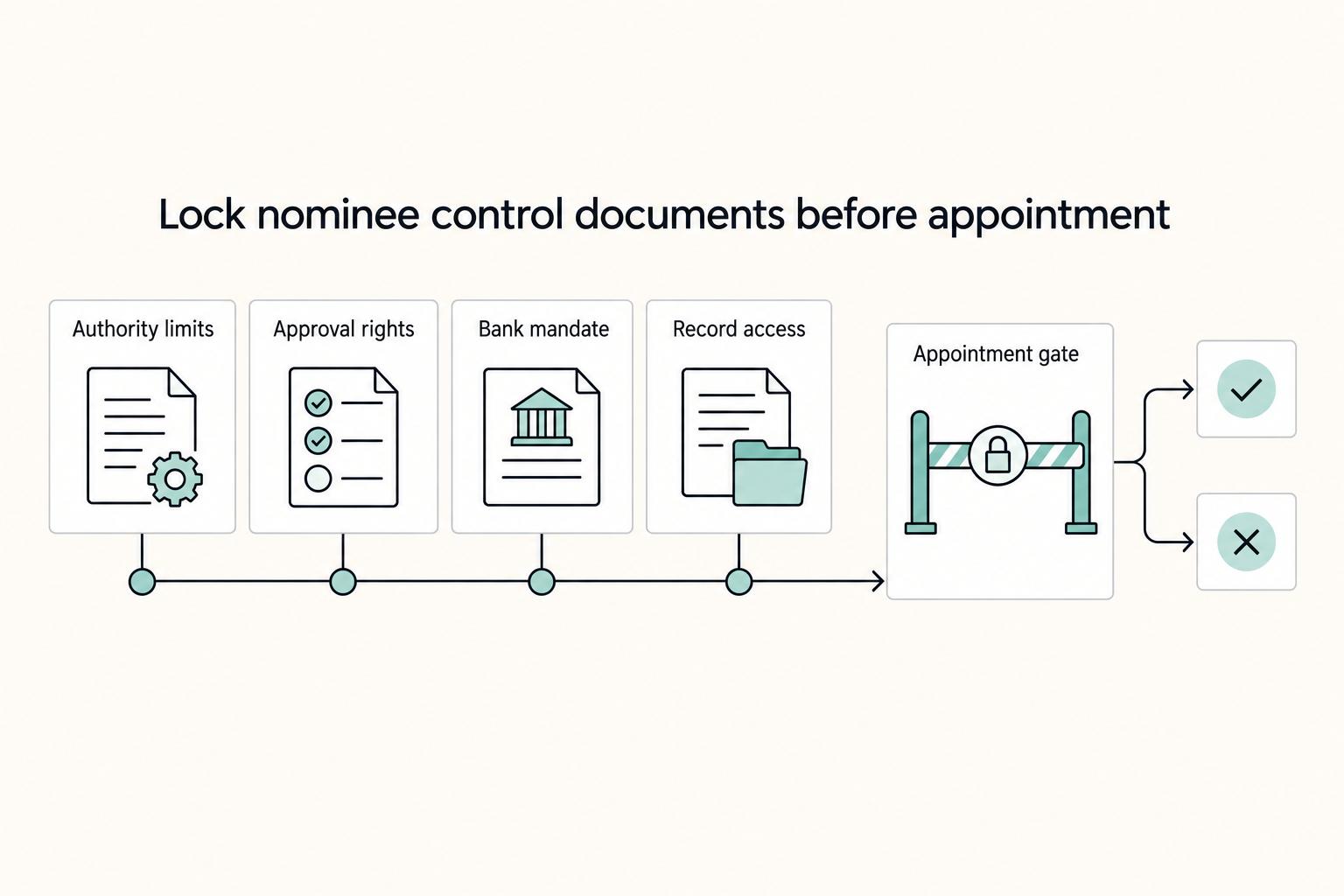
Before appointment, keep your authority documents consistent as an internal control step: board resolution, Nominee Director Agreement, any Power of Attorney, and conflict disclosures should describe the same approval boundaries and escalation flow. If they conflict, fix that first to avoid operational confusion.
Use a simple check: ask someone outside the drafting process to read the full set once and identify who can approve bank changes, major contracts, ownership changes, debt decisions, and litigation decisions. If they cannot answer clearly, tighten the documents before you proceed. For a broader compliance primer, see What is FinCEN? A Guide for Freelancers and FinTech Users.
Do you actually need a nominee director now#
If your documents would fail the one-read authority test from the last section, the answer is usually no, not now. Appoint only when you can point to a verified legal or commercial trigger and you are ready to supervise the arrangement every month.
Step 1 Decide which path you are actually on#
Pick one path first, then act.
| Path | When it applies | Control posture |
|---|---|---|
| Need now | Written legal confirmation for your jurisdiction and a documented business trigger that requires this structure | Clear authority limits, monthly oversight, and complete records |
| Need later | Privacy matters, but there is no immediate legal or business trigger | Prepare documents and reassess when jurisdiction, client expectations, or compliance burden changes |
| Do not use | No verified trigger, or controls are not strong enough for monthly monitoring | Do not appoint now |
A nominee is a legal stand-in on official records, while the beneficial owner keeps control through separate legal documents. That split can help with representation or administration, but it also adds moving parts. Use it only when you can show why it is needed and how decisions stay bounded.
Strong triggers are concrete compliance or operating needs. Weak triggers are privacy alone, vague tax assumptions, or a hope that a title change will clean up a messy structure. If you are still deciding between simpler entity options and a layered setup, compare those tradeoffs first in Sole Proprietorship vs. LLC: The Definitive Guide for Global Freelancers.
For U.S.-exposed operations, make the trigger test specific. If foreign financial accounts exceed $10,000 in a single account or in aggregate maximum value, an FBAR filing is triggered. Maximum account values must be recorded in U.S. dollars and rounded up to the next whole dollar. If you have fewer than 25 accounts and cannot determine aggregate maximum value, FinCEN says to complete the account sections and use the amount-unknown handling in item 15a. This does not prove you need an offshore nominee arrangement. It does mean you need clarity on who has signature authority, who keeps records, and who tracks deadlines.
Step 2 Run the pre-commit checklist as pass or fail#
Before you commit, run these items as true pass or fail tests:
| Check | Pass standard | Watch for |
|---|---|---|
| Control map | Decision rights are clearly split between the beneficial owner and the nominee role | Even one strategic action unassigned |
| Document alignment | Trust declarations or powers of attorney and approval rules match line by line | If they conflict, fix that first |
| Recordkeeping capacity | Dated instructions, signed approvals, and filing records are stored together without gaps | Records are spread across inboxes with no central log |
| Monthly supervision | One owner reviews activity each month, with a clear escalation rule for unsupported actions | No reviewer is named for monthly checks |
- Control map: decision rights are clearly split between the beneficial owner and the nominee role.
- Document alignment: trust declarations or powers of attorney and approval rules match line by line.
- Recordkeeping capacity: dated instructions, signed approvals, and filing records are stored together without gaps.
- Monthly supervision: one owner reviews activity each month, with a clear escalation rule for unsupported actions.
Use pass or fail criteria, not soft judgment. If control mapping leaves even one strategic action unassigned, fail the item. If records are spread across inboxes with no central log, fail the item. If no reviewer is named for monthly checks, fail the item.
A nominee arrangement is not an automatic tax advantage and does not remove transparency, AML, or reporting duties discussed in What is FinCEN? A Guide for Freelancers and FinTech Users. One common failure mode is treating secrecy as if it lowers scrutiny. FinCEN has previously described offshore banking situations where secrecy and weak supervision drew enhanced scrutiny from U.S. institutions. Treat that as a warning pattern, not a shortcut.
Step 3 Choose narrow scope or delay#
If you fail, do not proceed yet. Choose need later, fix the gap, and set a real reassessment date on the calendar. This matters even more if your facts touch FBAR signature-authority questions, because FinCEN has noted unresolved rulemaking in that area. In the cited notice, April 15, 2026 remains the due date for all other individuals with an FBAR obligation, while certain previously extended signature-authority filers have an April 15, 2027 date instead.
If all items pass and the trigger is real, proceed with the narrowest authority scope that meets the requirement. Start with restricted signing authority, a reserved-matters list, and a written instruction protocol. Narrow scope is not distrust. It keeps execution clear when pressure rises.
Once the decision is yes, operational follow-through matters more than labels. A simple review tracker from The Best Project Management Tools for Freelance Writers is often enough to keep monthly checks, filing reminders, and approval logs from drifting.
Where nominee structures help and where they backfire#
A nominee structure helps when you need to satisfy a resident-board requirement and can keep control bounded in writing. It backfires when the role is treated as surface paperwork or handed to an unreliable representative.
| Scenario | Usually the better call | Why |
|---|---|---|
| Your registry requires a resident board member, and you can run the role through private-contract limits plus written owner instructions | Consider appointment with tight limits | This is the core use case: a local proxy can satisfy statutory residency requirements while authority stays contractually constrained |
| Authority boundaries are vague, instruction flow is informal, or nominee quality is uncertain | Delay appointment | Weak controls and weak counterparties are where nominee setups create financial risk |
Treat this as a decision aid, not a slogan. If you proceed, keep authority narrow, require written instructions, and keep filing coordination and records aligned from day one. Before you appoint, vet the nominee's financial standing, criminal-history status, and professional background. If you want a deeper comparison on entity choices, read Sole Proprietorship vs. LLC: The Definitive Guide for Global Freelancers.
We covered related operating tradeoffs in How to Form and Run a Cayman Islands LLC.
Choose jurisdiction with compliance reality in mind#
Choose jurisdiction only if you can document compliance duties before appointment, not after. This setup works only when local filings, disclosure duties, and director responsibilities are clear enough to assign and monitor.
BVI, Seychelles, UK, Hong Kong, and Cyprus are separate legal projects. In the evidence for this article, only a narrow UK structure point is supported now. Country-specific appointment duties, deadlines, disclosure rules, and enforcement posture still require local confirmation across all five. If you are still deciding whether you need a company at all, settle that tradeoff first in Sole Proprietorship vs. LLC: The Definitive Guide for Global Freelancers.
| Jurisdiction | What is supported now | What must be confirmed before appointment |
|---|---|---|
| UK | Business structure affects tax treatment and legal responsibilities. A limited company is legally separate and run by one or more directors. | Your exact filing path, required disclosures, director duties, and local enforcement context for your fact pattern. |
| BVI | Confirm with the relevant authority | Local disclosure duties, director obligations, filing triggers, and enforcement practice. |
| Seychelles | Confirm with the relevant authority | Local disclosure duties, director obligations, filing triggers, and enforcement practice. |
| Hong Kong | Confirm with the relevant authority | Local disclosure duties, director obligations, filing triggers, and enforcement practice. |
| Cyprus | Confirm with the relevant authority | Local disclosure duties, director obligations, filing triggers, and enforcement practice. |
Use this order before appointing:
- Step 1: Shortlist the jurisdiction.
Write the operational reason for that country, not the provider pitch. You need a one-line rationale you could defend to a bank, auditor, or regulator. Verification point: you can state why this jurisdiction fits your operations, owners, and banking path.
- Step 2: Confirm the local appointment rules in writing.
Ask local counsel for a jurisdiction-specific memo naming required filings, beneficial-owner or control disclosures, director responsibilities, who must sign, and what happens if something is missed. A memo that reads the same for UK, BVI, Seychelles, Hong Kong, and Cyprus is not usable for this decision. Verification point: the advice names actual filings or explicitly states that no filing is required for a given step.
- Step 3: Validate related reporting duties for the company and relevant individuals.
Cross-border reporting can apply in parallel. If you have U.S.-person exposure and foreign financial accounts, a FinCEN review may be required. FBAR can apply when a single account or aggregate maximum account values exceed $10,000, and signature authority can matter even without financial interest. For a plain-language U.S. agency refresher, see What is FinCEN? A Guide for Freelancers and FinTech Users, but do not treat it as a substitute for country-specific legal advice or assume it applies outside the U.S.-person context. Operator detail matters: FBAR instructions use a reasonable approximation of the greatest account value during the year, amounts are reported in U.S. dollars rounded up to the next whole dollar, and if no Treasury exchange rate is available, another verifiable rate may be used if you cite the source. Some form paths also allow an "amount unknown" handling step. Missing required data elements can cause rejection. Verification point: your memo or tax note states whether reporting applies and what data must be collected, and leaves filing timing pending until verified against current official FinCEN/IRS or jurisdiction-specific source records before use.
- Step 4: Assign accountability before any filing happens.
Assign one owner to each obligation and one backup to each owner. Keep the checklist simple and non-negotiable: - prepare - review - file - confirm receipt - store evidence Verification point: every filing or disclosure item has a named preparer, reviewer, filer, confirmer, evidence custodian, and storage location.
Pause the appointment if the advice is generic, hedged, or silent on consequences. If counsel's memo does not include jurisdiction-specific filings, responsibilities, and enforcement context, that is a no-go, not a soft warning. The same applies if your calendar says only "annual compliance" instead of naming the form, trigger, owner, and evidence folder.
Lock control documents before appointment#
Lock the full control stack before anyone signs, files, or touches a bank mandate. If any authority can be read two ways, pause the appointment until the documents are aligned.
Use this as an operating model, then have counsel adapt it to the jurisdiction and your facts.
| Possible document | What to lock before appointment | Red flag |
|---|---|---|
| Nominee Director Agreement, if used | Instruction scope, decision limits, reporting expectations, termination path, and a clear reserved-matters boundary | Broad wording that allows action outside written limits or without defined owner sign-off |
| Power of Attorney, only if counsel confirms it is needed | Specific signing powers, account or transaction scope, practical limits, and who approves use beyond routine admin | Open-ended authority that reads wider than the board approval or bank mandate |
| Board consent or resolution, as applicable | Approval trail, role scope, reserved matters, and the exact authority being granted | Approval record that names the role but not the limits |
| Conflict of interest disclosure, as applicable | Known conflicts, ongoing disclosure expectations, and how new conflicts are escalated | No written conflict position at the start, or language that conflicts with the appointment terms |
- Step 1: Draft before appointment.
Do not appoint first and paper later. Use one control test: every authority grant maps to a reserved-matters boundary and an explicit sign-off path. If a document grants power to sign, open, amend, borrow, settle, or instruct, it should also state what cannot be done without owner approval and how that approval is recorded.
- Step 2: Tighten the two drift-prone documents.
In the Nominee Director Agreement, keep clause groups concrete: instruction scope, prohibited actions, information rights, confidentiality, and termination triggers. In any Power of Attorney, keep powers narrow and readable. Mark each granted power and note the matching approval source next to it (board resolution, owner instruction, or routine admin authority). If you cannot map it, cut it.
- Step 3: Confirm disclosure and banking implications before launch.
If the role includes authority over foreign accounts and you have U.S.-person exposure, document that early because signature authority can matter even without financial interest. Keep the account list, authority notes, and statements together so disclosure and record discipline stay audit-ready; for context, see What is FinCEN? A Guide for Freelancers and FinTech Users. When applicable, FBAR depends on whether a single-account maximum or aggregate maximum exceeds $10,000, and reported amounts are in U.S. dollars rounded up to the next whole dollar.
- Step 4: Run a final alignment meeting and pause on mismatch.
Before appointment, confirm the board resolution, signing mandate, banking permissions, and conflict disclosure language are aligned in one operational direction. A key red flag is banking permission that is broader than board-approved limits. Read authority clauses aloud, record edits and approvals, and save marked drafts, final versions, and sign-off notes in one audit-ready file before any filing or account action.
If you want a deeper dive, read Anguilla vs Seychelles Offshore for Independent Professionals.
Set authority boundaries that survive real operations#
Set the boundary now: strategic actions require recorded owner approval before any signature, and only routine admin can move inside written limits. Anyone touching a payment, contract, filing, or bank instruction should know which lane applies before acting.
If you are still deciding how much control belongs in the legal structure before you delegate authority, compare your baseline model in Sole Proprietorship vs. LLC: The Definitive Guide for Global Freelancers. A cleaner starting structure makes it easier to hold a hard line on decision rights later.
| Action class | Approval rule | Evidence to keep |
|---|---|---|
| Routine admin | Director may act only within written scope and any preapproved monetary limit | Written instruction or standing authority note, dated request, proof of completion |
| Bank account changes or new signing rights | Owner approval required before any mandate change, new account, or signer update is signed | Owner sign-off, board approval record, bank forms or mandate copy |
| New debt, major contracts, ownership changes, litigation decisions | Treat as reserved matters every time unless local counsel approves a narrower rule in writing | Approval record, signed resolution or consent, final executed document |
Step 1: Write the owner-approval rule so it cannot be read two ways. Use one sentence across the board resolution, agreement, and signing matrix: no strategic action is valid until owner approval is recorded for that specific action before signature. Avoid labels like "material decisions" without definitions. A practical checkpoint is to test sample actions with two reviewers; if they classify any action differently, tighten the matrix.
Step 2: Define a valid instruction before the first request lands. Each instruction should tie four points to one audit trail: the action, the business reason, the approval record, and the scope limit. In practice, name the account or contract, amount cap, any expiry date, and exact approval source. If you cannot trace a signature to one dated file without backtracking across messages, your instruction standard is too weak.
Step 3: Block the two failure modes that show up most often. First, stop any overbroad Power of Attorney that grants more authority than the board approved. If POA language is wider than board consent or the signing matrix, realign before anyone signs. Second, prevent urgency bypass, where an urgent payment, amendment, or bank update is treated as routine admin. Use a hard escalation rule: if action class is disputed, reclassify first, sign second.
Step 4: Tie authority boundaries to compliance exposure where banking is involved. If someone has signature authority over foreign accounts, that can matter even without financial interest. Where U.S.-person exposure exists, keep the account list, signer list, and maximum-value support together because FBAR can be triggered when a single-account or aggregate maximum exceeds $10,000. Record maximum values in U.S. dollars, use a verifiable exchange rate with the source on file when needed, and round up to the next whole dollar. Keep the related compliance context easy to find in your operating folder with What is FinCEN? A Guide for Freelancers and FinTech Users.
Build the compliance evidence pack from day one#
Your control model is only as reliable as the evidence behind it, so build the pack early and keep it current.
| Evidence track | What to keep |
|---|---|
| KYC and onboarding records | Identity, address, and verification records for the beneficial owner and relevant counterparties |
| Corporate and registry records | Submitted filings, confirmations, and receipts in the governing jurisdiction |
| Appointment and authority records | Signed appointment instruments, effective dates, and approvals tied to documented powers |
| Instruction logs | Dated owner instructions tied to specific decisions, contracts, or account actions |
| Conflict disclosures | Initial and refreshed declarations from directors and key decision makers |
| U.S.-reporting track (where relevant) | Records organized so U.S. reporting can be supported without rebuilding history later |
Keep these tracks in one controlled location with consistent naming. If records are scattered, you lose the instruction trail that shows who authorized what and when, which is where control and tax-residency questions start.
For U.S.-exposed operations, maintain a dedicated reporting track from day one. If an FBAR obligation may apply, keep records in a format that can support filing and confirm current category, timing, and calculation details against official guidance such as maximum account values in U.S. dollars rounded up to the next whole dollar and qualified advice.
Keep a short evidence index beside the documents with file name, date, owner, and linked action. This is a retrieval tool, not legal analysis, and it keeps reviews efficient as transparency expectations tighten across the 2024-2026 period.
Tie governance records to live operations so reviews stay clean:
- Link each material payment to its approval record, instruction-log entry, and contract file.
- Record each exception with a reason, approver, and remediation date.
- Treat any mismatch between board records and bank activity as a control failure.
Run a quarterly reconciliation and keep written output:
- Match current legal documents and authority records to live signing permissions.
- Match service-provider records to internal approvals and board decisions.
- Sample payments and contract approvals for instruction-trail completeness.
- Log mismatches, assign owners, and set dated correction deadlines.
If a document cannot be tied to a real decision or filing, remove it from your compliance file. If a major action lacks written authority evidence, pause execution until the record is repaired. Clean evidence beats bulky evidence every time. For internal coordination habits that reduce missed handoffs, see The Best Project Management Tools for Freelance Writers.
For a step-by-step walkthrough, see The Best Jurisdictions for an Offshore Asset Protection Trust.
Supervise the nominee relationship year-round#
Year-round supervision keeps delegated authority from drifting beyond what you approved, especially when the named director and beneficial owner are different people. Use the evidence file you already built with a fixed review rhythm and written outputs.
Step 1 Fix a review cadence that can be audited#
Set monthly, quarterly, and annual reviews as your standing governance rhythm, and document each cycle. The same discipline used in structure choice and ongoing control responsibility applies here: more formal structures need more formal oversight.
| Review cycle | Primary check | Evidence to retain | Escalation trigger |
|---|---|---|---|
| Monthly activity review | Actions taken vs written instructions | Action log, approvals, filing confirmations, payment samples | Any material action with no instruction record |
| Quarterly authority review | Documented authority vs actual permissions | Current agreement set, delegation records, bank and provider permissions | Permissions broader than documented limits |
| Annual legal refresh | Internal policy vs current legal position | Counsel memo, policy updates, board acknowledgement | Internal policy conflicts with applicable law |
Close each cycle with three outputs: a dated summary, assigned corrective actions, and a closure deadline. If a review note has no owner and no due date, it is not a control.
For U.S.-exposed operations, add one recurring monthly checkpoint: whether any foreign account hit a single-account maximum or aggregate maximum above $10,000 during the calendar year. That is the FBAR trigger. Record maximum account values in U.S. dollars rounded up to the next whole dollar (for example, $15,265.25 becomes $15,266); periodic statements are acceptable if they fairly reflect the calendar-year maximum; and if no Treasury exchange rate is available, use another verifiable rate and keep the source. This is the same reporting discipline and record-quality standard outlined in FinCEN reporting discipline and record quality.
Step 2 Score relationship health with objective signals#
Do not rely on familiarity. Score observable signals.
| Signal | What to watch for |
|---|---|
| Conflict of interest disclosure | Missed conflict of interest disclosure updates or late declarations |
| Undocumented actions | Including filings or approvals with no matching instruction log |
| Delayed reporting | Delayed reporting that repeatedly misses internal deadlines |
| Policy exceptions | Repeated policy exceptions on the same control point across cycles |
Add a severity marker to each issue: low if corrected in the same cycle, medium if it carries into the next cycle, and high if it affects strategic actions, bank permissions, or statutory filings. This keeps escalation consistent across reviewers.
One check matters more than most owners expect: compare live permissions to signed documents, not to informal assumptions. If a bank mandate, payment platform profile, or corporate provider instruction allows broader action than the board resolution, Nominee Director Agreement, or Power of Attorney, treat it as a control failure immediately. These structures usually fail through drift, not one dramatic event.
A second red flag is weak recordkeeping at the provider or jurisdiction level. A historical FinCEN advisory described an environment where offshore banks were not required to maintain customer identification or transaction records, and it referenced nominee shareholder or director availability in that context. Do not read that as current country law, but treat the pattern as a warning: if a provider cannot produce basic customer ID or transaction evidence promptly, your oversight model is already compromised.
Step 3 Reconfirm role integrity and escalate early#
Run one role test each quarter: is the appointee staying within documented limits, or drifting into daily decisions beyond delegated authority? Sample major decisions and trace each one to the written instruction, board record, and contract file. If strategic commitments, litigation decisions, debt actions, or bank mandate changes occurred without documented owner sign-off, reset role boundaries immediately.
Make the reset specific. Freeze authority expansion, suspend discretionary signing in the affected category, and require dual approval from the beneficial owner and a second reviewer until the gap is closed. Resume normal permissions only after the evidence file, provider permissions, and approval logs are aligned again.
Use the annual refresh to confirm filing categories and deadlines are still applied correctly. Certain individuals with signature authority but no financial interest whose deadlines were previously extended have a due date of April 15, 2027 for reporting signature authority held during the 2025 calendar year, while all other individuals with an FBAR obligation remain at April 15, 2026. If your reviewer cannot state which category applies and why, do not assume the later date.
Related: BVI Corporate Law for Independent Professionals.
Spot red flags early and replace cleanly when needed#
Start replacement planning as soon as a control gap survives review or affects filings, bank permissions, or disclosure quality. The goal is continuity, not punishment: keep operations running while you narrow authority, protect the evidence trail, and transition to a successor without creating new record gaps.
Step 1 Escalate on signals you can verify#
Escalate based on records, not impressions. Act when you see:
- Refusal to document decisions or refresh required disclosures.
- Vague communication around actions that should be clear.
- Unexplained filings or approvals with no matching instruction trail.
- Resistance when authority is narrowed after exceptions.
Use public filing anchors as your first cross-check, including filing date and jurisdiction fields. For U.S.-exposed operations, add a second traceability test tied to FBAR support records: maximum account values in U.S. dollars rounded up to the next whole dollar, exchange-rate source retained when conversion is needed, and a clear classification of financial interest versus signature authority only.
If nobody can explain why April 15, 2026 applies, or why a limited signature-authority case falls under the April 15, 2027 extension, treat that as a replacement signal, not a filing-side annoyance. Apply the same standard if your team cannot quickly produce the backing file for filing transparency and record traceability.
During escalation, freeze any expansion of authority. Keep routine obligations moving, but do not add new powers, new accounts, or broader signing rights until the evidence is back in order. If a filing package is incomplete enough to fail a required-element check, the governance issue started earlier.
Step 2 Replace in a fixed order#
Use a predefined internal sequence instead of ad hoc handoffs:
| Step | Action |
|---|---|
| 1 | Trigger the relevant clause in your agreement set and log the event |
| 2 | Approve a successor and set temporary authority limits |
| 3 | Appoint the successor and complete any required filing updates |
| 4 | Rotate signing controls across banks, payment providers, and key vendors |
| 5 | Reconcile downstream records so minutes, contracts, and provider profiles show the same authority state |
Keep one transition owner responsible for timeline and document completeness. Shared ownership is where bank mandates, provider profiles, and board records drift apart. Verification is simple but strict: the signed appointment, live permissions, and current authority matrix should all show the same scope on the same day. If oversight burden rises every cycle, step back and consider choosing or revisiting the right legal structure when oversight burden rises instead of carrying a heavy-control setup forward by inertia.
Step 3 Close the transition with a no-drama checklist#
Do not declare completion until each item is closed:
- Signed successor acceptance and approval records.
- Updated authority matrix aligned to current authorization scope.
- Confirmations that bank and provider permissions were updated.
- Contract-facing notices where signature authority matters.
- A handover pack covering open filings, pending approvals, and unresolved exceptions.
A historical FinCEN advisory described a failure pattern where offshore banks were not required to maintain customer identification or transaction records, and nominee roles were available in that environment. Do not treat that advisory as current law across jurisdictions. Do treat the pattern as a hard warning: if a provider cannot quickly produce customer ID, transaction records, or authority evidence, a clean replacement is already overdue.
Related reading: How to Incorporate a Company in the Cayman Islands.
Conclusion#
A nominee director can help when the need is real, control is documented, and oversight is continuous. The defensible value is clear role separation plus records, not privacy theater.
Keep the legal baseline explicit. Appointment does not remove duties or compliance exposure. Depending on jurisdiction, the role can still carry director-like legal duties, and legal or regulatory obligations for the company still apply.
Treat control as a documentation and execution discipline. The beneficial owner should retain actual control through clear agreements, such as a nominee director agreement and power of attorney, with scope and limits written plainly. Then make sure those documents match live signing rights and day-to-day practice.
Transparency is what keeps the structure workable. Names listed in formation filings may not always be the actual owners, so nominee layers do not remove the need for clear disclosure and governance records. This remains defensible only when governance clearly shows the real owners and who controls major decisions.
Choose your path now, later, or no, then execute it this week:
Need now: confirm jurisdiction-specific advice, finalize control documents, and set a review cadence before appointment.Need later: record why the trigger is not active, set a recheck date, and keep baseline records current.Do not use: close the option, keep direct governance, and revisit only if constraints materially change.
Professional structure beats privacy theater.
Frequently Asked Questions
What is a nominee director in an offshore company?
A nominee director is a legal stand-in who holds the director role on behalf of the beneficial owner and acts in name only. The beneficial owner should retain actual control and rights through separate legal documentation.
Who controls the company after a nominee director is appointed?
The beneficial owner should retain actual control and rights. That control is typically preserved through separate agreements, usually a declaration of trust or a power of attorney.
Is using a nominee director legal?
It can be legal when used properly. It still must comply with transparency and AML requirements, and local legal requirements apply.
Does appointing a nominee director reduce tax liability?
Not by itself. This guide does not support any automatic tax reduction from appointing a nominee director. Tax treatment depends on the underlying facts and applicable legal obligations.
What documents are typically used to retain owner control?
A declaration of trust and a power of attorney are commonly used to preserve beneficial-owner control.
What are the biggest risks in nominee director arrangements?
A key risk is selecting an unreliable nominee representative, which is described as a major financial risk. Another risk is weak control governance: nominee authority should be restricted by private contracts and written beneficial-owner instructions.
How often should a nominee arrangement be reviewed?
This guide does not specify a single mandated review interval. Reassess the arrangement whenever underlying facts or risk exposure changes.
Try a related tool
Researched and edited by the Gruv editorial team. Gruv builds cross-border billing, payouts, and finance-operations software for global businesses.
Sources
Includes 1 external source outside the trusted-domain allowlist.
- bsaefiling.fincen.gov/docs/XMLUserGuide_FinCENFBAR.pdftrusted
- business.gov.uk/support/business-structures-governance-and-e...trusted
- faa.gov/documentLibrary/media/Order/Order_8000.95D.pdftrusted
- fincen.gov/report-foreign-bank-and-financial-accountstrusted
- fincen.gov/reporting-maximum-account-valuetrusted
- gao.gov/assets/a249637.htmltrusted
- irs.gov/irm/part25/irm_25-005-006trusted
- cfsformations.com/help-article/why-use-a-nominee-directorexternal
Educational content only. Not legal, tax, or financial advice.
Related Posts

Sole Proprietorship vs LLC for Global Freelancers in 2026
For most freelancers in 2026, the practical default is still simple: use the simplest structure you can run cleanly, then formalize when risk actually rises. If your work is still in validation mode and the downside is contained, a sole proprietorship is often the practical starting point. When contract exposure, delivery stakes, or dispute risk starts climbing, forming an LLC deserves earlier attention.

What Is FinCEN for Freelancers and FinTech Users
If you are asking **what is fincen**, focus first on the decision in front of you. FinCEN, the Financial Crimes Enforcement Network, is tied to FBAR filing through FinCEN Form 114 when foreign financial accounts create reporting duties. By the end, you should know whether to act now, gather records, or escalate.
The Best Project Management Tools for Freelance Writers
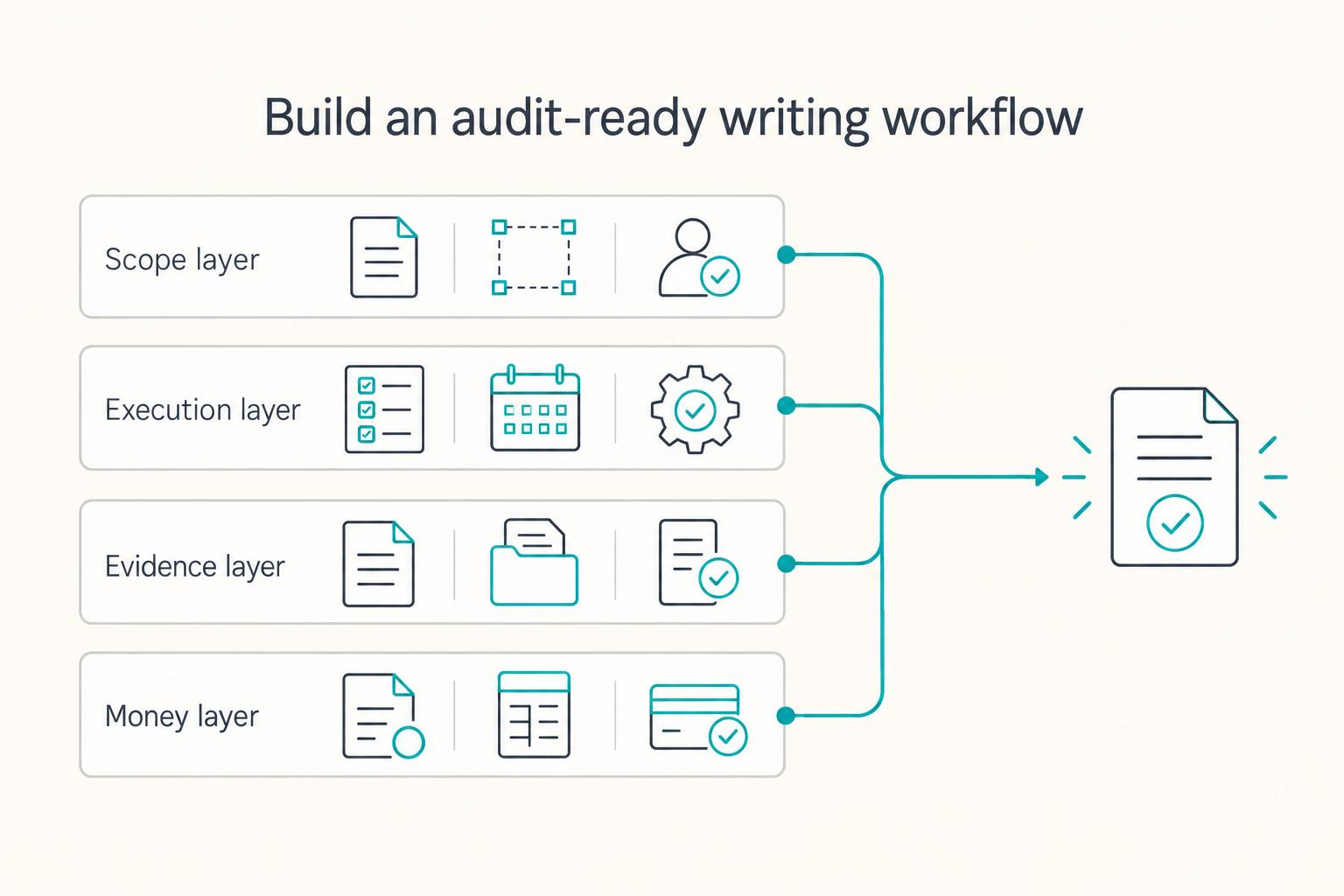
**Build one traceable system for scope, execution, and billing, and give each tool one clear job.** Freelance writing ops is not "a writing project." It is overlapping deadlines, revision cycles, approvals, and payment triggers. When you can't reconstruct what happened, you lose time, margin, and sometimes trust.