
Quick Answer
Start with a side-by-side matrix, then choose the city with fewer unresolved unknowns rather than the lowest headline rent. For nomad cost of living vs quality of life, this article recommends using cost and quality indexes only as directional inputs, validating neighborhood reality on the ground, and clearing visa and paperwork checks before you book flights. If two hubs are close on price, pick the one with lower daily friction and cleaner renewal and housing continuity.
How to Balance Cost of Living and Quality of Life#
Most people approach nomad cost of living vs quality of life as a rent puzzle. The bigger risk is making bad decisions when the evidence is mixed. A city can look affordable on a headline chart, then get expensive in time, stress, and rework once visa requirements, housing terms, and everyday friction show up.
Use this article as a sequence of checks, not a travel opinion piece. On this topic, the source mix is uneven. Some pages are current and structured, some are anecdotal, and some are old or hard to access. You can still use that mix if you treat each source type for what it is: broad indexes for shortlisting, lived stories for stress-testing, and official pages for the final go or no go call.
| Input type | Best use | Core weakness | Practical use in this guide |
|---|---|---|---|
Standardized indexes (Cost of living index, Quality of life index) | Narrow a long list quickly | Weak on neighborhood-level friction and personal context | Use as first-pass filters only |
| Anecdotes and personal essays | Surface real problems after month three | Selection bias and uneven comparability | Use to generate verification questions |
| Restricted or unstable pages | Add context when available | Incomplete evidence and difficult validation | Treat as directional and recheck elsewhere |
The sequence matters. First, compare hubs using identical criteria. Second, build your own baseline so you know what your monthly floor actually is. Third, define quality of life in checks you can run in a specific neighborhood. Then choose by scenario, map the next 90 days, and finalize the document stack before you spend nonrefundable money.
When two places look close on top-line costs, pick the option with fewer unresolved unknowns. In practice, that usually protects day-to-day quality better than chasing the lowest rent. A common failure mode is price-first decision making followed by late surprises in the visa path, lease terms, or first-month logistics.
Before you book flights, run one checkpoint to keep the whole process honest. Mark every key claim by evidence type and recency. If you cannot trace when a number was published, what city setup it assumes, and whether the source is currently accessible, reduce its weight. Attractive but weakly grounded numbers should never drive a commitment.
A simple decision sheet is enough. Use three statuses: Verified, Directional, and Unknown. Every time you update a row, note what changed and why. You do not need a complex template. You need one place where assumptions stay visible and where weak claims cannot quietly turn into commitments.
Add two columns that force accountability: Owner and Next check date. Owner makes each verification task explicit, and Next check date prevents stale assumptions from surviving into booking week. If a row reaches its date without new proof, move it back to Unknown.
If you want a broader first-pass shortlist, use the digital nomad visa index for 50+ countries, then come back to this guide and apply the same checks to each option. If you want help organizing the admin side while you evaluate choices, A Freelancer's Guide to Business Process Automation (BPA) and Browse Gruv tools can support execution.
Compare Nomad Hubs at a Glance#
Use this section to screen, not to crown a winner. The goal is to surface uncertainty early. If the evidence for a hub is mostly directional or anecdotal, the next move is verification, not false confidence.
Cost of living index and Quality of life index are useful anchors, but they do not settle long-stay decisions on their own. They rarely capture renewal friction, neighborhood fit, or document burden in the level of detail you need before committing.
| Criteria | Mexico | Ireland | Georgia | Kuala Lumpur | Switzerland |
|---|---|---|---|---|---|
| Housing | Directional only; city-level costs vary sharply | Directional only; city-level costs vary sharply | Directional only; city-level costs vary sharply | Directional only; city-level costs vary sharply | Directional only; city-level costs vary sharply |
| Visa friction | Requires current Visa application verification | Requires current Visa application verification | Requires current Visa application verification | Requires current Visa application verification | Requires current Visa application verification |
| Admin burden | Verify with official sources | Verify with official sources | Verify with official sources | Verify with official sources | Verify with official sources |
| Internet reliability | No validated hub-specific metric in current pack | No validated hub-specific metric in current pack | No validated hub-specific metric in current pack | No validated hub-specific metric in current pack | No validated hub-specific metric in current pack |
| Healthcare access | No validated hub-specific metric in current pack | No validated hub-specific metric in current pack | No validated hub-specific metric in current pack | No validated hub-specific metric in current pack | No validated hub-specific metric in current pack |
| Community fit | Anecdotal unless tested locally | Anecdotal unless tested locally | Anecdotal unless tested locally | Anecdotal unless tested locally | Anecdotal unless tested locally |
Operational friction (Digital nomad visa path, Visa renewal risk, document load) | Unknown from current evidence set; verify official requirements | Unknown from current evidence set; verify official requirements | Unknown from current evidence set; verify official requirements | Unknown from current evidence set; verify official requirements | Unknown from current evidence set; verify official requirements |
| Unknowns to clear before commitment | Eligibility, renewal terms, required documents | Eligibility, renewal terms, required documents | Eligibility, renewal terms, required documents | Eligibility, renewal terms, required documents | Eligibility, renewal terms, required documents |
The repeated cells are intentional. They show exactly where hub-level detail still needs verification. That is fine if you treat it correctly. It means this step is for elimination and risk labeling, not final selection.
Run the table in two passes. In pass one, remove options with clear blockers or too many unresolved basics. In pass two, keep only the places where official checks are available and current enough to support a real timeline. That keeps your effort focused and stops you from over-researching options that cannot clear baseline requirements anyway.
Before you narrow to two hubs, use one rule: no option advances unless you can confirm an active visa path and a realistic document stack for your case. If those basics are still unknown, the comparison is still early, even if cost signals look strong.
This is also where people read too much into index rankings. A city can score well in aggregate and still fail your setup. Keep rankings in the shortlist layer. Keep commitment decisions in the verified-details layer.
If your matrix is still mostly Unknown after the initial review, do not force a final choice. Extend verification, tighten assumptions, and leave options open until the critical unknowns become checkable facts.
Build Your Personal Cost Baseline Before Country Shopping#
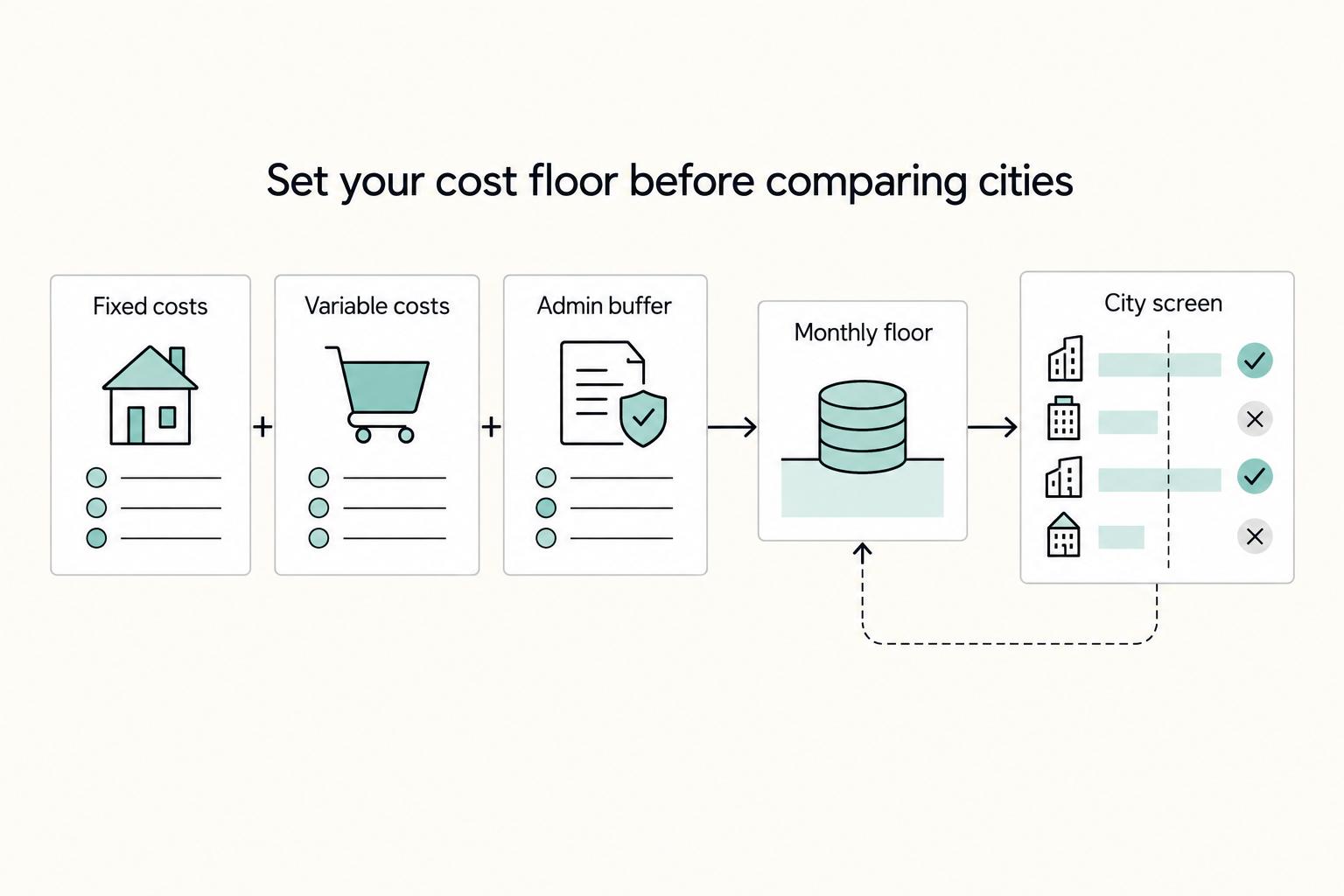
Build your monthly floor before you compare countries. If your plan only works with aggressive cuts, remove high-friction options early, even when the rent headlines look good. Country shopping without a baseline usually turns into optimism with spreadsheets.
Start by separating fixed essentials from flex costs. Fixed essentials are the non-negotiables that keep your setup stable. Flex costs can move once you are on the ground. Then assign a confidence label to every number so weak inputs stay visible instead of blending into the total.
| Line item | What to include | Confidence label |
|---|---|---|
| Housing fixed essential | Base rent target from a local Rental agreement | Verified source if current listing or signed terms exist; otherwise Unknown |
| Housing flex premium | First-month Airbnb gap above local lease target | Verified source if rates are bookable now; otherwise Anecdotal community claim |
| Transport | Routine commuting and regular transfers | Verified source if tied to posted fares; otherwise Unknown |
| Healthcare | Insurance premium plus expected out-of-pocket buffer | Verified source if policy terms are current; otherwise Unknown |
Confidence labels do more work than extra decimal points. A clean-looking budget can still fail if half the numbers came from old posts or broad averages. Leave weak rows marked as Unknown or Anecdotal community claim until you can verify them. That keeps false precision from steering a major move.
Add one control many people skip: tag each line item by setup assumption, such as Solo, Shared, or Short stay. The same city can look affordable under one assumption and fragile under another. When the assumption sits next to the number, those differences stay obvious before they become expensive.
Use United States figures as reference context only, not as a template for another market. One 2024 reference reports average salary of $63,795 per year, 1-bedroom rent of $1,500-$2,500 per month, shared accommodation of $700-$900, and transport of $100-$300. Those numbers can help you sanity-check your own assumptions. They do not tell you what a target city should cost or what your setup will require.
Apply the filter in this order:
- Calculate fixed essentials first.
- Add flex costs second.
- Remove any hub that fails your baseline without aggressive cuts.
That order matters because it prevents a common comparison error. People compare a local lease target in one location against short-stay pricing in another, or they compare rent only and forget the first-month flexibility premium. Keep category definitions and sequencing identical across hubs and your shortlist becomes more trustworthy.
Before you lock the baseline, run a simple stress test with the inputs you already have. Ask what happens if one Unknown row comes in above expectation while another stays flat. You are not predicting exact outcomes. You are checking whether the plan still works when uncertainty resolves against you.
For every unresolved row, add a Low, Base, and High case using the evidence already in your sheet. If a hub only works in the Low case, treat it as fragile. If it still works in the Base case, your shortlist has a stronger operating margin.
Do not move to quality-of-life scoring until this baseline is done. If the monthly floor is unstable, quality comparisons become noise because you are evaluating scenarios that are hard to sustain in the first place.
Once your floor is clear, the question changes in a useful way. It is no longer, "Which place is cheapest?" It becomes, "Which place supports a stable routine at a cost I can actually hold?"
Define Quality of Life in Measurable Terms#
When costs are close, recurring friction is the real tie-breaker. Over a longer stay, that usually matters more than a higher Quality of life index. You are not buying a city score. You are choosing daily conditions.
Quality of life only becomes useful when you turn it into checks you can run. A strong city-level reputation does not guarantee that your neighborhood, commute pattern, or care access will work for your routine. The fix is to convert abstract quality into checks you can run before you make longer commitments.
| Check | How to test in your target area | Why it matters for longer stays |
|---|---|---|
| Clinic and hospital access | Run real trip checks from your neighborhood at times you may need care | Care access is a core stability driver |
| Internet reliability | Test connection stability during your normal work hours in the exact area | Work continuity depends on reliable uptime |
| Commute burden | Measure likely travel windows for your weekly rhythm | Transit friction compounds over time |
| Noise and safety | Observe the area at the times you will actually be outside | Comfort and risk tolerance shape settlement quality |
| Social fit | Trial your normal work and life pattern before committing | Long-term fit depends on routine sustainability |
The point of this table is to force location-specific testing instead of generic "good city" judgments. If your workday depends on stable afternoon calls, internet at your exact address matters more than broad reputation. If care access matters, map distance alone is not enough without route testing at realistic times.
Use a simple scoring method to keep the process grounded. Mark each check as Works, Borderline, or Unknown for the exact area you plan to use. Then compare hubs by count, not by vibe. That keeps the decision tied to observable conditions and makes it harder to overvalue polished narratives.
Anecdotal content still has a role when you use it correctly. One long-stay perspective describes Bali's safety and family values as a major appeal. Treat that as an input for question design, not as proof. The useful part is the underlying prompt: which local conditions matter enough that they would change whether you can settle comfortably?
In practice, quality comparisons go off track when lifestyle narratives become decision evidence. Stories are good at surfacing blind spots and common failure modes. They are weak at producing conclusions you can cleanly transfer to your own case. Keep that boundary clear and your decisions get better.
When cost is broadly comparable, use this tie-breaker: prioritize the option with fewer recurring frictions and clearer continuity for renewals and housing. Verify Visa renewal document expectations and Rental agreement extension terms before you commit. Many places that look good on paper fail right there.
If you cannot run neighborhood checks yet, keep the uncertainty explicit in your decision sheet. Unknowns are manageable when they are named. They get expensive when they stay hidden.
Once these checks are mapped, the scenario choice gets easier because you can see what each hub demands in daily execution, not just in monthly spend.
Choose by Scenario Instead of Chasing the Cheapest City#
Pick the scenario first, then pick the place. If you reverse that order, price will pull you toward options that do not fit your constraints. A city that works for one remote worker profile can be the wrong choice for another, even when headline costs look similar.
Start with the operating priority you are actually protecting. Are you optimizing for flexibility, or for stability? That single choice shapes the housing structure, admin load, and timing risk you can tolerate.
| Scenario | Practical first move | What to check before commitment |
|---|---|---|
| Early-career solo worker with tight runway | Keep first commitments short, such as Airbnb, when flexibility is priority | Current Visa application requirements, full month-one housing terms, and your trigger for moving to longer stay |
| Established consultant with higher income floor | If reliability is priority, plan for longer setup that may include Rental agreement and more local admin | Healthcare and internet fit for your routine, plus lease terms in writing (deposit, extension, notice) |
This framing prevents category mistakes. If you need optionality, a lower monthly number tied to rigid commitments may still be the wrong deal. If your work depends on continuity, short-stay churn can cost more in disruption than it saves in rent.
When the options look close, use a practical tie-breaker: choose the place with the clearer entry process and cleaner paperwork path right now. Process clarity usually beats a marginal price advantage when the goal is stable execution.
Run this checkpoint before flights:
- Confirm visa details on the current official page and defer to official versions when sources conflict.
- Pause any option where key pages are unavailable until current requirements are verifiable.
- Save required documents, deadlines, and housing terms in one working file before payment.
Another useful operator detail is to set your exit trigger before you land. For example, if spend runs above baseline and the core friction checks fail in week one, pause the extension. Predefined triggers reduce emotional decision making during stressful weeks.
You can also define a commitment ladder in advance. Start with the smallest commitment that still supports work continuity. Move to longer commitments only after your baseline and quality checks hold under real conditions. That keeps your downside limited while still leaving room to settle when the evidence is strong.
Once the scenario is clear, the next risk control is sequence. Even good choices fail when the steps happen in the wrong order.
Follow a 90 Day Relocation Timeline#
Use a 90-day sequence to reduce rework and avoid early lock-in. This timeline is a planning tool, not a legal standard for any Digital nomad visa route. Its value is practical: it tells you what to decide first, what to verify next, and what to delay until the risk is lower.
| Window | Primary action | What to verify | Common failure mode |
|---|---|---|---|
| Weeks 12-8 | Narrow to one or two hubs and run eligibility checks | Passport coverage for intended move period and current Visa application requirements on official pages | Picking a city first and finding paperwork friction late |
| Weeks 8-4 | Build and submit core evidence pack | Proof of income, Health insurance policy, and accommodation plan aligned by names and dates | Mixed formats and mismatched details that trigger rework |
| Weeks 4-1 | Lock first-month landing setup | Book Airbnb or sign Rental agreement, then align arrival timing with first-week admin | Paying nonrefundable travel costs before documents and housing are stable |
| Week 1 onward | Run reality check before longer commitments | Compare actual spend and lived friction against baseline before extending | Extending too early and getting stuck in weak-fit setup |
Weeks 12-8 are for elimination, not optimization. You are not looking for perfection. You are removing options that already show unclear eligibility, weak document paths, or too many unresolved housing questions. If two options survive, choose the one with fewer unknowns in paperwork and landing logistics.
During this window, keep your notes brief but explicit. Record why each option was removed or retained. That stops circular debate later and saves time if conditions change and you need to revisit a candidate.
Weeks 8-4 are about evidence quality and resend speed. Build one folder structure that makes resubmission easy if it is requested. Keep file naming consistent across identity, income, insurance, and accommodation records. Inconsistent naming, date mismatches, and mixed scans are common causes of avoidable delay.
At this stage, do one dry run of your own file from a reviewer perspective. Open each document in order and ask whether it answers the obvious questions without extra explanation. If you hesitate while reviewing your own stack, that is a signal to tighten it before submission.
Weeks 4-1 are where flexibility matters most. Housing choices affect timing, address details, and first-week admin workload. Delay nonrefundable travel until housing and core documents are stable enough that you are not gambling on unresolved items.
If your plan depends on one fragile assumption, keep contingency paths visible. If one document is still pending or one housing option is not final, avoid commitments that would force expensive changes if that assumption breaks.
Week 1 onward is a verification phase, not a victory lap. Compare real spending against your baseline and compare lived friction against your pre-move assumptions. If spend is above plan and quality signals are weak, pause longer commitments. It is usually cheaper to correct early than to stay locked into a setup that only looked good in theory.
Use one simple rule across the full 90 days: every commitment should come after its prerequisite check, never before it. That single discipline prevents most avoidable resets.
Handled well, this timeline keeps relocation from turning into a reactive scramble.
Prepare the Document Stack That Prevents Delays#
Treat the document stack as the final gate before flight payments. Budget planning gets most of the attention, but delays usually come from paperwork inconsistencies. Reviews slow down when names, dates, and file details do not match across the documents you submit.
Run one side-by-side pass so every item gets checked against the same standard.
| Document | What to verify | Evidence to keep ready | Delay risk if weak |
|---|---|---|---|
| Passport | Expiry checked and name format matches all supporting files | ID page scan plus one physical photocopy | Rework from mismatch or validity issues |
| Proof of income | Recent, readable, and consistent with declared monthly means | Bank statements, client contracts, payslips, or invoices in one folder | Review stalls when evidence appears thin |
| Health insurance policy | Active dates align with arrival period and wording is clear | Full policy PDF plus certificate card if issued | Clarification loop from incomplete wording |
| Visa application | Every field matches supporting records, including dates and address format | Submitted form copy (PDF or export) plus payment receipt if applicable | Manual corrections and resubmission cycle |
Accommodation evidence (Airbnb or Rental agreement) | Name matches passport and dates and address are complete | Booking confirmation or signed lease plus host or landlord contact | Extra verification steps for weak address proof |
The main objective is cross-file consistency. A document can look fine on its own and still create delays if its details conflict with the rest of the stack. That is why side-by-side checking beats one-file spot checks.
Run a final sweep across all five items using the same lens: expiry status, exact name and date matching, and backup readiness. If accommodation evidence is central to your file, verify identity details carefully. If income evidence is central, verify recency and readability against what you declared.
Another practical safeguard is simple version control for your own records. Keep one active file set and archive older drafts so outdated copies do not get reused by accident. Mixing old and new files is a common source of mismatch that looks minor but creates real delays.
Keep a one-page index in the same folder listing each required file, its latest revision date, and where it lives. Update that index first whenever any document changes. This makes last-minute cross-checks faster and lowers the risk of submitting mixed versions.
A common failure mode is simple: the budget works, but Proof of income is weak or insurance wording is incomplete, so review slows and clarification begins. If either area is borderline, pause booking and strengthen the file first. That tradeoff is usually cheaper than trying to repair weak documents while fixed travel dates are approaching.
Use this pre-payment checklist:
Passportchecked and aligned across all recordsProof of incomerecent, readable, and internally consistentHealth insurance policyactive for travel period with clear language- Completed
Visa applicationexported and cross-checked Airbnbbooking or signedRental agreementcomplete and identity-matched- Digital and physical backups ready
Once paperwork is stable, cost planning gets more reliable because fewer unknowns remain in timing and compliance.
Avoid the Hidden Costs That Break Quality of Life#
Most hidden costs come from instability, not from visible monthly line items. If you keep resetting housing, admin, or daily logistics, a low advertised price can lose quickly to repeated friction.
Housing drift is the clearest example. Short Airbnb hops can pile on layered fees and repeated setup costs. Transport drift follows when your routine depends on long commutes, frequent transfers, or ad hoc workspace spending. Renewal admin can erode time and focus too, which lowers quality of life even when direct spend still looks acceptable on paper.
| Signal source | Useful signal | Typical blind spot | What to verify before deciding |
|---|---|---|---|
Nomad Capitalist style content | Fast country-level comparisons | Weak visibility into one neighborhood and one month | Your transport pattern, healthcare reach, and renewal admin burden |
Reddit r/digitalnomad threads | Real-time anecdotal experiences | Mixed timelines, partial context, selection bias | Post date, visa context, and whether totals include setup fees |
Facebook Groups | Local leads and practical tips | Promotional posts and incomplete cost breakdowns | Full move-in costs, internet reliability at exact address, and contract terms |
The pattern is consistent across all three channels. They are useful for generating questions and weak as final proof. Keep them in the signal layer until you verify the important parts elsewhere.
A practical habit is to convert every anecdotal claim into a verification task. If a post claims low monthly costs, ask what fees were excluded. If a thread praises a neighborhood, check whether transport and care access fit your routine. That way, social signal stays useful without driving the decision by itself.
Lived-experience pieces can still surface worthwhile risk flags. Some accounts highlight stress points like illness, heavy admin, and loneliness, and related research notes that this lifestyle is not always experienced as fully free and may require strong self-discipline. Those signals matter because they point to failure modes that budget tables usually miss. They are still not universal outcomes, so use them to test your own tolerance and setup rather than assuming a fixed result.
Before you extend a stay, follow one order of operations: stabilize housing continuity, internet reliability, healthcare reach, and renewal admin first. Optimize rent second. That sequence usually protects both budget and quality better than cost-first optimization under unresolved basics.
If a place feels affordable only when everything goes right, treat it as fragile. Durable affordability comes from routines that still work when normal disruptions show up.
Use a weekly reality check while you decide on extensions. Compare actual spend, admin load, and daily friction against your baseline assumptions. If two or more basics are still unstable, keep flexibility and delay longer commitments until conditions improve.
For deeper shortlist work after these checks, The Best Digital Nomad Cities for Affordable Living can add context.
Conclusion#
A reliable move decision is less about finding the cheapest city and more about sequencing evidence. Compare options on identical criteria, verify unknowns before payment, and commit only when budget, housing, and document signals line up.
Keep budget expectations grounded in categories, not a single monthly headline. One published long-term nomad budget grouped costs into Daily Expenses, Flights, Extras, and Business costs, and reported 3,795 ($2,886) per month for two people across March 2014 to February 2015. Use that as structure, not as a universal target.
Treat older case studies and broad remote-work narratives as context, then verify current local conditions before you lock plans. If a claim cannot be traced to a clear date, location, and living setup, reduce its weight and keep it out of the final commitment logic.
If you keep one principle from this guide, make it this: clear unknowns before commitment, and keep assumptions visible until they are verified. That discipline protects both cost control and quality of life.
Run this go or no go check before booking flights:
- Complete your hub comparison with identical criteria across options, including rent structure, transport burden, healthcare reach, internet reliability, and renewal friction.
- Finalize the document stack using current official requirements for your target program, then run exact name and date checks across all records.
- Commit only if the next 60 days look stable on both spend and daily quality. If either side is weak, delay and close the gap first.
For broader shortlist validation, use The 2026 Global Digital Nomad Visa Index for 50+ Countries before committing money. If you need program-specific support, Talk to Gruv.
Frequently Asked Questions
How should I compare `Cost of living index` and `Quality of life index` without oversimplifying?
Use indexes as directional signals, then compare them with your real day-to-day experience. This guide does not provide a validated formula for combining Cost of living index and Quality of life index, so treat both as inputs rather than a final answer.
Is a lower monthly budget always better for digital nomads?
No. One published solo nomad case from 2021 reported total annual spend of $52,924 and a monthly average of $4,410.33. That example shows spending levels can be higher than expected, but it should not be generalized to all nomads or current-year costs.
Which costs are most often missing from nomad budget comparisons?
Short-stay lodging can add up quickly. In that same 2021 case, travel spending included 73 Airbnb nights for $6,112 and 117 hotel nights for $10,106. Use comparisons carefully, since one case study cannot represent every nomad setup.
What should be in my minimum paperwork set before applying for a `Digital nomad visa`?
This guide does not provide a validated minimum document checklist for Digital nomad visa programs. Treat requirements as country-specific and verify them directly with the program you plan to use.
How do I decide between starting on `Airbnb` and signing a `Rental agreement`?
A practical approach is to compare flexibility versus commitment, then choose the option that best fits your stay length and risk tolerance. Accommodation choices can materially change budget outcomes, including whether costs are shared or paid solo.
What is actually established here, and what remains unknown?
It supports that outcomes vary widely and anecdotal posts are not universal proof. It does not provide one validated formula for combining Cost of living index and Quality of life index, and it does not provide one official document threshold across all visa programs. Use social and blog content as inputs to verify, not final answers.
Try a related tool
Researched and edited by the Gruv editorial team. Gruv builds cross-border billing, payouts, and finance-operations software for global businesses.
Sources
Includes 2 external sources outside the trusted-domain allowlist.
- flsenate.gov/Session/Bill/2020/7097/BillText/Filed/PDFtrusted
- pmc.ncbi.nlm.nih.gov/articles/PMC11384521trusted
- sec.gov/Archives/edgar/data/1651717/0001651717250000...trusted
- euronews.com/travel/2023/04/14/low-cost-of-living-and-hig...external
- johnspencerellis.com/cost-of-living-comparison-best-budget-friend...external
Educational content only. Not legal, tax, or financial advice.
Related Posts

The 2026 Global Digital Nomad Visa Index for 50+ Countries
Start with legal fit, not lifestyle filters. The practical order is simple: choose a route you can actually document, then decide where you want to live. That single change cuts a lot of wasted comparison work and stops you from falling in love with places that were never a real filing option.

The Best Digital Nomad Cities for Affordable Living
If you want a low-cost base that still feels affordable after you land, start with friction, not rent. Affordability can break down when work setup and logistics wobble at once. Your best first move is the city you can operate from with the fewest unknowns.
A Freelancer's Guide to Business Process Automation (BPA)
**Build your freelancer BPA system around a repeatable process with controls, not a pile of apps.** You are the CEO of a business-of-one, and your job is to make the machine run even when you are busy. Tools like Zapier, n8n, Calendly, Zoom, Google Meet, and Invoice Ninja help only after you decide what "done" looks like at each step.