
Quick Answer
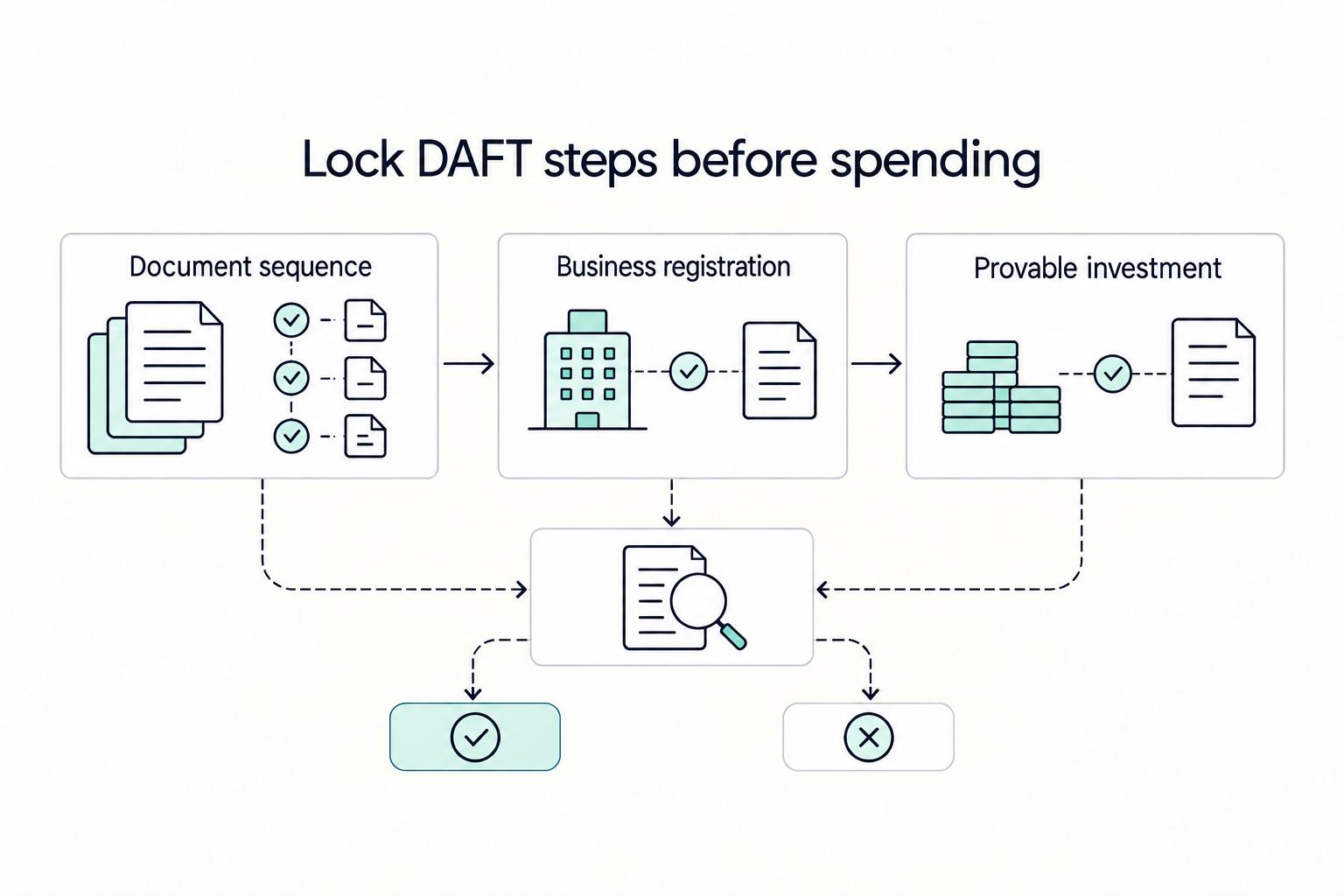
The Netherlands DAFT visa is a treaty-based residence permit path for U.S. citizens who want to live and work in the Netherlands by starting a business under the Dutch-American Friendship Treaty. A clean DAFT case usually follows a sequence: register an address with the municipality to get a BSN, use BSN to open banking, register with KvK, keep provable €4,500 in a business account, then submit a complete IND pack.
You're not looking for "DAFT info"-you're looking for a clean execution plan#
The Netherlands DAFT visa is a residence permit path for U.S. citizens under the Dutch-American Friendship Treaty. It works best when you treat it like an execution problem, not a research hobby. Your job is not to "learn DAFT." It is to run a sequence that ends in an IND-ready file and a business that already looks real on paper.
DAFT gives U.S. citizens a way to apply for a Dutch residence permit by starting a business in the Netherlands. In practice, that means setting up and documenting a real operating business, then presenting it in a way the authorities can assess quickly.
Run it like a project (because it is one)#
The most useful mindset is simple: every step should produce evidence you can reuse. One decision should support the next. One document should do more than one job.
That means thinking in three layers from the start:
- Decisions: what you sell, who pays you, and how the business works day to day.
- Dependencies: which step unlocks the next one, especially around address registration, BSN, banking, and filing.
- Artifacts: the confirmations, statements, extracts, and records that prove each step happened.
If you run it this way, you stop treating the process like scattered admin and start building one coherent case.
What to lock before you spend time#
Use the Dutch immigration service (IND) as your source of truth for current rules and required documents. If advice sounds fuzzy or contradictory, stop and verify before you build your timeline around it.
| You're doing this | Not this |
|---|---|
| Convert requirements into a sequence of appointments and documents | Collect DAFT tips and hope they add up |
| Register your Dutch business with the KvK | Keep operating informally while you keep researching |
| If applicable, make the €4,500 investment or deposit provable and consistent | Assume you can explain it later |
Keep logistics separate from eligibility. Housing, city setup, and relocation details matter, but they are not the same as building a permit file.
If you're relocating to Amsterdam, pair this with Amsterdam Digital Nomad Guide for a 2026 Move so your move stays organized without muddying the permit side.
If you want a wider comparison before you commit, read the 2026 Global Digital Nomad Visa Index.
DAFT fit check: commit to DAFT or pick a different permit route#
DAFT only makes sense if you clear the U.S.-passport gate and you are genuinely prepared to operate as self-employed. It is the wrong route if your real plan depends on regular employment. This is the first hard checkpoint. Make the route decision now, before you spend weeks collecting the wrong paperwork.
Gate check (60 seconds)#
Start with the basic eligibility logic, then ask the practical question: do you actually need this route?
- U.S. passport: a DAFT requirements checklist includes holding a U.S. passport.
- EU/EEA/Swiss reality: if you're not an EU/EEA/Swiss citizen, you need a Dutch residence permit, which is why DAFT can matter for a U.S. citizen business plan.
| If this is you... | Then your move is... |
|---|---|
| You have a U.S. passport and want to start a business in the Netherlands | Keep going and commit to DAFT execution |
| You're an EU/EEA/Swiss citizen | Pressure-test whether you need DAFT at all |
| Your plan requires regular employment | Pause, because DAFT cannot be combined with regular employment |
This is meant to save time, not add theory. If the route fits, move forward decisively. If it does not, switch early.
Route triage (don't guess)#
If you might qualify for another residence route, for example through a Dutch partner, do not assume DAFT is automatically better. Compare the routes side by side on paper: documents, timing, and what each route lets you do in practice.
Put IND-first confirmation on that list. It is much easier to make a route choice at the beginning than to unwind the wrong one later.
Entity trigger (choose for operations, not myths)#
The entity question matters, but not for the reasons people usually think. Some DAFT FAQ material says that choosing a sole proprietorship or a B.V. makes no difference to the DAFT process. The better question is operational: which structure matches how you will actually work, invoice, and handle admin?
Choose the one you can run cleanly, then plan to invest at least €4,500 of starting capital into the business in the Netherlands.
The practical rule here is boring on purpose: pick your lane once, then support it with consistent paperwork. Do not mix a self-employed permit plan with an employment reality, and do not let entity myths distract you from the evidence you actually need.
Before you book anything, compare DAFT against other long-stay options so you are not building the wrong document stack. Use this quick tool to shortlist routes that fit your situation: Explore visa options for digital nomads.
The sequence (don't freestyle): address/BSN → banking + KvK → deposit proof → IND#
The process moves fastest when you respect the dependencies. Address and municipality registration support your BSN. BSN helps unlock banking. Banking gives you a way to make the €4,500 provable. That proof, together with your business registration, supports a cleaner IND filing. Different guides may describe parts of the order differently, but the sequence is what matters.
1) Start with the keystone: address → gemeente → BSN#
The address piece is not just relocation admin. It is the keystone for gemeente registration and your BSN (Citizen Service Number). Without that, the rest of the setup gets slower and messier.
Book the municipality appointment as early as you can. In practice, appointment availability is often the hidden bottleneck.
A few habits help immediately:
- Book the gemeente appointment as soon as your situation allows.
- Store every confirmation in one place, including emails, receipts, and registration notes.
- Treat address-related documents as critical, not secondary.
Once your address plan is solid, the rest of the chain is much easier to manage.
2) Open a business bank account with your BSN and document the deposit#
The bank step matters because it turns intention into proof. The sequence matters for a reason: you need a BSN to open a bank account. Once you have it, move quickly so the €4,500 sits in a form you can document clearly.
The practical goal is straightforward:
- Open a business bank account.
- Deposit €4,500 in a way that will show up cleanly on a statement.
This is not the moment for improvisation. A messy transfer path or unclear account ownership creates avoidable friction later.
3) Register your business with KvK (your operational anchor)#
Your KvK (Dutch Chamber of Commerce) registration is more than a checkbox. It anchors the business in the Dutch system and gives you a core piece of evidence you'll reuse.
Get the KvK registration extract and treat it like a primary credential. Save it clearly, name it well, and keep it easy to retrieve. If someone reviewing your file wants to understand whether the business exists in an official sense, this is one of the fastest ways to show it.
4) File with IND with the proof set ready#
By the time you file with the IND, your pack should already tell the story without extra explanation. Do not rely on cleaning it up later.
Commonly referenced items include proof of the deposit and your KvK registration extract, along with the required paperwork for the application itself. If you have to answer follow-up questions, it is much easier when your first submission was already coherent.
If you are also building the business side of life in the Netherlands, pair this with Taxes in the Netherlands for Expats and Freelancers. It helps keep the operating side from surprising you in the middle of setup.
Preflight (before arrival): set up your admin system, address plan, and first appointments#
Before arrival is where you can remove a lot of later friction. Use it to decide how you will store documents, confirm your address plan can support registration, and line up the first appointments where possible. That work turns the first month from reactive scrambling into controlled execution.
Build a system you'll actually maintain#
Keep this simple. You do not need special software. You need fast retrieval, consistency, and enough discipline that future-you can find the right file in seconds.
A workable setup looks like this:
- One place for everything you may need quickly, whether that's a folder, drive, or document hub.
- Consistent filenames so core records are easy to locate.
- A short running note of open loops, who owns them, and when you will follow up.
That's enough. You want to avoid losing time every time someone asks for a document you already have.
Pre-clear address + registration requirements#
Address registration can fail for small reasons, and those failures are expensive because they push everything else back. If you plan to register at someone else's address, some municipalities require permission from the main occupant or owner. Some also ask for proof of occupancy when you report a move.
Find out what your municipality expects before you are standing at the counter.
| What you want to learn before you arrive | Why it matters |
|---|---|
| Which document or documents your municipality asks for to register at your address | Missing paperwork can delay registration, which can delay your BSN |
| Who must sign permission, if applicable | This prevents last-minute failures because the wrong person signed |
A lot of stress disappears once you confirm the address side in advance.
Plan appointments like inventory#
Appointment slots are a resource. Treat them that way. Municipality and KvK calendars can fill up, and booking from abroad may not always be possible depending on the process and your circumstances.
If you plan to stay longer than 4 months and do not have a BSN, expect to register in the municipal records soon after arrival. That means you should know which appointments matter first and which can wait.
Think in sequence, not as one giant checklist. You are not booking "everything." You are protecting the few dates that unlock the chain.
Align your business description to KvK/SBI reality#
This is a small step that prevents bigger problems. KvK registration asks you to specify your business activities, and that description helps determine your SBI code.
Write a short, concrete description of what you actually do. Keep it specific enough to map to real work and stable enough that you can repeat consistently across your registration, invoices, and any supporting materials.
Avoid vague labels like "digital services" if they do not actually tell anyone what the business does.
First 30 days in the Netherlands: the setup sprint#
The first month is about building the paper trail in the right order: BRP and BSN first, then KvK, then banking and invoicing. Once those basics are in place, DAFT stops being an idea and starts looking like an operating business with a documented trail behind it.
Week 1: BRP registration → BSN#
If you arrive as a resident, register in the BRP within 5 days. That registration gets you a BSN, and that number quickly becomes central to almost every official and administrative step that follows.
Go to the appointment with your documents organized, not loose. Save whatever proof the municipality gives you, whether that is an appointment confirmation, registration extract, letter, or email. Do not get hung up on the format. What matters is keeping the evidence.
The first week sets the pace. If this slips, the delay tends to cascade.
Next: KvK registration (and keep entity choice boring)#
Every new company in the Netherlands must register in the KvK Business Register (Handelsregister). That is why this step should happen early, while your setup still feels contained and manageable.
One practical point matters here: when you register with KvK, you do not register separately with the Netherlands Tax Administration. That happens automatically.
If you are debating sole proprietorship vs BV, keep the decision grounded in what you will actually be doing in year one. Pick the simplest structure that matches your real operations. If you truly need a BV, decide that before you register and keep the rest of the setup sequence the same.
From here, the next pressure point is financial proof, because your registration and your bank records need to support the same story.
The €4,500 deposit: make it provable, not arguable#
For DAFT, treat the €4,500 as evidence, not a talking point. Keep it in a Dutch business bank account in your business name and be ready to show a recent bank statement that reflects the balance. This is where "I have the money" becomes "I can prove it immediately."
What "provable" means in practice#
The usual problem is not the amount itself. It is proof that's sloppy enough to make a reviewer work too hard.
Aim for one clear document that shows the essentials at a glance.
| Proof element | What it should show | Why it matters |
|---|---|---|
| Business bank account | The account is in the business name, not your personal name | This matches the checklist expectation for the deposit account |
| Minimum balance | €4,500 or more visible on the statement | This shows you met the stated minimum |
| Recency | A recent statement | This keeps the evidence current and credible |
If a stranger had to understand the deposit in under a minute, the document should let them.
Build a "deposit proof" mini-pack (without inventing requirements)#
Keep this part narrow and readable. You are not trying to impress anyone with volume.
- Save a recent bank statement showing the €4,500 balance in your business account.
- If the bank offers a downloadable statement format, use that rather than screenshots.
- Store the file in your DAFT dossier so you can pull it up quickly for scheduling, submission, or follow-up.
That is enough if the document is clear. More clutter usually makes this worse, not better.
Continuity: don't treat €4,500 like a one-time stunt#
Multiple DAFT guides frame this as an ongoing requirement: maintain at least €4,500 in the business account throughout your stay.
That changes how you should think about the money. It is not a one-day hurdle. It is part of the ongoing picture your records need to support.
A practical approach helps:
- Keep a buffer above €4,500 so routine expenses do not push you below the line.
- If banking takes longer than expected, keep the timeline honest instead of forcing a workaround that creates ugly proof later.
This is one of the simplest parts of the route to handle well, which is exactly why it is worth handling carefully.
IND submission pack: ship one clean story, one time#
Your IND file should make review easy. A good submission lets someone see identity, business registration, and the DAFT capital requirement without digging through extras or sorting out the wrong permit track. The standard to aim for is assessable, not impressive.
Build for "assessable," not "impressive"#
The IND warns that an incomplete application cannot be properly assessed. Use that as the operating principle for the whole pack.
Organize for speed and legibility:
- One folder, one version: keep the exact PDFs you submit, plus any confirmation or reference details you receive afterward.
- Clear filenames:
01_identity.pdf,02_kvk_registration.pdf,03_bank_statement_4500.pdfis far better than a pile of vague files. - Readable documents: prefer official statement formats over screenshots, cropped images, or messy phone grabs.
The goal is to remove ambiguity. If the reviewer has to guess what a document is, your pack is working against you.
Core artifacts (keep it tight, keep it relevant)#
Focus on the items your DAFT checklist and IND materials actually point toward:
- Identity document copy such as a passport copy
- Business registration from the Chamber of Commerce (KvK) as proof you registered the business
- Recent business bank statement showing €4,500 as proof of the capital requirement reflected on the checklist
- Signed antecedents certificate as a required checklist item
- Evidence you invested "substantial capital" in your enterprise as the IND framing for DAFT self-employment
If you add supporting context, keep it short and consistent with your KvK activity description. Anything extra should reduce questions, not introduce new ones.
Avoid the wrong track: don't import the points-system checklist#
This is where people create avoidable work. The IND's general self-employed person route includes requirements such as Trade Register registration and may also involve a points-system style requirement. A DAFT-specific warning matters here: the points system does not apply to American DAFT applicants.
So use a simple filter. If an IND page or form clearly directs DAFT applicants to a specific list, use that list. Do not bulk up your submission with evidence designed for a different route unless you have a clear reason.
If you are based in Amsterdam and want local logistics help while you wait, use Amsterdam Digital Nomad Guide for a 2026 Move. Keep that separate from your IND pack so your immigration file stays focused.
Year 1 operations: run the business like renewal starts today#
Year one gets easier once you stop thinking in application mode and start thinking in record mode. Tight monthly finance habits, a documented VAT position per client, and early tracking of U.S. reporting triggers all make renewal less painful later. The business should stay legible month after month, not just at filing time.
Monthly finance routine (simple, relentless)#
Do not leave the books to memory. A simple monthly close is enough if you do it consistently.
At minimum:
- Issue invoices with the basics every time: include an invoice number and invoice date, and in some cases include your VAT identification number.
- Track paid status: mark invoices as sent or paid and keep the payment evidence.
- Match bank-to-invoice: tie each incoming payment to an invoice in your ledger so the story stays consistent.
None of this is sophisticated. That is the point. What saves you later is the repetition.
VAT posture: decide per client, document why#
VAT is not something to leave vague and fix later. Decide it per client and write down the reason.
The draft rules of thumb here are practical:
- Rule of thumb for services: services are only subject to VAT if you supply them in the Netherlands.
- B2B services: when you provide services to entrepreneurs, the service is often taxed in the customer's country.
- B2C services abroad: services supplied to consumers abroad are usually taxed where you are established.
Keep one notes file with a line for each client: client type, location, your VAT position, and why. That gives you a record of your reasoning instead of forcing you to reconstruct it later.
U.S. tax reality: track triggers early#
If U.S. reporting applies to you, track the triggers early instead of trying to reverse-engineer them at tax time.
The two items already on your radar should be:
- FBAR: you report accounts by filing an FBAR on FinCEN Form 114. FinCEN guidance describes an FBAR requirement when the aggregate value of foreign financial accounts exceeds $10,000.
- Form 8938: use Form 8938 to report specified foreign financial assets when you meet the filing requirements.
You do not need to solve every tax issue on day one. You do need to capture the account and balance information cleanly from the start.
Don't budget on myths: treat the 30% ruling as "not yours" by default#
This is one of the easiest assumptions to get wrong. The 30% ruling is described as a wage-tax facility that provides a tax-free allowance from an employer, up to 30% of salary.
Eligibility conditions include being in paid employment. If you are here as a DAFT entrepreneur, the safe practical assumption is that you do not have this benefit unless a qualified advisor confirms a compliant path.
If you want a fuller operating baseline, use Taxes in the Netherlands for Expats and Freelancers as your year-one reference.
Renewal-proof evidence kit (save these as you go)#
The easiest way to make renewal less stressful is to save a small, consistent set of records as the business runs. If you do that monthly, your extension is less likely to depend on memory, screenshots, or a late scramble to rebuild what happened.
The one rule that makes everything easier#
Record retention is the baseline rule: you must keep business records for at least 7 years, and 10 years for data related to immovable property.
That is the horizon to design around. If a document matters now, store it as if you may need it again much later.
What to save (and why it holds up)#
KvK's definition of a proper administration is a useful anchor. It includes copies of outgoing invoices, transaction statements, and contracts and correspondence with clients and suppliers.
That set already tells a coherent story: work agreed, work invoiced, money received.
For a DAFT case, two additional layers make life easier:
- Money proof: keep bank statements together so you can show continuity, including evidence of the €4,500 capital where applicable. Some guides state it should remain in the account throughout the duration of your permit.
- Health insurance proof: if you live or work in the Netherlands, you must have Dutch health insurance. Save the policy documents and payment evidence.
The reason this matters is simple. Renewal questions are much easier to answer when your records already match how the business actually operated.
A simple folder system (use months as the spine)#
A month-based folder structure keeps retrieval simple and avoids random storage habits.
| Evidence type | Save these | When you save it |
|---|---|---|
| Money proof | Bank statements, key transfers, receipts | Monthly, or on a cadence you control |
| Business proof | Contracts and correspondence, invoices, transaction statements | As issued, plus a monthly tidy |
| Tax proof | VAT returns, if you must file | Each filing cycle, with VAT returns usually once a quarter |
| Life proof | Health insurance policy and payments | As received |
When extension time comes, use the IND's online Decision aid flow for treaty-based extensions and hand over a file that reads like a clean ledger.
Risk register: the failures that waste months (and how you block them)#
Most delays come from a short list of predictable problems: the address does not support registration, the BSN arrives later than planned, the application gets pulled toward the wrong self-employed route, or the business story looks thin on paper. These are normal failure points, which means you can plan around them.
1) Address trap: you can't register, so you can't move#
This is one of the most common ways timelines break. Municipality (gemeente) registration unlocks the chain because you can't get a BSN if you don't register.
Many short-stay options will not let you register at the address, and that makes them a poor fit for this process even if they seem convenient.
Block it with a pre-sign checklist:
- Confirm the place supports address registration before you commit.
- Get a valid rental agreement lined up, because you cannot register at the municipality without one.
- Schedule the gemeente appointment early, then plan backward from that date.
The main point is simple: do not confuse temporary accommodation with a registrable setup.
2) BSN compression: everything queues behind one number#
Once you see how many steps rely on it, the BSN stops looking like routine admin. It is "the number" for official transactions and forms, and delays here can push back the entire setup chain.
Treat it as a critical-path item:
- Put housing choices behind registration first, neighborhood second.
- Assume delays here will affect banking and other steps downstream.
- Keep all registration confirmations so you can track exactly where you are.
This risk is boring, but it is real. A late BSN often means a late everything else.
3) Category confusion: ending up in the wrong ruleset#
This failure mode usually starts with shorthand. DAFT exists because U.S. citizens can qualify by starting and running a Dutch business instead of going through the standard points-based self-employment test used for other nationals.
That standard path references a points-based test of 300 points.
The practical fix is easy: when speaking with advisors or completing forms, say "Dutch American Friendship Treaty (DAFT)" in full. Do not reduce it to "self-employed permit" if that creates room for the wrong assumptions.
4) Narrative gaps: you look real on paper or you don't#
Because DAFT is described as requiring a comparatively low capital amount, €4,500, documentation quality matters more. Your paperwork should make the business look legible, not improvised.
A few items do a lot of work here:
- Write a one-page description of what you sell, who buys it, and how you deliver it.
- Keep one sample contract and one sample invoice ready.
- Make sure the documents tell the same story from end to end: agreement, invoice, payment.
Review this list weekly until the business is fully up and running. After that, it becomes a useful quarterly check to keep yourself out of avoidable trouble.
Conclusion#
A smooth DAFT outcome usually comes from the same pattern: choose the right route early, execute the setup chain in order, and keep records that make the business easy to understand. The strongest case file is usually the least dramatic one. It is legible, complete, and consistent.
1) Decide the route (before you collect documents)#
DAFT exists because of a bilateral agreement between the U.S. and the Netherlands signed in 1956.
It is a treaty-based path for U.S. citizens, so stay in that category clearly when you deal with the Immigratie- en Naturalisatiedienst (IND). Use the same "DAFT" or "Dutch American Friendship Treaty" label consistently across your paperwork so there is no drift into the wrong ruleset.
2) Execute in order (no skipping gates)#
The setup works best when you respect the sequence instead of trying to optimize around it.
Use this as your operating checklist:
- Enter the Netherlands
- Register at the municipality and get your BSN
- Set up banking and register your business
- Fund and prove the €4,500 deposit
- Apply at the IND
The financial threshold appears consistently as €4,500 in a Dutch business account. Keep the ownership clear, keep the evidence clean, and make sure your statements are easy to export when needed.
3) Operate like an auditor is watching#
Once the application is moving, the next job is to make the business readable month after month.
Save the records you already create: contracts, invoices, and bank statements that match each other. If you must file VAT returns, keep those with the same discipline. A future renewal should feel like assembling existing records, not reconstructing a lost year.
4) Plan with a realistic timeline (and include your family intentionally)#
Treat every timeline as a range, not a guarantee.
One applicant reports the whole process took exactly 4 months for them. At least one guide also says family members can join and receive the right to work freely, but permissions can vary, so confirm what applies to your specific permits before you budget or make family decisions around it.
Then plan your household runway accordingly.
Aim for boring. That is usually what works.
To keep the year more renewal-ready, track where you are and when. Then save the export with the rest of your evidence kit.
Start a simple log here: Use the Tax Residency Tracker.
Frequently Asked Questions
Is there a minimum income requirement for the Netherlands DAFT visa?
There's no minimum salary threshold described for DAFT, and one source states there's no official minimum income requirement. Treat that as freedom to focus on the work. Run a real business, keep clean records, and avoid hand-wavy finances.
Do I need Dutch clients, or can I work for U.S. clients on DAFT?
You can work with U.S. clients. One guide states there are no requirements on the type of customers your business serves or their origin. Optimize for revenue, not geography.
Can I apply for DAFT from inside the Netherlands?
Yes. One DAFT process overview explicitly describes entering the Netherlands first (with 90-day tourist entry allowed) and then applying at the IND. If you're using that path, treat the clock seriously and build your dossier fast.
How long does the DAFT visa take to process?
One guide gives a processing estimate of ~8-12 weeks. Use it as a planning range, not a promise. Keep runway in the plan, and avoid commitments that assume a specific decision date.
Do I need a BSN before I can apply for DAFT?
Don't assume BSN is a hard prerequisite in every case. Preparing documentation often includes proof of municipal registration. In practice, municipal registration often sits upstream of BSN.
Where does the €4,500 DAFT deposit go, and how do I prove it?
The €4,500 amount is described as needing to sit in your business bank account for the duration of your visa. One guide says having the amount in a Dutch bank account can satisfy the condition. Proof stays simple: keep a clear bank statement showing the deposit.
Can my spouse work in the Netherlands on a DAFT residence permit (and can my children attend school)?
One DAFT FAQ source says your direct family can join you under the Dutch American Friendship Treaty. Work rights and school details can vary by residence status and registrations. Confirm the exact permissions for your family member's permit before you plan around them.
Try a related tool
Researched and edited by the Gruv editorial team. Gruv builds cross-border billing, payouts, and finance-operations software for global businesses.
Sources
Includes 2 external sources outside the trusted-domain allowlist.
Educational content only. Not legal, tax, or financial advice.
Related Posts
Amsterdam Digital Nomad Guide for a 2026 Move
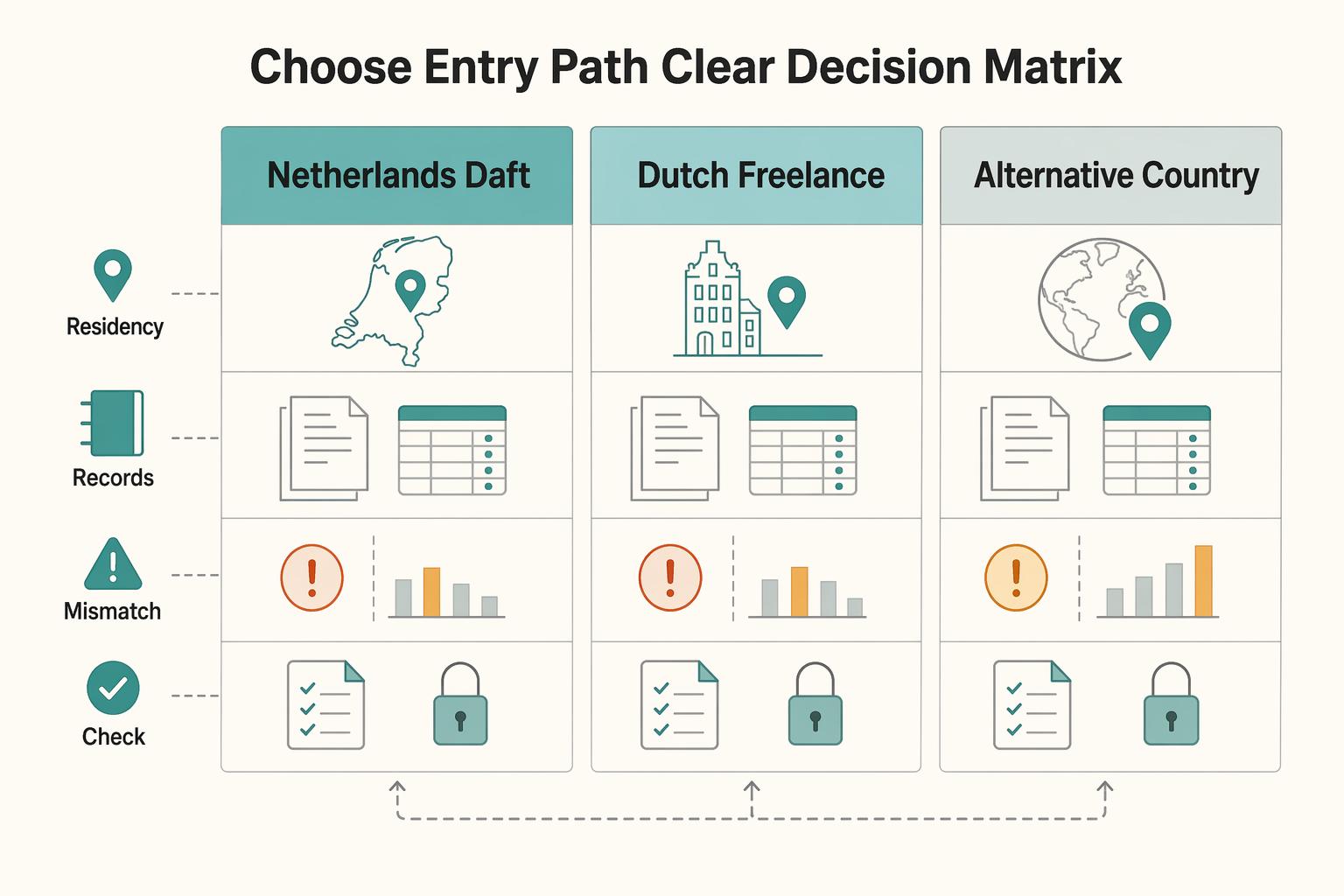
The smartest way to plan this move is simple: get legal clarity first, then start spending. That habit saves more money and stress than any packing checklist or neighborhood deep dive. If you cannot clearly name the legal basis for your stay and the documents that support it, hold off on flights and long housing commitments.

The 2026 Global Digital Nomad Visa Index for 50+ Countries
Start with legal fit, not lifestyle filters. The practical order is simple: choose a route you can actually document, then decide where you want to live. That single change cuts a lot of wasted comparison work and stops you from falling in love with places that were never a real filing option.
Taxes in the Netherlands for Expats and Freelancers
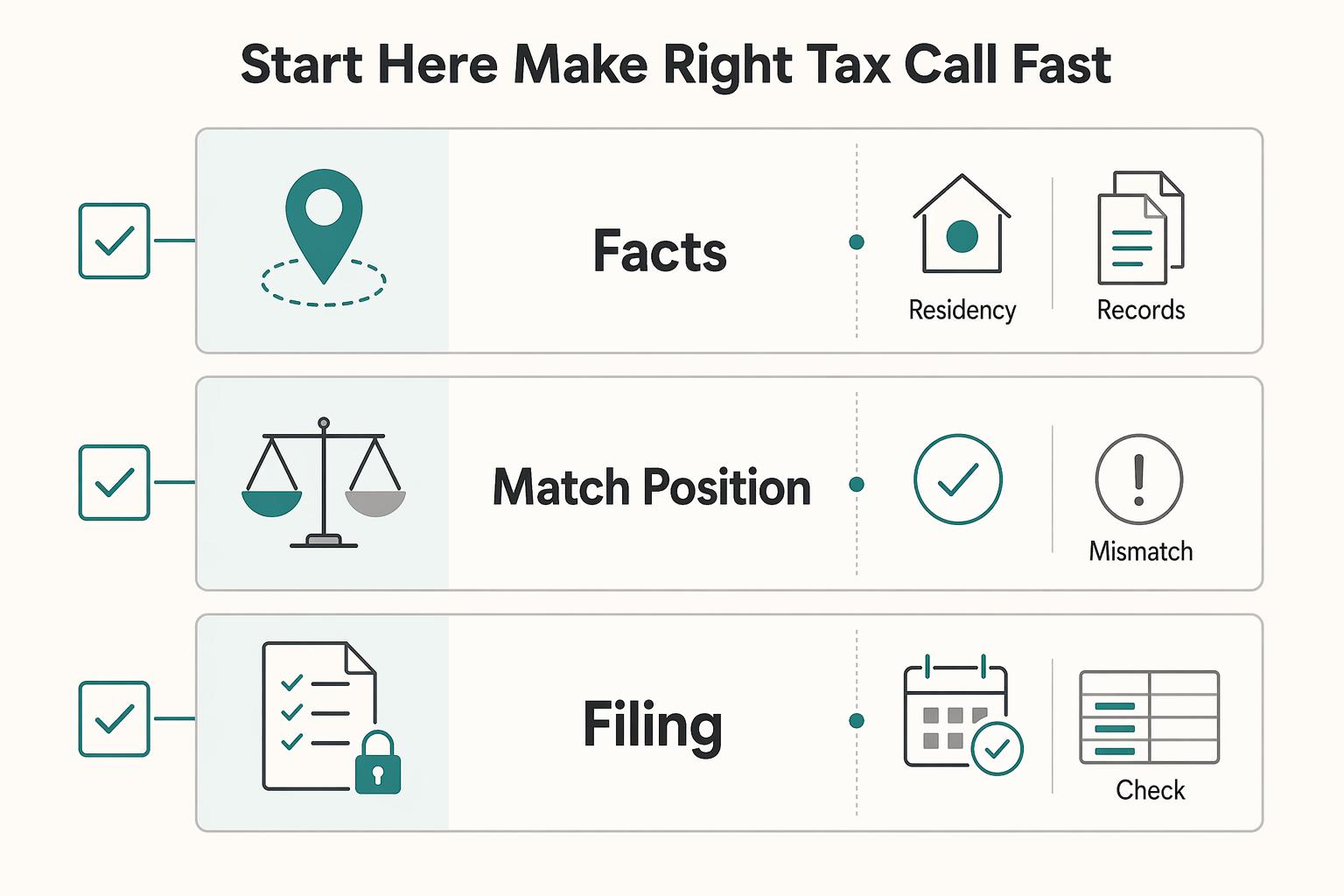
Make one decision first: are you filing on a Dutch resident track, or a non-resident track with Dutch income. Once that call is provisional, everything else gets simpler: choose the likely return path and gather the records that support it.