
Quick Answer
Negotiate the IP section of an enterprise contract by starting with your own asset inventory, then redlining the clauses that control ownership and risk, and finally keeping clear post-signature records. Separate background IP, foreground IP, and third-party materials, define exactly what transfers, preserve reuse rights, and label deliverables so the ownership split stays clear in practice.
The biggest mistake independent professionals make with enterprise contracts is reacting to the client's paper as if it sets the baseline. Once you do that, you are already negotiating from their definitions, their ownership model, and their risk allocation. The stronger move is to show up with a clear, usable inventory of what is yours before you ever see the first draft.
This is not about being combative. It is about staying in control. This three-phase framework helps you draw clean boundaries around your core IP so you can negotiate with large companies as a confident partner, not as someone trying to claw rights back later.
Phase 1: The Pre-Negotiation Audit#
Start with your paper, not theirs. Before you review client language, build your own IP inventory so you know what you own, what you can transfer, and what you can only license or disclose. That file becomes your starting point, because IP definitions and ownership defaults vary by contract and governing jurisdiction.
Classify each asset before the draft classifies it for you#
Before the contract defines your work for you, define it first. Use these three working buckets each time, and make sure the agreement reflects them:
- Background IP: For this audit, IP you already owned or controlled before this engagement, or created outside this project.
- Foreground IP: IP first conceived, developed, produced, or reduced to practice under this contract work.
- Third-party materials: IP owned or controlled by someone other than you.
Use this quick test when something feels blurry:
- If it existed before this project, treat it as background.
- If someone else owns it or licenses it to you, treat it as third-party.
- If it is first created for this engagement, treat it as foreground.
- If it is mixed, split it into components and classify each part.
| Item type | Default owner starting point | Transfer risk | Recommended contract treatment |
|---|---|---|---|
| Pre-existing library, template, method, prompt set, design system | Often you, if you created or controlled it before the work | High when drafts assign "all work product" or "all materials used" | List in a Background IP schedule and exclude from assignment |
| New client-specific deliverable created under the engagement | Depends on governing law and contract wording | Often negotiated to transfer | Define as Foreground IP and state exactly what transfers, and when |
| Open-source package, stock asset, licensed font, dataset | Third party | High if you promise full ownership or ignore license terms | Disclose in a third-party materials schedule with license and usage limits |
| Mixed build (your base + client-specific layer) | Split by component | Very high if treated as one assigned item | Carve out your underlying materials and assign only the client-specific layer |
If U.S. law governs, add one more checkpoint: identify the actual author for each copyrightable asset and track any transfer language in signed writing.
Build the audit file you will actually use in redlines#
Your audit file should be usable in a live negotiation, not something you build once and forget. Keep it reusable and easy to reference:
| Audit file part | What to include |
|---|---|
| Asset register | item, short description, creation date, creator, current owner/controller, classification (background/foreground/third-party) |
| Ownership evidence | prior SOW, invoice, repo history, dated files, purchase record, or license record |
| Reuse intent | reusable across clients, internal-only reuse, or no reuse |
| Contract placement | where each item appears (definitions, Background IP schedule, third-party schedule, ownership carve-out) |
Do not hide everything under a vague label like "tools and know-how." Name the asset classes clearly and tie them to evidence you can produce if someone challenges the distinction later.
Map third-party dependencies like an intake form, not an afterthought#
Third-party inputs create avoidable problems when they surface late. A lightweight SBOM-style intake makes those issues visible before you negotiate rights you do not have.
| Component | License (SPDX if available) | Usage limits | Attribution/notice obligations | Client disclosure note |
|---|---|---|---|---|
| Name each component you use | Complete for each component | Complete for each component | Complete for each component | Complete for each component |
This protects you from promising rights you cannot grant. For example, MIT includes notice-preservation requirements, and Apache-2.0 includes change-notice requirements for modified files. Some procurement-sensitive clients may also ask for a more formal, machine-readable component inventory.
Set your priority ladder before Phase 2#
Do this before the redlines start. If you already know what is non-negotiable, what is tradeable, and what forces a stop, you can move quickly without improvising.
Use a simple three-level ladder:
- Must keep: core reusable assets, pre-existing methods, and anything you cannot legally transfer.
- Negotiable with conditions: client ownership of foreground deliverables, with clear exclusions and third-party disclosures.
- Walk-away: terms that force transfer of all materials used in services, block future reuse of general know-how, or require rights you do not control.
Once this ladder is set, Phase 2 becomes clause matching instead of on-the-spot judgment.
Related: Ghostwriting Contracts That Protect Payment and Ownership.
Phase 2: Clear Use Rights, Retained IP, and Proportionate Liability#
In this phase, your job is to give the client clear use rights for what they are buying while keeping ownership of your reusable IP and keeping liability proportionate. In practice, a precise split often gets approved faster than a blanket refusal.
Redline the four clauses that decide ownership and risk#
Most of the outcome turns on four clauses. Start there.
- Work made for hire: This clause determines who is treated as author and owner of copyrightable work. Under U.S. rules, "made for hire" applies only in 2 situations, so broad wording should be narrowed to defined deliverables that actually fit. If ownership is transferred, keep assignment language precise and in signed writing.
- Indemnity: This clause determines who pays for defined losses or claims. Narrow triggers to risks you control, and avoid language that makes you responsible for client changes, client-supplied materials, or losses outside the agreed scope.
- License back / retained rights: This clause determines what you can still use after delivery. A nonexclusive license can be drafted to give the client broad use rights to deliverables without transferring your copyright ownership.
- Warranties: This clause determines what you are promising as fact. Keep promises tied to what you can verify, and avoid absolute guarantees that reach beyond your control.
Use a decision matrix, not instinct#
A quick matrix keeps you from over-negotiating low-risk language and under-reacting to the clauses that matter.
| Clause | Accept | Revise | Walk-away or escalate |
|---|---|---|---|
| Work made for hire / assignment | Limited to final client-specific deliverables in the SOW, with pre-existing and third-party materials excluded | Draft says "all work product," "all materials used," or "in connection with" services; tie rights to defined deliverables | Client claims ownership of pre-existing tools, templates, methods, or assets you cannot transfer |
| Indemnity | Trigger is narrow and tied to your defined breach/misconduct | One-sided scope, unclear triggers, or inclusion of client modifications/supplied inputs | Unlimited defense or payout exposure disconnected from deal value |
| License back / retained rights | Client gets strong use rights for deliverables; you retain rights to reusable materials and know-how | Reuse rights are silent or ambiguous | Contract blocks future reuse of core materials or treats general know-how as client-owned |
| Warranties | Limited to defined deliverables and facts you can stand behind | Absolute originality/noninfringement promises beyond your controls | You must guarantee third-party rights or other facts you cannot verify |
Use the matrix across the whole package, not one clause at a time. If one provision is fixed but another quietly recreates the same risk, the deal is not actually fixed.
Use a practical redline sequence#
A good redline sequence keeps the review moving and gives legal a reason to say yes.
- Mark overbroad phrases first.
- Tie each edit to a business rationale such as clear ownership boundaries, consistent third-party disclosures, or usable delivery rights.
- Offer fallback wording that preserves client use rights without transferring your core reusable IP.
That framing often helps because legal sees risk control, not resistance. If you need a quick refresher on structure, use: Work for Hire vs. Assignment of Rights: A Freelancer's Guide to Owning Your IP.
Check cross-border dependencies before sending markup#
Before you send markup, make sure the surrounding clauses do not undercut your IP edits. Review choice of law and forum selection together, because they solve different problems. If arbitration is part of your cross-border enforcement plan, confirm the recognition and enforcement path for the countries involved. If GDPR applies and subcontractors are in scope, make sure the required written authorization chain appears in the contract flow. Also keep confidentiality aligned with retained-rights language so client confidential information is not accidentally swept into what you can reuse.
| Area | What to confirm |
|---|---|
| Choice of law and forum selection | review together, because they solve different problems |
| Arbitration | confirm the recognition and enforcement path for the countries involved |
| GDPR and subcontractors | make sure the required written authorization chain appears in the contract flow |
| Confidentiality | keep confidentiality aligned with retained-rights language so client confidential information is not accidentally swept into what you can reuse |
If you want a deeper dive, read A Freelancer's Guide to Negotiating with Enterprise Clients.
Before your next redline round, create a clause-ready baseline you can compare against client paper: Use the freelance contract generator.
Phase 3: The Post-Signature Shield#
Once the contract is signed, the ownership split still has to survive in practice. Your job now is operational: keep those boundaries visible in your workspace, your delivery package, and your records so the negotiated language still holds up if anyone questions it later.
Separate the workspace#
Use a separate workspace or repository for each client matter when possible. It is not a universal legal requirement, but it lines up with SSDF guidance to separate and protect development environments and to apply least-privilege access to code and configuration.
Before the first production commit, run this governance checklist:
- Access controls: Limit access to only the people working on that client project, including source, executable artifacts, and configuration-as-code.
- Branch permissions: Protect
main(or your release branch), require review or passing status checks before merge, and keep force-push and branch deletion disabled. - Handoff and archive process: Record where final releases, required notices, and archive artifacts for that client workspace are stored.
At each milestone, ask one question: can you show who had access, who approved merges, and which commit/tag was delivered?
Deliver with ownership labels#
Do not leave ownership implied in a handoff email. Use a repeatable delivery protocol and label what the client is actually receiving.
For each release, include a short delivery index that clearly separates contract-defined categories, such as:
Client-Owned DeliverablesLicensed Pre-Existing IP(if your contract defines this asBackground IP)Third-Party Components
Keep that index with the deliverable itself, whether that is a release folder, release notes, or the repo root.
Pair it with a short acceptance record the client can confirm, such as a ticket, email, or signoff note, that includes the delivery date, version/commit/tag, attached delivery index, included third-party notices (if applicable), and acceptance status or listed defects. That record helps show what was delivered. Ownership still depends on the contract terms.
Keep a third-party log and closeout evidence#
If third-party materials are in the build, keep the log current during the project instead of reconstructing it at closeout.
| Component | Source | License obligations | Modified? | Attribution required? | Approval status |
|---|---|---|---|---|---|
| MIT component | Upstream repo/package URL | Preserve required notices | Yes/No | Yes/No | Approved/Pending |
| Apache-2.0 component | Upstream repo/package URL | Mark modified files and follow notice requirements | Yes/No | Yes/No | Approved/Pending |
| GPLv3 component | Upstream repo/package URL | Source-availability obligations may apply when distributed | Yes/No | Yes/No | Approved/Pending |
At closeout, save a lightweight evidence pack:
- Repository history snapshot (for example, a
git bundle) - Delivery snapshot (for example, a
git archive) - Dependency manifest or SBOM
- Final delivery index
- Approval trail
This is the pack you rely on if ownership scope, permitted reuse, or license compliance is challenged later.
You might also find this useful: How to Handle a Client Dispute Over Intellectual Property.
Conclusion: Treat the IP Clause as an Operating Decision#
Treat the IP clause as an operating decision, not a trust exercise. You are deciding what you keep, what you transfer, what use rights flow back, and what future losses you may have to cover.
For this deal, keep these terms precise:
- Background IP: pre-existing IP you bring into the deal and need to perform the contract or use its results.
- Foreground IP: IP created under the contract.
- License-back rights (grant-back): negotiated rights where defined improvement rights flow back to the original owner/licensor.
- Indemnity exposure: the risk that you must cover the other party's future specified losses if your indemnity promise is triggered.
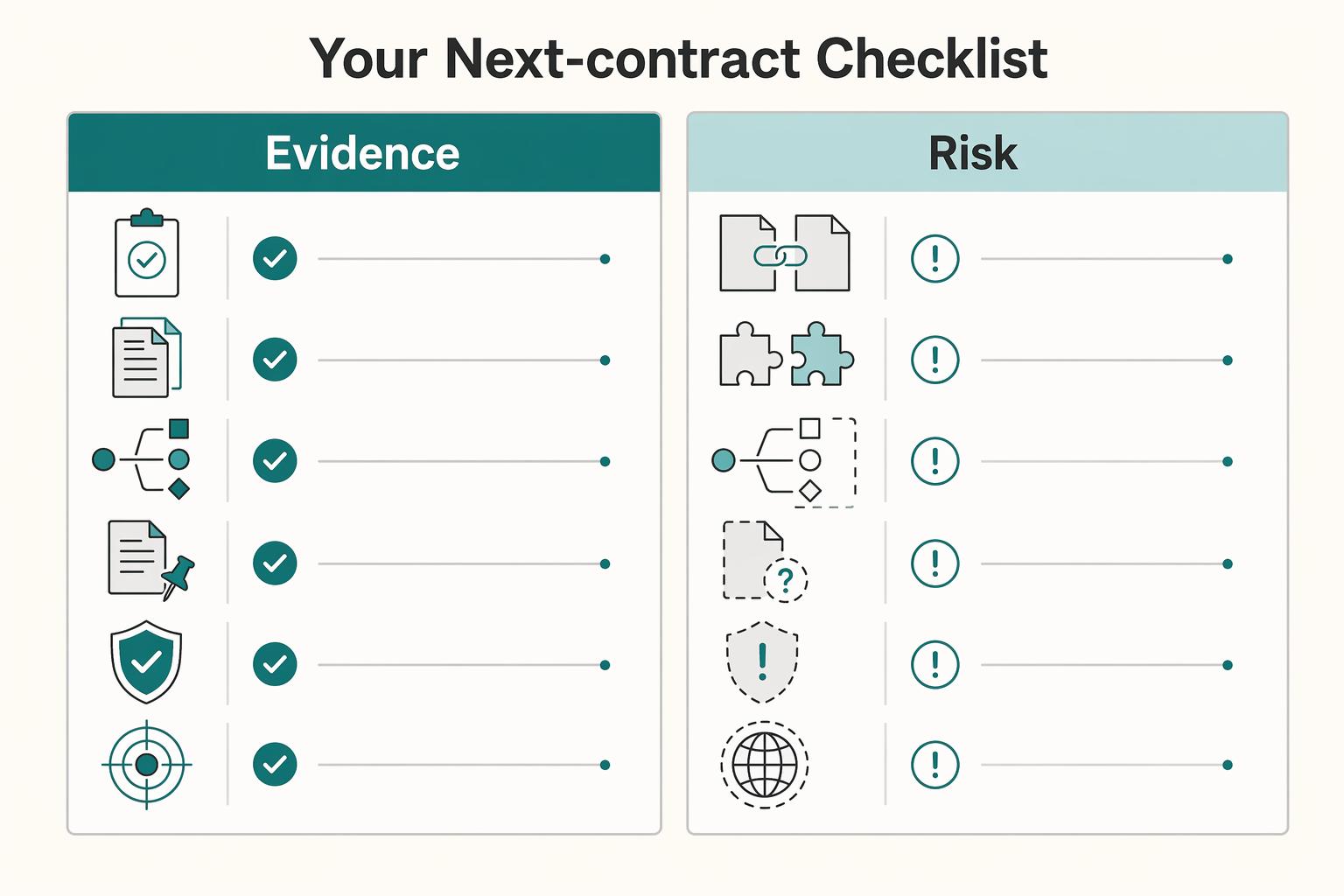
Your next-contract checklist#
| Stage | Accept if | Request fallback if | Pause for counsel if |
|---|---|---|---|
| Before you sign | the draft clearly separates your listed Background IP from contract-created deliverables and asks only for the license rights needed to use those deliverables | ownership and license wording are blended or unclear | the team resists documenting your IP status or refuses to separate transfer language from license language |
| While redlining | rights are scoped clearly by deliverable and intended use | scope is broader than needed | clauses stay ambiguous after redlines or the risk allocation is still hard to map to specific obligations |
| After signature | those records stay current and auditable | records are incomplete or labels drift | a dispute risk appears around ownership, license scope, or indemnity interpretation |
- Before you sign
Mark your pre-existing IP and document it clearly, for example in an IP schedule. Make sure the draft separates your listed Background IP from contract-created deliverables and asks only for the license rights needed to use those deliverables. If ownership and license wording are blended or unclear, ask for fallback language. Pause for counsel if the team resists documenting your IP status or refuses to separate transfer language from license language.
- While redlining
Use fallback language as a normal tailoring step, not a confrontation. If scope is broader than needed, narrow it by field of use, territory, asset, use case, or deliverable, and define any grant-back terms for improvements. Pause for counsel if clauses stay ambiguous after redlines or the risk allocation is still hard to map to specific obligations.
- After signature
Run the contract you signed. Keep the IP schedule/list, final redlines, and clear records of what was created under the contract versus what you brought in. Fix the process if records are incomplete or labels drift. Pause for counsel if a dispute risk appears around ownership, license scope, or indemnity interpretation.
For your next negotiation cycle, prepare three items before the first draft call: your current asset list, a short fallback clause set for ownership and license terms, and a post-signature governance routine for exhibits, version history, and project-specific IP records.
For a step-by-step walkthrough, see A Creative Director's Guide to Negotiating Usage Rights.
If your deal has unusual cross-border risk or approval constraints, sanity-check operational fit before signing: Contact Gruv.
Frequently Asked Questions
Who owns the code I write for a client?
The contract decides who owns the code, not informal discussions. If the ownership split is unclear, disputes are more likely. Mark each ownership sentence and attach your IP schedule before negotiating other edits.
What is a work-for-hire clause and should I sign it?
A work-for-hire clause is contract language about who owns IP created in the engagement. Do not auto-accept it. Ask for wording that clearly states what is transferred and what is excluded, and escalate for legal review if the clause is broad or ambiguous.
How do I protect my pre-existing IP in a client contract?
Protect your pre-existing IP by documenting what you own before negotiations start. Licensing discussions go better when your inventory is already clear. Attach your IP schedule and ask the contract to reference it clearly.
What are the biggest red flags in an enterprise IP clause?
The biggest red flags are ownership terms that are broad, vague, or blended with license language. Assignment language should say exactly what is transferred and what is excluded. Accept clauses tied to defined deliverables, revise unclear scope, and escalate ownership terms that stay ambiguous.
Can I reuse code I wrote for a previous client?
Only if the earlier contract clearly preserved your reuse rights. Do not rely on memory alone. Review the prior contract and write a short reuse memo listing what you believe you still own and why.
What's the difference between assigning ownership and licensing?
An assignment transfers ownership from one party to another through contract language. A license grants permission to use IP on stated terms while ownership stays with the original owner. Keep assignment and license language separate and explicit for each asset.
Try a related tool
Researched and edited by the Gruv editorial team. Gruv builds cross-border billing, payouts, and finance-operations software for global businesses.
Sources
- acquisition.gov/far/15.406-1trusted
- acquisition.gov/far/4.805trusted
- cisa.gov/sbomtrusted
- copyright.gov/register/se-hire.htmltrusted
- copyright.gov/circs/circ30.pdftrusted
- csrc.nist.gov/pubs/sp/800/218/finaltrusted
- ecfr.gov/current/title-32/part-37/section-37.840trusted
- ecfr.gov/current/title-48/chapter-1/subchapter-G/part...trusted
Educational content only. Not legal, tax, or financial advice.
Related Posts

Work for Hire vs Assignment of Rights for Freelancers
A freelance agreement is not just about price and scope. It decides who controls the rights in the work. If the ownership language is loose, rights can move earlier than you expect, cutting down your control once the work is delivered or used.

A Freelancer's Guide to Negotiating with Enterprise Clients
Enterprise deals can be good business, but only if you protect your margin, cash flow, and risk before the paper starts moving. The point is not to win every clause. It is to get a deal signed that you can deliver profitably, get paid for on time, and defend if the relationship gets strained.

The Freelance Payment Penalty: A Modeled Audit of Platform Fees, FX Spreads, and Payout Delays
The money rarely disappears through a single, easy-to-spot fee. The real loss is stacked. A marketplace takes its commission, a processor adds a charge for international cards, a bank or payment company converts the currency at a spread, a platform holds the funds before release, and a wire sheds a little to intermediaries on the way in. Each layer looks defensible on its own, but the worker feels the combined result as a smaller deposit and a later payday.