
Quick Answer
Yes - treat mexico tax residency for nomads as a separate call from immigration status. A Temporary Resident Visa may support legal stay, but your tax position should be documented through day count, center of vital interests, and a written recheck trigger. Then align RFC and SAT actions with that decision and keep U.S. obligations on a parallel track, including FEIE or Foreign Tax Credit analysis plus separate FBAR and Form 8938 checks.
Start Here With the Decision You Actually Need to Make#
Start with one conservative call: are you likely becoming a Mexican tax resident this year, and what evidence supports that call today? That decision shapes the rest of your year. If you skip it, every later task turns reactive, from local tax planning to U.S. filing choices.
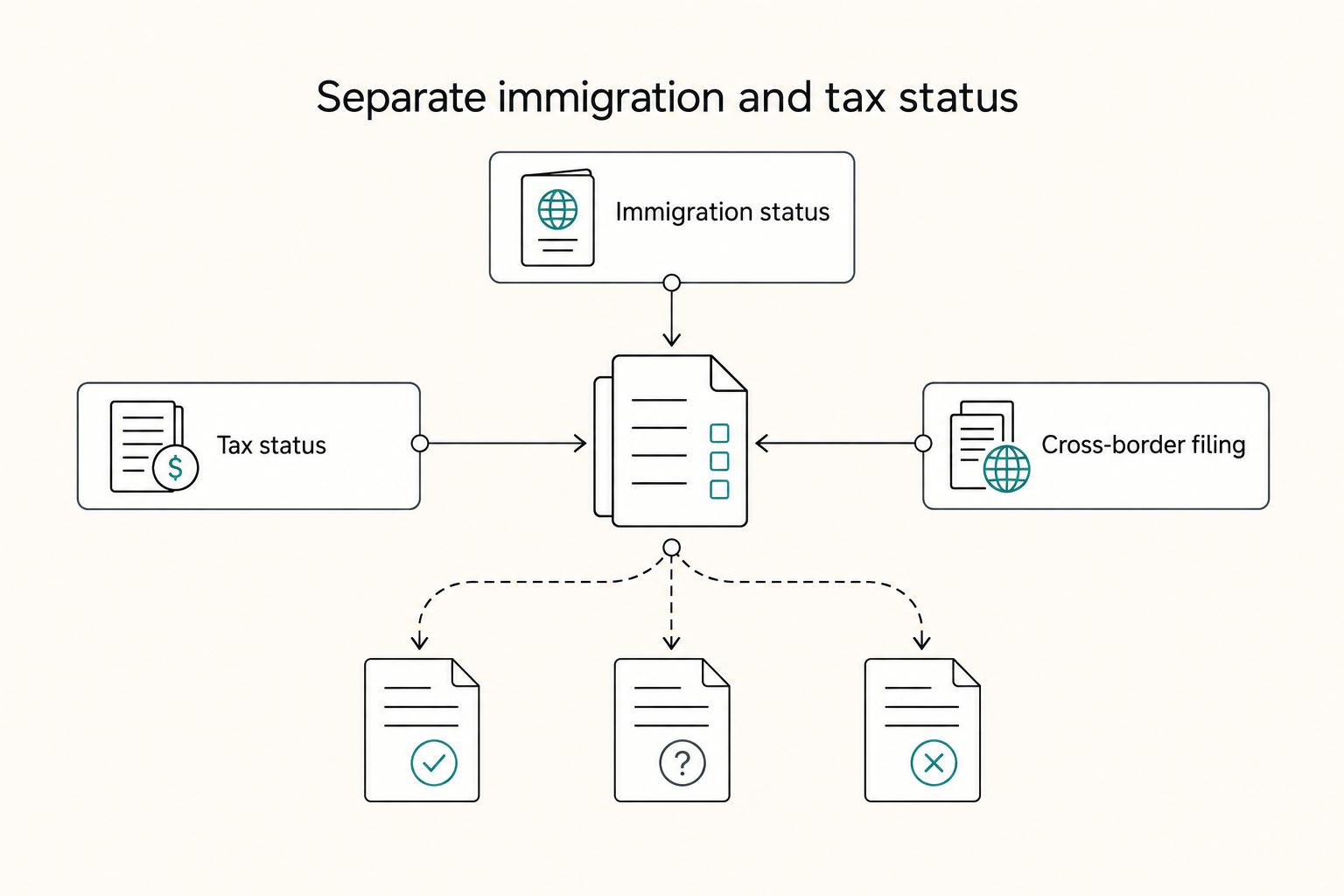
Treat immigration, tax status, and cross-border filing as separate lanes from day one. A Temporary Resident Visa can support legal stay, but legal stay is not the same as tax residency. Foreign clients and foreign invoices also do not automatically remove local exposure. Keeping these lanes separate is what prevents one wrong assumption from turning into three different compliance problems.
Keep these three tracks separate:
- Immigration status: what currently allows legal stay.
- Tax status: whether your facts point to likely residency.
- Cross-border filing: what can still apply in your home country.
For U.S. filers, worldwide income reporting continues, and FEIE can help but has limits. Use the 183-day mark as a risk signal, not an automatic verdict. If your day count, work base, or home-country obligations shift, update your notes and recheck before filing.
One simple practice helps: keep one short decision note and update it as facts change. Log what changed, why it matters, and when you will review again. That note becomes the bridge between your residency call and your filing execution. For a quick next step, use Try the tax residency day counter.
Define the Core Terms Before You Act#
Use one rule throughout: do not mix immigration labels, tax-status decisions, and administrative actions. Most filing confusion starts when people collapse these into one idea and act too early.
Treat Mexican tax residency as a separate tax analysis, not something you can infer from a visa label alone. A Temporary Resident Visa and a tax position can be evaluated on different tracks. Keep that distinction in writing so it survives deadline pressure.
Immigration terms still matter for planning. In the cited consulate guidance, Temporary Resident status is framed for stays longer than 180 days and less than 4 years. The same guidance says to apply at least two months before travel because appointments are typically booked for the next two months. Use that for timeline planning, not for tax conclusions.
Keep terms in separate lanes:
- Temporary Resident Visa: an immigration category.
- Mexican tax residency: a tax status to assess separately from immigration planning.
- Tax administration: filing execution steps.
Do not treat consulate financial examples as universal or permanent tax rules. If U.S. filing duties apply, run that work in parallel because obligations can apply in both countries.
When in doubt, test each action against one question: is this immigration planning, tax classification, or filing execution? If the answer is unclear, pause and sort it before you submit anything. If you want a companion checklist, see Are You an Employee or a Contractor? A Self-Assessment Checklist.
Separate Visa Permission From Tax Residency Status#
Treat visa permission and tax residency as parallel decisions. A Temporary Resident visa can allow legal stay and remote work, but it does not by itself determine your Mexican tax residency status.
| Item | What the article says | What it does not decide |
|---|---|---|
| Temporary Resident status | Can allow legal stay and remote work, with annual renewals up to a four-year maximum. | It does not by itself determine Mexican tax residency status. |
| Tourist status | Work is not permitted on a tourist visa, and remote work during your stay requires Temporary Resident status. | Client location does not answer local compliance questions. |
| Mexican tax residency status | Treat it as a separate call after confirming legal stay status and before planning tax administration actions. | Visa permission alone is not a tax determination. |
In the referenced guidance, Mexico is described as not having a standalone digital nomad visa. The route presented for remote workers is Temporary Resident status, with annual renewals up to a four-year maximum. That is an immigration status point, not a tax determination on its own.
Tourist status is different. The same guidance says work is not permitted on a tourist visa, and remote work during your stay requires Temporary Resident status. If you are still on tourist status while billing foreign clients, do not assume client location answers local compliance questions.
Follow a conservative sequence:
- Confirm legal stay status first.
- Assess tax residency as a separate call second.
- Plan tax administration actions only after that classification is documented.
This sequence helps keep your records aligned. If legal stay and tax classification move on different timelines, it can be harder to maintain a clean record later.
Before each new billing period, run a quick checkpoint: confirm visa status is current, confirm your residency note is current, and confirm your next compliance tasks match both. If one item is missing, fix that first, then continue.
Use a Three-Step Test to Estimate Likely Mexican Tax Residency#
Use this three-step check as a pre-filing risk filter. It helps you make a defensible call and connect it to next actions. The goal is not perfect certainty on the first pass. The goal is a position you can explain and maintain.
| Step | What to check | Next action |
|---|---|---|
| Step 1 | Start with facts you can document: where you live, how long you stay, and whether the arrangement is temporary or ongoing. The Temporary Resident Visa material covers immigration timing only. | Use the visa material for immigration timing, not as a tax test. |
| Step 2 | If your living and work footprint spans countries, mark the outcome as uncertain until the applicable tax criteria are confirmed. | Treat tax-residency status as a formal review point and support one position with records. |
| Step 3 | Map the estimate to filing actions. | If likely resident or unclear, schedule formal tax review and align related filing tasks. If likely non-resident, keep a dated memo and a recheck trigger. |
- Step 1: Check what the evidence set actually confirms.
Start with facts you can document: where you live, how long you stay, and whether the arrangement is temporary or ongoing. The Temporary Resident Visa material covers immigration timing only: a stay period greater than 180 days and less than 4 years, with a recommendation to apply at least two months before intended travel.
- Step 2: If your footprint spans countries, treat tax-residency status as a formal review point.
When your living and work footprint spans countries, mark the outcome as uncertain until the applicable tax criteria are confirmed. The goal is one position you can support with records.
- Step 3: Map your estimate to next actions.
If your result is likely resident or unclear, schedule formal tax review and align related filing tasks on the same timeline. If your result appears likely non-resident, keep a dated memo and a recheck trigger for changes in facts.
Keep a one-page decision log with current facts, current estimate, and next review date. Update it before major billing, payout, or location changes. A dated note is more useful than a perfect memory when you need to explain why a filing choice was made.
Do not use consulate solvency figures as a tax test. One consulate example lists CAD 108,894 average monthly balance for 12 months or CAD 6,461 monthly tax-free income for 6 months. Secondary guidance notes these amounts can vary by exchange rates and consulate practice, and requirements should be verified with the consulate handling your application. Those figures support visa planning, not tax classification.
If any step stays ambiguous, escalate early. Delayed clarification usually creates more correction work later. Early review is often the lower-cost move because it prevents rework across both countries.
Apply the Center of Vital Interests Test in Real Nomad Scenarios#
When life and work are split across countries, your filing position should match your day count and center of vital interests. Treat this as a decision checkpoint, not a convenience label.
If your center of vital interests is effectively in Mexico, that can support a Mexico-resident outcome. The same guidance also treats 183+ days as a residency trigger regardless of visa type, so visa status alone is not decisive.
If your center of vital interests is genuinely outside Mexico and you are below 183+ days, non-resident treatment may still be possible, but only if your facts remain consistent over time. Mixed signals across countries are a red flag and should be treated as uncertain until reviewed.
Avoid shortcuts like 'paid abroad means no Mexico tax.' Keep your reasoning tied to Federal Tax Code framing and center-of-vital-interests logic. Treat any summary guidance as preliminary and confirm the statutory text in official Mexican materials.
Use a short memo as your checkpoint:
- Branch used:
183+ days, center of vital interests, or uncertain. - Facts relied on: day count and living and work footprint.
- Decision date and next recheck trigger if facts change.
Add one more habit: review that memo whenever your work pattern changes, not just near filing deadlines. A shift in where you work or where you stay can change your risk profile faster than people expect.
If you want a deeper dive, read Digital Nomad Taxes in 2026 With a Defensible Filing Plan.
Handle US Filing Duties Without Confusing Them With Mexico Rules#
Keep U.S. filing on its own track. Living in Mexico does not end U.S. filing duties, because U.S. citizens and resident aliens are generally taxed on worldwide income. The cleanest approach is to make U.S. filing decisions explicit, then store support files so each choice is traceable.
Build the U.S. filing stack in order:
- File the U.S. return and report foreign earned income, including income you may exclude.
- Choose FEIE versus Foreign Tax Credit based on your facts, not convenience.
- Treat other non-FEIE/FTC obligations as separate checks and verify their requirements independently.
| Filing track | What to verify before filing |
|---|---|
| FEIE | Confirm you are a qualifying individual with foreign earned income and that your facts meet the required tests, which include minimum time requirements with limited exceptions. For 2026, the maximum exclusion is $132,900 per person, and the general housing amount limitation is $39,870. |
| Foreign Tax Credit | Prepare Form 1116 by income category, using a separate Form 1116 for each listed category. |
Use a short filing memo to lock in your position:
- Why FEIE or FTC was chosen for your facts.
- How income was categorized.
- What records support the filing position.
If FEIE appears favorable but the FEIE versus FTC tradeoff is still unclear, get cross-border CPA review before filing. One practical failure mode is choosing FEIE or FTC first, then trying to force records to match. Reverse that. Build the record set first, then choose the treatment your facts can support. That order can reduce amendment risk and review friction.
If you also need operating-metrics discipline, How to Set and Track KPIs for Your Freelance Business may help.
Complete the Mexico Setup Checklist in the Right Order#
Use the same order each time: confirm tax status first, then align any RFC and SAT administration actions to that decision. That keeps records aligned and easier to defend.
Start with status because a Temporary Resident Visa does not automatically make you a Mexican tax resident. Tax status is assessed using triggers such as 183+ days in Mexico and center of vital interests factors, so document that decision before taking tax administration steps.
Run one cross-border checklist. Assign an owner and due date for each item:
- Confirm the current residency branch and log decision date, evidence used, and next recheck trigger.
- Review whether RFC registration applies to that documented branch.
- Complete SAT actions tied to that branch and keep submission proof with the same decision record.
- Track home-jurisdiction obligations in the same checklist so Mexico and non-Mexico tasks stay aligned by period.
If facts change mid-year, treat that as a new decision point. Handle any required SAT updates using current requirements, and verify timing directly with official materials before filing.
A practical risk is partial setup: visa complete, billing starts, but tax registration or administration is delayed. Keep immigration financial proof separate from tax-residency analysis, and tie each filing step to a documented status note.
Before you call this complete, run one final consistency check. Your status note, RFC state, SAT actions, and home-country tasks should all point to the same period and the same residency branch. If one element is out of sync, fix that mismatch before filing moves forward.
Keep an Evidence Pack That Survives an Audit Conversation#
Your evidence pack should make the same story easy to follow across your U.S. foreign-asset filings and tax workpapers. The goal is simple: a monthly record that proves timing, classification, and submission history without reconstruction.
| Monthly file | What to keep | What it supports |
|---|---|---|
| Account statements | Account statements and related records used to support reported foreign account values. | Reported foreign account values. |
| Invoice and payment records | Invoice log and payment records tied to bank entries. | Invoice-to-bank matching. |
| U.S. return workpapers | U.S. return workpapers and versioned calculation files. | Return calculations and filing support. |
| FBAR support | Account list and max-value worksheet for FinCEN reporting. | Separate FBAR reporting support. |
| Form 8938 support | Threshold check and specified foreign financial asset inventory. | Form 8938 filing position. |
Use one folder per month in YYYY-MM format with the same structure every time. Keep a one-page decision log that states your Form 8938 filing position, key assumptions, and what changed from the prior month. Consistency matters more than perfect formatting.
Minimum monthly contents:
- Account statements and related records used to support reported foreign account values.
- Invoice log and payment records tied to bank entries.
- U.S. return workpapers and versioned calculation files.
- FBAR support for FinCEN reporting, including account list and max-value worksheet.
- Form 8938 support, including threshold check and specified foreign financial asset inventory.
For Form 8938, keep the decision logic explicit. It is attached to the tax return, and if you are not required to file an income tax return for the year, you do not file Form 8938. Do not rely on one universal threshold in your notes. IRS guidance includes a $50,000 baseline for some taxpayers, with higher thresholds for some joint filers and some taxpayers living abroad.
Keep FBAR on a separate track. Filing Form 8938 does not remove a separate FBAR duty when that duty otherwise applies. For each account, keep statements used, a maximum-value worksheet, and your U.S.-dollar method. FinCEN allows a reasonable approximation of the highest annual value and requires rounding up to the next whole dollar.
Do not keep only the final forms. Keep the files and calculations behind them, and fix any incomplete month before finalizing year-end filings. If a month cannot be reproduced from records, treat that as a stop sign and repair it immediately.
A simple monthly close routine works well: archive source documents, update the decision log, reconcile totals, then note unresolved items with owner and due date. That gives future you a clear handoff at filing time.
Ignore These High-Risk Claims and Shortcuts#
Many compliance problems start with shortcuts, not bad intent. Treat any claim as untrusted until you can tie it to a legal basis and a filing action.
Ignore claims like these unless a qualified advisor can connect them to your exact facts:
- Temporary Resident Visa automatically settles Mexican tax residency.
- No Mexican clients means no Mexican tax exposure.
- A forum post or blog summary is enough authority for filing decisions.
Low-authority content can help you form questions, but it should not set your filing position. At least one popular relocation source explicitly says it is not written by tax experts or CPAs, so it cannot replace qualified tax or legal advice.
Use the same filter for aggressive marketing claims. Industry reporting has described alleged pitches for Mexico citizenship in 14 to 21 days for about US$60,000 per applicant. It also describes reported resale claims around US$100,000 to US$150,000. The same reporting says Mexico nationality law has no legal provision for selling citizenship and flags these offers as false advertising.
Run this quick claim check before you act:
- What is the legal basis for your Mexico and U.S. facts, in plain language?
- What filing action changes now, and what document proves it?
- What is the downside if the claim is wrong, including amendment effort and timing risk?
- Can the advisor explain which notice or status update applies in your case, and when?
If answers stay vague, pause and escalate. If a claim cannot survive a document check, do not use it in your filing position.
One extra filter helps: separate persuasive language from decision evidence. If a claim sounds confident but does not produce a clear legal basis and a concrete filing action, it is marketing, not compliance guidance.
Know Exactly When to Escalate to a Professional#
Escalate before filing when facts do not line up cleanly or when FEIE versus Foreign Tax Credit choices can materially change your outcome. Waiting can increase complexity because more periods, forms, and assumptions may need correction.
Start with FEIE qualification complexity. If your facts do not clearly satisfy FEIE requirements, including minimum time requirements tied to the bona fide residence or physical presence tests, pause and get cross-border review before submission.
Escalate on FEIE versus Foreign Tax Credit decisions. FEIE applies only if you qualify and file a return, and part-year qualification requires prorating the maximum exclusion. For 2026, the FEIE cap is $132,900 per person and the general housing limitation is $39,870, so timing and classification choices can change results.
Escalate when minimum-time exceptions are unclear. IRS guidance describes two exceptions to meeting the bona fide residence or physical presence minimum time requirements, including waiver situations such as war or civil unrest.
Escalate when Form 1116 treatment is unclear. The instructions require a separate Form 1116 for each income category, and only one category box is checked per form. If income spans categories, get pre-filing review instead of guessing.
Use this trigger list:
- FEIE qualification facts, time requirements, or exceptions are unclear.
- FEIE versus Foreign Tax Credit changes expected outcome in a meaningful way.
- Part-year qualification affects FEIE prorating.
- Form 1116 category treatment is uncertain.
If one trigger is true, escalate before filing. If two or more are true, escalate and pause submission until review is complete.
When you escalate, send a tight evidence bundle first: your decision log, period-by-period day count view, current filing checklist, and draft treatment choices.
Use Gruv Records to Reduce Tax-Time Stress#
After you decide what needs escalation, let your records carry the load. Keep one ledger narrative that supports both your non-U.S. tax package and your U.S. return file without manual patching.
Use monthly close, not year-end cleanup. Reconcile invoice date, paid date, payout date, and wallet transfer date while details are fresh so both tax files tell the same timing story. If those dates drift across records, classification and timing questions multiply at filing time.
Use this month-end checkpoint:
- Confirm each paid invoice maps to one payout or wallet movement, with no orphan transactions.
- Flag cross-month timing differences so income timing is explained, not reconstructed later.
- Export statements and ledger views for the month, then store them in a read-only archive.
- Rebuild one sample month from exports only. If totals do not reproduce, fix tagging before moving on.
This directly supports FEIE documentation. Claiming the Foreign Earned Income Exclusion does not remove the need to file a U.S. return reporting that income. The FEIE maximum is inflation-adjusted each year, and for 2026 the cap is $132,900 per person with a general housing limitation of $39,870. If qualification covers only part of the year, prorate the maximum by qualifying days, so date-level records are essential.
Use the same discipline for account reporting records. Keep periodic statements and account snapshots that fairly reflect the highest value reached during the year. Record maximum account values in U.S. dollars, round up to the next whole dollar, and convert non-USD balances using the Treasury rate for the last day of the calendar year. Keep Form 8938 and FinCEN Form 114 support records side by side because one does not replace the other.
Where supported, use Gruv tax-document features to centralize FEIE and FBAR support files so sensitive records are not scattered. Coverage varies by market and program, so confirm feature availability before relying on it for compliance evidence.
If one ledger cannot produce both packages cleanly, fix records before filing. Doing that earlier is usually faster than defending mismatched timing after submission.
Make the Conservative Call and Document It#
Close with the position you can prove now, then execute it on time in each relevant jurisdiction. A documented decision plus complete follow-through is still your best protection.
When facts are clean, make your call using all three levers together rather than one in isolation: living costs, tax treatment, and the path to longer-term residence. Cross-country comparisons show a real tradeoff between low-tax, simple-entry options and options built around lifestyle and clearer residency pathways.
Before you lock the decision, run a dated evidence check. The reference material here is time-bound, published 12 February 2026 and based on 2024-2025 expert reports. Log your review date and set a final pre-filing recheck date.
Use this short closeout routine:
- Write a one-page decision memo with your chosen position, key facts, and what would change the position.
- Keep the official government materials, legal texts, and current expert reports you relied on.
- Remove weak evidence. If a source is mostly consent language or platform boilerplate, do not treat it as tax authority on its own.
- Keep one evidence pack so your narrative stays consistent from first assumption through filing.
For Mexico, keep scope tight: do not assume a Temporary Resident Visa counts as automatic proof of Mexican tax residency. If your conclusion depends on visa label alone, stop and verify against current official materials.
If facts are messy, escalate early. More than 50 countries now offer remote-work visa routes, and it is easy to import rules from the wrong jurisdiction. Country-specific examples like Spain's 0% and 24% structure do not transfer to Mexico.
A practical finish line is simple: your decision note, checklist, and evidence pack should all tell the same story for the same periods. If they do, file with confidence. If they do not, fix alignment first and submit second.
Frequently Asked Questions
Does a Temporary Resident Visa automatically make me a Mexican tax resident?
Verify whether a Temporary Resident Visa determines Mexican tax residency by checking the current legal criteria directly from official Mexican guidance before filing.
What is the center of vital interests test in Mexico?
Confirm the statutory definition and criteria for Mexico's center of vital interests test in official Mexican materials before relying on any summary.
If I still file in the United States, can I ignore Mexico tax rules?
This guide does not support using U.S. filing alone to resolve Mexico-side obligations. Treat Mexico compliance as a separate track and verify requirements directly with official guidance.
What should I do before changing tax residency status?
Build a country-by-country checklist for the transition year, then verify each item against current official requirements. Confirm timing and filing steps directly before you submit anything, and keep submission proof with your decision notes for later review.
Can I rely on 'I'm paid abroad so I owe nothing in Mexico' advice?
Treat that claim as unverified until it is tied to legal criteria and your documented facts. Informational IRS international FAQs can orient you, but they are not citable legal authority. Use anecdotal claims to form questions, not to set filing positions. If a claim cannot produce a clear legal basis and filing consequence, do not use it.
Where do FBAR and FATCA fit if I live in Mexico?
They are separate U.S. reporting tracks that may both apply. Form 8938 is attached to your return when specified foreign financial assets exceed the applicable threshold, including a cited $50,000 trigger for some taxpayers with higher thresholds for some categories. If no income tax return is required for the year, Form 8938 is not required. Filing Form 8938 does not remove separate FBAR obligations, so keep support records for both Form 8938 and FinCEN Form 114 together.
Try a related tool
Researched and edited by the Gruv editorial team. Gruv builds cross-border billing, payouts, and finance-operations software for global businesses.
Sources
Educational content only. Not legal, tax, or financial advice.
Related Posts

Digital Nomad Taxes in 2026 With a Defensible Filing Plan
With digital nomad taxes, the first move is not optimization. It is figuring out where you may be taxable, where filings may be required, and what proof supports that position.
Are You an Employee or a Contractor? A Self-Assessment Checklist
Forget the label. Classification turns on the relationship you actually run, not the title you typed into the contract. It is also much easier to fix before you sign.

How to Set and Track KPIs for Your Freelance Business
Better decisions matter more than more metrics. The practical goal is to finish each review knowing what to change next, who owns that change, and when you will verify whether it worked.