
Quick Answer
For remote workers, the mexico residencia temporal visa is a practical path for stays over 180 days and under 4 years, but execution depends on both national rules and your local consulate workflow. The safest approach is timeline-first: pick one route you can prove, build a consulate-specific packet, keep travel flexible, and complete INM processing quickly after arrival.
Move to Mexico Without Visa Guesswork#
Treat your move like an operations project: lock your visa route early, validate local consulate rules, and only then commit to travel dates.
If you are planning remote work in Mexico, the fastest way to burn time is assuming the process works the same everywhere. You need to manage two layers at the same time: national visa rules and local Consulado de Mexico requirements, including appointment flow and document checks.
The Temporary Resident Visa is the path for stays longer than 180 days and shorter than 4 years. You will also see this discussed as the Temporary Resident Visa route within the broader residencia temporal process. Start with the national model, then verify how your specific consulate actually runs it before you spend money or lock a move window.
| What you can treat as fixed | What you must confirm locally |
|---|---|
| You need a visa appointment to apply. | Appointment availability at your selected Consulado de Mexico. |
| The Temporary Resident Visa covers stays over 180 days and under 4 years. | How far out appointments are currently booked, which can reach the next two months at some posts. |
| You should start the process well before travel, with at least a two-month lead time. | Whether extra proof is required for non-citizens, such as legal status in the country where you apply. |
Run this guide as a checklist with clear gates:
- Timeline gate: Start at least two months before intended travel.
- Packet gate: Build one controlled document set with matching names, numbers, and dates across every file.
- Decision gate: Do not book flights or housing until your appointment status and required evidence look stable.
A common failure mode is committing to travel plans first, then discovering your preferred consulate has limited near-term slots. This playbook prevents that by enforcing one rule: verify consulate reality first, then execute the move plan. By the end, you will have a working timeline, a clean checklist, and decision points you can actually use.
What Is Residencia Temporal and How Is It Different From Tourist Entry?#
Residencia Temporal is Mexico's residence track for stays over 180 days. Tourist entry is a separate, non-residency route.
Lock the legal model before you choose your application route. If you mix up entry permission with residency status, you can plan travel perfectly and still create immigration risk.
The Temporary Resident Visa is the visa route used to begin temporary residence in Mexico. Residencia Temporal then continues in country through a resident-card step. A Permanent Residence Visa is a separate long-term track for indefinite stay. It is not the same workflow.
| Track | What it does | Where you execute it | Duration signal |
|---|---|---|---|
| Tourist entry | Entry as a visitor, not a residency track | Port of entry in Mexico | Non-residency route |
| Temporary Resident Visa plus Residencia Temporal | Starts legal residence workflow | Mexican consulate first, then INM in Mexico | Over 180 days, up to 4 years |
| Permanent Residence Visa | Starts permanent residence track | Consular route, then in-country migration processing | Indefinite |
After you arrive with a Temporary Resident Visa, you present your passport with visa and submit the Forma Migratoria Múltiple (FMM) to migration authorities at entry. Then you move fast. Within the first 30 calendar days after arrival, you must present your case to the Instituto Nacional de Migración (INM) to complete resident-card processing.
Use this two-layer operating rule for remote work Mexico plans:
- National layer: Residence visas cover stays over 180 days, and INM handles resident cards in Mexico.
- Consulate layer: The visa step is handled through a Mexican consulate before travel, and appointment/document flow can vary by post.
- Execution layer: You treat arrival as a handoff, not the end of the process.
If you enter Mexico and focus only on housing and setup, you create avoidable pressure later. Run the safer sequence instead: entry paperwork, INM action window, then normal relocation tasks. Want a quick next step? Try the visa planner.
Which Application Route Fits You Best Right Now?#
Pick the visa category you can prove with clean documents now, then schedule your interview.
| Route sheet item | What to note |
|---|---|
| Chosen branch | One route only, with a backup route noted |
| Why this route fits | One sentence tied to your actual facts |
| Required evidence list | Exact documents you already hold versus missing items |
| Host-country status proof | Include immigration documents if your case needs them |
| Pre-booking gate | Recheck current consular requirements because they can change, and missing support can lead to a new appointment date |
With the tourist versus residency model clear, you now need a route decision you can actually execute. That choice determines your evidence set, your interview prep, and your timeline risk.
For stays over 180 days and under 4 years, the Temporary Resident Visa route can follow different legal bases. The branches to evaluate here are Economic Solvency, Scientific Research, Real Estate Basis, and Investor Basis. Choose the branch your current documents support most clearly, and avoid forcing a category without category-specific evidence.
| Route branch | When it fits | What you must prepare before interview |
|---|---|---|
| Economic Solvency | You can document financial capacity clearly | Complete solvency evidence set required by your Consulado de Mexico |
| Scientific Research | Your purpose directly matches scientific research activity | Category-specific research support documents |
| Real Estate Basis | You hold qualifying real estate basis in Mexico | Property-related proof tied to category rules |
| Investor Basis | You hold qualifying investment basis in Mexico | Investment proof tied to category rules |
If you apply outside your nationality country, confirm legal-stay proof for that filing country early. In the United States, non U.S. citizens may need status documents such as Form I-797 or Form I-20 as part of that proof. Treat these as support documents, not guarantees. They help establish legal stay where you apply, but they do not replace route-specific evidence for the Temporary Resident Visa decision.
Use a one-page route logic sheet before you book any appointment:
- Chosen branch: one route only, with a backup route noted.
- Why this route fits: one sentence tied to your actual facts.
- Required evidence list: exact documents you already hold versus missing items.
- Host-country status proof: include immigration documents if your case needs them.
- Pre-booking gate: recheck current consular requirements because they can change, and missing support can lead to a new appointment date.
If your strongest paperwork supports solvency, do not force an investment narrative just because it sounds cleaner. Choose the branch your documents can carry, lock that file, and move forward. Related: Are You an Employee or a Contractor? A Self-Assessment Checklist.
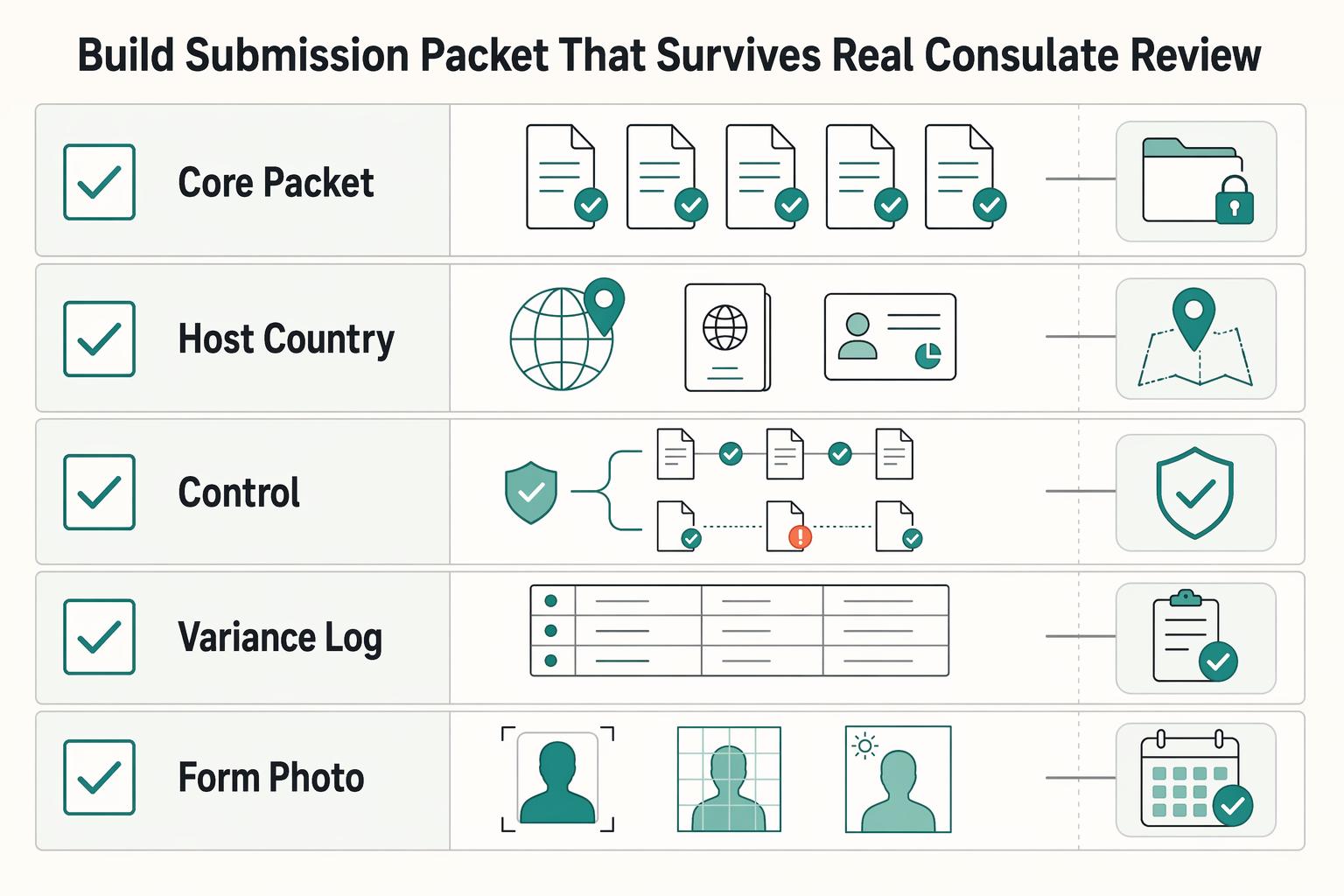
Build a Submission Packet That Survives Real Consulate Review#
Assemble a consulate-specific packet with exact matching data across every document, or expect delays.
| Checklist item | What to include or verify |
|---|---|
| Core packet | Application form, compliant photo, fee plan, and route-specific evidence |
| Host-country status proof | If the post requires it, include legal-status documents for the country where you apply, for example non-Canadian applicants filing in Canada |
| Same-data control sheet | Match full name, passport number, document numbers, and dates across form, copies, and support files for SRE review |
| Variance log | Track post differences, for example New Orleans vs Leamington, so you do not reuse the wrong specs |
Once your route is chosen, execution risk shifts from category choice to packet quality. Your objective is operational clarity: build one complete file tailored to your Consulado de Mexico, and keep it free of internal contradictions and missing route evidence.
One common reason cases stall or get denied is submitting false, incomplete, or poorly prepared documents, including invitation letters. Treat that as a quality-control rule. In practice, one weak document can disrupt an otherwise solid plan.
| Packet control point | Leamington example | New Orleans example | Operator action |
|---|---|---|---|
| Form and photo format | Form printed on one page, double sided, completed and signed. Photo: 3.9 cm x 3.1 cm, white background, no eyeglasses. | Follow local post instructions for accepted format. | Keep a post-specific spec sheet and verify before printing. |
| Fee method | Cash payment listed for visa processing. | $54.00 fee listed, with cash, credit card, or money order accepted. | Confirm payment method before appointment day. |
| Appointment and issuance timing | Recommend applying at least 2 months before travel, with appointments often booked for the next 2 months. | Same day issuance is normal, but not guaranteed. | Build fallback dates and avoid fixed travel assumptions. |
Use this preflight checklist before interview booking:
- Core packet: application form, compliant photo, fee plan, and route-specific evidence.
- Host-country status proof: if the post requires it, include legal-status documents for the country where you apply (for example, non-Canadian applicants filing in Canada).
- Same-data control sheet: match full name, passport number, document numbers, and dates across form, copies, and support files for SRE review.
- Variance log: track post differences (for example New Orleans vs Leamington) so you do not reuse the wrong specs.
If your move date is getting close, the temptation is to rush the packet. Do the opposite. Freeze your packet, run the checklist, and submit only when every field and document agrees.
How Early Should You Start and What Happens Week by Week?#
Start at least two months before travel, and treat each milestone as a go or no-go gate.
A strong packet can still fail if your timing is sloppy. Your job is to get the right file to the right Consulado de Mexico at the right moment, with fallback dates ready.
Use this as an operator timeline, not as a legal deadline chart. Official rules define eligibility and process, but consular availability and interview outcomes drive real-world timing.
| Planning window | What to do | Gate before you move on |
|---|---|---|
| T-8 to T-6 weeks | Lock your route, such as Economic Solvency when that category fits. Confirm current post rules on SRE consular pages and book through MiConsulado where required. | You can explain your route in one sentence and show every required core document. |
| T-6 to T-2 weeks | Finalize interview packet, rehearse category narrative, and verify payment and photo specs for your exact post. If you apply in the United States as a non U.S. citizen, prepare legal-status proof such as Form I-797 or Form I-20 when requested. | Your packet and your spoken narrative match exactly. |
| T-2 weeks to travel day | Protect optionality. Keep fallback interview or travel dates because issuance timing can vary by post. New Orleans says the visa is normally ready the same day, but this is not guaranteed. | You can absorb a delay without breaking housing or client commitments. |
| Arrival week in Mexico | Enter with your Temporary Resident Visa and complete the handoff to INM for the residency card step. | You schedule the INM step immediately and track the first 30 calendar day window. |
This timeline supports remote work Mexico planning by reducing avoidable surprises. Those surprises can disrupt housing moves and client delivery.
Watch these red flags before each milestone:
- Appointment slots move out.
- Post requirements change.
- Interview outcome changes your next step.
- Your route evidence no longer matches your declared category.
If availability shifts and your preferred date disappears, do not force travel first. Re-validate requirements, keep your packet version-controlled, and move to the next viable slot.
What Do You Do After Entry and How Do You Avoid Status Mistakes?#
Treat your visa sticker as the start of the process, then complete the INM residency step before you optimize anything else.
Once you land, your risk shifts from interview prep to in-country execution. The first 30 calendar days after arrival are critical if you want to keep your status clean.
Your Temporary Resident Visa sticker is valid for one single entry. After entry, you must go to the Instituto Nacional de Migración (INM) within the first 30 calendar days to process the residence card that proves legal status. Do not confuse this with tourist logic. Visitor status is framed for up to 180 days and activities without remuneration, which is a different immigration track from Residencia Temporal.
| Situation after entry | Correct control action | Risk if you ignore it |
|---|---|---|
| You entered with a Temporary Resident Visa | Start INM card processing within the first 30 calendar days and track your case status. | You compress your timeline and create avoidable status pressure. |
| Your INM case is pending and you need to travel | Confirm rules with INM, then request Permiso de Salida y Regreso (PSR) at the office handling your pending file. | You assume free movement and create re-entry or process conflicts. |
| You treat the move as regular tourism | Separate residency tasks from visitor assumptions from day one. | You follow the wrong workflow for your legal objective. |
While your case is active, run a conservative protocol:
- Keep nonessential travel minimal until INM steps stabilize.
- Verify each travel decision directly with the National Migration Institute and your issuing post.
- Keep an audit file with appointment proofs, receipts, filed forms, and dated status notes.
- Track permit validity windows carefully. PSR can have a limited validity period of up to 60 calendar days, so time your movement to that window.
If you find a better apartment and want to take a quick trip before your file closes, pause first. Confirm the rule path, secure the right permit if needed, and move only when your immigration sequence stays intact.
How Do Renewals Work and When Should You Plan for Permanent Residency?#
Plan renewals from day one, and treat permanent residency as a separate eligibility decision, not an automatic next step.
After your post-entry INM process is stable, shift to lifecycle planning. You are really running two tracks: keep Residencia Temporal valid, and prepare early in case you later qualify for permanent residency.
The Temporary Resident Visa covers stays longer than 180 days and shorter than 4 years. That range gives you room to operate, but it does not remove timing risk. For renewal, INM expects you to file within a limited validity window. This is described as up to 30 calendar days at filing. Late prep can compress your options quickly.
Run checkpoints before pressure builds#
Use internal checkpoints, not legal deadlines:
| Checkpoint | What to review |
|---|---|
| Early-cycle checkpoint | Update identity, financial, and category evidence, then log what you know versus what still needs confirmation |
| Pre-filing checkpoint | Pre-validate forms, appointment path, and file consistency so you can file inside the correct window |
| Known vs unknown log | Separate confirmed rules from assumptions per office, especially if you are balancing remote work Mexico logistics and cost of living moves |
- Update identity, financial, and category evidence early, then log what is confirmed and what still needs verification.
- Pre-validate forms, appointment path, and file consistency so you can file inside the correct window.
- Keep a known-versus-unknown log by office, especially if you are balancing remote work Mexico logistics and cost of living moves.
If you switch cities mid-year, your underlying case may still be fine, but small format differences can appear. A checkpoint catches that early, before timing turns a mismatch into a status risk.
Decide renewal versus permanent with a clear gate#
INM treats cambio de condicion de estancia from temporary to permanent as eligibility-based. One cited route requires four years in temporary status, and applicants still need to fit the listed criteria.
| Path | Decision gate | Safe next action |
|---|---|---|
| Renew Residencia Temporal | You need continuity now | Prepare the renewal file and align timing to the validity window |
| Move toward permanent residency | You meet INM eligibility criteria | Build a criteria-first file, then confirm exact requirements |
Before every renewal action, run one protocol: check SRE guidance, then validate specifics with your exact Consulado de Mexico, because consular officers may request additional case-specific information. For long-stay planning, pair this with Tax Residency in Mexico: Beyond the Temporary Resident Visa.
Lock National Rules First, Then Adapt to Your Consulate#
Run your plan as a two-layer system: lock national rules first, then adapt every decision to your Consulado de Mexico.
The point of this playbook is simple: reduce guessing. Immigration is not one checklist you run once. It is a sequence of gates, and the consulate layer is where plans often change.
Use this control model for every stage of a Temporary Resident Visa move:
| Control layer | What you treat as fixed | What you verify locally |
|---|---|---|
| Mexico-wide rules | Residencia Temporal covers stays over 180 days and under 4 years. The consular interview requires in-person attendance. After entry, you complete the INM canje and residency card step within 30 calendar days. | Office workflow and exact filing sequence at your consulate and local INM office. |
| Consulate-specific rules | You must present the full document set for your visa type on appointment day. | Solvency formulas and evidence format. One official post uses a 680 UMA benchmark over six months, while another uses a 300-day minimum-wage benchmark. |
Run this final operator checklist before you book travel:
- Pick your exact Consulado de Mexico and freeze that as your filing post.
- Request your appointment early and build buffer into your move calendar.
- Bring the complete document packet for your visa category on appointment day.
- Wait for visa approval before buying flights or reserving hotels.
- Enter Mexico, then open your INM card process immediately and finish within the 30-day window.
- Keep a simple known-versus-unknown log so you can resolve gaps fast.
If you compare two consulates and notice different solvency formulas, do not blend requirements across posts. Choose one filing post, rebuild your packet to that standard, and keep travel flexible until approval clears.
Your next move is concrete: pick the consulate, open your route sheet, and complete your pre-travel planning checklist before booking travel. If you expect a longer stay, queue Tax Residency in Mexico: Beyond the Temporary Resident Visa as your next planning document.
If you want a deeper dive, read our digital nomad visa index for 50+ countries.
Frequently Asked Questions
How long can I stay in Mexico with Residencia Temporal?
SRE frames Residencia Temporal for stays longer than 180 days and shorter than 4 years. Treat this as a status you keep valid through the resident-card process. Then assess next-step residency options when your eligibility is clear.
What documents are required for a Temporary Resident Visa application?
Start with a valid passport or travel identity document and one photo, then align supporting evidence to your route. If you apply outside your nationality country, you must also show proof of legal stay in the country where you file.
Do financial requirements change by consulate location?
Yes, and this is a core planning constraint. A Consulado de Mexico can apply different evidence expectations, and one San Diego post example lists a minimum month end balance benchmark of $1,332.00 USD. Confirm the current standard at your exact post before you finalize your file.
How early should I apply before my intended move date?
Do not rely on one fixed lead time. Move as soon as your file is complete, then add buffer because one consulate states visa timing can vary from one to ten days. That buffer protects your housing and travel plan.
What happens after I enter Mexico with the visa sticker?
Entry starts the in-country step. It does not finish the process. On the mexico temporary resident visa route, you must process your Tarjeta de residencia within 30 calendar days after entry.
Can I travel while my residency process is still in progress?
Use a controlled rule, not assumptions. INM provides a Permiso de salida y regreso path for foreign nationals who need to leave and return while a migration case remains pending. Time travel around that permit logic.
Is same-day visa issuance guaranteed at consular appointments?
No. One consular page states it does not guarantee visa issuance or same-day issuance at the appointment. Build your timeline with fallback dates so a delay does not break your move plan.
Try a related tool
Researched and edited by the Gruv editorial team. Gruv builds cross-border billing, payouts, and finance-operations software for global businesses.
Sources
Includes 1 external source outside the trusted-domain allowlist.
- consulmex.sre.gob.mx/leamington/index.php/non-mexicans/visas/115-...trusted
- consulmex.sre.gob.mx/washington/images/2022/visas/eng/TEMPORARY_R...trusted
- embamex.sre.gob.mx/espana/index.php/documentacion-a-mexicanos/6...trusted
- embamex.sre.gob.mx/elsalvador/index.php/cultural/cooperacion-de...trusted
- gob.mx/sre/acciones-y-programas/visa-de-residencia-...external
Educational content only. Not legal, tax, or financial advice.
Related Posts

The 2026 Global Digital Nomad Visa Index for 50+ Countries
Start with legal fit, not lifestyle filters. The practical order is simple: choose a route you can actually document, then decide where you want to live. That single change cuts a lot of wasted comparison work and stops you from falling in love with places that were never a real filing option.
Are You an Employee or a Contractor? A Self-Assessment Checklist
Forget the label. Classification turns on the relationship you actually run, not the title you typed into the contract. It is also much easier to fix before you sign.
Tax Residency in Mexico for Nomads Beyond the Temporary Resident Visa
Start with one conservative call: are you likely becoming a Mexican tax resident this year, and what evidence supports that call today? That decision shapes the rest of your year. If you skip it, every later task turns reactive, from local tax planning to U.S. filing choices.